Razer made quite the impression at CES 2014, with both the Razer Nabu smartband and Project Christine, a modular PC concept. For the third year straight, the company won “Best of CES” awards from Engadget, the official awards partner of CES.
The Razer Nabu was selected as the “People’s Choice” by way of public vote, while Project Christine won a “Best PC” distinction. In 2013, Razer earned “People’s Voice”, and in 2013 took out “Best of Show,” “Best Gaming” and “People’s Voice” once again. Min-Liang Tan, Razer co-founder, CEO and creative director, had the following to say;
Razer is not just a gaming company – we are a company that designs products for gamers. Our continued success at CES really speaks to the gaming lifestyle as a global phenomenon. We’re just a start-up, but our worldwide community of gamers and what we do for them positions us shoulder-to-shoulder—albeit uniquely—with the largest tech companies in the world.
But those weren’t the only accolades Razer received, as the Razer Nabu won the Popular Mechanics Editor’s Choice Award, the Tom’s Guide Readers’ Choice Award, and the Digital Trend’s Best of CES in the Sports and Fitness category. Project Christine also ran away with Tom’s Hardware’s Best of CES in the Outside the Box category, and PCWorld and TechHive’s Best of CES Award in the Best Prototype category. Click through on the link at the top to learn more about the two products.
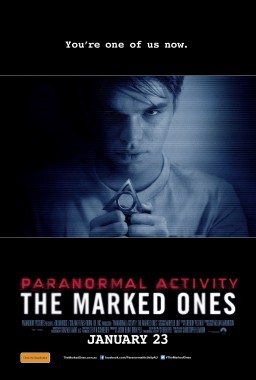
Paramount Pictures have released another clip for Paranormal Activity: The Marked Ones – the anomaly of the series, being the only one releasing outside of October and not following the main story arc of the franchise.
This time we get to take an extended look at a scene dubbed ‘Into the Basement’, of which a shorter cut was released at the end of December. It’s pretty self-explanatory what exactly you should expect from the clip.
There should be a horror-survival class taught somewhere in the world. One of the first lessons – don’t go into the basement! Electricity goes out? Don’t investigate or look for the breaker box! Call an electrician from your mobile!
Anyway, you can watch the clip in question embedded directly below. Also check out the last one entitled ‘Chasing Oscar’ here. Paranormal Activity: The Marked Ones releases on January 23 nationwide.
Heaven, Hell and everything in between. The Bible can be translated and perceived in many different ways; it can be used as a guide in which a person may live, it can be used to teach lessons to the masses or it can be used as inspiration for an epic movie/game/comic with kick-arse action and a divine protagonist that gets fans of the supernatural into an excited frenzy. Black Tower Studios alongside Unity Games have jumped onto this bandwagon with the release of their new action game “Archangel” which puts you into the holy boots of a soldier working for the lord as he is tasked with a mission that revolves around the cleansing of a darkness-filled plane of existence. Boasting fantastic graphics and an innovative control systems, “Archangel” has been presented as the game to end all mobile games but does it truly hold it to hype?
Story
As I mentioned above; the story revolves around an Archangel (a well-ranked angel of God) that has been deployed into an area of existence that has become occupied by the forces of darkness and evil, clearly the almighty has seen that this darkness will soon spread and has sent one of his “top men” to eradicate the threat. This is basically all you are given to start off with and it sticks with you for a while because the story doesn’t entirely have a nice pacing to it so you grasp the idea of being a holy soldier and you keep it in your mind as you begin to play the game. As you play through the game you realise that no new or exciting information has been delivered to you, every couple of levels you’re met with a small piece of text that says something profound about your mission or what exists in the area you’re currently in but nothing that really has any hold on the audience.
It has such a slow pace, it leaves a lot tot the imagination but it may have left too much to the imagination, it gave us a jumping off point but then never really gave us anything else. If you’re clever you can pick up the story from the small pieces of unspoken dialogue that appear throughout the game but they’re few and far between. I quite enjoy the idea of an angelic battle against the demonic, it is movies like “Dogma” or “Legion” that pique my interest so you can imagine I was actually quite ready to dive head first into this game and unfortunately I was met with something below my expectations. Fantastic idea for a game that, although somewhat generic, would have been incredible had it been executed and paced properly. it is unfortunate but it is the truth.
Gameplay
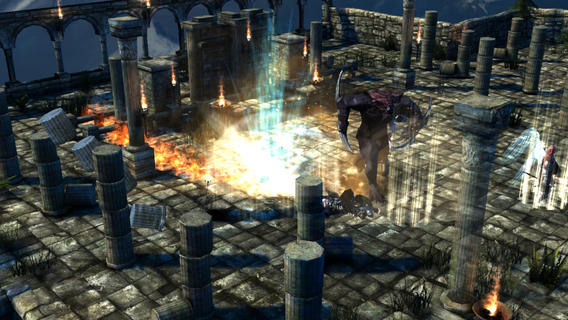
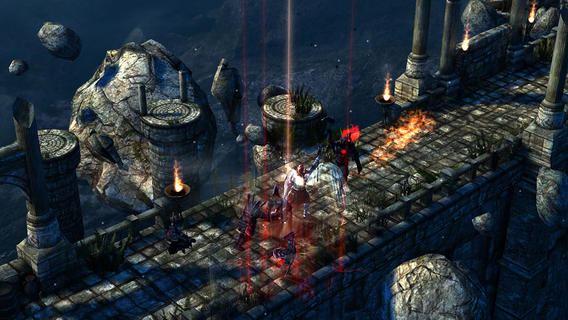
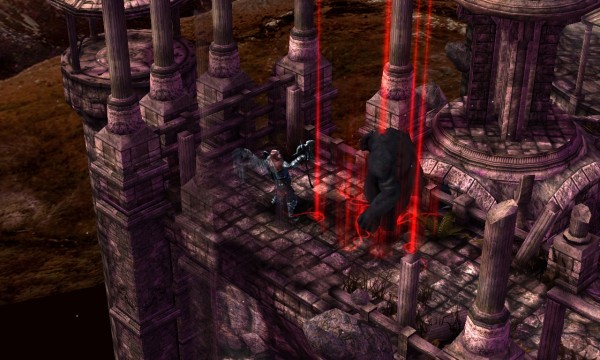
The gameplay is where “Archangel” made its second mistake, I could honestly see what the development team were going for when they implemented this style of gameplay but it came across as, somewhat, lazy and it really wasn’t as effective as I assume they first thought. Basically it is a game where you are forced to “tap” to do most things, this includes walking and attacking enemies. “Archangel” is very gesture-heavy, alongside tapping, it has players make symbols and shapes to execute moves; flicking across the character will have him dash forward with his shield ahead of him knocking enemies away, drawing a line across the ground will have the character summon a wall of fire that damages enemies walking through it, it is things like this that are actually kind of nice to play around with but quickly falls to pieces when you’re met with more than three enemies at a time.
The different gestures constantly confuse themselves of each other, sometimes swiping a line near my character wont make a wall of fire but instead it will dash into an oncoming enemy and vice versa.Though I actually enjoy the idea of gesture-based gameplay I don’t think it works in a game like this, not when you’re expected to fight many enemies at once and react to them as quickly as possible, you’re also faced with obstacles that you must overcome which is terrible when the character has to be signalled to walk with a tap, this means there’s no such thing as quickly ducking out of the way of a speeding arrow or fireball which I can only assume is what has been expected considering the creation of these levels were not done by accident.
There were a lot of unlockables, weapons, armour, spells, etc that you could get your hands on throughout the game which actually played a fairly big part statistically, giving you more defence or more attack with some equipable items being part of a set that could be obtained and used for an all around boost. They did that extremely well but it would have been a lot more enjoyable that the actual gameplay allowed for it to be. Another thing I both enjoyed and resented was the way the health system worked; you begin with standard health and standard attack power but the more combos you built up and the more enemies you defeated, the more health and more power you would earn. I found that quite interesting but ultimately underwhelming simply because you can be brought from maximum health to half health with nothing more than a standard attack from an enemy, it’s odd to punish a player after putting in so much work and that is exactly what it felt like. Look, put simply; if your car is a lemon, customising it with all the flashiest accessories wont make it any less of a lemon.
Visuals
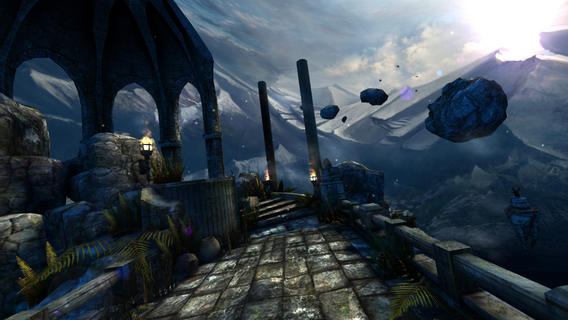
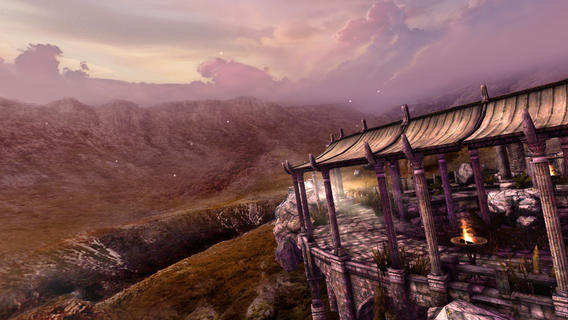
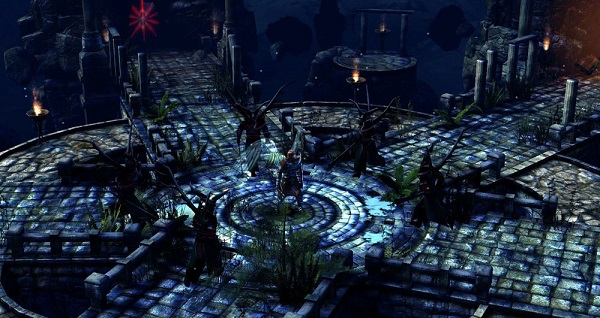
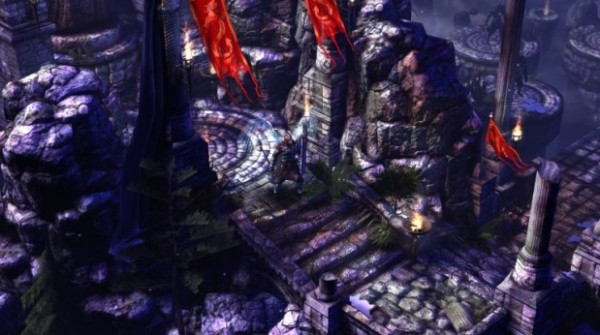
Black Tower Studios clearly went all out when it came to the visual side of “Archangel” and I say that because the graphics were absolutely amazing! The entire game looked well-polished and a majority of screenshots one would take in a level would probably make for an incredibly good-looking wallpaper, if only the gameplay was as fantastic as the aesthetics of the game. Let me start by going on the all around design and theme of the title: Because of its “otherworldly” setting, the development team made the levels as ancient, beautiful and somewhat daunting as they possibly could. I’d compare the style of this game to that of, let’s say, “God of War” or “Dante’s Inferno”, fans of those games will know exactly what I’m talking about when I compare them, I don’t believe this to a clone of those game but I do believe there was a sense of inspiration that came from those titles.
It was all very mythological yet divine and because of its “break away” level layout it did seem like the area WAS decaying. When I say “break away” I refer to the look of the levels, it looks as though the stages were built in the middle of the air so paths don’t always lead onto other paths, sometimes a pillar may be floating next to a ledge or a huge piece of rock would be hovering next to a large piece of land you can actually walk on, I would almost compare it to the way the game “Bastion” looked bar the “being built as you walk” style in which that game employed. The animation was great too, though it did often glitch and the character would fall through the ground or vibrate half way off a ledge before eventually just dying and respawning at a checkpoint.
Audio
The music throughout “Archangel” can actually be described in quite a similar way to the visuals of the game. I’ve used this word a few times but the music does indeed seem to have a sense of divinity about it though something else you could say is that it has a, kind of, creeping sound where you’re lead to believe you’re in an are or a situation which calls for you anticipate or fear, it’s quite a daunting sound that suits the game to a tee. As for things like sound effects I can’t honestly say any of them made a real impact on me but on the same token I can’t say they did nothing for me either. the best way to categorise or to put a label on the sound effects of “Archangel” is that they were…expected, which is actually not a bad thing to say.
The good thing about the sound effects were that they properly conveyed the message that they were intended for and, after playing through the game only for a short time, you can already tell what sound means what which is great for times where you’re surrounded by enemies and you’re trying to use a spell but don’t know why it isn’t working, the sound tells you that that move cannot be used, it’s something so small but it is also something you pick up on. I had no problems whatsoever with the audio of this game, it was done just as will as the visuals which gives it a nice big tick in the “pros” column.
Overall
The game is good at best, it talked the talk but it couldn’t walk the walk. It boasted a great deal of things that I never actually witnessed while playing through as much of the game as I could bare and its gameplay style made me put it down several times out of pure frustration but I cannot speak for everyone, there may be many people out there who enjoy this type of game and you reading this might actually be one of them.
If you have a spare $4.99 to spend than maybe you could try this game out for yourself but I wouldn’t suggest it to anyone that is NOT forgiving enough to put what it lacks aside and enjoy it for what it is which is, essentially, a good looking game but, for me, looks aren’t everything when it comes to a game. I highly suggest that, if you do plan on playing this game, it is probably better to play it on a system like the iPad rather than the iPhone or iPod Touch, the larger screen gives you a better idea of just how good the game looks and the already difficult gameplay will be less difficult on a larger machine. Neither Heaven nor Hell…this game resides somewhere in Limbo.
Capsule Computers review guidelines can be found here.
This serves as a fairly big reminder for those of you out there who have been playing the latest Nintendo/Game Freak masterpiece, Pokemon X and Y. Months ago we brought you the news of the very first Pokemon distribution event for the new generation of Pokemon games and it was that of a very special Torchic that came with its very own “Blazikenite” which gave it the ability to eventually transform into a Mega Blaziken, well it seems as though time is almost up for those of you who are yet to get your hands on this dangerous little chicken.
The distribution event will be ending on the 15th of January which is only a few days away so I suggest you jump onto your game now and grab it before it is too late, this Torchic isn’t obtainable through normal gameplay and I’d say this is one of the easier ways you could get your hands on one. To get the Torchic head to the “Mystery Gift” section of the Pokemon X and/or Y main menu, there you will find a selection that reads “Receive Mystery Gift”, click on that and you’ve got yourself a fiery Torchic!
Hozuki No Reitetsu Episode 1 – Making Or Breaking Hell/The Discovery Of Hell’s Mysteries
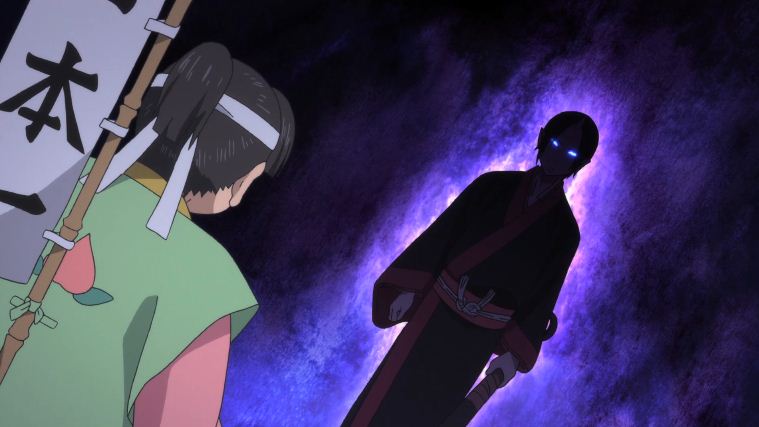
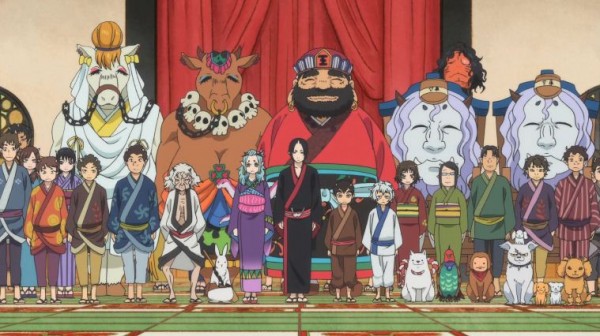
Hell surely is the place to be! Pop Culture really romanticises the afterlife and the concept of eternity in a way that scriptures can’t. Hozuki No Reitetsu follows a demon, or “Oni“, that works as the “secretary” of hell, basically the guy is second in command under King Enma who you may all know moreso from the legendary series Dragon Ball Z rather than the literal legends that have been passed down the ages and I think that’s perfectly fine. Hozuki basically overlooks Hell and makes sure everything is going smoothly…for the demons working…as for the tortured souls, well, I can’t say things are going smoothly for them at all.
Hozuki No Reitetsu is a dark comedy that has an oddly real view of what hell would be like yet twists it up with semi-human problems that we can all somewhat relate to but, from what I’ve seen from the first episode, it is ready to take episodes in all different directions and it is not at all afraid of swiftly changing pace. It seems as though episodes will be broken up into two segments, both of which will still follow the main cast but will show us different stories to do with them that wont directly continue off from the previous story but small signs in the background suggest that it does. For my Impressions I’ll be separating both episode stories and I will talk about them individually so as to get the most out of the short experience.
Making Or Breaking Hell:
This being the first episode you can assume that the first few minutes were character introductions, they were exactly that but they did it in a nice subtle way, it was almost like they threw to the characters already in-story rather than introducing them and then proceeding with the story and I quite enjoyed how it went. I suppose it being a short half-episode story meant that they had to be quick about certain things while also keeping it in a certain flow that would have the audiences attention and I’d like to say they did exactly that.
King Enma is overrun (this is how he was introduced), his office is filled with people who need problems solved from all around hell and, as usually, he palms them off onto Hozuki who is currently doing the rounds. I found the way they went about this episode to be very intelligent and quite clever, Hozuki was presented with a few little problems that would add up to a fairly big problem in the long run.
There’s a lack of workers in the animal torture section of hell, Shangri-la (a place of positive energy) is having some sort of peach problem that shouldn’t concern a worker of hell anyway, and there’s a rogue samurai spirit that is causing trouble around hell. This is a slice-of-life series so the problems weren’t resolved with an action sequence or a huge fight, instead it was solved with well-timed humour and was put across fantastically with on-the-mark voice acting.
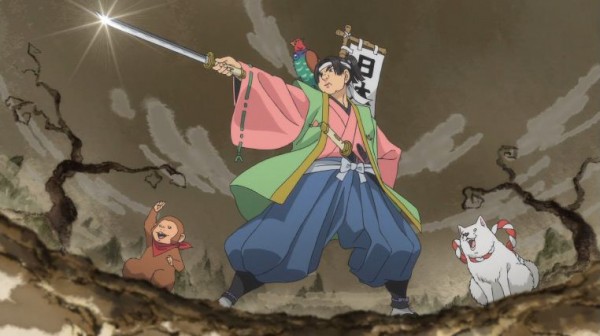
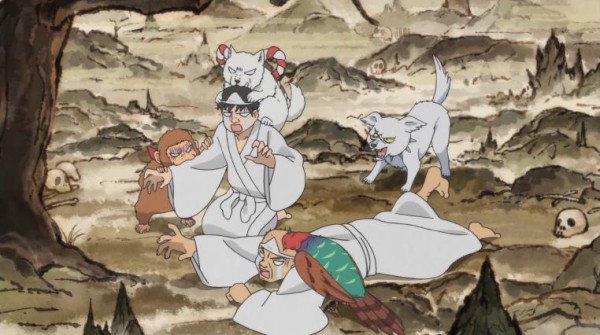
The samurai spirit was accompanied by three animal familiars who, once he was dealt with, were put to work in the “Animal Torture” section of hell which actually solved two of three problems, the third problem was solved when the samurai spirit (who was clad in what seemed like a peach-themed samurai uniform) was sent to deal with Shangri-La’s peach problem. The small segment was wrapped up so nicely and everything came full circle, that along with some great writing hooked me in to continue watching the second half of the episode and that, well, read on.
The Discovery Of Hell’s Mysteries:
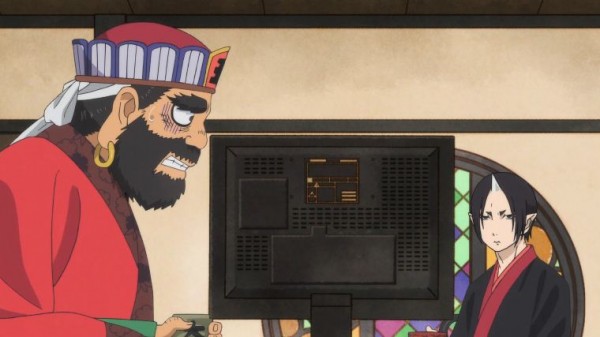
This half of the episode made the change of pace that I mentioned in the first paragraph of this article. It wasn’t as though it went from comedy to action or from slice-of-life to horror, it stuck to the roots it had planted in the beginning of the episode but what really got changed was the vibe. This half-episode is so easy to condense into a synopsis because it basically had Hozuki and King Enma sitting down to a meal at a local restaurant, watching some TV and having some Seinfeld-esque conversation, it was so simple yet worked brilliantly.
This episode continued to prove that this series is going to be a hilarious one because the writing alone was fantastically clever yet silly and the voice actors chosen clearly made their bones in the recording studio because it all just came across lightly, I don’t speak a lick of Japanese but speech is speech and you can tell when a voice actor give it their all. They somehow made a 10-minute conversation so entertaining, in any other Anime I bet audience members would sit there and wait for something flashy to happen but with Hozuki No Reitetsu you just relaxed and let the laughs roll in.
Now I mentioned the “Seinfeldian” conversation the two demons were having and I believe it really was that just on a supernatural level; pets, women, even Australia got some huge mentions as they were watching a documentary on “Mother Earth’s Bellybutton“. Nothing was too “off-topic” for Hozuki No Reitetsu, even the things that I’m sure the audience felt were like how Hozuki believes Koalas to be “huggable” and how Kangaroos are quite “dull”, he even mentioned his dream woman would be one that could get strangled by an large snake but not make a big deal out of it, everything was in good fun.
Even background characters got a giggle out of me; just seeing the animals from the first half of the episode make an appearance as they sit down at the restaurant and eat dinner just like any other customer was just so funny to me especially because it strictly happened in the background of the episode. Hozuki No Reitetsu has, in one episode, proven that it is going to be one of my favourite series’ this season and possibly even this year.
Check out more Hozuki No Reitetsu impressions HERE.
Welcome to the inaugural Capsule Computers Anime of the Year Awards. This is our first time ever doing an Anime of the Year Awards and we want to kick things off big. In what will become an annual awards article, we will be giving out several awards highlight some of the biggest facets of anime each year. This year in particular has been a particularly big one for anime, with countless quality anime bursting onto the scene. With so much great anime this year it is only right to celebrate the best of the best. So without further adieu, here are our winners for the year of 2013.
Welcome to Capsule Computer’s 1st Annual Anime of the Year Awards!
Click on the pages below to and find out who wins, along with our editors’ choice awards and special bonus feature AOTY Podcast!
CastleStorm is the Tower Defense/Physics puzzler amalgamation that appeared on Xbox Live and PSN mid last year. Now it has made its way to the Wii U with a few exclusive additions. Sadly these additions don’t make the experience much different from the originals.
Tower Defense games have you spending your accrued resources to deploy troops and other objects to defend your base require quick thinking and immediate responses. Physics puzzlers are on the opposite end of the spectrum and often require patience, concentration and a keen eye.The amalgamation of these two genres creates an experience that is a lot less fun than the sum of its parts and frequently leaves you feeling like you are rubbing your stomach and patting your head at the same time. The Wii U’s GamePad allows for a lot of off-screen controls and more precise movements than its older counterparts but still don’t make the game feel or play any better
Story After a brutal and bloody war, the Kingdom Knights and the Nordic Vikings have been at peace. This peace was the result of two gems of power being bestowed upon the leaders of the respective factions, protecting their land and granting their owners eternal life. However all goes awry when one day the gems go missing and so war breaks out once again.
The story here is pretty stock-standard and isn’t a standout feature of the game, the characters are all quite two-dimensional, and the narrative never really serves as more than a way of introducing the next battle, or explaining gameplay changes. An example is early on in the game where the Kingdom troops are all in need of the bathroom, so they are unable to be used in the following battle.
The plus side is that as mild and thin as it may be, at least there is a story. Typically tower defense or physics-puzzle games we get a modest introduction at best. This at least provides a narrative reason for why we as players are laying siege to structures.
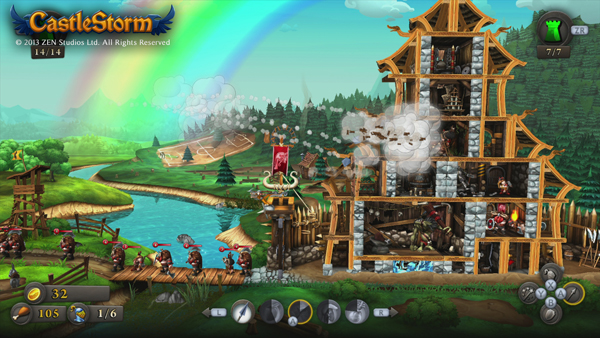
Gameplay There are three game-types in CastleStorm: Skirmish, Survival and Hero Survival, but sadly they usually amount to the player largely doing the same repetitive tasks. The Angry Birds inspiration is clearly noticeable, not only in the castle design but also in many of the weapons which function identically as the birds in the popular mobile franchise.
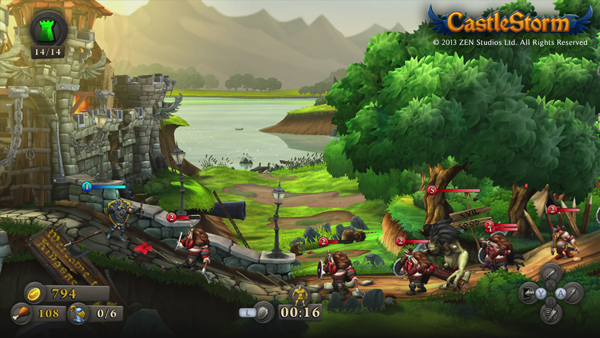
Skirmish is the standard game mode, where you use your ballista to fire projectiles at the enemy, while also casting spells and deploying ground soldiers to head off the opposing forces and to attempt to break down their doors. The aim is to destroy all of the rooms within the opposing castle before they can do the same to you. All actions have a cool-down timer before they can be used again, with more powerful projectiles and units requiring longer times between uses. You also have the option of sending your Hero Character into battle, where you take control and use their power to defeat the waves of enemy troops for a short amount of time. The Hero Character can be great at clearing the field of enemy soldiers, but as long as you are controlling them, you cannot deploy troops, fire your ballista or use magic which can leave your castle open to some serious damage.
Survival is a slightly different take on Skirmish, where instead of destroying the opponent’s castle, the aim is to use your soldiers, spells and weapons to defend your castle for as long as you can against waves and waves of enemies. Hero Survival is a variant on this system, but instead of defending your castle you just play as a Hero Character, fighting off waves of enemies until you run out of HP.
The game’s campaign makes use of all three of these game modes, while offering variations between them, such as levels where you don’t have the ability to deploy your soldiers, or where your ballista is not functional. There is actually a fair bit of replayability for those who can stand it, as each of the game’s campaign levels has a series of five stars to collect as well as an optional bonus objective to complete. This is in addition to the nearly endless Skirmish mode, which involves single battles separate from the campaign.
All of the game modes are selected in Multiplayer, which plays out almost identically to the single player experience. However instead of facing against an AI Controlled enemy, you are against another Human but please note that playing in local multiplayer in split-screen can get a bit cluttered.
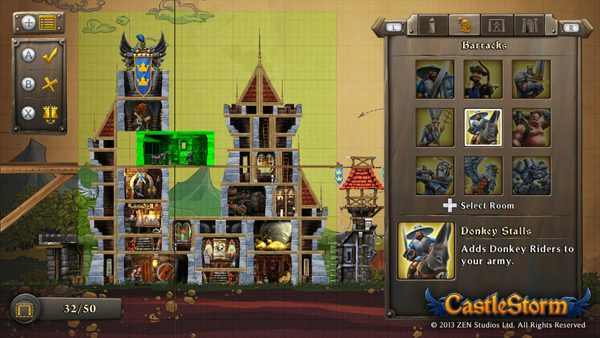
As you play the game you earn coins which can be spent to upgrade your arsenal of weapons, soldiers, spells and castle rooms. Upgrading results in your equipment dealing more damage, requiring a shorter cool-down, soldiers having more health or rooms increasing their effects. There is also an in-depth castle builder that allows players to customise one of the pre-set castles to their own look and feel, or to start from scratch. However customising these castles doesn’t amount to anything more than a cosmetic change from the pre-made.
The Wii U GamePad allows for some new additions to the control schemes. As expected, there is off-tv play on the GamePad’s screen, however taking the already cluttered game and putting it onto a smaller screen is just a recipe for disaster. What is more helpful is the addition of the touch-controls. You can use the Wii U’s stylus to select your units and aim your ballistas. This helps to overcome the game’s clumsy and unresponsive controls, as well as giving you a brand new level of accuracy.
Visuals & Audio
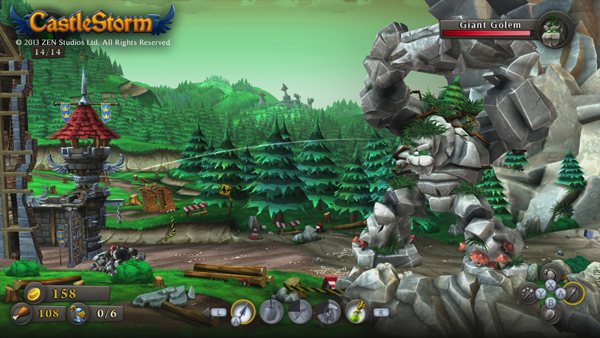
Zen Studios have made a game that is hugely reminiscent of the building blocks and figurines that so many of us played with growing up and the visual design goes a long way to show that. The lines and detailing of the characters and world are all very thick and the world is vibrantly coloured, which when combined give a very cartoony feel to everything.
While the art-style is very nice and cheerful, a lot of the animations (or lack thereof) are quite flat and uninspired. Characters all constantly have the same facial expression, no matter what emotion the story calls for, and the small dialogue-sections of the game lack any visual indication that the character is talking aside from a text box at the bottom of the screen. It makes the game look and feel more like you are playing with blocks and toys, but even so just looks bland and boring.
There are also the occasional graphical hiccup, such as the aiming cursor of the ballista just disappearing. It is a minor problem but one that definitely has a profound impact on the game.
The audio, although clean, crisp and delightfully cheerful very quickly becomes repetitive and flat out annoying. Most of the game’s cut-scenes are not fully voice acted, instead with characters talking in a series of grunts and groans while their dialogue is written in the bottom of the screen. During gameplay the same sounds will be heard time and time again, every time you summon one of your soldiers, they will say one of three or four short phrases. The audio really doesn’t add to the overall experience, and after a few minutes playing it in fact starts to detract from it.
Overall
CastleStorm is an ambitious game that wears its inspiration on its sleeve. While the Wii U version adds a few new features to prove the overall experience, unfortunately the combination tower defense/physics puzzler works about as well as mixing oil and water. The game devolves into a cluttered mess of micromanaging tasks. There is a lot of content here for players who may be interested but all in all it is a frustrating, inconsistent and overall underwhelming experience.
Capsule Computers review guidelines can be found here.
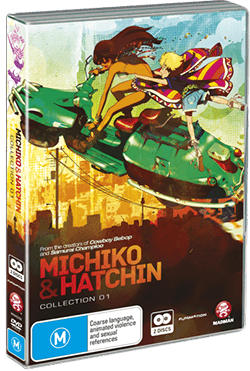
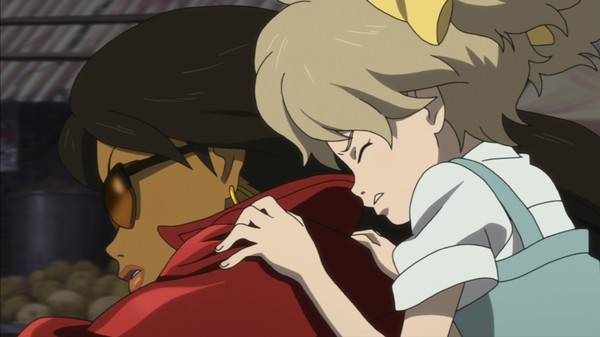
Michiko & Hatchin Collection 1 Studio:Manglobe Publisher: Madman Format: DVD (reviewed), Blu-ray Release Date: December 4, 2013 Price: $59.95 – Available Here
Overview Michiko & Hatchin was one of the shows that slipped under the radar for many, including myself. The cover is flamboyant with art that is unlike most other Japanese anime, looking almost like a Western cartoon. It’s no surprise that the director has recently made Lupin the Third: The Woman Called Fujiko Mine and Manglobe studio recently produced Samurai Flamenco.
Director Sayo Yamamoto was also involved with the much-loved Samurai Champloo, and a similar art style and approach can be seen here. From the creators of that funky series plus the famed Cowboy Bebop, Madman brings the series over to Australian shores in two parts starting with Collection 1.
Story
This anime starts off with a bang, as the latino Michiko Malandro breaks free from a prison. Meanwhile, a little girl by the name of Hana Morenos lives as an adopted child in a wealthy, uncaring family. The first episode tries incredibly hard to portray her family as callous and downright nasty. Which they are, of course. The father is a hypocritical priest who exploits his position of authority and uses the pretext of religion as a means to gain wealth.
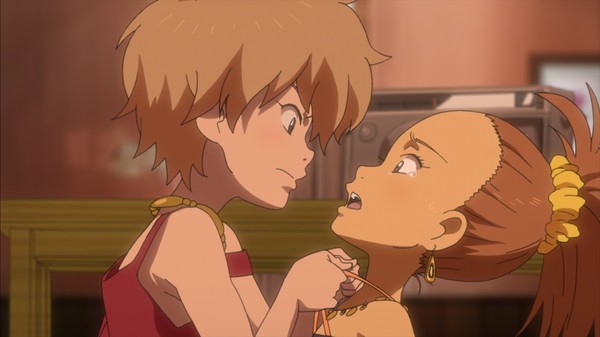
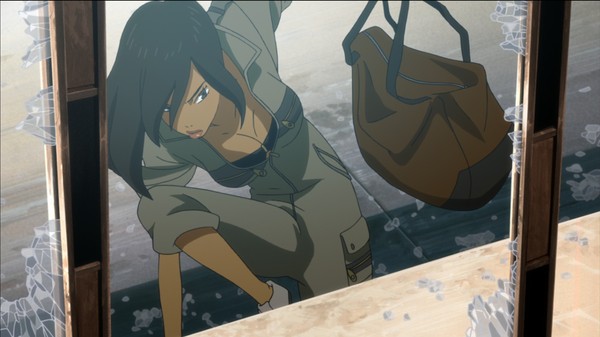
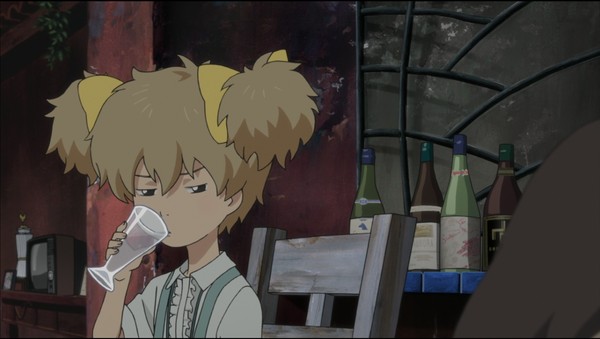
It’s almost hard to watch Hana’s daily life of misery, until Michiko breaks through the dining room window on a motorcycle and demands Hana over. At this point it’s pretty clear this crazy, foul-mouthed woman is the mother of the sensible, reserved Hana. The two polar-opposites escape and hit the road in search of the other missing member of the family, the father Hiroshi Morenos. All the while they are being hunted by the police inspector and old acquaintance of Michiko, Atsuko Jackson.
Their journey is marred by distrust, brushes with the law and armed gangs as well as stories of infidelity and other adult themes. Each of the characters are powerful in their own way, and the series puts a strong focus on women. The solid cast of female characters is largely thanks to the female director, hence why we see a very real outlook on complicated relationships and even prostitution.
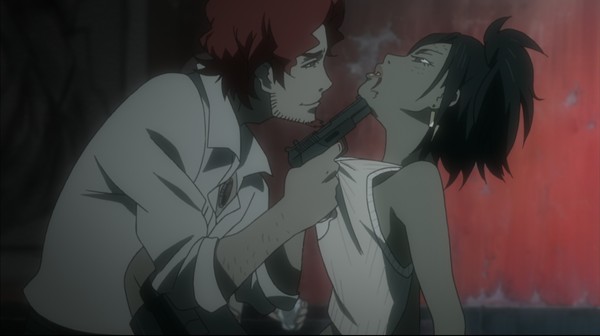
While the action is few and far between, when shots are fired and kicks are landed it’s intense and well-choreographed if only a little far-fetched sometimes. Considering how many times Michiko charges unarmed at a gun, it’s a miracle she hasn’t been shot yet! But that’s probably due to the horrible aim each villain seems to have.
The 11 episodes in Collection 1 are broken up into various short arcs, involving new characters and their problems. The dangerous setting of South American ghettos provides a vehicle for the two main characters to grow and understand each other, leaving Collection 2 to provide a (hopefully) satisfactory ending and resolution. Michiko & Hatchin feels very much like the classic theme of the journey being more important than the destination our heroes are striving for.
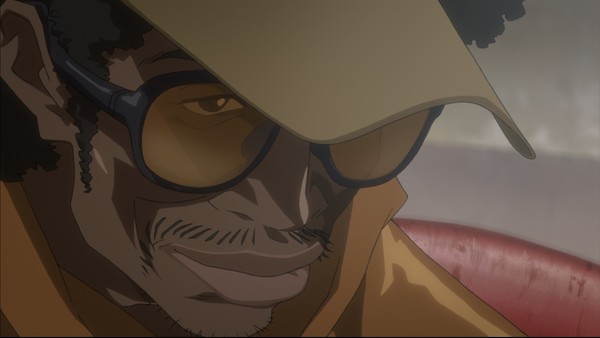
Visuals Michiko & Hatchin isn’t your typical anime and that’s largely thanks to the character designs and art style. The series has that familiar, dirty look from Samurai Champloo but with splashes of flamboyant colour to match the Latin American setting. Many of the characters forgo the traditional cute or attractive look and appear more realistic, while others like Michiko herself look entirely foreign rather than drawn in Japanese style.
Even the dates and locations are written in Portuguese to give the anime a more authentic feel. Although not unheard of, it’s fairly uncommon for an anime set outside Japan to feel this genuine. While it certainly looks different and doesn’t rely on flashy animation, the visuals will do little to impress folk who are used to brighter, more “attractive” anime.
Audio Both Japanese and English voice tracks are handled very well in Michiko & Hatchin. Those who prefer Japanese dubs will almost be tempted to leave the audio on English due to the foreign feel of the show. My only complaint is that hearing Michiko’s yelling can be somewhat annoying after a while, as all she seems to do is shout and hurl abuse. Admittedly, this is inline with her character, though.
Strangely, the sound mixing for the English dub will often have you struggling to hear some of the voices while in Japanese each voice is clear and at equal volume. This can be a slight issue for those who prefer to watch with the volume down.
As you’d almost expect for a show of this look and feel, the sound track sounds jazzy with a South American influence. This is thanks to the recording being done by Brazilian artist Kassin and produced by Shinichiro Watanabe. The music suits every scene perfectly and there’s little to complain about here. The opening theme is purely instrumental and, while groovy, it can get a bit wearisome and is hardly a tune you’d flick on in your spare time. The ending theme however is a more familiar, quiet Japanese song that suits the plot of the show.
Extras
There are a bunch of on-disc extras that come with Michiko & Hatchin Collection 1 including episode commentaries, “Michiko: The Woman Behind it All”, the show’s Japanese unveiling press conference, a live action promo, anime promo and textless songs, all of which give fans more insight into the anime.
Overall Michiko & Hatchin deals with some serious themes such as the role of family, the criminal underworld and adultery within a gritty and underused setting. Despite the dreary locations Hana, or Hatchin as Michiko calls her, is a highly likable character and watching her struggle against such a cruel world is downright inspiring.
Collection 1 deals with the pair’s initial distrust despite being mother and daughter and eventual reconciliation after many trials. Their journey to find the father begins and a great deal of genuine characters are introduced, and some are subsequently killed off. The direct nature of events and the blunt character interaction has me looking forward to the second half, which is sure to include some surprises.
Capsule Computers review guidelines can be found here.
Noragami Episode 1 – A Housecat, a Stray God, and a Tail
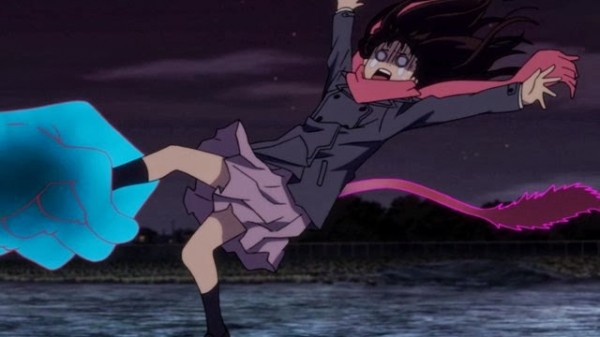
Wham, bam, thank you ma’am! Now that is what I’m talking about. Noragami bursts out of the gate with one hell of a series opener. Half-way between Yu Yu Hakusho and Soul Eater, Noragami tackles the afterlife with bombast and flair. While it borrows elements of past supernatural action series, it manages to find its own unique soul underneath it all.
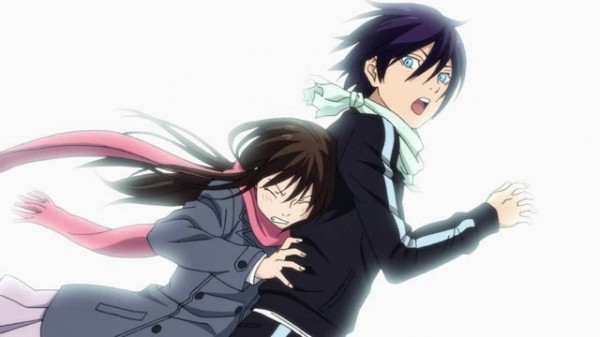
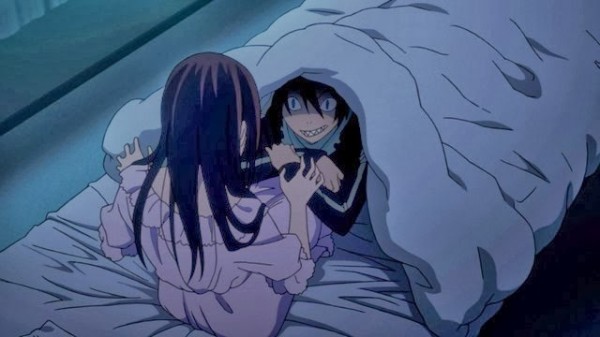
This first episode packed one hell of a punch, setting the stage for the series in a big way. We follow a ‘God’ by the name of Yato as he goes about his daily routine of helping those in need all for the price of 5 yen. Things go awry once Hiyori crosses paths with our friendly neighbourhood Stray God. Somehow, someway she can see him, things just get crazier and crazier from there.
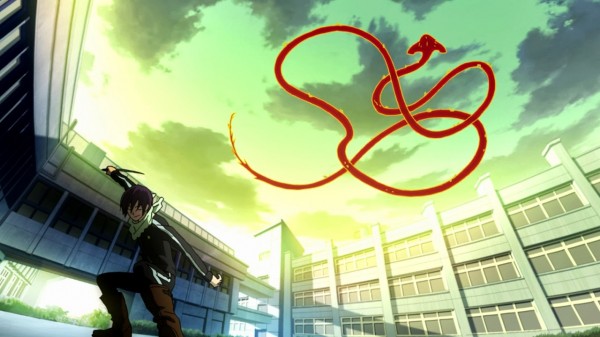
The way the series handles the afterlife is reminiscent of the early episodes of Yu Yu Hakusho or Bleach. We see Yato going head to head with Phantoms, not unlike the Demons and Hollows of Yu Yu Hakusho and Bleach. The only problem for Yato is that he has no weapon to fight with as his human-weapon just quit on him. So being the somewhat crappy God that he is, Yato is kinda hopeless. But with his care-free persona you can’t help but root for the guy to somehow make it out okay.
The connection we see Yato forge with Hiyori is quite interesting to say the very least given the circumstances. Her soul keeps on slipping out of her body and Yato could do with a helping hand, but you get the sense that there is more than meets the eye here. Something beneath the surface between these two that we just can’t see yet. I’m sure in the coming episodes we will see that relationship develop in some interesting ways.
From this first episode it isn’t exactly clear where the series will head, but the concept and hook of the series is tasty enough for now. I do suspect that we will soon encounter other Gods for Yato and Hiyori to have to deal with. One can only imagine the possibilities with a setting like this. There is a lot of directions this could go and I’m very eager to see what happens next.
One of the things that stood out about Noragami was its sense of humour. There was some genuinely funny moments in this first episode and there is a general sense of whimsy about the proceedings that adds so much more fun to the action playing out. Hand in hand with the superb fight scenes and we’ve got what could be the best action anime of the season.
It is worth noting that BONES is animating this alongside Space Dandy and judging by first episodes alone, both series have been given a great amount of attention to quality. It will be interesting to see however if the quality declines in either series. Here is to hoping that things stay par for the course because what we were treated to in this first episode was gorgeously animated action and great artistic direction. Right down to the small movements to the over-the-top facial expressions, BONES have produced something of quality here in Noragami.
Noragami is off to a great start here and with a concept as broad as this there are any number of ways for it to go. It could end up as a straight up action series or maybe just an odd-jobs slice of life series with supernatural elements. Either way, Noragami has got my interest and I look forward to seeing what this Stray God wanders.
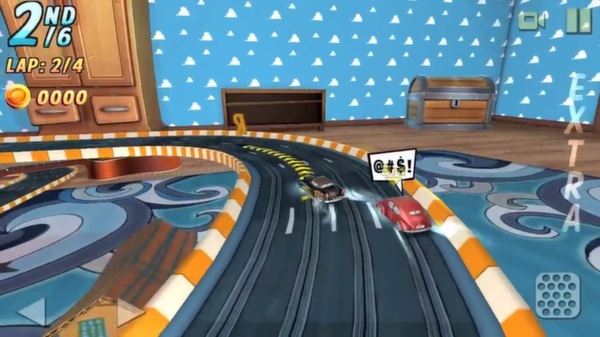
One of my fondest childhood memories is playing with a scalextric kit with my dad, shooting miniature model cars around a dusty old track until they eventually lost grip and went shooting across the room. The problem that scalextric had was that once you’d flung the cars off the track at your family and left enough of them with permanent scars and a morbid fear of F1 cars, the novelty wore off pretty quickly. Rail Racing addresses all of these problems and makes racing model cars on rails more fun for you and less physically and mentally scarring for your friends and family around you.
Gameplay
Unexpectedly, I actually had a very fun time with this game. It throws you into a world of awesome race environments and pits you up against 5 computer-controlled racers in a style that feels akin to runner style games, but with enough complexity to set it apart from the cookie cutter formula so common within that genre. You are only given two inputs: an accelerator pedal, and a set of directional buttons that allow you to swap rails. But only by hitting speed boosters, slowing down into corners, and tackling your opponents will you be able to assure success in this genuinely very challenging game. I thought sometimes that the only reason that I won was pure luck and button mashing, but for completionists who want to collect every star and unlock every car, they’re going to have to put in a lot of time to get the necessary in-game currency. Especially if you want to customise your cars, and trust me you will, in which case you often need several times the value of the actual car to do so.
What I loved about this game was its accessibility and how easy it is to pick up and play. Each race only takes around a minute or two so you never feel bogged down if you lose a race and have to try it again. For someone like me who primarily uses mobile games as toilet gaming or something to play on public transport, this game was a great alternative to the tedium of trying to 100% Angry Birds.
Visuals
Rail Racing went far beyond my expectations in terms of its aesthetic. It definitely doesn’t do anything groundbreaking or original, but it uses a cute concept that I haven’t seen since Hot Wheels on the SEGA Megadrive, whereby each course is literally an elaborate scalextric track set up in various places around the house and themed as such. It achieves a decent framerate that keeps up with the speed of the races and all the time that the game isn’t crashing due to its integration of Game Centre for the multiplayer, the game looks really quite good. The cars for each stage differ so you can eventually get access to a massive variety of adorable model cars that aren’t too hideously hard to unlock and serve as a satisfying payoff as you progress through each stage. I’m not entirely sure why the kid’s bedroom stage had a big cardboard cutout of Dolan in the middle of the track, but I’ll let them off for including such an irritating meme since everything else in the course was so charming.
Audio
Music was not this game’s strong point. Each stage has its own unique track and if you can survive through the first stage’s awful, unfitting background music then you are a better man than I. I actually turned the sound off on my iPhone after race 2 until I got to the garage stage at which point the music picked up. From then on the music is still not hugely appropriate for a racing game, but it is at least okay background noise. The rest of the audio assets suffer from the same problem and I feel like a bit more attention to sound design would serve this game well, but nothing is so awful that you wouldn’t play the game because of it.
Overall
Going into this game, I did not expect a lot since I am not a fan of runners or racing games for the most part. However, Rail Racing went above and beyond my expectations, showcasing a casual game that is easy enough to be enjoyed by anyone, but has enough complexity to make the competitive among you want to complete absolutely everything and even want to dive into the multiplayer scene and show off your precision timing and skill which I certainly lacked. To summarise, Rail Racing is an excellent pick-up and play racer that is as fun and challenging as it is charming.
Capsule Computers review guidelines can be found here.