One of the most prominent features in any wrestling title in the past ten years has been character creation. THQ recently released a new video to give players a brief run-down on what they can expect from the creation tool on the new WWE All Stars. The clip features one Superstar who didn’t make the cut for the final roster of the game, Santino, making a version of himself to compete.
After a comedic process, Santino made a pretty decent version of himself which shows that this tool should be useful when it comes to making just about anybody. It is also obvious that the creation isn’t quite what we have seen in the Smackdown vs Raw series, but for such an over-the-top title I think a little imagination will be able to go a long way. Check out the new creation video below and in just a little over a week, WWE All Stars will be available to throw down with some of the most larger than life performers when it hits stores March 29th.
SHMUSICUP: Shoot Music Up
Developer: Tzai Entertainment (website)
Publisher: Tzai Entertainment
Genre: Shoot ‘Em Up, Rhythm/Music
Price: $14.99 ($9.99 forpre-orders)
Platform: PC
Release Date: TBA
Hybrids are usually risky when it comes to video games, but sometimes when pulled off right they can be revolutionary. SHMUSICUP: Shoot Music Up claims to be a hybrid of the shoot em up and rhythm/music genres developed by Tzai Entertainment, a recent start up developer based in Singapore. This combination offers the potential for true greatness, so let’s see how SHMUSICUP holds up. Keep in mind, the game is currently in its beta form, so things may change between now and its release.
GAMEPLAY
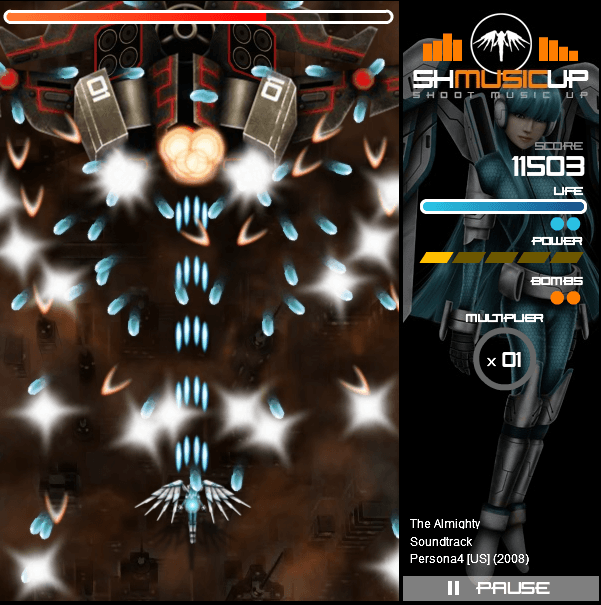
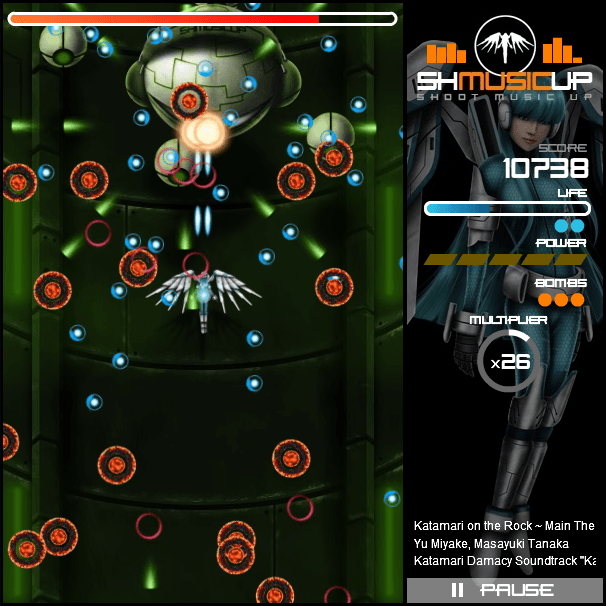
SHMUSICUP belongs to the subset of shooters referred to as bullet hell due to the staggering amount of shit on screen for you to dodge. The game is definitely not lacking in this department. While it may not have as many projectiles as the legendary Mushihime-sama Futari (which has been called subjectively by some the “hardest game ever”), SHMUSICUP is still pretty manic as far as shmups go.
The way that Tzai integrated music into their game is by having the player choose a song in the form of an MP3 file as the background music for each level and then generating a bullet pattern based on the rhythm and intensity of that song. There are a few free songs available to choose from, but most players will probably enjoy being able to play along with some of their favorite songs from their hard drives. Because of this feature, players can affect how fast and intense they want their shooting experience to be. It should also be noted that players can use *any* MP3 file, which can make for some interesting experiences (more on that at the end).
In my time with the game (I played all of the pre-loaded songs plus a few dozen of my own in varying genres) I didn’t really notice any problems with the game recognizing my songs nor did I find any songs that weren’t fun to play with. Occasionally the beginning of a song would have almost no bullets to avoid, but the difficulty quickly increased after 30 seconds or so. The last few seconds of most songs are equally devoid of bullets regardless of how the song ends musically, only to be followed by a final splurge of bullets right before the boss dies.
Another interesting mechanic of SHMUSICUP is that there are no small enemies. Each of the six stages is a boss fight, and similar to Shadow of the Colossus, defeating these giant creatures is your only specific objective (well, that and survive). However, in Shadow of the Colossus this worked well because each boss fight was significantly different and required different strategies to defeat, whereas in SHMUSICUP it sort of just feels like an aesthetic difference. Later bosses are harder than earlier ones to be sure, but they don’t feel significantly different and I think that the inclusion of enemies leading up to the boss would have added some variety.
There are several different modes and difficulties in order to add said variety however. The default setting is called Prox mode, and offers higher score multipliers to players who are brave enough to stay near the top of the screen, a strategy many wouldn’t be encouraged to use in most shmups. In the unlockable Graze and Aim modes, players are given multipliers for allowing bullets to pass near them and for continuously getting hits on the boss, respectively. As you can imagine, each of these modes adds a different type of strategy to getting a high score.
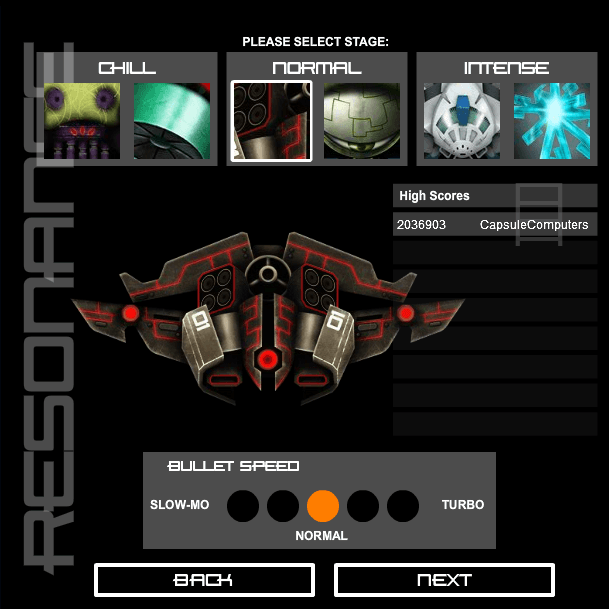
Along with the modes are the different speeds at which you can play the game. Normal is the speed at which you will need to play at first, but you can also unlock Slow-Mo and Turbo speeds. Slow-mo obviously slows bullets down for you; however it also significantly increases the number of projectiles on screen at a time. Turbo mode works in just the opposite way, with shots rocketing towards you, requiring you to have your reflexes at max capacity. Each of these speeds can be combined with a mode to offer interesting and unique play and scoring styles.
One of the aspects of SHMUSICUP which I found a bit strange, albeit logical, was the amount of HP each boss has. Each stage will end when the boss dies, and this will always be at the same time that the music ends. This means that from the beginning of the level the boss is fated to die, assuming you are able to survive his onslaught of bullets. Even if you don’t fire a shot, the boss’s health will slowly drain with each note of the song until his inevitable demise. The only responsibility on your shoulders is to stay alive and to score as many points as possible, which you do by shooting the boss. While this doesn’t make the game worse, it just seems strange that you can finish a level with a score of zero, and it may affect the motivation of some players to continue with the game.
There are also two unlockable difficulty levels, one which allows you to continue infinitely and one which gives you only one life. The former obviously offers players a chance to relax and enjoy the show while listening to their MP3s, and the latter offers a tougher challenge to veteran players. To add even more to the replayability of SHMUSICUP, the devs at Tzai have also included dozens of achievements (just shy of 40 at my count) for players to earn. Some of these are as simple as completing a stage or choosing a certain preloaded song, while others challenge players with high scores or songs of a certain length.
While I enjoyed checking off the list one by one, I found that most of these could be completed pretty quickly, especially if you’re willing to bend the rules a bit. I also ran into a glitch with two of the achievements which tasked you with completing a certain number of songs. Each time I would close the game and come back later, my song count was reset, meaning I would need to play 20 or 50 songs in one sitting in order to complete it. Hopefully this bug will be fixed by the full release of the game.
GRAPHICS
Although the videos I’ve uploaded to YouTube (see below) don’t do it any justice due to my low-tech recording techniques, SHMUSICUP is a very nice looking game. It doesn’t have exactly what I would call high end graphics but it’s definitely pleasing to the eye. All 6 of the bosses look awesome and have some really cool design behind them. The playable character (in all 3 modes) looks equally cool, and reminds me more than a little bit of KOS-MOS from the Xenosaga series. There is also a huge variety of projectiles for you to doge in the game. Not only bullets of different colors, but also different shapes, sizes, and movement patterns that you’ll need to learn.
While SHMUSICUP won’t require a decked out computer to run, you can tell that there was a lot of care put into its creation. The only complaint I have about the visual presentation of SHMUSICUP would be that the backgrounds to each stage are a bit boring. I think that this comes from a functional requirement, as it could be confusing to follow hundreds of tiny bullets with your eyes if there is something too distracting behind them, but I felt myself missing a more dynamic background.
SOUND
Since MUSIC is right in the middle of the title, I would consider sound a pretty important element to SHMUSICUP. Obviously, the quality of the sound is largely dependent on the player, and this is a huge benefit for the game. There have been plenty of games I have played (and I’m sure I’m not alone) that have had soundtracks or perhaps individual songs that just get on your nerves eventually. This could be either because they’re not your taste of music, they’re short, repetitive loops (I’m looking at you, Persona 4!), or they’re just not that good. The ability to use whatever songs you want in SHMUSICUP basically eliminates this problem altogether. If you don’t like the music you have only yourself to blame.
There are a few songs that are included with the game (six in the beta version) and while I didn’t choose any of them that many times, I did make sure to try out each of them. One thing I can say is that the style and genre of the songs definitely fits well with the mood of the game. Each song had a distinct electronica-techno sound to it (I’m not great at distinguishing between electronica, techno, trance, house, etc so forgive me if I use the wrong terms) and the tempo and rhythms do a good job of getting you pumped for the action. I particularly liked Magdalenian by Wahnsinn which had a very metal flavor to it. While this sort of electronic music definitely isn’t anywhere in the realm of my very ska tastes, I didn’t find any of the songs offensive to my senses and I thought they were well-composed.
In terms of sound effects, the game is actually a little on the disappointing side. While none of the sound effects are bad, they also just aren’t very satisfying. The sounds of your shots hitting the boss will be mostly drowned out by the music and sound like your typical shmup sounds. Getting hit by a projectile makes a very distinct but oddly inappropriate soft thud. Even the sound of the boss exploding, which should be a cathartic experience after a difficult level, is lackluster and subdued. While this isn’t the most important aspect of the game, it is disappointing to see a shmup (and a musical shmup no less) with mediocre sound effects.
FINAL THOUGHTS
SHMUSICUP is a good game. I really don’t have much to complain about even in its beta form, which is extremely promising for a game by an unknown indie developer. SHMUSICUP is not as much of a hybrid as its name would lead you to believe, but that doesn’t mean it isn’t fun. Fans of shmups should enjoy it for its ridiculous bullet patterns and huge enemies, while most players will probably appreciate the use of a custom soundtrack. I found that it was the most enjoyable when I was experimenting with different variations of modes, speeds, and songs to see all the different experiences Tzai had to offer me. Add the online leaderboards and intensely score-based gameplay and you have a combination that will keep competitive players coming back again and again. If you’d like to try out SHMUSICUP now, head on over to their website and take it for a spin.
To get a look at one of the later levels not available in the demo, check out the video below. It shows me failing miserably at the Resonance stage on Turbo speed. For more videos of SHMUSICUP, head to my channel here.
As a fun little addendum, here are some of the more quirky things you can try while playing SHMUSICUP:
I enjoyed using some of my favorite video game soundtracks along with SHMUSICUP, with songs like Katamari on the Rocks (Katamari Damacy), Donuts, Go Nuts! (Splosion Man), and any of the tracks from the Ys 7 soundtrack.
Playing with slower, mellower songs can make for an ironic experience. Some very chill songs can still produce crazy bullet patterns, and manic action accompanied by ukulele is something that needs to be experienced at least once.
If you want a challenge of endurance, try using an hour long podcast and see how long you can survive (yes, I did do this). If you really want to push yourself, try using an audio book (no, I’m not that crazy).
Processed white noise that some people use to fall asleep can look pretty crazy when it’s translated into a spread of bullets. It’s not too enjoyable on the ears though.
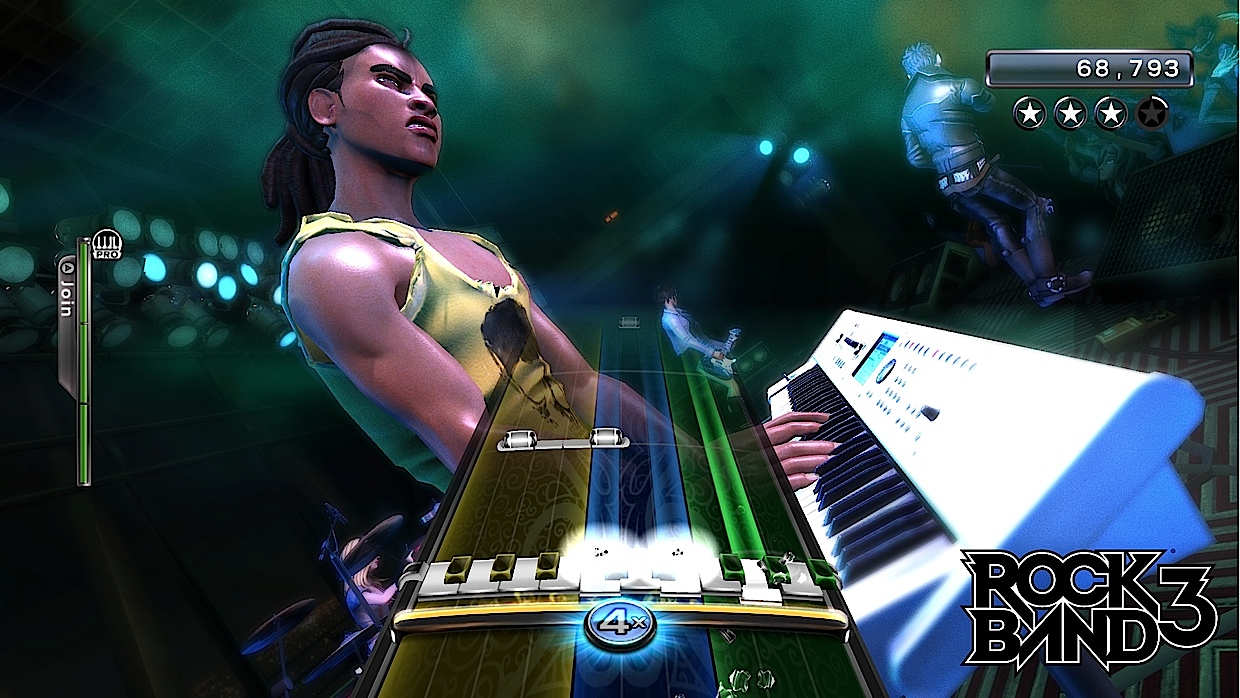
Youtube sensation Antoine Dodson is coming to Rock Band 3. Yep, thats right. If you have ever wanted to sing the “Bed Intruder Song”, you will be able to in a few short weeks. One Mr. Kario Charts has signed the Gregory Brothers for the rights to produce the song for the game, and the only current delay in making it publicly available is the difficulty in making the song have Pro Key charting. But, if you would like to test the song out, you can check out the forums here. Or, you can take a look at the preview video below. Either way, its epic. You can also check out the original video here (you have not seen it yet? FOR REAL?)
Get ready for April! It has been announced that Charlie Blackmore’s adventures will continue in the early part of that month.
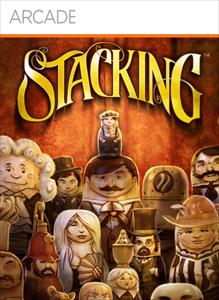
When you download the expansion, you will be able to help Levi, the hobo who helped you in the game, reclaim his royal heritage in the kingdom of Camelfoot! “The Last Hobo King” will feature an all new world in the form of said kingdom, and you will be able to again cause awesome mayhem with your special stacking doll powers. Specifically, you will be able to discover 15 new dolls, complete original hi-jinks and earn achievements/trophies specific to the unique adventure.
If you want more info on the game, read our review here! It is an amazing game that will benefit greatly from the DLC.
Hi-Rez Studios is now giving 100% of this weekends game sales to the Japan quake relief effort. Their MMO shooter, Global Agenda, has been marked down to $9.99 until Sunday, March 25, 2011. Get the game from their web store here. So, you can get a cheap game and still help others. Awesome! It is great to see how much of the gaming population is stepping up to help our fellow humans across the world. If your still in the giving mood after buying this game though, you can still help others by clicking the link on the left side of this page. We at Capsule Computers can’t wait until Japan is back is on its feet and feeling better.
Ar tonelico Qoga: Knell of Ar Ciel Developer: Gust Publisher: NIS America Platform: PlayStation 3 (Reviewed) Release Date: March 15th 2011 (US), March 25th 2011 (PAL) Price: $59.99 Buy Now!
Overview:
Variety is the spice of life they say and variety in a JRPG can be something that is hard to come by sometimes. The Ar tonelico series has been known for having many unique features not often seen in your run of the mill JRPG and has grown a name for itself over the years since the first two games were released on the PlayStation 2. Now that the final game of the series and the first one on the PlayStation 3, Ar tonelico Qoga: Knell of Ar Ciel has been released, does it provide a satisfying end to the series?
Story:
The hero of our story is a relatively lazy and laid back man named Aoto whom we are introduced to through him slacking off in bed after finishing a job ahead of time. That quickly all is thrown out the window as the Clustanian army attacks a group of travelers outside of his house. The Clustanian army is chasing after a young Reyvateil named Saki and Aoto isn’t about to let a young girl be taken by the soldiers and well…. man-woman.
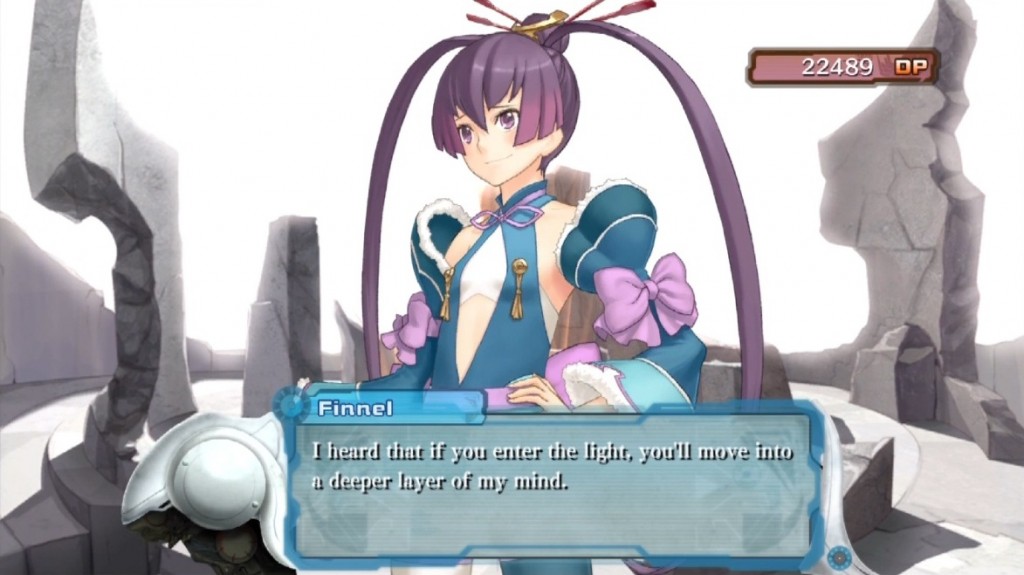
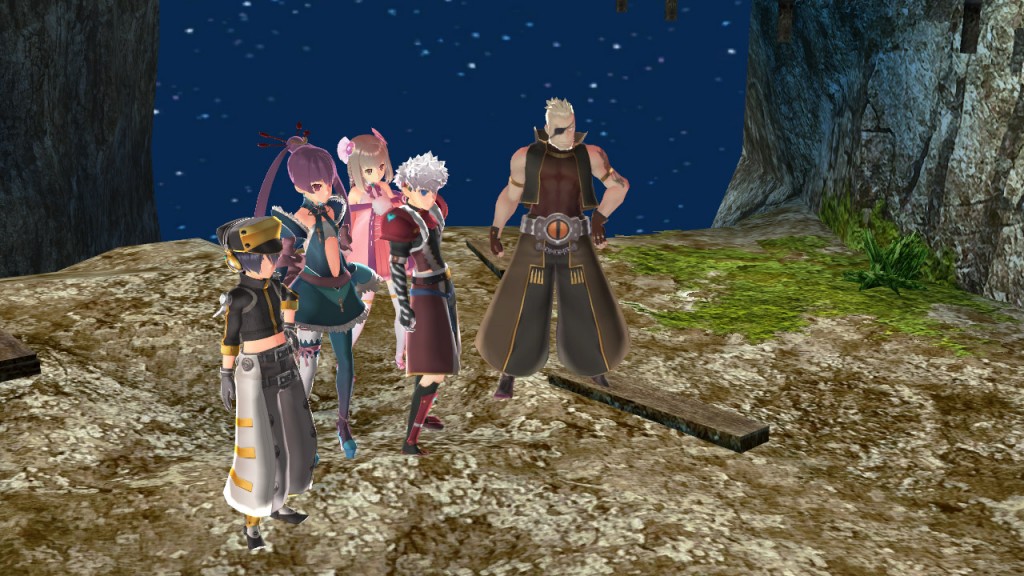
This means that Aoto is no longer able to enjoy his carefree lifestyle and is thrown into circumstances far beyond himself. Along his journey he finds help in the form of Tatsumi, a V-boarder in training, Hikori Gojo, Reyvatologist, Finnel, a clumsy Reyvateil with a mysterious secret and more as they attempt to not only survive the Clustanian army but find out exactly what they want with Saki and the deep secrets inside both her and Finnel’s mind.
I believe a little bit of an explanation is order before I continue further. Reyvateil’s are beings that have been constructed with the ability to harness the power of Song Magic and this is the main source of power in the world of Ar tonelico. Alongside their ability to harness Song Magic they are also contain the ability to be “dived into” meaning the main character can enter the Reyvateil’s mind to unleash more of her power.
Now this is exactly where Ar tonelico Qoga takes a step away from your standard storytelling and provides an intricate and in-depth story full of plot twists that will have you searching every nook and cranny of the world to find out more about the story and interact with the characters more. Finnel and Saki contain dark secrets within their minds and only Aoto can try to help out these women for the sake of not only themselves, but the world.
Now usually I would continue this in the gameplay section of my review but this deserves being placed here due to the fact that the storyline is obviously the central part of this game and many things focus around it. Each Reyvateil is able to be dived into via a Dive Shop and this allows Aoto to enter the “Cosmosphere” of that girl’s mind. Through this the player is able to unlock more of the girl’s power and understand the deeper workings of their mind by growing closer to them by knowing more of their psyche and personality.
This is an intricate part to the gameplay but also provides some of the biggest storyline twists that must be delved into to truly enjoy the game. Through entering the Cosmopshere the player is able to find out much more about the Reyvateil’s they are traveling with, even their hidden sides that no one, even themselves, know about. To trigger certain events inside of a Reyvateil’s mind the player must accumulate DP to use inside of her mind; this is done through fighting alongside said Reyvateil in battle. However the player can only dive as far as they have advanced into the storyline which means that even if you think you can make it to the 5th level of Saki’s mind you will be stopped at the 2nd level until you go further along.
The story of Ar tonelico Qoga can draw around thirty hours of your time into it but that is only if you scrape the surface of what you can truly find out about each girl and venture into the relationship building aspects of the game. Rather than having multiple side quests that are often placed to pad out play time the player is encouraged to interact with their own party members. Or should I say mostly on the Reyvateil’s themselves.
There are at least eight different endings that can be experienced depending on the choices you make and how well you know the Reyvateils in your party. This is done by locating glowing icons that unlock extra dialogue in the game’s Camp Mode which lets Aoto interact with the Reyvateil companions such as Saki and Fennel. By doing so the player is able to build their relationship with that Reyvateil and find out more about them by throwing character information at you like a rainstorm, but all funneled properly enough to be understood.
Overall the storyline has a serious undertone to what is first shown off as a comedy. Throughout the story this persists with a nicely weaved balance that forms a comedic tragedy as you find out more about the dark pasts about the Reyvateil’s in your party. Well that and sex. Lots and lots of sexual innuendo is laced into the game and the fact that it is an integral part of the game may either bring players into the experience or make them take a second look at the game itself. I will speak more of this later.
Graphics:
Ar Tonelico Qoga: Knell of Ar Ciel sports some spectacular looking artwork that provides a mixture of HD 2D background images in a 3D world where the characters venture around in. For the most part the areas aren’t too varied or well-designed but they are usually great to look at when you explore the world. Also the character’s 3D models are good enough looking without looking bad even though when contrasted with the detailed appearance the characters look in the still-art dialogue scenes they are noticeably less detailed.
As far as the Purge modes go they are well animated with a sort of magical-girl styled transformation sequence that can be turned on and off depending on how many times the player wants to watch their Reyvateil “purge” their clothes. Occasionally the game will treat the player to a crisp anime cutscene which looks amazing as the full detail of the characters’ still-art is translated into the anime cutscenes.
Audio:
First let me address the fact that the game contains an option to either choose between the English voice actors or the original Japanese cast. Everything is still subtitled which means despite your preference you will always be able to understand what is going on. The English voice actors do a great job matching their tone to the localized dialogue that NISA has done for the series.
As for background music and the fact that the battles revolve around the tempo and rhythm provided by the singing Reyvateil it is hit or miss. Some songs may seem out of place but for the most part the background music is pleasing on the ears and it is interesting to see it worked so well into a gameplay mechanic like it is within this game.
Gameplay:
The game itself doesn’t play too differently from what you would expect a standard JRPG to play as. There is your standard overworld experience where you venture through an environment and encounter battles randomly. Thankfully the player is warned about how close they are coming to a battle via a colored bar in the bottom right corner of the screen that changes color overtime to show the higher chance of entering a battle.
Once the player enters a battle they will be treated to a real-time experience similar to what we have seen in the Tales game series which sets it apart from previous Ar tonelico titles. Players are given three “vanguard” fighters which form the active combatents while the fourth character on the field is a Reyvateil that controls the flow of the battle. She does this by singing a song during the fight and displaying a beat meter at the bottom corner of the screen.
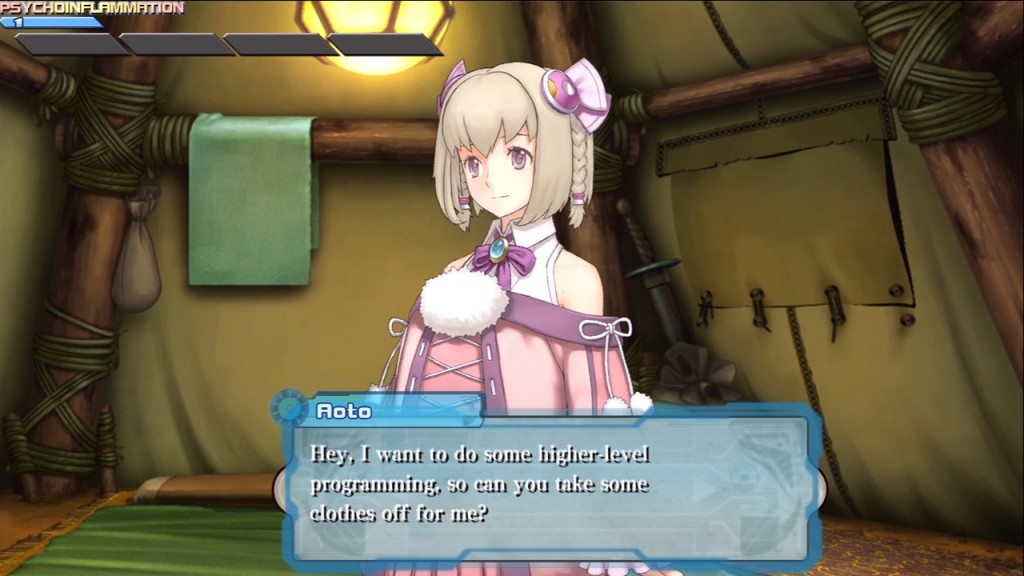
The player is encouraged to time their attacks to the higher beats on the meter to increase the tempo of the song and build up a Purge Meter faster. The purge meter can then be used to make your Reyvateil strip her clothes off and perform powerful Song Magic to destroy the enemies on the field. Yes, you read that right, strip. The game explains this fact by saying that the more skin a girl exposes the stronger their magic grows and this means that the higher the level of Purge the more clothes the girl takes off.
This also means that the strongest Song Magic requires the highest level of purge which leaves your Reyvateil singing in nothing but her underwear at a certain point. Developing this stronger power and creating better Song Magic also requires the Reyvateil’s to strip in their rooms allowing the players to assign specific skills to their Purge abilities.
Other than battling and stripping your Reyvateil down to their underwear there are a couple of other features in Ar Tonelico Qoga. The crafting system has players acquiring random recipes from treasure chests scattered around areas in the world which are shown as ?Fan? or similar to that. The player then uses these recipes from various items they acquire in battle to create numerous items ranging from usable healing items to better equipment and special character moves. The player also gets to decide which Reyvateil they want to help craft items with and are treated to a mini dialogue between Aoto and his chosen Reyvateil which also boosts the relationship between the two but uses acquired DP.
Besides finding out a Reyvateil’s dark secrets and hidden sides of their personality the player can also acquire fairy-like creatures called Hyumas from each Reyvateil’s Cosmosphere. These Hyumas are then equipped to their respective Reyvateil to allow her to give special stat boosts during combat and for their Purge abilities.
In the end a lot of the mechanics involving a Reyvateil’s Purge ability, Cosmosphere, and stripping point are based around how well that Reyvateil actually likes Aoto and the better the two know eachother the stronger they become. In the end though there is no actual nudity to the title, although the player can choose to jokingly pursue further and be shot down by the respective Reyvateil. Some people may find this a disappoint in their RPG but it actually serves a relatively useful purpose outside of being fan service and is also something that the series has been known for since the beginning.
Premium Edition:
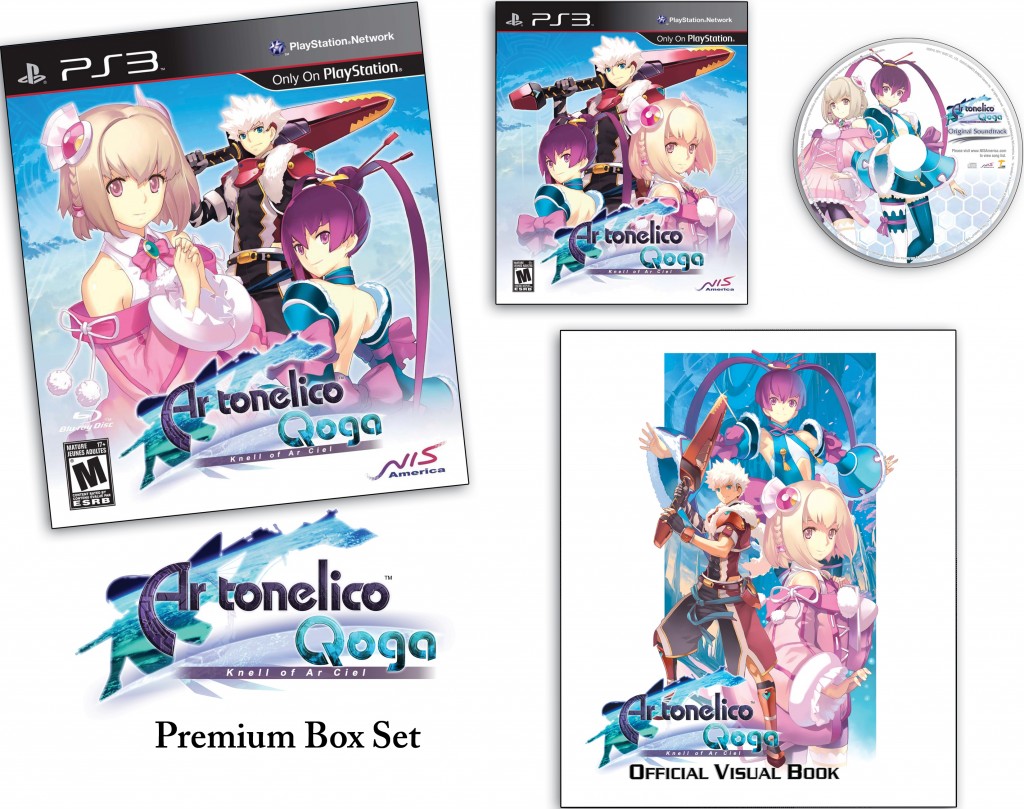
Now you didn’t think that there would be an NISA game released for the PlayStation 3 without a premium edition would you? Well Ar tonelico Qoga: Knell of Ar Ciel isn’t the exception to the rule after it began last month with Hyperdimension Neptunia. The premium edition includes a ATQ official soundtrack which features a little over an hour of music from the game itself which is primarily all the background music you will be treated to. Fans of the music or in the need of some background music to their own activities can find this a nice addition to their collection.
Also included in the oversized game case, other than the game itself is a fully colored hard covered artbook that features 40 pages that show off character profiles, a few pieces of character artwork and information of some of the more obscure pieces of information within the game itself. The only complaint about the Premium Edition that I found was the fact that the soundtrack CD was placed inside of a simple sleeve as opposed to being bundled in the game case itself but this is mostly for aesthetic purposes only.
Overall:
Ar tonelico Qoga: Knell of Ar Ciel has plenty to see, literally in some cases, and enjoy for fans of the RPG genre. With multiple endings and a very interesting story with plenty of twists and lots of character development you will constantly be trying to find out what is going to be happening next. And that my friend is exactly what you should be asking for from an RPG, the drive to continue the story simply to find out what is happening. Sure there isn’t a whole lot of depth to actual gameplay, but that is because it all is sitting in the story. If you can handle the fact that the female characters in the game often take off their clothes, or if you don’t mind fan service, then you will certainly find yourself with a JRPG that will last you a long time.
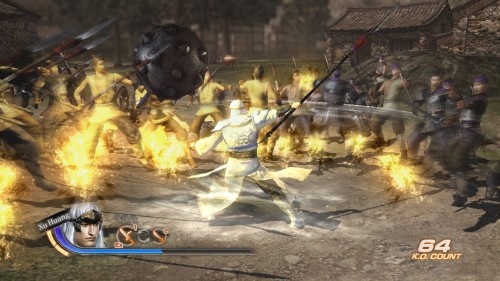
With Dynasty Warriors 7 only a mere 10 days away (unless you live in Europe, then it’s…20 days) Koei released some new screens and a video showcasing some gameplay in English. For those who may have forgotten or are simply unaware, this installment of Dynasty Warriors brings back the traditional charge based attack system that many are familiar with, which you can see for yourself in the video. This installment also features weapon swapping, allowing the player to have two weapons equipped and granting the ability to switch between them on the fly, even mid-combo.
Now a traditional DW vet will consider this blasphemy, changing up the warriors’ original weapons. Fret not, as their “ultimate” EX attack (musou) will have them revert to their iconic, classic weapon style. Xiahou Dun and his sword, Lu Bu and his halbred, etc. This way the characters still retain their classic origins but allow the player to utilize whatever weapon they wish.
The graphics have received a decent upgrade since DW6 (not that 6 looked bad). The most notable visual changes are the character models themselves getting a new, re-imagined look which really gives the franchise a fresh coat of paint. Overall the game looks pretty great and seems poised to please hardcore players and newcomers alike.
Check out the screens and video for a better look.
64th Street – A Detective Story Platform(s): iPhone(reviewed)/iPod Touch/iPad Publisher(s): DotEmu Developer(s):DotEmu/Jaleco Genre(s): Arcade/Action Release Date: 09/03/2011 Price: $1.19 AU $0.99US (Buy now while on sale)
Overview
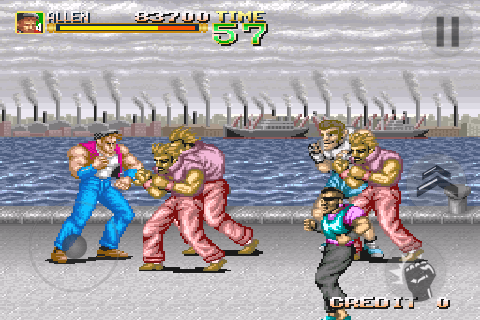
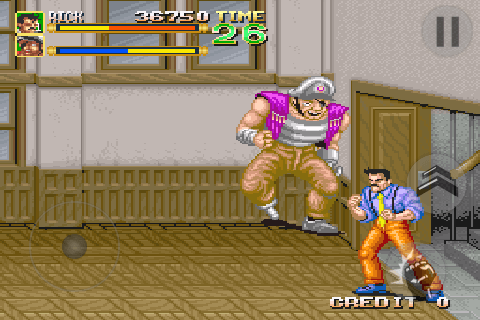
Welcome to the mean streets of New York, 1950. Detective duo Rick and Allen run through the mean streets, fighting against the evil organisation “the legacy” in order to rescue the daughter of one of the most influential men in town. This is 64th Street – A Detective Story, the Super Nintendo, beat ‘em up, street brawler brought to the iPhone by DotEmu.
Gameplay
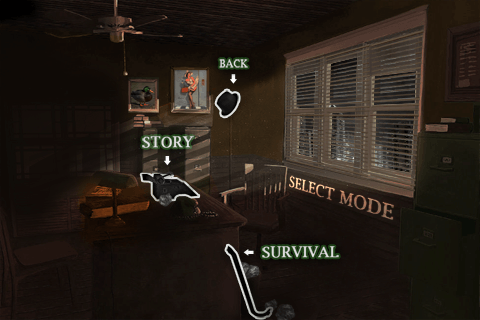
The detective story begins with a protagonist, either Rick or Allen (your choice!). Once those formalities are out of the way, the game begins. 64th Street has six levels that must be completed in order to track down the kidnapped daughter. There are two options for going through these levels, firstly there is survivor mode. Here you are given four lives and try and get as far through all the levels as possible before game over. While this is pretty fun, I find it more difficult and don’t really enjoy playing for a high score. If you are more like me and like to be pulled along by a narrative, then story more would be the best bet. Similarly, you are given four lives. However if you beat the level you are granted four new ones and the level is now unlocked to return to whenever. It’s through the story mode that the goal of the game can be completed. Both game modes are practically identical and it’s all a matter of preference which one to choose.
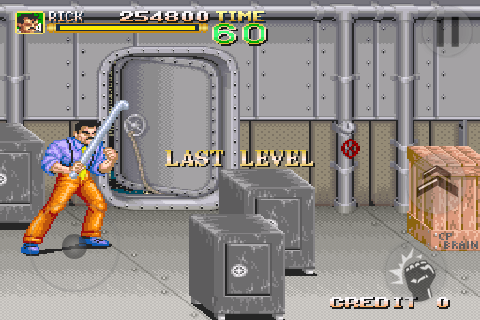
The game also comes with Game Center achievements, which has some pretty awesome bonus features. While Game Center usually means earning achievements by beating certain milestones, 64th Street has a pretty cool addition to this in that if you earn the spanner or steel pipe achievement, you can choose to start levels in story mode wielding either weapon. These are unlocked by beating ten enemies in a row with the appropriate weapon. While it may seem a little thuggish to start a level with a steel pipe in hand, I can’t help but take advantage of this exceedingly helpful unlockable feature.
In terms of adapting a Super Nintendo game control system to an iPhone, I think DotEmu have done a great job. The button on the left to control movement and buttons on the right to control action is a pretty standard compromise for adapting console games to iOS devices. However at times (this is particular for games where movement can take place in 3D game spaces) the movement controls are a little hard to manage. 64th Street’s opaque and minimal buttons mean that less screen space is dedicated to interface – which is a real issue for me on iPhone games as my thumbs tend to hinder my view of the game for games that require a little more dexterity.
Graphics and Audio
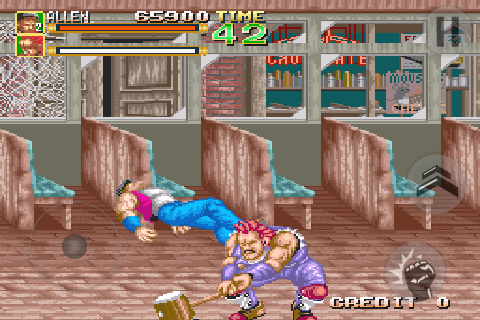
While the pixel graphics might be crude by today’s standard, there is something refreshingly nostalgic about pixel-based games for the iPhone. 64th Street- A Detectives Story is no exception. A little paradox in the character design is the appearance of enemies who look somewhat like Hulk Hogan circa the 1980’s which is a little odd considering the game is set in the 1950’s. Despite this, Rick and Allen suit the theme, and look pretty hard-boiled if you ask me. The level designs are great and I think really do give off that 1950’s “track down the kidnapper and I’ll pay big bucks” vibe from film-nior movies – in particular the grey docks featured in stage two.
While the music isn’t all that complex, it is gritty, retro-synthesised and perfectly sets the scene for beating your way across the six levels of 64th Street. This coupled with awesome thudding sound effects and grunts of defeat knocks the game up another notch and really adds to the overall fun and playability of the game.
Conclusion
In a nutshell 64th Street: A Detectives Story is fantastic. Whether you pick Rick or Allen, opt for a steel pipe or spanner, or choose to wail on the masses of enemies who strut around 64th Street with your bare knuckles, 64th Street – A Detectives Story is a highly addictive reimagination of a Super Nintendo classic that has been beautifully transferred to iOS devices by DotEmu. Keep an eye out for other games being published by DotEmu, because this game is defiantly a winner.
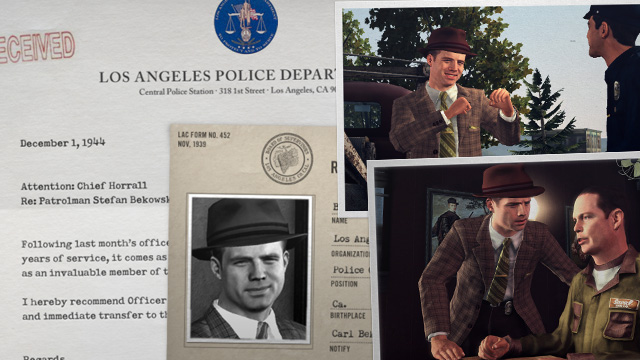
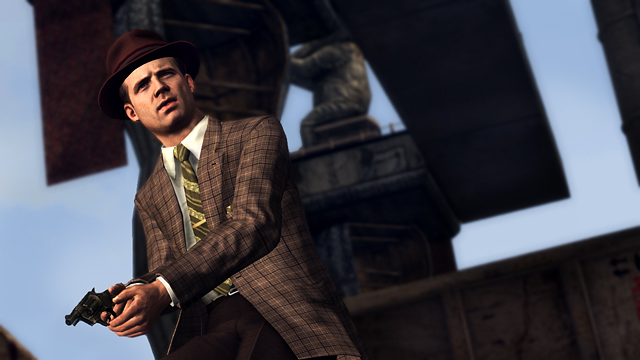
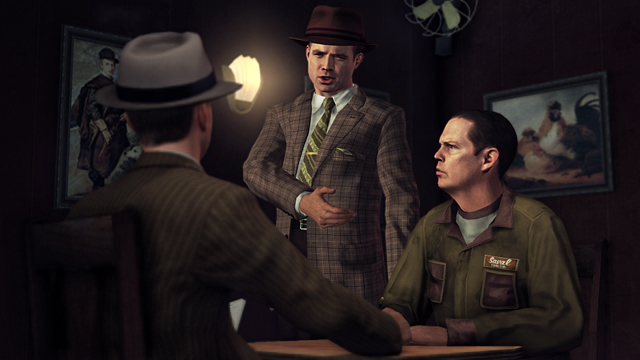
What is a detective story without a sidekick? Answer: a story with no wise cracking comedic relief and no heart, thats what! Luckily, Team Bondi has recognized this fact and included Stefan Bekowsky in the upcoming video game, L.A. Noire.
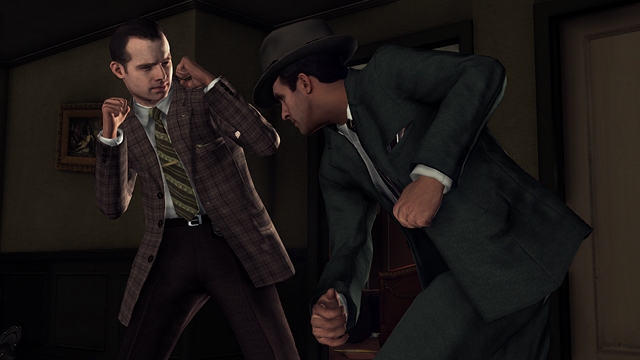
He is one tough cookie who lays the smackdown on the ruffians and yet is also not above goofing off while on duty. Sounds like my type of guy! Get ready to meet this dude on May 17, 2011.
If you want more info on one Detective Stefan Bekwosky, go to his Rockstar bio page here. While there you can download the newest HD wallpapers.
Just 8 more days and the whole handheld world will forever change with the release of the Nintendo 3DS. Nintendo certainly have been doing some heavy promotion for their newest console and today the company released the official launch trailer for the device which hits stores on March 27th in the states (25th for EU and 31st for AU).
Now the trailer doesn’t show anything new really, but it does include some “reactions” of “players” using the device before it starts rolling along with clips from the many launch titles such as Nintendogs + Cats, Street Fighter IV 3D, Rayman 3D, and a few other of the bigger names set to launch with the unit. I personally am ready for some more Monkey Ball and Street Fighter, but this set of launch titles really does seem to have something for everyone. The question is now, for those of you planning on picking up a 3DS at launch (or even later for that matter), which one of these titles are you most looking forward to. Leave a comment and let us know after you check out this brand new clip below (Courtesy of GameTrailers).