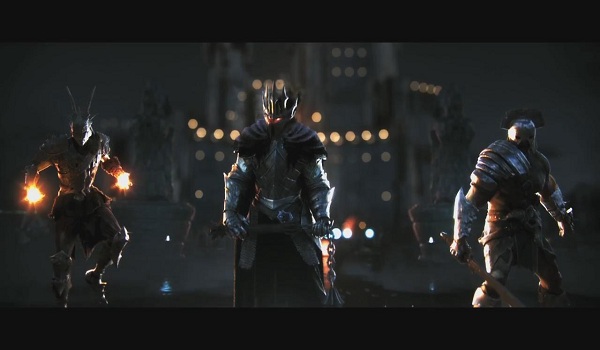
The fourth part to the Tutorial Series for Guardians of Middle-Earth has just been released by developer Monolith Productions. In this video we get to see how to most effectively use our customisable loadouts to achieve victory on the battlefield. Up to ten custom classes can be saved for future use in addition to the default character loadout that every Hero comes with. There are four slots to add varying stat buffs to your character and further customise your experience with Guardians of Middle-Earth as well as a pretty cool Belt system that allows your character to receive better buffs on the fly as they level up and fight in the game.
Guardians of Middle-Earth is a top-down tactical arena style game by Monolith Productions, in which players assume the role of one of up to 20 heroes and villains from Tolkien’s universe. Two teams of five players battle it out in hectic brawls filled to the brim with spells, steel and abilities where it is real player skill rather than level which will decide the outcome. The next tutorial video focuses on effective team co-operation and how to ultimately dominate the arena with the combination of all the skills learnt thus far. Guardians of Middle-Earth becomes available on December 4th 2012 for retail (PS3 only) or digitally on the Playstation Network and Xbox Live on the same date.
Arranger Developer: Arman Bohn Publisher: Ayopa Games Format: iPhone (Reviewed), iPod Touch Release Date: November 15, 2012 Price: $0.99 – Download Here
Overview
Arranger is a retro-adventure homage to the genre’s architects of the 8-Bit era. It mimics the visual and audio style of that generation, while adding some more modern accoutrements. Arman Bohn attempts to call on those nostalgic feelings, which I’m sure fans of such classics as Adventure on the Atari 2600 – a personal inspiration for Mr. Bohn – would appreciate. But, is Arranger worth the trip back in time, and can it appeal to those younger gamers who didn’t grow up with those games? Read on to find out.
Story
You play the Arranger, a boy who is burdened with the task of acquiring 8 valuable chalices for the King of Musica, who is looking to bequeath the throne upon a worthy successor. Throughout your travels as the Arranger, you will become involved in the happenings of other lands and your own. A citizen from each of the nine worlds requires a tune to be arranged for them for different reasons. One such example has the letter A requiring an arrangement to help lull its baby to sleep. These individuals are usually the ones who will reward you with a chalice, or at the very least an item that will assist you in your search. There are also many other residents of the realms that require assistance, though their stories go no deeper than that of a single quest that needs to be resolved – such as getting a wrench to an Eaternian so they can start their ovens again.
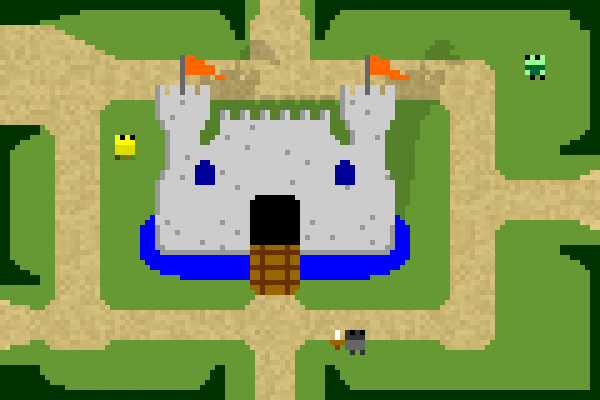
This castle could be yours!
Gameplay
As you would expect, Arranger has very simple gameplay. Using the touch screen, the player will find most of their time occupied with dragging and holding their finger where they want to move. There are two options for movement: a virtual D-Pad or by Touch. As simple as it is, navigation can be slightly frustrating with the restricted degrees of direction present in 8-Bit titles. You will find yourself stuck walking on the spot as you’re stuck against an object or part of the environment, and the touch screen, inherently, is not the most suitable control method for precise manoeuvring. Holding on your player character will bring up the in-game menu, where you can check your current side quests and their requirements, change settings and save or load your game – which you only have one slot for…annoying when you forget to save before the final battle and can’t do some final exploring in later unlocked areas without having to retread some ground. Engaging NPCs is as easy as walking up to them, although it’d be more accurate to say “into them”. The same goes for picking up items.
Speaking of items, you may only carry one at a time and can drop it by simply tapping on it. Your pet, named Dorg, will fetch all items you receive or find in the game and bring them to your home. The trouble is, Dorg stays in your house and in order to corral them all up, you must travel back to your home to instruct him to do so. This can be quite frustrating when an item is required for a mission or side-quest, and you have to back-track, either to the location you left it at (if you can remember where that is) or to your home. It would have been much better to have Dorg travel with Arranger and be able to fetch a chosen item then and there. It’s not a question of making the game any easier, but of making it less repetitive and monotonous. Finding and providing an item, such as a battery or wrench, is the main process for progression in Arranger. It’s a little tedious, but “fetch quests” as they are called are a trope of video games of the adventure/RPG genre, especially in the 8-Bit era.
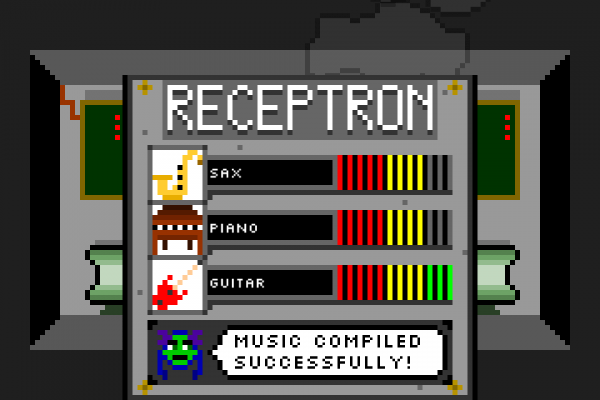
The meter displays how appropriate each instrument is for a particular song.
You also have 16 instruments to collect to be used in Music Battles, which, as I mentioned earlier, initiate once you speak to persons of interest. Winning these battles could net you a shiny chalice, or another important item. Before you begin, you must pick three instruments that will be most appropriate for a certain type of music that is being requested. The battle itself has a brain slowly moving up and down, shooting out obstacles at you as you try to hit its centre with your musical note. The note plays at automatical intervals; you just have to line it up. Each instrument’s note has a different trajectory; the electric guitar shoots straight out, while the piano shoots three keys at three different angles, for instance. You have three loops to fill the music meters of each instrument, with less appropriate instruments needing more hits to do so. I just wish there were more consequences and challenges to choosing the wrong instrument, as it is still quite easy, which makes procuring every single instrument void.
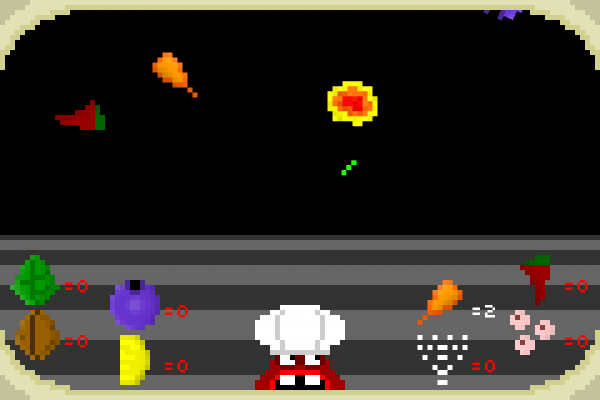
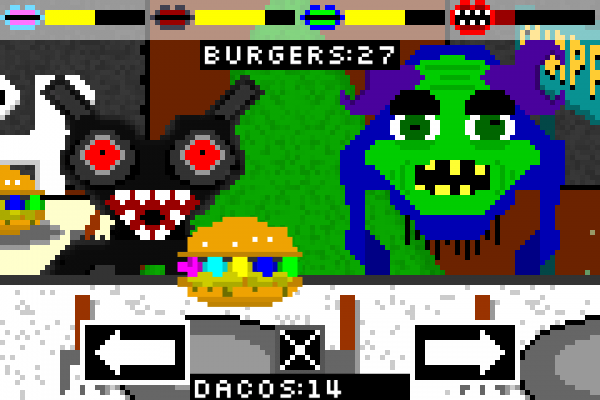
Aside from that, there are many arcade style mini-games throughout that change up the gameplay, if only for a brief time. Turpato Peeling has you swiping your finger to simultaneously peel turpatoes and land those peels in a bucket. Rainboworm Running is a timing-based mini-game where you must time your run, being careful not to step on and squash any rainboworms or you will have to start over. And in Burger Blasting, you must scroll across the screen to manage the feeding of a group of hungry diners, by tapping on their mouths, thus flinging delicious pixelated burgers at them. As you can tell, there is a good variety in gameplay here, and that’s only the tip of the iceberg. There are 24 mini-games in total that can unlocked and played competitively with Game Center leaderboard integration.
Spice Invaders, one of the more fun mini-games.
Visual
Arranger adopts the 8-Bit aesthetic that it was inspired by, and it generally gels really well. The game is colourful and vibrant, and is definitely reminiscent of the 8-Bit games of old. The charm is inherent, and each of the 9 worlds that Arranger visits represent their own art style and colour scheme that sets them all apart. Some of the visual design choices for the environments are absurd, but in a purposely comical way. The music school, for instance, looks like a haunted building with leaf-less trees out front, deep blue windows and “Music School” written in an ominous red tint overhead. Yet, when you go inside, you’ll find a regular school-room setting. Each area has it’s own distinct character, and they’re all based on a theme. Keeping with the 8-Bit era of gaming, some of these themes are as simple as the alphabet; Letterland is a world built with, and inhabited by, letters. Numerica is inhabited by, you guessed it, numbers (or, Numeroids, as they’re called here) who are naturally the bitter enemies of the Letterlandians.
The Feard on the left scares me…
Sometimes, however, when the screen gets busier, the 8-Bit graphics read a little worse than usual. What that basically boils down to is the fact that 8-Bit graphics only allow for a certain amount of detail and that detail is usually painted and defined using colour. As colourful and vibrant as the game is, there are sections where species from the 9 worlds interact or cross-over, and with that comes less visual continuity and consistency. Consequently, the designs of these creatures clash. Now, if the game were to use a 16-Bit graphics style, their designs would be more detailed and the difference between them would be less abrasive, and this problem wouldn’t be as evident. Sometimes even the perspective can affect how the game reads too. Either way, these issues, and the limitations of the 8-Bit style, were part of the reason why games of that time did not attempt to clutter the screen and environments were very basic, both in their construction and colouring.
Audio
The music and sound effects are similarly evocative and remindful of the chip-tunes of the 80s. Each world has their own theme, each effective in portraying the mood and atmosphere of the land very well. Happyland, for example, is appropriately upbeat and lighter in tone. When it comes to the big music battles, I was very impressed to find that each instrument chosen has their own individually written tracks and therefore change the landscape of the song completely. There is still an established beat and base tune that is consistent and keeps the song grounded in the style it is made in. I initially thought that the variation was only present in the instrument attack sounds, but replaying the songs in the Music School allows you to experiment with the different instruments and really notice those changes.
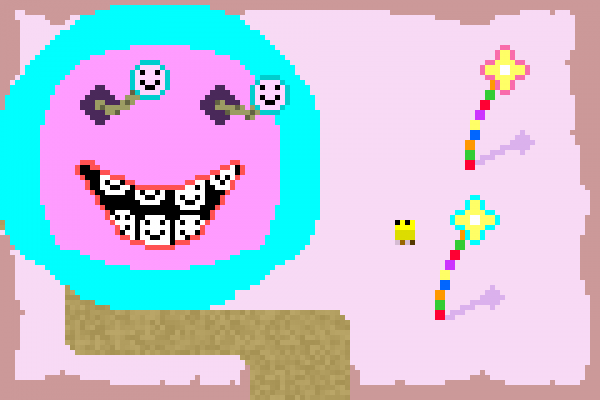
Hapnar, the…guy(?) to see in Happyland! Even his teeth are happy!!
Overall
Arranger is a nice little 3-4 hour throwback to the third generation in gaming (8-Bit era for those uninitiated), however it suffers from some very minor game design flaws and oversights. Yet, the charm is there, and although I’m a child of the 90s, I appreciated Bohn’s intentions and admire the attention to detail that went in to creating this love letter to adventure games of old. The dynamic music battles are great, but it’s just frustrating at times, and the visuals, as I mentioned, could have benefited from a slight tweak to perspective, and maybe even a 16-Bit facelift considering the ambitious detail, specifically in the characters and objects, that doesn’t always read particularly well (there’s some great 16-Bit adventures to pay homage to!!). In saying that, for a job by a one-man team, Arranger is beyond an admirable result. And at the price of $0.99, I can not justify any further criticisms. Nostalgia hunter or otherwise, give your spare change to Arranger.
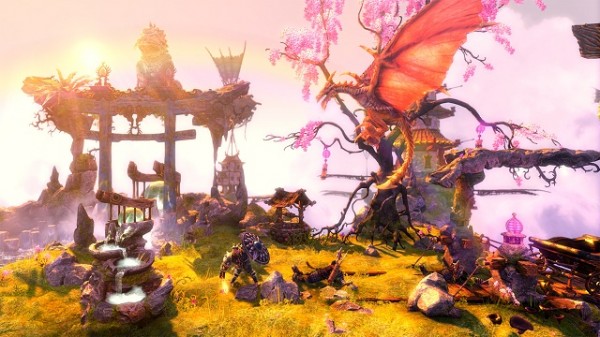
Players that have had the opportunity to collect their Wii U units will be pleased to know that there is already games appearing in the Virtual store on the console. One of those games in the store is the fairly popular Trine 2 video game. This particular version is the Trine 2: Directors Cut version of the game.
Trine 2: Directors Cut Wii U will be priced at $19.99 and will include some DLC content as part of the package. This is the Goblin Mansion expansion and there is also a Wii U exclusive level called the Dwarven Caverns. Wii U players will definitely enjoy this release.
The game is currently out in North American regions and will be available on Day 1 for European regions. Be sure to check out the website for more info.
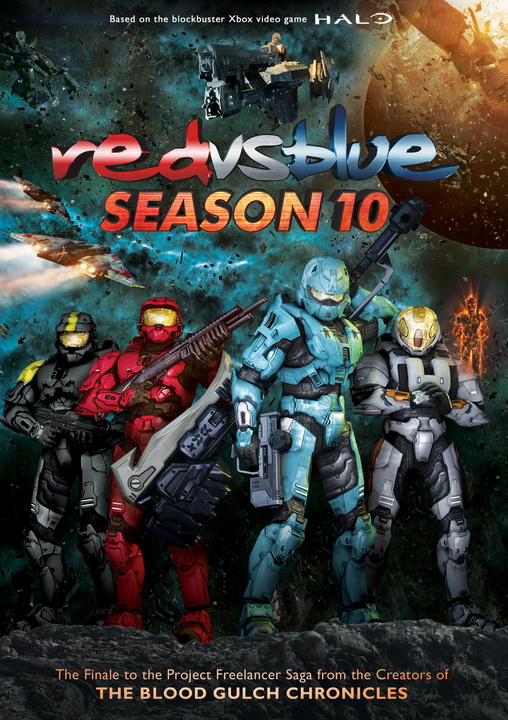
We have 3 copies of Red vs Blue Season 10 on Blu-Ray(1 copy) & DVD (2 copies) to give away
“Red vs. Blue: Season 10 is a machinima web series created byRooster Teeth Productions. The first episode was released on the Memorial Day of 2012 and the finale was released on November 5, 2012, a day before the release of Halo 4. The season wraps up the events of the Freelancer back story, first introduced in the previous season, while continuing the events of the Reds and Blues.”
TO WIN
For your chance to win a copy of Red vs Blue Season 10 on Blu-Ray or DVD simply answer the following question :
Who’s your favorite character in the Red vs Blue Series?. (also state which format you want to win – DVD or Blu-Ray)
Lucky winners will be selected on November 27th, 2012. Good luck to you all!
**SPECIAL NOTE**
When you enter please leave a VALID email address so we can notify you if you are one of the 3 lucky winners. You must be 15 years or older to enter.
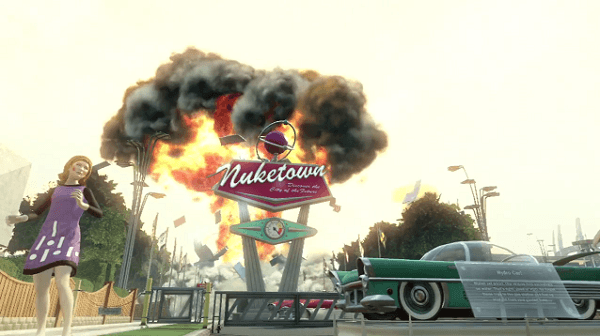
A few hours ago many Black Ops II fans were shocked to see that one of their favorite maps and a highly advertised pre-order bonus was missing from the game. To be a bit more specific, fans were outraged, and rightly so, that Nuketown 2025 was removed from Black Ops II’s matchmaking system.
However Treyarch has quickly tried to rectify the issue by releasing Nuketown 2025 back into the game’s playlists, however there is a small twist which Treyarch revealed over Twitter. Currently the only playlist that contains the Nuketown 2025 map is called “Chaos Moshpit” a brand new playlist that was just released. Chaos Moshpit will involve “small maps with a variety of game modes.”
This means that while you may not be able to play Nuketown 2025 24/7, you can still play it occasionally within this new playlist.
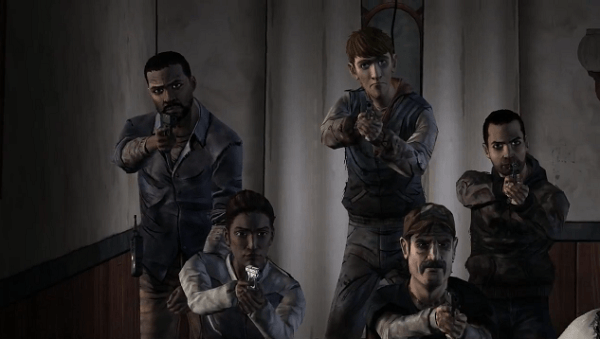
Today Telltale Games released the trailer for the first season finale’s final episode, No Time Left. The trailer can be seen below and the episode itself will be made available this week on the US PlayStation Network on November 20th and then on November 21st for every other console, the PC, 360, iOS and Mac, and territory.
If, for whatever reason, you haven’t played any of Telltale’s video game based off of the very popular Walking Dead franchise then you will be interested to learn that all five episodes will be released as a physical retail copy on December 4th on the Xbox 360 and PlayStation 3.
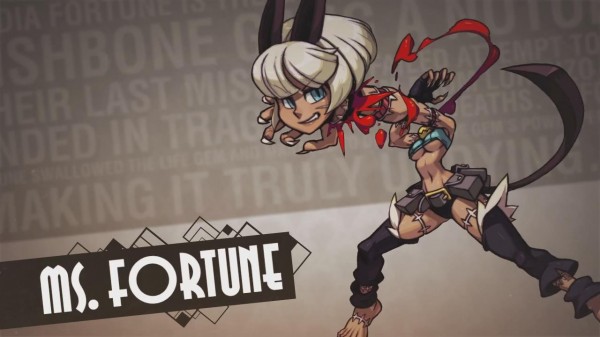
Today the PlayStation 3 version of Skullgirls received a rather extensive patch which is meant to fix and balance a large number of issues. It is worth noting that so far only the PlayStation 3 version of the title was given an update as the Xbox 360 patch is still waiting on a release date.
A brief summary of some of the patch notes, posted a few months back, can be found here. However fans can expect a more extensive list of the fixes this patch entails to be released eventually by the game’s developers but many will be glad to hear that one of the things added in this patch is a move list that is accessible in-game.
If you were hoping to hop on Black Ops II tonight and play on everyone’s favorite map Nuketown 2025 then you will be saddened to hear that Treyarch has removed this map from the game’s multiplayer playlist. In fact, the only way to even access the map is in custom game modes which is are only playable with local friends or those who join your game.
This means that the match is not available in public matchmaking and players can no longer receive any experience points for playing on the map. David Vonderhaar, game design director, announced on Twitter that the map would be removed saying “Double XP weekend is official over. That means Nuketown 2025 / 24-7 is as well. I know. RIGHT? Don’t kill the messenger.” He went on to say that“Nuketown 2025 / 24-7 will be back for special events. You can always play it with your friends in Custom Games.”
Now this has led to quite a lot of anger in the world of Black Ops II as at no time was it ever mentioned by Treyarch or Activision that the map would only be available for a limited time or for special events and, while many people would have bought Black Ops II anyways, a highly publicized pre-order bonus has suddenly been made useless and practically non-existent for a bulk of the fan base. Whether the map will be added back in to the game in the future is currently unknown.
Update: Treyarch has re-added the Nuketown 2025 map to Black Ops II in the form of a new playlist. Information about this can be found here.
All the way from Belarus, Aterdux Entertainment is promoting their title Legends of Eisenwald as a dark and realistic medieval world rather than glorifying on fantasy ridden folklore. Even with dynamic fast-paced battles, the developers believe they maintain a strong ideal for strategy in the mix.
Legends of Eisenwald has been in production for approximately two years and was involved in a successful Kickstarter campaign. To check out the progress of the title, take a peek at the screenshots below as well as their hilarious Kickstarter video.
Interested in learning more about Legends of Eisenwald or even want to partake in their beta? Join as a member to their website (here).
TAITO have just announced that their exhilarating rhythmic music game GROOVE COASTER released on the iOS in July will now be available to play for free in Free-to-Play form with the release of the new GROOVE COASTER ZERO. With the new free version of Groove Coaster ZERO you can unlock new tracks (levels) as you progress through the game resulting in a game that grows as you play it. Along with that you can earn awards and badges for obtaining perfect plays and obtaining awesome scores!
Groove Coaster Zero will also have an awesome line-up of new songs to suit a variety of musical tastes. Free tracks will become available as you progress further into the game and will contain over 30 free tracks with more becoming available in future updates.
If you already own the original Groove Coaster that was released back in June, TAITO have not forgotten about you and as show of gratitude owners of the original game will be eligible to receive three limited edition gift tracks within Groove Coaster Zero. (note these Tracks are not for sale and will be available to purchase any where else)
You can download GROOVE COASTER ZERO from the iTunes store right now (Click here) If you want to know more about the game check out review here.