A new world is available for you to explore in EA‘s The Sims 3, although it’s not for the faint of heart. Midnight Hollow is the latest expansion after the recently released Movie Stuff, and it is spooky!
Tucked away within the forest lies the town of Midnight Hollow…sounds like the perfect vacation destination if you ask me. Entrepreneurial souls can open up businesses in the haunting locale, and may just come across a familiar face in Olive Specter – a popular resident which fans will remember from The Sims 2. You can also expect new Sims, décor and added gameplay with the Savvy Seller’s Collection.
Check out the trailer embedded below. For more information or to purchase The Sims 3 Midnight Hollow, click here.
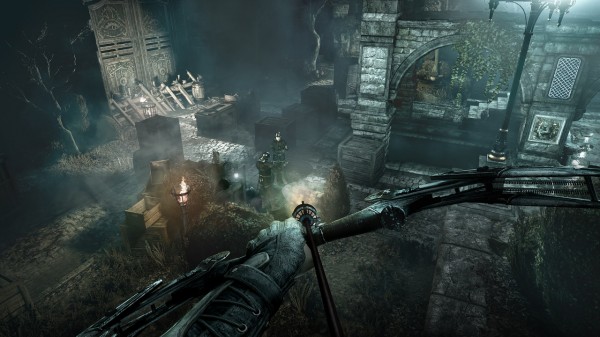
Anyone planning on getting the PC version of the upcoming Thief game when it comes out next year now has more options as to what edition to get as publisher Square Enix and developer Eidos-Montreal have announced the Master Thief edition. Now available for preorder, those wanting to get the ultimate collection of bonus material can opt for the Master Thief edition, which will be completely for digital download.
Including the official digital artbook, the complete set of digital comics, booster pack of in-game consumables, digital soundtrack, and the previously announced Bank Heist bonus mission the Master Thief edition has plenty to offer for fans of the series. Those wanting to get the PC Master Thief edition for themselves will be able to order it from the Square Enix Store, as well as other digital retailers.
While the Master Thief edition has only been announced for PC as a digital download, only time will tell if other editions of the game will be available for the other versions or the retail version of PC. Thief is set to release February 28th, 2014 for Xbox 360, PS3, Xbox One, PS4, and PC.
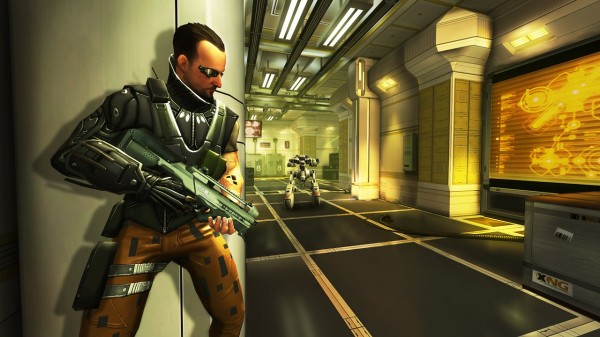
Square Enix have announced a weekend sale on two of their biggest iOS titles for both iPad and iPhone. Both Deus Ex: The Fall and Lara Croft and the Guardian of Light will be reduced by over 60% over the coming weekend. Both games picked up highly respectable scores here at Capsule Computers, scoring 8.5/10. You can check out the reviews for both titles through the links below:
Deus Ex: The Fall picked up seven awards at this years E3 for best mobile/iOS game, and follows the quest of an augmented ex SAS soldier who sets out to unravel a global conspiracy that threatens his life. The game is compatible with the iPad 2 and above, iPad Mini, iPhone 4S and above, and the iPod Touch 5 and above.
Lara Croft and the Guardian of Light is available in HD (iPad) or SD (iPhone, iPod Touch), and provides a different style of Lara Croft adventure from the usual Tomb Raider game with more of an emphasis on co-op game play.
Price drop : £0.69 from £3.99 / €0.89 from €5.49 (iPad)
£0.69 from £1.99 / €0.89 from €2.69 (iPhone, iPod) Click here for store
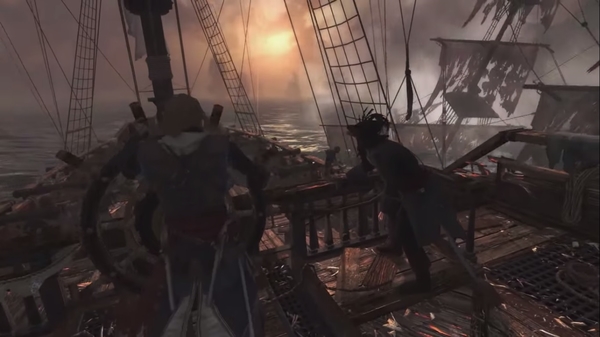
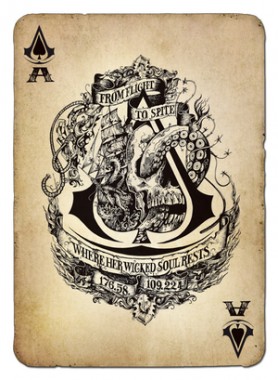
This year’s Eurogamer Expo, hosted in the heart of London, gave players a chance to get a hands on experience of the brand new, highly anticipated Assassin’s Creed IV: Black Flag. What has everyone’s attention isn’t the game itself, however, but what Ubisoft are giving away at their booth. Enigmatic playing cards with a beautifully designed ace of spades have been the talk of the town at Eurogamer and rightly so as they hold the key to unlocking an exclusive Black Flag reveal as well as a treasure trove of prizes.
Anybody can take part by heading over to the Ace of Spades experience’s official website and signing up today. Live the life of a bloodthirsty pirate by stealing gold, and overcoming countless dangers as you aim to fill your pockets and prepare for the ultimate end game… A battle to the death… Only those with hearts of coal and hands of midas will reign victorious. Every gold piece earned by your ship brings the world one step closer to an elusive Black Flag reveal that Ubisoft are keeping fiercely guarded.
Sign up today, and get your first taste of the pirate life, ready for a life on the high seas as the next assassin.
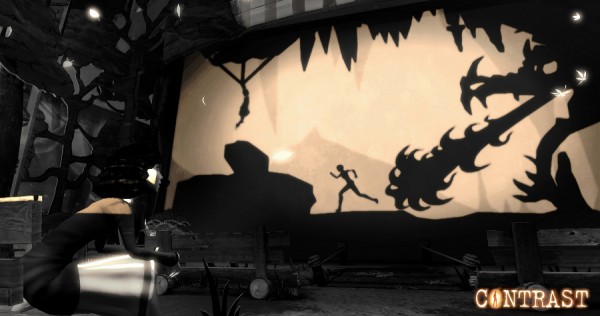
It seems that people have been very taken by Contrast from what they have shown at convention and the demos that have been available there for people to get a chance to try it out. Though information has been somewhat limited about who all and what all will take place in the game, from publisher Focus Home Interactive and developer Compulsion Games, based around light and shadow.
Well, some new information on Contrast has just been released, the first in the form of new screenshots showing off some more of the game’s characters Didi and Dawn, as well as new locations in the game. But, while screenshots are nice to see some new sights of the game they don’t provide all that much information, which is why the official website is now up.
Those wanting to check out the see the new screenshots can click on the images in the gallery below, but for even more information players can check out the Contrast Official Website to see images, videos, and read the developer blog. Contrast is set to release soon for XBLA, PSN, and PC.
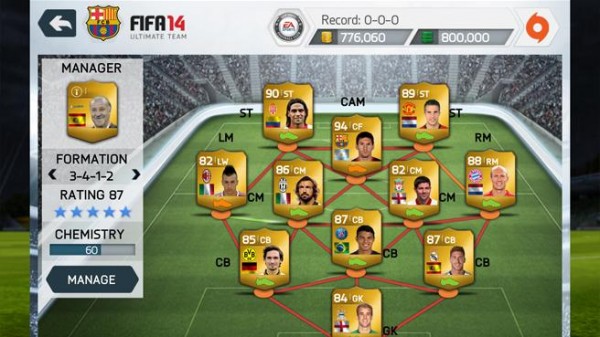
FIFA 14 by EA Sports has stepped foot onto the pitch, and this time it is free-to-play. That’s right, for the first time in the series’ history, you can download FIFA 14 for your mobile, free-of-charge. That doesn’t mean there isn’t a paid component or micro-transactions, although they are completely optional. Barring premium modes, players will be able to experience FIFA Ultimate Team, FUT Seasons (offline), EA Sports Football Club Match Day, Online Quick Matches and Friendlies and Penalty Shoot-outs. That is a lot of content, but without responsive, accommodating controls, they are nothing… so, does FIFA 14 on Mobile have that golden goal touch?…
Gameplay
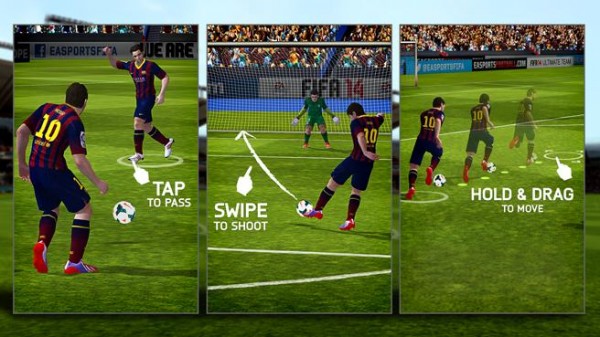
Understandably, FIFA 14 on Mobile is stripped down across almost all facets, but doesn’t lose too much functionality. Due to things like through-ball and lob options being lumped into the all encompassing pass button, shot-making may not be as technical. Thankfully, the A.I. takes distance – among other things – and appropriately adapts in the style of delivery, although when using the new Touch Flow control scheme, conditions change. i.e., through-balls can be purposely executed by tapping in front of a squad-mate. The issue with the touch-based controls is that sometimes gestures can get muddled and misinterpreted, and that run you wanted to make may just turn into a wasted ball, mistakenly kicked out of play.
The above mistake, specifically, arises from not holding on a character that half-a-second long enough to select them, but continuing with the drag action that then becomes a strike instead. It can be learnt to be avoided. Also, for iPhone or iPod Touch users, keeping your finger pressed on the screen can be obstructive in itself. So, when choosing a player, drag your finger right to the end of the screen in the direction of play so it does not get in the way. If it becomes a problem for you, the floating joystick control scheme is available for you to use in its place. Aside from control options, there are numerous settings that affect gameplay, camera angles, audio and more. Want to turn off handballs and first-touch for instance? You can easily do that.
The only disappointment I had presentation/settings-wise pertains to the restriction on camera when using Touch Flow controls. The camera height/angle can not be modified and is substantially pulled back in this case. In regards to modes, along with those listed in the Overview section of the review – which function in largely the same manner as their console counterpart – Manager Mode, Tournament Mode and Kick-Off can be “unlocked” with a $5.49 purchase. I came across an inconsistent bug where the game would crash upon an attempt to play my own matches in Manager Mode instead of simulating them, although this can surely be rectified in an update. On a side note, how smoothly an Online Match (which is free, mind you) runs obviously relies on the Wi-Fi connection of both participants, so you are bound to get fluctuating stability.
Visuals and Audio
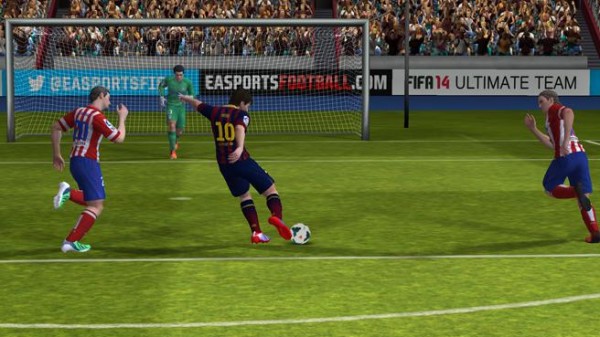
FIFA 14 on mobile adopts a form of the series-wide revamped user interface, which is easily navigable. Being a mobile title, there is no use comparing visuals to the console versions; the quality of character models, stadiums, crowds and all the other smaller details will always be sacrificed due to the platform’s technical limitations. The important thing is, that it doesn’t get in the way of your enjoyment. Visual cues and representations of your swipes and selections are also clear, even on a smaller screen like the iPod Touch’s compared to the iPad’s. Just remember the tip I mentioned in the Gameplay section to avoid obstructing your own view of the gameplay.
After you’ve played through the opening tutorial, you will be asked to download an audio track from five languages: English, French, German, Italian and Spanish. I have only listened to the English track because, well, I can only speak and understand English, and disappointingly, I’ve encountered instances where the commentators would speak the wrong lines at the end of a match, as if it was only the end of the first half instead. It’s also worth noting that the crowd is generally more quiet than you’d expect. The soundtrack features a good selection of 12 songs from the overall 37 included on console iterations that maintains the signature up-beat FIFA energy.
Overall
There will be a multitude of players happy solely with the F2P modes available here. Overall, the new Touch Flow control scheme works well, although gestures can sometimes be confused and result in unwanted actions. FIFA Ultimate Team is almost as addictive as its big brother console edition, and if you choose to pay the $5.49, Manager Mode – alongside Tournament Mode and Kick-Off Mode – should occupy quite a sizeable chunk of your playtime and make the purchase worthwhile. It’s not perfect, and although I’ve pointed out multiple flaws, they are nothing but nitpicks. You can’t ask for much more from FIFA 14 on mobile, especially when considering just how plentiful the free offerings are; definitely the best sports game on the platform.
Capsule Computers review guidelines can be found here.
Overview Tiger & Bunny: The Beginning may serve as an alternate introduction to the series, but the limited change in the intro provided in Side A, the full review of which can be found here, had little to offer readers. Now with Tiger & Bunny: The Beginning Side B, are there enough differences to warrant a look?
Story Whereas Tiger & Bunny: The Beginning Side A recapped everything fans of Tiger & Bunny have seen before; Side B immediately takes the story on a different route. Following the events with the NEXT child, Kotetsu wants to try and strengthen the bonds between Barnaby and the rest of the heroes so he attempts to organize a little get together for them to chat.
Not only are we given a chance to see Rock Bison’s NEXT power for the first time, readers are also able to take a glimpse at the other heroes’ personalities before the group became a bit friendlier with one another. After Barnaby’s rough dismissal of the group, the heroes are called to capture a criminal that has stolen the Statue of Justice, a statue which symbolizes the people’s trust in their heroes.
However this criminal also happens to be a NEXT and his ability quickly gives the heroes more trouble than they bargained for. To make matters worse, thanks to Barnaby’s rough interaction with the heroes earlier in the day, the group refuses to work together despite being pushed to the point where the criminal may escape.
Thanks to the new storyline this time around, readers are given a brand new chance to see the heroes in action as well as a new side of them. A few pieces of information concerning Barnaby and Ouroboros are provided and Part B also serves to drive home how, while Kotetsu and Barnaby may not get along, at least Kotetsu is willing to go the extra mile to put some faith in his partner. After wrapping everything up nicely, Part B ends with the heroes being a little closer together and Barnaby actually giving Kotetsu the time of day.
Artwork As before it is worth noting that the artist between the original manga and Tiger & Bunny: The Beginning has changed and while characters still feature the same appearances, this version of the manga also features more detailed outfits and hero suits. There are no two page spreads in Side B but there are a handful of great looking scenes where the amount of detail put into the characters and backgrounds are delightful.
The various sponsors on the hero suits are still not included and despite being broadcasted on Hero TV, many of the little visual touches that come from that broadcast were not included in Part B. As for Viz’s handling of the translation, sound effects and text translation is clean and does not affect the artwork in the slightest.
Extra Content Similar to Side A, Side B has no extra content included within the release outside of the cover art that is meant to be paired with Side A.
Overall Naming these volumes Side A and Side B was an apt choice as, at least storyline wise, they are like night and day. While Side A was almost entirely redone content, Side B’s focus on an entirely new criminal and highlighting more of the heroes and their interactions with one another offers a delightful read. Pair that with impressive artwork and Tiger & Bunny: The Beginning Side B is certainly worth picking up.
Capsule Computers review guidelines can be found here.
Overview Despite being animated back in 2011 and being rather successful, Tiger & Bunny has not been given a second anime season. There is some hope however, as two movies were planned for release and now that the first movie, Tiger & Bunny: The Beginning has been released and is making its way overseas, Viz Media is also bringing the manga adaptation of the movie over to North America as well. Does Tiger & Bunny: The Beginning Side A kick everything off with a smooth start?
Story In the world of Tiger & Bunny, there are people who have developed special superpowers called NEXT. The origins of these mutations are unknown but while some people live normal lives with these abilities, others have taken to a life of crime. To combat super powered criminals, super powered heroes are needed and Hero TV has created a program for that exact purpose.
Hero TV is a television series broadcast throughout Sternbild City, the setting of our story, where heroes are recorded as they take out criminals. Heroes gain points for saving civilians, capturing villains, arriving first to the scene of a crime and other accomplishments and every year the hero with the most points is crowned the “King of Heroes.” Since heroes are also sponsored by companies in an effort to advertise themselves to the public, this title is coveted by both heroes and companies alike.
Kotetsu Kaburagi, also known as the veteran hero Wild Tiger has been in the game for a long time and despite his power to increase his physical abilities hundredfold for five minutes, his sense of justice doesn’t mesh well with the producers of Hero TV and he spends most of his time languishing in the bottom of the rankings with almost no popularity.
When his close friend Ben tells him that Kotetsu’s sponsor has been sold to another company, Kotetsu is stuck forming Hero TV’s first ever hero duo with newcomer Barnaby Brooks, the man who shares the same powers as Tiger and recently embarrassed him. Side A follows these two from their first meeting to the end of the skating rink event, allowing readers to see how these two seem incapable of working together thanks to their goals being practically night and day.
Now, it is worth noting that Tiger & Bunny: The Beginning is pretty much a reproduction of the first few episodes of the Tiger & Bunny anime with a number of new events that take place. Almost all of these new events are focused in the second half of the movie, meaning that Side A is almost an exact replica of what readers have already found in Tiger & Bunny Volume 1.
Unlike Volume 1, more characters surrounding Kotetsu are introduced, including his family and his former employer. Side A also touches upon Kotetsu’s wife and provides a brief appearance of the Ouroboros logo and Barnaby’s obsession with it. Unfortunately some minor details have been left out thanks to this, but for the most part everything remains very much the same, with a bit of action here and there as well as some comedy between Kotetsu, the other heroes and the beginning of his partnership with Barnaby.
Artwork It is interesting to note that Tiger & Bunny: The Beginning’s manga volumes are handled by a different artist than the manga volumes. Tsutomu Oono handles the artwork this time around and while the art style is very similar, it is clear that more detail has been put into designing the character’s clothing and suits this time around. This makes a few notable moments, especially the occasional two page spread, very impressive looking.
Unfortunately the various logos and advertisements are still stripped from the characters, but there is a certain sense that the artist put more effort into trying to replicate the feeling of the movie and highlighting the Hero TV aspect as the scores earned while attempting to capture criminals are shown at the forefront and are less obscured.
As for Viz’s handling of the text, sound effects are all cleanly translated with no interference with the artwork and anytime that text is placed directly over a picture there is little obstruction to the artwork.
Extra Content Unfortunately Side A is a bare-bones manga volume with no extra content included. This means that there are no character sketches, color pages or even notes from the artist or editors.
Overall Tiger & Bunny: The Beginning Side A is an interesting start to this version of the introduction to the Tiger & Bunny series. That being said while it does introduce a few new characters and plot points early, the story of Part A follows the same exact path as we’ve seen before. While the artwork may be more detailed this time around, it does little to alleviate the repetition Side A has to offer.
Capsule Computers review guidelines can be found here.
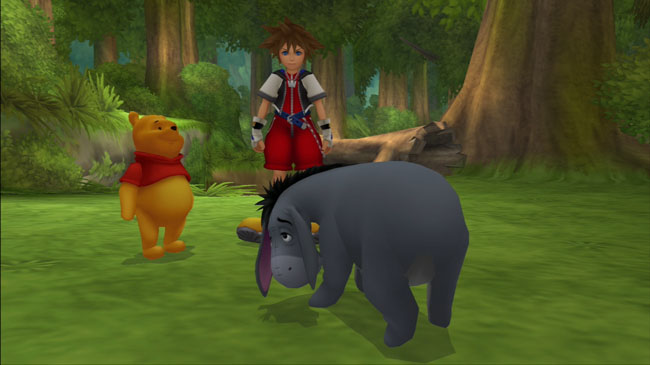
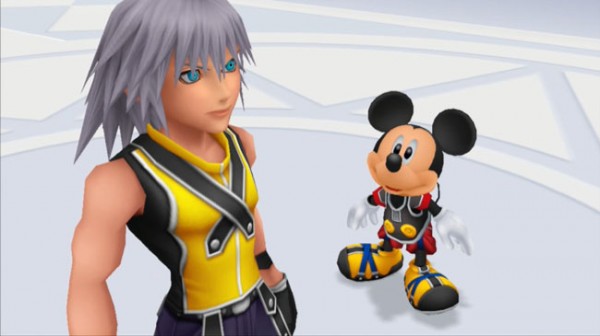
A brand new trailer for the recently released Kingdom Hearts HD 1.5 ReMIX has made its way online and it is all about Disney. The trailer serves as a reminder that Kingdom Hearts is a crossover game with Disney and in fact features many Disney characters and locales.
If you are new to the Kingdom Hearts franchise, the trailer below will give you a great idea of what the series is all about. Here’s a hint: Disney. Kingdom Hearts HD 1.5 ReMIX is a great entry point into the series for newbies and an awesome nostalgia trip for long-time fans.
Kingdom Hearts HD 1.5 ReMIX is available now exclusively for PlayStation 3. Be sure to check out the trailer below and pick up the game at your own discretion.
Overview
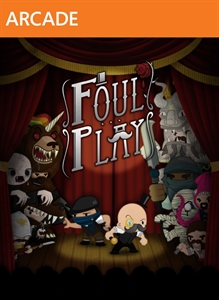
A quick glance at this title will have many indie gamers instantly wondering if Behemoth had some sort of involvement. While Foul Play may look like the adoptive brother of Castle Crashers, it has been created by developer Mediatonic in Great Britain. Other titles that you may or may not recognize are Amateur Surgeon 2, Superbia, Monsters (Probably) Stole my Princess, Who’s That flying?, and Robot Unicorn Attack (Evolution). However, this is the first time the British based developers have taken on a side-scrolling brawler as a project. Let’s take a look at how they did.
Story
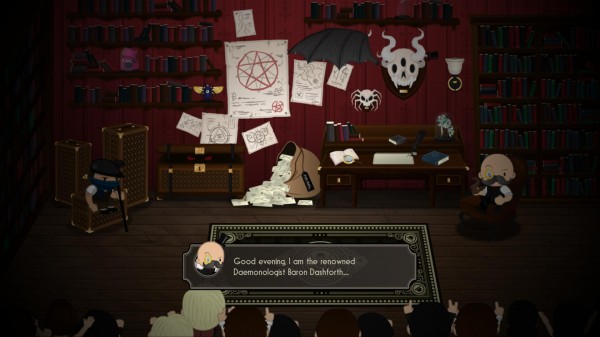
Foul Play certainly operates unlike any game that I have ever played. Setting itself apart from other side scrolling brawlers is actually the presentation of the title’s story. Once the game opens we are welcomed to the abode of Daemonologist Baron Dashforth and his most trusted sidekick Scampwick. Yet what we are witnessing is a stage set for Baron’s most incredible adventures filled with hired actors to provide memorable battles. Each act of Dashforth’s life yields new acquaintances as well as new obstacles for the player to overcome thanks to a young boy in the front row…
The context of the background story means to be humorous in its delivery and is quite noticeable immediately. When you have the play’s janitor randomly appearing in the background – not doing his job, you are made aware that the play is simply a performance in itself and you are the one to deliver the excitement to the audience.
Gameplay
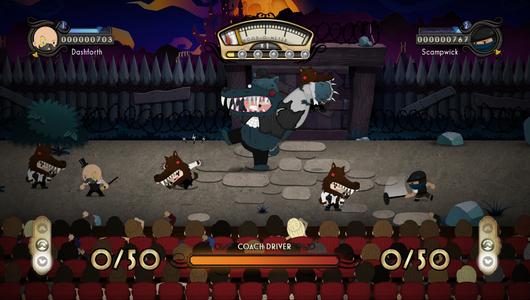
Side scrolling brawlers tend to be plenty similar with one another, and this section will help distinguish if Foul Play has extraordinary characteristics. Finding differences came easy as Foul Play leads an alternative look towards the user interface, multiplayer, and inventory/weapons. Health is technically non-existent as your character’s existence thrives off of the audiences’ mood. By performing subsequent hits on enemies you attain higher combos which pleases the crowd and increases your mood meter. However, taking too many hits can result in a very unhappy audience with your arse kicked off the stage. Actors portraying enemies have a set life counter to them, but the player does not see this.
Multiplayer is essentially the same in theory – being able to join another person online or play co-op offline. But players like myself want the whole package deal. Side scrolling brawlers give off the visage that you can have four players on one screen playing at once. This is an aspect that Foul Play does not include, and I can safely guess due to story direction. By creating a sidekick – Scampwick – the game’s story portrays two adventurers with dialogue that cannot be as appreciated with a third or fourth player.
Another attribute that may alter a gamer’s view of the title is that there is not a true inventory nor additional weapons to be attained. The cane and broomstick are what you get – not saying you cannot beat someone senseless with these… Considering the inventory, you may equip two charms/squabbles that you have attained prior to entering a performance. These items can be attained by performing all three goals listed next to the chosen act. Such goals could ask you to “Kill the Leader Last!” or to “Find the Second Mate! under 5 minutes”. In addition the squabbles will grant you bonuses like “+3 bonus for combos on successful block”.
Both negative and positive, the game can be completed by using the same move list repetitively. By pressing (Y) multiple times in a row, Dashforth performs an uppercut swing with his cane and continues the upward motion by jumping whilst swinging – twice if you button mash – and then lands a blow on the ground ending the attack chain. By doing this attack alongside your guard (B), you can utilize only these two buttons and complete the game. New attacks can be learned, but you will find your favorite combo and just bloodstain your controller there.
Difficulty settings are not present in Foul Play. With that being said there are accomplishments and goals that can be reached by completing tasks in a certain amount of time or by performing move combos. After completing the game an initial time, you may challenge yourself to garner a 5 star rating in each act or to complete each of the three goals given. There are plenty of collectibles to keep your interest generated while maintaining a fun brawling title for you and your plus one.
Visual
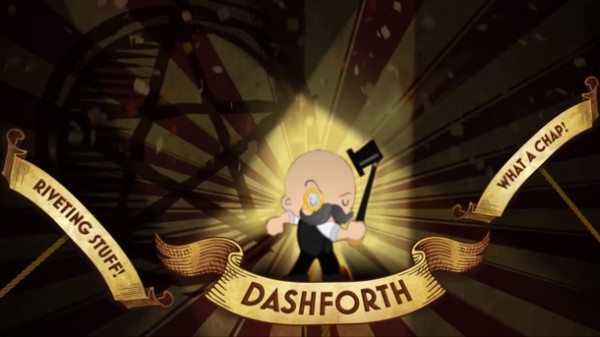
Visuals tend to make a title attractive or memorable, and such attributes are found in Foul Play. Let’s first start off by looking at the main character Baron Dashforth. As I began playing my wife decides to chime in and ask me, “is that the Monopoly guy?” Now if I were to ask her a few weeks from now what game I was playing, she wouldn’t have a clue. But all I would have to say to jog her memory would be, “remember? It had that Monopoly guy.” (Foul Play = Memorable)
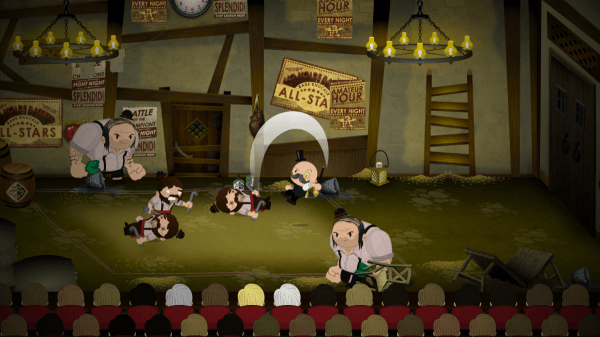
Both characters and environments have been implemented well according to the “play” theme. While experiencing each act you are subjected to new visuals in both stage setting and non-playing characters (NPCs). Mummies, werewolves, pirates, and more are all part of the intrinsic play and thus demands acts to dawn the appropriate attire. For flying enemies straps can be seen propelling their movements in the air. And the outfits provide a comical approach as well considering you can see individual actor’s heads within certain attire (i.e. werewolves, gargoyles).
One negative look on the visuals is that the stage itself is constantly changing, but the audience also shifts. Now are there mechanics such as a treadmill set up to allow this to happen? Since everything else has been made transparent to the gamer, a bit more commitment could have made this game nearly flawless in delivery. Such instances with daemon bosses can be noticed as well where special powers seem to be caused by actual daemons rather than actors. Otherwise the developers were too trixy for their own good.
Audio
Perhaps most interesting about Foul Play is that while every action is being “acted” out, the enemies themselves do not actually die. Instead of dying, actors fall to the ground and appear to be dead. Grunts in junction with cane/broom whacks propel this sense of “killing” yet none are killed in the process. I felt reprieved when I noticed that these characters I thought to be dead were – not so secretly – crawling off stage. Sound effects definitely enhanced the feeling of dishing out a lot of damage but fooled me to believe that the characters were dead.
Overall
Mediatonic has done well with Foul Play by making the title attractive, addictive, and memorable. Though the game may have some attributes that could be more desirable, this button mashing brawler will keep you up all night. Throw a partner into the mix, and you will certainly have a blast beating up some pretend baddies with a cane and broomstick!
Capsule Computers review guidelines can be found here.



 Anybody can take part by heading over to the Ace of Spades experience’s