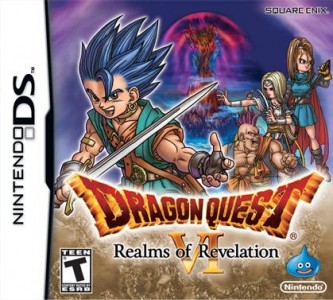
Just the other day we brought you news about a new rating that was released which signaled that Dragon Quest VI: Realms of Revelation would be headed to the PAL region. It now seems that the game hitting Europe is now a reality as Nintendo have announced that the beloved remake would be released as soon as May 20th.
This does leave a question of when Aussies might get the same news as it was the Australian Classification Board that rated the game, so I look for a similar announcement to be coming out of Nintendo of Australia sooner rather than later. For now though European DS owners now have Realms of Revelation to look forward to. Dragon Quest VI as I have mentioned several times is a fantastic addition to any DS library and it is great to see it slowly releasing worldwide. We will bring you the news when an eventual Aussie date is announced, so stay tuned.
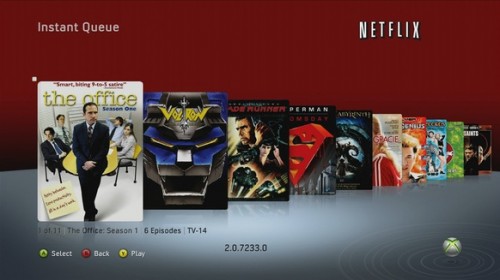
Good news for everyone who uses their Xbox 360 to access Netflix. The latest update that was applied today made it so that the Kinect will now be able to work with the program. Netflix now supports all voice control and hand waving that you would expect after seeing the Kinect in use after so many months.
The update also created a brand new Kinect-only recommendation channel which uses only gesture controls. The channel is the same as the standard recommendation channel but it gives titles that can only be used by gesture or voice. Unfortunately the recommendations are as far as you can go at the moment, as more choices require the use of a controller which is more than a minor let down.
Anybody who’s read my articles, or listened to me on our podcasts on this site would’ve probably picked up on my passion on this current issue of the Australian Rating system, and the recent banning of Mortal Kombat. And recently I’ve had a couple of people email and ask about how they can help fight for change, and it’s really made me think. I too am sick of just complaining and would like to take action, but the question is how I can do this, and how can anybody partake in it. I am writing this to bring further awareness and recognition of a couple of people fighting for this online, and I highly encourage everybody to support them and their cause.
Grow Up Australia
Starting in October 2009, Grow Up Australia are at the front lines of the Australian fight for a better ratings system. Anyone even slightly interested in the subject should definitely check out these guys. These guys are doing amazing things and are a great source for information and updates. Check them out at www.growupaustralia.com, and add them on twitter at www.twitter.com/growupaustralia.
R18games.com.au
This website is presented formally and professionally and within one glance you can tell these guys know what they’re talking about. They’re not updated as often, but they are certainly doing good work in fighting for the R18+ rating in Australia. A great source of information, and most importantly check out the ‘how you can help’ section! It has a very impressive list of people to contact within the government, and valuable contact information. Check out the website at www.r18games.com.au.
Bald At Games
Be warned kids; this guy does swear a little, however there is no denying his passion for the ratings system in Australia, and particularly Mortal Kombat. BAG (Bald At Games) is a a youtube channel with over 860, 000 views, currently protesting and raising awareness about the Australian rating system, and obviously a massive fan of Mortal Kombat. He may not seem so serious as he does have a bit of a Aussie/bogan thing going on there, and does speak informally and throws in a bit of humour, but don’t under estimate him; he is a valuable fighter for the cause. His slogan ‘We’re Tough Here, Give Us Our Games!’ has helped rallied many to the cause, as well as a highly successful petition with over 1750 signatures. You can sign the petition at http://www.gopetition.com/petition/43381.html (do it!) and view the youtube channel at www.youtube.com/user/BaldAtGames. His channel also mentions this link, which is worth checking out if your passionate enough to speak up http://australia.gov.au/have-your-say.
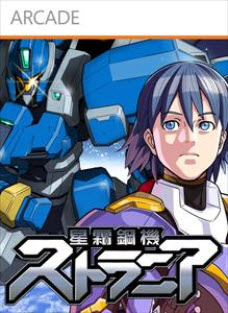
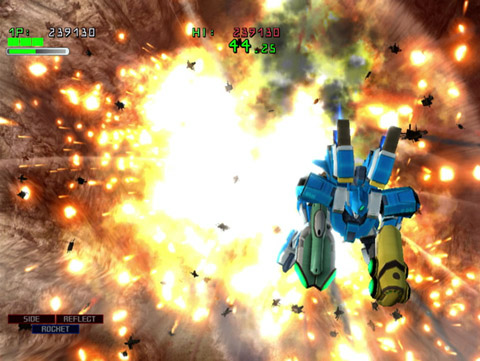
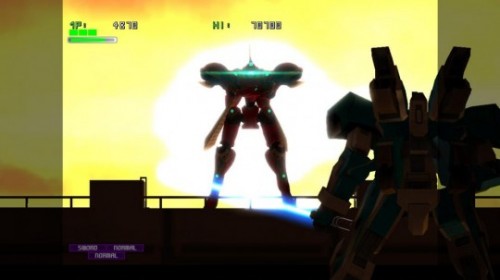
Strania – The Stella Machina is a recently released arcade shooter title available from the Xbox live marketplace. This latest entry into the games market by Japanese developer G.Rev shows an attempt to capture the spirit and gameplay style of the famous jet-fighter style arcade shooters that were popular in the 80’s and 90’s games markets. Only for the 21st century age of gaming, audience fascination with jets and planes has been replaced with: Giant Robots. You dig them. I dig them. We dig them. Chicks dig them. The overall sales of tickets for the last 2 Transformers movies prove that well enough. But just how well does this title stack up against the standards of past arcade shooters? Does it deliver something a little different to the audience? And more to the point, will audiences still find arcade shooter type games fun?
Story/Campaign
The central plot of the game revolves around an ongoing war between the human race that reside on the planet Strania (hence the title of the game) and the human-like synthetic race that hail from the neighbouring planet of Vower. Whether this game takes place in a far distant future or some alternate reality is not hugely relevant to the plot, but it does provide an opportunity to explore concepts of new worlds, technologies and beings that are not limited by fragments of reality. The story portrayed by the official G.REV trailer tells us that both races of Strania and Vower were aware of each other’s existence for at least a few hundred years. However, for whatever reason, the first contact between the two sides went less than well. Now, you as the player are forced to fight in this ongoing war that could very well determine the fate of two civilisations.
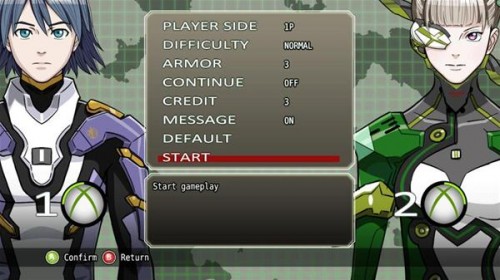
The protagonist of the game is an unnamed ace mech pilot from Strania. His reasons for becoming involved with the war or his own individual origins are never actually explored. We can assume that the young man portrayed in the opening menu is the protagonist character. From the very first level, the player is launched straight into the action without knowledge of who they are fighting, or even why. Contextually, the events of the game cover a military campaign by the Stranians to break the Vower front line and destroy their bases, in operation “Stella Shooter”. Piloting a Blue war Mech, the pilot is provided with a collection of missions that involve either assaulting key Vower tactical positions and bases, or defending Stranian resources. However, players themselves are not offered any details of this plan, or that it even exists as it is never explicitly stated in the game. Besides that, the game involves no dialogue between characters, no in-depth story cinematics and really lacks any sort of context beyond what is explained in the trailer alone. In fact, if the player were to have no prior knowledge regarding the trailer or the ongoing war between the Stranians and Vower, then chances are they would assume that the game simply involves a standard aliens vs. humans scenario.
As an Xbox live arcade title, it is understandable why story and context has taken a backseat to gameplay. A typical arcade shooter in the past very rarely draws heavily upon story elements to augment the feeling of raw fun. The basic low down is that you, as the player, have a giant robot with the capability to destroy entire alien armies. The levels are simply the time frames in which you use the Mech for its intended purpose. So for what it’s worth the story holds very loosely together and players won’t always know what’s going on in context. But frankly, it’s not exactly an overly important facet of the game.
Gameplay
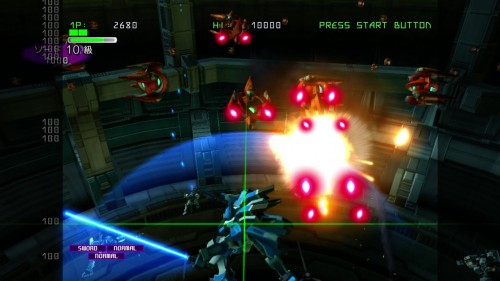
The controls of the game are pretty simple for a console game, and therefore quite easy to pick up. The player controls the movement of their mech unit on a 2- dimensional pane, having the choices to move up, down, left and right using the control stick or D-pad. For the most part, the game features a pretty linear forwards moving gameplay, but occasionally a third dimension is added during different stage in an attempt to mix up the gameplay. That said however, even in these 3 dimensional sections, the player is still restricted to movement in 3D. The only change in these section is perspective, as opposed to the character movement. The rest of the controls are very easy to learn as well.
The (A) button can be pressed for semi-automatic burst fire of both left and right hand weapons. Holding down (A) will enable rapid fire for selected weapons. There are 3 weapon slots available on the player Mech unit. One slot for each hand, and a reserve slot for an additional weapon. The player can use the (X) and (B) buttons to scroll through different weapon combinations to find the right weapon to fit the right scenario, enemy or boss. It’s always good to have a few different kinds of weapons available so the player doesn’t feel bogged down with a single weapon or weapon progression “power-up” tree like other shoot ’em ups. I found that personally however, if you have the Vulcan cannon and the beam sword (which are two of the most basic starter weapons) then you can handle pretty much any enemy that comes at you from the front, side or rear. The customisation of weapons actually occurs in game. While in combat, the player may defeat an enemy Vower soldier unit that will drop a special Vower weapon to use against them. Alternatively, the player’s allies will also send them supply boxes which feature different weapons that can be picked up simply by flying over and touching them. Now while this sounds all fine and dandy, unless you approach the pick up from the ideal direction, quite often players will find themselves losing weapons they didn’t want to, and replacing them with other weapons which make the job so much harder… The only way to ENSURE you drop the right weapon and pick up the right alternative is if you approach if from the left or right hand side to specify which weapon you want to ditch. However, in a game that places a high degree of the survival element upon the movement of the player character around shot projectiles, this is often hard to achieve. Especially since the player will ALWAYS be getting shot at. And in most instances, while most of the power-ups look nice and shiny and full of helpfulness, I tended to avoid them like the plague unless they were a Sword, Vulcan cannon or Vower Laser.
Since the game deliberately sacrifices story development and context for gameplay, it has a high standard to live up to. While it is not an absolute necessity to understand why the player character is fighting, since the game missions are comprised of both attack and defence missions, being able to identify enemy from ally and good from evil would better help players accomplish their missions. This is made all the more complicated by the fact that friendly fire capability is always on, with very little to help distinguish what should and should not be shot at.
For instance in the first defence mission, the player is tasked with defending a Stranian transport and assault vessel in mid air combat. With the Vower ships constantly attacking your transport, players will no doubt feel the urge to fire upon everything that moves, and jam down rapid fire to wipe out all traces of the enemy. Only problem with this: since friendly fire is at an unchangeable ON setting (unless you’re in co-op play) you’ll end up doing more damage to your transport ship than the Vower themselves. It’s rather degrading to be told that you failed the mission because you shot at the wrong things. Only really by practicing and learning which units are which will the player be able to pass many of these types of missions.
The game also features a co-operative play system, allowing two players to work together simultaneously to play through the game, either locally or on Xbox Live. However, from what I did notice from it, the gameplay did not change a single iota for it. Traditionally, whenever two players are involved in a single campaign, the difficulty curve is adjusted to create an adequate challenge for multiple players. However, Strania throws that notion out the window, and sticks with the raw formula for the campaign. Although I feel that this is a warranted move. Why? Because regardless of how many players you have playing this game, it’s HARD. Even on normal mode, the difficulty scaling is quite extreme. Survival until later levels without wasting credits will only be experienced by the most hardened and veteran players. In this respect, it does follow the flow of a standard Shoot ’em up quite well.
he basic formula that a shoot ’em up style game like this relies on is making the players loose lives quickly while being in pursuit of a high score. Considering that these types of games were traditionally played on arcade machines in Timezones worldwide, it makes sense why these games would want to be hard. To force players to add credits to get to the end. Now while this is reflective of its arcade origins, Strania is a little more lenient towards the console audience by providing a 4 square health bar. This way, even if the player suffers a hit, their unit won’t be completely destroyed like in old het-fighter shoot ’em ups. Additionally, Mech units can be healed at regular points, under the proviso that the player meet certain ranking requirements. The game also features a ranking system based on player performance, which, at times, will seem almost condescending if you pull off what you thought was a great battle, but turned out to be C rank material. However, again, the ranking and scoreboard is also reflective of the origins of the Shoot ‘Em Up Genre.
However, despite a few of these set-backs in gameplay, I can’t say that I DIDN’T enjoy myself playing this game. The combat was fast paced, the levels were challenging, and for all its flaws, it was still fun to play. As an additional bonus to the game, G.REV is currently also working on a DLC bonus package that will allow players to side with the antagonist, but much more badass looking Vower force in a subsequent act to re-capture Strania. From what has been revealed so far, this will be an entirely new campaign, with completely different levels, enemies, bosses and special effects. The only thing that will really stay the same is the gameplay, and I believe the expansion will be better off for it.
Graphics and Sound
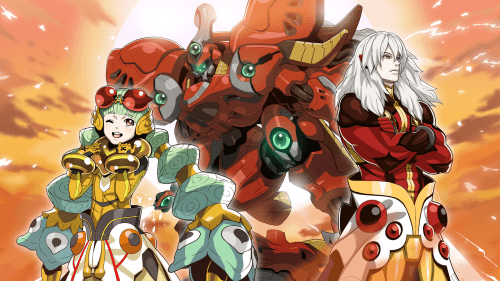
The Japanese origins of the game is immediately clear from the get go. If the player is not tipped off by the anime inspired opening screen and accompanying Japanese Kanji text, then it would most certainly be the general make-up and design of the in game graphics themselves. I personally really like the designs of both the hero Mech units, their weapon designs and even the designs of the enemies. While not exactly the most original designs (humanoid shape of the robots), they edit enough elements to help individualise the series. Having said that, I found that the designs of the main characters themselves to be a bit bland and simplistic. If you’ve ever seen an episode of Gundam, Gurren Lagaan, Evangelion or any other kind of Mech anime, you’ll be able to draw for yourself the type of protagonist design you’d be seeing. On the other hand, the announcement artwork and graphics shown for the Side Vower DLC look far more interesting and have a brighter, more unique and lively design. And given this colourful and lively display, I still ask myself: Who are the bad guys in this story? I mean let’s face it, humanity doesn’t have the BEST track record with other species, in fictional universes or otherwise.
One of the visual aspects I enjoyed the most in playing this is the background animation. The flow of the backgrounds in Shoot ‘Em Up games like Strania often make a large difference to how well it is received. After all, the background is the only thing that will help the player determine the context of the battle they are experiencing. In that respect, the limited graphics capability that exist with the production of arcade games is obvious, but I found that the level of detail providing in a majority of the visuals were highly appealing and sufficient to achieve the afore mentioned contextualisation of situation. There were other visual facets however, in which my feelings are still mixed. In particular I’m referring to special effects and battle effects. While the game IS still fun to play, being able to blast and shoot every which way, sometimes the game suffers for it. This is a problem however for many Shoot ’em up titles. In particular, there is often so much happening on the screen in way of special effects, that it is hard to tell what the player should be doing. To say the screen gets busy is an understatement. This can actually be made WORSE by the addition of an almost identical looking second player unit. The projectiles being fired are very often difficult to see amongst the torrent that the player characters themselves will spew forth, and sudden unexplainable deaths will inevitably occur, much to a player’s frustration. However, I do acknowledge that the game is working off a genre formula that pretty much always ends in this outcome. For what it’s worth, the glowing colouration of the projectiles do make it somewhat easier to see where the player should, and should not be flying.
When looking into the audio, I found that the techno soundtrack really worked well for this game. In fact, the soundtrack was one of its best elements. The pace and pitch were quite appropriate for battle scenes, and the pace and pitch adequately dropped during an event of boss battle to provide a greater sense that it is time for the player to start REALLY playing seriously. “Stellar” would be a good way to describe the nature of the soundtrack. Listening to the fast paced techno and electro beat really provides an “out of this world” feel that is trying to be achieved by the game’s flowing visuals. Additionally, the sound effects were accurately timed, and well selected for use with certain in game items and actions. Without a proper catalogue of sound effects, the game itself would have seemed a degree more lifeless for it.
Additional Comments
While the concept of battling giant robots in out space is a very cool concept, I did not feel enough of that notion seeping through in the gameplay. I felt that one could have interchanged the mechs with jets or shuttles or several varieties of large birds with guns attached, and the game would have felt the same. While this may seem like nit picking, I feel that if a game is going to market itself as a mech game, it should involve some degree of unique mech capabilities. Personally, I would have thought that having the chance to customise your mech in colour and with different starting weapon sets before each stage would have worked in the game’s favour.
That said, a selection of different suits with differing stats or weaponry may have also worked. Many different players are comfortable with different play styles, with some preferring melee combat, and up close and personal, others long range precision and others mass heavy destruction. To this end, it may have been beneficial to cater to these different groups with different mechs, rather than relying on power ups to achieve that.
Overall
While I still enjoyed playing it, I would not expect it to live up to the standard of other Mech games available for Xbox360 already, such as Dynasty Warriors Gundam, Armored Core and Chrome Hounds. However, I did feel it was more enjoyable that many other standard arcade shoot ’em ups. For what it’s worth, I found that this game is a standout for its genre. That is to say it was actually very good. FOR A SHOOT ‘EM UP. While not exactly what you would consider in the league of Super Meat Boy, Castle Crashers or Limbo on XBLA, if you’re looking for a good quick burst of fun, then Strania is certainly worth a go.
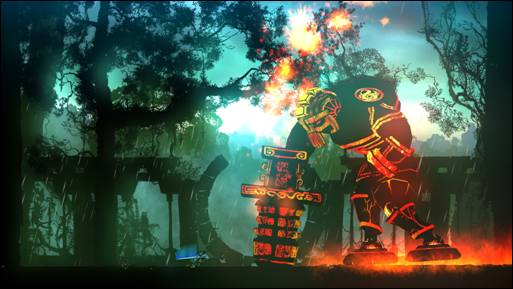
Outland, the latest game from Ubisoft, has a new trailer for everyone to enjoy.
The colourful trailer shows off some dazzling gameplay and colourful, yet interesting, graphics. It also gives us a glimpse into the games story, which is basically that once every era these gods awaken and threaten the balance of world and that a hero must emerge to defeat the gods and bring balance back to the world.
The gameplay looks like it will be a platforming game (yay) in a similar vein to Megaman or Metroid. So far I cannot comment as to whether or not this will be a ‘Metroidvania’ type game with backtracking and revisiting past locales.
What’s interesting to note with this title is that it is unusually vibrant, which seems to be a new theme amongst Ubisoft titles. There have been a fair few titles recently by them that seem to follow the ultra-awesome colouring and lighting being published by them, like most recently Child of Eden. Outland looks like it’s going to be quite fun.
Outland is set to be released on the PSN and the X360 Live Arcade on the 27th of April.
Kingdoms of Amalur: Reckoning, the upcoming action RPG from EA, has a pretty solid pedigree behind it. The game is being developed by 38 Studios and Big Huge Games and is in the very capable hands of people like Ken Rolston, R.A. Salvatore, and Todd McFarlane. Rolston will head up the design of the game, following a prestigious career as lead designer of both Elder Scrolls III and IV. Salvatore, best known for penning Forgotten Realms and DemonWars, will write for the game. Most exciting for me personally, Todd McFarlane, creator of comic legend Spawn and more recently Haunt, will be handling the art for the game.
If ever a team could be assembled that is more than capable of creating a truly epic experience, it is these three men. That’s not what has me excited about Kingdoms of Amalur however. The newest trailer for the game, titled Visions, is what really gets my nerd juices flowing. As a fellow Capsule Computers editor put it, it looks like what Fable should have been. The action is fast paced and the designers have compared it to God of War for the more sophisticated gamer (my words, not theirs). Players will need to use strategy and roleplaying elements in order to survive in this kingdom.
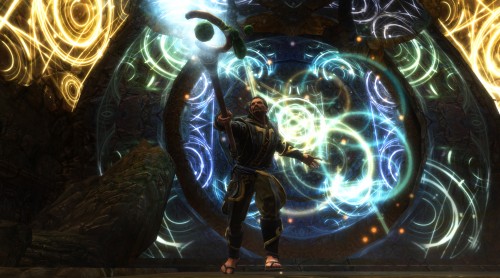
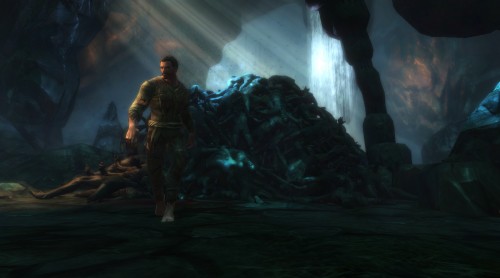
EA has also released two new screenshots along with the trailer which show off the tone of the game. The first, shown above, shows the player as a mage doling out magical punishment. The second screenshot, below, depicts the protagonist next to a pile of corpses which he’s recently crawled out of after being resurrected, which is where his story begins. Seriously, is anyone surprised that Todd McFarlane is working on this? Why won’t that guy let anyone just stay dead in peace?
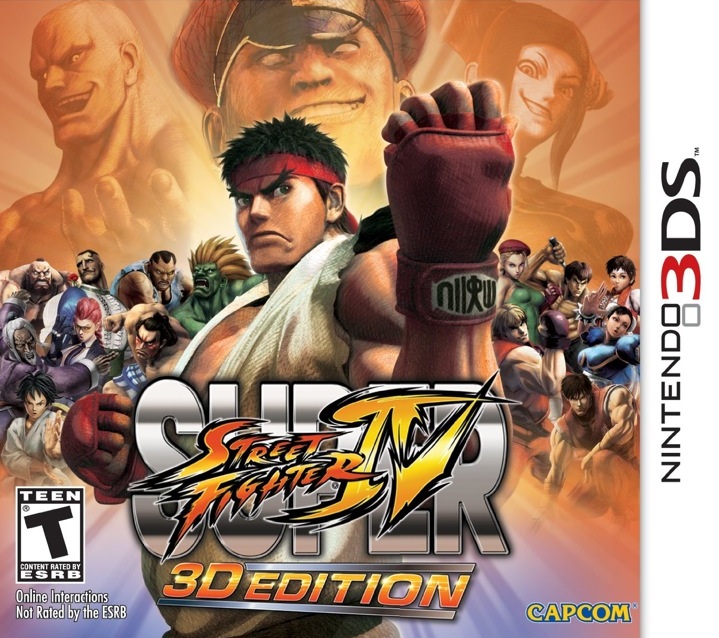
Super Street Fighter IV 3D Edition Developers: Dimps, Capcom Publisher: Capcom Platform: Nintendo 3DS (Reviewed) Release Date: March 27th 2011 Price:$39.99 US, £39.99 UK, $69.99 AUS
Overview:
Street Fighter is a franchise that has been around for over twenty years now. It had humble beginnings as an arcade game and flourished from there. No one thought that all these years later that the Street Fighter franchise would still be going strong and would have seen so many different games over the years. Street Fighter IV is no exception to this rule. The first Street Fighter IV was released in arcades in 2008 and saw a home console release in 2009. Now after receiving an upgraded Super version Street Fighter IV has received 3D to create Super Street Fighter IV: 3D Edition. How does Street Fighter IV handle being placed on a handheld and most importantly, how are the 3D effects?
Story:
Street Fighter has never been known for its storyline and you will not find much of one in the 3D edition. The only actual story mode in the game is the Arcade Mode which will allow players to play as one of the thirty five different characters in the game. Each of these characters has their own individual storyline which can either be relative to the actual fights happening or will simply be something fun and enjoyable.
The story really doesn’t see a whole lot of development and although each fighter will eventually end up fighting their rival, the final battle will usually always result in a fight against Seth, with a special fight afterwards if the player managed to meet specific requirements. Each character’s story gets an anime-style cutscene ending and opening but that is unfortunately as far as it goes. Despite the fact that Street Fighter isn’t known for its story it is still a bit of a letdown to see nothing developed further in this day and age.
Graphics:
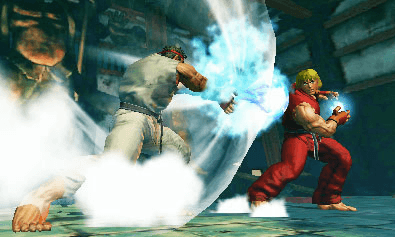
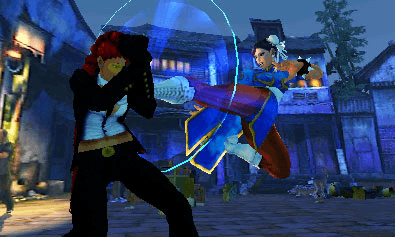
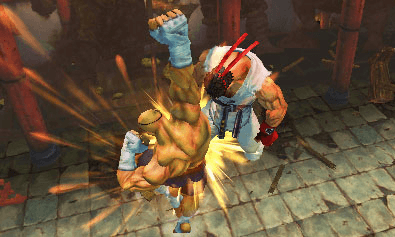
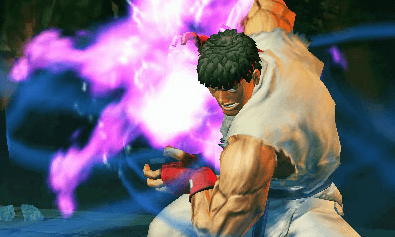
One of the most significant changes you will find in Street Fighter IV is obviously the graphical change. Being a title that was originally released on the Xbox 360 and the PlayStation 3 it is practically unfair to gauge the graphic difference but surprisingly enough the character models are very good looking. There are few differences to be seen between the two titles minus the crisp finish that console versions have. The flashy attacks and special moves are as stunning as you may remember them to be.
The one noticeable difference between this handheld version and the console version is that the background details have taken a significant hit. Most likely in an effort to preserve character appearance the backgrounds that usually had characters in the background that responded to the fight or at least followed specific actions are now completely static. This is something that really isn’t noticeable unless it is looked for as who has time to check out the scenery with a foot being placed in your stomach.
Audio:
The background music has not seen any loss in quality and is still contains plenty of memorable fighting music. The announcer is as great as one would expect with his upbeat voice announcing KO’s and more. Characters are voiced well enough with plenty of in-game voice clips that occur during a fight or before the fight starts. The opening and ending cutscene to every character’s story is completely voiced and is a nice touch to really reward the fighter. There is unfortunately no option to listen to the original Japanese voice dialogue which some may look for in a fighting game with such a long history but the English cast is suitable enough.
Gameplay:
Not much has changed about the structure of Super Street Fighter IV: 3D Edition. You will play as your selected fighter against your opponent and whoever drops the other’s health bar completely wins. With enough attacks you will raise a bar that will allow you to execute your Super Combo, or if you receive enough damage you can unleash a devastating Ultra Combo to swing the fight in your favor.
The shift to a handheld device leaves the controls changed however. Super Street Fighter IV has six different attack buttons, three punch varieties and three kick varieties. This means that one punch and one kick button is placed on the shoulder buttons and the L and R button are unfortunately very inconvenient to use, especially when trying to chain together a combo attack that uses the face buttons along with these shoulder buttons.
This is remedied partially by the addition of two different customizable control schemes that make use of the touch screen on the 3DS. These two modes are Pro and Lite controls. First the Pro mode allows players to assign basic button or button combinations to quick and easy taps that give them the ease of playing without having to worry about the shoulder buttons if they don’t want to.
Lite mode on the other hand is certainly an enjoyable addition as it allows the player to place four different special moves of their choosing on the touch screen. Players are able to place Super Combo and Ex attacks onto these Lite buttons as well as special moves. The addition of Lite mode provides a new accessibility to Super Street Fighter IV: 3D Edition which has never been available in the franchise. Although some pro fighters may cry foul about this addition the ability to perform special attacks heightens the fun factor for those who never have picked up a Street Fighter game before. Each character has their own customizable control scheme so you will always be able to use what you want with each fighter you select as well.
Other than Arcade and Versus mode the Challenge and Training modes return to help pad out the player’s options on what they want to do. Of course also returning is the online play. SSFIV:3D has two separate lobbies for Online Multiplayer; Versus and 3D Versus. In these modes you can search for players you want to fight or fight with friends via the Friend Code system. I had zero difficulty connecting to random people around the world and experienced zero lag online, even in 3D versus matches which makes Super Street Fighter IV: 3D Edition an amazing handheld title for fans of fighting games and enjoy online matches.
An interesting addition to the title is the figurines that you are able to collect. As you play through the game you earn points to buy collectible figurines that take the form of characters from the game. These figurines serve more than one purpose however. While you can collect them all and look through them at your leisure you can also build a team of five figurines that will do battle with other people that own SSFIV:3D via the SpotPass system with winners receiving more points to buy more figurines. Of course this requires you to pass players who also have their 3DS in sleep mode and own SSFIV:3D which makes use of this system limited and perhaps nearly impossible without being planned ahead of time.
3D Effects:
First it is worth mentioning that activating the 3D does affect how smooth a battle will play out. The loss in frame rate will cause battles to either go slower than normal or will occasionally cause lag between actions compared to when you are playing in 2D mode.
Moving on from that however we have a mode that was implemented entirely with the 3D effect in mind. In an effort to not confuse anyone they simply called it 3D Versus. This mode places the camera slightly over the shoulder of one of the fighters and implements the 3D extremely well into gameplay. So much so that I found myself enjoying this mode much more than the original mode as it provided some spice to the standard 2D fighting.
Now the opening cutscene doesn’t have 3D effects and neither do any of the cutscenes that play out during the Arcade mode which leaves a lot of lost opportunity. I don’t believe I have yet to see anime in 3D but it can most certainly be done and should have been implemented in a title that was launched alongside the 3DS.
Overall:
Some people may think that having a title released for current generation consoles released on a handheld would cause a severe loss in quality. While those people may be right occasionally, Super Street Fighter IV: 3D Edition is in a different league from those games. Despite a minor loss in graphics the title is everything a Street Fighter fan would want and more. The inclusion of the Lite mode allows players to easily access the title like they never have before and with the 3D to show off, more people should certainly be picking up Capcom’s latest installment to the franchise.
Last week, we brought you five of the worst Sega Genesis boxarts period. Keeping with the nice Sega theme going on at the moment, it is now time to display the top five eyesores of the Genesis’ predecessor, The Sega Master System. The arts we seen released on the Master System really take the cake when it comes to “bad” and the laziness applied shines through with many titles, making this the hardest week to actually choose which were the absolute worst.
After some thorough thought and a lot of cringing, here are the top 5 Bad Boxarts for the Sega Master System.
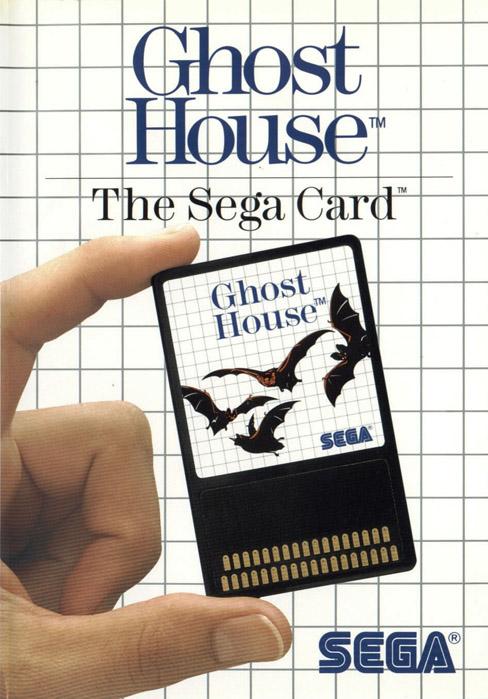
Ghost House
It takes a lot of time to actually draw out a complex masterpiece to portray just what a player is in for when they purchase your game, but apparently Sega just were not feeling up to doing much of anything when it came to printing an art for 1986’s Ghost House. Taking a picture of a hand with the game card…..right. I can’t even imagine how a kid would go about describing this title back then. “The one where the guy is holding it…and BATS!”. Even on the label, no ghosts, no actual house, just four bats who I am sure are laughing at the actual hand that decided to pick this title up to start with.
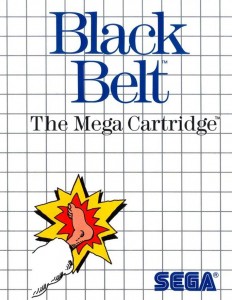
Black Belt
I guess it can be said that at least they didn’t take a picture of a hand holding a cartridge for Black Belt, but a foot really isn’t much different. I guess it is a nice foot, though considering there is no body actually attached to it makes me a bit worried of just what this game could possibly be about. If Black Belt ever gets a sequel, I demand we see a shoe.
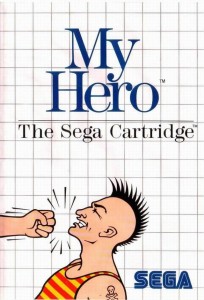
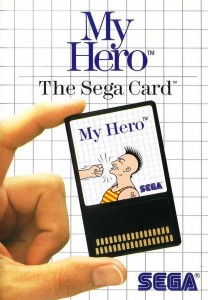
My Hero
Every just want to punch someone? My Hero takes out all of that rage on it’s European cover and fully delivers with a fist flying into a man wearing a striped wife-beater. Yep, all action with this one. Sadly, this lovely box-art had to be Americanized..
Now I see the fist’s point…
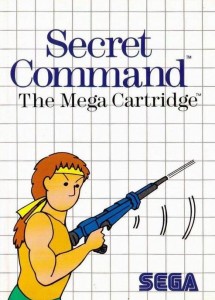
Secret Command
In the mid-80’s, there was no denying that Rambo was a huge property. This led Sega to take the popular run and gun title for the Master System by the name of Ashura and turn it into Rambo: First Blood Part II. Now since Rambo was an American thing at the time, Europe received the same game under the name of Secret Command. As you can see by the cover above, this release of the game certainly seemed like a rushed one when it came to whipping up a quick art. Armed with some sort of what appears to be an air gun, a yellow headband, and no mouth, there are literally no words I can say to truly describe just what is going on in this picture.
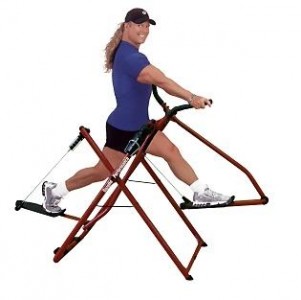
Tony Little never graced another video game after Secret Command and went on to find his true calling, selling exercise equipment.
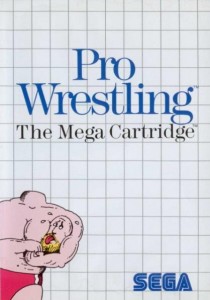
Pro Wrestling
Just looking at this cover can make any fan of wrestling games cringe. I have no clue what Sega could have been thinking to release Pro Wrestling with this cover, honestly. What we see here is a man who has been decapitated and holding his severed head in his arms, and judging by the expression, this must be a pretty uncomfortable experience for everyone involved. Pro Wrestling in my book ranks as one of the worst BoxArts of all time for not only some lazy and downright creepy artwork, but for later becoming an unfair representation of what the Master System had to offer.
Now you can tell us in the comment section below which one of these covers you loved or hated the most, and post any Master System gold we may have missed.
Join us next week when we steer away from Sega to go back even further and take on the Intellivision.
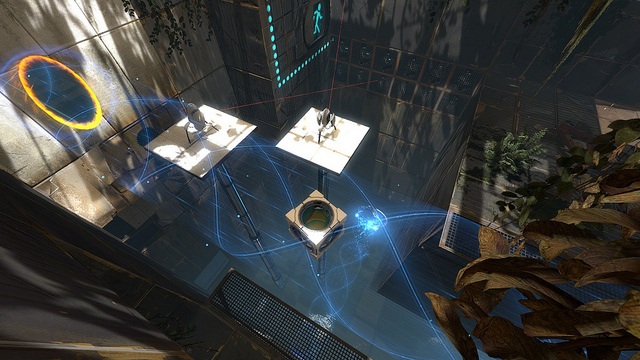
A while ago, the team behind the much talked about upcoming title Portal 2 revealed limited information regarding the incorporation of Steam access in the PS3 version of the game. Via the official Playstation blog, Doug Lombardi, the VP of marketing for Valve, reveals some more information on this fantastic inclusion. Some in game functions Steam will control include cross-platform matchmaking, gameplay, friends, chat and achievements. An interesting inclusion is the ability for players to save co-op and single player games to the Steam cloud, allowing them to resume play saved from ANY PS3 in any location.
The Steam function is provided as an overlay within Portal 2 and allows players a quick route to their Friends, displaying in game stats and online status. There are also Steam achievements to unlock in conjunction with PSN trophies all accessible through the Steam overlay system.
Players will need to link their Steam and PSN accounts to activate the service and its functionality, something which can easily be done within the game itself. This also applies to new users who can create an account in the game and start to enjoy its features straight away something he believes will make the PS3 version of the game the most attractive across all consoles. Microsoft were apparently also offered the Steam technology but decided against its use within their version.
Portal will also be available on XBox 360 and PC and will be distributed by Electronic Arts.
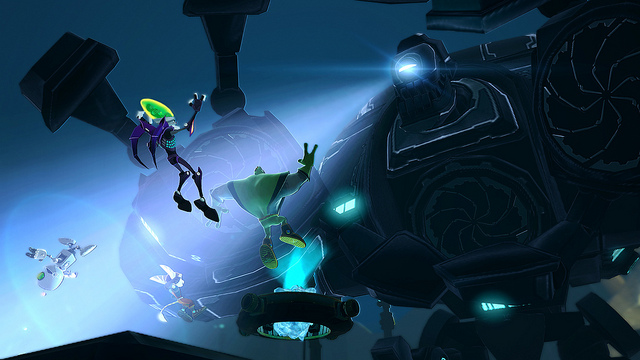
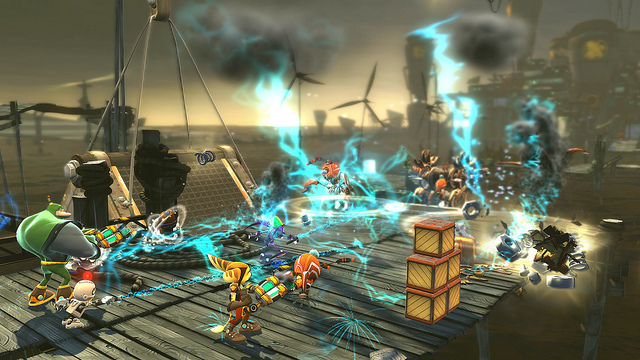
Insomniac Games have released a new demo from their upcoming title Ratchet and Clank: All 4 One, to a select group of US and EU journalists. While they also showed off some of the new arsenal available to the various characters, focus was given to the huge encompassing environments and an emphasis on co-op play. James Stevenson, the Senior Community Manager for Insomniac games explains that although players must help each other out it will be players individual scores that will allow them first choice of the plethora of new weapons available.
This is illustrated in a preview of a new level within the game set deep within the Terawatt Forest on Planet Magnus. In this environment all the plants and animals have been mutated by a strange alien meteor, and to make matters worse it’s also home to a mad scientist named Dr Croid who holds the key to the Creature Collector, built by Dr Nefarious and responsible for the current situation.
Stevenson goes on to explain that every weapon now has a co-op mode, so put simply the more characters that are using that weapon the more powerful its effects on enemies will be. Players are rewarded with extra bolts for co-op and specialised kills. Another exciting feature is special gadgets that are upgradeable and unique to each particular character. Imagine being able to create a clone of your character to trick the enemy while other players flank and bombard it, then also have it upgrade into a formidable turret gun. I don’t know about you but that sounds like a pretty cool feature and incentive to collect as many bonus bolts as possible.
Ratchet and Clank All 4 is due for a 2011 release and will be available in 3D for a truly immersive experience. Players will enjoy up to 4 player mayhem with a drop-in drop out system allowing players to leave and connect whenever they choose to.