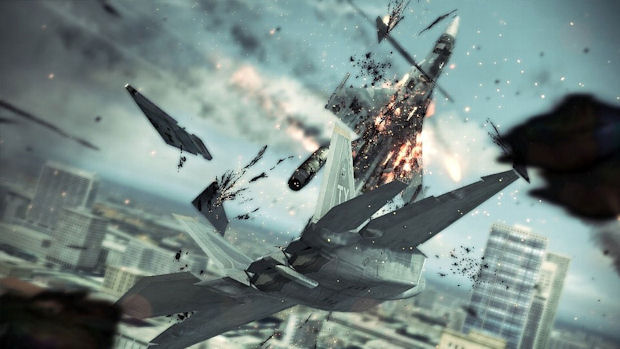
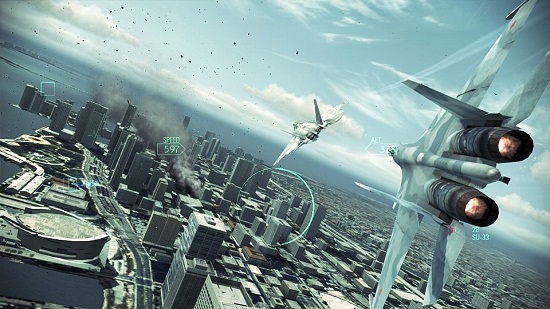
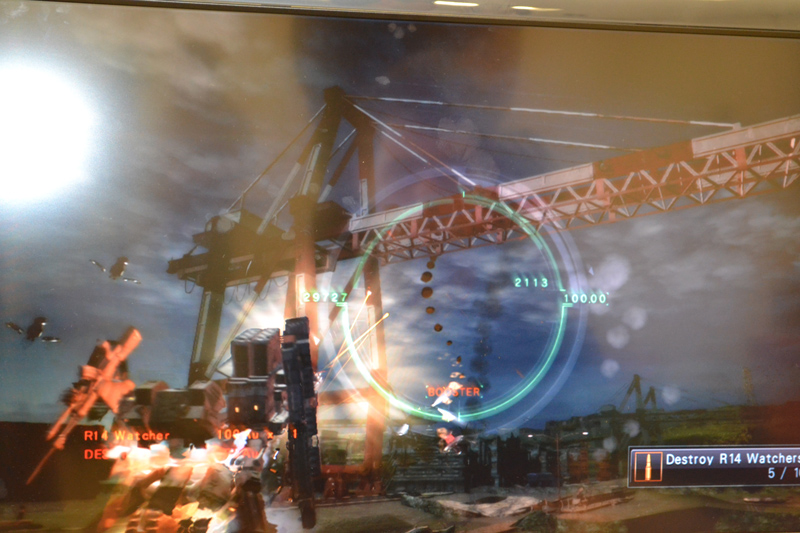
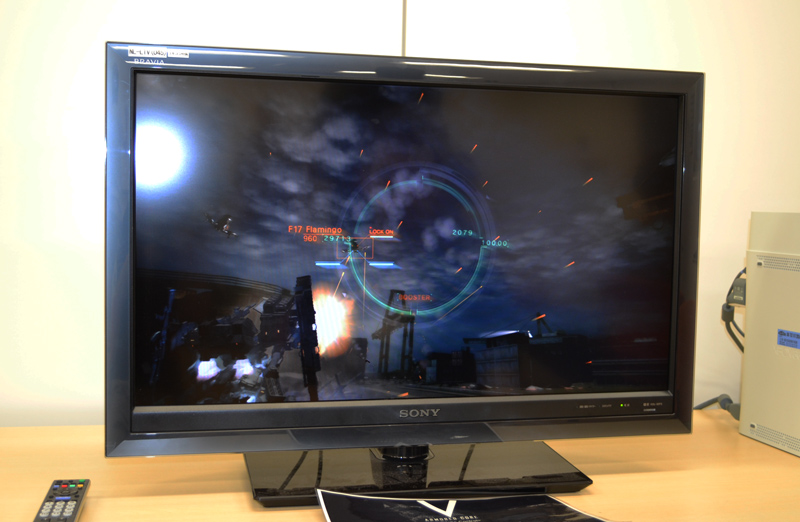
At Namco Bandai’s pre-Tokyo Game Show event, a couple of the Capsule Computers team members were lucky enough to have a play through of the soon to be released title for Xbox 360, Ace Combat Assault Horizon. Despite having some impressive graphics, from what we played the game didn’t seem to be the most user friendly. After a few deaths we learned that you are able to select a number of different planes before returning to the game. The aircrafts were all visually impressive, and the ability to swap between multiple views was pretty cool, especially the in cockpit view point.
Players are also given the option to play between five different maps, with us having a hands on preview of both Paris and Dubai. There is also the option of playing in Miami or Washington DC. Namco Bandai also stated their intention to release two more downloadable maps later on down the track.
While the controls are a little fast, they are also equally responsive. Perhaps this might work in favour for players with a little more expertise; however new comers to the game or even genre as a whole might feel a little daunted by the steep learning curve. Luckily missions can be played co-operatively, with up to sixteen players being able to play at one time. Ace Combat Assault Horizon will be available for both Playstation 3 and Xbox 360 in October 2011.
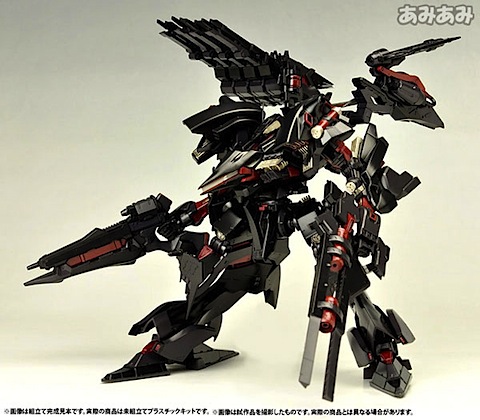
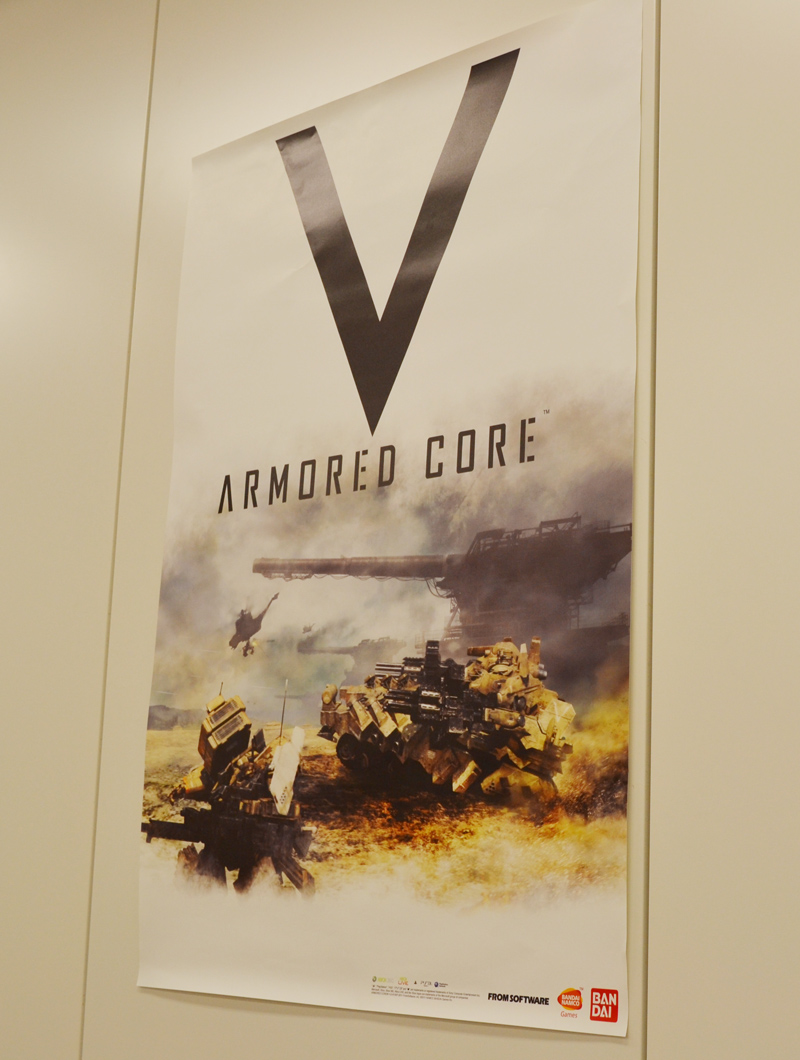
Capsule Computers joined other Namco Bandai enthusiasts at the pre-Tokyo Game Show event held at Namco Bandai headquarters in Tokyo on the 14th of September. One game we had the privilege to play was the soon to be released Armored Core V for Xbox 360. After 30 minutes of game play between us, getting to grips with the controls, and blasting away at some robotic enemies and bullet trains in a visually stunning single-player mission, we were allowed time for some questions and answers with the game’s software producer, Toshifumi Nabeshima. Please note, the following questions and answers have been paraphrased from translations.
Q: Will the game feature any multi-player options?
A: The game has been designed to focus mainly on multi-player gaming, which will be based online. While story based missions are designed to for single-player gaming, you can also do these missions in multi-player. W e have developed multi-player elements such as voice chat for players to communicate in game.
Q: How many players can play at one time
A: When playing online, teams can include up to as many as twenty members. Within the teams of twenty, up to five players can play co-operatively to complete a mission.
Q: Do you plan to bring it to PC?
A: There are currently no plans to bring the game to PC, but it will be available for both Xbox 360 and Playstation 3.
Q: When is Armored Core V due to be released?
A: Armored Core V is set to be released in 2012 in both North America and Europe.
Q: Armored Core V seems to be designed to appeal to hardcore players, how are you catering to newer players?
A: We want to bring the Armored Core franchise to a higher level. The reason that development is taking so long, is that we are trying to make the game as accessible as possible. Rather than make the game less difficult than other Armored Core games, we want to keep the standard of difficulty to please hardcore fans, but also bring in new elements to attract new comers.
Q: What specific elements are being developed to attract new comers?
A: Because the main focus of the game is multi-player, team members can help out the new comers. As well as co-operatively completing missions, team members can also share money and items to help the new comers ease into the game. We have also worked to improve the control system to be a little simpler, allowing everyone to understand it.
Q: Are there any plans to release downloadable content?
A: There are no plans as of yet, but there is a possibility for it in the future.
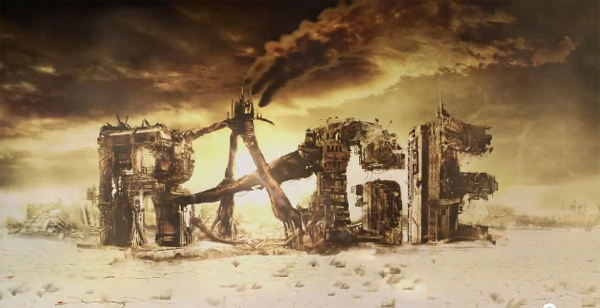
Last night at an event at the Sydney Opera House, id Software had shown off their upcoming shooter RAGE. Leading the event was the games lead designer Tim Willits, who had come prepared with a slideshow and the Xbox 360 build of the game.
Tim talked for around twenty minutes on the background of id, their philosophy, the influence that he’s had over games internal to the company, how he got his start from being a simple modder and about the certain generations of games. Very briefly, the generations are as follows (in a non all-encompassing manner) – the Grandfather of FPS’ is Wolfenstein 3D, the Father of FPS’ is DOOM, the Grandfather of Awesome was Quake, the first actual 3D shooter was Quake II, Quake III Arena was [is] Awesome; and so on.
Sadly, nobody cheered for the QuakeLive shoutout. :'(
After the slideshow presentation, we were shown a trailer (trailer 2) of the game while he got the Xbox 360 set up on stage. The event was about RAGE, and RAGE left me raging for reasons that will be discussed below.
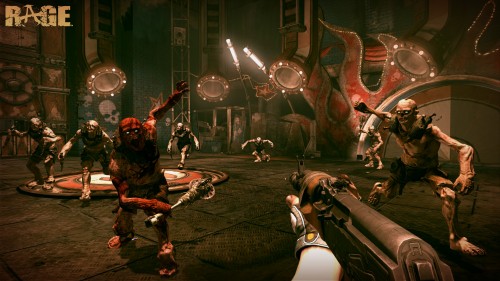
The first thing that I noticed, and said out loud, was that RAGE was a very pretty title. I don’t mean it in a way that the forest in AVATAR was pretty for the first half of the movie with all glowy stuff and exotic animal life, I mean it in more of a graphical sense. Like, those rocky cliffs felt real, we could have been actually walking through a valley, it was only that it was accompanied by a HUD that we knew it wasn’t real.
While the background textures in RAGE were amazing, sadly, on the XBOX 360 version at least, the character models were not of the same quality. Yes they worked, yes they looked cool, but they were not as realistic as the background world. I’m hoping that for the PC version this isn’t the case, it could just be a limitation on the Xbox 360’s architecture.
RAGE is a 60hz game, which means that it designed to run at 60FPS at all times. I’m assuming that this is in regards to the consoles, as different PC hardware configuration would yield different results. As Tim suggested, anyone who has played Quake III Arena, or QuakeLive will know exactly what this means. Fluidity, nice, easy fluidity. And from what we had seen of the game, this was definitely the case.
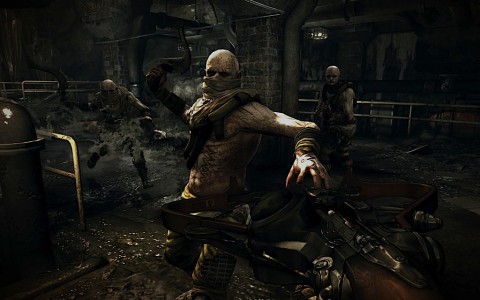
This game is in many ways a throwback to the classic id formula and Anyone who has played a past id game will know what I’m talking about. Basically, you get a bunch of cool guns, you stick a player into this world and get him to kill lots of cool stuff. RAGE takes this formula further with the addition of a bunch of cool gadgets that players get to use, such as sentry guns, robot sentry guns, other awesome gadgets and the like. Players will also get a variety of different ammunition to use over the course of the game, such as a crossbow bolt that allows to to take control of enemy units and, of course, BFG ammunition.
During the playthrough of the game, I was unable to determine if RAGE had regenerating health or not. I certainly didn’t see any medpacks during the first mission, but there were bandages which could be applied during combat. Though, there is a cool dynamic during combat in regards to death. Basically there’s a defibrillator mechanic, where, upon being killed, you can get a chance to resurrect yourself using the defibrillator. If you complete this challenge, you will be brought back to life. Depending on how well you did during the challenge, you can come back in different levels of health. For instance, it if you did badly, you’d be low on health, the opposite is true for doing well. The defibrillator can also kill all enemies around you upon awakening.
The last thing that I’m going to talk about is that, in RAGE, there are numerous amounts of fun areas and easter eggs to be found. From what we were told, there was a hidden area for each of id’s franchises, as well as a few areas/ nods to the TV show Breaking Bad. So be sure to keep an eye out for those.
Good news for the modding community, RAGE will have an SDK available for players and professional designers to play with and design additional content for the game. As explained on the night, id have always had a large modding community, and it looks like this will continue that lineage. The SDK is coming in two flavours, 32bit and 64bit.
While RAGE certainly looks like it has all the ingredients of the next big FPS, we will still have to see a final product to make that decision. Overall though, it is definitely a must have game and will certainly entertain for hours on end.
It’s a beautiful day in Sydney, we’re just getting into spring and it’s a wonderful day to spend going to the Sydney Opera House. What a startling contrast to go from beautiful scenery and weather to see id’s new FPS set in a bleak post-apocolyptic future, RAGE. Admittedly RAGE is beautiful in it’s own right. The world is wonderfully realised and idTech 5 is one hell of an engine to see in action, but I think you get the idea.
After being ushered into the hall, we were treated to a trailer showcasing id’s considerable carrier. Starting with Commander Keen and going through the chronology covering games like Doom and Wolfenstein, most of which made the crowd erupt in cheers until we eventually landed on RAGE. I at first thought this would be just a RAGE event, and while that was the primary focus we certainly spent a long time learning about id and RAGE’s Creative Director Tim Willits.
The first thing Willits states is what he was instructed not to talk about. Namely, Doom 4, Skyrim and why games are so expensive in Australia. His timing was perfect and everyone in the audience laughed. Tim Willits is a charming guy. It’s interesting to state that he got his start in the industry by creating levels in Doom with the level editor. This is something that Willits championed during the session as a great way of getting your foot in the door, however he stressed that you should finish projects before presenting them. Nobody hires someone with half done ideas. While talking about his carrier with id before he eventually became the Creative Director for RAGE, Willits gave lots of insightful information like, “the real reason you couldn’t use the flashlight as well as a gun [in Doom 3] was because it ran too damn slow” or continually referencing how id could have trademarked the term “deathmatch” as they coined it for Doom.
After his intro and presentation he jumped into the real meat, which was a live demo of RAGE. It’s interesting to note that he was running the game off of a 360 and not a PC. RAGE looked and ran beautifully. The idTech 5 engine obviously can hold it’s own with the big boys and ran buttery smooth. We were treated to the first mission to the game, but with more weapons and ammo then what will be available at the outset. You have different ammo types for every weapon. Most notable that was shown off was the mind control bolt (for the crossbow) where you can take control of a character and when you’re done you can blow them up. Lots of things blow up in RAGE and it’s certainly better for it. It wouldn’t be an id game if it wasn’t over the top. In addition to the mind control, there was also an electro and dynamite bolts as well as grenade ammo for a shotgun which looked a little bit like liquid death. The mission required you to drive to a location using an ATV, and the driving physics looked quite good, going into a 3rd person perspective. Willits noted that there are only 2 races that you’re required to participate in during the single player campaign and neither of them are extraordinarily difficulty to accomplish, so if it’s not your thing you don’t have to spend too much time on it.
While in the mission a game mechanic was shown off using a defibrillator when you’re close to death. There’s a mini game to accomplish this and the better you do the more health you receive when revived, not to mention it electrocutes anyone around you if you can pull it off to give you bit of a breather. There was one exclusive bit of info for Australia that was broken during the event and that was the hidden rooms. There is a hidden room for every id franchise in the game and each room mirrors how the game looked when released. The Wolfenstein room was shown off and when the door opened you walk into a small room that could have been set in the original Wolfenstein 3D with giant pixelated tiles. It’s certainly jarring to see but a fantastic bit of fan service. Willits also let it drop that there’s also an easter egg for the popular AMC show Breaking Bad, which featured the character Jesse Pinkman (played by Aaron Paul) playing RAGE during this season.
After the demo finished, Willits did a quick Q&A with the audience and talked about MOD support. Namely yes, RAGE will absolutely release a SDK and will support MODS for the PC version. You can expect the SDK “soonish after we ship”. Willits made a note stating that it will be a little difficult for people to create their own “Megatextures” but will find it much easier to create layers onto existing ones rather easily.
All in all RAGE looks pretty impressive and has come together rather nicely. I’m excited to see id move into a space that’s not just filled with standard FPS’. I like the idea of id branching out and adding RPG elements into their games. The game looks beautiful and runs like butter. RAGE is due for release next month.
The creators of the amazing Steins;Gate and Chaos;Head visual novels, 5pb Games had some big things on show at Tokyo Game Show 2011. The biggest of which was their trailer for their upcoming title, Robotics;Notes!
5pb are known for creating visual novels that focus on science-fiction with a dash of romance thrown on the side. This time with Robotics;Note, as you can imagine, they are focusing in on robotics. You can check out the trailer below to get a look at what to expect from the title.
Robotics;Notes is set to be released on the Playstation 3 and Xbox 360 in Spring 2012. It is unknown whether it will make it out of Japan, but with the massive growth in popularity of Steins;Gate and Chaos;Head, it wouldn’t be too far a stretch to guess that 5pb may be looking to branch out.
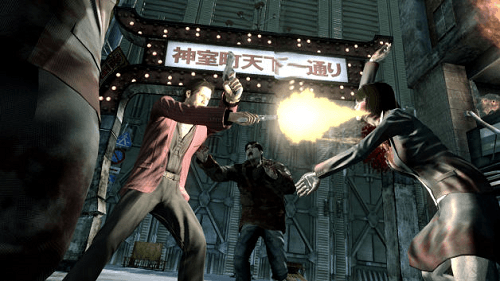
It seems that a few things will be adjusted if Yakuza: Of the End actually sees a localization for Western release. Daisuke Sato, the director of Yakuza 3 and Binary Domain spoke with Joystiq during Tokyo Game Show and there he responded to a question as to how Binary Domain would compare to Yakuza: Of the End.
He said that “For the western version of Yakuza: Of the End — if that’s going to happen, then we will tweak the controls, to be closer to other western shooting franchises.” Of course the thing to pull out of this statement is that he said “if” not when. So while nearly every Yakuza game has made it to Western shores through some form of localization, Yakuza: Of the End isn’t exactly guaranteed.
Calling all Xbox360 owners, don’t miss your chance to give something back to those who haven’t had the same opportunities or healthy lives as yourself by simply doing what you love, playing games. Get involved and enjoy a free weekend of Xbox Live Gold with Microsoft as they host the Gaming and Giving for Good (G3), Xbox Live charity event on October 1st to aid those less fortunate.
The proceeds of the event are going to the Children’s Miracle Network which raises funds for more than 170 children’s hospitals across the US and Canada; truly a good a cause as any. Microsoft will be providing any participating player with free Gold memberships for the weekend, with participants obtaining donations based on every hour of gameplay they complete.
“We are inspired by the support from the gaming community and how it has rallied around our Extra Life programs to support Children’s Miracle Network Hospitals,” said John Lauck, CEO of the Children’s Miracle Network.
“We’re honored and thrilled that Xbox is helping the Extra Life fundraising effort with its G3 event on Xbox LIVE.”
Other main sponsors of the event include Gamespot, Hulu and 2K games as well as Capcom, Square Enix and EA (so thumbs up to these guys for additional support). It’s really easy to take part so visit this site for more information and all the participating details will be there for you.
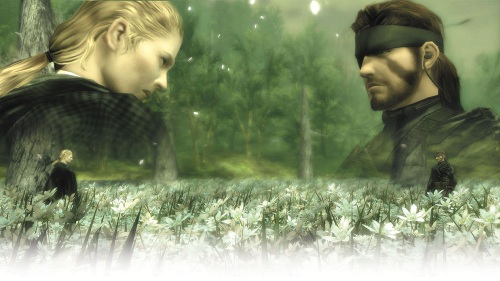
Kojima Productions and Konami revealed at Tokyo Game Show that the Metal Gear Solid HD Edition is going to be released on November 23rd in Japan. Both the PlayStation 3 version of the game and the Xbox 360 version of the game will be priced at ¥5,480 ($72 US) which is relatively cheap for a Japanese game release.
Players will be able to choose how they want to view cutscenes and events in the game as well. They can view it either in the old format of 4×3 or in upgrade wide screen. This is useful for people with old televisions or strange viewing habits. The Japanese version of the game on the PlayStation 3 will include a code to download the Game Archives version of Meal Gear Solid, but the Xbox 360 version will not.
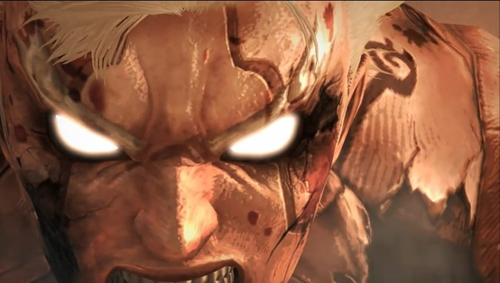
Asura’s Wrath is going to be a bit of a strange game. Not only does it involve a guy who will have both of his arms literally ripped from his body only to grow back six new ones, giants bigger than a planet, swords that can reach from the moon to the Earth but now it also has some science fiction looking stuff thrown in as well.
As you can see in the trailer which Capcom released for Tokyo Game Show today, we learn a litttle bit about the plot of Asura’s Wrath and even more strange looking things including Asura’s brother in law Yasha who may be a playable character in the final game. Let us know what you think about this crazy over the top action title?
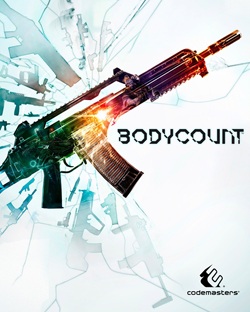
Bodycount Developer: Codemasters Publisher:Codemasters Platform: Xbox 360, PS3 (reviewed) Release Date: September 2, 2011 Price: $26.47 (buy here)
Overview:
This article is coloured by the fact that only two days after I received my review copy of Bodycount the division of Codemasters that developed the game was shut down, leaving 66 people jobless. Whilst Codemasters emphasised a ‘restructuring’ to focus more on their racing titles, it’s obvious that Bodycount’s lack of commercial or critical success played a part in the closure.
The game has failed before I’ve even begun, but that’s no reason to ignore it.
Story:
The world is a horrible, corrupt place, where dictators and criminals who commit murder and genocide are punished by pathetic trade sanctions and political cold shoulders. Governments and political bodies are useless when it comes to dealing with the problems of the world, so that’s where the Network steps in. Playing as one of the Network’s operatives, it is your duty to solve these highly complex, multifaceted issues with LOTS OF GUNS.
(I hope it’s satirical, I really do )
Initially dropped into an African nation in the midst of a civil war, it is quickly discovered that one big bad organisation is behind all the evil goings on – the Target. Also named from the ‘enemy’ page in a thesaurus is the big boss of said organisation – the Nemesis. The rest you can fill in for yourself, fight through the lower ranks, eventually take down the organisation. Boom.
A set up like this is ripe for some humour, but Bodycount never really capitalises on it. The tongue in cheek side of it should have been amplified, but the disembodied female voice that gives you all of the plot details is strictly for explanation, not entertainment. Learn from Portal – narrators can be more than that! It would have been a great selling point for Bodycount if the whole thing had been turned into a full on parody of the FPS genre.
As it is, the plot is standard stuff that never really registers. It’s clear enough to know what you’re supposed to be doing, but don’t expect to care about anything more than the next gunfight. It is a refreshing change not to be bogged down with overly serious end of the world exposition though, so points to Bodycount for trying to keep up a lighter feel than some of its competitors.
Gameplay:
The control system definitely sends out warning signals from the off. In the PS3 version the trigger is mapped to the R2 shoulder button and grenades to R1 – the first enemy I ran into promptly had a grenade thrown into his face point blank as I wandered why the heck my gun wasn’t firing. The cover system is hampered by a drunken wobble that seems to strike whenever peeking out from behind objects that aren’t perfectly flat, and works in the clunky fashion of move to object, press crouch to hide behind object, etc. Bodycount is the first game in a while where I felt I actually had to learn the controls, to get used to them before they made sense. Sure the issues are all fairly minor and not exactly game breaking, but a little bit of counter-intuitive control goes a long way when players expect to roll smoothly into the action.
As well as the usual duck and cover, shoot it all gameplay, there are four power ups on offer. These are all linked in to the gathering of ‘intel’, the curiously named blue orbs that enemies drop when you kill them. Fill up the intel gauge and you can unleash an airstrike, an EMP, explosive rounds, or even become bulletproof. Aside from mission objectives and big health bar enemy fights (AKA boss battles) the only one I found useful was the timed invincibility.
The gunplay in Bodycount can be great fun, and is at its best when you just blast through it and let yourself react first, think later. The chaos can ratchet up as you’re caught between two sides, and I often found myself jumping into a building to recover from one onslaught only to find half a dozen of the other side’s soldiers right behind me. That’s when the special powers come in handy, triggering a brief bout of bulletproof can’t-touch-this-ness and obliterating the whole lot. Ammo and grenades are in copious supply, so you’ll never run short of ways to liven things up.If you do get caught unawares the respawning is super fast, although the enemies that got you in the first place will still be there – so try not to die in close quarters surrounded by six guys – they’ll be there when you get back!
Strangely the game’s scoring system encourages a more measured approach to combat, with better end of level grades coming from a series of skillshot kills that boost your bodycount multiplier. Skillshots are basically anything deadly that isn’t a straight bodyshot, so grenades, headshots, shots through cover and explosions are the way to go for the high scores. Headshots are generously given, but racking up the best multipliers is dependent on slowing down and neatly picking off enemies, which I found a bit at odds with the general ‘shoot everything to hell’ attitude of the game.
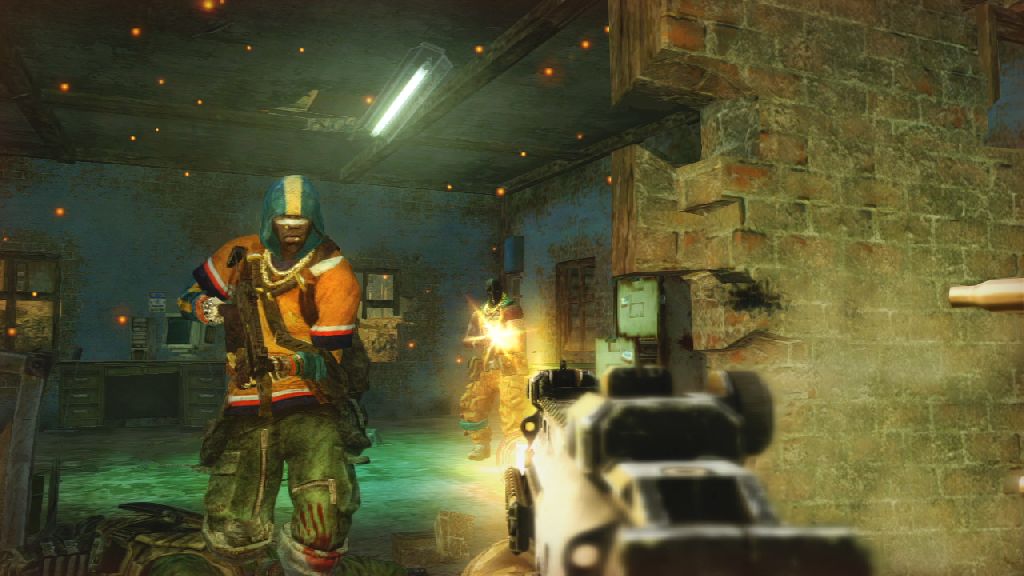
The enemy AI is at times kamikaze, at others blind. Enemies will charge at you head on through huge open areas, which makes sense for the explosive carrying mercenaries early on but not the sci-fi super soldiers. Some seem to have a hobby of squatting down in the open to reload their weapons whilst you stand there filling them with shotgun shells. It’s an odd mixture! Some levels find you up against two armies, and whilst they do fight each other, there’s a bit too much of a tendency for them to all focus on the lone guy crouching behind the crate in the corner.
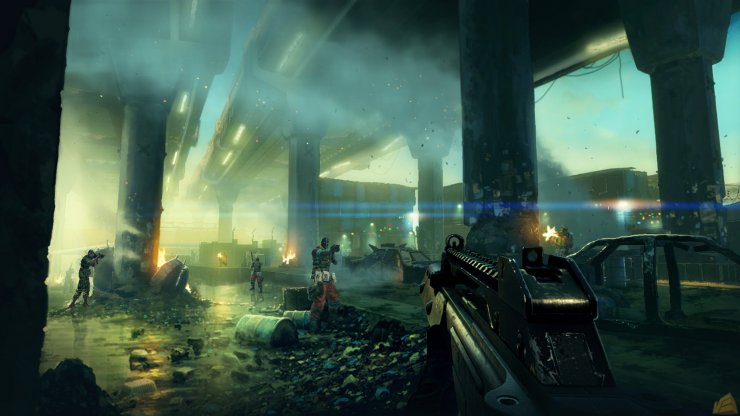
Given that Bodycount’s big selling point is destruction, that crate won’t last long. Although some things are mysteriously indestructible the effects are really well done, with concrete flaking off pillars to reveal the supporting steel inside. Most of the objects I gravitated towards for cover would be quickly shredded, so you have to stay on your toes. It can get a bit frustrating when nothing seems to be able to protect you though, and the game has a habit of throwing enemies at you from every side and from every doorway.
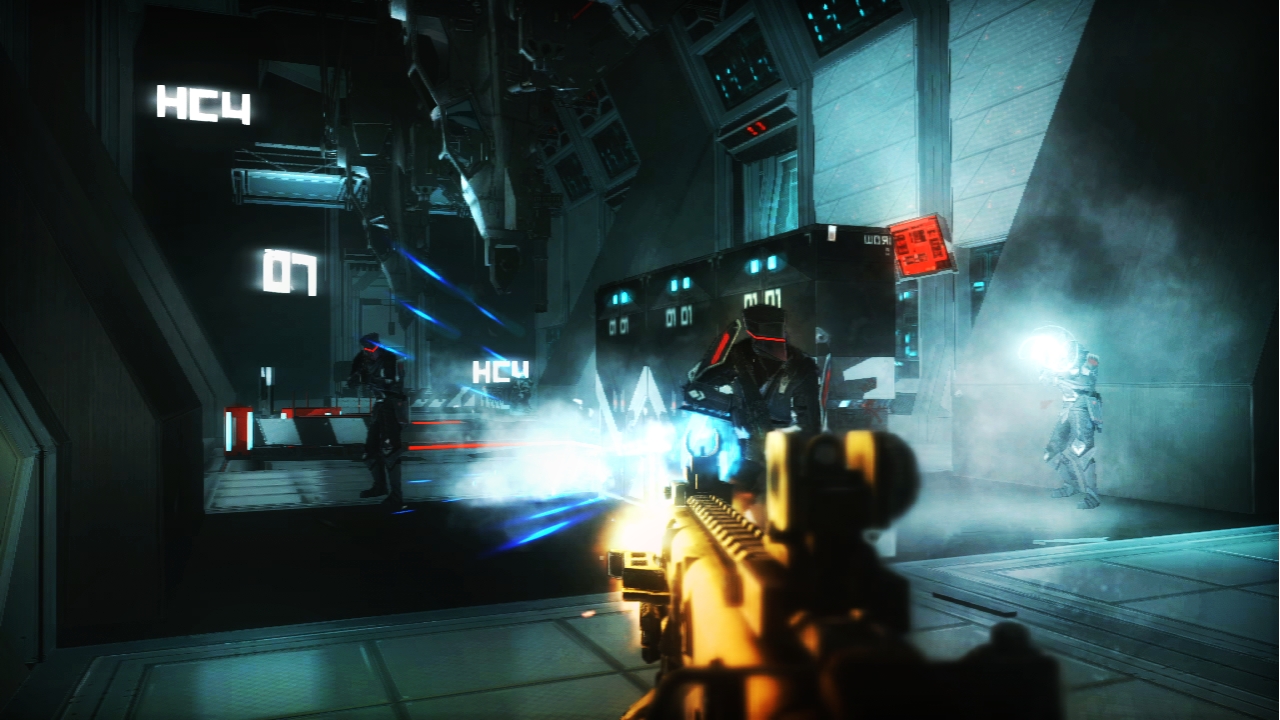
The Africa and Asia set levels are well constructed, giving players a lot of room to manoeuvre. It’s a shame that there are no collectibles or pick ups to be found though, the space is just there to be run through. The stages set in the sci fi base force a different style of play, pinning players into smaller rooms and narrow corridors that require a bit more consideration. The destruction system comes into play here too, smashing glass panels to break into some hidden cover.
There’s little variation in the missions, and most could be described by two words, ‘shoot everything’. There are attempts to break this up, calling in airstrikes to destroy comm links, ‘hacking ‘ into computer terminals (push square and wait!), but really it’s a case of going from A to B with your finger on the trigger.
As far as the multiplayer goes I can report that running around a huge map with one other player is incredibly pointless, but that was all I could find – Bodycount’s online mode is dead in the water.
Audio & Visual:
Graphically the game is fine, though it lacks the sharpness of some other titles. The Africa and Asia settings go in for a realistic style which has been seen hundreds of times before, although it does at least have more colour than it’s brown obsessed cousins. The Target base levels look like something out of Tron, all white and black and glass with neon lining. It’s completely at odds with the style of the Africa and Asia levels, and it really jars when you find a huge glowing white and red vault door in the middle of a rundown building made of splintered wood and corrugated iron. How on earth is that base supposed to be secret? It is all a bit bland after a while, and repeating the same handful of settings doesn’t help. The enemies suffer from the same problem of repetition, and in later levels can be a bit difficult to spot.
The sound is a strong point, and is just as it should be for the genre – loud. When the bullets are flying and the obligatory barrels are exploding it sounds great, and the music kicks in with some adrenaline pumping electro to let you know that what you’re doing is AWESOME. I was a bit unnerved by the constant chatter in the African levels despite the fact that nobody was around but other than that Bodycount does well for itself on the audio front.
Overall:
Bodycount is by no means an awful game; the fire fights are a good dose of frantic, high energy fun, and the story is still an interesting one even if it isn’t used to its full potential. Yes it has problems, and the campaign is far too short to warrant a full price purchase,( especially with the lack of online community) but the main issue for Bodycount is the competition. What chance could it possibly stand against FPS juggernauts like Call of Duty, Gears of War, Halo, and Resistance? Some of these franchises have been running for nearly a decade, and have had all those years and numerous sequels to iron out the kinks and polish the product to perfection. Players have their own favourite franchise that they know and love, and it takes something great to pull them away – Bodycount just doesn’t have anything unique about it to do that. It’s a real shame that a genre can get to this point, but if you’re developing a new FPS there’s just no room for ‘OK’.