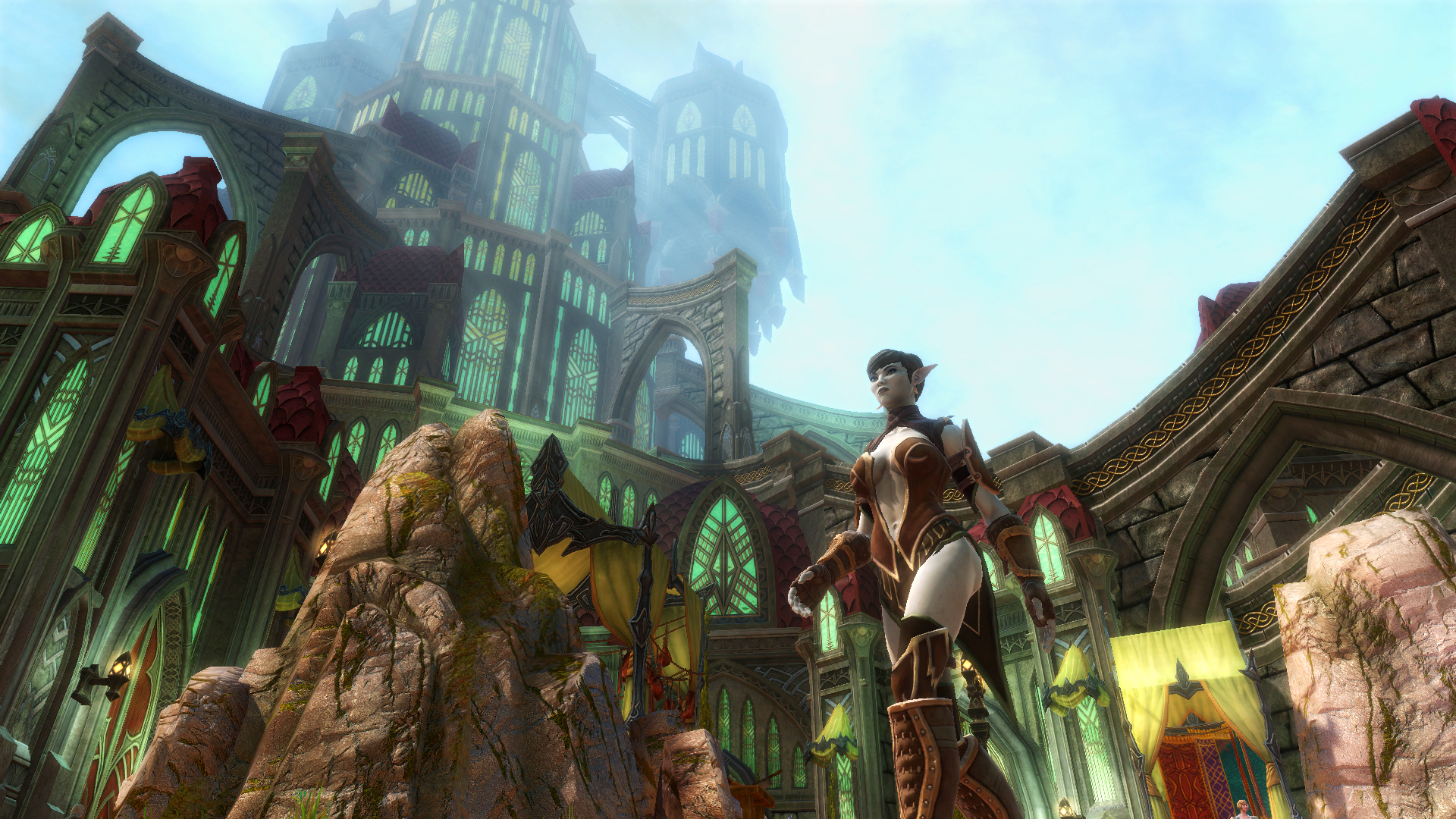
Kingdoms of Amalur: Reckoning is something of a sleeper title at the moment, but it certainly shouldn’t be. From what I’ve seen of the title already it appears to have the scope of an older Elder Scrolls title combined with the fighting style of Fable. You will see what I mean when you see the video that was released today for the combat of the title.
The developers themselves provide a bit of a walkthrough on how various skills and abilities can be put together to create devastating chain attacks. Of course combat also revolves around the fate mechanic which is being pushed heavily for Kingdoms of Amalur: Reckoning. We’ll be seeing much more of this title in the months to come as it is scheduled for release sometime early 2012.
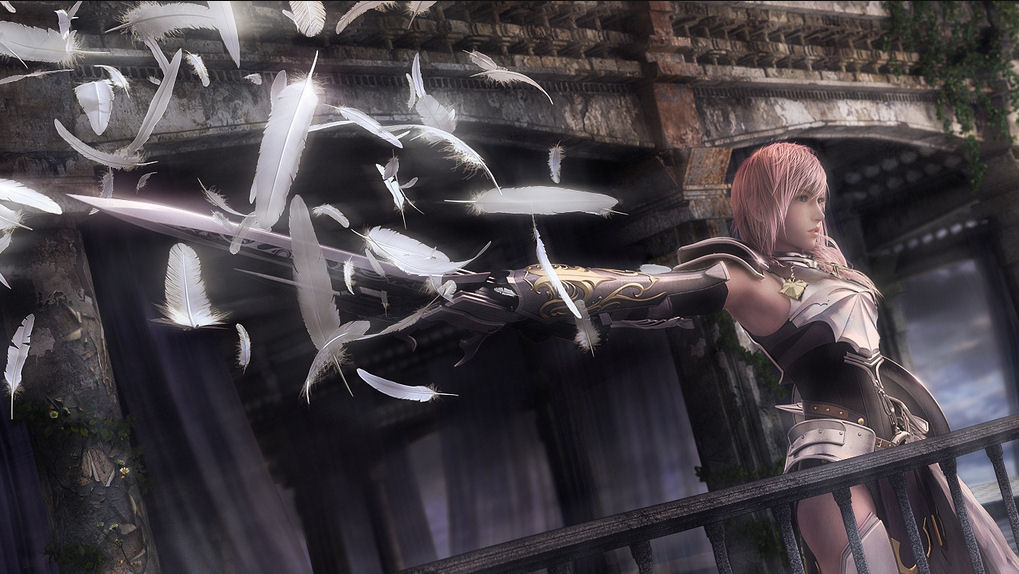
While we may not know yet as to how Lightning got to where she is now in Final Fantasy XIII-2, it is quite obvious she is an important person there. Square Enix has released a two minute video where we are treated to quite an epic looking battle that takes place in Valhalla. In the video it appears that Caius, the bad guy, is invading Valhalla with an unknown force of soldiers.
It also appears that this guy has powers to outdo even the final bosses of Final Fantasy XIII. Also, those wager to see the quality of FFXIII-2’s CG work should be happy to see that it is still top notch. Final Fantasy XIII-2 will land in Japan on December 15th while those in North America have to wait until January 31st to tackle the next Final Fantasy tale.
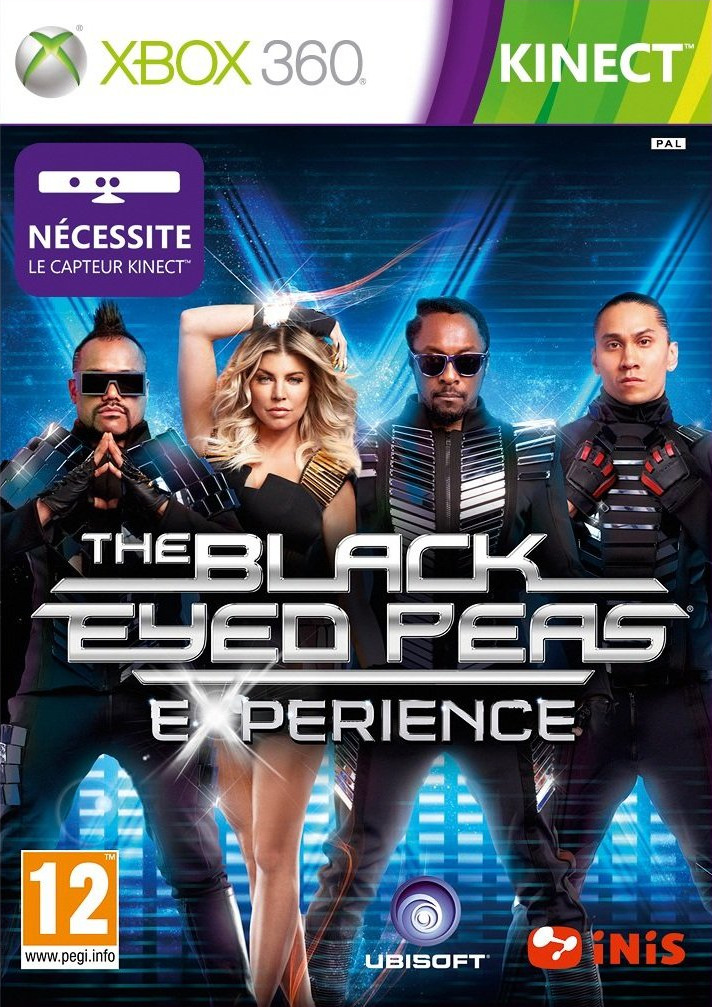
The Black Eyed Peas Experience Developer: iNiS Publisher: Ubisoft Platform: Xbox 360 Kinect (Wii) Release Date: 11th November Available Here
Overview:
This time last year Michael Jackson: The Experience made it onto Wii, before Kinect was later supplied with a version in April 2011. Now The Black Eyed Peas are giving you an experience with them. I must admit, initially I was a bit sceptical about the whole thing. I’m not questioning The Black Eyed Peas’ popularity as most artists would come out second best when compared to Michael Jackson, but he’s a tough act to follow and on paper it appeared to simply be a move to make a quick profit. I was pleasantly surprised to find it was a decent dance game, then.
The BEP are big; Where Is The Love topped the charts in many different territories worldwide and announced their arrival to the music scene, and they have since moved with the times musically, following the trends and producing a much more ‘dance’ sound. This new sound works in their favour, though, as the new tracks are more suited to dancing to. That’s not to say there isn’t any of their older material on the game, though. In fact, scrolling through the setlist of 28 songs and seeing all the album art, you realise just how many records The Black Eyed Peas have released over the time they’ve been active, with songs from older albums like ‘Elephunk’ and ‘Monkey Business’ as well as their latest album ‘The Beginning’.
Gameplay:
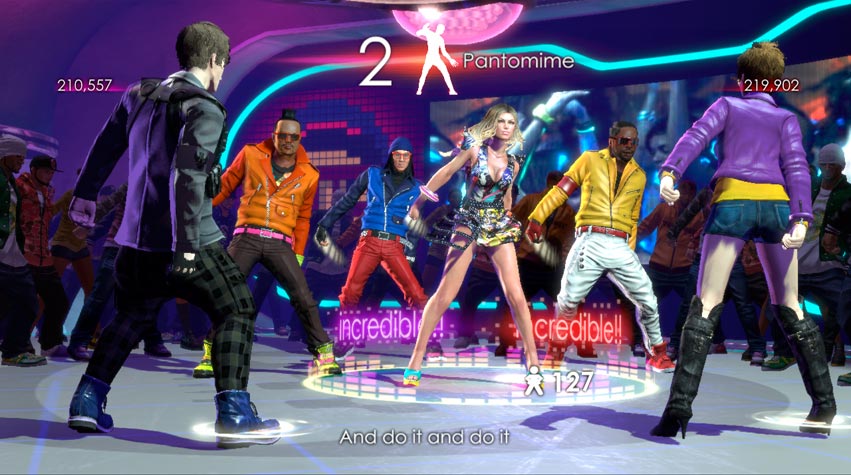
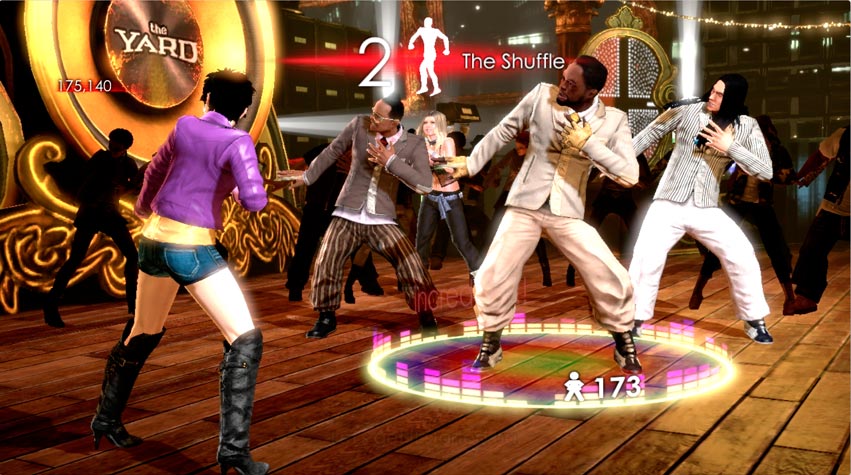
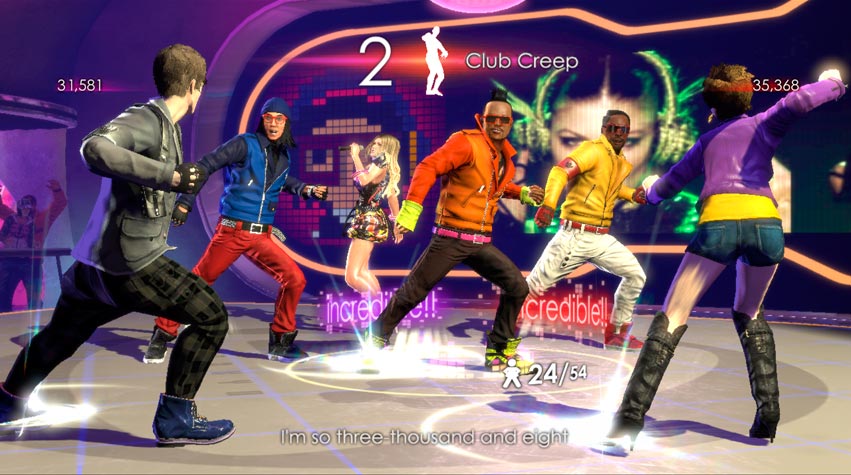
Of course, gameplay is made up almost entirely of dancing, with Kinect tracking the movements of your arms and legs and your body position to see how well you are following the moves. Your execution of each the dance move is judged with ratings of almost, good, great or incredible, with your final standings represented with a exam-style grade: ‘C’ or above is classed as a pass. The two modes are ‘dance party’, catering to your instant action needs if you’re playing with friends, or the more progress orientated ‘deluxe experience’ in which the grades you get have more weight, as a C or above will mean clearing the stage/song so that you can move on.
Depending on the mode you’re playing, your onscreen guides will either be the Black Eyed Peas themselves, or a set of backing dancers while you learn the routines before the main performance. Whoever your main guides, your in-game avatar will be standing onscreen facing them from the same perspective as you facing your Kinect. There’s also usually plenty of other dancers dancing away in the background to give the locations some added activity. All this contributes to a feeling that you are in a Black Eyed Peas music video, almost as the choreographer standing out of view and facing the group, except from the fact that you are following their moves, not the other way around.
The deluxe experience mode has a wonderful way of teaching you the dance moves; before you perform the main routine for each song, it makes you work through three steps. Each step contains three dance moves, making for a total of nine different moves in the real thing, where they are thrown together in a order you won’t have come across. By forcing you to work your way through these practices it simplifies the final routines and you end up doing them far more accurately than you would if you jumped in without preparing. You actually feel like you are learning the dance moves and doing the choreography correctly, an aspect that most other dance games overlook with the exception of the Dance Central games.
Satisfying clinking sounds and glinting visual cues accompany the tracking and scoring of each dance move, but success is also measured in another way. Well-executed moves earn followers, and the deciding factor on whether you pass a song or not is whether you have reached the required amount of followers by the end. Your rewards outside the song are also based around the amount of followers, because as the number continues to grow you upgrade and unlock venues, and unlock new clothing to dress your character in.
Multiplayer allows a second player to enter the fray with ease, simply by stepping in and being given their own character. It is also here that the singing sections of the game come into play, although the game can be enjoyed very well without them and they are best ignored. Those looking for a karaoke game should go elsewhere, as The Black Eyed Peas Experience is better for just dancing. In addition, you can create your own choreography in a dedicated creation mode which encourages you to share routines with friends, although it manages to simplify it to the point where you can’t achieve the effect you want, while still overcomplicating it so that the compromise isn’t exactly easy either.
Visuals:
The graphics manage to convey the likenesses of each member of the group, capturing some of their personality in the movements. Much of the choreography is recognisable from its appearances in music videos, as it’s all moves from one of The Black Eyed Peas’ choreographers. However, although ultimately it doesn’t have a major bearing on the gameplay, there are only four stages meaning repetition becomes apparent even very early on. You can edit your character’s appearance to mix things up, but this is rather pointless as you spend most of your time looking at The Black Eyed Peas dancing as you follow their motions, and their outfits only change between each of the four levels but otherwise remain the same.
Overall:
The Black Eyed Peas Experience left me with a sweaty back and a new-found love for The Black Eyed Peas. The structure in place ensures you learn the moves, ultimately allowing you to have more fun as you will be doing them correctly. Occasionally you can feel it’s a bit lax with the movement tracking, although it’s never anything serious. Repetition threatens to affect the ‘Experience’ you’ll have with The Black Eyed Peas, and the selection of 28 songs can be stretched a little thin after a while, but if you consider every last one of the tracks comes from the same group then the variety they’ve managed to achieve is something quite special. It lets you fully appreciate the groups versatility and prompts the conclusion that they do deserve their own game. Even if they aren’t as legendary as the King of Pop. It may not be the complete package, but I Gotta Feeling that for neutrals and for those who love The Black Eyed Peas, it’s a top-notch dancing game.
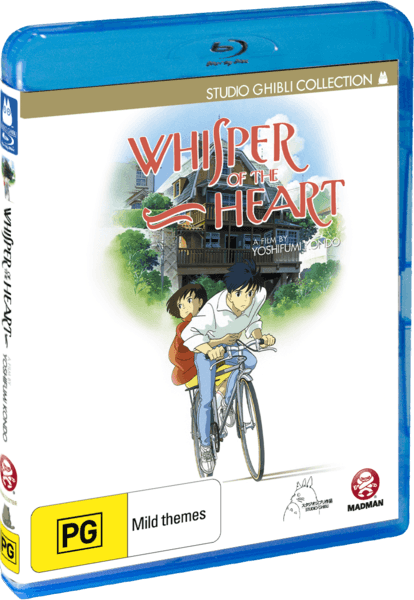
Whisper Of The Heart Studio: Studio Ghibli Publisher: Madman Platform: DVD/Blu-Ray(reviewed) Release: 16/11/11 Price: $39.95 – Available Here
Overview
For decades Studio Ghibli have been entertaining people across the globe. A joy for young and old, their heart touching stories are conveyed through a unique and beautiful animation style that is nothing short of a pleasure to experience. Originally released in 1995, Whisper of the Heart is no exception to the animated mastery fans have come to expect from Studio Ghibli. Adapted from Aoi Hiiragi’s manga of the same name by the talented Hayao Miyazaki, Whisper of the Heart is the first Ghibli film to be directed by someone other than Miyazaki himself. Yoshifumi Kondo took the role of director for what sadly, is his only film ever made. Luckily for us, Kondo’s masterful direction has been released in all its cinematic glory as a blu-ray disc, with extra bonus features for fans, new and old, to enjoy.
Story
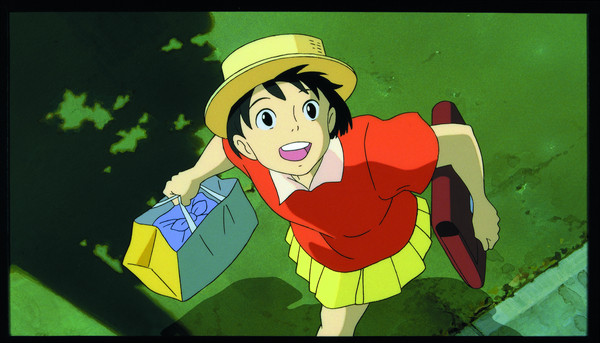
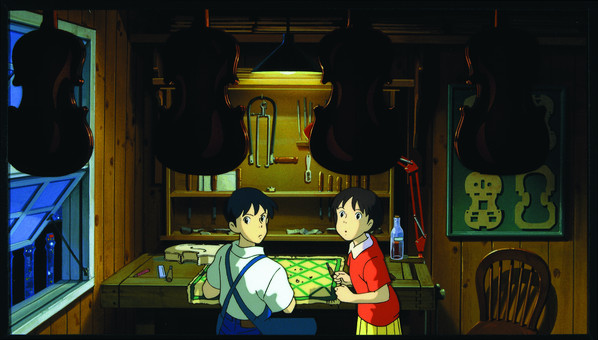
A bookish young girl, Shizuku Tsukishima, spends her last remaining weeks of junior high with her head buried in works of fiction. As she attempts to read twenty books before summer is through, she starts to notice a familiar name appearing on the book’s library card, Seiji Amasawa. Through a series of seemingly coincidental events Shizuku and Seiji cross paths and discover their desired direction in life. Seiji is destined to become a great violinmaker, while Shizuku wishes to become a writer. Unfortunately their paths pull them apart. But they are both determined to remain true to each other.
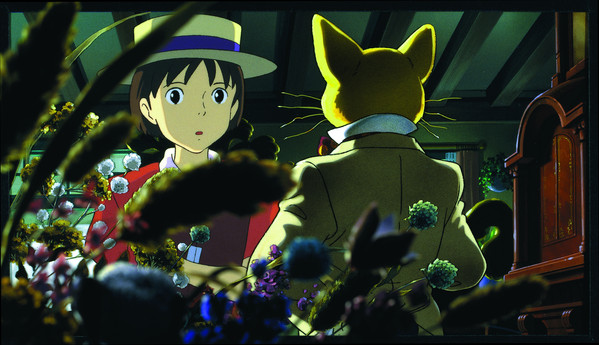
As Shizuku tries to find the mysterious Seiji Amasawa from her library books, she finds her way into an antique store where she encounters Baron Humbert von Jikkingen. The Baron is a statue of a cat, wearing a suit and top hat. As the story progresses, and Shizuku strives to become the best writer she can be, her story brings The Baron to life, and also brings up long lost memories of love for the own of the antique store, Mr. Nishi. While Shizuku has a lot to learn about being a writer, she is dedicated to try her best in order to earn the respect of Seiji. Mr. Nishi critiques her work and gives her permission to use the story of the Baron and his long lost Baroness as the characters for her tale. At points, the story moves from the real world, to the world of Baron Humbert von Jikkingen, and also brings memories of the antique shop owner Mr. Nishi to life as well, much the same as Shizuku’s story does. The tales are beautifully weaved together and seamlessly create a narrative arc that stretches through out the film.
The story line is typical of Ghibli’s works: a coming of age story with a strong female lead. But this by no means makes it any less compelling. Intertwining stories of hopes and dreams, of love and density are beautifully conveyed through simple, yet heartfelt animation.
Visuals
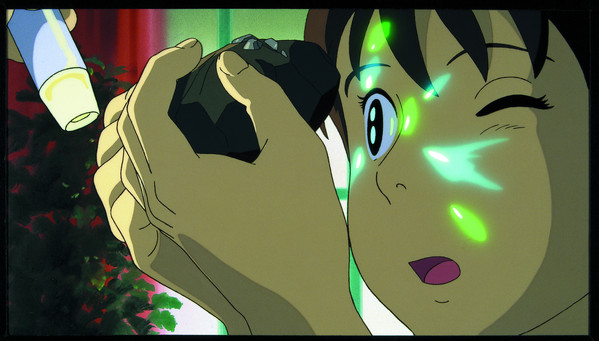
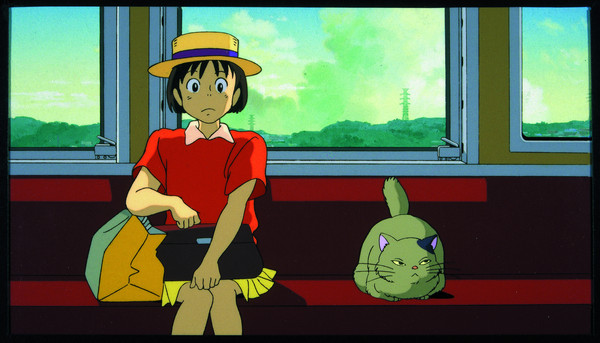
The visual style of Whisper of the Heart could be conveyed most accurately by Shizuku’s rendition of the song “Country Road”. Her lyrics read “concrete road, continuing forever, concrete road” and are used in the film to describe the children’s view of Tokyo. While the city of Tokyo may be the scene of the film and the lyrics may accurately describe Tokyo, Kondo, has transformed the city to be much more than a continuing grey road. The mundane elements: the subway, Family Mart and even stairs and streets are beautifully constructed to make a sprawling city, and indeed a self-contained world. The city isn’t conveyed as bleak, but as inspirational. These scenes of the ordinary are juxtaposed by leaps into the imagination of Shizuku through her creative writing. If the scenes of Tokyo are beautiful, then these are simply fantastic, with floating worlds and disproportionate landscapes. Shizuku and The Baron leap across this magical world hand in hand, and Kondo takes us along for the ride with them.
Audio
If there is one flaw in Whisper of the Heart, it is the audio. Not so much the audio, but the repetition of one particular song, Country Road. This is the opening music to the film, and isn’t the best way to welcome you to the journey you are about to be taken on. That being said, when the credits roll and a Japanese rendition of Country Road begins to flow from my speakers, I immediately grow nostalgic and want to watch the movie all over again. Through out the film, there is a subtle soundtrack running alongside the brilliant voice acting, of both the English and Japanese actors. Sadly, the soundtrack itself is not spectacular, but does work well within the parameters of the film.
Extras
Sadly, Studio Ghibili films seem to be lacking in special features on their DVD releases. Often they will include a Japanese cinematic trailer, and sometimes trailers for other Ghibili features. Ghibili fans will be spoiled for choice with this blu-ray re-release of Whisper of the Heart. The disc has both storyboards, and background art: giving insight into the artistic style that Ghibli fans have grown to love. There is also an emphasis on the soundtrack side, with an extended version of ‘4 Masterpieces of Naohisa Inoue: From Start To Finish”. There is also a short documentary-style behind the scene segment called “Behind the Microphone: Making of” which features the English voice actors talking about the process of dubbing the Japanese original. For English speaking fans such as myself, this was a real treat to witness the process of not just shifting languages, but also making sure none of the subtle nuances present in the original film are lost in translation.
Overall
While it may not have an overtly fantastical plot or visual style and the soundtrack is a little lack luster in comparison to over Ghibli films, Whisper of the Heart still holds it’s own against some of the greatest animations to come out of Japan, nay the world! If you are a fan of Studio Ghibli, this will be a welcome edition to your collection. If you’re not, what is wrong with you? Whisper of the Heart is a beautifully composed and subtle edition to the Ghibli collection, and it is no surprise that director Yoshifumi Kondo was set to take on the leading role at the studio before his untimely passing away.
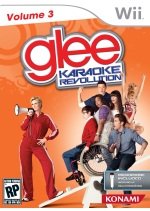
Gleeks everywhere! Calm down your constant replays of the Rumour Has It/Someone Like You Adele mash-up and listen up! The third volume of Karaoke Revolution Glee is now available for Wii and Xbox 360.
Konami Digital Entertainment and Twentieth Century Fox have officially released Karaoke Revolution Glee Volume 3, with the largest song lineup to date, with 35 brand new hits, memorable performances and exclusive footage from Season 2!
Sing along in multiplayer games of up to six players, and – for the first time – you get to belt out your favourite memorable performances from Season 2 from episodes such as “Britney/Brittany”, “Auditions”, “The Rocky Horror Glee Show” and more.
As with the soundtrack of Glee itself, there is a huge range of songs from iconic pop songs, to ballads (not the male duck), duets, and even some hip hop (as long as there’s no Mr Schue raps I’m cool with that). With a set list spanning across decades, the whole family just might want to join in.
As long as having a good amount of songs available with the game you can also purchase downloadable content on Xbox Live for $1.99 (or 160 Microsoft points) for each or in a bundle for $9.95 (or 800 MS points).
Karaoke Revolution Glee Volume 3 is available for Wii and Xbox 360 in the US for $49.99 with a microphone and $39.99 for just the game.
Check out the Facebook page here or the Konami site for more info!
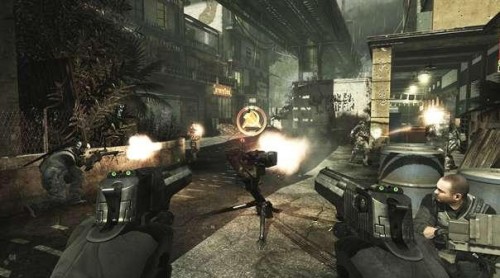
So do you remember back on November 8th when Activision announced that 3.3 million players had been concurrently playing Modern Warfare 3 over Xbox Live?
“Uh…oops,” says the PR representative.
In a statement released today, Activision retracted the statement, saying that the correct figure was 1.4 million simultaneous users. The mix up was created by the fact that on November 8th 3.3 million players blasted each other over the course of the day, but they weren’t all online at the same time.
The funny part is, despite the embarrassing admission, 1.4 million simultaneous users still blows most games right out of the water, so yes, Call of Duty: Modern Warfare 3 is still the game with the biggest launch in history.
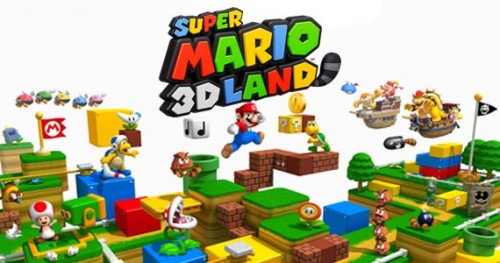
Mario is returning with a big bang in the next couple of weeks. However, it is all new again as he debuts on the Nintendo 3DS. Last night, Nintendo hosted an event showcasing Mario’s latest portable adventures. Fellow Capsule Computer Editor Michael Marr (also known as Spike) gave his impressions on Mario Kart 7, while Capsule Computer Editor Claire Phillips recounted the events of that night. So, what was I in charge of? Well, unless you did read the title of the article, I was in charge of playtesting Mario’s latest adventure through the Mushroom Kingdom in Super Mario 3D Land. To put it simply, this is going to be one of the best portable titles this year.
So, after trying out some Mario Kart 7, the three of us moved on with Super Mario. The first thing I had noticed (after loading the file already there) was how they have designed the map. In previous outings, notably the first trilogy, it was a 2D map where you move Mario around. This time, it is a straight line with the level confined into a cube. What I liked is the quick selection of the worlds. At the top of the map, each of the worlds are tabbed. If you have finished a world, tapping the tab will teleport you straight back to that world. Just like most of the 2D games, Super Mario 3D land will feature eight worlds.
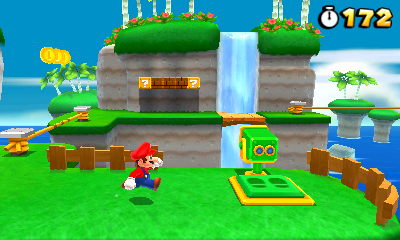
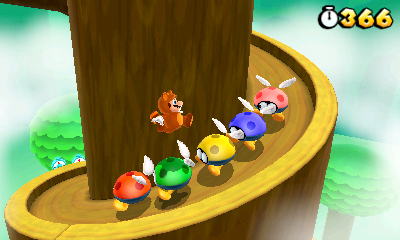
Alright, so what about the levels themselves? First off, they look very impressive. They are vibrant, colourful and bright. The animations are smooth. But the level design is what makes this game a must own. The 3D feature in the Nintendo 3DS has been called gimmicky, but I expected Nintendo make the 3D essential in a game like Mario. I can proudly say that the 3D is not only essential, but it works. The level revolves around the 3D. In one particular level, I had to guide Mario down platforms of clouds. The perspective was top down. The 3D added depth to the level. It looked liked I was actually free-falling in the sky towards these platforms. This is one of the most standout sections of the level. The gyroscope controls do make a cameo as binoculars at certain levels. It allows you to see where the end of the level is.
Alright, now there is one more thing that I need to speak about that I have not mentioned in this preview at all. It is the main focus of Mario’s new adventure. I am talking about, of course, of the famed Tanooki Suit. It had made its debut in Super Mario Brothers 3 and makes its return in Super Mario 3D Land, as well as the leaf making its debut in the Mario Kart series in Mario Kart 7. The Tanooki Suit looks very good in 3D. The classic racoon look never looks better, with the finer details, like the underskin, given the attention it deserves. The classic tail whip is back and very useful. however, as the levels are 3D, you won’t be able to glide yourself from one end of the level to the other side, meaning that P bar in Super Mario Bros. 3 will not reappear. The gliding element is still implemented, however, and it will help you with reaching the top of the flagpole at the end of the level. I mean, it is going to be a great way to gain those extra lives.
All in all, Nintendo are once again bringing the big guns with their own hardware. Alongside Mario kart 7, Super Mario 3D Land will bring out the best of the Nintendo 3DS. With the levels taking advantage of what 3D has to offer for those still sitting on the fence. The game also brings out the best of the 3DS graphical capabilities, with the bright, vibrant colours that bring out that Mario charm. The Tanooki Suit’s reappearance also adds a new element of gameplay while bringing back a popular power up, which is surprising that they are bringing it back now. Drop your smartphones, people, as Mario is back and better than ever.
Super Mario 3D Land is in stores November 24, which happens to be tomorrow.
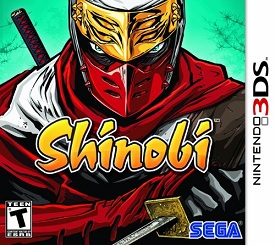
Shinobi Developer: Griptonite Games Publisher: Sega Platform: Nintendo 3DS (Reviewed) Release Date: November 15, 2011 Price: $39.95 – Available Here
Overview:
It seems the most popular thing to do at the moment in the video game industry is to reboot an old franchise or revive it from the dead with some sort of sequel. While Sega usually focuses on everyone’s favorite blue hedgehog for revivals, they have chosen to revive a favorite that hasn’t seen much love from the company in a while.
The series I speak of is Shinobi. Shinboi was originally created back in 1987 as a stand-up arcade cabinet that you could find in arcades around the world. This fan favorite title is back now on the Nintendo 3DS and Sega has entrusted their series to developer Griptonite Games. Will this revival of the title bring the Shinobi title back into the limelight?
Story:
Those with long memories, or at least those who have played one of the ports of the original Shinobi should remember that the hero of that story was named Joe Musashi. Joe won’t be returning for this Shinobi however as players will be taking over the role of his father, Jiro Musashi who is also a katana wielding member of the shinobi and in fact the leader of the Oboro clan.
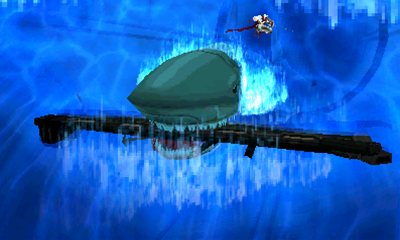
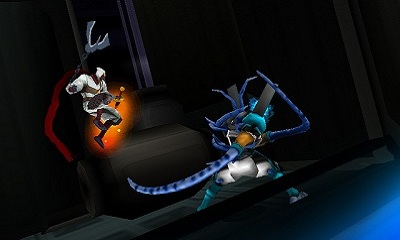
The story begins in the Feudal Japan and Jiro’s village immediately has fallen under attack by an enemy clan. Now while the story begins in 1256, it won’t stay there very long. In fact the story takes a rather strange jump through a vortex in time that takes Jiro into the year 2056 where he must face off against the same people who burned down his village 800 years ago, as they have since amassed a massive army full of futuristic soldiers and genetically enhanced creatures to stand in your way of revenge.
As a whole the story of Shinobi is decently told and players should have no actual issue following what is going on, though they may be a bit perplexed as to why a future jump had to occur in the first place. The eventual combination of ninja versus futuristic armies is an odd one at best but it at least provides a complete change in scenery once the jump through time has occurred.
Visuals:
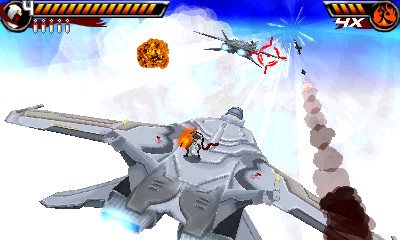
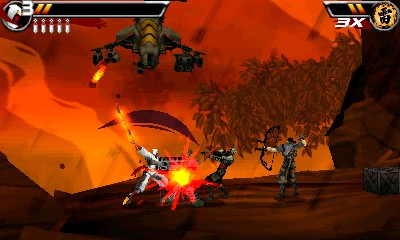
The Shinobi that most gamers may be used to is obviously quite old and it is great to see the series take the jump into more modern graphics. Rather than feature any pixelated characters the characters spring to life with modern techniques and high quality texture. While most of the enemies you face off against will begin to look quite bland as you see the same type of enemy way too often for enjoyment, they are at least well detailed and animated well. The levels themselves are quite detailed and the amount of special effects when the player activates their ninja magic abilities is also a nice treat for the eyes.
Being that Shinobi is a title on the Nintendo 3DS, the 3D enhancement to the series has been performed quite well. The 3D provides plenty of depth to the levels which usually are played on a 2D plane. The 3D really shines however whenever the game decides to switch into a more 3D plane. This means as you go through the level or ride through on your horse there will be plenty of pieces of the environment popping out at you with surprising accuracy. Still, there were times I found it more enjoyable to play with the 3D off as it either grew to be annoying or simply made the game more difficult.
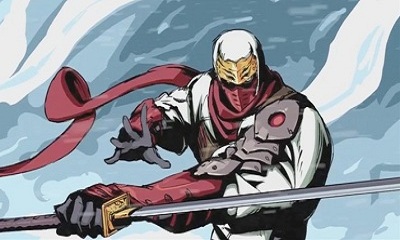
Besides the 3D and gameplay graphics themselves, the short but sweet cutscenes deserve an honorable mention as well. The cut scenes feature animated artwork and pop up at various parts in the title. The artwork for these cut scenes is gorgeous and look like something you would see in an animated feature. It is a shame however that the cut scenes do not support 3D at all and will automatically shut off the 3D function whenever one begins.
Audio: When the story is presented in cutscenes, whatever dialogue is present is fully voiced but sounds unfortunately generic that does little to enhance the experience and in the end is easily forgettable. The background music on the other hand does a great job setting the tone well by providing a very oriental sounding theme that fits the Japanese environment nicely. Unfortunately sound effects are rather bland and completely lifeless, which means that it is great that the soundtrack is at least nice as it usually overrides the lackluster sound of the rest of the title.
Gameplay:
Shinobi was originally a title which would certainly test the skills of the player and this Shinobi is no different. Players are presented a difficulty level to choose from when they choose to start their game up, ranging from either Beginner to Very Hard and let me just say that even those playing on Beginner will find the task to be quite challenging despite being provided with unlimited lives. Those who play on the Very Hard difficulty, I tip my hat to you as higher difficulties provide fewer and fewer lives and harsher punishments for running out of them.
Players are equipped with a katana sword, kunai (throwing knives), a chain to help get around easier that can also be used as a weapon occasionally and four different elemental based magic attacks which not only kill nearby enemies but also provide various buffs for Jiro, but the use of Magic must be earned through successfully killing enemies, or dying. Plus, while using magic may help you make it through a difficult section of the game it will also punish you by providing a lower score once you finish the stage you are playing on.
Oh and did I mention that you are being scored? In fact players are scored on nearly every single thing they do. Most enemies will die to one strike with your sword or thrown kunai, but players are encouraged to chain together attacks to earn more points. You see, players earn points for hitting enemies, even multiple times. They also earn points for parrying knives and other attacks, breaking objects and collecting items dropped from said objects or littered around the world as well.
The player can lose points however by either taking too long to finish a stage, or are even actually damaged in any form. This means if you are hurt from being hit by an enemy, an environmental hazard or anything of the like, points will be deducted. Dying on the other hand will completely set your score to absolute zero, which means trying to be the perfect ninja is the best way to finish with a high score. In fact, while players can earn point multipliers for chaining together successful attacks and accomplishments in the game, the multiplier is automatically reset to zero the instant any damage occurs.
Oh and damage will occur, there are plenty of moments in Shinobi where surviving takes not only skill but proper timing as well. Even with an adequate amount of skill with the title experienced players may not survive areas simply because their timing was slightly off and will instead die to either a trap of some sort or falling into a bottomless pit. This makes runs through the game on anything but Beginner difficulty a serious challenge and often one that will leave most players frustrated and annoyed at cheap deaths and level design.
To Shinobi’s credit, the controls are very responsive which is a must in this title which involves very intricate platforming that may as well be classified as a puzzle all their own. On the other hand, one mechanic in the game which is just dreadful is blocking, or should I say parrying. In most games and you would think even in the ninja world, the fighters would be able to hold and sustain a block for as long as you could stand the blows of the opponent. In Shinobi however, blocking is a simple wave of Jiso’s sword that has to be timed perfectly or you will miss parrying the attack and instead suffer damage, which can be a complete stage ender if at low health.
While the difficulty is something that many will be turning their heads away from, the relatively small campaign itself is at least provided with some padding through challenge areas that can be either picked up through StreetPass or by unlocking with Play Coins. These challenges are even more difficult than story mode and the loss of a life will start the player right back at the beginning of the stage, providing the toughest challenge in the whole title.
Also provided to try and keep player longevity for those capable of standing up to the challenge are a number of in-game achievements to try and be obtained through either playing the game well or playing the game poorly. These achievements can be quite humorous when they are trying to be condescending to the player’s missteps. Along with achievements there are also numerous pieces of artwork, cheats to make the title a bit easier, pieces of music and also the history of the Shinobi series that can be unlocked to be viewed as well.
In the end Shinobi revels in its difficulty level and players will find themselves either reveling in their masochistic selves or finding the difficulty off putting. While I’ve played difficult titles before, none of them have felt as cheap as Shinobi’s difficulty level felt. The learning curve is extremely steep and this title will harken back to those who want to remember truly difficult titles that don’t give their players room for error.
Overall:
In the end Griptonite has done a fantastic job providing a bit of a modernization of the Shinobi series, however it seems very unfriendly to those who have not played a Shinobi title before. There is a decent amount of enjoyment to be had here for those who enjoy a challenge or like to die a ton without advancing further in a game. That doesn’t make Shinobi a bad title by any means however, as the combat and platforming is certainly enjoyable. Still the presentation is lackluster as a whole and most will probably set the title down after completing it once. Or spend hours trying to beat it on Very Hard and throw their 3DS out a window.
It’s attack of the tanooki’s with Dustin playing Super Mario 3D Land and PETA releasing a horrifying take on Mario. 3DS sales are up, we continue to gush all over Skyrim and Sony decides it’s a good idea to start a social network.
Cast: Alexis Ayala, Dustin Spencer, Michael Irving and Michael Marr
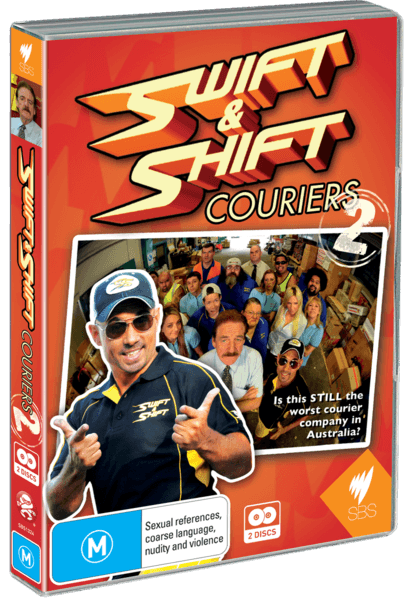
Swift and Shift Couriers Season 2 Studio: SBS Publisher: Madman Language: English Release Date: October 5th, 2011 Price: $29.95- Available Here
Overview:
It is sadly not a common occurence for us to see an Australian Comedy series. Amongst the crowded Australian television scene filled with Reality programmes and soap operas, it is easy to miss out on the great Comedy series that comes out of the country.
Arguably the most notable Australian Comedy series of the past decade is Pizza, a series created by Paul Fenech. Well, Fenech returns once again this time with Swift and Shift Couriers, which not only breaks ground that Pizza simply couldn’t but it also is without a doubt his best work to date.
Story: Pizza featured a large cast of characters with each fitting the bill of a hyper-exaggerated stereotype. This stereotype humour plays a large part in Paul Fenech’s comedic repeteur. It is a well he often goes to for humour and while he does return to said well for Swift and Shift, what makes it work so well is that it’s to a much lesser degree.
Swift and Shift Couriers, like Pizza follows a cast of characters delivering things, while Pizza was only confined to having it’s cast delivering Pizza and having the humour spring from the people they encounter during their deliveries, Swift and Shift’s humour is capable of being born from the objects they have to deliver. For example one episode focuses around characters delivering medical equipment which they are clearly not qualified enough to handle.
It’s this slight change in concept that allows Swift and Shift to break new comedic ground that Pizza couldn’t. As a comedy series it is hard to say that there is ever an unfunny moment in Pizza. No longer is Fenech constructing cut and dry hyper-stereotype characters, in their place is deep characters with deeper motivations and relationships than most Australian comedy series manage.
As for this season in particular, it featured an overall satisfying closing episode with all of Swift and Shift’s Hashfield Depot breaking out into utter chaos in a way that only they know how. It not only marked a comedic end to the series but also one that resonates with the viewer after following this chaotic cast all over the country (and even to other countries) over the course of the series.
All in all, Swift and Shift Couriers is undoubtedly one of Australia’s best comedy series it’s ever produced. But for those who are not fans of the Australian brand of humour, you will most likely find little enjoyment out of this series unfortunately.
Visuals:
When it comes to the visuals of Swift and Shift Couriers, there is such a wide variety to be seen, which is extremely unusual for a comedy series in general. With such a stunning contrast of suburban landscapes, cityscapes, deserts, snowy mountains and even the ocean, there is an utterly astonishing amount of aesthetic pleasantries to behold in this series.
It is simply an achievement from Fenech that he managed to fit in so much different sides of Australia in Swift and Shift. It not only works wonders for the series in keeping things fresh but it also conveys the beauty of Australia that most other Australian television series do not bother to do. It is clear that Fenech has a deep love of the country and by extention considers the country a canvas for his art, and that is what Swift and Shift really is – Aussie Comedy Art.
Besides the set pieces used, there is a common trend of a yellow and black colour scheme that is both instinctive of the series and in a way becomes it’s “Colours”. This is another way the series maintains a resonance with viewers. I know that I personally thought of Swift and Shift Couriers the next time I saw the colours “Yellow and Black”.
Audio: Swift and Shift features a soundtrack of songs that were not intended to be synonymous with Swift and Shift. The series does not feature an opening or ending theme song and instead features a large array of incidental musical pieces specifically chosen for specific scenes.
This makes the soundtrack difficult to comment upon but at the very same time easy to summarise. Swift and Shift’s soundtrack is not only wildly varied but also wildly original. What pushes the series beyond greatness is the way it is constantly changing. You’d be hard pressed the find a background track that reappears each and every episode.
As for the overall sound quality of the DVD itself, well there is little to say other than it sounds great. I can’t imagine there being any problems with sound for anyone watching this series.
Extras:
When it comes to special features, Swift and Shift Couriers Season 2, is no pushover. The DVD collection features a multitude of extras for fans to plow through once they have finished watching each episode. With over 80 minutes of extra footage for you to enjoy there is so much replayability for this release that it is honestly staggering.
If you are a special features junkie, you will definitely get a kick out of the sheer mass of material available here. It is definitely more than your average Madman release. Needless to say, I left Swift and Shift Couriers Season 2 a very happy customer.
Overvall: Swift and Shift Couriers, is not only one of the best Australian comedies this year, but also one of the best the country has ever produced. I can not express enough how much bombastic entertainment is packed into this series. Not only that, but it is unfortunately a common trend nowadays that it’s become less likely that you can say that a television show made you laugh. I can say with a hand on my heart that I laughed many times with Swift and Shift Couriers Season 2, more than I have laughed in a very long time. If you are looking for a laugh, Swift and Shift Couriers Season 2, is the right place to be looking.