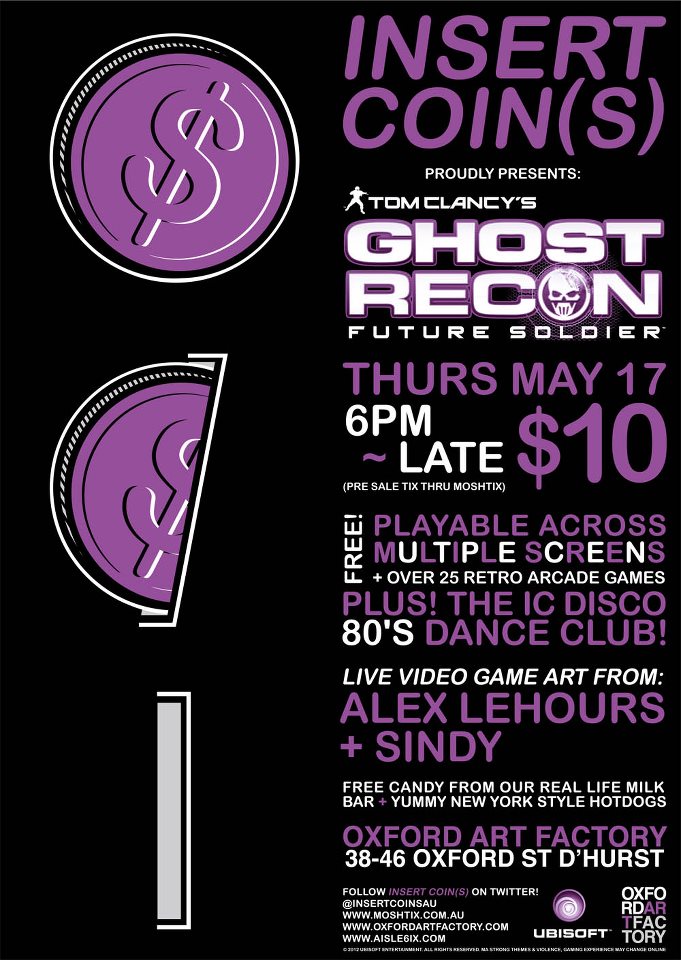
Keen to have a sneak peek at Ghost Recon: Future Soldier? Well, if you’re a Sydneysider then you’re in luck! Awesome gaming event, Insert Coin(s) is having a Ghost Recon: Future Soldier launch party on May 17, a week ahead of the release date. The game will be playable across multiple screens, so there won’t have to be any fighting with others to try and get a go at some Future Soldier goodness.
Insert Coin(s) is an event that pays tribute to old school arcade games, good music, art and geek culture. Oh and it previews awesome games like Ghost Recon. It’s just $10 for entrance to the event, which is quite value considering the awesomeness that is inside the event. Plus, there is a milk bar (which serves alcoholic milkshakes, spiders and free candy) and a New-York style dog vendor.
Plus, if you dress up in military costume you have a chance to win exclusive prizes from Ubisoft, so get yourself kitted up and grab some free swag! Plus, if you get the most likes on the Insert Coin(s) Facebook album by the end of the week then you win FREE ENTRY for the next event for you and four of your friends.
Whether you’re a hipster, a hipster geek, or just a plain arcade gamer geek, this is definitely a fantastic event for you. The Ghost Recon: Future Soldier launch event is on May 17 at Oxford Art Factory with the doors opening at 6pm for just $10 at the door.
For more information on the event visit the site HERE and the Facebook page HERE
The latest One Piece film was announced last year and just this past week had it’s title revealed to be One Piece Film Z. Now a teaser trailer for the hotly anticipated One Piece movie has made it’s way online and boy do they take the word ‘teaser’ seriously.
The trailer can be seen below. The film is set to feature a new villain created by One Piece author Eiichiro Oda. Alongside an Oda created villain, the film will be the first One Piece movie set within the New World.
One Piece Film Z is set to hit theatres across Japan on the 15th of December, 2012. Check out the trailer for One Piece Film Z below and let us know what you think of the upcoming film in the comments section.
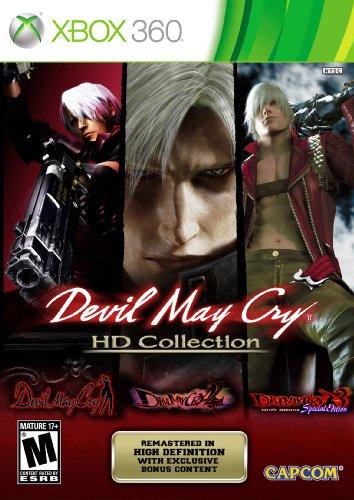
Devil May Cry: HD Collection Developer: Capcom, Pipeworks Software Publisher: Capcom Platform: Xbox 360, Playstation 3 Release Date: April 3, 2012 Price: $39.99 BUY NOW!
Overview
Before Vanquish, Before Bayonetta, and before God of War, Dante burst onto the scene in 2001 and introduced the world to a new type of action game. While third person hack and slashes were very much around 11 years ago, the Devil May Cry franchise brought about a more stylized and polished form of combat, with a killer soundtrack and top notch character designs to match. Today, the series has a hardcore cult following due to Dante’s past masterpieces, and lately, the entire fanbase has been awaiting the series reboot from Capcom, simply titled DmC.
I’ll admit it. I don’t care for HD remakes that much. Due to how much the industry has changed, playing an older game on a current console is just not the same. The flaws are more obvious, the newer graphical designs can seem forced and pixelated, and what was exciting and fresh then is now below average by today’s standards. This collection is for the first three Devil May Cry titles though, and if Capcom know anything about their fans, it’s how to tap on our nostalgia soft spots. How does everything fare as a complete package? Here is my review for Devil May Cry: HD Collection.
Story
For those who were unaware, the Devil May Cry series is not actually in order in terms of release, as Devil May Cry 3 serves as a prequel to the first game. Even with the odd numbering though, this franchise’s narrative is still as intriguing as ever and of course stars the badass demon hunter, Dante. The original title has Trish send Dante on a journey to take out the demon emperor, Mundus on Mallet Island, while the second steers to another territory and has our hero fight off a sharply dressed demonic entity known as Arius on yet another mysterious isle. In the prequel (DmC3), players get to learn more about Dante’s brother, as well as how the shop titled “Devil May Cry” came to be.
Those who are new to the franchise don’t have to pick a title based on it’s numerical order, as each plot stands strong on it’s own and doesn’t require playthroughs of the other titles on the disc to properly enjoy. With that said, Dante’s own story is expanded upon greatly throughout the trilogy, and learning more about the cocky main protagonist is plenty of reason to go through each Devil May Cry, even if the second isn’t quite up to par with the rest. One of the strongest elements this series had going for it was characters, and luckily each antagonist or ally you come across still has the same charismatic or sadistic charms, and that agelessness of the cast is further proof of why this trilogy is still very much relevant in today’s world of un-fulfilling sequels that are filled shallow and meaningless encounters.
Gameplay
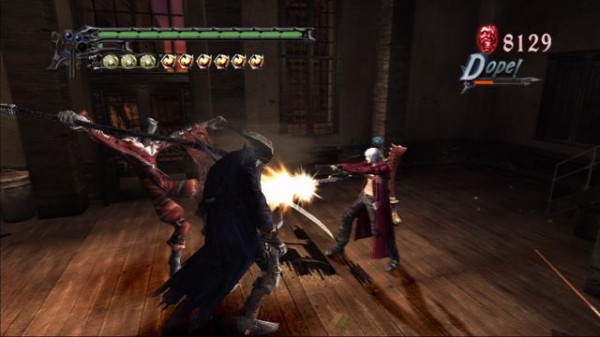
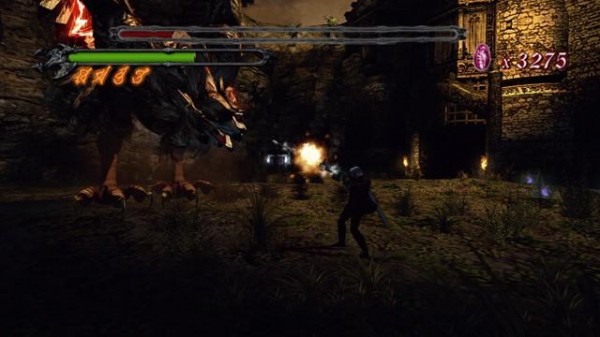
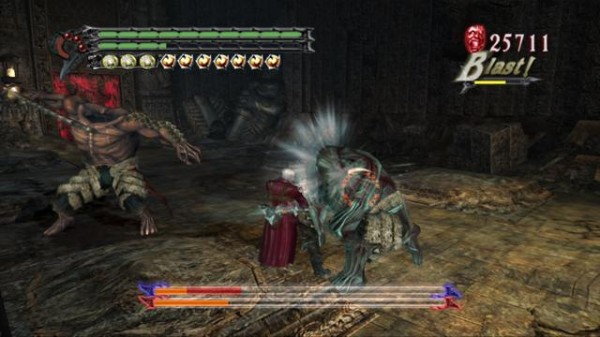
Running through all of the gameplay aspects of each game in the collection could take up pages, so with these remakes it would be best to just inform you of the basics. Devil May Cry as a whole plays out like your standard hack and slash action title, but with flips and flare thrown in to make the entire experience stylistic. Dante is a graceful swordsman, and can run up walls or float over an enemy to perform a kill. Players are also equipped with a set of pistols that can be used at anytime, which allows for a bit more variety to be used while taking down demons or the famed underworld bosses within the games. Bringing the combat full circle are the combos, which track the number of hits the player gets off before being interrupted. The more violence you incite, the more you are rewarded. That concept is the heartbeat of the trilogy and is honestly what made the games stand out then, and even more so now.
Evasive maneuvers also tie into the combat mechanics well, and make it easier to continue a chain without being stopped. Even though the story is what pushes the game along, the ultimate objective in each stage is to perform flawlessly and obtain the highest rank possible at the end. Weapons can be upgraded over time to make this easier, and each stage can be revisited later for those who crave perfection. It’s a solid scheme that allows for plenty of reason to keep going back in for more and luckily, extra characters can be unlocked to play through the entire game with all over again (for the 2nd and 3rd installment) that have a completely different feel from Dante.
As far as differences go, the black sheep of the trilogy is Devil May Cry 2. Not only is this title the easiest of the three, but it’s also the shortest and the most mediocre. Yes, the narrative and general gameplay are still decent, but a lot of the challenge was taken out for this entry and boss battles require a lot less strategy compared to the much more in-depth fights seen in Devil May Cry 1 and 3. On a higher note, I did find the world to be a bit more open and easier to explore, as it’s easy to see that this sequel attempted to rid the linear aspects from Dante’s first outing. It’s still the weakest out of all of the Devil May Cry series, but playing through all of these years later has definitely made me appreciate it’s existence more.
Devil May Cry 3: Dante’s Awakening is the standout release on the disc, and players have been treated to the Special Edition, which includes new bosses, the option for faster combat, and a lengthy yet enjoyable survival mode. This title also brought about varied fighting styles, which gives the player a choice of six different styles and switch between the lot at the beginning of each stage.
Visuals
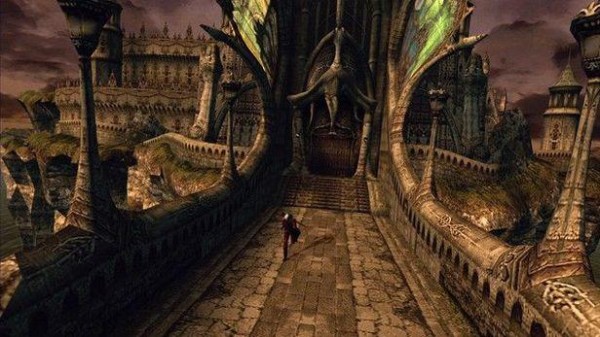
Everything I have mentioned so far should be known about Devil May Cry as to be honest, these three titles are old and a good number of us beat them to death years ago. This is an HD Collection though, and while the combat and story is the same, the graphics have been revamped entirely…well, almost entirely that is. Each model has been given a new coat of paint, making them now appear much smoother and ridding the characters from any unwanted pixelation from the past. Dante, Trish, Vergil, and the rest look better than ever before, and animations have been stabilized to run fluidly on any high definition television. This is great news considering the high emphasis on stylized animations, but those who wanted the same treatment for cutscenes will be a bit disappointed as they have remained untouched, leading to a glaring change when going from combat to a pre-rendered movie.
The textures within the environments appear to be a bit smoother, but it’s also a bit obvious that these areas were given much less attention than Dante’s (or any other characters) model. It wasn’t too long ago that I gave the original Devil May Cry another spin though, and I must say the gothic charm of the art design is still very appealing to myself, pixelated or not. As far as menus go, the main menu is rather generic and only acts as your hub to choose a title to play. Once you are in a game, you also must completely reboot the disc to choose another title. This is the norm for HD collections, but it would have been nice if Capcom could have combined content that was originally split on two discs (like the two campaigns from Devil May Cry 2) into one game.
As far as the sound goes, things have definitely improved, but nothing has really changed. That’s a good thing, if you were wondering. The rock soundtrack still blares up when enemies approach and what was great voicework then still stands strong today. Yeah, there are still some awkward pauses in dialogue and a few hiccups with the score, but it’s hard not to appreciate how much went into making this dark atmosphere come alive.
Overall
It’s easy to hate the existence of a HD Collection, as if done wrong they can harm one’s perspective of what might have been their favorite game of all time. Devil May Cry’s treatment however was pulled off to near perfection, stapling one of the most influential series together into one package for fans to enjoy for the first time, or all over again. While the artistic design will always remain as stunning in my eyes, the incredible combat system keeps Dante not only feeling timeless, but legendary as one of the heroes that truly kicked the action genre in the ass and showed the world how it was done…with style.
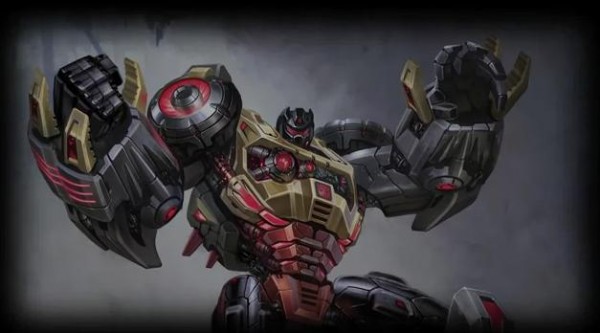
With the huge success that was War for Cybertron, it’s no wonder High Moon Studios have already started heavily promoting the follow-up, Fall of Cybertron. This time, we have been treated to a new trailer, showing off Grimlock in action. As the clip states, Grimlock will focus on melee attacks with his sword and shield, and honestly looks fantastic as this character seems to be one of the more unique within the game.
Although it’s a bit lesser of note, I also thought it was nice to have a developer so passionate about this project explaining how much went into creating the Dinobot, as all that passion has surely went in to making this title into yet another blockbuster for the team, jam packed full of fan service. You can check out the trailer below, and stay tuned as there is sure to be even more footage release as the August 28th release date for Fall of Cybertron nears.
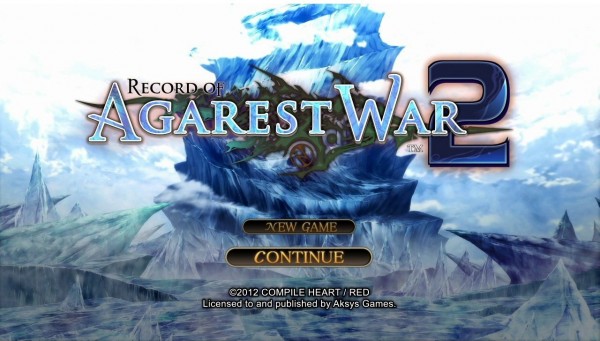
If that isn’t an article title that gets your attention then I don’t know what is. Though Aksys Games themselves have not revealed whether or not Record of Agarest War 2 would be getting a special edition of any kind, Amazon.com went ahead and revealed it for them.
According to the updated listing for Record of Agarest War 2, a Limited Edition version of the game will be available for only $10 more and anyone who purchases it will contain an art book, the game itself, heart shaped compress towels and apparently a blow up character doll…
Now anyone who purchased the “Really Naughty Limited Edition” of Record of Agarest War 1 may remember that it came with an Ellis pillowcase and a breast mousepad, so it will be interesting to see what this Limited Edition will look like when it is officially revealed by Aksys.
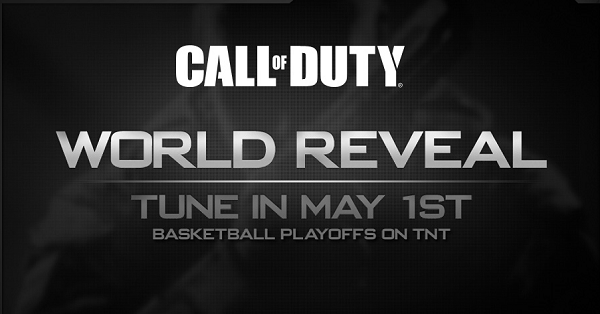
Want to know the best way you can get people to watch the basketball playoffs even if their team isn’t one of the ones competing? Plan a major video game release sometime during one of the playoff games. Today Activision launched a countdown clock on their website here that promises that a brand new game will be revealed on May 1st during the basketball playoffs on cable channel TNT.
The teaser site itself doesn’t contain any extra hints besides the silhouette of an indistinguishable soldier in the background. With rumors circulating earlier this year about a Black Ops 2 being released this holiday season all signs point to that being the game revealed, but perhaps we will all be surprised next week when the title is revealed.
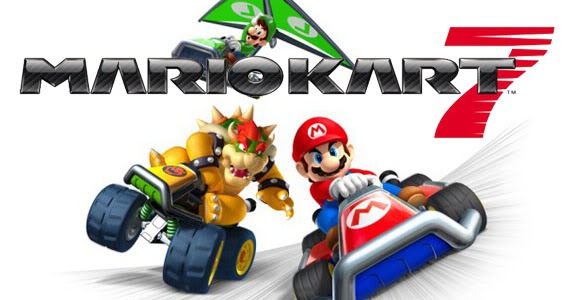
It seems that Nintendo, a company notorious for never releasing patches for its games minus once a few months ago for Skyward Sword will be releasing a patch for one more game in the coming weeks. During a Nintendo Direct briefing it was revealed by Nintendo of Europe’s boss Satoru Shibata that Mario Kart 7 will soon receive a patch.
The patch which is expected to be released through the eShop will be released sometime in “mid-May” and will contain a number of fixes including a terrible exploit in one online map that allowed racers to abuse a glitch in the game and instantly win.
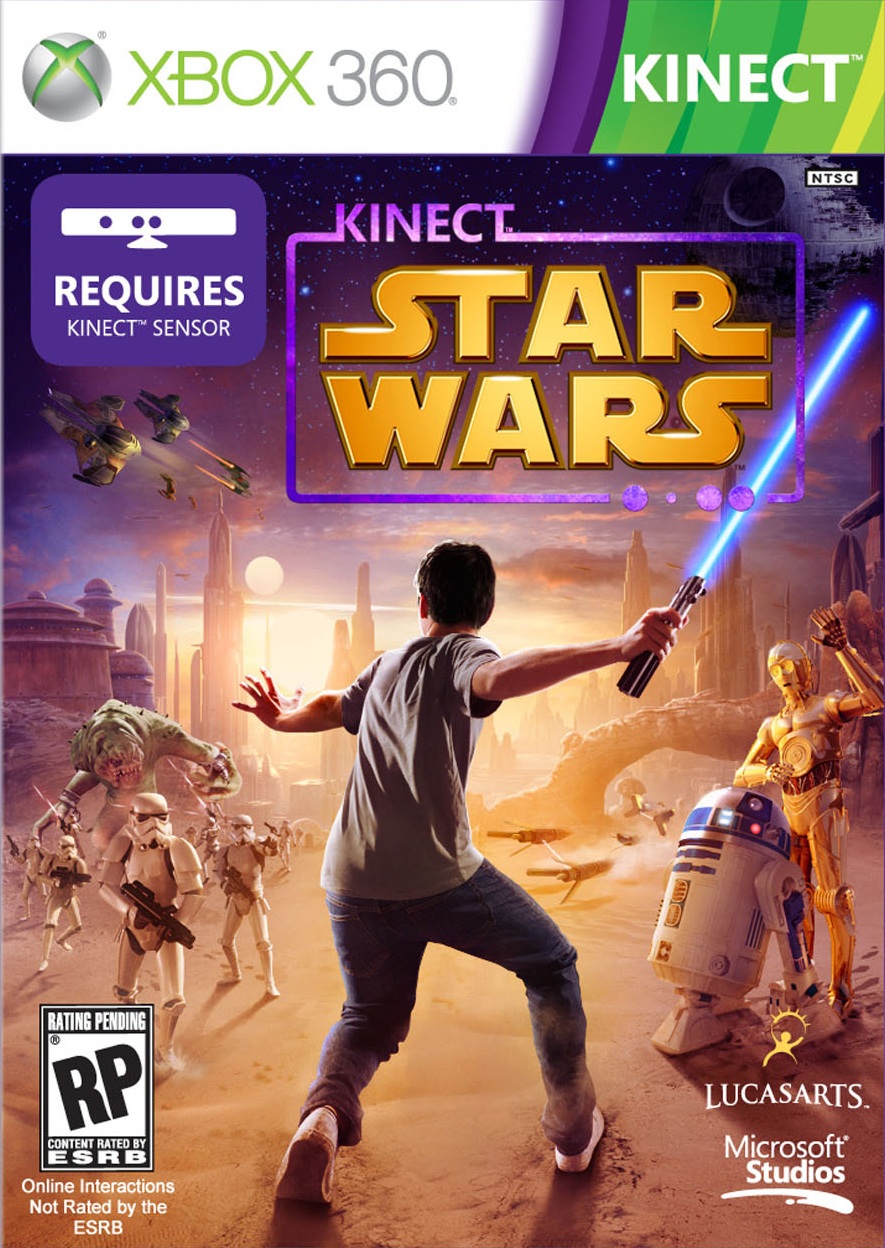
Star Wars Kinect Developer: Terminal Reality Publisher: LucasArts Platforms: Xbox 360 Release Date: April 3rd, 2012 Price: $49.99 – Available here
OVERVIEW
As it happens, time and again, the release of new titles integrating motion sensor technology are often met with mixed reactions from the modern gaming market. Many of us will know the feeling all too well when we express our feelings regarding a new Wii, PSmove or Kinect title with either indifferent shrugs or moans of disdain. However, when title involves a particularly famous brand name or intellectual property, that’s when gamers get interested. Additionally when a particularly renowned and well-loved series such as Star Wars is given the motion-control treatment, the ever watching eyes of a highly devoted fanbase immediately turn to see if the game is worthy of publicising itself as a product of this much loved universe.
If you’re anything like me, than the odds are that you’ve often spent childhood days swinging around a stick, or picking up a flashlight only to suddenly name yourself a Jedi and actively attempt to move objects with your mind. So naturally, the idea of playing a game that had the potential to turn those childhood antics into virtual-reality was an opportunity not to be passed up. From the very launch of the control system itself, it was made clear to Xbox fans the world over that Star Wars Kinect would be one of the large titles to look forward to. Dreams and nostalgia value aside does Star Wars Kinect deliver on providing that quality gameplay experience fans yearn for, or does the Kinect control scheme spell the downfall or another potential winner?
GAMEPLAY
The core gameplay of Star Wars Kinect is actually divided up into 5 different control schemes for 5 different gameplay modes. In light of that, it is best to describe Star Wars Kinect not so much as a singular linear game, but more so as a collection of mini-games, each with their own distinct control styles, goals and challenges. However, odds are that any hardcore Star Wars fan will want to jump straight into swinging their lightsaber around in Jedi Destiny mode.
This first gameplay mode tells what is essentially the official “story” of the game. The plot is set after the events of The Phantom Menace, and during the events of Attack of the Clones and Revenge of the Sith. Players take on the role of one (or two) of the Jedi academy’s newest Padawans as they head for the Jedi training grounds on the Wookie homeworld of Kashyyyk. Long story short, the Separatist forces attack and the player is sent on a mission to uncover what is going on and why in the Jedi Council’s usual ‘throw-students-into-immediate-danger’ policy. For what it’s worth, the story sticks to the canon of the universe without challenging any of the pre-established plots, which goes to show that the developers truly do care for the intellectual property they’re handling. However, the story itself is bland and forgettable. Characters are given little development and the events that take place in the game have a largely negligible impact on the player’s understanding of the universe. It feels like watching the Clone Wars cartoon. It exists, but the ultimate canon of the movies holds up perfectly well without it. An unfortunate downfall of most Star Wars game stories as of late.
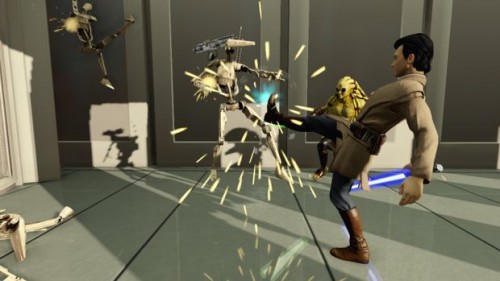
The core gameplay has the player utilise the motion control scheme to move through levels using a combination of thrusts, jumps, steps and slashes to move throughout each stage. Occasionally the hack-and-slash functions are also replaced with speeder bike piloting and turret manning. Props to the developers for getting creative with gameplay and pacing, but the major criticism that most players will have is in regards to the Kinect’s control scheme. Surprise surprise. There were often too many times in my playthrough of Jedi Destiny mode where this reviewer had to wrestle with the controls to make the on screen avatar do what I wanted. For instance, attempting to perform a defensive movement to deflect blaster bolts with the lightsaber can be difficult when the associated movement is very close to that of a horizontal slash attack. Even when the player is able to grasp the controls, the only strategy likely to be implemented is that of “rush in and swing wildly at everything”. The result is the removal of any sense of control on the part of the player. This unfortunately also applies poorly to the Duels of Fate and Rancor Rampage game modes.
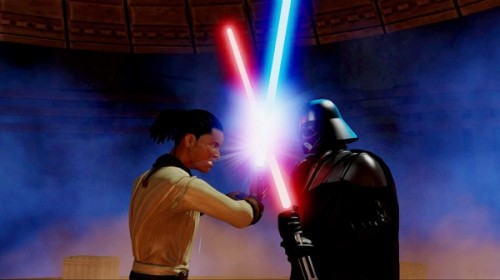
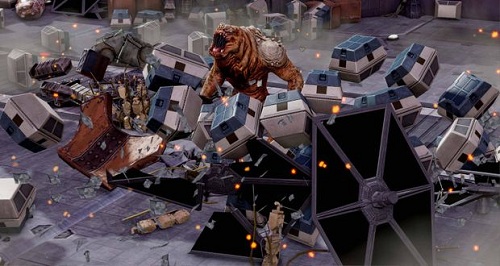
Duels of Fate is a game-type that pits the player against several iconic and less than iconic foes in a 1 on 1 lightsaber duel. (The most iconic villains have to be unlocked, like Darth Vader). Rancor Rampage places the player in the oversized feet of an escaped Rancor. The goal of this gametype is to achieve the maximum amount of destruction as the player is encouraged to smash, slam, munch and charge through a collection of environments on planets such as Tatooine and Felucia. Both of these gametypes suffer from similar control flaws as Jedi Destiny in that the player will be in a constant struggle with the controls to perform particular actions. Duels of Fate is especially frustrating not only in terms of gameplay, but also appeal. What is usually the most epic aspect of the Star Wars movies unfortunately makes up the most bland section of gameplay. The duels are often flow in a turn based defend and attack format broken up by a simple saber-lock to let the player know when it’s ok to start flailing their arms wildly. I actually had to grab one of my own model lightsabers to help emulate my afore mentioned childhood experience. (Though a helpful tip to players who have one on hand: it helps!)
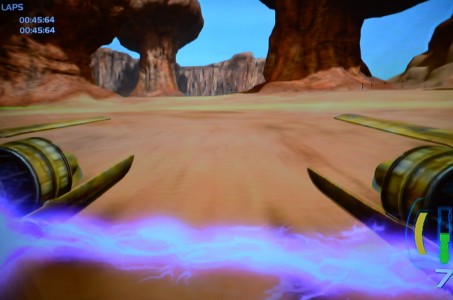
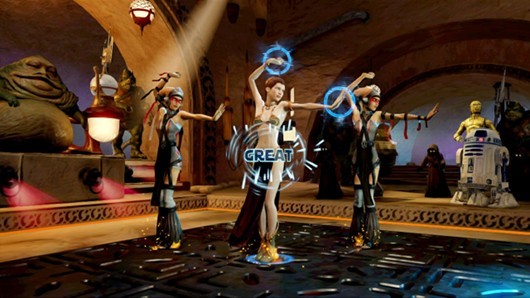
The two other gametypes: Podracing and Galactic Dance-off are much more reactive to player input, mostly a result of the simpler gameplay mechanics. As the names imply, these game modes revolve around achieving victory in the galactic podracing circuit and undertaking dance-offs against other famous characters in the Star Wars Universe. While these game types are commendably more reactive to the Kinect controls, chances are most players aren’t going to think of dancing and racing as the iconic ‘Star Wars’ gameplay experience.
The unfortunate drawback of the control schemes makes the game feel less of an epic Star Wars experience, and more of a string of Star Wars themed mini-games of differing quality. While the game has clearly made a strong attempt to emulate a motion control experience while staying loyal to the canon of the series, the Kinect’s motion control scheme has once again brought down the game’s playability. In reviewing this title, I was continually trying to establish which market this game was intended for. Old school Star Wars fans? Young Children? Families? I ultimately settled on this being a game intended for the younger Clone-Wars watching masses. This is accentuated in one of the space battles where I passed the whole level without moving my body in the slightest. I simply folded my arms and watched the level essentially pass itself. This removes any sense of challenge or incentive to continue. Very little of the original Saga is to be seen here, and the parts that are shown do are poorly executed. And while the dance and podracing game modes do work well, it’s a sad commentary on the overall quality of the game when these gametypes are the best experiences to be had in a Star Wars title. Old school Star Wars fans are unlikely to find much video game love here.
AUDIO AND VISUAL
Now, despite the letdowns of the gameplay in several of the game variants, the audio and visual quality shows off surprising attention to detail. The game features a plentiful variety of musical scores from the movies to capture the movie moments in gameplay or cinematics. For instance, adding the speeder bike musical score from Endor in Episode VI to a strikingly similar in-game situation on Kashyyyk. The voice acting of the game is relatively faithful to the characters of the movies, which can be taken as a good or bad thing. Let’s just say having to deal with C3PO every time you start up the game doesn’t stop being annoying.
One of the best, and most surprising aspects of the game is to be found in the visual quality. Despite the slightly disjointed flow of gameplay resulting from the Kinect controls, the visuals are surprisingly well detailed and extremely fluid. The entire game is quite well animated and the graphic quality is able to accommodate many different elements at once without sacrificing processing power for detail. If nothing else can be said for it, this game looks damn pretty.
OVERALL
What enthusiasm I had going into reviewing this particular title was unfortunately sucked out of me as I wrestled with the controls. This is not so much the fault of the game itself, but that of the technology that it is attempting to accommodate. That said, the game honestly felt like it contributed nothing as a Star Wars experience, at least in terms of story. It’s rather disheartening to think that the most playable section of the game is to be found in dancing, something which nerds the world around are notoriously bad at. Sometimes, it can be said that a game is not so much bad as it is disappointing, which I feel is the case here. Again, for a control system sold largely on potential, the Kinect has hardly delivered on its promises of being the future of gameplay. Certainly, there is potential to be found here, but it is expressed as a mere shell of what it could be with a bit more refinement and a better developed scheme of controls.
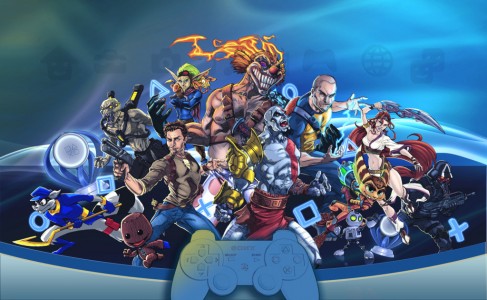
It looks like the rumoured Sony fighting game could be one step closer to reality after Sony registered two site domains with the name Playstation All-Stars Battle Royale. The name itself was leaked after a survey asked the public whether the name was one that Sony should use or search for another, as revealed by Playstation site Playstation Lifestyle. This latest leak brings the rumour back into the public eye after tapering off at the end of last year.
The first domain is http://playstationallstarsbattleroyale.com/ while the second domain is the shorter http://playstationallstars.com/. Both have been registered under Sony Computer Entertainment America, which adds to the legitimacy. To raise more eyebrows, there is going to be a massive announcement from Sony via GTTV this Thursday. With all of these pieces of information falling into place, is the Sony fighting game emerge from a dream to reality?
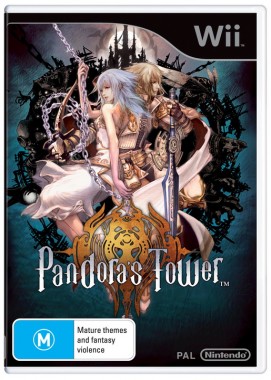
Pandora’s Tower Publisher: Nintendo Developer: Ganbarion Platforms: Nintendo Wii Release Date:April 12, 2012 Price: $69.00 – Available Here
Overview: It’s not too far a stretch for one to state that the Japanese RPG genre has taken a turn for the worse in recent years, with the Western world missing out on a large portion of the truly brilliant Japanese RPGs and instead receiving the next ‘big’ Square-Enix game. Now this isn’t a knock on Square-Enix, they can still produce a quality title (sometimes), but they have caused an unfortunate stagnation in the genre with their overwhelming quantity of monotonous drivel that they pass off as JRPGs.
That’s where Pandora’s Tower comes into the equation. Amidst the stagnation in the genre and on a console on it’s last legs, Pandora’s Tower provides a fresh burst of a life to both the genre and the Wii itself. It’s a classic throwback to role-playing games of old, while implementing a dash of new school style that make’s Pandora’s Tower such a delight. In the overpopulated and malign market of Japanese RPGs Pandora’s Tower represents hope for the once mighty genre.
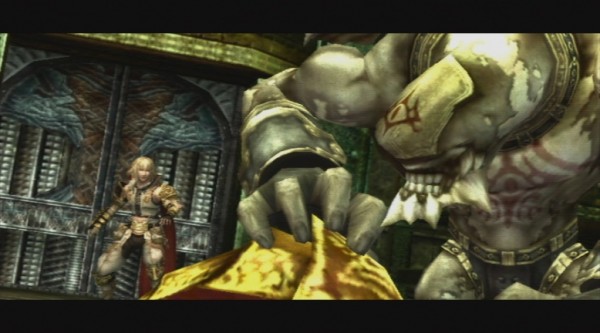
Story: Pandora’s Tower tells a simple tale that harkens back memories of the RPG genre’s past, specifically games like Azure Dreams and Guardian’s Crusade. The concept is simple and doesn’t dabble too long in overwrought cut scenes, putting more emphasis on the journey and the feelings it evokes in the player.
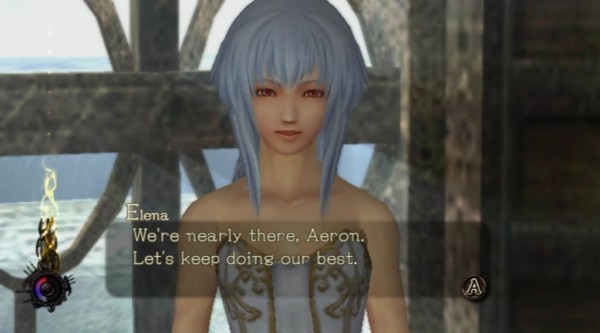
The plot revolves around two ‘friends’ Aeron and Elena, both of whom are on the run from the military. Why is the military after them? Well as it turns out Elena has received an unfortunate curse that is slowly turning her into a beast. The military appear to want to keep this curse hushed and plan to eliminate Elena, hence eliminating evidence of the curse. Aeron of course wants to save her, to do so he needs to overcome the trials and tribulations of 13 towers in order to break Elena’s curse.
It’s a rather simple concept, but it works excellently. The world itself and the history of the characters is slowly revealed over the course of the story without the unnecessary gameplay halting cut scenes that are commonplace in the genre these days. It’s utterly refreshing to see such a ‘to the point’ storyline in an RPG game and it would definitely remind gamers of RPGs of generations passed.
Gameplay:
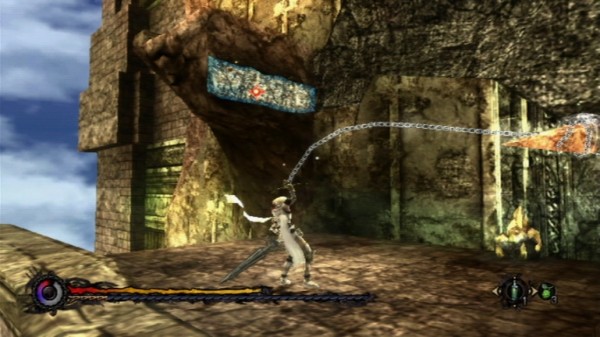
Interestingly enough, while Pandora’s Tower feels old school aesthetically and thematically, it’s gameplay is decidedly new age. Instead of being turn-based like it’s fore fathers (Azure Dreams for instance), Pandora’s Tower is an entirely real time action RPG. There is no random encounters just pure hack and slash, reminiscent of action adventure games more so than RPG games. The real time combat feels a lot like the 3D Castlevania games or even like the Legend of Zelda franchise.
It is a rather nuanced experience with a large amount of attention to detail gameplay wise. As you progress through the game you of course level and unlock more equipment and items, giving more different ways to battle. But it’s not all about the battle system, perhaps the most interesting part of Pandora’s Tower is it’s dungeon crawling aspects.
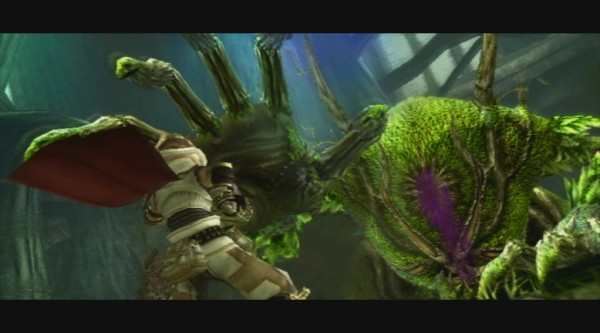
Each tower in the game is essentially a dungeon with a big boss at the end (Tower Master) for you to take down. This dungeon structure doesn’t necessarily work the same way as your average RPG dungeon instead opting for a more Zelda dungeon vibe. There are puzzles to solve and a fair amount of backtracking and area memorisation to take in. Each tower in itself is largely different, which prevents any repetition one may find from a dungeon crawler such as this. The emphasis on exploration is incredible and is refreshing especially when placed alongside the linear structure of the common modern RPG.
All in all, Pandora’s Tower mixes a bit of old with a bit of new to great affect. There isn’t a lot to this game as it’s a rather simple yet emotionally rewarding game. The depth and profound journey the player takes is such a rewarding experience, that ploughing through each tower is addictive.
Visuals and Audio:
Like most good things, Pandora’s Tower has it’s let downs and that is unfortunately it’s weak visuals. Of course for the graphical standards of the Wii, this is beautiful. But visually Pandora’s Tower looks sadly very rough around the edges, this is more the fault of the Wii as a console than the fault of the game. The game looks like it does not belong in this generation and it’s messy graphics only serve as a detriment to the game. It honestly looks like a late PSOne/early PS2 RPG game and that is not a good thing, not in this day and age. It’s a crying shame, because the graphics alone will deter many as the game itself looks more than a decade old aesthetically.
While there isn’t much that can be done in the way of visuals due to the Wii’s limited power, Pandora’s Tower features a beautiful soundtrack as well as excellent voice acting from an entirely British cast. The soundtrack does not feature a single dark spot and features tracks that sound as though they would be at home in classic RPGs of yesteryear such as Final Fantasy IX. It is an all round great job from Ganbarian aurally, but a disappointing visual experience due to a console that has spent the last 3 years knocking on death’s door.
Overall:
In a time when most people’s Wii’s are doing nothing but collecting dust, Pandora’s Tower is released and gives the Wii that last flash of life before it will begin being phased out in place of the Wii U. The game itself is an anomaly, coming out so late in the Wii’s life span it’s a wonder why it couldn’t wait for the surely superior Wii U was released, but it also serves as a reminder that the Wii could house good games, even when it feels like the Wii has long since been written out of the equation for many gamers.
In Ganbarion’s first RPG attempt, they have certainly done a commendable job. After spending years making mostly One Piece tie-in games, they come out of practically nowhere with a brilliant and inspired game that proves that as a studio they are capable of so much more. Pandora’s Tower is a game that deserves more than a tail end release on the Wii and Ganbarion have proved themselves to be a developer that we should all keep our eyes on.
At the end of the day Pandora’s Tower is an incredibly fun and wildly addictive RPG that doesn’t bother with any tedious formalities. All it wants is for you to simply have fun and isn’t that really the measure of what makes a good game?



 The latest One Piece film was announced last year and just this past week had it’s title revealed to be One Piece Film Z. Now a teaser trailer for the hotly anticipated One Piece movie has made it’s way online and boy do they take the word ‘teaser’ seriously.