

Home Blog Page 4705

R.I.P. Rally Review

RIP-Rally-Logo

R.I.P. Rally iOS Review
Developer: Bravo Game Studios
Publisher: Chillingo
Platforms: iPhone (Reviewed), iPad, iPod Touch,
Release Date: 18/04/2013
Price: FREE – Available Here

Overview:

I honestly would not be surprised if I was told there is a total of one million zombie-themed game in the iTunes app store right now, there’s just that many. However what does surprise me is how unique and original many of these titles are. However original does not always translate to excellent. Enter: RIP Rally from Bravo Game Studios. While I’m sure the concept of a driving a jeep with a mounted automatic weapon destroying zombies has been done before, it’s certainly something I haven’t personally experienced on iOS devices. But like all ideas weather they be good or bad, never really go that far if they’re not fleshed out and RIP Rally is a prime example of this.
RIP-RALLY-REVIEW-1

Gameplay:

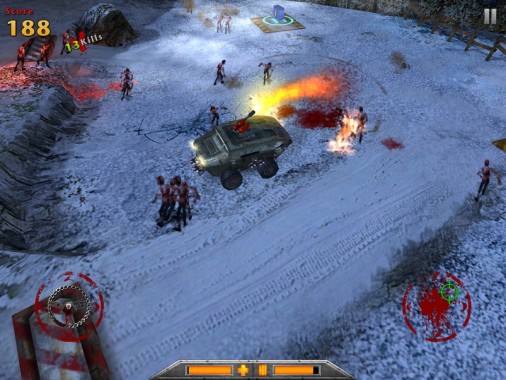
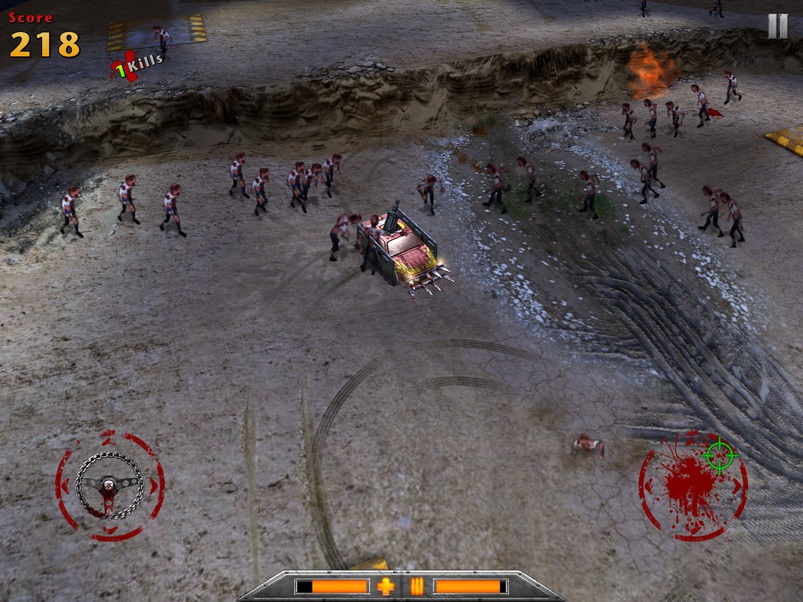
The concept is simple – you’re locked into an arena and placed into a vehicle with a mounted firearm. Your goal is to survive endless hordes of zombies that are then let into the arena. A simple an slightly original idea. The execution of this however is done so in a manner that is extremely cookie cutter in this day and age – earning points to upgrade your weapons and vehicle so you can replay the same damn level over and over again and try to get a better score.Of coarse if you want to speed up that process there’s also in-app purchases that are slightly encouraged as well. Furthermore advertisements are constantly thrown into the mix to annoy you further, which tends to feel a little less like a video game and a little more like an interactive banner you’d find on a website. In between these onslaught of adds is minimal gameplay where the player is given duel stick controls for movement and firing of the weapon. Anybody who is familiar with this concept on home consoles probably already knows how boring this as while it may give the player more freedom of movement, it also disconnects them from the action because you’re just pointing at stuff rather than accelerating a vehicle or firing a weapon. To make matters worse your other alternative for attack is to run over zombies, but that damages your ride as a simple touch makes you lose health. Difficulty is also poorly balanced. Instead of slowly introducing new types of opponents within each wave, they come out all at once. This means you’ll go from a round of only simple zombies to a round of only zombies which explode on impact and frustrating deaths. Worst of all is the only strategy you’ll ever need is to just keep distance from your enemies while shooting. So ultimately you’re simply just moving a little forward, stopping and keep going again like you would to prank your mates back when you were seventeen. Aside from upgrading your vehicle there is no sense of progression throughout the entire game as there are only three arenas to chose from as well. When you put all this together gameplay feels more like a tech demo to test out the engine rather than an actual game. This could be forgiven as just a simple title but with all these in-app purchases thrown in your face and advertisements popping up constantly it honestly feels like you see more ads than gameplay. This questions what the developer thinks of the consumer’s actual intelligence.
RIP-RALLY-REVIEW-2

Audio & Visuals:

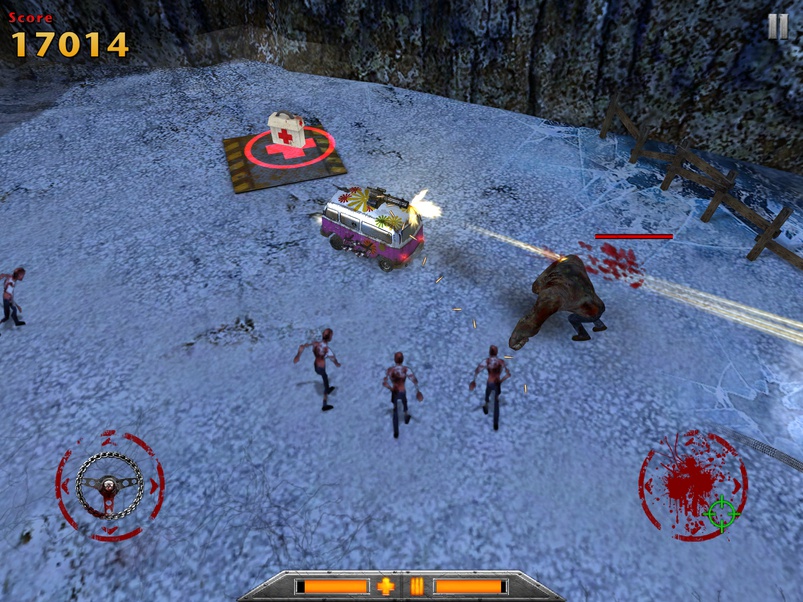
The best way to describe the audio in RIP Rally is to think of a typical wrestling intro where the wrestler storms in with outdated heavy rock music. This approach at the soundtrack works however as it is an arena-based title and is probably the only aspect of the game that doesn’t frustrate the crap out of me. Sound effects are a mixed bunch ranging from tolerable to terrible. While the gun fire and zombie moans could be improved they get the job done. However the announcer is cringe-worthy and will do next to nothing except constantly repeat the word “amazing” in the same annoying way it’ll urge you to put the game on mute. To further salt the wound the sound effect of zombies dying is an odd squashy sound that sounds bizarre and out of place. A death sound effect should make the player feel like they’ve done a good job or reward them for defeating their enemy, but instead here it’s like some cartoonish flysquatter noise that doesn’t suit the dark and gory tone of the game. 3D models are tolerable for the most part, but dark, gritty  and unattractive textures cover the game making it quite unappealing. The worst offender of RIP Rally beside the onslaught of in-app advertisements however is the zombies. The zombies are blurry and of less quality than every other subject in the game and are animated poorly. I honestly can’t tell if they are terribly done 3D models or pre-rendered 2D sprites like old school Donket Kong Country or Mortal Kombat. In a game all about zombies, you’d think a priority would be to make the zombies look good but honestly it’s one of the biggest flaws of RIP Rally. They look so terrible if feels like a mercy killing every time you murder one.
RIP-RALLY-REVIEW-4

Overall:

RIP Rally is a huge disappointment coming from such a remarkable and well established publisher like Chillingo. Gameplay is not engaging, short and frustrating, the game’s lifespan is short, difficulty is poorly balanced, the zombies look terrible, sound effects are a mixed bag and in-app purchases & advertisements are uncomfortably thrown in your face. Very little works in favor for RIP Rally. The core flaw however is that there truly is nothing to do- you play in a tiny arena for a few minutes and you’ve already experienced everything it has to offer. Then, instead of encouraging you to play more, you’re just shown a bunch of advertisements. My best advice to Brave Game Studios (and any other developer out there with similar intentions as this is becoming increasingly popular lately on mobile devices), is to remember you are not a advertisement agency, you’re a game developer. We’re looking for games to play not ads to watch. Better luck next time.

2-5-capsules-out-of-10

Capsule Computers review guidelines can be found here.
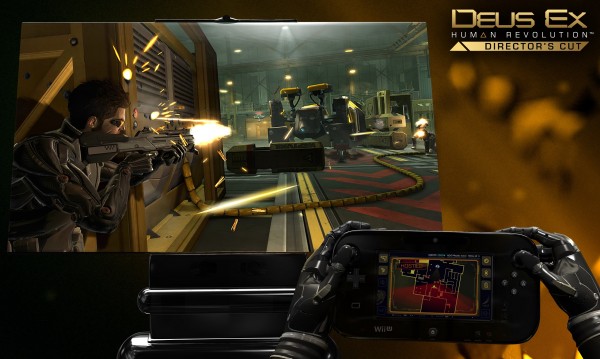
Behind the Scenes of Deus Ex: Human Revolution – Director’s Cut

deus-ex-wii-u- (6)

With Deus Ex: Human Revolution – Director’s Cut having been announced exclusively for release on the Wii U later this year, and after seeing its first gameplay trailer, Eidos Montreal are now giving us some behind-the-scenes insights into this version’s additions and changes.

The video, which can be viewed below, features key developers David Anfossi, Antoine Thisdale, Steve Szczepkowski, Jean-Francois Dugas and Émile Pedneault explaining what is unique with the Director’s Cut, why it is the ultimate Deus Ex experience and what their philosophy in its development was as they decided to not simply port it over to the Wii U, but re-work many aspects of the game.

On top of everything mentioned in the video, the Director’s Cut will also offer approximately 8 hours of developer commentary and a 45 minute “making of” video that reveals secrets and background info on the creation and production of Deus Ex: Human Revolution.

Stay tuned to Capsule Computers as we keep you up to date on all things Deus Ex.

Sacred Citadel “Jungle Hunt” DLC Launches on day of Release

sacred-3-01

While it is odd to see same-day DLC arrive for a game that just hit consoles in a digital format, those already playing Sacred Citadel will be happy to know that the “Jungle Hunt” pack for the game has been released for $4.99 (400 Points) across all platforms.

Here are some details:

The “Jungle Hunt” DLC offers an all new chapter of the Sacred Citadel story, a brand new setting as well as three exciting bonus levels. This DLC will be available for 400 MS points or 4,99 USD / Euro.

The battle has been won, but the war is not over yet for the battle hardened heroes of Sacred Citadel! “Big Mama”, the malodorous leader of the evil Grimmocs has escaped into the menacing jungles of Ancaria with a sacred relic. The heroes will need to bring “Big Mama” to justice and retrieve the valuable item.

Just as they did during the main campaign of Sacred Citadel the four unique character classes need to gather once again and combine their different skills in this exciting co-op adventure.

While the release has some odd timing, it is nice to see support already added in for a new title – even though it’s a bit questionable of why we didn’t see this expansion of sorts make the cut. Deep Silver have a lot of faith in Sacred Citadel from the looks of it, and let us hope that this support continues if the game proves to be a success.

Yoshi’s Island 3DS Announced

yoshis-island-3ds-01

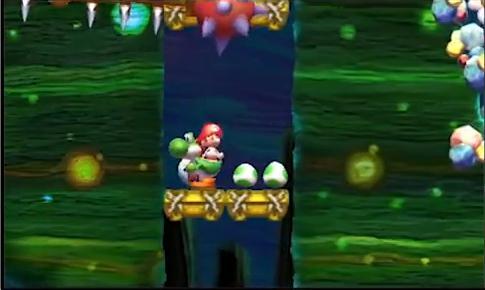
During Nintendo Direct, there were a good batch of games revealed including the localization of Bravely Default, Earthbound‘s long awaited debut on the eShop, and plenty more, but one game in particular made me feel a bit warm inside. Yoshi’s Island is finally getting an all new follow-up, and will be the first from the side series since Yoshi’s Island DS released seven years ago.

Now, I will say that there is not much news on this release. No release date, no feature information, just a trailer with a good bit of gameplay and a history lesson. As you can tell, the art style has changed to a more pronounced pastel look, with Yoshi and Baby Mario sporting 3D models. Some may hate it, but I for one love the color and charm seen in the clip, and strongly advise you to check out the trailer below. Stay tuned, as when more information drops, we will be sure to keep you covered.

Earthbound Coming to the Wii U Virtual Console

earthbound-vc-01

Perhaps the most shocking news from today’s Nintendo Direct was that Earthbound would finally be headed to the Wii U’s new Virtual Console. Yeah, this is MEGA news for those who have been begging for a re-release for the past four generations.

There are not a ton of details aside from the fact that it will drop for all regions worldwide on the Wii U’s eShop by the end of the year, but come on – this is stuff worth celebrating over. After a lot of false hope, wishing, and waiting, Nintendo have answered a lot of prayers with one meager release – proving that our voices are now being heard.

Hyperdimension Idol Neptunia PP’s opening video released

Hyperdimension-Idol-Neptunia-PP-noire

Today Compile Heart has released the opening video that will be used for Hyperdimension Idol Neptunia PP and from the looks of it, the game has quite a lot of potential. In case you didn’t already know, Hyperdimension Idol Neptunia PP is a full blown idol spin-off game of the Hyperdimension Neptunia series.

In the video, which you can see below, we see the CPUs from the game, Neptune, Vert, Blanc and Noire all dancing, singing and transforming into their CPU forms while also presenting some great examples of the game’s animation. Currently Hyperdimension Idol Neptunia PP is set to be released on June 20th for the PlayStation Vita in Japan and, although every Neptunia game so far has been released in the West by NIS America, it is unknown if NIS America has any plans on bringing this unique spin-off over to Western shores.

Ark of Sinners Advance Review

Ark-Of-Sinners-Logo

Ark of Sinners Advance
Developer: Anima Game Studio
Publisher: BulkyPix
Platforms: iPhone (Reviewed), iPad
Release Date: April 18, 2013
Price: $2.99 Available Here

Overview
Ark of Sinners Advance is a game with quite a unique background. It’s a polygonal two-dimensional side-scrolling action-RPG. Originally released for Nintendo’s WiiWare, it has now been rebuilt for iOS devices, trading in a controller for a touch screen. It is also set in the Anima: Beyond Fantasy RPG universe. But how does Ark of Sinners Advance hold up in its jump to the iOS? Will it be absolved or are its sins unforgivable? Let’s find out.

ark-of-sinners-advance-screenshot-01

Story
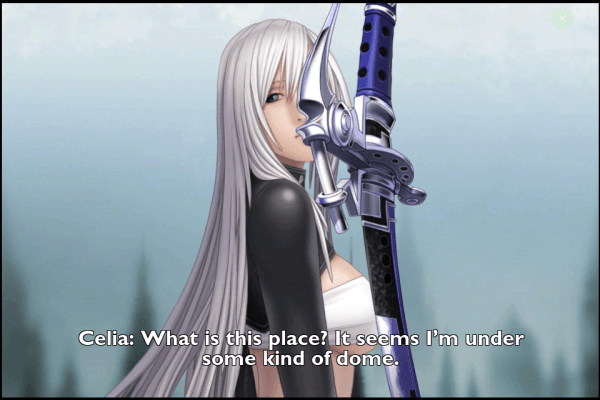
Players take control of a young white-haired lady named Celia. When she wakes up, she knows only that she is in a strange place and that her friend Nemo is missing. With nothing but a sword, hyper-sexualized fetishist clothing, and some help from an unnamed harlequin, she sets out to explore her new surroundings and find her friend.

Gameplay
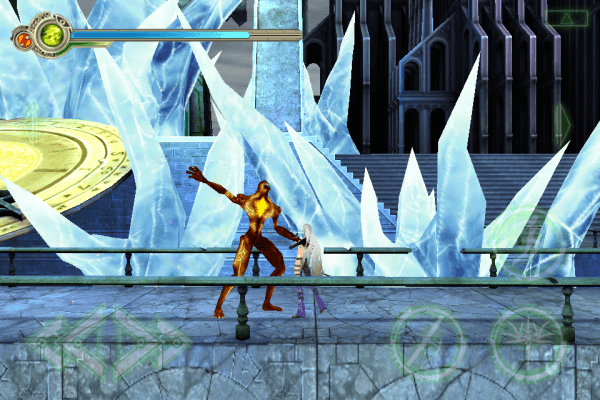
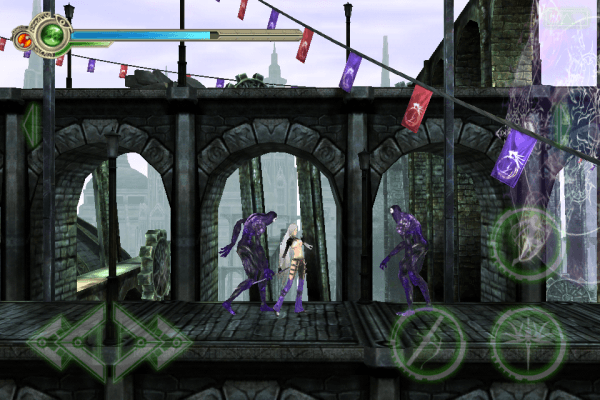
Ark of Sinners is a fairly straightforward side-scrolling action roleplaying game. You’re given only a small set of on-screen buttons to contend with. These will let you move side to side, jump, and perform two styles of attack with your sword. It’s great to see a game know the limitations of its platform. The button layout serves its purpose well without overcomplicating things with on-screen joysticks and the like.

Even with the well executed simplicity of the controls, the gameplay is pretty rough around the edges. You will be doing quite a bit of platforming as you explore the Ark. The problem is that jumping in Ark of Sinners is slow to respond and floaty once you’re airborn. You can expect frustrating, unresponsive jumping to be the cause of more than a couple deaths in the game.

ark-of-sinners-advance-screenshot-03

To its credit, the combat in Ark of Sinners is much more responsive than the jumping. It’s rare that you’ll die in combat due to issues with control. Unfortunately, combat is largely uninteresting. It generally boils down just repeatedly whacking the attack button until everything is dead. That’s a shame, too, because it’s clear a lot time and effort went into the skill system that augments your combat skills so heavily. Enemy design is also pretty boring. You’ll fight one type of shade over and over before moving onto the next type of shade. There is some variety to be had, but only a few encounters in the game feel genuinely refreshing.

The skill system in Ark of Sinners is fairly interesting and makes it feel like you really are being rewarded for collecting Lost Time Memories (blue orbs hidden throughout the game). You can earn new skills and upgrade stats. While these give you some interesting new things to toy around with in battle, it doesn’t change the repetitive nature of the beast.

ark-of-sinners-advance-screenshot-04

If uninteresting combat and troublesome platforming weren’t enough to deal with, occasional frame rate stuttering won’t help either. There’s nothing more frustrating than fighting with the jumping controls and finally getting up to the platform you needed when the screen stutters and you fall all the way back to the bottom.

Seeing how heavily sexualized the protagonist, Celia, is should raise some eyebrows as well. It’s overbearing and unnecessary, with many of the single-frame cutscenes focusing on her “assets”. Though it’s almost par for the course in media today, this feels boorish and harmful to the overall game. Character design should have avoided leaning on a sexual crutch and spent more time fleshing out the story.

ark-of-sinners-advance-screenshot-02

Visuals & Audio
The visuals in Ark of Sinners Advance are fair, though they do nothing that will break the mold. The backgrounds in the world do a great job conveying the sense that Ark is, indeed, a vast city to be explored. Also, the hand-drawn cutscenes look great, much like something from an anime. Otherwise, enemy design feels fairly bland and, as previously mentioned, Celia’s design could use a more conservative overhaul. The end result is a visually mediocre game with flashes of brilliance in the large outdoor environments.

Musical tracks in the game provide a good sense of urgency and bewilderment, playing heavily on the strings and horns of a classical orchestra as well as occasional operatic vocals. The other audio is serviceable but nothing more.

Overall
Overall, Ark of Sinners Advance is an action-RPG with some good ideas that ultimately fails to deliver. Some glaring gameplay and design issues really hamper what could have been a genuinely interesting experience. The music in the game does a good job conveying urgency and bewilderment. Otherwise bland audio and visual design do nothing to pull this game up from its mediocre story. At the end of the day, Ark of Sinners Advance just comes up short.


5-0-capsules-out-of-10

Capsule Computers review guidelines can be found here.
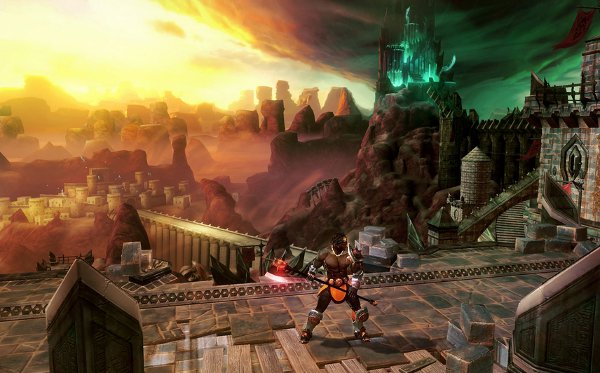
Pikmin 3 release date set for North America

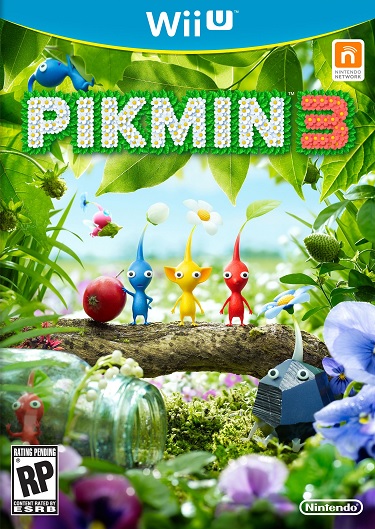
pikmin-3-box-artRemember Pikmin 3? Pepperidge Farm remembers… and so does Nintendo! Despite being something that probably would have kept the heavy dust layer off of gamers’ Wii U consoles for quite some time, the game was delayed until sometime later in 2013 and finally Nintendo has announced the game’s release dates for Japan and North America.

In Japan the game will be released on July 13th while North American fans can purchase it on August 4th. The company also revealed a new Pikmin called a “Winged Pikmin” during their release date announcement. This Pikmin will fly through the air and follow the player while also carrying items through the air.

Shin Megami Tensei IV release date and bonuses announced for North America

SMT-IV-first-run-copies

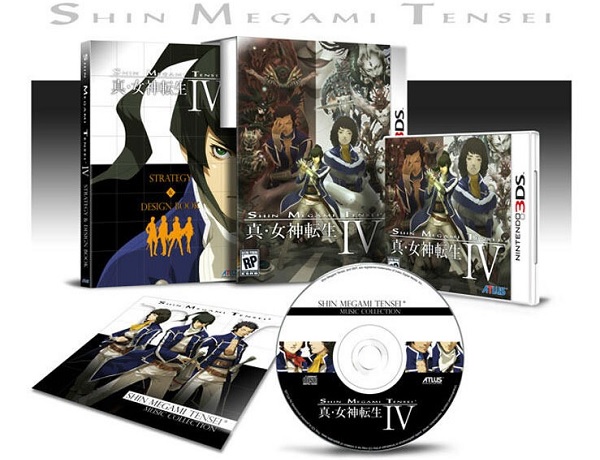
Great news for fans of the Shin Megami Tensei series. Not only has Atlus announced that Shin Megami Tensei IV will be coming to North America on July 16th and eventually in Europe, but anyone who buys a first-print copy of the game will be getting a bunch of bonuses.

As you can see above, all first-print copies will include a 176 page Strategy & Design Book, a music collection that contains music from several different SMT games, and a special slip cover case that will hold all of the bonuses in one neat display piece. It is worth noting that Shin Megami Tensei IV will cost $49.99 at launch, though with all of these bonuses and the amount of content that Shin Megami Tensei IV provides, that extra $10 certainly seems worth it.

How Michael Jackson Mastered the Art of Chiptune in Sonic 3

sonic-the-hedgehog-as-michael-jackson-01

I’m throwing caution into the wind – Michael Jackson did Sonic 3 and that’s that. In case you didn’t know, much ink has been spilled over whether or not MJ actually wrote the soundtrack to the greatest game on one of our favourite consoles. It’s certainly no secret he enjoyed playing them. Debating about it any longer is futile – how could you argue with this man?

Now that it’s settled it’s worth considering how Michael managed to work within the confines of a 16-bit gaming system. The limitations of the system required the music to be composed in chip-tune. For a comprehenisve understanding of how the form of chip-tune music is generated you can watch the video below. If you just want to bludge I’ll explain what you need to know when we get to it.

In order to explain how these basic constraints impacted Michael, we need to look at the differences between an 8-bit and 16-bit system. The one thing you should know about chiptune is its definitive feature – all music must be created by hardware, rather than software running on the device. For the sake of looking at Sonic 3, it’s easiest for us to compare the Sega Mega Drive (16-bit) with the Sega Master System (8-bit). While the Mega Drive has a 16-bit processor, its audio chip is only 8-bit, which makes it a perfect candidate for this analysis.

There are two types of chips required to create sound in a classic game console, the PSG (Programmable Sound Generator) chips and FM (Frequency Modulator) chips. PSG chips work by sythesising multiple wave forms and mixing them with the output of a noise generator to create a single waveform that has its amplitude manipulated. The final result is a decent mimicry of a sound that can be found in the real world. An FM chip is essentially a synthesiser. In fact the concept behind the chip within both systems originates from Yamaha’s famous line of synthesisers.

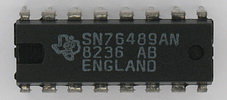
Both systems use the Texas Instruments SN76489 PSG chip. For our purposes all we need to know is that it contains 3 square wave tone generators and one white noise generator and is able to operate at various frequencies and sixteen different volume levels.

psg-chip-sn76489-01

The Texas Instruments SN76489 PSG chip (ironically made in England, apparently)

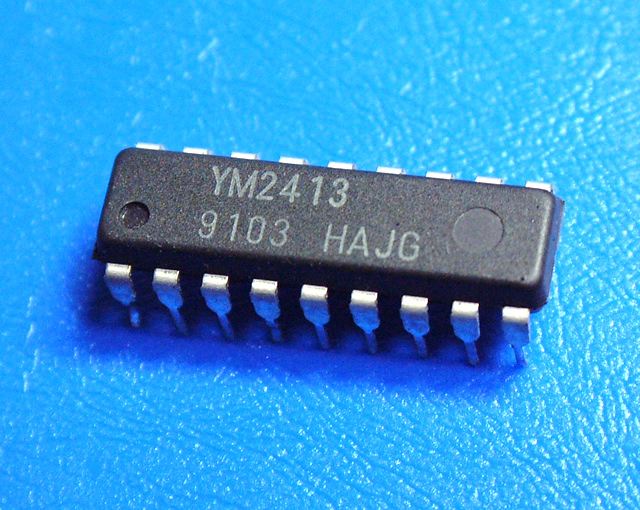
Between the two consoles there is a significant increase in what the FM chips are capable of. The Yamaha YM2413 that can be found in the Sega Master System is not only impacted by the fact that it’s older, it has also had a lot of functionality removed in order to be cost effective at the mass production level. Such a paired down model has resulted in 15 hard-coded instrument settings with one left over to be user-defined. Only 2 waveforms are included and there’s no adder to mix the channels, instead the chip’s digital to analogue converter simply plays one channel after the other.

ym2413-01

The Yamaha YM2413

Comparatively, the Yamaha YM2612 has an analogue stereo output (acting as the digital-to-analogue converter) – the obvious difference being that it can certainly handle more than one channel playing at once. In fact, it can handle 6, with up to 4 operations occurring on each channel. The third channel can have frequencies set independently, allowing for dissonant harmonics.

yamaha-ym2612-pinout-01

A diagram of the Yamaha YM2612 chip

Having covered these differences we will be able to witness the real world function what Linus Akesson is talking about in his lecture. The key element to consider here is that constraints enforce the creative process as either workarounds, acceptance or by choosing to ignoring issues when technical limitations impose themselves on compositions. He breaks his lecture down to 4 parts, which I will apply to Sonic 3 in order.

1.Waveforms

The 1-bit squarewave is handling the bass in this song. You can hear the flat buzz that defines this kind of wave during a solo at 1:00 mark. This flatness is a product of the way 1-bit music is generated. The chip has then set an external parameter on the function before passing it through the DAC. Also note the flange effect on the backing tracks. This effect is created through by layering the same sound over itself at least once. During the Sega Master System era one passover with the flange would be all that they could afford. The scaling up in the YM 2612 means that they can apply the flange to multiple instruments.

Michael Jackson had a way of using epic captured sounds to make his music feel full of life. The glass shatter sounds is a great example of this. Smooth Criminal is probably the MJ song that features this effect most prominently but he has used it in multiple songs. How do you get a computer chip to make this noise? Let’s take a look at how it was used in the Carnival Nights level in Sonic 3. It’s in the first few seconds so you don’t have to listen to the whole thing:

By shifting from pulsewave to noise and back quickly a single noise can be made by several different unique sounds. Linus identifies several ranges of sounds based on their frequencies. This sound is created at the ‘effect’ range of frequencies, where sounds between 10-1000Hz are fast enough to be heard as a single unit of sound. If it had been played at the ‘rythmic’ range of frequencies, the glass shatter would dissolve into the multiple types of sounds that it is composed of. Any lower than 10Hz is where this breakdown would occur.

2. Pitch

Linus discusses the Atari in this section and in-as-much has very little for us to look at here.

3. Tempo

Gaming consoles have a massive constraint on the tempo of their music. Musical data is processed at the same time as the video data and in order to send out the signal to the television both types of data are required to take turns and being sent to their respective receivers. This process is known as Vertical Blanking. This binds musical data to the restrictions of the visual data. International standards regarding how images are processed change depending on the region, which has implications for their refresh rates.

In both Europe and Australia we use PAL which has a refresh rate of 50Hz, when interlaced with sound the composer is restricted to bpms of 107, 125 and 150. The USA uses NTSC which refreshes at 60Hz, changing the possible bpms to 113, 129 and 150. Those bpm ranges aren’t exclusive by the way, just the most common. The impact for Michael here is that he is required to write in either 150bpm or another shared value if the music is to be standardised globally. Surprisingly, this is slightly faster than some of his pop hits that feel particularly energised like Beat It, which is 138 bpm. The effect is that songs in Sonic 3 capture both Michael’s unique sound while characterising Sonic’s famous speed. If you watched the first video you’ll notice there are a few MJ hits that came after Sonic 3 that are simply pitch shifted versions of level theme songs to accomodate a more comfortable pace for the artist.

4. Polyphony

Just because chiptune music uses a limited number of channels doesn’t mean you can only programme one sound per channel. Much like having two hands while playing a piano can create the effect of having two melodies a chip can be used in the same fashion. In the Hydrocity Zone soundtrack you can hear that the drums and the flute are using the same channel. Sounds not overlapping is a clear indicator that they are using the same channel. The result in this song is that they both play off each other in a fashion similar to how the drumbeat and guitar notes are triggered on alternate beats on Beat It. These sounds do run over each other as they don’t have the limitations of being played through a chip though they are struck out of sync with each other. A funk beat emerges from this structure, one that Michael has used in multiple other places.

I could continue through so many more elements of the Sonic 3 soundtrack to demonstrate how constraints impact a composer yet I feel like half the fun here is to find them yourselves. Check out Linus’ lecture, it’s not just interesting to know how chiptune is composed but it’s a great starting point if you’re personally interested in getting into game music composition.