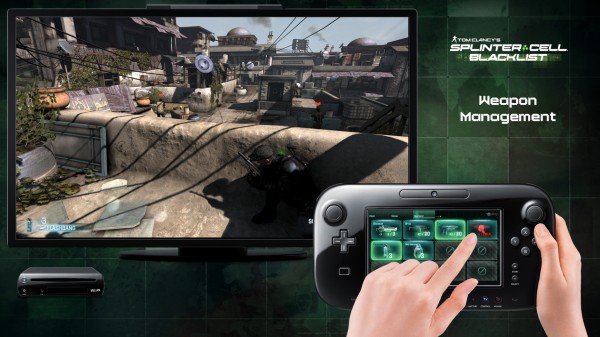
Just a scant two weeks ago Ubisoft let gamers know that Splinter Cell: Blacklist would be making its way to the Wii U in addition to Xbox 360, PlayStation 3, and PC, but as we all know developers are always trying to utilize the Wii U’s unique GamePad. So, the question on some minds was what all would Splinter Cell: Blacklist use it for?
The pictures show off a few of the controls, a new trailer has been released focused on showing off a few more, as well as in action. While the picture above confirmed being able to quickly select weapons, the trailer also shows off controlling the trirotor drone, controlling Sam Fisher’s snake camera, and to mark targets for execution, which seems the most functional over gimmicky.
Players can watch the trailer embedded below to see all of the controls in action. Regardless of which platform they prefer those looking to get their hands on Splinter Cell: Blacklist can do so August 22nd.
To celebrate the 25th anniversary of the Metal Gear Solid franchise, the Playstation 3 exlcusive Metal Gear Solid: Legacy Collection will be releasing in North and South America in June.
Tomoyuki Tsuboi, President of Konami Digital Entertainment had this to say about the collection:
“We wanted to give Metal Gear Solid fans the opportunity to experience the series from beginning to end, all on one console… with the collection’s multiple titles, players can truly see how Metal Gear Solid evolved into the critically acclaimed and beloved franchise it is today.”
With over 33 million units sold to date, if you haven’t tried any games in the Metal Gear Solid this legacy collection looks like a great place to start, especially if you want to get clued in with the story before the release of Metal Gear Solid V: The Phantom Pain and Metal Gear Solid:Ground Zeroes. Are you excited for this collection? Let us know in the comments section.
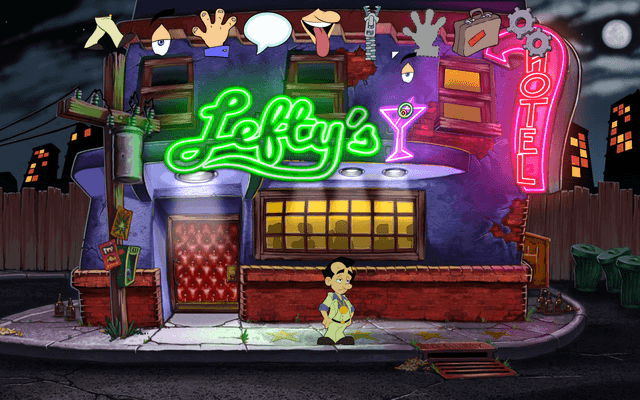
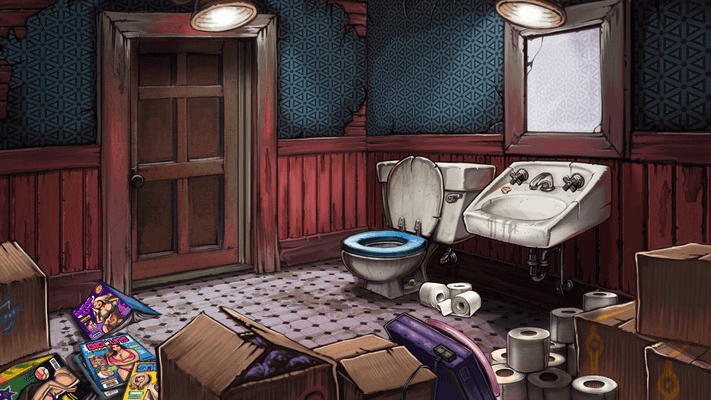
After 26 years since Sierra Entertainment’s original release, Leisure Suit Larry in the Land of the Lounge Lizards, the initial creator Al Lowe and writer Josh Mandel have re-made, expanded and improved in every detail their new game Leisure Suit Larry Reloaded.
As for the ‘mature’ audiences, they can expect just as much naughty (but nice) humour, adventurous gameplay, expanded puzzles and locations, along with high resolution, hand-drawn art and animation to accentuate the experience.
To top it off, a re-written musical score from Grammy-nominated and BAFTA-winning composer, Austin Wintory featuring Al Lowe on saxophone!
Keep June open for endless hours of Leisure Suit Larry Reloaded; availableon PC, Mac and Linux for only AUD $22.23 (USD $22.85).
After losing many game developers over the last few years, from prominent established big names like Team Bondi through to the multitude of smaller companies that shut its doors in the wake of the financial crisis, it seems the Australian gaming industry is again on the rise. Having finally clued on to what the rest of the world already knew the Australian Government has sparked into action with a modest 20 million dollar funding for new and existing companies and projects.
In a recent ABC interview, Screen Australia’s Fiona Cameron said although times had been tough for the industry, their was a ‘seismic shift in the games industry’ that will hopefully start to rectify the 50% drop in the workforce across the industry since 2009. She credits the huge increase in the adoption of smartphone technology worldwide as a catalyst for the growth, with games now being able to reach a much larger and broader audience than ever before with 92% of households owning a gaming device and the proportion of female gamers on the rise.
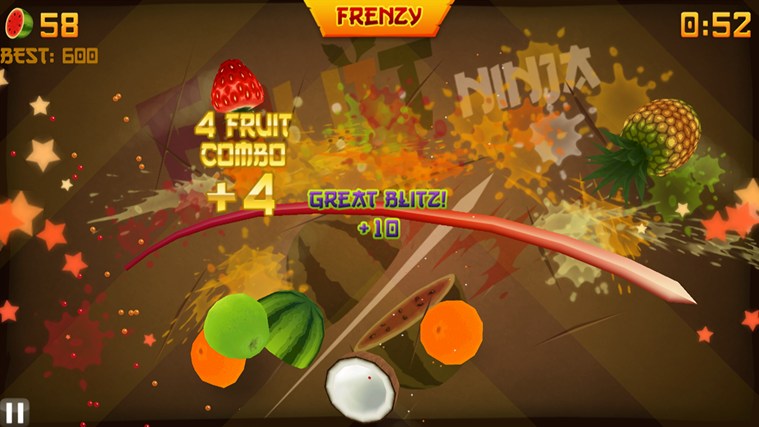
Local developers still have a lot of faith in the market, and who could blame them, with Fruit Ninja, the second most popular smartphone game with 400 million downloads being developed in our own backyard (or someone elses in Brisbane), something that seems to be a common changing thread throughout the industry. While there is and always will be a place for the huge gaming conglomerates, the days of the backyard developer are among us, with many choosing the comfort of their own homes in place of the office environment.
Morgan Jaffit, a Brisbane Game Technician says “We’ve moved away from working in what I would style a factory environment, where we’re working on intellectual property owned by other people in large companies, towards a home-grown ethos where we build our own IP, our own brands. Many individuals and groups alike have banded together and new companies have sprung up full of like, new ideas and more importantly, in the majority of cases, years of experience working for multinational gaming companies.
The Governments 20 million dollar funding will begin soon and will involve grants and business loans to assist existing companies as well as provide a basis for incentive for others to follow.
As everyone has been made previously aware, Disney have acquired the rights to the LucasArts company, and with it, the Star Wars brand. This means that the company Disney will be in charge of all things Star Wars unless they choose to license parts of it out.
What makes this interesting is that there hasn’t really been a lot of news being spread about the franchise. Even more interesting is that it seems that a popular Youtuber has some pretty keen information hunting skills and has in fact found what could very likely be legitimate casting news for the latest Star Wars film, Episode VII.
This latest piece of news shocked me, and it is almost unbelievable. So I’ll be labeling this as a rumour until it is absolutely verified. But the hints are still there. Check out the video embedded below to find out the latest in Star Wars Episode VII casting.
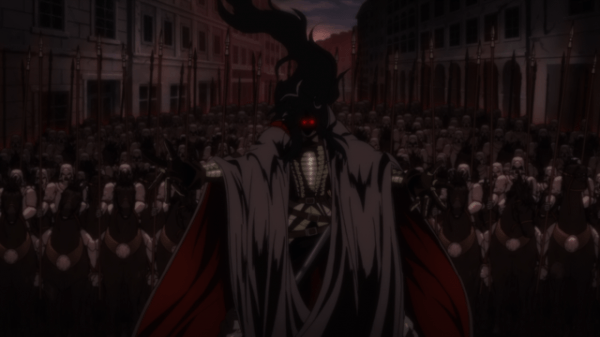
Hellsing Ultimate Collection 2 Blu-Ray Studio: MadHouse Publisher: Madman Entertainment Release Date: Out now Price:$59.95 Available here
Overview
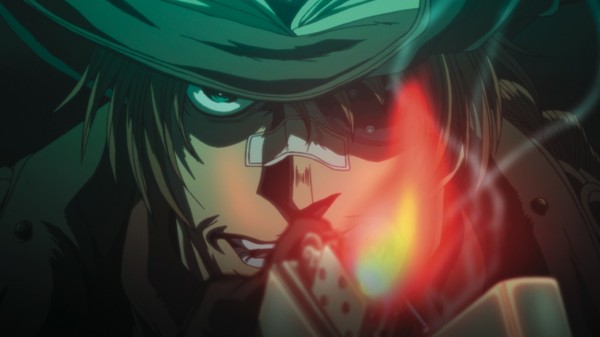
As many fans would probably know by now, Hellsing Ultimate, the well known and much loved successor to the original Hellsing anime series, recently made the jump to Blu-Ray release in Oceania. This is a series that has become well known for its up-front level of violence, surprisingly deep and structured character development as well as the creation of one of the most sadistically popular anime badasses of all time. Hellsing Ultimate is designed to appeal to a certain special variety of anime fan. These are the fans who laugh maniacally at the feast of violent madness that is so consistently offered throughout the course of this series.
So far, two Blu Ray collections have been released, containing OVA episodes I-IV and V-VIII respectively. A review of the first collection can be found on our site here. If you were a fan of the first collection for the afore mentioned reasons, then you’d best be prepared for what collection 2 makes to offer. The box art for collection 2 has been outfitted with a shiny black R18+ rating, which is a promise of a step UP in violent content in comparison to collection 1’s MA15+. Long time fans will already know what they’re in for, so the real question is: how does the Blu Ray Collection 2 stack up?
Story
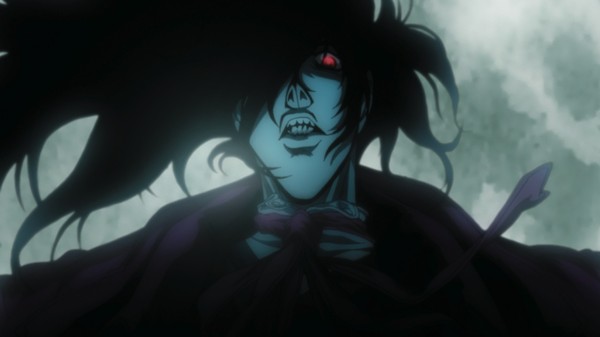
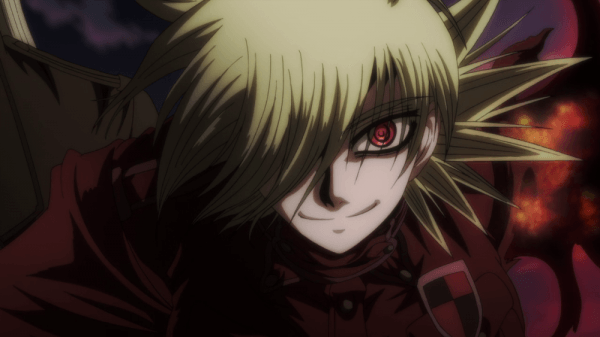
In the first collection of Hellsing Ultimate, new viewers were introduced to Alucard; an honor bound vampire lord whom had sworn an oath to serve an order of Protestant Knights known as the Hellsing Organization. In their quest to protect the world from numerous supernatural forces, Alucard serves as the organizations ultimate weapon. Audiences were also introduced to Seras Victoria, Alucard’s vampire fledgling who was still coming to terms with her new status as a member of the living dead. The events of the first collection revolved around the pair being dispatched to investigate and VIOLENTLY put down a number of supernatural insurrections around the world. Throughout their battles, one thing had become abundantly clear: that an enigmatic group called Millennium was orchestrating these events for some yet unknown grand design.
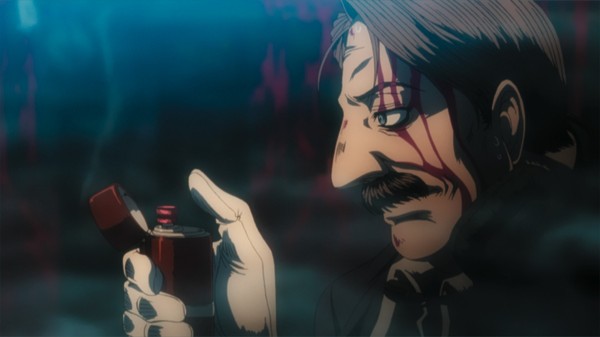
Collection 2 opens with Millennium on the cusp of launching their major assault on London. With only the Hellsing Organization standing in the way of their mad slaughter of millions, the enigmatic ‘Major’ sends an elite attaché of Nazi Zombies to strike at the beating heart of the organization. At the same time, the Iscariot Organization gears up to take on Millennium with an army of their own, though their intent is quickly revealed to be more sinister than their catholic makeup belies. Close to the end of the collection, each of the three groups: Hellsing, Iscariot and Millennium, reveal their respective “trump cards”, creating one crazy three-way confrontation.
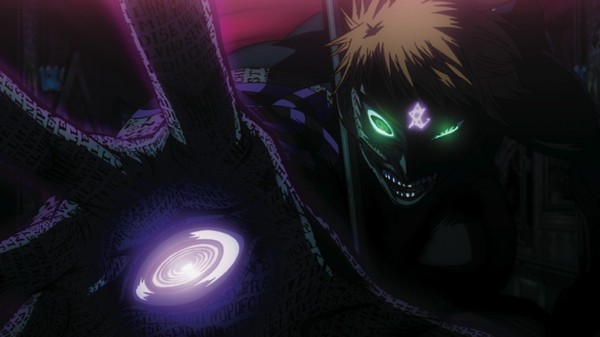
Many characters of the series undergo a significant amount of character development in this collection, chief among them being Seras. Her struggle with her clashing human and vampire nature’s reaches a head, and her role quickly changes from that of a comedic support character to one of the most badass chicks in anime history. On the other hand Alucard’s role in the series is very much downplayed in this collection, only making an appearance in the final episode. However, this protagonist’s lack of screen time is quickly made up for when Alucard reveals his most powerful ability, known as “Level Zero”. This revelation also comes with a significant dose of character development and an explanation as to why a vampire as powerful as he is bound to the will of humans.
Where the first four episodes of collection one dealt with character introductions and contextual set up, the episodes of Collection two are centered on what is widely considered to be the major conflict of the series. All four episodes are structured in an arc style of storytelling, unlike the episodes of Collection 1 which featured more one-shot standalone episodes. Even so, the story still flows at a well considered pace. Despite the abundance of over-the-top action sequences, such scenes are broken up by some very well written transitional dialogue which serves to not only let the viewers metaphorically “catch their breath” but also heighten suspense at the next action scenes to come. And with a series so intently focused on delivering fast paced, bloody action, this effect makes the viewing experience all the more attention grabbing.
This particular collection is a completely madness induced slaughterfest from start to finish, but like the first collection, the level of violence is never so realistic as to cause nausea in the viewer. That said, the R18+ restriction should be adhered to quite strongly, not just due to the violence, but also due to numerous disturbing scenes audiences are shown in Alucard’s and Seras’ pasts. The warning is there for a reason people. However, for all the brief unpleasantness, Collection 2 of Hellsing Ultimate is still an intense roller coaster of action driven events and one insanely entertaining anime (both figuratively and literally.)
Visual
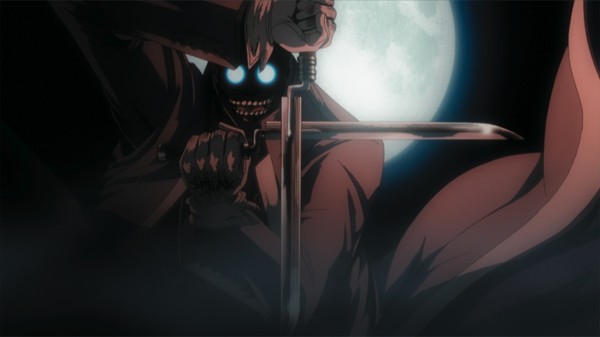
The presentation of Hellsing Ultimate in Blu Ray is nothing short of amazing. Much like the first collection, the presentation of a series that is still a good five years old still stacks up, and in fact outshines many other anime series of the modern day. Character modeling is handled with a great amount of care with its detail, as is the manner in which said characters are bloodied, torn apart or liquefied in action sequences. Each character’s design is handled in a way which exemplifies their individual visual characteristics, which are at their richest in looking at Alucard’s and Seras’ transformation forms. After each transition, you can still tell that they’re the same character, but the look and feel of both is completely different.
If there would be a single colour that viewers are liable to get used to seeing, it’s RED. The fires of London and the bloody execution of violence will provide exposure in droves, which contrasts very strongly against the dark drawn backgrounds. Speaking of which, the background detailing is similarly well presented, highlighting a great visual juxtaposition between the colorful foreground elements with dark environmental ones. With the exception of confusing elements of mangled anatomy, there is never a scene where the viewer can’t visually discern what is going on.
Audio
The soundtrack of this collection is very much on par with that of the first collection, though the themes associated with action sequences do feel much faster paced to compliment the rapid deliverance of action. The increased intensity of the musical scores appropriately fit the increase in pace and euphoria as the bloodiest battle yet takes place.
Voice acting is equally as well handled in this second collection as it was in the first. The English translations are still performed exceptionally well, with a hugely respectable performance going to Crispin Freeman once again. However, this time around Katherine Gray and Steven Brand steal the show for their portrayals of Seras and Anderson, whose character performances really shine given their great level of development, and for continuing to nail those British and Irish accents without making them sound forced.
Extras
As is standard for a Madman DVD and Blu Ray release, Hellsing Ultimate Collection 2 is filled with a variety of bonus features. Of course the standard episode commentaries, trailers and textless openings are present, as is standard fare. The collection also contains a special round table segment which addresses both fan questions of the series creators and voice actors. A dubbing session for the show is also shown in a part of this presentation, which gives fans a great insight into what things are like behind the scenes in a recording environment.
The bonus features also includes a special panel event in Las Vegas 2010 for AnimeVegas, and most interestingly of all, a special subbed “prequel” episode called The Dawn, which explores the roots of the conflict portrayed in this collection, as well as the presence the Hellsing Organization had in one particularly famous conflict in human history. Like the first collection, if you enjoy your series extras, you won’t be disappointed.
Overall
Hellsing Ultimate Collection 2 takes everything from the first collection and makes it a faster, bloodier and crazier than the first. This series still remains a joy to watch from beginning to end with its intriguing characters; unique world perspective and challenging what some are liable to consider heretical views. Each episode will keep you fixated and wanting to see more, a feeling which is exemplified at the end of this collection’s events. Nonetheless, the madly maniacal rush of adrenaline you will get from this series is something which has yet to be challenged or reproduced in any series, and is something that truly must be experienced.
Capsule Computers review guidelines can be found here.
U.S. data collection company Superdata has crunched the numbers to reveal the health of the video game industry. While the numbers are for the U.S. only, it’s fair to say the results will impact gaming globally. So broadly speaking, what do the numbers look like?
On the plus side March showed an increase of 2.9% month-on-month dragging the annual numbers up 1.3% year-on-year after February’s decline. This increase is due to sales reaching $875 million in the U.S. alone for March. Unfortunately this has been balanced off by social gamers tuning out as time passes on the bigger titles. The data shows that it’s the casual gamers ditching the joystick as conversions and revenue per user are up.
Free-to-Play MMOs are still pulling in audiences, with an extra 3 million players joining the fold in March. Monetisation is improving with time as well with revenue in the sector increasing by $195 million. Hawkenand MechWarrior Onlineare currently doing a lot of the heavy lifting in the sector.
Despite Pay-to-Play MMOs losing badly, having dropped 289,000 subscribers in the last month, revenue is stable at $86 million. Further decline is projected in April.
Mobile gamers are starting to show a disinterest in the platform but revenues are still strong in the ever expanding mobile platforms. A 7% year-on-year increase in revenues has converted into a pay day of $157 million for the sector this month.
Downloadable PC and console games are doing the largest amount of leg work for the sector. Of the $312 million revenue generated in March, equalling a 19% increase from last year, Bioshock: Infinite and Tomb Raider by themselves account for 9% of total growth.
That’s it for the numbers. Unfortunately the industry has seen better days but these numbers are still healthy; even if they do indicate negative traits that we’ve seen in the gaming world.
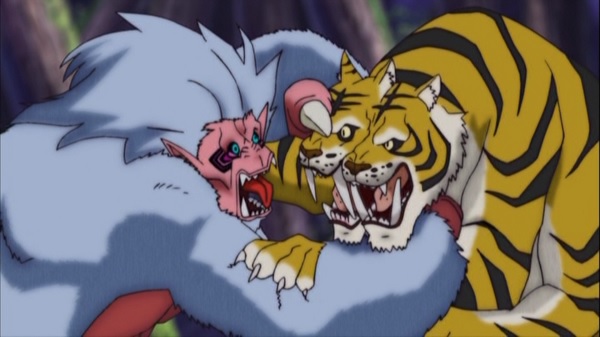
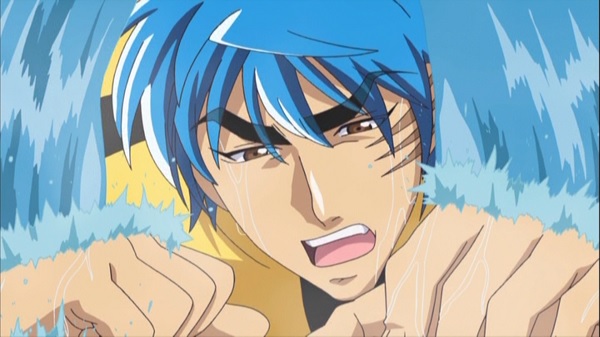
Toriko: Part 4 Studio:Toei Animation Publisher:FUNimation Format: DVD Release Date:May 7, 2013 Price:$39.98 – Available Here
Overview: The Toriko experience has certainly been an interesting one so far. Since FUNimation began releasing the series at the beginning of the year, anime fans have had a chance to experience a shonen series unlike any I’ve personally seen before. One focused almost entirely around food. Now while Part 3of the release was more combat oriented compared to the first two releases, does Toriko: Part 4 bring monster slaying, ingredient hunting and food back to the forefront while also keeping the show interesting?
Story: Let me start this off with a bit of a warning, anyone attempting to jump into the series at this point will not only be completely lost on the storyline of Toriko but also missing out on important plot points. Therefore knowledge of the rest of the Toriko series up to this point is required not only for enjoyment but also understanding the various terms used in the series.
Back when Toriko: Part 3 ended, viewers probably felt shortchanged thanks to the fact that despite focusing entirely on the longest running story arc of the series, the “Century Soup” arc, the release ended one episode away before the end of said arc. Although rather predictable, Toriko: Part 4 kicks things off by bringing the “Century Soup” arc to a close with the first episode before moving on with the story.
Unfortunately, it quickly becomes evident that after the long running Century Soup arc, the writers of Toriko decided to take a break because rather than keep things moving at a brisk pace, half of Toriko: Part 4 consists of episodes which simply feel like filler. The following mini-arc presented after “Century Soup” is completely inconsequential and only shows off more of the strange creatures in the world of Toriko, nothing more.
Thankfully, once the series moves past the filler mini-arc, viewers will find that Toriko: Part 4 actually contains not only character development, but new revelations about the world that show that Toriko and the rest of the Heavenly Kings are still nothing more than small fish swimming in a big pond full of predators and mysterious creatures with unfathomable power.
While battling against the Gourmet Corps’ forces has always been a challenge for Toriko and the group, rarely has there ever been a time that Toriko was actually pushed to the limit by a monster or even the environment. With the revelations of the Gourmet World and the power wielded by the older generation of Gourmet Hunters, viewers are left knowing that despite his beastly strength, Toriko has quite a ways to go.
Now while the Toriko series hasn’t been completely devoid of character development since it began, the only character to really ever be developed, outside of inconsequential powering up, is Komatsu. However Komatu’s development has always been squandered instantly thanks to the fact that no matter what type of successes he had up to this point, he remained the whiny boy who practically “fudges” himself anytime something happens.
However Komatsu, and by proxy Toriko thanks to their bonding, receives some actual noteworthy character development in this release. Not only does he grow more confident in his own abilities he also becomes a useful member of the group. Of course whenever he is presented with a dangerous situation he still will react rather characteristically, but even then he no longer believes that everyone is going to instantly be killed.
Toriko: Part 4 finally finishes the “Century Soup” arc before languishing in the middle in filler territory before finally sending Toriko and Komatsu off on a character building journey together. Of course things also take an interesting turn when the true terrors of the “Gourmet World” are revealed and even Toriko finds himself at death’s door despite his confidence.
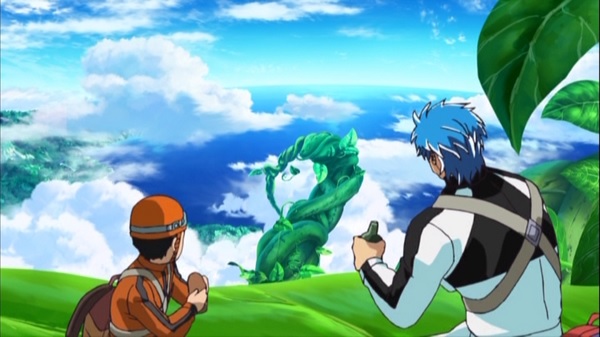
Visuals: While Toriko’s animation quality and artwork has always been a mixed bag throughout its release history, Toriko: Part 4 falls into the middle of the spectrum of decent and terrible artwork. While viewers are presented with some jaw-dropping scenery and great food-themed areas in Part 4, the character animation itself is quite poor at times, often suffering noticeable drops in quality that remain apparent for minutes at a time.
As mentioned before, one of the biggest highlights of Toriko is the exaggerated food and ingredients that the cast hunts down and creates. This offers viewers not only various lush landscapes vibrantly colored with a wide-range of colors, but outlandish animals/monsters as well which helps keep things fresh.
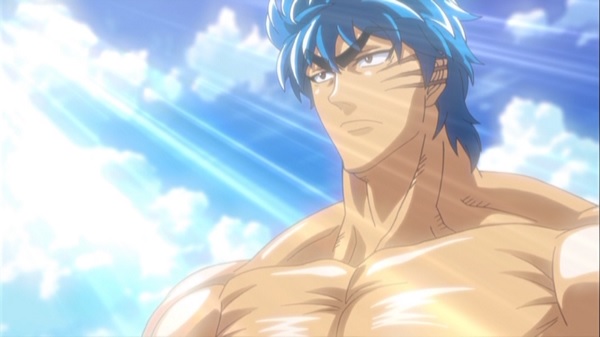
Audio: The English voice track for Toriko has always been very impressive and it remains true with this release. Toriko’s voice actor Ian Sinclair is priceless as the muscle-bound glutton with his exuberant voice acting perfectly fitting the character. The rest of the cast also offers impressive voice work and again it is worth highlighting that a few of the voices in Toriko are actually quite fresh to the voice acting scene, so this is especially noteworthy.
As for the background music, Toriko: Part 4 continues to be very forgettable as far as the series’ soundtrack goes. There is an unknown insert song with vocals in the second episode of this release which was quite refreshing, though this treatment is not given to any other episodes contained in Part: 4. The opening theme continues to be “Gatsu Gatsu” by Akira Kushida which, despite being a bit old now, still is an excellent opening that fits the mood of the series perfectly. As for the ending track, we have a more dramatic song called “Sabrina” by Leo Ieri. At first this ending theme felt out of place, however it quickly turned into my favorite ending theme in the entire series.
Extras: Toriko: Part 4 comes with a rather interesting set of special features that, while not too far from the norm, are interesting thanks to one inclusion. Before that however we have your standard inclusions such as the clean opening and ending themes, trailers for other FUNimation shows, the US trailer for Toriko, two episode commentaries and an actual video commentary which is quite a delight.
The first commentary track is for episode 40 and it features Ian Sinclair, the voice of Toriko, and Jarrod Greene, the voice of Coco. These two spend most of the commentary discussing various “foodie” topics as well as what Jarrod’s favorite meal would be for his birthday. The second track is for episode 46 and for this one, Ian Sinclair returns once again and Josh Grelle, the voice of Komatsu, joins him for the second pairing of this group. Since the two already discussed their favorite foods etc in their first commentary, this one focuses more on the episode itself and how the characters have developed sine the start of the series.
Closing out the bonus features we have the “Feast with the cast of Toriko: Episode 42 Video commentary” which features Ian Sinclair the voice of Toriko, Jarrod Greene the voice of Coco, Aaron Roberts who voices Sunny, and Morgan Garrett, the voice of Tina. Each cast member brought a dish that was inspired by food from Toriko, including some very weird combinations and they discuss the episode while pigging out on the food. This is a very nice change of pace and a sign that hopefully more video commentaries like this will be included instead of the simple audio recordings.
Overall: Once more viewers find themselves in the food-rich world of Toriko with a great English cast but sub-par visuals. Toriko: Part 4 expands the world of the series greatly by not only giving viewers their first glimpse of the Gourmet World, but also showing just how far along Toriko actually is when it comes to the true challenges Gourmet Hunters can face. Actual character development somewhat makes up for the poorly-paced story, though given the arc that Part 4 ends with, viewers are left with the reveal of a new character and a new challenge for Komatsu and Toriko that goes past simply defeating an opponent or conquering an ingredient.
Capsule Computers review guidelines can be found here.
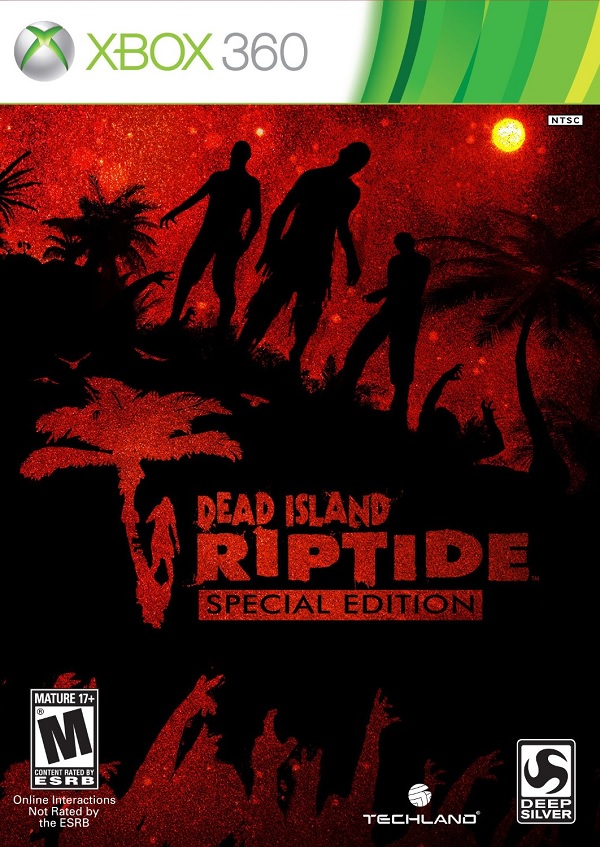
Dead Island: Riptide Developer: Techland Publisher:Deep Silver Platforms:PC, PlayStation 3, Xbox 360 (Reviewed) Release Date:April 23, 2013 Price: $49.99
Overview: Dead Island was originally released back in 2011 and my experience with the title was a very enjoyable experience full of zombie slaying goodness that was almost devoid of the various issues with bugs that many people had with the title. Now two years later Techland and Deep Silver have returned with Dead Island: Riptide, a game which has been emphasized as more of an expansion than a full blown sequel. As a spin-off/expansion, how is Riptide? Let’s find out.
Story: The story of Dead Island: Riptide actually takes place immediately after the events of the original Dead Island. The survivors of the Banoi outbreak managed to escape with their lives and have found what they think is a safe aircraft carrier run by a military organization. However it quickly becomes apparent that something shifty is going on as all of the survivors are imprisoned in the bowels of the ship. Here they meet a new survivor named John who has been held captive for quite some time.
After an unknown issue causes a zombie outbreak aboard the ship, causing it to crash, the group of survivors washes up on a new island which is called Palanai. Palanai is suffering from the same zombie crisis that afflicted Banoi, however the stakes are higher than ever now that a surviving member of the military informs the group that a nuclear weapon will be used on Palanai soon and they must hurry to escape the island with their lives.
Similar to Dead Island in a number of ways, Dead Island: Riptide is quite sparse on its storytelling. There is certainly a story to be told in the game and the secrets behind the zombie outbreaks are in fact revealed in Riptide, however the storyline is very basic. Even when the game introduces a plot twist involving mutagens, the story is unfortunately very predictable and quite barren.
This is perhaps due to the fact that the game’s storyline is told through a series of quests that have to be completed and often these quests simply involve going to a certain area and gathering a missing item, killing a few zombies or simply reaching a specific area. There is a little spice here and there in these mission and two sequences in particular are not only enjoyable but actually create a tense suspenseful atmosphere, but many of them simply devolve into fetch quests.
Thanks to the siege system that will be discussed later, players are supposed to take a bit more interest in their fellow survivors and their survival, though ultimately they play such a minimalistic role, or barely any whatsoever, in the storyline it is almost pointless to be concerned for their safety. It is also worth noting that there seem to be a number of plot holes that are left unanswered by the time that Dead Island: Riptide wraps up. This means that while there are a few new developments and twists to the story and the reason for the outbreak is revealed, many will find the story of Riptide lacking.
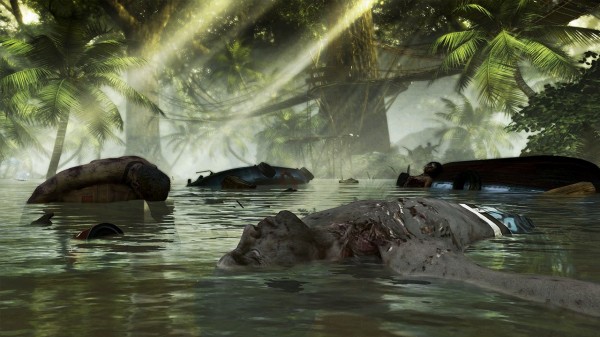
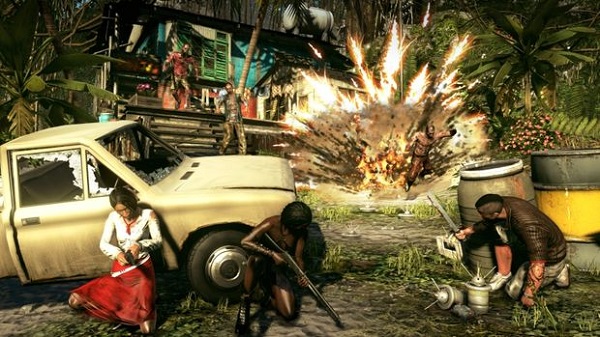
Visuals: Something must have went wrong when it came to creating Dead Island: Riptide’s environments. While its predecessor that took place on the island of Banoi was a beautiful resort town that starkly contrasted the horrible things players were seeing, Palanoi is quite an ugly place. There are only two, though you could stretch things and say two and a half, zones in Dead Island: Riptide and each of them feels bland and unimaginative. The starting area may look decent enough initially, but quickly players will find themselves exploring bland areas that are poorly designed. That says nothing for the amount of building interiors and “Dead Zones” which are duplicated almost to the exact detail numerous times within the game. It is worth noting that the environmental system with the heavy amounts of rain that can fall at times does do wonders for the game’s atmosphere.
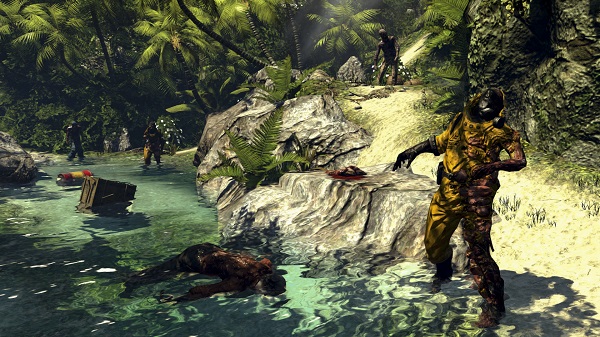
As for the zombies themselves, they appear quite similar to what gamers experienced in the original Dead Island; though their clothing does match the more subdued nature of the island compared the resort that was Banoi. There are a few new enemy types included in this release as well and although they are nothing to really write home about, it is nice to see some more variety to spice things up.
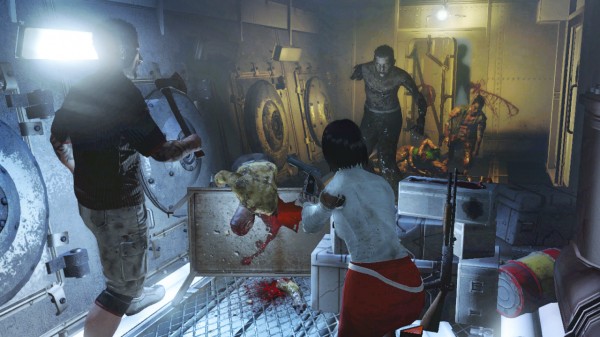
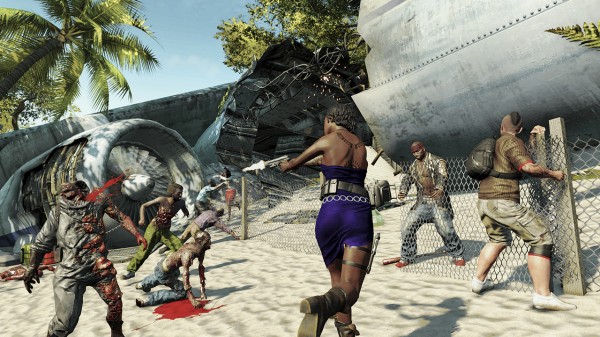
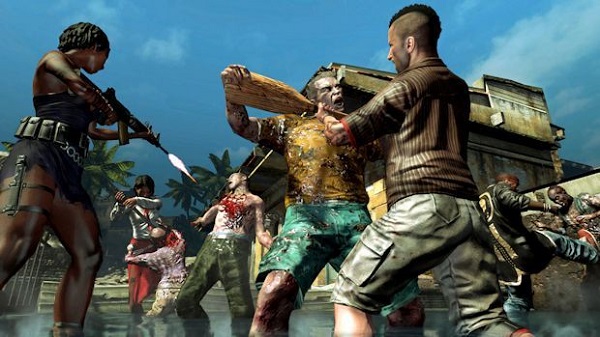
It is worth noting that the zombies are also more than willing to part with their limbs similar to the past game. Literally disarming zombies or slicing off their legs or heads remains both visually satisfying and quite visceral as the first person combat and camera pack quite the punch when it comes to combat. Unfortunately I must mention that the game does suffer from quite a bit of slowdown. This primarily occurs whenever the player is fighting in water, though given the flooded nature of Palanoi, there is water everywhere and any combat that takes place in these flooded zones will often slow down to a complete crawl.
Audio: While Dead Island: Riptide can still be quite the scary experience, the terror aspect of hearing zombies in the distance is practically non-existant in this release. Perhaps it is due to the fact that the ambient noise I enjoyed from the first game has either been removed completely or I failed to notice it at all, but the moans and snarls from the zombies lack the feel that made the first Dead Island an experience to remember.
As far as voice work goes, the cast has remained the same for the playable survivors and John’s voicework is commendable, though some of the accents used in the game which seem to still be Australian in nature are forced sounding.
Gameplay: One of the first things that players should note when they start up Dead Island: Riptide is that they can import their previous character with all of their levels and skill points. However it is worth noting that thanks to their confinement on the boat, all of their weapons and money has been removed. This means that players start from square one equipment wise if they choose to import their character. Of course starting fresh is always an option, especially for those who want to check out John’s fresh set of skills and focus on hand-to-hand combat.
The old survivors have been given a number of new skills as well and with the level cap raised to 70, players still have to be a little choosy when it comes to selecting their skills as there aren’t enough points to go around, but by the time that cap is reached nearly every skill can be leveled up fully. Also added into Riptide is an experience system for the various weapon types: Blunt, Edge, Hand-to-Hand, and Firearms. Using these weapons on zombies raises the level of those weapon types and this adds various bonuses for using weapons of those types, such as more XP, damage or Rage points. While a neat system, the fact that every survivor’s skill tree is designed specifically for a specific weapon type in mind means that while you can certainly work on leveling up your blunt weapon skill, if your character’s entire skill-set adds bonuses to edged weapons, it is rather pointless.
Also newly added into the game is the aforementioned siege system. At various points in the story players must defend their base of operations from an incoming horde of zombies. Not only can players die (only to lose money) in these fights, but other survivors can lose their lives if the player isn’t quick to help them. This is because not only will you be fighting in these siege battles, other non-immune survivors and the other playable characters will be CPU controlled to defend the base.
Despite there being various quests to give the survivors stronger weapons, even at their strongest the survivors feel very inadequate compared to the player and will almost always need saving of some kind. This means that while you are trying to not only set up fences to hold zombies off, you’ll also be running from place to place to save your hapless allies.
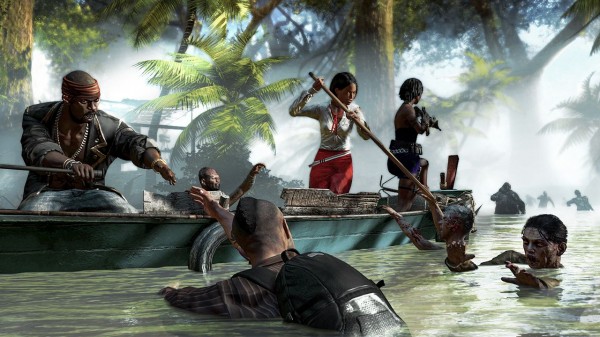
Riptide also sees the addition of a boat as a faster way to navigate the flooded island of Palanoi. Traveling through the deep waters of flood zones is extremely tedious without a boat, making aquatic travel a necessity. While driving the boat you can use a boost system to ram through zombies wading through the water, often creating a satisfying visceral collision. However if you aren’t careful, zombies can rip your team members off of the boat or even climb onto the craft and tackle you into the water, forcing you to fight for your life before returning to your dinghy.
Outside of these additions, Dead Island: Riptide is still very much the same game as Dead Island, players will come across numerous weapons and creating poisonous, electrified or weapons on fire is always a great experience that allows for the game’s satisfying combat system to always be enjoyed. It is worth noting that the hand-to-hand weapons and mines that can be used to help in sieges or normally are really the only actual weapon additions in Riptide while everything else will be extremely similar.
The game can still be incredibly difficult at times and thanks to the zombies scaling to your level, there is never a time that you’ll truly feel safe. Even the weakest zombies pose a major threat as they can levy enough damage that simply taking a few hits can put you on the ground. This makes taking out these enemies by slicing their limbs off, throwing weapons at their heads or whatever else you feel like doing all the more satisfying however as the first-person camera really helps sell the experience.
It is also worth noting that as mentioned earlier, there are a few new enemy types. These enemies add a bit of a challenge as those familiar with the series will be caught off guard, especially when it comes to special versions of basic zombies appear. The “Grenadier,” “Screamer,” and “Wrestler” special zombies are certainly unique, however they aren’t all that challenging due to their very obvious weaknesses. It is also worth noting that there are special areas called “Dead Zones” where players can challenge an enclosed area full of basic zombies, infected, special versions of infected and “Boss” type enemies which are extremely strong and difficult to kill. These Dead Zones often contain some of the best loot in the game, though these Dead Zones are also some of the most re-used segments in the game.
As for the game’s online system, the co-operative mode remains online only as there is no split-screen option however it continues to play flawlessly. With the game’s drop-in and drop-out online system, players can easily join a team of three other survivors to tackle various missions with four players at a time without a hint of lag, though the frame rate can drop with four players fighting enemies at one time.
It is worth noting that the bugs that plagued the original Dead Island are still prevalent in Riptide. There are numerous graphical glitches, glitches involving quests either not finishing properly or requiring an incorrect number of items and even a few odd bugs that teleport players to the other side of the map and more. While many of these do not ruin the experience and even the quests can be completed once you gather more than the shown amount, they are quite noticeable.
Overall: Dead Island: Riptide is without a doubt a very enjoyable game. With the same satisfying combat system and enjoyable weapons of Dead Island, taking on the countless zombies in Palanoi is a blast, especially when you team up with your friends. However even though this release is an expansion, the game’s unimaginative and repetitive environments, bland storyline and blander quest system, issues with slowdown and bugs and a number of new additions that just fail to work well make the experience pale in comparison to the original.
Capsule Computers review guidelines can be found here.
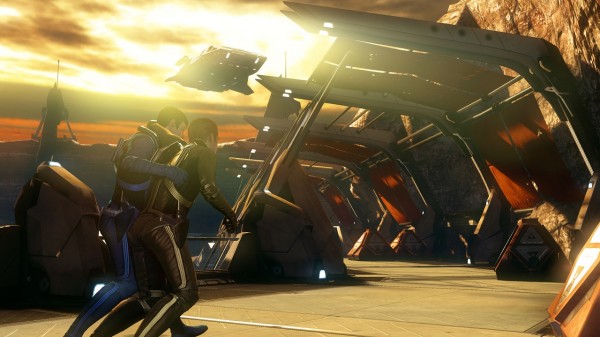
Star Trek: The Video Game, available from April 26th in Australia for the Xbox 360, Playstation 3 and PC, provides players and Trekkies (will most likely be one in the same) a brand-new canon story within the new universe continuity of the films, set after the first, but before the upcoming Star Trek: Into Darkness.
Paramount Pictures hired BAFTA-award-winning writer Marianne Krawczyk (God of War), to pen the narrative for the title, which we had the chance to get some hands-on time with earlier in the month. Paramount have just released a new video which featuresexecutive producer Brian Miller delving deeper into this rich, exciting story, examining the plot that awaits players. Check it out below, along with the making-of video released a few days ago.