The new RazerAdaro series of audio products is now available in Australia. The Adaro is Razer’s latest addition to their lifestyle line aimed at audio enthusiasts. The Adaro line is composed of four products: a set of in-earphones, a pair of wired headphones, a pair of Bluetooth wireless headphones, and a pair of DJ headphones.
The cheapest in the lineup is the Razer Adaro In-Ear Analog Earphones, which sport 10mm neodymium drivers nestled inside a milled aircraft aluminum body. The earphones come with flat anti-tangle cables and a set of ear tips in different sizes. The earphones are tuned for crisp stereo sound for $109.95 AUD.
The Razer Adaro Stereo Analog Headphones are a lightweight set of closed back headphones powered by 40mm neodymium drivers. They are tuned for a natural sound that is comfortable to listen to for long periods of time. The headphones feature plush leatherette ear cushions, an anti-tangle braided fiber cable, and a sturdy construction that will survive all of life’s adventures. The Razer Adaro Stereo Analog Headphones are available for $149.95 AUD.
For those looking for freedom from cables, the Razer Adaro Wireless Bluetooth Headphones uses the same tuned drivers found in its analog sibling, but adds Bluetooth 4.0 connectivity with aptX codec to deliver CD quality sound. The batteries are rated to last 20 hours of music playback between charges while the headphone still clocks in at a light 197g. The Razer Adaro Wireless Bluetooth Headphones have controls for playback and volume built into the headphone. A micro USB cable recharges the headphones in approximately 2.5 hours. The headphones are now available in Australia for $199.95 AUD.
Finally, the Adaro line is headlined by the Razer Adaro DJ Analog Headphones, which are designed for producers, performers, and fans of bass heavy music genres like dance and hip hop. Like any good DJ headphone, the Adaro DJ headphones are built tough with metal and resilient plastics. To make it easier to travel with, the headphones can fold down into a more manageable size when on the go. 50mm dynamic drivers power the Adaro DJ to provide thumping bass in a closed back set up. The cables are swappable in case of damage, and comes with a coiled and straight cables. The Razer Adaro DJ Analog Headphones are now available in stores for $279.95 AUD.
Find out more about the Razer Adaro lines of products at the official mini-site.
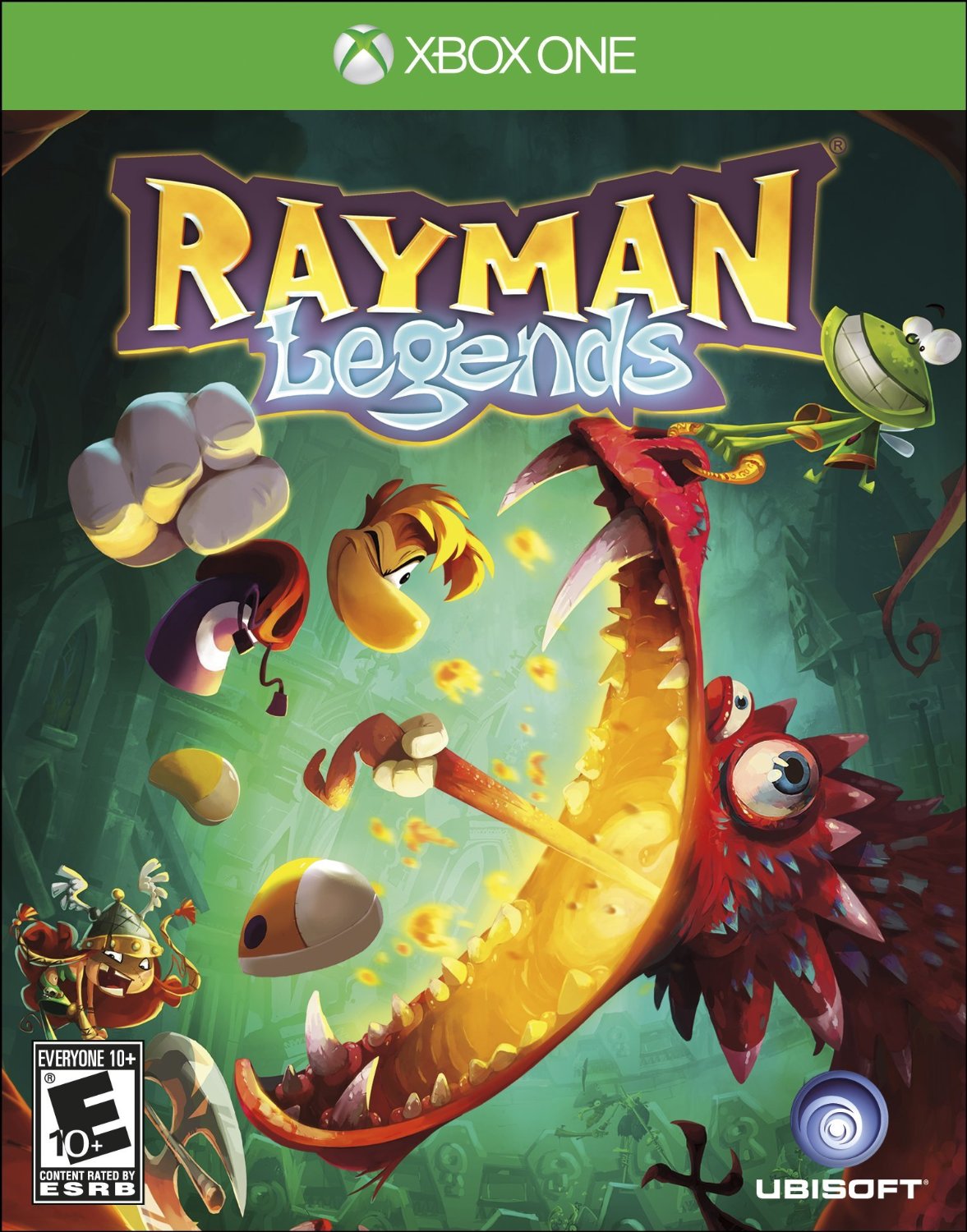
Rayman Legends Developer:Ubisoft Publisher: Ubisoft Platforms:Xbox One (Reviewed), PlayStation 4 Release Date: February 18, 2014 Install Size:4.3 GB (Xbox One) Price: $39.99 – Available Here
Overview
Originally set to be an exclusive release for the Wii U, Rayman Legends is a follow-up to 2011’s critically acclaimed 2-D platformer, Rayman Origins. The game received numerous delays on the Wii U, ultimately dropping for last gen consoles and, recently, receiving a release for the Xbox One and PlayStation 4. Can Legends reach the high marks set by its predecessor? Is the next-gen version of the game worth picking up?
Story
After a deep, century-long sleep, Rayman, Globox, and the Teensies are subjected to terrible nightmares that have been growing ever stronger with the Bubble Dreamer. Awoken by their friend Murfy, they find out that five Dark Teensies have been wreaking havoc. They set out to rescue the 10 princesses captured in the nightmares along with hundreds of Teensies who have also gone into hiding, as well as defeat the Dark Teensies and restore peace to the land.
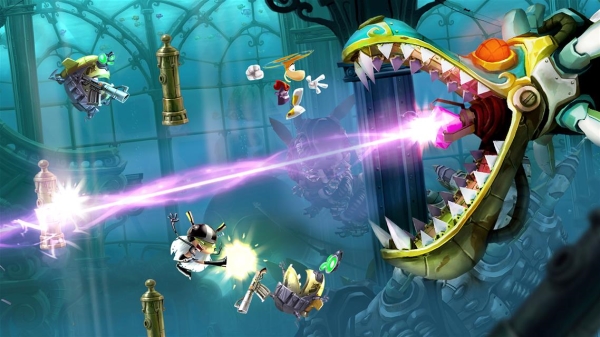
Gameplay Rayman Legends is a deep, rich game that will keep players busy for dozens of hours. The game is packed with 120 levels, 40 of which are back from Rayman Origins. With 700 Teensies to rescue and dozens of other collectibles and challenges, Legends promises to be the sort of platformer game you can sink your teeth into – and savor every single moment.
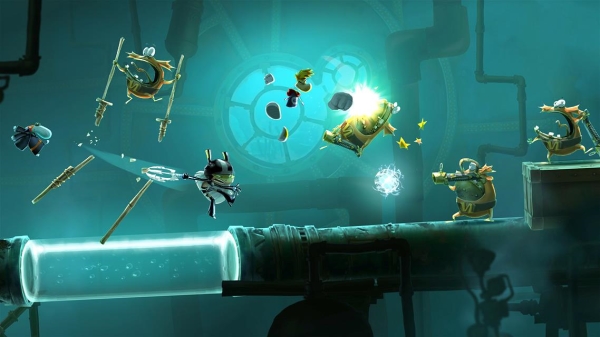
The game is set up into several worlds placed across a series of paintings. Within each world, you’ll have several levels to play through, many of which are your standard start-to-finish platforming levels. You’ll occasionally have those broken up by speed runs, time trials, boss stages, rhythmic platforming levels, and more.
Ubisoft does done an incredible job with its level design in Legends. There are 120 levels and you will rarely, if ever, feel like you’re replaying something you’ve already worked through. The mission variety is well implemented and expertly paced, giving you a few standard platforming levels before kicking in a dash of something else to keep things spiced up.
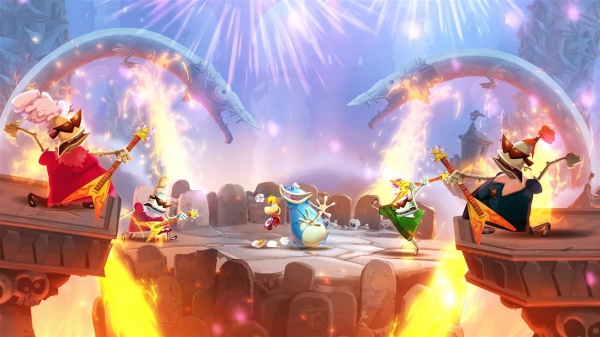
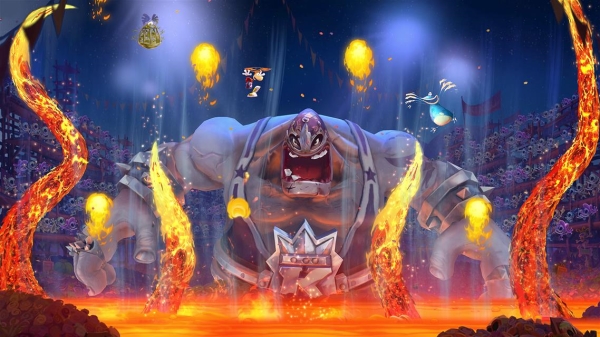
Beyond the simple variety of the level types, you’ll get to experience a multitude of objectives. You’ll find yourself trying to outrun a wall of fire to save a princess, collect as many lums as possible in a given time limit, take the optimal route backward through a level to save Teensies tied to timed fireworks, and more. Boss battles are interesting without ever feeling boring, lending a wonderful sense of discovery as you near the end of each world. One of the finest treats, however, are the rhythmically designed music platforming stages, which have you running left-to-right through the stage, attacking enemies and jumping to the beat of remixed tunes like “Black Betty” and a hispanic version of “Eye of the Tiger.” There’s nearly no end to the fantastic variety and endless flow of smiles and laughs you’ll get playing through this game.
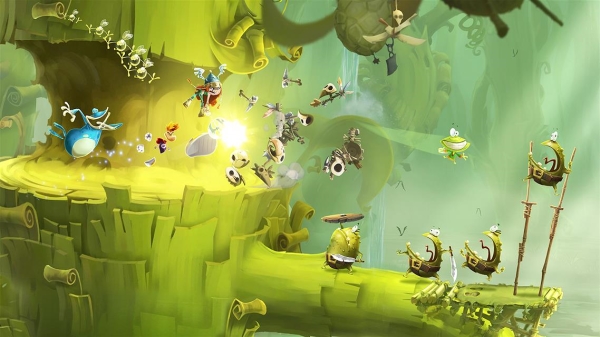
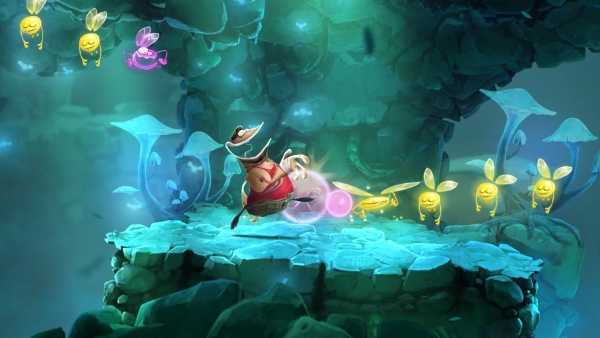
Each level is expertly crafted. Standard missions give you plenty of elbow room to branch out and explore, which is often needed to dig out and rescue all of the Teensies. You’ll have stages you have to run, jump, and wall-bounce through, and others where floating on the wind is your primary mode of transportation. Along the way, you’ll work to collect as many small, golden creatures known as Lums as possible for your score. You’ll also have to employ the use of your small, frog-like friend Murfy to manipulate platforms and the like in the stage, keeping the path clear and navigable for you. They’re all a blast to play through, keeping playthroughs fun and making level replays for enjoyable instead of burdensome.
One of my favorite aspects of Rayman Legends is in the way it eschews what games like the popular Super Mario franchise has always clung so tightly to – time limits and lives. Rayman is happy to be done with those painful hindrances, opting instead to utilize a helpful, intelligent checkpoint system that won’t completely break the flow of the game when it has to be called in. You can still die, sure, but you’ll never have to worry about the game ending on you because you didn’t have enough continues. It allows the game’s exploration to flower and grow, making for a more enjoyable product at the end of the day.
As you play through Legends, you’ll be rewarded with an onslaught of collectible items. Lums you collect are kept throughout the game, and the more you collect the costumes you can unlock – from a Splinter Cell inspired Rayman to a Far Cry 3 Globox and much more. On top of an excellent array of playable characters and costumes, there are both hidden and Originsstages to unlock, as well as a full collection of goofy “creatures” to gawk at and collect Lums from.
Among the embarrassment of riches, Legends also features daily challenges. These will let you jump on for a handful of quick daily challenges that let you see how you stack up compared to the rest of the world. You’re also rewarded accordingly with Lums, based on your performance. When you add in four-player cooperative play and a fun football (soccer) mode that’s great at parties, you’ve got a package you just can’t pass up.
Visuals & Audio
Ubisoft has done an incredible job with the visual design in Rayman Legends, which is only enhanced by it’s release on Xbox One and PlayStation 4. The worlds and characters are vibrant, intense, and stunning. Worlds are aesthetically unique and inviting, each with their own look, feel, and obstacles, while the larger-than-life bosses are humorous and memorable. The designers at Ubisoft did a great job utilizing visual hints and cues to direct players toward content without ever having to spell it out for the player. Most importantly, though, is that it’s all tied together by fantastic animation that’s quick to respond – an absolute must with any sharp platformer.
The audio design within Rayman Legends is also expertly designed and implemented. Sounds are used to great effect to liven an already vibrant world. The soundtrack, both the new and familiar, will have you tapping your toes and bobbing your head as you run through levels. The musical platforming levels previously mentioned are the perfect vehicle to a smile, providing twists on familiar tunes timed perfectly to the action on-screen. You’ll want to crank the dial to 11 while you enjoy Legends.
Overall
Overall, Rayman Legends is pure platforming bliss. The level variety and caliber of stage design shine through at every turn, while the beautiful visuals and rockin’ audio made the jump to next-gen even better than could be expected. The sheer breadth of content alone would be enough to easily recommend Rayman Legends, but the game’s rich quality makes it a must-have. Rayman Legends is a fun, beautiful, addictive platformer players will fondly remember for years. Rayman Legends is truly legendary.
Capsule Computers review guidelines can be found here.
This competition will close on March 3rd. Make sure you use a valid email when you register. If you choose to enter by logging in with your Facebook account, your email is not required
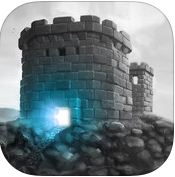
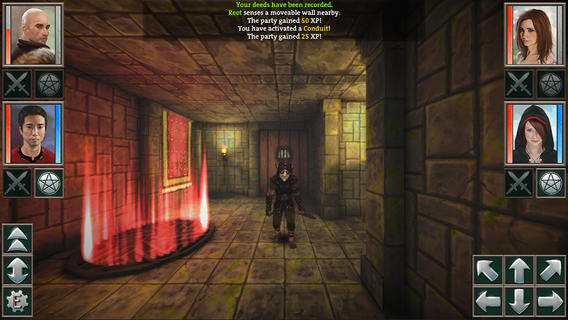
We’re now living in the ago of gaming where people want something totally brand-new but they also want something old-school, something that will remind them of their pasts and, you know what, some companies are actually pretty damn good at fusing the new and the old into a great game. “Coldfire Keep” developed and published by “Crescent Moon Games” is definitely a game that fits into the what was said in the above sentence; it’s a game that will remind people of the adventure titles of their youth while also giving them just enough to be able to enjoy it in a day and age where high-definition gaming is a must. Unfortunately for everything it does right it also does some things wrong but you can read more about that in the bulk of the review below.
Story
“Coldfire Keep” seems to have the type of story that, despite its taking a back seat to whatever smaller storyline or mission you’re currently working through, it continues to loom overhead while it constantly reminds you exactly where you’re heading and what all this adventuring is going to lead to. It’s the story of an old castle that, long ago somewhere through time, saw a mighty war take place. Many hundreds of years later the castle now serves as nothing but a reminder of what happened long ago though something strange has been happening within its walls as of late and, after a rogue monster trashes the nearby town, four heroes set off to find out exactly what is happening in the dungeon of the castle and how they can stop it before the forces of evil once again take reign over the land.
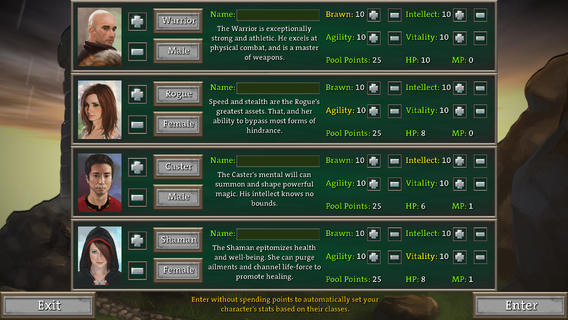
In my opinion the backstory for the game was glassed over fairly swiftly, it came in the form of a few paragraphs to read and told only the bare bones of what exactly happened so I’m lead to believe, as a player, the focus was not so much on what happened in the past but what you as an adventurer playing the game will make happen. It is a story that begs the player to create his or her own story through their decisions. At least, that’s the vibe I got from it. You get to choose your own team; what they look like, their combat classes, their battle statistics and even their names so I imagine it was a purposeful choice by the developers to make the story somewhat vague. The nice thing is that you know what your mission is throughout playing the game but it’s not always in focus, speaking adventurously…it makes sense.
Gameplay
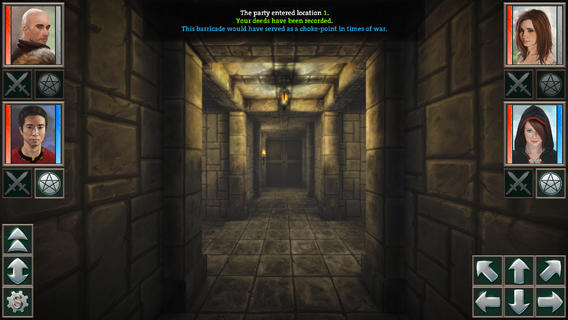
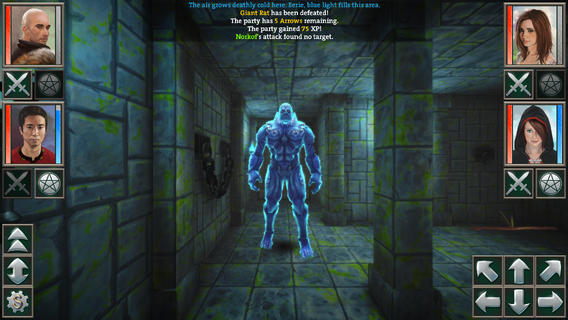
Playing through “Coldfire Keep” as someone who did not grow up enjoying old-school dungeon crawling, first-person, adventure games I found it quite…tedious. As mentioned, you’re placed in first-person view and all you really need to do is move around dungeons using either gesture controls or classic controls like arrows and buttons which can be changed in the option menu of the game. Characters, depending on their class, can use physical attack and/or magical attacks to thwart enemies but it seems as though the game doesn’t entirely have its combat system worked out seeing as you miss your attacks most of the time while enemies continuously land hits and you that deal more damage than you would have assumed. Essentially you travel through dungeon floors, dodging traps, finding secrets, fighting enemies and advancing lower and lower doing the same thing again and again.
Now I’m not going to say this game is “broken” but I will absolutely say that the developers clearly have things that they need to figure out. Things like the battle system, as I briefly mentioned above, really have some kinks that need to be worked out; enemies do an amazing amount of damage to player characters, It actually took me a couple of hours just to play through the first few floors simply because none of my hits were landing yet every enemy had laser accuracy. My characters were killed in a matter of a few turns and it wasn’t like I was fighting enemy demons or anything as extravagant as that…I was killed by rats.
It was also extremely difficult to pick up items, the controls were mostly unresponsive and what was supposed to be a double tap to pick-up an item turned into 8 or 9 furious taps of frustration. If only I was over exaggerating…I played it while sitting around with some friends one night and as my frustration boiled over and I began hitting the screen one of them turned to me and said “Frank, contain your excitement” in a sarcastic manner, that is truly how hard I was tapping the screen. Look, I can honestly see why people would enjoy this game. It takes a great deal from old-school fantasy and adventure titles, essentially it is itself in a pure form and I can see that.
Visuals
For the most part I’d say that “Coldfire Keep” is a fairly good-looking mobile title. It doesn’t do anything overly spectacular and pretty much sticks to the basics when it comes to visual representation of certain things but I believe that is what gives it the feel of an old-school title. I can see it having a nostalgic look to it but, unfortunately, since I never played these types of games years ago I cannot directly relate to that feeling. The game doesn’t really give you a chance to get bored of the environments because they’re constantly changing and throwing different obstacles and traps at you so you never really get too much time to get sick of it.
Something I didn’t particularly like was the colour choices for the text throughout the game. Like most aspects of this game it was fine for the most part but there were certain pieces of text that were coloured flouro green or yellow that really stood out, especially in a game where you’re meant to believe you’re in some dark and dingy dungeon, it just didn’t fit with the theme. It mixes some nice old-school style layouts and models with an upgraded kind of graphics system and it’s hard to be angry at something like that.
Audio
The game, kind of, ditches a soundtrack to instead focus on environmental sounds like the dripping of water or the squeaking of rats which I’ve experienced in other games that do it incredibly well, “Coldfire Keep” on the other hand doesn’t do it as well as it could. Do not get me wrong here, I’m not saying that it does a terrible job when it comes to environmental sound effects, all I’m saying is that it could use some work. A great deal of mobile titles try to give players an opportunity to immerse themselves within the game, sometimes they choose the auditoral road wherein which they advise players to wear headphones because they’ve put so much effort into the sound and I think “Coldfire Keep” could have done it closer to how others have, it definitely would have made the game more engaging and possibly even a little bit scary. Music would not have helped this game, maybe just a little more attention to detail and it would have been golden. I’ll say one thing; the voice acting was quite a pleasant addition to the game, though there was no actual spoken dialogue, there was the occasional “arrgh” or “aaahh” when being attacked and they sounded pretty well-acted to me.
Overall
My job as a reviewer is to look at games from all different angles, I tried very hard to enjoy this title but there were far too many problems to even begin enjoying it. Maybe had I had some experience within this genre as a child or pre-teen than, yes, the nostalgic value of an old-school-style title such as this would have raised the enjoyment level quite a bit but as far as it goes actually being a game…it’s powerfully average. It’s not great and it’s not terrible, it’s just kind of good.
If some of the gameplay elements where tweaked and changed even a tiny bit I can imagine people (including myself) would enjoy this game so much more. Once again, these opinions are mine alone so most of you out there who are still reading this may absolutely love the sound of it, if you do than I suggest you go out and buy it in the hopes that there will soon be an update to fix the slew of semi-broken aspects with the gameplay. I don’t enjoy being harsh but I have to be honest. It’s a great game but if definitely needs work.
Capsule Computers review guidelines can be found here.
Last Friday Hanabee Entertainmentannounced three new title acquisitions to their members through email news blast. Now they have released details on each of these titles including release dates and formats. Read on for information on each of these titles release plans from Hanabee.
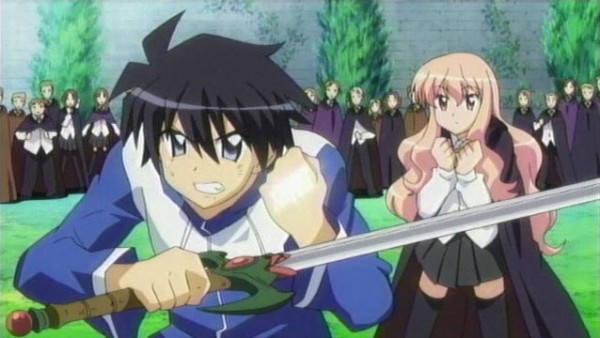
Familiar of Zero also known as Zero no Tsukaima is the tale of a familiar summoning gone wrong, rather than getting a magical creature, Louise the Zero gets a human instead, another magical blunder in a long line of them. Hanabee have confirmed their release of Familiar of Zero to hit shelves on the 7th of May, 2014 for both DVD and Blu-Ray. It will retail for $59.99 (DVD) & $64.99 (BLU-RAY). The release will feature an English language dub and collect all 13 episodes.
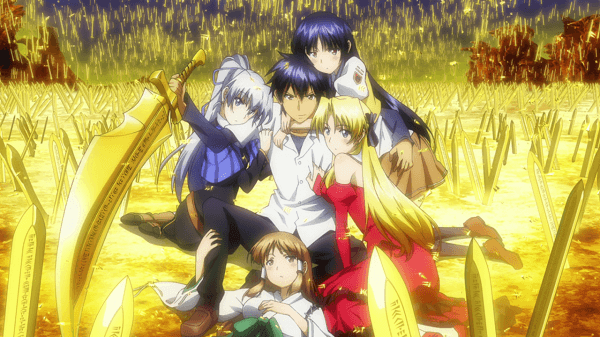
Campione! follows Kusanagi Godo, a God Slayer who must defend his title from those who wish to take it from him. Hanabee plan to release Campione! on the 7th of May, 2014 for DVD and Blu-Ray in a dual language release. It will retail for $59.99 (DVD) & $64.99 (BLU-RAY) and collect all 13 episodes in one release.
From the New World is set 1000 years into the future in a world that is on the verge of falling apart. A group of friends must uncover the dark truth of the world or fall apart with it. Hanabee will be releasing From the New World on 7th of May, 2014, beginning with Part 1 of 2 planned releases. Both releases are to be for both DVD and Blu-Ray in dual language. It will retail for $59.99 (DVD) & $64.99 (BLU-RAY) for each part. Part 1 will collect the first 13 episodes of the series.
On top of these announcements was the revelation that Accel World will be getting a Blu-Ray release now for the price of $64.99. They also confirmed that they will be releasing the second season of Little Busters. Stay tuned for further information on this as it comes to light.
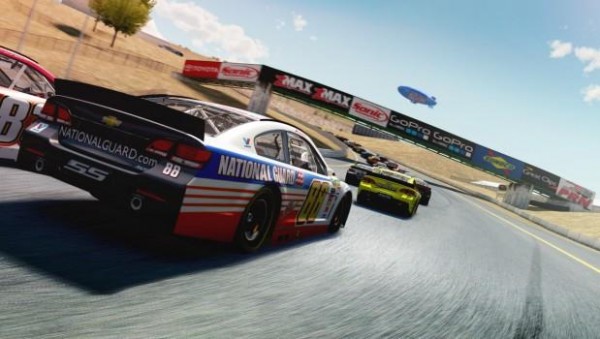
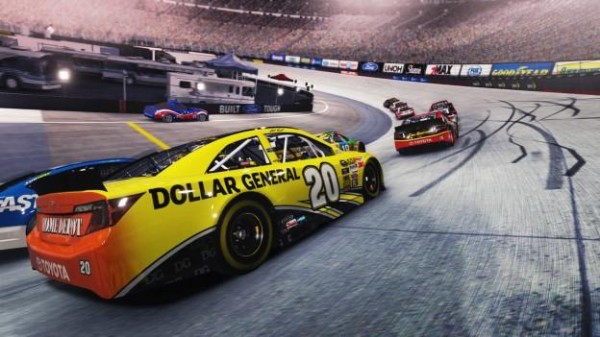
Overview Nascar in many ways is like wrestling. You either get it, or you don’t. You can watch it for the injuries or the competition, and it of course has its own loyal fanbase that spend a heavy amount of time and money to celebrate the high-octane energy that the drivers bring to the sport. The video game adaptations over the years have been hit or miss, but fans still manage to see further installments due to the demand in the market. Nascar ’14 is Deep Silver and Eutechnyx next iteration of the franchise for home consoles, and one that brings a lot of tools to make the player feel as if they were behind the wheel. How does it fare? Let’s find out.
Gameplay
To understand Nascar races, you have to understand the sport – as this title is not going to go out of its way to treat newcomers with kid gloves. Players start their races out in a line and have to pass others using a very strict strategy that mixes both patience and intelligence in order to come in first when that checkered flag is waved. Go past the line? You are forced to watch a cutscene as you pay the price for the penalty. Wrecking is a hallmark tradition at Nascar, but one task you do not want to partake in as it just shows your own shortcomings – which will almost always cost you the race. Eutechnyx really fine tuned the mechanics behind Nascar ’14, and treating the fans like they are not the stereotypical beer swigging, buy anything schmucks we see outside of the sport is exactly why this game is a step above previous entries.
Controls are easy enough to learn, and fully customizable to provide a comfortable layout to anyone picking up the controller. Use the analog to move, right trigger to accelerate, left trigger for brakes and reverse. The simplistic setup comes off as very polished and shines when having to pull off tough maneuvers on the track such as drafting and tightly pulling through other racers on the track. In my opinion, drafting may be the finest attribute of the game, as even in the real deal – getting your head behind the aerodynamics of boosting off the air stream behind another vehicle can be daunting. Luckily, with patience and precision one can execute this with ease here, where they are rewarded for their efforts with great momentum that can decide the fate of an event. The AI can be a tad out of place when on the track – but keep it together for the most part to give a formidable challenge, pitting and actually attempting to win (which was an element missing in similar titles that came before this one).
Career mode is the true heart of the game, as it allows players to go through a great number of events by starting from the bottom and working their way up to legend status. Now, I am not a huge enthusiast of Nascar to be honest, but the customization and constant stream of upgrades make this mode immersive and quite fulfilling to even the lightest of followers. Each week, the player can use their stream of cash to upgrade their vehicle. These upgrades allow you to shift the weight of your car so it is more in tune with the track, get proper tires and parts, and literally control the difficulty level to balance out the AI’s intelligence. The customization also comes in while setting up each race, as players can utilize sliders for damage, gas levels, and other options to provide a little relief or up the volume of the intensity, based on the selections chosen. Once everything is in line, it is off to practice before the big event to make sure that the options selected actually show on the track. No good? Then a slight reshuffle will do some good, and with multiple practices before each race, there are plenty of opportunities for improvement and further immersion.
Online mode is detailed, but lacking a lot of other users at this moment to truly enjoy due to how early we are into Nascar ’14’s release. Online leagues have been added which allows a player to host a league and have their stats tracked for them. Up to 16 players can partake, which adds a lot of replay after one has had their fill of Career and the other modes within the game. Matchmaking has been overhauled as well, now allowing for a more skill-based session. I am not the best driver, so not being thrown to the wolves was a pleasant change of pace compared to the random online sessions seen previously.
Visuals
The visuals were truly one of the most impressive parts of Nascar ’14, as much like the gameplay mechanics, they too can be tuned to ones liking. Yeah, the tracks look authentic and the tire tread on the track adds to the experience, but turning visual damage on does a lot to bring this track full circle so to speak, with cars displaying their war wounds as they occur. Each vehicle also looks highly realistic as well, with small details magnified by shading and color, where the polish is truly evident through and through. Though it doesn’t have much to do with visuals, being able to change the camera angle to several different perspectives also lets this world be seen in new ways – just adding more comfort and customization to an already broad line-up of rich options.
Audio
The sound is the only thing I truly had an issue with during my experience – though some of that is based on taste. Having an audible assistant of sorts is perfectly fine, but during a race his constant tips and babbling about how to race can prove to be a distracting to an otherwise exhilarating session. On a brighter note, these cars sound fantastic and differ as upgrades are added. The soundtrack is where the preference comes in. I know Nascar fans are mainly from the south, but the “redneck rock” is just not my cup of tea, and these tunes are offered during every single menu – so be ready to get the volume switch out, depending on your own liking of the music.
Overall
Nascar ’14 is a polished gift to the fans, and one that will go down as one of the finest adaptions of the sport due to the level of customization alone. Sure, the gameplay has been improved and the visuals look fantastic, but its catering to the player’s needs that sends Nascar ’14 through the checkered flag, and on to a full victory for both Eutechnyx and the consumer alike. While it has a ways to go to being absolutely perfect, Nascar ’14 is the best choice for fans wanting to continue to celebrate the legacy of Nascar.
Capsule Computers review guidelines can be found here.
Every mecha-centric anime series has the same set of fundamental ideas, ideals and execution. The fact of the matter is that we as fans of the sub-genre choose to follow certain series’ over others due to their major differences despite the fact that, deep down, they are all incredibly similar. What makes a series like “Neon Genesis Evangelion” better than a series like “Mobile Suit Gundam” or vica versa?
Is it maybe that some shows stick closer to their roots? Is is maybe that some shows choose to take a path not yet travelled by others? There is no right or wrong answer to a subjective question, the point I’m making is that we don’t just follow series’ simply because they revolve around mechs and their pilots, it goes a lot deeper than that and it’s mecha animes like “Aquarion Evol” that attempt to give us more than what we expect from a seemingly simple mech plot. Does it though?
Story
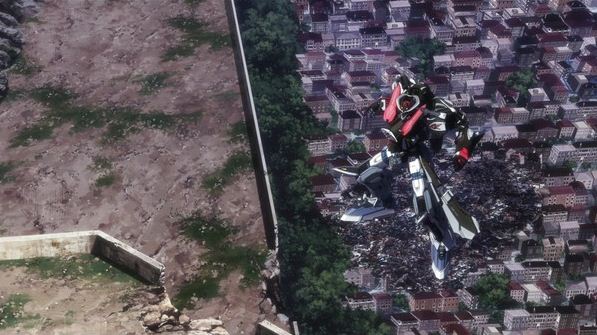
Set 12,000 years after the events of the series’ predecessor “Genesis of Aquarion”, “Aquarion Evol” follows the story of a young man named Amata; a lover of old mecha movies and a strange teen that gains the ability to fly/levitate once charged with emotion. One afternoon after heading down to the cinema he works in to clean the seats he notices a beautiful young lady who cannot help but be stuck to the screen, her gaze I’m talking of…she wasn’t literally stuck to the screen. Amata and Mikono (the cinema girl) quickly become friends as they talk through the old movie that was just being played and their views on life. The two soon came into contact with an inter-dimensional force known as the “Abductors” who have travelled through the space inbetween space to collect the women from this dimension/planet to take back to their home world where women have basically gone extinct.
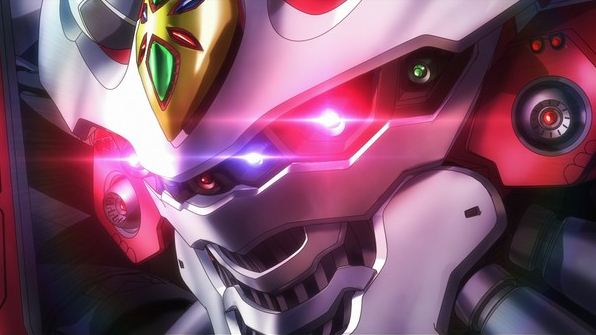
The “Aquarias” are swiftly deployed to combat the threat but it doesn’t seem like they’re much of a match for this particular enemy, one that will soon be Amata and Mikono’s biggest threats. The “Aquarias” are a set of massive robots each piloted by a group of boys and a group of girls, the segregation of genders came after a great tragedy involving a former soldier and his now-departed wife which came about, apparently, because of their incredible love connection. Long story short: Amata and Mikono end up inside a “Vector” (one of the three jets that fuse to create an “Aquarias”), they eventually end up destroying the crystals that stop the male and female “Vectors” from fusing together and they, along with a couple of the existing “Aquarias” pilots, fuse to create the legendary “Aquarion” the titular mech of the series. From then on in Amata and Mikono are recruited into the “Neo-DEAVA” forces who are tasked with protecting this world from the “Abductors”. There they attend a pilots school where, once again, male and female students are separated…but not for long.
“Aquarion Evol” does a great deal of things correctly in my eyes story-wise but with everything it does right it also does a few things totally wrong and while some of the things aren’t even barely big enough to mention, there is one thing that “got my goat” almost the whole way through the entire first collection. The biggest themes that run throughout this series is that of friendship, love and the bonds between humans – which are actually some fantastic themes to have throughout a series of this kind seeing as the characters are constantly connect and disconnect from each other both emotionally and spiritually. It’s the extreme focus on the coming together of the genders that really makes from some incredibly annoying scenes that have far too much of a highlight for a show where the actual focus should be on the looming doom of a planet and its female population. I will say this much; I don’t really mind when two characters enjoy each others company or even fall in love, that shows true character depth and development but when each and every single character falls into an awkward love struggle with another…well, I just can’t handle that because, let’s be for real here; it isn’t real.
I do enjoy the connecting of the two genders throughout collection 1, it was nice to see that these characters actually developed together thanks to the events of the series, they grew closer to each other and they begin to understand and accept each other…THAT is some incredible writing, not awkward conversations and unnecessarily embarrassing situations. Essentially a few episodes/scenes were only there for the sake of extreme fan service. In one of the earlier episodes the students/pilots were shipped off to the main land where they were meant to have a nice relaxing day in the local city doing pretty much whatever they wanted to, they were put in mixed-sex teams of three and equipped with an arm band that electrocuted them as soon as their “emotion levels” got too high which basically meant they would get electrocuted as soon as one of them got turned on by another member of their team. It was labelled a “training excercise” but, to me, it was just an unnecessary addition to what is brilliant anime series. The bad thing is that it was one of many, luckily the rest of the story and the series made up for what the story did wrong…thank the lord.
Visuals
I will give “Aquarion Evol” a lot of credit for the way it is put forth visually, I actually didn’t have high expectations for this series and that was simply based on the fact that I had never really heard of it until the review copy arrived at my front door not 4 days ago. I was pleasantly surprised by its high-calibre animation as well as its masterful mix between CGI and tradition animation which I can honestly say was done so much better in this series than in any other series I’ve seen up until now and that includes one of the newer mech animes “Valvrave The Liberator”. What was also so different about this series was the environments and locations where characters travelled through, lived in and fights took place; it wasn’t your typical Tokyo-esque city nor was it a super evolved sci-fi utopia…it honestly just looked like Venice (Italy).
There were canals and gondolas and the architectural structures were all design in a traditionally European style and I enjoyed that so much. Though it did take a little bit of a shift throughout the collection, you begin to notice that the city isn’t entirely tradition as the series goes on but it is also something I thoroughly enjoyed because it contrasted both modern and ancient.
The animation was smooth and fluid in motion, you barely ever saw a dip in the animation quality which is something I’m going to assume a lot of anime fans have come to terms with considering it is in literally every anime series. Everything was done perfectly, from the costuming to the actual “Aquarion” variations, everything was designed so brilliantly. I would have loved to have seen this collection released on Blu-ray rather than just DVD because I can imagine how much more crisp and clean the visuals of the entire anime would have looked. What else can I say? It is only rare that a series like this comes out of left field and leaves me speechless regarding the way it looks.
Audio
When it comes to anime series’ like this I’m not often blown away by its auditory aspects, possibly because I’m much too focused on the action scenes or the voice action but something that “Aquarion Evol” forced me to do was to take not of its soundtrack and I actually enjoyed it despite my dislike of the genres used.The series uses a great deal of classical and orchestral music, the great thing about its use was that it wasn’t only during non-combat scenes, in fact, the booming orchestral sound mainly made its home amongst the battles between giant robots and it made so much sense because, while they are creations of science, the people piloting them are spiritually connected to each other which adds another layer onto what was already a fairly solid foundation, the addition of loud and haunting orchestral scores just bind it all together and a brilliant way.
I’m not too surprised now that I’m aware a great deal of the music was done by Yoko Kanno who you may know from a great deal of Shinichiro Watanabe projects like “Cowboy Bebop” and “Kids On The Slope”. Something else that blew me away was the incredible talent of the English voice acting cast, they performed admirably! Each and every character was defined by their voice and the way they were acted out in a fantastic way and while there were some annoying characters, they were mostly drowned out by the well-written and well-acted ones. Once again, I was shocked at just how good the voice acting cast was, unfortunately they were tasked with acting out some horrendously awkward and silly scenes but I believe, for the most part, they kept their composure and acting integrity.
Extras
I’m quite impressed at what “Aquarion Evol Collection 1” brought to the table in terms of on-disc extras. As usual it came packed with trailers for the series, trailers for other series’, clean opening and closing sequences, episode commentary (which also gives you quite a large level of insight), etc. What I was actually very interested in was the featurette that was also present on the disc which worked as like a small documentary that covered the series conception, its announcement, its creation and its release. While it was really the only worthwhile extra in the release it was still something nice that I can imagine fans of the series would be really into. Even me, as someone who never watched the original series and had just finished the first collection of the second, I enjoyed it quite a bit.
Overall
“Aquarion Evol” seems to me like another fantastic anime series that is held back due to a flaw in its story regarding its characters. For the most part “Aquarion Evol” is absolutely amazing and it actually has a great overall story, unfortunately it is constantly interrupted by simple teenage struggles, the type of thing that shouldn’t really be present in a story where giant robots must fight other giant robots for the sake of each others planets. Fact is; the series was filled with “primo” animation and some fantastically suiting music as well as some of the best voice acting I’ve heard in a while. I’m actually really into this series but I still find it hard to sit through the silly scenes. At the end of the day, this is simply my opinion, a lot of you out there will enjoy this as much as I did or even moreso, if you can get over the silly teenage stuff then I’d say this is the series for you.
Capsule Computers review guidelines can be found here.
With last week’s minor divergence into the case of the zombie warships, we once again find ourselves exploring the repercussions of the Invasion Objects landing in Taiwan. Utilising his Easy Chair, Vidocq determines that the Invasion Objects may just have a few secrets that are aiding them in their quest for humanity’s end. Namely, their own personal undersea highway.
Yeah, in her dreams…
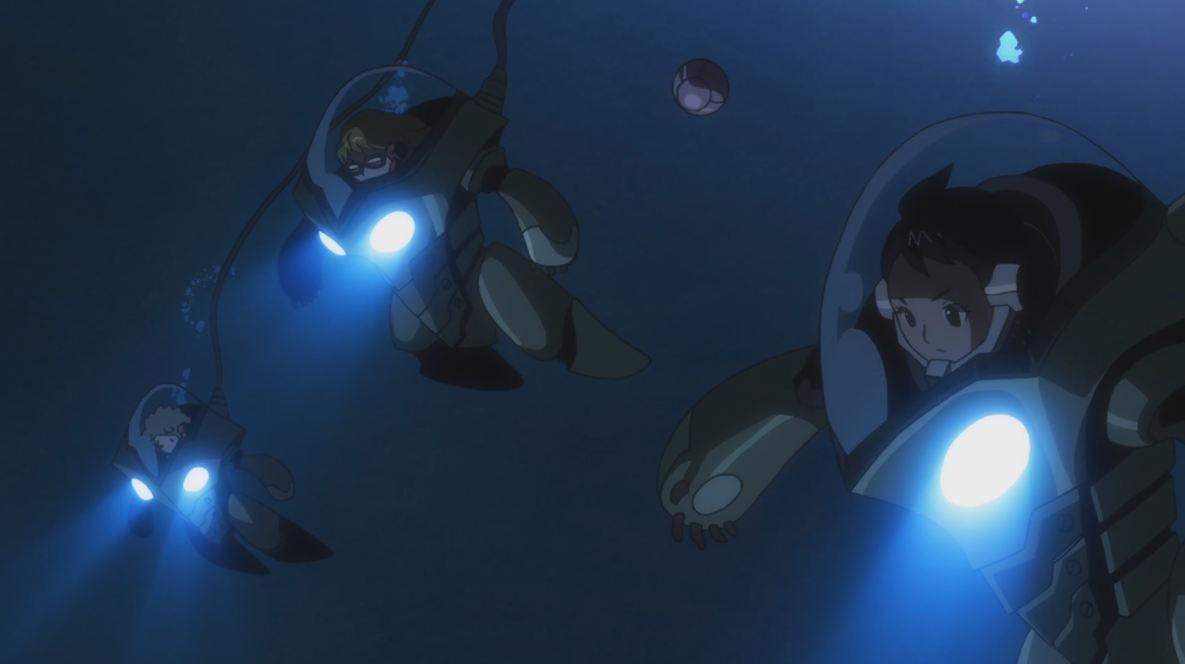
Beginning the episode with Vidocq’s report to the Commander, we are able to learn a tad more about what exactly an AU chair can do. True to his strategist nature, the chair is able to organise input data and extrapolate every possible scenario. It is due to this that Vidocq hypothesises an undersea tunnel that has helped the Objects cross oceans unhindered. As such a crucial mission, the First Platoon is called into action. Whilst exploring said tunnel, they discover countless Objects that have taken up residence in a network of caves. This being the case, there may not be just one tunnel hidden in the depths. True to anime form, these grunts are merely protecting their leader, who is in this case a colossal squid/octopus/cephalopod thing. This in itself is interesting as it represents an Invasion Object still suited only to a water habitat, a fact which may indicate its age. However, it may also express an ability within the Objects to adapt to environments individually, something hinted at way back in Episode 1. It should also be noted that the minions of the tunnel bore more of a resemblance to insects than previously seen Objects. Again, a sign of the bizarre physiology that makes them such a strange and interesting force.
During the undersea expedition, we also catch a glimpse of Vidocq’s true colours. Hell bent on acquiring data, he will go to any means he sees fit to complete a mission. In this case, poor Galiko bore the brunt of his emotionless actions. It is also due to these actions that we witnessed some of the negative aspects of an AU Weapon. As her Europa satellite was crushed by the cephalopod, Galiko herself was injured. As noted by Hunter, there is a feedback from weapon to wielder that forces them to feel pain should their weapon be damaged. In the case of Galiko, the destruction of Europa could have possibly killed her. Something that she would have done for Vidocq and something he would let happen. Thank god the Second Platoon showed up. However, for the sake of discussion, Vidocq was merely doing his job. In the quest for peace and safety from the Invasion Objects, each member of DOGOO is aware of the risks. Were it for the greater good, each one should be prepared to lay down their life. Would it really have been better to save Galiko at the cost of the data on their enemy? These are the tough choices that plague the battlefield.
Devotion can be dangerous
This episode also gives us yet another glimpse into the interesting world that dwell inside Sio’s head. It would seem that her bizarre new living conditions are indeed affecting her, whether she admits it or not. Within her otaku brain, not only did she imagine her and Asao on the beach in fairly revealing swimsuits, but also Jack and Gandhi…as a couple. On top of that, Newton also made an appearance as her “true lover” and proceeded to greet Sio in her typical way. Luckily Sio awoke from her dream and entered the real world once more…with Newton in her bed next to her. Boundaries aren’t exactly an important thing at DOGOO are they? Anyway, in a completely different part of Sio’s mind, we also witness her latent tactical abilities appearing once more. However, as opposed to previous bouts of battlefield competence where her Nobunaga personality took over, Sio was still in her right mind. As the battle raged on around her, she ran through a number of scenarios in order to protect her Commander. However, still possessing her trademark nervousness, she was too afraid to interrupt her trained compatriots. Despite this, she did not underestimate herself too much, as she still decided to trust her instincts, a fact which save the day. Even at the moment of impact, Sio utilised brilliant tactics and damaged her own ship in order to save it. Something that couldn’t have been easy for the military fanatic. Not even the almighty First Platoon, nor the Second, considered the Invasion Object’s true intentions, something which may have just earned Sio their respect…and ire.
Just one big happy family
So, with the cephalopod living to fight another day, it’s time for First and Second Platoons to regroup and restrategise. Acts which may proceed more smoothly if the groups could stop bickering for a few minutes. Though the chances of that happening are astronomically small. With doubts placed in their minds by their resilient foe and their own inability to forsee battle scenarios, the dream teams of DOGOO still have a lot to learn. Not that they’d ever admit it. Oh, and if someone could pick up Sio on their way home that’d be great. She’s kinda drowning at the moment…
Overview
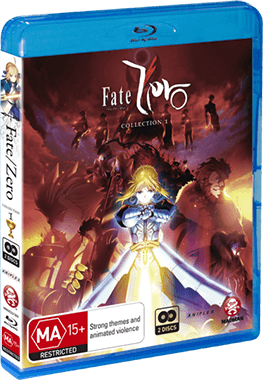
Originally, Fate/Zero is a set of light novels written by Gen Urobuchi that chronicle the events leading up to Type-Moon’s visual novel, Fate/Stay Night. Fast-forward several years and the series was given the green light for an anime adaptation by a studio already familiar with Type-Moon’s work, having earlier adapted the Garden of Sinners into a series of feature films.
The TV anime adaptation of Fate/Stay Night is notorious for being less-than-stellar and is considered by many to be a poor gateway into the franchise. Fate/Zero has the advantage from the get-go of being a linear, focused narrative. Does this darker, more serious tale prove to be a winner for both new and existing fans?
Story
Fate/Zero had unique beginnings. The character designs and ultimate conclusion were already predetermined before the author could put pen to paper. However, Urobuchi was given enough creative freedom to inject his own flavour to the “Nasuverse”, resulting in less fooling around during the main plot and more action.
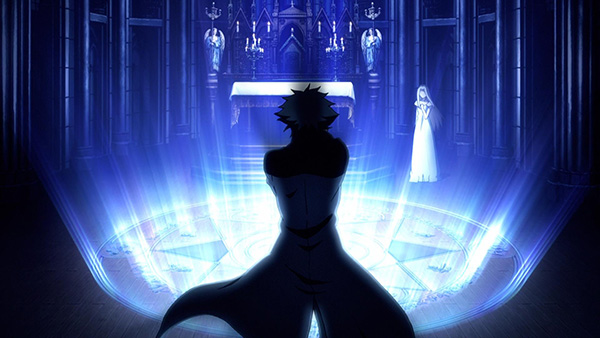
The Holy Grail War is a competition fought amongst seven Masters, mages chosen by the Holy Grail, who in-turn summon seven Servants that must do battle to the death. The winning team is then granted any wish that they desire, good or bad. You can imagine each Grail War would have a few unsavoury types. So it has been for hundreds of years and so it is held again, this time in Fuyuki City, Japan, during the 1990s.
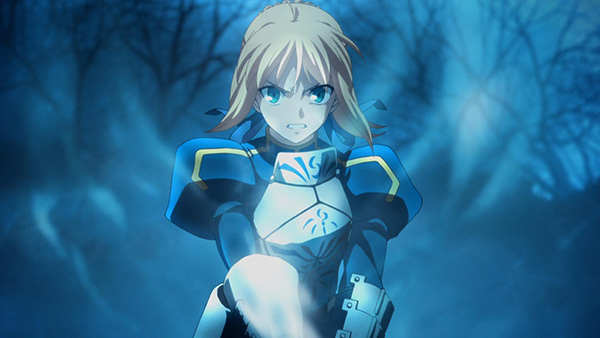
Before Shiro Emiya is thrown into the 5th Holy Grail War of Fate/Stay Night, there was a 4th War which was fought by his foster parent Kiritsugu Emiya. Fate/Zero follows Kiritsugu and six other Masters as they throw everything they have against each other for the grand prize (and our entertainment). While every character is formidable in their own way, the real deal here is arguably Kiritsugu and his nemesis, Kirei Kotomine. Backed by the Servants Saber and Assassin, the two develop a fascination with each other and come to realise they’re each others’ biggest threat.
Each character is fascinating in their own way with each having an intriguing story behind their actions. Equally as interesting are the Servants. These are manifestations of ancient heroes, real or fictitious, that are summoned into the modern world. Although they are bound to their Master by a Command Seal, which can be used three times to give an absolute order, they also have their troubled pasts and desires that reflect the legends behind them.
The Servants fight in spectacular battles, utilising their signature weapons or Noble Phantasms to devastating effect. As the war progresses, alliances are forged while betrayal is rife, keeping the viewer in suspense from the start of each episode. Complementing the intriguing plot is a whole lot of masterful dialogue. Not the back-and-forth play on words that goes on in other anime like Bakemonogatari, which is also famous for its dialogue, but a real and tangible script that doesn’t stray from the ultimate task at hand: to acquire the Holy Grail.
While some Masters make use of every minute to plan their next attack, others like the young Waver Velvet and his rambunctious Servant Rider, who is Alexander the Great, develop a companionship that’s simply heartwarming to watch.
Up to episode 13, Collection 1 is slow but tense with the occasional battle being incredibly fierce yet indecisive. Like a cautious game of chess no one is pushing their luck and throwing all their cards in yet. Though slow-burning, the show is so far well-paced and you truly get the feeling that you’re watching something very special. The huge, almost insanely unfair cliffhanger at the end makes the wait for Collection 2 all the more painful.
Visuals
Fate/Zero is way up there in terms of production values. Simply put, each episode looks as good as an animated feature film. Ufotable has once again nailed Takashi Takeuchi’s distinct character design and blended some serious technical wizardry of their own that makes the animation shine.
While some anime make their mark by introducing unique visual styles and making use of clever art direction, Fate/Zero forces its way to the top with sheer quality. From simple conversations to explosive and well-choreographed confrontations, it’s a pleasure to watch.
Audio
I feel like I’m getting deja vu having only reviewed The Garden of Sinners a few months ago. That’s right it’s not only the same studio but the same music composer as well. And that’s a damn good thing. Yuki Kajiura has created some truly powerful music that often builds up to an epic peak. Fate/Zero’s soundtrack is emotional, theatrical and beautiful.
The opening theme “Oath Sign” by LiSA is a fun and catchy song with a nice melody while the ending theme, “Memoria” by Eir Aoi is a thoughtful ballad set to images of the Servants during their past.
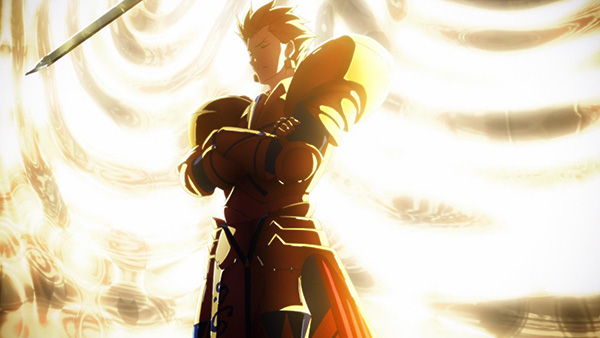
The English cast has mostly performed well. The Masters’ voices, as well as most of the Servants, are a good match with actors like Matthew Mercer and Crispin Freeman . Unfortunately there are some glaringly mismatched voices to be heard, especially Gilgamesh. I feel David Vincent just doesn’t have the authority behind his voice to portray the snide and commanding King of Heroes.
Extras Firstly, let’s just say how lucky we are in Australia and New Zealand to be getting Fate/Zero at an affordable price while our friends in the U.S. have to fork out at least $150 for each half of the show.
While they get a set of extras for their trouble, this edition is a standard release with Textless Opening, Closing and trailers included on the two discs. Those wishing to splash out a bit more can grab a limited art box version to house both collections.
Overall
Fate/Zero is very much a character-driven, plot-heavy battle royale, mixing modern intrigue with historical heroes who are infused with jaw-dropping powers. If you’ve never delved into the Fate universe or Type-Moon’s other works before, this is the best place to start. Both fans of action and clever script will find plenty to take away from here.
While a little slow at first, the first half of Fate/Zero takes its time to set the stage while teasing the audience with exotic skirmishes. The result is masterfully done drama that draws you in and doesn’t let go. Collection 1 builds up to a grand confrontation and leaves us hanging for what’s set to be one heck of a part two.
Capsule Computers review guidelines can be found here.
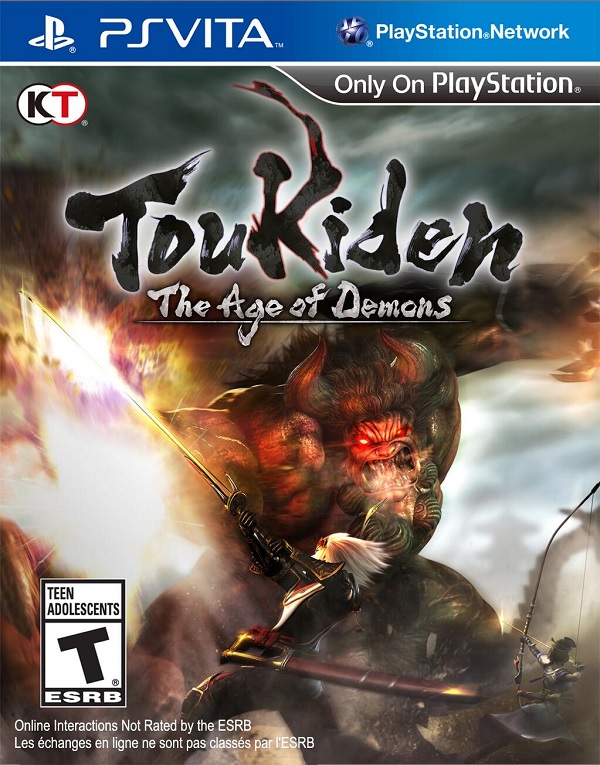
Overview While the PlayStation Vita has a number of exceptional titles in its library, including RPGs, visual novels and other types of games, there is a certain type of game many people have been hoping for but still haven’t received. Now Omega Force, the team best known for their work with the Dynasty Warriors series, has stepped in to try and fill that gap with Toukiden: The Age of Demons by giving gamers something refreshingly different to play. Now the question is, were they successful in this task?
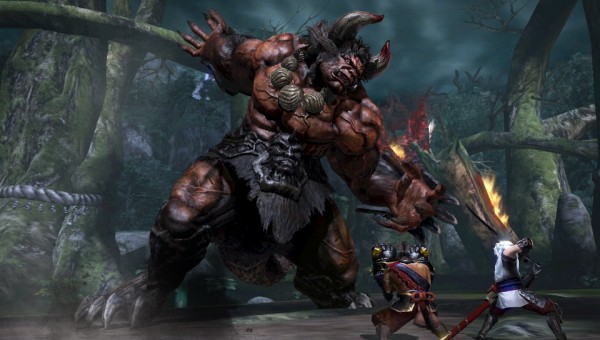
Story In the world of Toukiden, demons, or as they are called in Toukiden, Oni, are a constant threat to mankind. Humanity has been struggling against these powerful enemies and only the elite Slayers are capable of defeating these monsters and purifying the land. Players take the role of a fresh Slayer that is assigned to protect the small town of Utakata, one of the last bastions of defense for humanity that is right on the front lines.
Despite their precarious position, the village is protected by a priestess named Kikka capable of putting up a powerful barrier to protect its residents and give the Slayers a chance to recover between missions. However when the Slayers begin to realize that the previously disorganized Oni have begun attacking in waves and using elements of strategy to put the village at risk, the fight for survival becomes harder than ever.
Toukiden: The Age of Demon’s storyline starts out pretty strong and the cast of named characters that occupy Utakata have some interesting backgrounds and hints of a story, none of it is really explored to any major length. It is possible to grow a bit closer with allies by completing side missions and fighting alongside them but many of their developments are story oriented and even then the story doesn’t expand much further than simply slaying your way through the ranks of countless Oni to protect the village from its current threat.
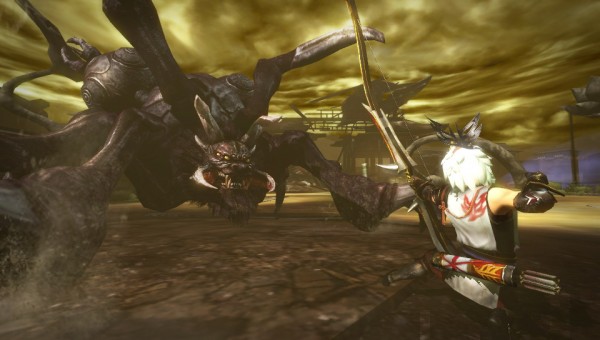
Gameplay As a Slayer, players have six different types of weapons they can bring into combat; a sword, dual knives, a spear, gauntlets, a chain & sickle, and a bow and arrow set. While players can find themselves preferring a certain weapon type over others since each set has different attack patterns, special abilities and power attacks, sometimes it is necessary to change your attack patterns to fit your opponents.
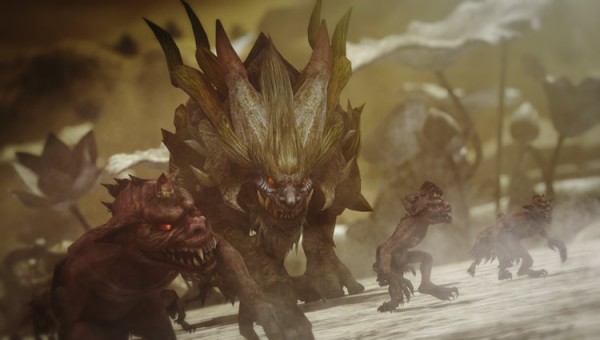
You see, when players are preparing to set out on a mission, which is accepted in Utakata Village, they are often told or shown a picture of what type of enemy they will be mostly facing off against. While smaller Oni are less threatening and can usually be dispatched with any type of weapon, the larger far more dangerous Oni will require not only team work to take down but some preparation as well since some weapons fair better against certain types of large Oni than others.
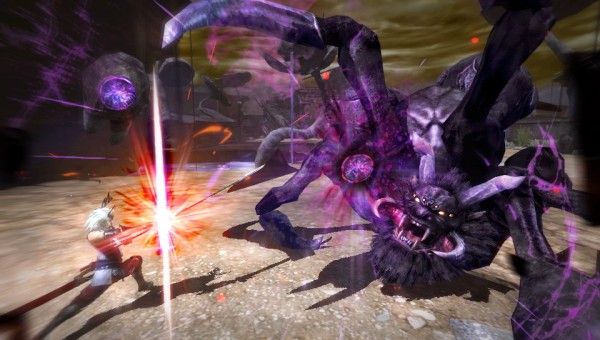
Swords, gauntlets and other power weapons are great for dealing large amounts of damage but many of their attacks are low to the ground while a bow and arrow, dual knives, or chain & sickle provide a variety of attack options. The reason this is important is that large Oni are the most difficult challenge that players will face off against as they not only can unleash devastating attacks, but they are extremely resistant to punishment and hacking off limbs or other pieces of their body is required to weaken and ultimately defeat them.
That doesn’t even touch upon the fact that each Oni has a certain type of element that they are weak and strong against, which means to prepare for some of the tougher battles players may need to tweak their equipment to properly face their foe since Toukiden does not pull any punches when it comes to enemy difficulty. This is alleviated somewhat by the fact that players resurrect themselves a small number of times without failing and with the help of Mitama.
Mitama are the trapped souls of heroic figures from Japanese history that have been consumed by the Oni and can only be freed by the player slaying these Oni. Many of the Mitama players collect will be from storyline enemies, though normal Oni have a very small chance of dropping one as well. These Mitama can be equipped to weapons and each one comes with different stat boosts as well as four abilities that can be used a number of times in battle. These abilities range from attack boosting, to healing, to trapping, to all kinds of different elements as there are over two hundred different Mitama in the game that can be leveled up through continuous use.
Speaking of leveling up and equipment, as mentioned before it is important to make sure you are properly prepared for your fights in Toukiden and to do this players will need to forge new pieces of equipment using items acquired from defeated Oni as well as upgrade their current equipment to strengthen themselves against the powerful Oni. All equipment is strong against certain element types and upgrading weaponry can also add more Mitama slots, allowing for additional stat boosts that aid the player in battle.
You will not face the Oni alone, though there are a few missions that do force the player into this challenge, as many story missions will allow the player to take up to three fellow Slayers with them into combat and most of the time they are up to the player to decide. The ally AI is relatively intelligent as they will be quick to assist a player in need and will also target weakened large Oni, however they are usually pretty poor at coordinating their attacks on specific body parts.
This is where the online or ad-hoc multiplayer comes in. Players have the ability to team up with three other players to complete various missions online, a number of which are only available online, which allows for a more cohesive fighting unit capable of defeating enemies a bit easier than with the AI as not only are players more likely to be better equipped but will know an enemy’s weaknesses right from the start. Also loot is given to every player in the game and not singled out, making it a fun way to battle without sacrificing item gathering.
There is a reason for that last point and unfortunately it isn’t a good one. Repetition is a very major problem with Toukiden. There are a fair number of enemies to face off against but the number of large Oni types are fairly limited and while it might be interesting to fight against one the first few times, by the tenth time these foes can be seen as more of a chore than anything else. The same can be said for the game’s mission types which always fall into the kill a certain number of an Oni type, slay this large Oni, or clear an area. The game feels like it falls into a crutch at times like this where repetition becomes a major hindrance to the amount of time the player will want to sit and play at any given time.
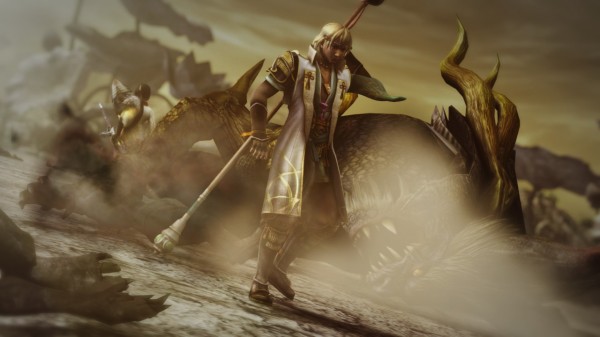
Visuals & Audio While the PlayStation Vita has always been a very capable handheld in the graphics department, few games have been able to harness that power as well as Toukiden: The Age of Demons manages to. There is an extensive amount of detail on every character model and all of the various pieces of equipment that the player acquires. The Oni are just as detailed, though again they suffer some repetition and palette swaps, and the environments are absolutely gorgeous.
The voice work in the game is Japanese only with English text but this isn’t too much of a problem as the voice work is nicely handled and fitting considering how steeped in classic Japanese artwork and architecture the game is. As for the background music, the battle themes are fitting and generally make battles as enjoyable as they can be, though they tend to take a back-seat to the action.
Overall Toukiden: The Age of Demons offers an exquisite looking action game where players can take on numerous Oni of all different sizes with either three other AI or three other players. There are even times when players face off against two large Oni at the same time, forcing the player to always think on their feet and prepare themselves using the extensive equipment customization system. A few poor design decisions and repetitious gameplay do hinder Toukiden from being an excellent game, but it is still a highly enjoyable title with a few shining elements that make it worthwhile.
Capsule Computers review guidelines can be found here.



 The Razer Adaro Stereo Analog Headphones are a lightweight set of closed back headphones powered by 40mm neodymium drivers. They are tuned for a natural sound that is comfortable to listen to for long periods of time. The headphones feature plush leatherette ear cushions, an anti-tangle braided fiber cable, and a sturdy construction that will survive all of life’s adventures. The Razer Adaro Stereo Analog Headphones are available for $149.95 AUD.