Another year, another Super Bowl, another batch of great commercials.
The half-time break for Super Bowl XLVII – or 47 for those who believe we should join the modern era and stop using Roman Numerals – did not disappoint, and neither did the many awesome ads. One of which was this Iron Man 3 ‘game spot’.
The 30-second spot gives us a glimpse at a perilous situation in which Iron Man must attempt to save 13 people…as they are falling from a hull-breached plane! Yeah, good luck with that. Check it out below!
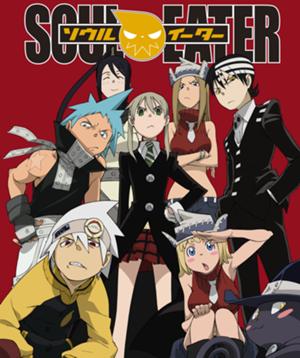
Toonami fans have been speculating over what series would replace Samurai 7 as it approaches its end and thanks to the TV Guide website we now have our answer. It appears that Soul Eater will join the Toonami line-up on Adult Swim starting February 17th at 1.30 am EST/PST.
Following TV Guide’s revelation of Soul Eater, Toonami itself then confirmed that the series would indeed be joining the fray with a post on their official tumblr page. At this stage it seems as though Toonami will air Funimation’s dub of the series, possibly in its entirety.
What do you think of Soul Eater joining the Toonami line-up? Let us know in the comments section below.
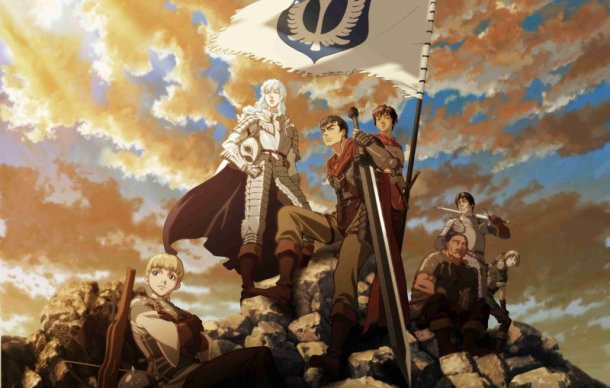
During a press conference for the third and supposedly final Berserk film, Berserk Golden Age Arc III: Descent, the film’s director Toshiyuki Kubooka suggested that this may not be the last we see of the Berserk anime.
While he didn’t disclose any great details on future Berserk projects he did confirm that there is indeed more planned:
We’re currently moving to make Berserk a saga project. But this is as much as I can say. It’s a secret. It’s really not at the stage I can say anything about it, but the project is in motion.
What do you think of the possibility of more Berserk anime projects in the future? Let us know what you think in the comments section below.
Streets of Rage fans will no doubt find De-Pixelated’s brilliant short film based upon the side-scrolling beat em up video-game classic to be streets ahead and all the rage.
The fan-film simply titled ‘Streets of Rage’ is filmed in entirely one single take and features a lot of nods to fans that will surely make them feel nostalgic for the days of raging through streets with fists and feet flying.
You can check out De-Pixelated’s Streets of Rage fan-film below and let us know what you think of this awesome tribute to the video-game classic in the comments section below.
Popular otaku idol Shoko Nakagawa more commonly known as Shokotan broke down during the recording of her cameo role in the upcoming film Dragon Ball Z: Battle of Gods.
Shokotan a known fan of Dragon Ball, broke down into tears and collapsed to her knees upon meeting famed voice actress of Dragon Ball protagonist Goku, Masako Nozawa. Shokotan promptly lost all control of herself but eventually regained her composure in order to perform a kamehameha for press in attendance.
You can see Shokotan’s breakdown in the video below. Let us know what you think of this bizarre occurrence in the comments section below.
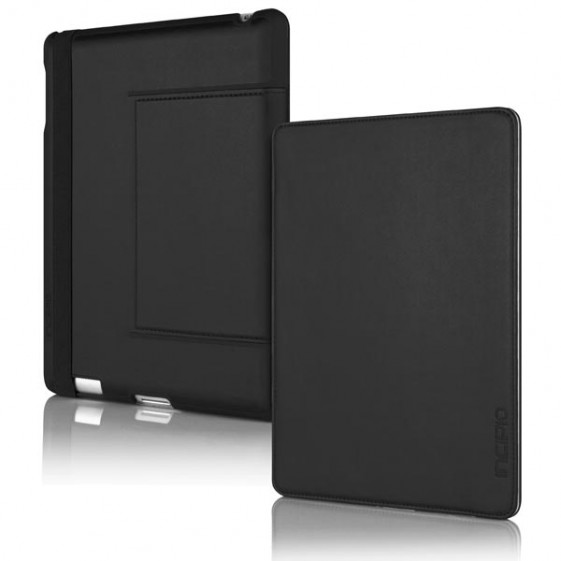
Incipio Slim Kickstand Folio Developer: Incipio Platforms: iPad 2, 3, 4 Price: $39.99 Get it Here
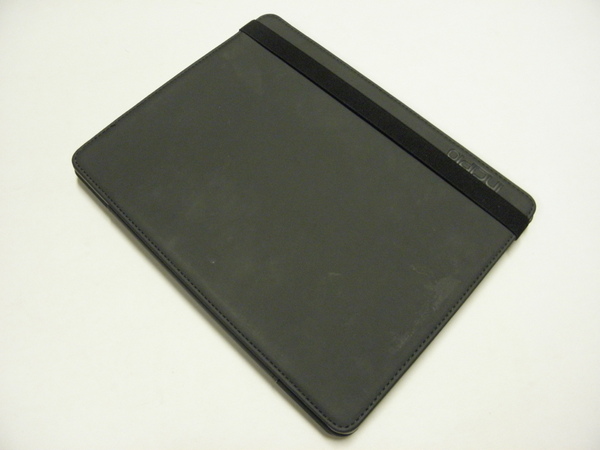
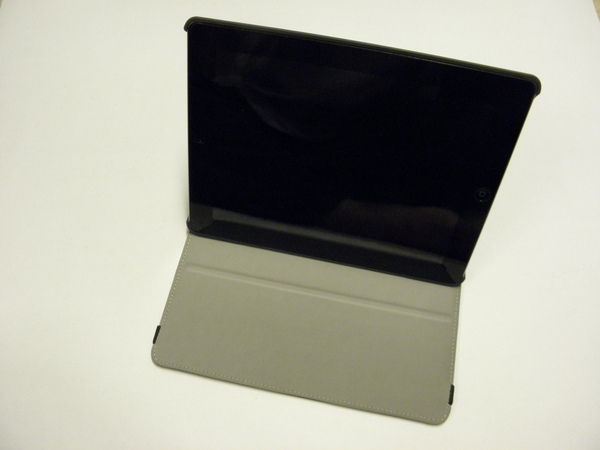
The Incipio Slim Kickstand is a vegan leather folio case with a plastic hard shell. The folio is held closed by an elastic band closure and features a micro suede interior to protect the iPad’s screen when the case. The case can be propped up for two possible viewing angles. The case is available in three colours, red, gray and black.
Installing the case was extremely easy. I simply needed to snap the case into the hard shell piece and close the front cover. The hard shell back holds onto the iPad by clipping into the two long sides of the iPad with a reasonable amount of force. Taking the iPad out of the case was very simple, I just needed to grab one of the corners of the case and push down and the iPad was freed from the case. The front cover is held down by an elastic band. This band is at the perfect tension, requiring enough force to keep the cover snugly closed without requiring so much that the elastic band is damaged in the process.
The vegan leather used is very slick and slightly plastic like in texture. It is rather puffy and soft to the touch. Unfortunately the vegan leather’s scratch resistance is less than real animal leather. With a little bit of force, I was able to scratch the top layer of the leather with my finger nail. The scratches were not easily seen with the naked eye, but running a finger across the area revealed the damage to the leather. The vegan leather on the front cover is stitched down to the rest of the cover. The sewing is extremely well done. The stitching is at a uniform distance with no fraying or stitches coming loose. The elastic band is sewn in securely, although one edge of the elastic band looks like it is really straining against the stiches. So far the elastic band or the stitching has not come apart or shifted with rough handling, so it will most likely survive the long term.
The interior of the case is Incipio’s standard micro suede lining. It is soft with a little bit of grip to the texture. It has yet to cause any scratches my iPad’s screen protector. Unlike the Apple Smart Cover’s micro fibre interior, the micro suede won’t clean your case just by rubbing against. However, the grippy texture Strangely enough, there are no magnets in the cover. This means there is no Smart Cover functionality in the case. This is an extremely curious decision considering the price point of the case. Also extremely curious is the choice of viewing angles provided in the case. The front cover is rested on the table and the iPad is slipped into one of two indents on the inside of the front cover. The two viewing angles are great for hands free viewing to watch videos and maybe play simple casual games. I did notice there was not a huge difference between the two angles, the differences were more subtle. What was really surprising about this cause is the fact there is no typing angle. To use the iPad’s keyboard comfortably, I was forced to resort to my tried and true rest it against a book method. This design choice seemed extremely strange to me considering some sort of typing angle is almost a requirement for cases with the introduction of Apple’s Smart Cover.
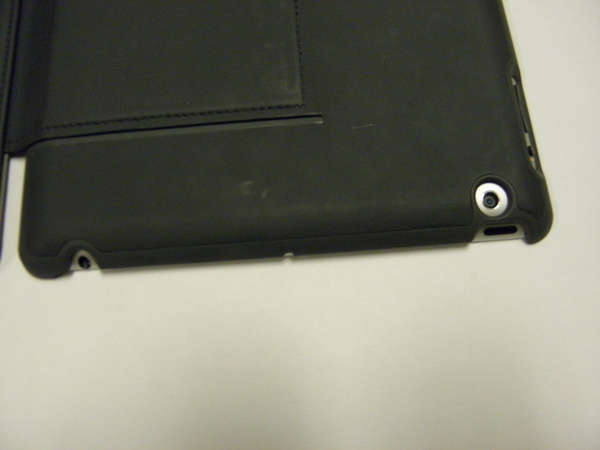
The back of the case is a hard plastic shell with the vegan leather attached to the back of the shell. The strip of vegan leather provides scratch resistance to the plastic shell and also served as the hinge for the case. I found the hinge to be poorly designed. Although it is resistant to damage from use, it is completely possible to close the case the wrong way. This causes the micro suede side of the cover to be facing outwards. This would not be too bad if it wasn’t for the fact this causes the hinge to jut out awkwardly. I found myself doing this a lot when not paying attention or closing the iPad in the dark.
The plastic hard shell of the case provides excellent coverage. There are holes cut out for each specific function on the iPad. The volume rocker button and the mute switch share one large cut out. The docking hole is cut out for the 30 pin dock connector, but will easily fit the newer Lightening connectors on the fourth generation iPads. The speaker hole even has a slight bar near the curved edge of the iPad to provide better coverage of the iPad. Due to the smooth vegan leather used, the case can be slid around on a desk relative ease.
The case is a bit on the bulky side, which is a tad ironic given its name, the Slim Kickstand Folio. The case almost doubles the width of my third generation iPad. However, considering the bulk of the case, the case itself is not actually that heavy. The up side of the extra bulk is that is does provide a bit of drop resistance. The puffiness provides a little give that will help the iPad survive a painful drop or two.
I cannot recommend the Slim Folio at the full price of $39.99. Although the workmanship put into the case is excellent, the vegan material does not stand up to scratches particularly well. The case has a lot of features missing that other cases at this price point have. Some are strange, like the lack of typing angle, and some are downright unforgiveable, like the lack of Smart Cover functionality. I really like the excellent coverage provided by the hard shell backing of the case. The coverage is one of the best I have seen yet. However, none of this justifies the $39.99 price tag. If you see the case sold at a steep discount, the Slim Folio is worth picking up, but even Incipio itself has better offerings for the iPad at this price point.
Capsule Computers review guidelines can be found here.
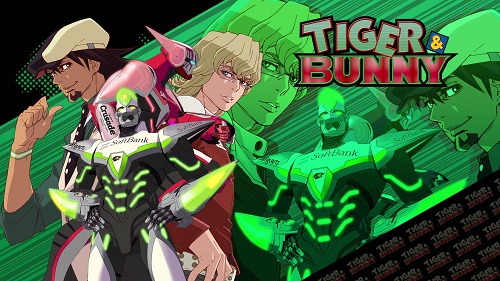
Siren Visual have announced at Wai-Con that they have acquired the license to distribute both Tiger & Bunny Movie – The Beginning and Tiger & Bunny Movie – The Rising.
They confirmed a DVD and Blu-Ray release for both films with Tiger & Bunny Movie – The Beginning getting a release at some point during July this year and Tiger & Bunny Movie – The Rising getting a release at some point later in the year. Siren Visual plan on releasing the Tiger & Bunny TV series later this month.
What do you think of the acquisition of these two Tiger & Bunny films? Are you excited for these two? Let us know in the comments section below.
Incipio Stowaway Case Manufacturer: Incipio Platforms: iPhone 4/4s Price: $34.99 Get it here
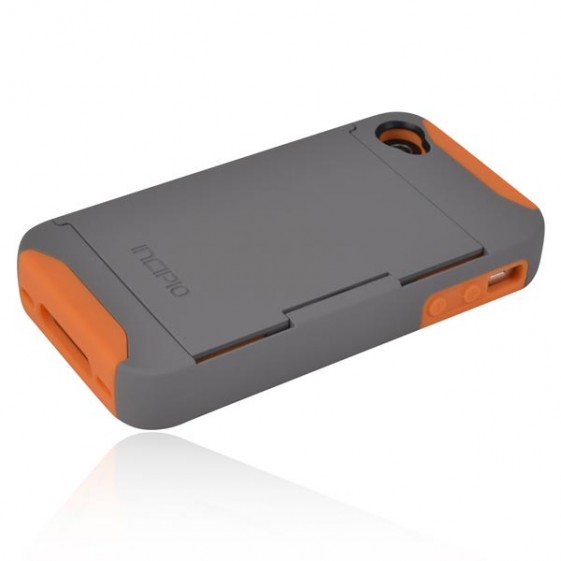
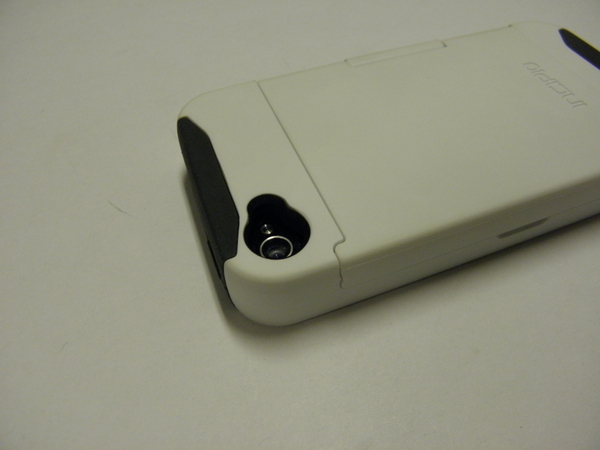
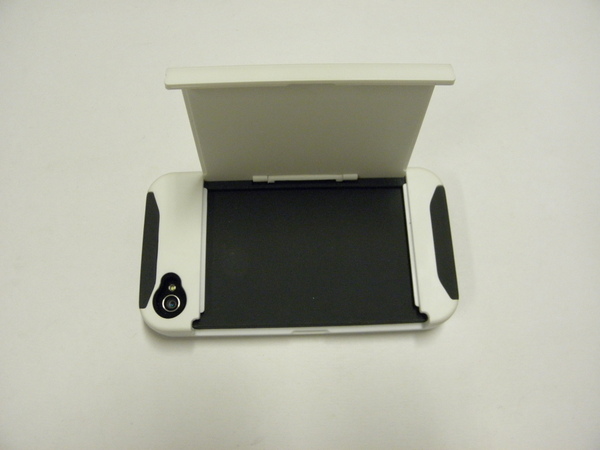
The Incipio Stowaway Case is a solid plastic case with a silicone core. The plastic is Incipio’s rigid Plextonium material. The outer shell has a small door that stores three credit card sized items inside. The door also doubles as a kickstand for hands free viewing. The case comes in six different colour combinations, ranging from the extremely discrete black plastic and black silicone to the eye catching grey plastic with neon orange silicone.
The Plextonium frame feels extremely good in the hand. I tried scratching at the plastic and was unable to make a scratch. Therefore I am not really sure if there is a slight matte rubbery coating on the plastic or not, but it feels very smooth to the touch with the very slightest bit of grip. The plastic almost completely envelopes the silicone core, there is only some exposed silicone at the very bottom, top, and a little bit over the volume button area. This case to easily slide into the pockets.
The silicone core is very thick, providing excellent drop resistance. Cheaper silicone has a terrible tendency to become lint magnets. I have yet to have any issue with the silicone used in the Stowaway. In fact, it is one of the less sticky silicone materials I have encountered in iPhone cases. It does not seem to lose shape or get stretched easily, another sign that high quality silicone was used in the construction of the case.
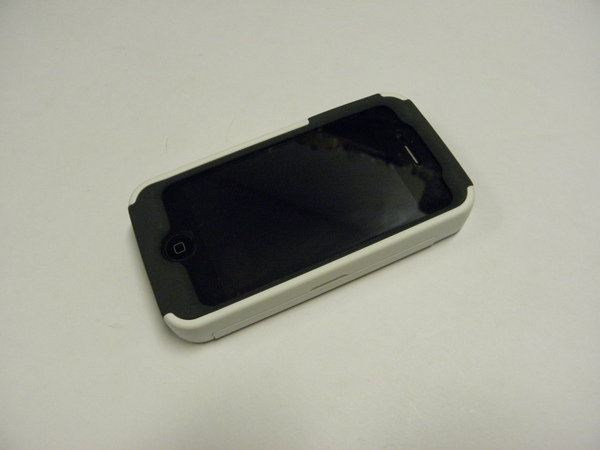
The installation of the case was extremely easy. I simply had to disassemble the case, slip the silicone core over the phone then snap it into the plastic frame. The fit was perfectly balanced between ease of installation/removal and secure construction.
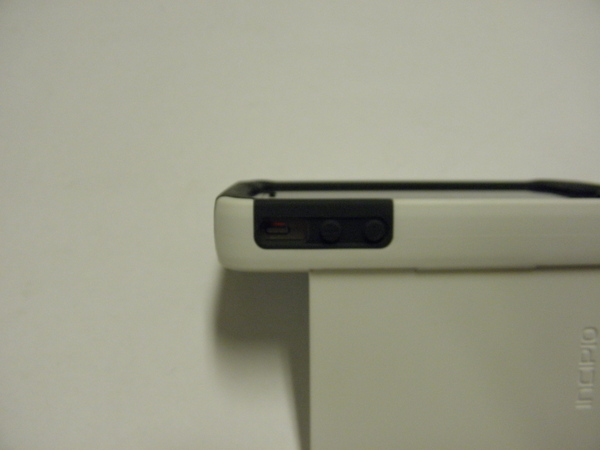
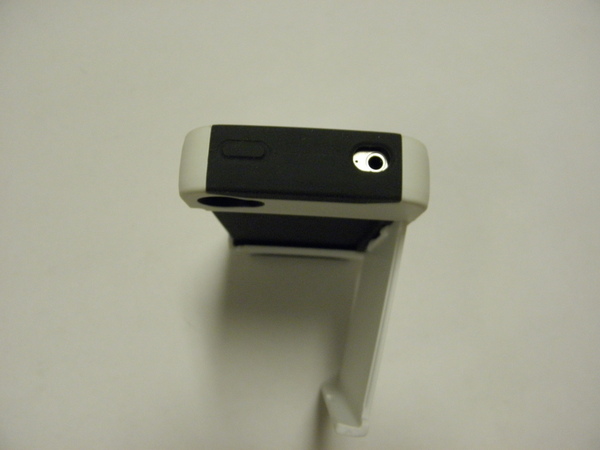
The top of the case is left uncovered by the Plextonium material to provide access to the headphone jack and access to the power button. The profile of the power button is replicated on the silicone, thus it is extremely easy to find the power button in the dark or inside a bag. The headphone jack is one of the smaller jacks I have encountered in a case. However, the silicone is stretchy enough that I found that it held onto larger headphone plugs better than slimmer ones that was just a little too big to be plugged in. Smaller plugs that were designed for iPhone cases will have zero issues with the case. However, the bigger plugs will be a bit of a crapshoot. It may be big enough to fit or it may be just small enough that the silicone will push the plug out.
The volume buttons are also replicated in a similar fashion like the power button providing easy access in the dark. However, due to the extreme thickness of the silicone core, accessing the vibration switch can be a little trickier. There is plenty of room for smaller hands, but if you have fatter fingers, getting in to flip the switch may become a little challenging.
The case is extremely thick at 0.70 inches or 12mm. This is definitely not a case that will fit in the pocket of your favourite pair of skinny jeans. For the same reason, this case is extremely dock unfriendly. Short of having a custom made dock designed for this case, you will be stuck using a sync cable to keep the phone powered. There is an extremely large hole provided for sync cables, so even older sync cables will be able to squeeze their way into the case.
There is a very generous lip on the front of the case. This does a great job of lifting the front of the phone off a table to prevent scratches to the screen. The generous lip manages to stay out of the way during gaming and texting. I had no issues touching the very edges of the screen where it met the silicone lip.
The case comes with a free Incipio Vanity Kit which contains a cheap crystal screen protector, cleaning cloth, and application card. Although the screen protector has some small issues of seeming hazy at certain angles under a few specific lighting conditions and the quality of adhesive used. It has a tendency to bubble on the edges easily, but considering it is a free pack in, I can’t complain too much.
The credit card slot in the back fits three credit card sized cards, with enough room to slip in an emergency twenty dollar bill between the silicone core and the first card in the stack. However, unless the case is filled to capacity with three cards, using the kickstand will result in the cards falling out of the case. The door to the slot has a pronounced indent that makes it very easy to access the cards. Those of us who keep our fingernails trimmed close will have no problems opening the storage area. I had zero issues with accidently opening the storage area in regular use as there is a slight raised area that keeps the door closed. Shutting the door also provided a very satisfying click. The door hinge seems sturdy enough to be used a kickstand without any issues.
If you are looking for a case that will help you shed a little bit of bulk by allowing you to keep your wallet at home, the Stowaway is a great option. It can easily fit three credit cards and a spare bill or two tucked in there for good measure. The case is also a great choice for the clumsy iPhone owner as it is extremely well protected. However, if you have an iPhone dock you are particularly fond of or you prefer a sleek and slim case, this is most definitely not the case for you. At $34.99, it is reasonably priced considering the high quality of the materials used. The case slides easily into the pocket without becoming a lint magnet due to quality of silicone and the plastic feels great in the hand. I highly recommend this case.
Capsule Computers review guidelines can be found here.
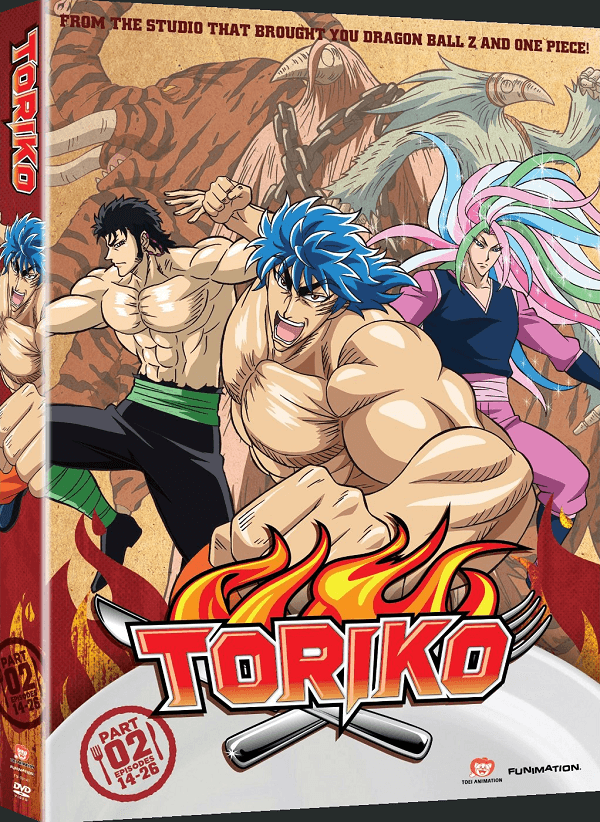
Toriko: Part 2 Studio: Toei Animation Publisher: FUNimation Format: DVD Release Date: February 5, 2013 Price:$39.98 – Available Here
Overview: Anime series of the shōnen genre tend to be rather formulaic when it comes to story progression and nearly every single one of these shōnen series tend to feature humans fighting against one another in some form. However what happens when you take a shōnen series an base it on food instead of politics and survival? Well you have the series Toriko that’s what. Now while this unique series may have started out slow in Part 1 (the review of which can be found here), will Part 2 of Toriko fare any better?
Story: Before we begin, let’s go over a bit of recap on the anime’s story so far. The world of Toriko is in the “Gourmet Age” where the only time anyone fights is to fight against monsters to eat them, not because of starvation but simply because their meat is so delicious. The people who fight against these exotic animals are called Gourmet Hunters and in their quest to find the most delicious ingredients they travel the world in search of a “Full Course Menu of Life.”
After going on a mission to track down a rare ingredient, the young chef Komatsu quickly becomes friends with Toriko, a Gourmet Hunter so skilled he is called one of the four “Heavenly Knights.” Since their meeting the two have traveled to a number of areas and gathered a large number of exotic ingredients from strange creatures and many members of the main cast have been introduced along the way.
Now Part 2 picks up immediately where Part 1 of Toriko left off, in the middle of the anime’s first major story arc as Toriko and his allies battle against the Gourmet Corp’s robots in an attempt to find the rare Jewel Meat inside of the Regal Mammoth. Throughout Toriko Part 1 nearly every fight or plot point felt inconsequential thanks to the fact that Toriko and the rest of the Heavenly Knights were so strong that any fight they entered would ultimately result in their victory.
This changes in Part 2 where Toriko, Sunny and Rin are pushed to their limits in combat as their reason to fight changes from simply reaching the Jewel Meat first to trying to stay alive against these devastatingly powerful robots. Their desperate actions and struggles to survive make for tense combat sequences that the series has been lacking up until now.
Unfortunately it is worth noting that most of the fighting this time around focuses more on human vs human/humanoid type combat as both the hunt for the Jewel Meat and the consequential mini-arc for BB Corn and cliffhanger story for Century Soup see the inclusion of the Gourmet Corp now that they have begun moving in the open against the rest of the Gourmet world.
One thing that Toriko Part 1 lacked was explanation and exposition. Not only were characters underdeveloped but viewers were left with little knowledge about the Gourmet World and the powers these Gourmet Hunters possess. Well thankfully Toriko Part 2 remedies that fact by not only explaining a number of factors as to why the Gourmet Hunters do what they do and why the world is how it is, but also outlines the final goal that everyone in the Gourmet Age is looking to reach, including why the Gourmet Corp is finally moving in the open.
Unfortunately this final goal does seem to be absolutely ridiculous at face value and it is very easy to scoff at unless the viewer finds themselves really engrossed with the premise of the series as a whole but in the end the goal fits the entire premise of Toriko perfectly. That being said, there is a bit of character development here as Komatsu finally begins to stand up for his ideals and try to accomplish a few things on his own rather than simply tagging along on Toriko’s adventures.
Ultimately Toriko Part 2 improves upon the almost non-existent story and character development of the first part of the series by not only offering actual difficult enemies for the group to face off against, but placing a clear, albeit slightly ridiculous, goal in front of the heroes and villains. As far as cliffhangers go, Toriko Part 2 leaves viewers off with another new enemy introduction which bears striking similarities to a certain transforming alien whose entire family tree involves cold temperatures in the middle of an interesting environment where they have more to worry about than just the beasts roaming the land.
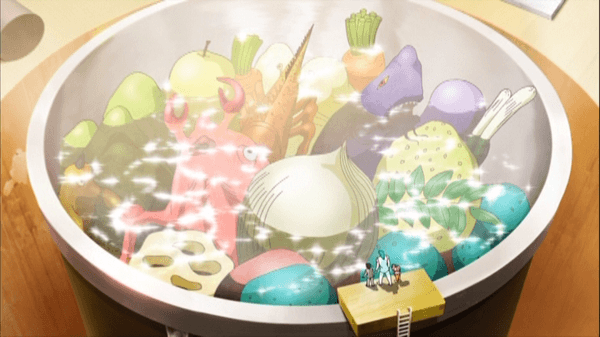
Visuals: Toriko Part 2 continues to impress with its vibrant color palette and gorgeous food designs. Unfortunately it also continues to disappoint when it comes to even the most basic character animations. While every piece of food that is highlighted or creature that is shown off may look stellar in appearance and the environments that the characters venture through are lush and detailed, the character design and animation quality struggles to remain consistent and usually dips drastically at times.
While Toriko is always given quality animation detail, the character’s often fluctuate on size and at times there was even some noticeable color shifting between scenes. Any time that group shots of characters are presented the artwork drops significantly unless the viewer is watching the opening or the ending animation sequences. Thankfully, the series’ battle animation remains consistently high and the odd designs of the Gourmet Corps forces will certainly take viewers by surprise.
Audio: Just as with Part 1, Toriko Part 2 features both the original Japanese dub as well as FUNimation’s new English voice track. It should come as no surprise that the English cast remains the same from the first half of the series and they continue to deliver an impressive and over-the-top performance that fits the over-the-top nature of most of these characters. For example, Ian Sinclair’s over-enthusiastic voicing of Toriko fits the muscle-bound glutton perfectly. It is also worth noting that the number of fresh voice actors have been placed into main roles for this series, such as the Narrator and Sunny.
As far as background music is concerned, Toriko Part 2 continues to feature the same forgetful background music that is common for the shōnen genre. The opening theme continues to remain “Gatsu Gatsu!” by Akira Kushida which is fine thanks to how fitting it is for a series such as this while the “Satisfaction” ending by F.T. Island is used for most of Part 2 it is replaced with “Deli-Deli- Delicious” by Sea A which matches the series better than the former ending song.
Extras: As far as bonus features are concerned, Toriko Part 2 contains a basic collection of bonus features such as the US trailer for the anime, trailers for other FUNimation releases, the clean opening and clean ending songs and actually three episode commentaries. The first commentary is for Episode 15 and features Ian Sinclair the voice of Toriko as the host, Heather Walker who actually voices Kruppoh, the bird, Morgan Garrett the voice of the bird’s owner Tina and Scott Freeman who handles Starjun. This busy voice over is quite funny thanks to the show discussion and the number of opinions passed around.
The episode 20 commentary sees Ian Sinclair once more, Chris Rager the voice of Grinpatch and Chris Guerrero, the rookie Narrator, discuss various topics including food once again, which is actually discussed on every commentary track in Part 2. Finally the third commentary for Episode 26 features Ian Sinclair yet again, Kyle Phillips the ADR Engineer and Zongeh Goon A voice, Tyler Walker the anime’s director and voice of Zongeh Goon B and Bryan Massey who voices Zongeh himself. This larger group focuses on the episode a bit and continues to discuss various foods and how the series’ voice work and translation needed more bro in it bro.
Overall: Toriko: Part 2 manages to pick up where Part 1 left off rather successfully by taking viewers deeper into the Gourmet Age by not only offering actual character development and story progression but explaining previously unknown aspects and setting a goal paired alongside impressive fight sequences. However where it has improved in narrative, the animation quality and visuals continue to drop to even lower levels than what was found in Part 1. Toriko: Part 2 continues to feature exuberant English voice work partnered with a better prepared narrative, the series’ animation continues to sour what could be a refreshing shōnen experience.
Interestingly, Nintendo held an investors meeting a couple of days ago over in Japan to discuss the Wii U device and some of the things to do with it. All of the important questions covered in the meeting were copied onto the Nintendo Japan website for fans everywhere to look over.
What was quite interesting to see was Nintendo’s comments on the perceived power of the CPU in comparison to the GPU. This is interesting because a few developers and gamers have criticised the Wii U’s processing speeds (2.6GHz, IIRC) as being underpowered. Nintendo on the other hand, believe differently:
Takeda : I would like to not get into too much technical talk, I think that the power consumption is low, and that the Wii U hardware, performance machine that it is coming out pretty. There was a story, “performance is biased towards GPU should compare the GPU and CPU, better CPU performance or not you do not come out a little”, in which you have any questions just that, I do so I do not think. I think the only thing “whether anything I measure its performance.” If you look at the chip size, better GPU is chip size is large indeed, CPU, the chip size is quite small. It may be that kind of thing and look at the die size (the area of the chip), the brain called, part logic to calculate really small and that the CPU of a modern, look at the CPU that is used in the server PC and the latest so that you can see and you, “CPU though large, is calculated as part of work really is small, around the SRAM cache memory that is greater” in that it is always in the world. If such a point of view, Wii U we do not necessarily think “CPU performance has not come out for the GPU” is. So, I think we have taken and the design of the memory design de-intensify, underscored the memory that is. I think because it is hard Kuroko, I can say this part can not be helped much, have come up with quite a performance. (Google Translate)
A NEOgaf user by the name farnham has taken it upon themselves to translate this a bit more accurately, as well as other important questions here. I will reproduce the relevant section below:
Takeda : WiiU is a machine that has a lot of performance compared to its power consumption. The GPU is definately more pronounced than the CPU . There are people saying that the CPU is weak but that is not true. It is a trendl that the cash memory is whats getting biggrr with CPUs not the processing power. i do not think at the CPu is underpowered. Its just a design where the memory is more stressed.
As someone somewhat technically minded, it sounds to me that although the CPU itself is not quite as fast, it does rely a lot more on pre-loading data. This would mean a higher stress on memory though.
For anyone wanting to take a look at the original article, you can click on this link here. You can also use Google Translate, linked here, to assist with the translation.
We’d love to hear from a native Japanese speaking person, or persons able to speak Japanese fluently on the best translation for this. If you wish to assist, leave a comment below or shoot us an email at [email protected].



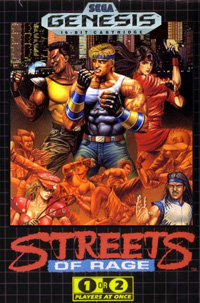 Streets of Rage fans will no doubt find De-Pixelated’s brilliant short film based upon the side-scrolling beat em up video-game classic to be streets ahead and all the rage.
 Popular otaku idol Shoko Nakagawa more commonly known as Shokotan broke down during the recording of her cameo role in the upcoming film Dragon Ball Z: Battle of Gods.