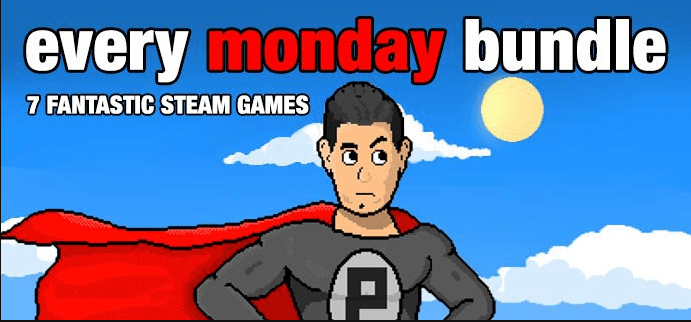
Did you know the Interstate 80 highway in the United States snakes all the way from San Francisco, California on the west coast to New York City on the east coast? Indie Gala’sEvery Monday Bundle #80 might not use as much gas as a cross country road trip, but it’s just as fun. This week’s bundle contains six great indie games.
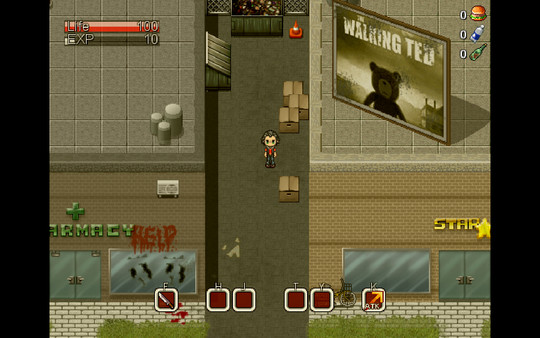
Home is Where One Starts… – A non-linear exploration game inspired by books like East of Eden and The Tree of Life.
Braveland – A turn based tactical strategy game set in a hand drawn fantasy world.
Braveland Wizard – The story continues with the introduction of a young Wizard who has just graduated from the Academy of Magic.
One More Line – A simple, yet insanely addictive action game.
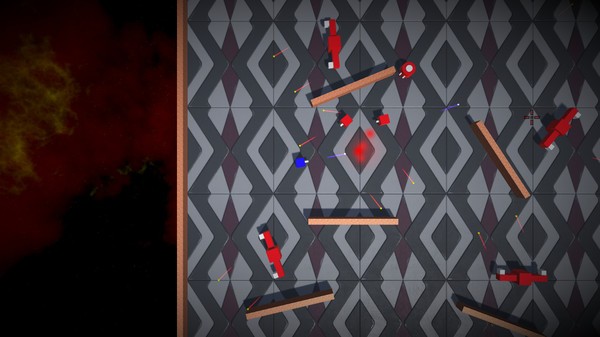
Mayhem Triple – Shoot up hundreds of enemies with a wide variety of guns in this super stylish and hyper-violent shooter.
The Logomancer – A JRPG that substitutes violence for logical discourse and persuasion.
For the first 24 hours of the sale, the bundle is only $1.89. Grab your bundle at Indie Gala today.
LONDON, UK — October 5, 2015 — Today, Ubisoft® announced a Windows PC closed beta for The Crew® Wild Run, the expansion to the action-driving MMO The Crew®. The beta will start on October 15 at 11am BST and last until October 19 at 11am BST.
The closed beta will allow players the first opportunity to participate in “The Summit”, a gathering of thousands of drivers and mechanics from around the world, taking place in iconic locations all around the USA. It’s an event where car culture is celebrated across a multi-dimensional competition with the widest variety of vehicles, from heavily tuned cars to agile bikes or more exotic concept cars. The Summit is the largest challenge in a driving game to date, where players will showcase their talents across a wide range of skillsets and terrains.
During the closed beta players will also have the opportunity to complete PvE and PvP missions to raise their ranking and unlock new features to customise their vehicles. FreeDrive activities will also be playable, as well as speed and skill challenges, stunt competitions with brand new trials created exclusively to fit new vehicle specifications.
Players will be able to test their skills with dragsters, designed to reach incredible top speeds; drift cars that demonstrate impressive control; unstoppable monster trucks that can perform dangerous backflips and insane jumps; or a range of agile motorcycles from prestigious brands, geared to take on the fastest cars on and off-road.
The beta will also showcase the graphical update that the expansions brings, creating stunning environments enhanced by new lighting effects and redesigned areas adapted for all types of vehicles. Existing owners of The Crew will also have access to this graphical update free of charge
The Crew Wild Run expansion will be available for download starting from November 17, and in a bundle with the base game and the expansion, in stores November 19.
Ubisoft is a leading creator, publisher and distributor of interactive entertainment and services, with a rich portfolio of world-renowned brands, including Assassin’s Creed, Just Dance, Tom Clancy’s video game series, Rayman, Far Cry and Watch Dogs. The teams throughout Ubisoft’s worldwide network of studios and business offices are committed to delivering original and memorable gaming experiences across all popular platforms, including consoles, mobile phones, tablets and PCs. For the 2014-15 fiscal year Ubisoft generated sales of €1,464 million. To learn more, please visit www.ubisoftgroup.com.
Avalanche Studios and Square Enix were not kidding, when they promised more explosions in their upcoming open-world action adventure, Just Cause 3. The third installment of the award-winning franchise promises fans the ultimate combination of chaotic sandbox fun and unlimited firepower, so much so that the world of Just Cause is going to burn to the ground this December.
Just Cause 3 marks the return of Rico Rodriguez, the badass you gotta love, whose job is to cause complete anarchy in areas that need new governance. With the third installment, players will get to know more about the protagonist, as he takes charge against an evil military dictator, to save his homeland within the Mediterranean archipelago.
Over the weekend at EB Games Expo 2015, Just Cause fans got first-hand experience of the creative destructiveness that makes this game so unique. Let me break it down for you. Imagine how much damage you could do in 1 minute and 30 seconds? This mini mission in Just Cause 3, serves as the perfect example of what Rico Rodriguez is capable of doing under pressure. Essentially, players need to destroy whatever they can reach within the time control, and will be rewarded with a greater score if they cause bigger explosions. Rico starts at the top of a building, with a rocket launcher strapped to his back, and all the C4 he could ever need at his fingertips. How can you possibly fail?
The best part of this mini mission, is that the timer only starts ticking after the first explosion you make. Therefore, players can explore their surroundings before kicking things into action. While playing at the Expo, I decided to venture away from the industrial area and take a drive across the gorgeous landscape. For the first time in Just Cause, the map has never been bigger for players to traverse, with an impressive 400 square mile Mediterranean island of Medici.
However, travelling too far from the main area and going out of bounds can result in a loss, that’s if you don’t make it back to the playing-field in time. Not going to lie, I spent more time exploring the area and trying to determine the best starting point for Rico to cause the most damage.
There is much more to look forward to in the next installment of Just Cause, with the new wingsuit enabling Rico to deal all sorts of chaos and mayhem, and travel at a greater speed over the Mediterranean island. The improved grapple, means that players now have multiple tethers they can deploy at once, which, if used right, causes bigger explosions.
As a new player to the franchise, I have to say, it was great fun blowing up everything possible in Just Cause 3 at EB Games Expo 2015. I am excited to see more of the game, when it is released at the end of the year. Just Cause 3 will be available on Xbox One, Playstation 4 and PC on December 1st. For those who pre-order via Steam, don’t miss out on the Air, Land and Sea Expansion Pass, with an exclusive Flame Wingsuit and Parachute Skins.
The creators of such classics The Neverhood turned to Kickstarter back in May 2013 in hopes of funding the game’s spiritual successor. Made in the same Claymation style as The Neverhood, Amikrogfollows Tommynaut and Beak-Beak’s adventure into space.
Story
Three astronaut brothers were sent into space in hopes of recovering enough P-tonium to power their home planet. Unfortunately, two of the brothers have gone missing during their quests, leaving Tommynaut the last remaining hope. While preparing the land on Spiro 5, Tommynaut’s ship hits an asteroid, sending him crashing into Armikrog fortress. With his sidekick Beak-Beak, Tommynaut discovers a mysterious baby that he promises to protect.
Although the premise of Armikrog has a ton of potential, the game is about as deep and as interesting as a puddle. The game is painfully short, leaving little time for plot or character development. There is very little interaction between Tommynaut and Beak-Beak, which really hinders character development. The entire plot is crammed in the last 15 minutes of the game. The writers attempt to use common plot tropes to shock some life into the story, but the attempts feel flat and forced.
Gameplay
Armikrog is a mess. Upon booting up the game, players are introduced to the standard game menu, which provides buttons to start a new game, change some options, and so forth. The problem is this menu never seems to change. To continue a previous game, the player must go into options and load their last save from there. This is only a hint of the mess that follows.
The game is a pretty standard point and click adventure. Players wander around levels solving puzzles that will let them explore a new area. Unfortunately, the puzzles almost always boil down to noticing some detail in one area, traveling to another area, and then recalling those details to solve a puzzle. Generous use of the screenshot function or a notebook is highly recommended. There are a small handful of puzzles that have a little more creativity in their design, but are quickly ruined by unnecessarily being drawn out or being repeated ad nauseum.
I couldn’t help but feel like developers Pencil Test Studios were constantly looking to extend the length of the game with ridiculous mechanics that force players to backtrack to discover the answer to puzzles or repeat the same puzzle several times over the course of the game. This tedious need to extend game time results in a puzzle that actually requires the player to walk back from almost the beginning of the game to find the answer. Keep in mind that the game itself is only three to five hours depending on how quickly players can slog through the puzzles.
Armikrog’s controls are pretty terrible. There is absolutely no tutorial in the game, leaving players to figure out that the game actually needs only one action, a left mouse click. The game’s hotspots that trigger actions are unintuitive at best, with many logical spots being unresponsive. The leaf pod controls are probably Armikrog’s lowest point. Trying to get in and out of them requires players to stay still and not click anything until they are sucked out, which runs against the idea of clicking to move or perform an action. The leaf pod needs player input every time it hits a rotating puzzle piece, even though there is no fork in the track. Moving around on rails that are particularly curvy can send the leaf pod zipping along in the wrong direction.
Armikrog is in deathly need of testing. The team offered beta test access to Kickstarter backers, but the game is still riddled with bugs. They range from minor visual glitches to serious game breaking bugs that prevent players from completing the game. It’s hard to shake off the feeling that the game is currently a really expensive beta test.
Visuals
Armikrog is clearly a labour of love. It is a beautiful game in an animation style took a lot of physical labour to complete. The hand worked clay is colourful and has a really unique texture that just can’t be digitally replicated. The cinematics have a wonderful 90s feel to them, which I suspect is from actual stop motion animation being used. The bug-filled nature of the game extends to the graphics, as I noticed a good bit of clipping and animation bugs.
Audio
Armikrog’s audio experience is good. The sound effects are solid, the voice acting is excellent, and the music is a pleasant jazzy soundtrack. The highlight of the game is definitely the 90’s Saturday morning cartoon-styled song that serves as the game’s opening cinematic. Unfortunately, Armikrog suffers from sound bugs, too. They are mostly minor, but expect things like the music cutting in and out at times to happen.
Overall
I can’t recommend Armikrog. The game is extremely short and feels like it is purposely being dragged out. The story fails to impress. The puzzles are bland and lack creativity. The controls are clumsy and unintuitive. The game is riddled with bugs and is in need serious patching. The beautiful Claymation work and solid audio experience just isn’t enough to save Armikrog.
Capsule Computers review guidelines can be found here.
Inari is a middle school student who has feelings for her classmate Tanbabashi. She begins to wonder if he may have a romantic interest in Sumizome, a mutual classmate of theirs. One day, Inari saves a fox from falling into a river while on her way to school. Uka-sama, the god of the Inari shrine, is grateful for this act of kindness and later tells Inari that she will grant one wish for her in return for saving one of her familiars.
Story
Inari decides that she wants to become Sumizome. Her wish is granted, effectively removing Inari from the face of the Earth and replacing her with a doppelgänger of Sumizome. She runs into Tanbabashi while her appearance has changed and finds out that he feels guilty for avoiding her. Inari has an opportunity to give him the charm that she bought for him, but she finds that even though she has physically changed, she has not changed on the inside. Realising her terrible mistake, she goes to Uka-sama and asks her to turn her back into Inari. This is where things start to go terribly wrong, or perhaps terribly right, for Inari.
This is a series where character interactions and character development are just about everything. It is all too common for a manga series or an anime series to make it seem as if changing one’s physical appearance is a guaranteed way to make one suddenly have some kind of appeal to the person they have feelings for. It is not common, however, for a Japanese series to show that superficial changes to one’s appearance are meaningless. Inari learns that she must find the courage to talk to Tanbabashi herself without the help of anyone else or divine power.
The greatest strengths of this series are the ways it handles the interactions between the characters, the depth of their personalities and their emotional development. It explores the unfortunate fact that some people, whether through their own actions or because of external influences, find it difficult to make friends and accept new people into their friendship group. It explores what it is like for someone to accept their own shortcomings and try to get over them. It also carefully explores the many difficulties and anxieties that come with having romantic feelings for someone. Morohe Yoshida has created a series that is more touching and feels more natural than many other anime and manga series do. Few of them feature characters with such depth and with realistic and familiar personalities.
Visuals
Production IMS has done a fantastic job with the animation and the visuals. The scenery is given a detailed, natural look, while the external appearance of the Celestial Plains is stylised to give a surreal feel to the home of the gods. Alternatively using both of these styles helps to create a unique feel, one that is always pleasant to look at. It also helps to distinguish the Celestial Plains from Earth, a distinction that becomes quite important as the series progresses.
It is always important for characters to be distinguishable from one another and fundamentally more so in this series. Inari looks like a normal human being instead of being the kind of cookie-cutter girl that is commonly depicted in many Japanese series. Uka-sama has the appearance of a wise god, or at least that is how she appears most of the time. Her tendency to play otome games allows for opportunities for her to be portrayed more like a human, a point that is the cause for significant concern on the parts of her creepy, incestuous and overprotective brother and the rest of her family. Inari’s other friends are all clearly distinguishable from one another, which helps when Inari transforms into one of them for one reason or another. Maru’s character design in particular is quite refreshing; issues involving being overweight are rarely discussed in Japanese series in such a realistic way. The male characters, however, are as bland as male characters are in any given harem series. Still, Tanbabashi’s bland appearance is not really a problem; it is his initial lack of personality that is the problem. In the latter half of the series, his feelings are briefly explored, helping him to become somewhat of a proper character, and Touka goes through some development as well.
This series does not push fan-service as much many other series do these days, but it is nonetheless present with the sexual objectification and humiliation of Uka-sama. There are also creepy men that hit on the two of the girls when the main group of friends goes on the contractually required beach trip. All of the ‘fan-service’ exists to humiliate or seriously frighten the female characters. It is not at all appropriate and detracts from the innocent feel that the series otherwise has.
Audio
The background music, composed by Takashi Senoo, is beautiful and fun to listen to, and it never feels like it is used inappropriately. One thing that is particularly effective is the use of atmospheric sounds. Ethereal atmospheric sounds can be heard instead of conventional background music when Inari is discovering Uka-sama‘s house for the first time, adding to the mysterious feel of the scene. The opening and ending theme songs are better than the usual pop songs used in anime, and the insert songs are pleasant as well.
The performances of the voice actors are convincing. Unfortunately, FUNimation still found ways to change the meaning of what is being said even without producing an English dub. The subtitles frequently use North American slang terms and phrases when they are clearly not appropriate for such a distinctly Japanese series. If you know enough Japanese to understand what is being said, you may wish to turn the subtitles off so as to avoid the unnecessary and inappropriate Americanisms introduced in the subtitles.
Extras
Although none of the episodes feature conventional previews for the following episode, nine special previews titled “Pub Fox Theater” are included. In these shorts, the foxes Shishi and Roro and later Uka-sama‘s sister Miya discuss random things while shots from the next episode of the main series play on a TV in the background. The commercial collection, promotional video, textless opening and ending animation and U.S. trailer are included as well. The textless opening and ending scenes in episodes 9 and 10 are not included, a common move for English releases of anime. The OVA episode is included. While it does not really further the story, it is one final chance to see the characters animated and doing things together, even if most of it takes place chronologically in the middle of the 10 episodes of the TV series.
Overall
Inari, Konkon, Koi Iroha is figuratively a hidden gem among the vast majority of the manga and anime series that make it into the English speaking world each month. It has a surprisingly natural and often mystical feel to it; when a character reveals something very deep and personal about themselves, it feels real. These moments have a real emotional power that is unfortunately rare in Japanese series. Although the main plot is resolved by the end of episode 10, much is left unresolved. This is because of two reasons: the anime adaptation finished over a year before the original manga concluded, and there are only 11 in total. The friendship issues were resolved throughout the course of the 10 episodes broadcast on Japanese television, and while some future developments are implied, enough is left unresolved to warrant another season being produced. Sumizome certainly deserves more screen time than she got after her powerful revelations in the middle of this adaptation, although it is unlikely that a second season will actually be produced. As it is, this adaptation provides a delicate, albeit brief, insight into the lives and minds of a group of mostly realistic characters.

Capsule Computers review guidelines can be found here.
JoJo is in the middle of his fight with Tarakus and the Dark Knight Blueford. Although he faces an immense challenge, he uses what Baron Zeppeli has taught him about Hamon and eventually emerges victorious with the help of his friends. Now he must face his greatest challenge yet: Dio himself. With his ever-growing army of mutant zombie monsters, Dio first plans to take over Wind Knights Lot. Can JoJo kill his adopted brother and enemy and prevent him from taking over the world?


Story
Jonathan Joestar is working towards a goal that will require sacrificing much of what he holds dear. He makes friends with all kinds of unique characters and is on an important quest, during which he will continually be required to push his superhuman strength to the limit. These points will undoubtedly be familiar to anyone who has ever read another shounen series or watched an animated adaptation of one. In its favour, JoJo’s Bizarre Adventure, or at least the Phantom Blood arc, does not simply feature a character with superhuman strength who spends the whole time just fighting various enemies of increasing strength and capabilities. It features supernatural elements and is set in a real time and place. It is not common for shounen series to be specifically dated in the history of Earth, let alone be set in a real location. It is this use of time and location by Hirohiko Araki that helps make this series stand apart from other popular shounen series while following a now-familiar formula.
Araki uses a technique common in realist fiction but uncommon in Japanese series, which is the use of newspaper excerpts to provide evidence of the supernatural occurrences. This technique is, of course, not employed here to actually add credibility to the story. As a supernatural adventure series, you are either going to suspend your disbelief and go along with what the narrator says and what you see happening, or you are going to think that this story is a bunch of bizarre nonsense. This story arc manages to dance the fine line between the former and the latter while moving towards a dramatic climax.
As with many shounen series, revenge is an important aspect of the plot. Equally important are the themes of sacrifice and death, both of which are featured in this volume. Many characters have died already, and the deaths are not going to stop as the plot ceaselessly moves towards the conclusion of this arc. Araki shows just how strong the bond of friendship can be between people; even knowing that they face certain death in doing what is necessary, the characters never falter in their conviction that what they are doing is right for their friends and for the good of humanity.
Another important element of shounen series is the incorporation of a character’s back-story into the plot. In this volume, Baron Zeppeli goes through some important character development. During his flashback, the Baron reveals how he learned the powerful Hamon techniques that he has honed over the years. We find out how he became involved in the plot of the phantom mask and when he resolved to do whatever it takes to destroy it. The flashback occurs during a rather odd time, that being right in the middle of the action, but it helps round the Baron out as a character. It is important for characters in shounen series, and indeed in any series, to be round instead of flat so that readers can understand what the characters’ motivations are. The quality of storytelling here goes to show why Hirohiko Araki’s series has been published for nearly three decades and why it is still receiving anime adaptations and video game tie-ins. Phantom Blood may be a tragic story, but it is told far more effectively than almost all other manga series are these days.
Artwork
Shounen series are known to be violent, but Hirohiko Araki takes things to a whole other level. The depictions of blood and gore are even more extreme than before and the monsters that Dio creates are even more disgusting and horrifying than before, so be careful when deciding whether or not to pick up the volumes comprising this first arc. Some of the panels can be rather crowded with highly detailed artwork of the characters, making the backgrounds generally less notable than they were during the beginning of the first volume. The rest of the artwork is both typical for a shounen series and very out of place at the same time. Baron Zeppeli’s character design, especially his hat, is very uncharacteristic of such series. He would presumably have been considered quite eccentric if such a person had actually lived in England towards the end of the nineteenth century.
Extra Content
As with Viz Media’s previous collected volumes of Phantom Blood, this volume features an interview with Hirohiko Araki. In it, he discusses how he initially conceived the character of Dio and other facts that will interest fans of the series.
Overall
The Phantom Blood arc has been a great introduction to the JoJo’s Bizarre Adventure series. It proves that the tropes common in shounen series have not changed much, if at all, over the past three decades. However, Hirohiko Araki is skilled at taking familiar tropes, combining them with historical references and time-specific pop-culture references and creating an engaging story with them. It may become a little disturbing at times with the animal/human hybrid monsters that Dio creates, and with Dio himself, but those of you who do not mind such things may find reading this arc to be an entertaining way to spend an evening. Although it concludes relatively well, with only one important plot point being left ambiguous at the end, it will be interesting to see what Araki does next when the Battle Tendency arc begins its first ever publication in English before the end of this year.
Capsule Computers review guidelines can be found here.
As a long time fan of Star Wars and the Battlefront franchise, you wouldn’t need to be attuned to the force to guess that I would be very interested in trying my hand at EA Dice’s newest installment in the series; Star War Battlefront. If you’ve never played a Battlefront game before it can best be best described as a tactical first-person shooter within the Star Wars universe… basically, think Battlefield on Tatooine/Hoth/Endor and you won’t be too far from the mark. After playing the game at EB Expo this year, I give you my insights:
The action in Battlefront is fast-paced. The map being showcased at the expo was Hoth (the icy snow planet from Empire Strikes Back) and I died frequently as I fought across its icy trenches. The map felt huge and there was plenty of space for to flank unsuspecting opponents or (as was more often the case for me) being flanked. Death wasn’t too much of an impediment though as you’d respawn quickly and fairly close to the frontline. Movement is fairly fast and largely what I expect from a modern shooter with the stamina bar of the previous Battlefront not making a reappearance. Everyone also has a jetpack which definitely helps with traversal.
The battlefield objectives added an extra element of strategic play to the mix as the teams (rebels vs imperials) gunned each other down in the snow. In this case, the Imperial side needed to escort their AT-AT walkers to blow up rebel shield generators across the map while the rebels needed to stop them. The rebels had nodes scattered across the map that they would need to activate and hold to call in Y-wing reinforcements to damage the shielding on the AT-ATs which would then be vulnerable for a limited amount of time to direct attack by the players. Depending on how successful they were, more would be called in and the AT-ATs would be vulnerable for longer.
This scenario was certainly a lot of fun to play and it certainly got that Battlefront itch that I’ve been missing for a while now. That being said, there were a couple of issues I encountered with some aspects of the game. Entering into turrets and vehicles can sometimes put you into a third-person view which can be difficult to use especially when firing over a ridge/other terrain as you cannot really judge when you’ll be firing at a target or at the ground. The lack of iron sights was slightly annoying as well as when I was playing rebels, the default loadout did not provide me with a scoped weapon while the Imperials did. I don’t imagine this would be too much of a problem if you have time to alter your loadout however…
Overall, I enjoyed the (limited) Battlefront experience I had at EB Expo and I look forward to the Beta in a couple of days. The Beta will be released on the 8th of October and will end on the 12th of October. It will feature the Walker Assault scenario I played as well as two other game modes and can be obtained through EA’s Origin service. The full game will be released on November 17th for PC, PS4, and Xbox Oneand you can buy it here.
A long time ago I had a house that I was proud of when I decided a garden would compliment the soil that bordered the residence. The garden of flowers was stunning and lovely. Opal, a former resident who I did not like (an elephant), convinced Big Top to move in right on top of my flowers and ever since, I have hated elephants. They will not exist where Animals Cross. Oh, hi! Welcome to another episode of CC Unplugged, where Dustin Spencer and Garrett Cheater have united once again to bring you news, talks, and so on. This episode we discuss the new Animal Crossing, Metal Gear, have a debate on skin breathing, and catch you up on Konsplosion. Its like having powers, but not as secret.
Grab some tunes from the lovely links down below, tell your friends, and prepare to get UNPLUGGED!
Acclaimed Developer Days of Wonder Announces Digital Release of Splendor available now on the Steam platform
Award-winning strategy board game makers invite players to dive into a unique world of Renaissance merchantry.
Los Altos, CA; Paris, France – September 17, 2015 – Days of Wonder, an Asmodee studio and a leading developer and publisher of board games, is proud to announce today the release of SPLENDOR on the Steam platform, the world’s most popular PC gaming platform. SPLENDOR is a faithful digital adaptation of the Space Cowboys board game, which has sold more than 200,000 copies globally, immersing players in the heart of a unique Renaissance world to deliver a friendly and exciting experience.
Following its success on iOS and Android devices this summer, Splendor is now available for PC and is landing today on the Steam platform. The adaptation of Space Cowboys’ popular board game, Splendor is a captivating strategy turn-based card game with simple and intuitive rules, which takes you to the heart of the Renaissance era. Splendor delivers an exciting gameplay where everything is based on your skills as a strategist.
To enhance the release, the new updated version (1.1) is improving the mobile and PC gaming experience through patches, but especially with new challenges! The “Saint Petersburg” pack joins the three previous packs of challenges, allowing players to test their ability to deal with complex and unique situations. These new challenges, based on historical facts, take place in Russia from the thirteenth to the early seventeenth century and push players to take on the infamous Ivan the Terrible.
Key Features:
Faithful adaptation of Space Cowboys’ board game.
Pick-up and play. Rules only take 5 minutes to learn with the game tutorial
Sublime graphics, originally seen in the board game, coupled with atmospheric Renaissance music.
Local pass and play mode for up to 4 players.
Exclusive “Challenges” game mode based on actual historical facts, which occurred during the 15th and 16th century.
A complex artificial intelligence based on player behavior instead of difficulty levels.
A playful interactive tutorial with an intuitive and user-friendly interface.
Online leaderboard enables players to compare scores from all over the world.
The official digital adaptation of SPLENDOR is available NOW on Steam for $9.99. To download and/or join Steam visit the Splendor Steam page.
About Space Cowboys – publisher of Splendor board game
Space Cowboys is an up-and-coming board game publisher who already has three games under its belt: the worldwide bestseller Splendor (Golden Geek Award 2014), Elysium (nominated for KennerSpiel des Jahres) and Black Fleet (UK Games Expo 2015 Board Game of the Year Award). This board game design studio was established in 2013 by the founders and pillars of Asmodee (French board game market leader) Marc Nunes, Philippe Mouret and Croc. Expanding their footprint over the game market for several years now, they have created a new synergy to create bold and innovative play concepts, such as Time Stories, scheduled for the end of 2015.
About Days of Wonder, an Asmodee studio – publisher of Splendor digital games
Days of Wonder®, a studio owned by Asmodee, develops and publishes one of a kind games, as reflected in the company’s slogan “Play different”.™. The smashing successes that are Ticket to Ride®, the best-selling train game, Small World® and its epic conquests in a fantasy world; and Memoir ’44® , the definitive World War II board game, supported by more than twenty expansions, motivate Days of Wonder to always raise the bar higher. Days of Wonder games are distributed in 40 countries and their digital versions are available on the App Store and on Google Play, as well as on Steam and on Days of Wonder’s website. To date, the company has sold more than 5 million games and over 45 million game sessions have been played online on its website. It also remains the youngest company to ever win the prestigious “Spiel des Jahres” (Game of the Year Award in Germany), the most coveted prize in the world in the field of board games.
About Asmodee
Founded in 1995 in France and with offices in 7 countries including England, China and the United States, Asmodee is a publisher and distributor of popular board and card games like 7 Wonders, Jungle Speed and Dobble. With six studios publishing and distributing games in more than 44 countries, Asmodee sells more than 10 million games per year. Asmodee’s reputation for delivering strategically challenging games with attractive design, has earned the company unfailing loyalty from fans, families, hard core players and also casual gamers.
A character that speaks in a Zelda game? The Princess’s Tell-All trailer has been released for The Legend of Zelda: Tri-Force Heroes, showing off a lot of facets to the experience. The game itself looks decent enough, and the trailer shows a lot of gameplay and the general co-op nature of the game.
Its a fun clip and to be honest it seems as if The Legend of Zelda: Tri-Force Heroes will be another fantastic entry within the franchise on the 3DS. Watch the clip below and enjoy the soothing voice of a princess who needs your help as well as comedic stylings of three little Links.