
Home Blog Page 6445

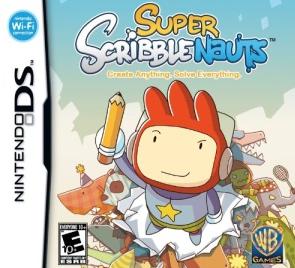
Super Scibblenauts – Nintendo DS Review

Game Name: Super Scribblenauts
Platform: Nintendo DS
Publisher(s): Warner Bros. Interactive Entertainment
Developer(s): 5th Cell
Genre(s): Puzzle, Action
Release Date: Oct 12, 2010 (US) October 27, 2010 (AU) October 29, 2010 (EU)
Price: $29.99

Just a little over a year ago, developer 5th Cell released the first Scribblenauts into the world on the Nintendo DS. While innovative and still a solid experience, the game had some control issues which brought the title down a bit. The new Super Scribblenauts included a new control scheme and adjectives giving gamers a whole new way to play and attempting to fix the minor problems based upon feedback of the fans. So how does Super Scribblenauts stack up? Here is my review.

Story
Much like the first entry, Super Scribblenauts has you assist Maxwell through puzzles to find the various starites scattered over the in-game universe. Each level requires thinking and creativity to decipher the puzzles and the level of difficulty increases as you move through the game. There really isn’t an overall story for the game but it is really about using your own words to solve a particular situation. For instance, a knight needs to take out a dragon so you must think up a clever weapon to help defeat the him. You could use a sword have a generic victory, but to be creative you can create a “Purple Freeze Ray” to instantly summon the weapon and assist the knight to a imaginative victory. It really comes down to how creative the player is on how much fun you can really have in Super Scribblenauts.
Gameplay
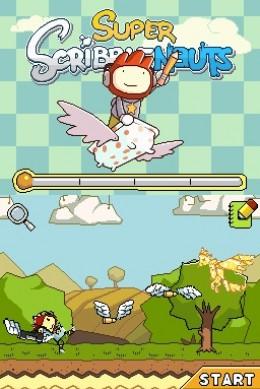
The biggest issue of the first Scibblenauts was the touch screen controls and I am glad to say that this has been completely fixed as the D-Pad is now fully implemented to move Maxwell so everything is much easier to do within the game. Another issue that was fixed was the “picnic basket” glitch which allowed you to place a starite in a newly spawned basket or any container for that matter and simply drag it to Maxwell. This time the starite will simply fall out leaving you to complete the level the way it was intended. For most levels, the starite does not appear until a solution is made to the puzzle which also helps rid the nasty glitch once and for all.

Now that the improvements are out of the way, the core game is even better than before. Super Scibblenaut’s in-game dictionary is now even bigger with hundreds of new words and adjectives added in for players to create just about anything. Simply type in any word (excluding pronouns and vulgar words) and you can instantly see your creation come to life. The adjectives are the main theme of the main game as many levels need you to think up items or people with emotions, colors, and many other expressive terms to solve a puzzle. Need to kill an enemy? Spawn a piece of evil sushi, give it a cross bow and watch the entertainment begin.

Most levels are pretty straightforward and as I mentioned so it is really up to the player how to solve a puzzle for the most part. As you play through the game, the more creative you are, the more Merits you will receive. The Merit system is a great way of getting rewarded for the crazy ideas you think of and made me go that extra mile to think up interesting solutions along the way. For those who don’t want the brain strain of a puzzle, you can simply play in the game’s returning sandbox mode which lets you do as you please and write up anything the heart desires. I spent my first few hours just playing in this mode as the dictionary of word you can use is HUGE and there is a lot of fun to be had and secrets to unlock just fooling around casually.
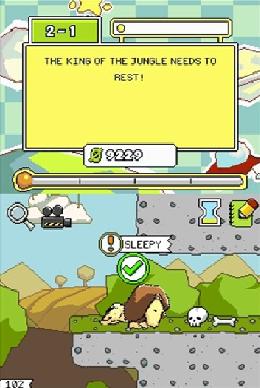
The level editor is another way to make your own puzzles and stages but it lacks anything different from the main game and since creations can be made on the fly anyway, there really isn’t much incentive to play it. Like the first game, internet memes and pop culture references are back and from Rickroll to Ceiling Cat and even a guest appearance from Mega64 which was quite humorous as well. Things like that add to the replay value which should buy you more hours of fun after you complete the over 100 puzzles in the game.

Graphics/Audio
As far as graphics go, besides slightly improved animations there really isn’t anything new but that is not really a bad thing. Animations could still use a bit more tightening up but all of the sprites are charming and creations reek of love from the development team.

Super Scribblenaut’s is still impressive music-wise with the game’s melodies being catchy and never monotonous adding to the colorful environments. Sound effects are the most impressive part of the audio though, as each creation’s audio sounds pretty realistic compared to their real-life counterpart. Cats, dogs, and the various humans you can spawn not only look the part, they sound it as well from a quick meow to the roar of an “angry dragon”.
Overall
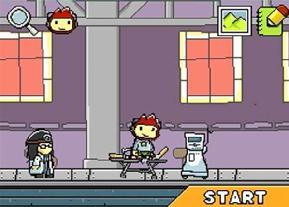
Super Scribblenauts is a game that rewards you for your creativity. 5th Cell did a great job at fixing the first game’s problems and it really shows the love they put into it by the enormous dictionary and funny and even somewhat creepy in-game sprites. If you are a casual or hardcore gamer, Super Scribblenauts is a game that defines pick-up and play with the simplicity of the interface down to the quick, yet fun puzzles. Graphics wise the game still could use some work and I would love to see more online features to fully utilize the functions on the DSi, but overall this is a worthy follow-up to a franchise I can see getting even better over time.

I Give Super Scribblenauts

8-5-capsules-out-of-10

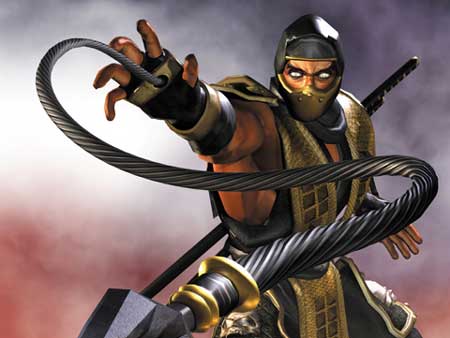
Mortal Kombat’s Scorpion gets character development in this trailer

What would you do if your entire family was killed by a ninja assassin? Then you were killed too by this ninja. Well you would be dead of course. Until you were resurrected and given a new name, Scorpion. Turns out that Sub Zero destroyed Scorpions entire family, which may explain why there has always been so much malice between the two fighters.

Sure it may sound like your standard revenge story but this is Scorpion vs Sub Zero we are talking about, two of the signature fighters for the entire Mortal Kombat series. The game itself is going to be a retelling of the first three MK games which will explain many questions that never have been answered since the franchise began.

Catch the brand new Mortal Kombat when it drops onto the 360 and the PS3 next year in 2011.

To Aru Majutsu no Index II Episode 2

0

So we begin this episode not in Japan, but in the streets of London. We join Laura Stuart, Archbishop of the Catholic Church in midst conversation with our good friend Stiyl. Laura tells Stiyl about the fact that a dangerous book has been stolen, called the Liber Al vel Legis has been stolen, along with the only nun who can translate it. The reason that this is a problem however is that the constents of this book can give the owner powers rival to God’s own.

Laura tells Stiyl that she believes the Amakusa Catholics were responsible for the theft. And therefore believes that the missing Kanzaki is involved as she originates from the Amakusa. Before I go further, yes both of these things are real in life, though the book obviously doesn’t contain such powers. She appoints Stiyl to use any means necessary to retrieve the book, which has somehow made its way to Japan.

We then join Index in a discussion with Maika, a maid in training that is sitting upon a spinning garbage robot. As they are talking and Maika idly spins in circles they discuss the fact that Index is bored and that she is interested in becoming a maid, despite the fact that Index has no housework skills at all. That is all ended however when Stiyl shows up behind Index and kidnaps her yet again.

Unaware of his friend’s plight, Touma is on his way home and reading a flyer about a sports event for the inhabitants of Academy City. He then reminds viewers that he has lost his memories during the first Season and doesn’t remember anything about the event ever happening before. Though considering the fact that he has hidden it from all of his friends well enough that they believe he is still with all of his memories.

Though upon returning home he hears Maika yelling his name only to find that Stiyl left a note to meet him outside of Academy City and that he has Index. Not worried at all Touma heads out to meet him. On his way however he finds a lost nun and decides that he will help her find her way, but only after he goes and finds Index.

All the while though Stiyl and Index meet with Anieze of the Battle Nuns. Index explains that the Amakusa magicians are amazing at stealth magic and can perform it with normal items that don’t appear out of place to the common observer. Because of this they are difficult to track. After this bit of exposition, Touma shows up along with the Nun he has with him. Stiyl tells him that the Nun is in fact the missing woman who can translate the Liber Al vel Legis, Aquinas. Stiyl then tells Touma he already completed the task he had for him and he can leave, along with Index.

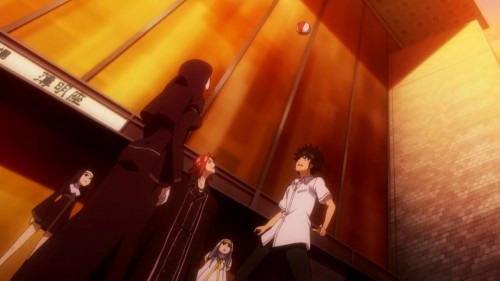
Obviously Touma is very angry at Stiyl for calling him out for no reason and they argue, leading to an interruption from a floating ball that is broadcasting an Amakusa magic users voice. They then open a small hole in the ground and kidnap Aquinas before anyone can stop them. Though Index quickly tells the group that the only way the Amakusa can escape is through a very specific portal at a specific time which makes tracking them a piece of cake.

So the group of a hundred battle nuns gather and prepare for a fight, though as the battle is tomorrow everyone sets up tents in preparation for the battle. All the while however Touma is introduced to Anieze, or at least to her underwear. Anieze turns out to be a very clumsy nun, and walking around on platform shoes that add 12 inches to her height makes it all the worse. So Anieze falls over and Touma, in an attempt to catch her, instead falls into the bottom of her robes.

To make things even worse, after this incident Touma is walking around the camp looking for Index who has disappeared only to hear a scream coming from a large tent. Thinking that someone is under attack from the Amakusa, Touma rushes in only to be met with a naked Anieze who clings to him and screams at a slug on the wall. Yes this is the fan-service part of the show ladies and gentlemen.

Then as Anieze passes out on his leg, Touma sees Index also naked in the shower. She starts crying as Touma notices that all of the Nuns are behind him and seeing the fact he barged into the shower on the two girls. Index then delivers her classic bites to Touma’s face and he is kicked back into his tent.

Inside the tent however Touma discusses with Stiyl that Kanzaki may be involved in all of this. But Stiyl vows that he would do anything, kill anyone, or burn anyone that he had to to protect Index. This means that if he has to, he will destroy even Kanzaki his long time partner.

Once everyone falls asleep though, Touma is awakened by something moving under his covers in the tent. Thinking Stiyle is messing with him, he looks over to see him sleeping too. Instead it turns out to be Anieze yet again, sleep walking and hugging him, as well as a sleep walking Index intent on chomping down yet again on the poor man.

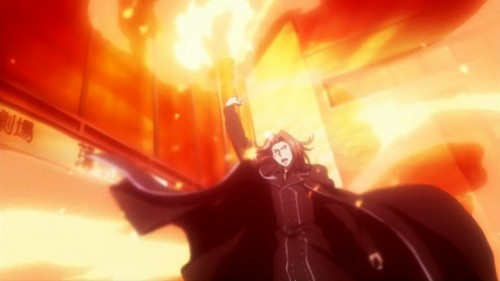
After this we flash to the enemy leader who looks extremely like Mugen from Samurai Champloo. The leader of the group says that it is time to show Kanzaki his power, which shows that Kanzaki isn’t guilty of assisting the group. Though it is still odd that she destroyed the knights from England then.

Well, first the different scenes of fan-service are actually parts of the story. In the Light Novels all of the various bits happen to emphasize the fact that Anieze is a klutz character and to provide a bit of levity to what will happen in the next episode. We are treated to what looks like the beginning of a large scale battle between Touma and the Battle Nuns against the Amakusa Catholics.

We are also introduced into the major conflict for this Arc and everything has been explained, so now it is time for the action scenes that fans of the series loved. The fact that JC Staff has also put more money into the animation and drawing of the second season will hopefully make the battle scenes all the more memorable.

To Aru Majutsu no Index II Episode 1

0

Ah at long last we finally have the sequel to To Aru Majutsu no Index with the second season. Though this first episode here was mostly for introductory purposes and to refresh everyone’s memories of who they are, and what they are capable of. Though there is still a good amount of action and a bit of plot development which will keep everyone happy.

We start off with Touma suffering his usual misfortune. It so happens that he only has one day left to finish his Summer homework, but because of everything that happened in the end of last season, he did not have any opportunity to finish it at all. On top of that Index isn’t being very helpful as she constantly pesters Touma to make her food and that she is bored, forcing Touma to take her out of the house and to a family restaurant.

Though in the end this turns out to be beneficial to him because lo and behold a magician is knocking on his door. But this time it is with a magically enchanted crossbow that tears apart Touma’s apartment. Though they are no longer there. Instead Touma and Index are waiting to be served at a restaurant while Touma tries to finish his work on time. Overall the story so far has been pretty much structure, though now it gets interesting.

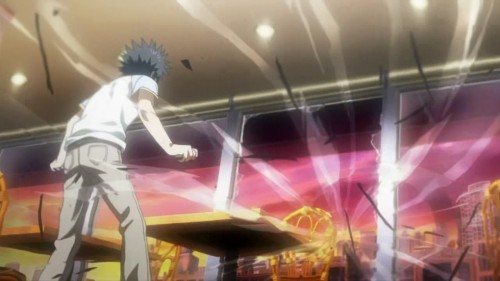
After being doused in food thanks to a clumsy serving waitress, the very unlucky Touma finds his homework completely soaked in food and liquids, only to then see the magician outside the window. The window suddenly smashes in as wind lashes out and tears apart the table and everything on it until Touma uses his right hand to dispel the magical attack with his Imagine Breaker ability.

Quick explanation for everyone who hasn’t seen the series before, Touma has the ability to dispel any sort of magical, or technological ability that he can press his right hand against. This is one of his biggest secrets but also his greatest power as he uses this ability to fight those who only have known their powers as strength and are now weak that it has been disabled. This also is why Touma has been so very unlucky, or as he puts it, misfortunate. Because as Index explained during the first episode of season 1, his hand even dispels the luck any living being possesses as a gift of God.

But back with the episode. Touma looks outside only to discover the magician, named Yamisaka Ouka, is now magically behind him. Though Touma could care less about the man, as he noticed his homework is now in tiny little pieces. After a short speech of Touma more or less ripping into Ouka for being a nuisance, Ouka captures Index by turning invisible and running away. Thus leaving Touma to try and find Index before it could be to late, though the restaurant staff are far from happy with the mess they have been left with, much to Touma’s misfortune.

Turns out that the magician that has kidnapped Index did so because he requires knowledge from one of the 103,000 forbidden books stored within her mind. To access these books he has constructed a magic encahncing setup to allow himself to delve into her mind and read the knowledge from this book. Touma though does not know of the magicians simple request and instead believes she is in extreme danger. He searches around for her anxiously until he stumbles into his frenemy and fan favorite Misaka Mikoto, or BiriBiri.

A hilarious scene ensues where Misaka is extremely angry at Touma for constantly ditching her, and flashes back to the episode where Touma pretended to be her boyfriend and ended up protecting her from an evil magician, swearing that he would protect her with his life. This leads to Misaka becoming extremely flustered and perhaps in one of the biggest dere moments of her tsundere style she can barely think of what to say when Touma confronts her that he is very busy and has had a ton of things happen to him already, before ditching the poor girl again.

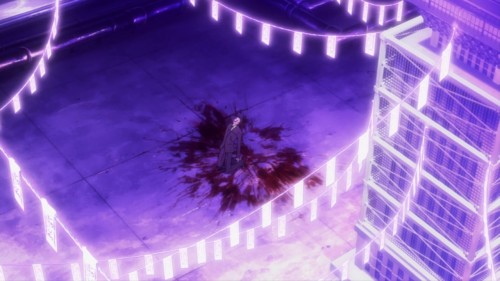
While this is happening Ouka has completed his spell and begins to find the book he needs within Index’s mind, only to have his body start tearing itself apart and bleeding all over the rooftop. Index warns him that if he continues to read the books then he will die, due to the fact that no human mind can withstand these forbidden books and he will kill himself if he continues. Thankfully though Touma shows up on the scene and quickly dispels the magical set up with one touch of his right hand, and unties Index from the ropes holding her.

Ouka fires a blast of cutting wind from his magical crossbow but it is no use against Touma as he dispels it immediately. Ready for the fight Touma braces himself, only to see Ouka collapse in exhaustion. As it turns out the reason that Ouka was looking at the forbidden books was to find a way to get rid of a curse on a woman that he loved, though he says she is a very boring woman. Touma gives him a speech whereas he explains that they both know what it feels like to be helpless to save someone and to relieve them of any suffering they have. Ouka then falls into unconsciousness, seemingly dead.

That is until Touma uses Index’s pet cat Sphinx to wake him up with a few scratches to the face. As Ouka rolls around in agony Touma explains that Ouka doesn’t need any of the forbidden books, instead all that is needed is that he touch her with his hand and dispel the curse that is killing her. Ouka breaks down into tears at this realization that she can be saved, and Touma promises that he will save her.

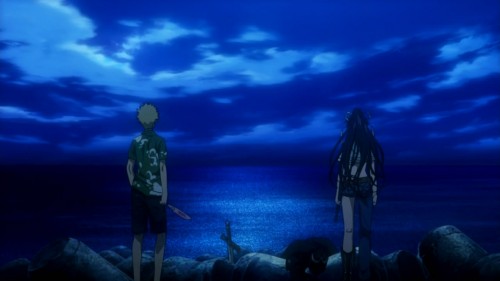
After the ending credits however, we see Kanzaki standing above a beachhead where knights are crawling out of the water, she quickly attacks and dispatches them. The last knight alive questions her if she knows who she attacked before dying. Tsuchimikado observes the battle but simply states that he is not there to stop her, but only there to spy for his superiors which are not revealed. This last bit sets up the storyline for what looks to be the Church of England having issues with Kanzaki, or someone related to her.

Overall I would have to say that J.C. Staff has definitely found their flagship show. The production values are simply amazing as the backgrounds are highly detailed and sustain the amazing look that they kept from the first series. Misaka has received a small addition to her character that has been brought over from the Railgun spinoff and both the opening and ending songs are very well done. With Mami Kawada returning to perform the opening song yet again, they are a delight to the ear without revealing too much about the show’s premise with just the opening scene. There is a little bit of a continuity problem between this first episode and last season, as this Arc takes place immediately after the fake date with Misaka in the Light Novels, so it will be interesting to see why they have made it so that the last two episodes of Season 1 have been passed over.

Sonic 4: Episode 1 Review

Sonic 4: Episode 1
Publisher & Developer: SEGA
Platform: XBLA (Reviewed), PSN
Release Date: 10/13/2010
Price: 1200 MSP ($15) – Buy Now!!!!

Overview:
Sixteen years is a long wait for any game. It’s longer than the wait that people had to deal with for the infamous Duke Nukem Forever to see the light of day. But Sonic fans have been patient and the sequel to the 2D scrolling Sonic games of old has arrived. With the last classic game releasing so long ago and all those adventures into 3D gaming, has Sonic kept his charms?

Graphics:
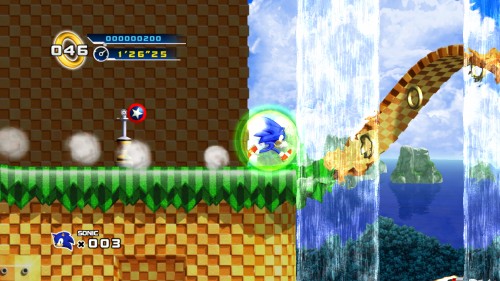
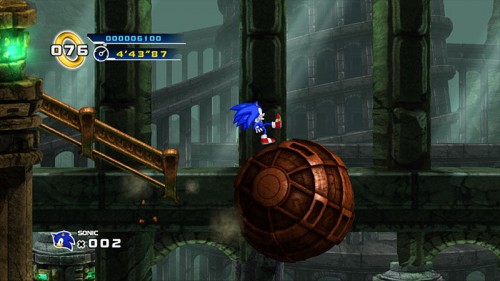
In the amount of time that has passed, graphics have made such an improvement that anything graphically similar to previous 2D Sonic games would have simply been lazy. Thankfully Sonic has received a complete revamp in the graphics department. The backgrounds as you zip through levels are have been beautifully rendered. Parts of the Casino street even have parts of the background that move as you run through them. Dice and cards attached to poles turn as you zip past, giving a nice feeling that Sonic is running so fast he is creating a, pun intended, sonic boom. Sonic himself has aged extremely well, looking better than ever. Running across High Def levels requires a High Def character and Sonic delivers.

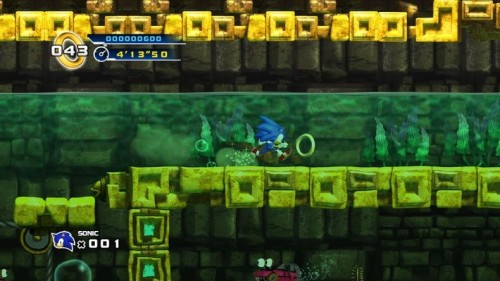
The areas you run through are quite varied and also throwbacks to previous Sonic stages of games gone by. They have all received a revamp and though they bare unmistakable similarities to previous Sonic game stages, it also brings about the nostalgia factor as you zip through them. There is also a decent amount of variety in these levels, including a few water levels, a level where Sonic only can see with a torch, and more that you will have to find out yourself. The special stage itself where you can get chaos emeralds is mystifying with its kaleidoscope feel is a throwback to the very first Sonic’s special stage

A small set back though is that the camera is very restricting. Of course you have the classic press up to look a little bit above yourself but that does not help very much when you are flying across a level only to plummet into oblivion that you did not see, or crash into a badnik that was just out of view. Ironically though these random deaths do not hurt the game much, and you will find out why later.

Audio:
Unfortunately though the graphics are beautiful, the soundtrack becomes less than nostalgic and more annoying. Especially when there are levels you will have to play through multiple times to finish the time attack mode and even get the special stages to unlock. None of the music is memorable, but it does contain a shadow of the old Sonic’s lovable themes, if only they were more likable.

Gameplay:
There really isn’t any story to go along with Sonic beyond the fact that he is trying to stop Robotnik from taking over the world etc etc. Therefore Sonic must adventure through four different zones and destroy his creations and finally put a stop to him at his E.G.G. Station. All of this may seem very familiar, because it is.
Sonic 4 brings everything to the table that classic 2D Sonic games have such as bosses and level designs. The good thing is that they also threw in a few additions that bring Sonic 4 more into a game of its own as opposed to a rehashing of old ideas.

The most noticeable add on is the fact that there is now a world map to choose from. This is unlocked after your very first completion of Act 1 in Splash Hill. The map allows players to choose from the first three Acts in any zone and play them in any order they wish to. It even allows players to go back and revisit special zones if they happened to miss the Chaos Emerald that was at the end. The map definitely is a great new addition to brand new fans, but may make some older fans a bit upset that it has been made easy to collect the Emeralds and finish the game.

Finishing the game is unfortunately quite easy thanks to not only the stage selecting map, but also the overall length of the game and the fact that Sonic receives extra lives nearly as much as he does rings. Being only four stages long it is possible to beat the game in a single sit down, much less an entire day. This used to be a standard in older Sonic games as they never were really long but the challenge there was that if you died and ran out of lives you had to start from the beginning.

This is no longer the case as Sonic gets so many lives that the game is practically throwing them at you. I mentioned before that there will be many cheap deaths during your time running through levels into pits of death or unseen enemies but thanks to the large amount of lives you will get there is no reason to fret. In the casino level for example, spinning hands of cards and receiving three of a kind of Sonic’s face will deliver an extra life. As one may expect there are perhaps a hundred or more cards in this level to be flipped and can easily pad your extra life amount. There is even an achievement for receiving over 99 extra lives at a time though the counter goes over a hundred.

Another addition added to the classic Sonic feel is the ability to perform a lock on air dash to enemies and assist Sonic in moving form place to place faster. This move which was transferred from Sonic Adventure into Sonic 4 actually makes the transition quite well into the 2D universe as it can be used to lock onto enemies and allow them to be defeated easier, though the air dash does have a down side as enemies with spikes are more likely to cause Sonic to lose all of his rings. It also is great for the platforming that Sonic is also famous for, allowing Sonic to chain attacks onto floating enemies and allow him to reach certain areas he could not otherwise.

If there is anything that the changes to the game have made worse, it is the fact that Sonic 4 lacks the momentum that other classic Sonic games have had. Literally. There is barely any momentum when you travel along the map. Sure Sonic is fast, but the way that he controls has changed completely. For example if you are moving at top speed down a hill, jump into the air and stop pressing forward in any direction, Sonic stops completely. This is true in practically every moment. There is no momentum or feel of uncontrollable movement. Sonic stops his advance instantly as soon as the controller isn’t being touched which some may find helpful, but others would find as a loss of what made Sonic great. The ability to tear through levels at unbreakable speeds and actually feel like you were an uncontrollable blue blur.

Overall:
In the end Sonic 4: Episode 1 is a great addition to the franchise as it returns back to Sonic’s golden years of 2D platforming. There are more than enough homages to old stages that everything feels familiar, but new twists create that spice that gives the game its own life. Unfortunately the game is able to be beaten in one sitting, and the physics change could have old fans upset. This though doesn’t take away from the feeling that Sonic 4 does deliver on the promise of bringing classic Sonic back into the limelight.

9-0-capsules-out-of-10

Sonic 4: Episode 1 Review

Sonic 4: Episode 1
Developer: SEGA
Platform: iPhone, iPad
Release Date: October 7, 2010
Price: $9.99 – Buy Now!!!!

Overview:
We’ve seen many different SEGA ports to the iPhone. We’ve seen the old classic Sonics making their way to the handheld, but what about the brand new Sonic? Guess what, it is here and is it what fans have been waiting for? Sixteen years have passed but does Sonic survive his transition back to the 2D world after his long stint in the 3D world?

Graphics:
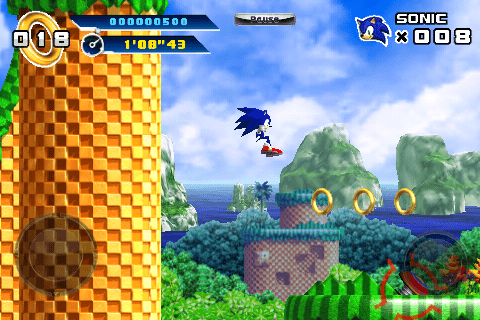
While the visuals on the consoles will always end up being superior to the iPhone, Sonic 4 is no slouch in the graphic department on the iPhone. The backgrounds to each level are well drawn and though stationary, are a nice backdrop to the running hedgehog as he runs through the new acts that come with Sonic 4.

The stages that Sonic traverses themselves are very sharp and though they are throwbacks to stages that have been in past Sonic games they have just enough of a unique touch to make them not feel recycled. Sonic on the other hand could look better graphically, as when he is standing still there is noticeable pixelation on the edges of the character, though how often does Sonic really stand still?

Controls:
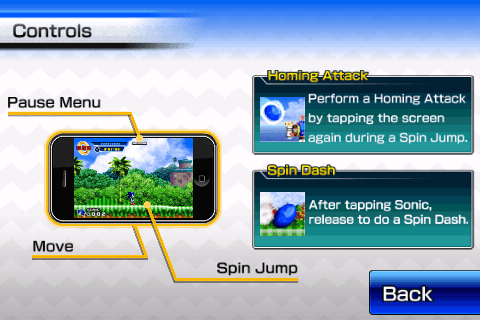
As with any iPhone game, Sonic 4 has the standard touch screen controls, but it also comes with a tilting control scheme. The difference between the two is that with one, the player moves using a D-Pad and jumping with another button, while in Tilt the player tilts their iPhone one way or another to make Sonic move, and jumps with a tap anywhere on the screen.

Unfortunately though the Tilt scheme is more interactive with Sonic 4, it also makes the game harder, this is because Sonic is already sometimes hard to control at top speed, and when you are forced to tilt your phone to move him around, there are times that platforming can be very difficult, and some stages require precise jumping or you will fall to your doom.

Using the Touch controls is much simpler and they are also very responsive which is a must when Sonic is running at top speed. There are a few times in the game that you will be forced to use the Tilt scheme but at least the one isn’t very difficult and actually benefits from this change. The special stages which are reminiscent from Sonic 1 are controlled entirely with spinning the iPhone around in order to control Sonic through the maze to reach the Chaos Emerald at the end.

Gameplay:
Sonic 4 almost feels at home on the smaller handheld that is the iPhone. Sure the console versions are on bigger screens but in the end nothing is lost in translation other than graphically wise.

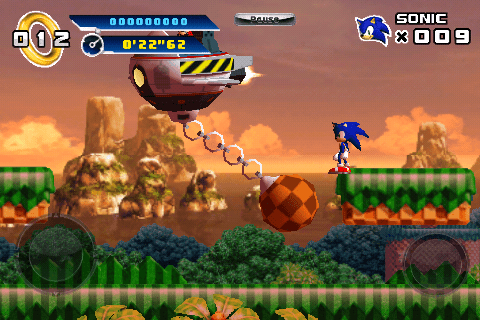
Sonic fans will notice one of the biggest add-ons to the franchise right after they finish the first stage as Sonic 4 now has a world map where you can choose where you want to play at and whenever you want to. Once you finish Act 1 of Splash Hill you will then be able to select any stage that you choose to, and any Act that you choose to at any time. The boss battles are only unlocked after finishing all 3 acts however so don’t think that you can jump to a boss immediately.

This add on is a major help to the game, as since the iPhone is a portable system, players aren’t always able to sit down and play through the Acts straight through without taking a break or something happening to interrupt gameplay. There is a small downside to this however as bonus stages are also available to be unlocked and played through multiple times, receiving a large amount of lives and chances at the Chaos Emeralds.

Another addition to the gameplay is that Sonic now has an air dash attack to lock onto enemies and kill them. This is a great addition to the franchise, though it has been taken from Sonic Adventure which was a 3D game. The iPhone benefits greatly from this add on by making it easier to kill enemies with the touch screen system and to reach areas they couldn’t before because Sonic can also use this to take a boost sideways in the air to reach a platform.

The game itself however is very short, with only four different stages and three Acts each it can be completed within an evening if played all at one time. Though there are a couple of modes of play, Score Attack and Time Attack it is still possible to finish the game quickly enough. There is the added bonus of gathering all of the Chaos Emeralds to unlock Super Sonic mode as well for the completionists in us all.
Then again Sonic 4 is also guilty of padding game time with slow moving parts inside the Sonic game. Yep, slow moving. There is a level within the game that requires players to gather a certain amount of points to advance further in the level, which isn’t difficult, but does upset the flow one would expect from Sonic.

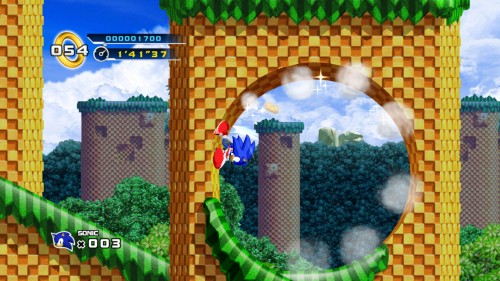
While I’m speaking about flow, the physics have suffered a change as well, and for fans of the franchise it isn’t for the better. The physics now have Sonic stopping immediately once the directional pad has stopped being touched, which means that there is no longer that sense of momentum. He can zip through a giant loop that are trademarks of the franchise, but if the player isn’t pressing the D-Pad exiting the loop, he will stop completely even though he was at top speed a millisecond before. This does mean that Sonic is more controllable, but the way that the physics have changed just feels wrong.

Overall:
Sonic 4: Episode 1 turns out to be a great addition to the franchise. There are plenty of nostalgia moments as various levels and bosses are taken directly from old 2D Sonic games and given a few new add ons to make them different. The physics have changed for the worse, though new players to the series won’t find this an issue. Sonic 4 turns out to be just what fans have been waiting for by bringing the good ol’ 2D Sonic we all fell in love with as children.

8-5-capsules-out-of-10

Every RPG ever – Flowchart

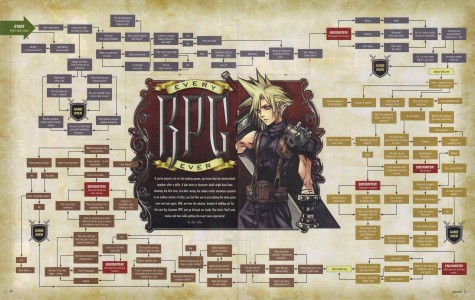
During my daily searchings of the internets, I came across this gem.  I figured the good people who read this site would find it comical/interesting.  In short, this is a flowchart detailing the basic form and premise of RPG’s (more specifically, JRPG’s) as they are quite predictable and cliche in this day and age.

Direct link: http://i.imgur.com/bFeoW.jpg

(note: I found this whilst browsing Reddit, which was in turn taken from Game Informer.  Giving credit where credit is due)

Assassin’s Creed: Brotherhood- The Story

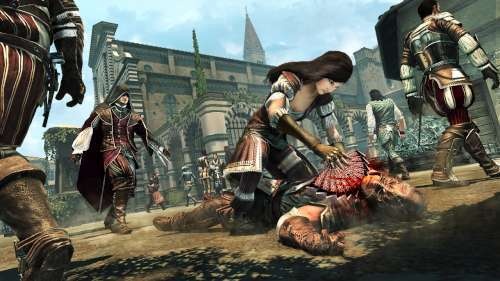
Assassin’s Creed Brotherhood has a new trailer, and it kills!  I have yet to beat AC 1 and 2, but this really makes me want too.  And if this soundtrack is ever released separately, I would buy it.   Take a look at this trailer, and tell us what you think.   Assassin’s Creed Brotherhood will be released November 16, 2010 on PC, PS3 and Xbox 360

Shaun White Tricks Trailer

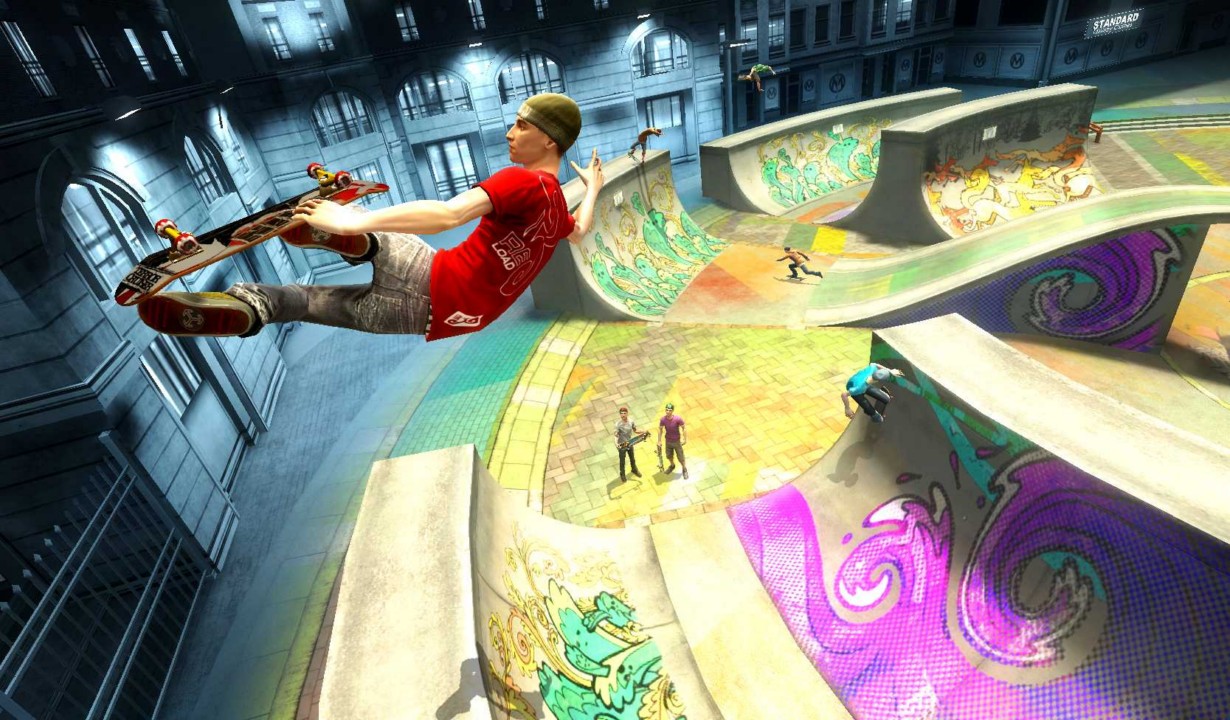
Skateboarding games must have tricks in them (crazy right?) Shaun White Skateboarding is no exception.  This trailer shows off the game’s tricks and controls.  If a game can balance the arcade nature of Tony Hawk, and the hardcore of SKATE, this game has potential.

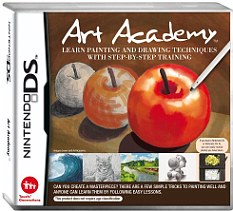
Art Academy Review

Art Academy
Genre: Art Simulation
Platform: DS
Developer: Headstrong Games
Publisher: Nintendo
Released: Out Now

Now, for anyone who has had a go on Pictochat, Flipnote Studio, or for that matter, any of the other software out that involves using the stylus to draw or write: your sceptic feelings are completely justified. I too was highly sceptical when considering whether an art sim could work on the Nintendo DS. With no sensors measuring how hard you are pushing the stylus down on the touch screen, how could the DS possibly formulate a line corresponding to the strength you pressed down? If it couldn’t convey the exact mark you were trying to make, getting the boldness or consistency you were aiming for wrong, how could you even contemplate creating pieces of art? Mark making is essential for artists, and the sharpness of a line can completely transform a piece, which is why it was crucial for Nintendo to get Art Academy right.

Thankfully, they did, and after only the first lesson I had been convinced that the art sim could work. This is down to the large range of resources and materials at your disposal. In contrast to the ’one size fits all’ clumsy stylus markings of other games and applications which have only one setting; bold, Art Academy has you building up lines from smaller, faded lines. This approach of slowly building up from small lines which add up to form a stronger line is supported by the choice of three pencil types you are given: 2B, HB and 2H. Anyone who’s tried some art for themselves will probably already know the difference between these types of pencil, but for those who don’t the arrangement of numbers and letters indicates how soft it is. 2B is a very soft pencil, making it ideal for shading or adding delicate lines and details. The scale then moves on with HB being slightly harder and 2H being the hardest. With the hardest graphite, 2H offers artistically hard and sharp lines, but also quite light ones which means it’s useful for shaping up a framework for a painting, whereas HB is, to put it simply, the safe medium.

The differentiation between pencil types is just the tip of the iceberg, as other clever features help you to overcome the drawbacks of the touch screen technology. Such as the problem of the DS being unable to pick up whether or not you are holding the ‘pencil’ at an angle, a techniques popular among artists that is mainly used for shading. This problem is cunningly solved through a straight-forward pop-up menu, the same one you use to select a pencil, which presents you with a choice drawing with the ‘point’ or with the ‘flat’.

And it’s like this throughout the game. Every time the game is met by a hurdle which makes you wonder how the game will handle it with realism, it bounds over the hurdle gracefully. For instance, paint, a hard substance to master use of in real life at the best of times, behaves realistically from when you mix it in the virtual pallet, to when you apply it to your piece. If anything, it’s been simplified down a tiny bit just because paint is such a hard medium to use -by no means a bad thing. In fact, by making the paint a little less challenging to use, the developers have made the game more accessible and easier to learn from, as opposed to it’s real life counterpart in which no matter what colour you are aiming for, it will always end up brown.

The game is made up of two modes, and both of which possess relatively simple concepts. The first of which is Lessons Mode, which as the name suggests teaches you how to draw and paint using the software, but at the same time educating you on the skills and techniques that can be applied when doing art for real, outside of the game. Although there are no specific instructions beckoning you into the classroom and your mentor Vince, even if you are Wassily Kandinsky himself it’s highly recommended you visit this section before the other mode. Even if you know what you are doing art-wise, it’s still worth a look if only just to come to terms with the software before you move onto the next mode, Free Paint Mode. Again, it’s name is a large giveaway and subsequently, this mode is fairly self-explanatory. Basically, you have a blank piece of paper and are given free reign to sketch or paint whatever you like.

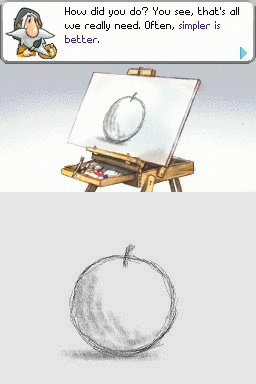
But first, Lessons Mode, a key part of the game where the ‘step-by-step’ training is delivered. You are guided by your teacher, Vince, hardly and arty name, though it is probably meant to have some link with the legendary Vincent Van Gogh, it’s just a shame it couldn’t be something more arty. How does Pierre sound? Anyway, we’ll forgive them because the lessons are present in a basic and linear style, with easy instructions and a tidy control scheme/menu system. It truly is step-by step with Vince taking you through each stage, teaching you not only the game mechanics but techniques applicable to the real thing. He also shows you each and every process by doing each one for himself for you to see, before you give it a go for yourself. The Lessons Mode spans over 10 separate lessons, with each one telling you something new. The save system compliments the lesson structure too, with save points offered midway through lessons, as well as the ability to save manually if you need to stop in the middle of a lesson. While these 10 lessons will fly by, you will learn a lot from them, both about the software and art in general, so in this respect, playing through Lessons Mode is a positive use of time.

However, it is in Free Paint Mode, with the shackles off, that some of the games great added extras begin to shine. Like using the top screen to display a reference picture, a brilliant move by the developers which makes full use of the DS’s dual screen interface. Simply scroll through the game’s image gallery, select a reference image and voila! It appears on the top screen for you to examine as you see fit. But not content with solving both lack of inspiration and lack of a willing subject, two problems artists have been known to regularly suffer from, the developers have included even more bonus features, particularly for DSi owners. Utilising the DSi’s camera, the game lets you take your own photographs and store the scene for future reference when sketching. Combined with how small and portable the DS is, it makes for a great artist’s tool. Not only could you carry it with you and use it to sketch the scene unveiling before your eyes, but if you didn’t have this duration of time to divulge into drawing at that point, you could snap a few pictures and come back to it later.

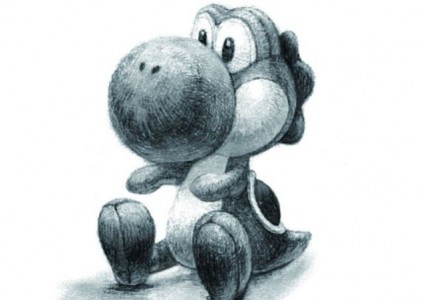
With everything taken into account, Art Academy is a decent game. While the nature of play won’t suit everyone, (with the game’s target audience being those interested in art), it’s a fairly good bundle and almost two things in one: a software application and an art guide. The game is subtly educational , but not to the point where it feels like a chore, teaching you how to use the software, and at the same time expanding your knowledge of mixed media and how to use it, as well as vital techniques and skills used in the art world. It may not constitute doe an expansive art guide, and learning about art on the game should probably be supplemented by a more detailed art guide if you’re serious about picking up art, but for a videogame it’s pretty darn good for learning how to do art. Plus, seeing the masterpieces on the box art should be motivation enough to buy this game and develop a mastery of it. The works of art that this game is capable of creating in the right hands are breath-taking.

7-5-capsules-out-of-10

Pros

  • Simple step-by-step training which helpd you to develop knowledge applicable to real world art
  • Well thought-out controls
  • Capitalises on the DS/DSi’s features
  • Free Paint Mode provides an art studio for endless hours of entertainment

Cons

  • The nature of the game means it’s not for everyone
  • Squeezing your hands around a tiny screen trying to do art
  • Advanced software means Lessons Mode is a must- no pick up and play value
  • Can be text-heavy at times