Capcom has revealed that there will be a playable demo of Resident Evil: Revelations with every purcahse of a Resident Evil: The Mercenaries 3D game. The Mercenaries is set for release on the 3DS sometime in June in Japan and worldwide sometime this summer. This is the first time that a demo will be released complimentary with a game for Nintendo’s hand held and is a good sign of things to come.
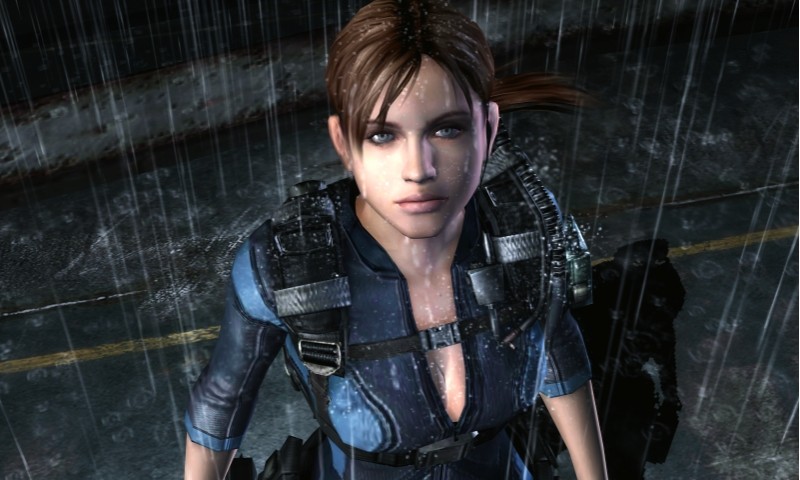
The demo of Revelations will place players in control of player’s favorite Jill Valentine who will be trapped on an ocean liner and of course it wouldn’t be a Resident Evil game if there weren’t plenty of zombies and who knows what else crawling around the ship’s decks. The story will take place before the events of Resident Evil 5 and it is currently unknown if the demo will be available for worldwide purchases or only to US residents at this time.
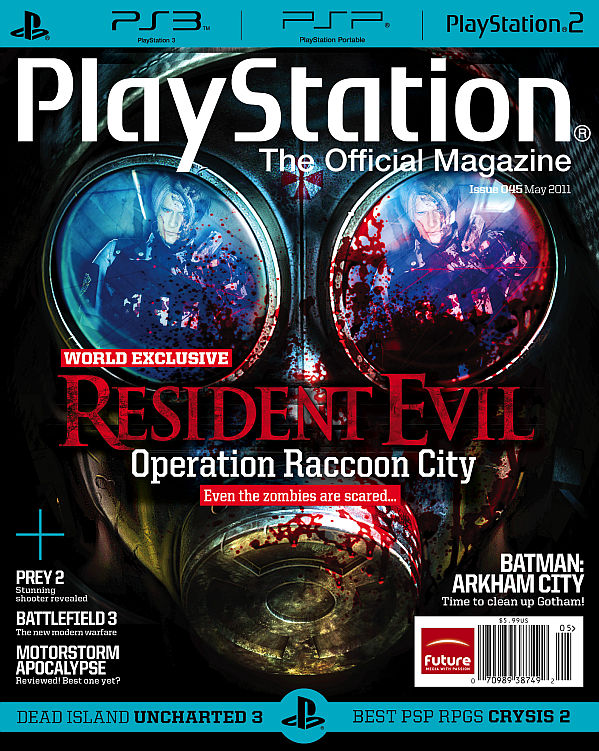
There have been rumors circulating regarding the announcement of a new Resident Evil game and it seems that, after appearing on Xbox Magazine covers and now the Playstation Magazine, that Capcom has finally announced that Resident Evil: Operation Raccoon City will be released during the winter season of this year for the Xbox 360, PlayStation 3 and the PC.
Players will take control of the Umbrella Security Service forces and be thrown into a third person team based shooter that will give players a chance to see the events of Resident Evil 2 and 3 on the side of Umbrella forces. Their job is to eliminate all evidence of a T-Virus outbreak and kill survivors, including it seems Leon Kennedy. Will you be able to rewrite history? We’ll definitely be eager to hear more about the storyline.
Other than that, the interesting news is that Capcom is teaming up with Vancouver based Slant 6 who previously has worked on SOCOM: Confrontation. Also detailed is the multiplayer mode which will place players either as the Umbrella forces or the US Government as well as the undead monsters of course. Check out the latest cover below.
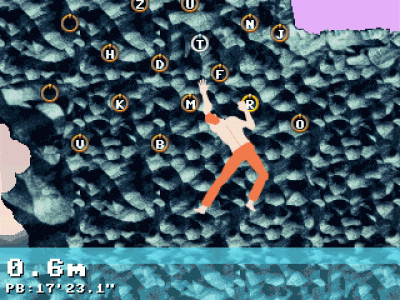
Anyone who enjoys playing flash games online will probably remember QWOP, a flash game simulation of a 100m dash runner where the player must control the individual muscles of the runner’s legs. It gained notoriety on the internet as being nearly impossible to play well and many players uploaded their humorous attempts at making progress on YouTube. The maker of QWOP has now released his next game, GIRP.
GIRP is somewhat of a spiritual successor to QWOP, and it is arguably even more straining on one’s fingers. This time around, the player controls a rock climber, and I use the word control loosely. With one finger you will need to hold down the shift or control key (or mouse button for you masochists) and with your other fingers you will need to navigate Twister style (the game not the Helen Hunt film) around to the appropriate keys. If you don’t mind a few hand cramps, I’d recommend giving it a shot.
While there are plenty of gaming-related podcasts out there on the ol’ interwebz (i.e. series of tubes), it can be hard to find a show that fits one’s personal style. Destroy All Slackers, a gaming and nerd culture podcast, just might scratch that itch for gamers who enjoy both retro and modern games and fart jokes. The show is most certainly NSFW and I would recommend it only to those who are not easily offended, but the comedy is certainly there for anyone who is comfortable laughing at more risqué material. The hosts, Teller and Kris, will usually discuss the week’s gaming news, their opinions on all things nerdy, and in their VS. Destroy All Slackers episodes they interview members of the gaming industry and community.
Guests on the show so far have included legendary voice actor and narrator of Dragon Ball Z, Kyle Hebert (who also provides the intro to the show), voice actor of Dr. Robotnik, Mike Pollock, former Sega composer of Sonic Spinball and Comix Zone, Howard Drossin, and most recently Brentalfloss, the popular video game music parody writer. The show is definitely worth checking out for these awesome interviewees alone.
If you want to check them out, you can either find them at the Destroy All Slackers website or download their episodes on iTunes. If I were to recommend an episode, both #10 and #13, with Kyle Hebert and Howard Drossin respectively provide plenty of chuckles and interesting conversation.
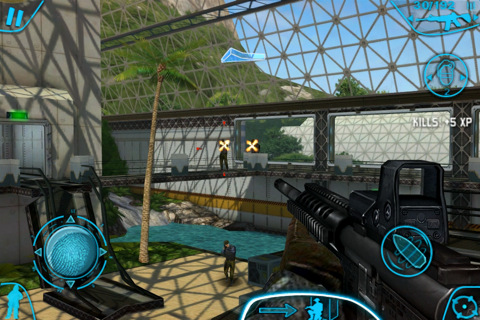
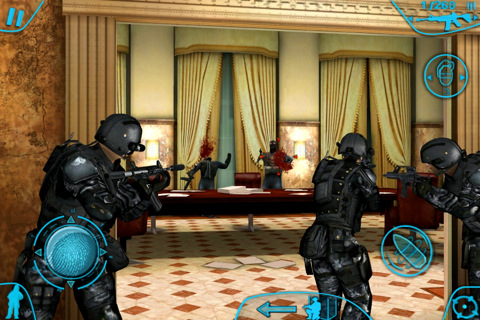
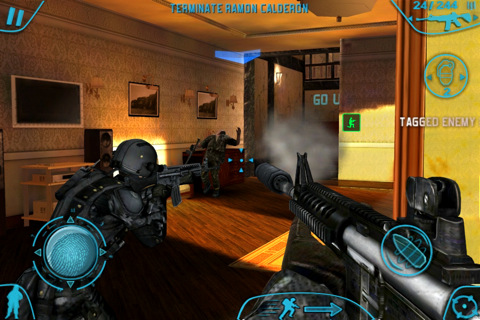
Tom Clancy’s Rainbow Six: Shadow Vanguard Platform: iPhone 4 (Reviewed), iPod Touch, iPad Publisher: Ubisoft Developer: Gameloft Genre: First Person Shooter Release Date: March 17, 2011 Price: $8.99BUY NOW!
iPhone games, like all games can be easily divided into two categories: ones aimed at the casual market and other aimed towards more hardcore gamers. The iPhone seems like the perfect device for casual games, as the lack of buttons and simple touch screen controls make it easy to appeal to all people of all ages. However, there is still a market is cater to that craves for a more than just ‘drag the blocks here’ or ‘tap to pop the bubble wrap’. Recently we’ve seen a genre much loved by hardcore gamers begin to take control of the iPhone device and dominate; of coarse I’m talking about First Person Shooters, many of which are attempting to compete with home console games. However it appears for an FPS game to be successful, it needs to stand out amongst it’s competitors, and in this aspect, Tom Clancy’s Rainbow Six: Shadow Vanguard succeeds and passes with flying colours. As the latest addition to the successful gaming franchise, Shadow Vanguard Implants a unique realistic stealth and tactical element to the gameplay, and easily stands out against it’s competitors, and it’s outstanding graphics, audio and presentation surely gives titles such as N.O.V.A and Modern Combat 2 a run for their money. However throwing so much onto a tiny screen can be overwhelming to some, while others may be craving for a game just like this title. So players must ask themselves ‘how much is too much?’
Presentation
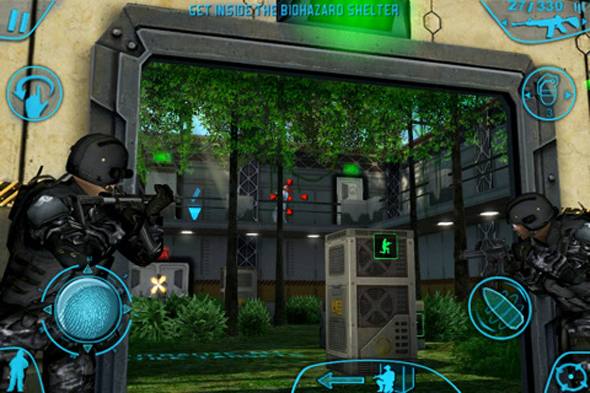
Rainbow Six: Shadow Vanguard is certainly one of the most polished titles on the iPhone device. The cut scenes are to a very high standard, with some of the most impressive voice acting to date on a mobile phone game, presented with details maps and cut scenes with detailed textures and smooth animation. Even the opening menu screen showing off character models and patriotic music really sets the scene and straight away you get the feeling you’re going to play a game that will impress you, and you will. The atmosphere set is next to flawless. Hell, even the loading screen is good, well presented with surprisingly short loading times for such great detail displayed during gameplay. There are a few glitches here and there though, but nothing major. An interesting choice taken from Tom Clancy’s Splinter Cell: Conviction is the stylish inclusion of mission objectives written on various surroundings. This works well and suits the iPhone device perfectly as the objectives are clear and appear in a manner that isn’t distracting from the gameplay. Speaking of the gameplay, it should be noted that the gameplay isn’t perfect, but the presentation of the game in general is done so well that it can be easily over looked. If a glitch or something is to occur, the situation in many cases is saved as it becomes easy to overlook because the atmosphere set by the graphics, audio and design has the player so wrapped up in the game it often becomes easily forgivable.
Gameplay
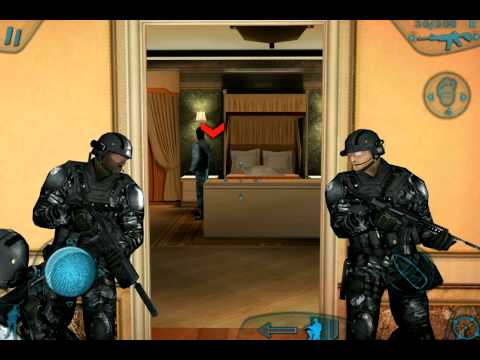
Tom Clancy’s Rainbow Six: Shadow Vanguard plays like a typical first person shooter for the most part, with a few interesting twists to switch up the gameplay. There is a major focus on controlling two NPC’s and devising tactical strategies into combat. At first to many players it can seem overwhelming, but as you go on throughout the campaign it begins to start feeling more and more natural. You can order your team mates to do a variety of manoeuvres that range from ordering a troop to a particular position, clearing a room, throwing flash bangs and disarming bombs. It also contains a heavy on a stealth element to the gameplay, with a few ideas implemented from Tom Clancy’s Splinter Cell franchise. A heart beat sensor shows how aware of your presence so you can take them out with stealth, silence weapons, ‘tag’ enemies to decide who the AI should kill in which order, and use a ‘snake cam’ to see what is behind a particular door and observe where particular opponents are in a room before entering it. Also, your team mates can get injured and will need you to revive them at times, adding to the already rewarding a sense of teamwork in the game.
However control schemes range from perfect to slightly awkward. You begin playing by having to tilt the device in order to move the x and y axis of the protagonist. While it is highly responsive and does feel natural, it really is difficult to control and destroys the feel of the game. Thankfully, you can turn this option off and move the camera by swiping your finger, but this is where the next issue comes into play. The need to constantly drag your finger on the screen will occasionally have you accidently going over the fire button, causing your player to shoot, and sometimes either ruining your stealth or just being a nuisance. Still, this is better than having to tilt the device but it still takes away from the experience. With so many options and icons on the screen to silence your weapon, throw grenades, control stick, fire your weapon, running, controlling the AI, and more, it sometimes feels that too many options are displayed on such a tiny screen at once. It isn’t always a problem, but it can take away from the experience. This problem most likely wouldn’t exist if it was a Mac app, or maybe on an iPad, but this isn’t the case here as it is an iPhone review. Furthermore, a big focus is placed on the games cover system, but it is often difficult to tell what you can use for cover and what you can’t. It is nice how the camera zooms out into third person when this does happen, because it really intensifies the experience.
While many aspects of the gameplay do have a lot of room to improve, what is there does have many highlights that shine quite brightly. The level design is done well and is complemented by it’s story, and once players get used to the control schemes, the game can be a lot of fun. You can zoom in with a tap of a button and sometimes upon getting a headshot the camera will zoom in on your victim. Players are constantly gaining XP for their deeds and it can be used to unlock upgrades which really maximise the gameplay experience, creating a strong sense of accomplishment. The game also contains a great co-op campaign mode which works well, and a death match mode which isn’t as spectacular, but it can be played with up to nine other players if you can find them. Shadow Vanguard may have a few small hiccups here and there, but if the player can look past these and give it a chance they will find that this title is actually a lot of fun, and provides a unique gaming experience that can be very enjoyable.
Graphics & Audio
While the gameplay does involve many unique elements to mix up all the FPS action that is to be commended, the greatest selling point of Shadow Vanguard is the atmosphere created by its outstanding graphics and audio. The cinematography seen in cut scenes are some of the greatest out there on the iPhone device, with outstanding voice acting, although the dialogue may be a little stiff at times, and some of the in-game voices aren’t always of the same high standard. Sound effects are spot on and the graphics are nothing short of impressive. The attention to detail is to be admired with almost every surface covered in luscious textures. The occasional frame rate drop may be seen, but only if the player is looking for it as it isn’t very noticeable, and I suppose it is to be expected with a game of this amazing graphical quality on an iPhone device. Anyone familiar with a typical Tom Clancy game will feel familiar with this soundtrack, expect to feel like you’re an actual covert military soldier, because the soundtrack will accomplish making you feel like a deadly, stealthy bad-ass.
Conclusion
Tom Clancy’s Rainbow Six: Shadow Vanguard is a game obviously aimed at fans of the series from home consoles. It’s a game I’m sure hardcore gamers will appreciate, as it contains a little bit of complexity to it and creates a strong dynamic atmosphere that really sucks the player into the world of the game. Unfortunately these experiences are constantly interrupted by various issues ranging from confusion over where and where not you can find cover, controls that range from great to terrible and sometimes it just feels there is just to many options to take advantage of at once it can feel overwhelming. But stick it out through this and players will find a powerful experience and a great game. It may not be the greatest FPS title on the iPhone, but it almost comes close to titles such as N.O.V.A 2 and Modern Combat 2. A unique game that stands out amongst it’s competitors, Tom Clancy’s Rainbow Six: Shadow Vanguard is a title easy to recommend to fans of the FPS genre.
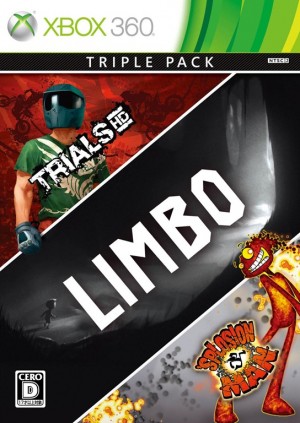
Microsoft’s new XBLA compilation ‘Triple Pack’ bundle will feature three award winning Xbox Live Arcade games Trials HD, ‘Splosion Man and Limbo. For those who missed out on playing them the first time around, ‘Triple Pack’ brings these three award winning Xbox Live Arcade games together on one standalone retail disc. “We understand that there are still many gamers who only purchase games through traditional retailers. Thanks to our partners at Microsoft, all Xbox 360 owners now have a chance to check out the Trials experience, along with two other great games” so said Tero Virtala, CEO of RedLynx the developers of Trials HD, which has sold more than 1.3 million units since its release in 2009.
Microsoft’s ‘Triple Pack‘ bundle is set to be released in North America on April 19, Europe on May 13 and Japan on May 19, for a suggested retail price of $29.99 USD.
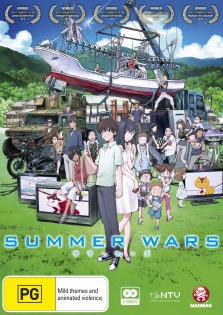
Genre: Comedy, Science Fiction Platform: Blu Ray (Reviewed), DVD Produced by: Madman Entertainment Directed by: Mamoru Hosoda Voice Actors: Michael Sinterniklaas, Brina Palencia, Pam Dougherty, Maxey Whitehead, J. Michael Tatum Running time: 144 mins + extras Language: English dub, Japaneese with English Subtitles Release Date: March 16, 2011 Available At: Madman Online Store,Amazon US, Amazon UK
Kenji is your typical teenage misfit. He’s good at math, Bad with Girls and spends most of his time hanging out in the all-powerful, online community known as OZ. His second life is the only life he has – Until the girl of his dreams, Natsuki, hijacks him for a starring role as a fake fiance at her family reunion.
Things only get stranger from there. A late-night email containing a cryptic mathematic riddle leads to the unleashing of a rogue AI, intent on using the virtual world of OZ to destroy the real world, literarily. As armageddon looms on the horizon, Kenji and his new “family” set aside their differences and band together to save the worlds they inhabit. –Blu-Ray Blurb
Overview
It’s easy to see how Summer Wars is so critically acclaimed. From the award winning director Mamoru Hosoda, Summer Wars contains some very impressive art direction and animation, and any anime fan will easily feel familiar to almost every aspect of the film, and will appeal to a wide variety of audiences regardless of taste in genre. It contains many different aspects of anime one may not ever expect to see within the one film, but it is done so in Summer Wars, and done quite remarkably well. Summer Wars is a must see, preferably own to all kinds of fans of Anime, and is truly a masterpiece in every sense of the word.
Plot
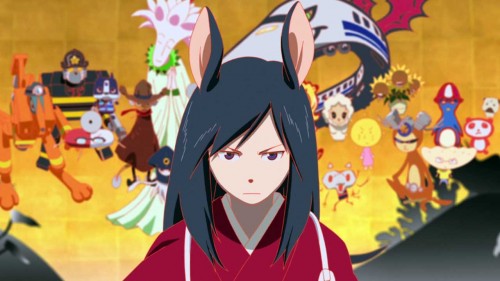
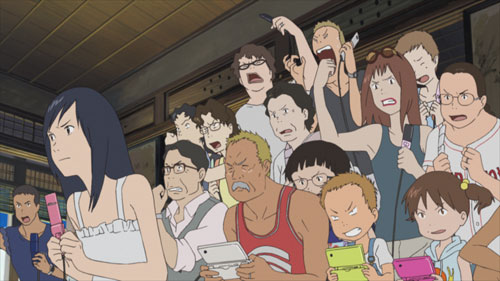
The film begins with an introduction to a social networking system called OZ- a virtual world accessed via mobile phones and computers where you can do almost anything, or buy almost anything, and runs much like an MMORPG video game such as World Of Warcraft, but more popular and accessible to the population like Facebook. We then meet our protagonist Kenji Koiso, a math nerd who does maintenance checks on OZ who agrees to pretend to be a ‘fake fiancée’ to the girl of his dreams at her family gathering. Things get out of hand though when a rouge AI program in OZ known as Love Machine hacks into Kenji’s account and uses it to cause widespread damage in OZ. It begins to spread and eventually becomes a worldwide hazard, hacking into millions of accounts and damaging economies and eventually begins hacking into military bases and firing weapons into the human world. While this is going on, the family begins to realises their true values and beliefs and eventually decided to gather all their OZ accounts together to fight against the wrath of Love Machine.
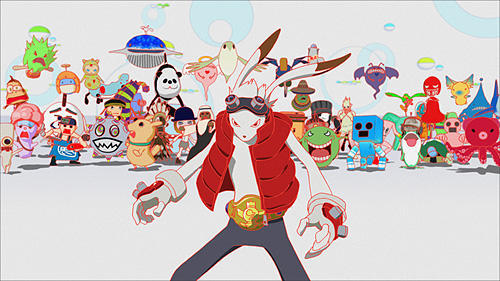
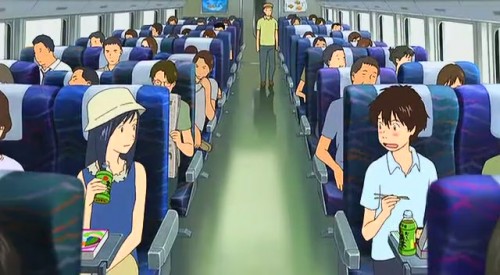
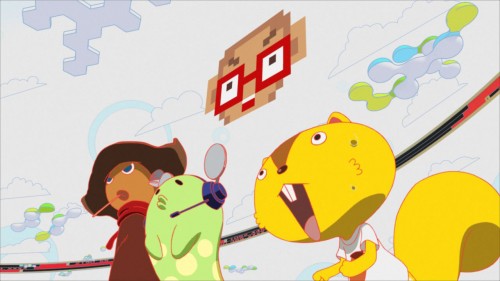
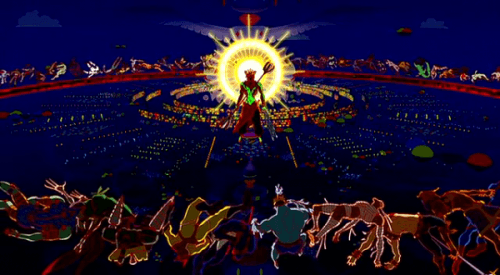
Summer Wars will have a very familiar feel to all fans of anime, regardless of taste in genre. The plot has been done before (Think of the original Digimon Movie, or even The Matrix) but it has a unique twist on combining it with a strong sense of family values and traditional Japanese culture. Jumping between the world of OZ and reality really has two completely separate tones, exploring two completely separate styles of anime. OZ represents a fantasy world where characters can fly, preform superhuman fighting skills and cute animals can talk, while reality has more believable character designs, family dilemmas, comedy, a love story and human emotions. One would think that skipping between these bipolar opposite worlds would be strange, however the script and directing combined makes it feel quite natural and it never seems out of place at all. It would’ve been nicer to see the world of OZ more explored in depth as the main focus is in reality, but its plain to see it was intended to be focused mainly on the character development of characters in the real world. It should be noted there is a scene that looses its relevance and appeal to western audiences based around a Japanese game called Koi Koi. There are a few parts of the movie that make you wonder though, such as why the main family appears to be the only ones fighting the global crisis, while the military appears to not be involved at all, and there are a few plot points and relationships that did have the opportunity explored in depth which never came around. But that’s the beauty of the film, it gets you so involved it leaves you wanting more. At times it does feel that Summer Wars is just taking all the best parts of various anime and throwing them into the same film, but it never feels like a rip off or a cliché, but rather homage, creating a sense of familiarity to the film and making it more appealing to a variety of audiences. Some will enjoy the scenes in OZ more, other will enjoy scenes in reality more, but Im sure most will just enjoy the film in it’s entirety, as it is a really enjoyable plot to follow.
Characters
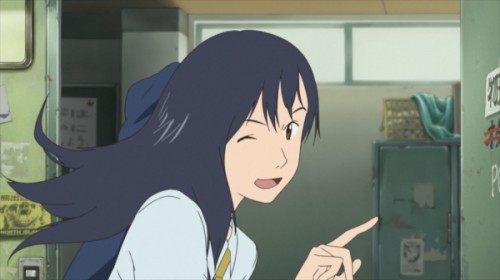
Theres about thirty different characters in Summer Wars, all with their own unique distinguishable personalities. The thing about them that makes each one stand out however is how they all appear to be based on a different stereotype commonly seen in anime, so viewers will easily feel connected to the characters and understand them, and provide variety to the story. Each character is presented well, with excellent voice acting and character design. There are many twists to the plot that will change your views on many characters, so they do keep you interested throughout the film. Almost the entire film takes place within a house filled with almost thirty people so as you can imagine it does provide a lot of dialogue and character development. The large cast of characters however can take away from the individuals and perhaps if there were less members of the household or less focus on them, it would be easier to build stronger emotional connections with other characters. Instead, we see a more ensemble cast, where almost all characters are just as important as each other. This isn’t the case as we do have the grandmother who acts as the movies speaker, often conveying the underlying message behind the film and protagonist Kenji Koiso as the leading role. His love interest also plays an important role and a young boy who acts as the lead warrior/protector. However, this isn’t always so obvious, as the film tries to focus on the family as a whole, and so Kenji, the grandmother and a suspicious uncle seem to be the only characters that stand out besides the antagonist who never speaks a word throughout the entire film. However, this is all to convey a message that working together to defeat outrageous odds, respect for elders, forgiveness and family honour, and it does so effectively, and the viewer really does begin to feel love for the family.
Art, Animation & Audio
What truly makes Summer Wars shine is its beautiful art direction. The scenes based in reality contain an interesting approach, having very basic simplistic character designs yet very detailed a beautiful scenery and backgrounds. The contrast to this however are the scenes based in the virtual land of OZ, containing much brighter colours and a fantasy setting with much more simple settings and much more detailed character designs. The vastness of the internet is truly expressed with OZ’s settings being very open-spaced and appearing to be never ending, while the moralistic values of togetherness are represented in reality with often seeing closed-in spaces such as bedrooms and dinner tables bringing characters closer together. The animation is very fluent and highly impressive. Every movement feels natural and graceful and remains detailed throughout the film. The voice acting in Summer Wars are of the highest standard in anime, featuring many well-known names in the world of anime english dubs, and honestly there’s way too many to name. Pretty much just think of it this way: there’s a pretty good chance that one of the voice actors from one of your favourite anime is in this film. It’s also especially hard to compliment particular performances as they all have done quite a splendid job. The music is possibly the weakest aspect of Summer Wars, but honestly it’s not that bad. It does it’s job quite well and does compliment an already amazing movie.
Final Thoughts
Summer Wars is a must see film for all anime fans. It has something for everybody: a virtual science fiction world, traditional Japanese culture, cute talking animals, comedy, awesome action scenes and good character development. Its great to see that the 2011 Madman English dub lives up to the extremely high standards set by the original Japanese film released in 2009. But don’t take my word on how much of a masterpiece Summer Wars is, check out the list of awards it has received:
A number of staff from the deceased developer Bizarre Creations have got together to form Hogrocket games. Bizarre Creations closed its doors and dispersed on February 18th this year, shortly after owners Activision failed to find a buyer for the studio.
However, Hogrocket games have revealed that developing for the Xbox 360 or other home consoles is just too costly seeing how they have just started it. Instead, they are working on the more modest iPhone/iPad platform given that they are self-funded. At this point in time, their priorities lie with more agile platforms, including the possibility of PC and Mac, although if their efforts prove successful, who knows. Maybe we could see an XBLA title from these guys once they are a bit more established.
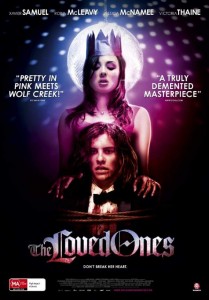
Genre: Thriller Director: Sean Byrne Starring: Xavier Samuel, Robin McLeavy, Jessica McNamee, Victoria Thaine Tag line: “Don’t break her heart…” Running Time: 81 minutes Available:Madman Online Store ($34.95 DVD, $39.95 Blu-Ray)
Overview:
“It’s good… for an Aussie film.”
That unfortunate qualifier is often used when people discuss Australian films. Sadly, even true blue Aussies seem to look down on Australian films simply because of the stigma attached to them, and even worse, the view is often justified.
The Loved Ones is in no sense a bad film; in fact, as far as Aussie films go, (See? Now I’m qualifying it) it’s pretty good. But it does seem to falter in the same areas that many Aussie films do. But please, leave your prejudices at the door, and give it a chance.
Plot:
The story of The Loved Ones is comparable to that of Wolf Creek, or the increasingly awful, increasingly unnecessary Saw series. Thankfully, it’s more subdued than the thirteen-odd hour torturefest that constitutes the seven Saw movies, and much more character driven.
The Loved Ones follows Brent Mitchell (played by Xavier Samuel), a fairly successful high school student, who is asked by Lola (Robin McLeavy), the quiet girl at school, to accompany her to the upcoming school formal. He politely declines, on the reasonable grounds that he is already going with his girlfriend Holly.
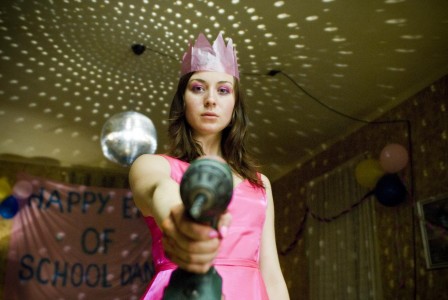
As Brent prepares for the dance, he is ambushed and drugged, and wakes to find himself tied to a chair, dressed in a suit, attending a very different dance hosted by Lola. At her mercy, she will make him fulfil her fantasy prom night, whatever it takes.
The story progresses nicely, avoiding the potential genre pitfall of becoming nothing more than a series of inventive torture methods (I’m looking at you, Hostel). Brent’s helplessness is conveyed effectively; one advantage of being categorised as torture-horror is that the genre doesn’t necessarily require a happy ending. As such, we are never sure during the build up if Brent will survive or not, creating a deepening sense of dread.
The film also never glorifies the violence as others are known to do. Most of the torture happens out of sight, only hinted at or shown briefly, which serves to heighten its impact while drawing attention to the characters.
The film is plagued by the occasional clunky line of dialogue, and it’s difficult to tell if the writing or the delivery is at fault. There also seems to be some “padding”, with events that have little or no connection to the main story being given a large portion of airtime. The opening sequence shows Brent learning to drive, and an accident sees him total the car and kill his father. The story picks up six months later, and besides making Brent a brooding emo teen, the tragedy has little influence over the plot. The scenes depicting Brent’s unexplained cliff-climbing behaviour before the dance, and his friend’s date the same night, feel irrelevant.
Towards the end, the plot begins to hint at the supernatural, and although it isn’t a serious offence, it does somewhat break the believability of the story, which until that point was effective because of its plausibility.
Despite its flaws, the story is emotionally engaging as a whole, relying on well-drawn characters rather than copious amounts of gore.
Characters:
The true star of the show is Lola, lonely, unhinged and more than a little psychotic. Her character is given the richest personality, and more is revealed about her during the course of the film than any other character. Her reasoning for the kidnapping and torture become clear, and despite the terrible things she does, you can’t help but feel a little sympathy for her.
Her father is also an interesting character, and while not much is expressly told about him, his actions hint at a history, for him and his daughter, that we can only speculate on. It becomes clear that the father/daughter relationship is just as disturbing as the scenes of torture.
Comparatively, the protagonist Brent is fairly underdeveloped. Beyond a belief that he truly doesn’t deserve what happens to him, it’s difficult to identify strongly with him and as a result, much of the impact may be lost. He never has a lot to say, so we never feel very close to him. After his father’s death, he becomes a quiet, brooding young man, and soon after being kidnapped, his vocal chords are deliberately damaged to prevent him from screaming. Unfortunately, this also prevents him from developing as a character, and his changes through the film are strictly physical, the results of torture.
With that in mind, kudos must be given to the actor Xavier Samuel for managing to communicate a range of emotions with various screams and grunts.
Soundtrack:
Normally, I’m not one to pay particular attention to the soundtrack of a film, but that of The Loved Ones stands out. The song choice contributes much towards the audience’s understanding and enjoyment of the film.
During Brent’s driving lesson at the beginning, his father plays the Little River Band song, “Lonesome Loser”. The upbeat, innocent sound of the song is a good fit for the opening scenes of the film, when everything is fine, while obviously foreshadowing later events.
At several points, Lola sings or listens to Kasey Chambers’ “Not Pretty Enough”, a fitting theme song for her. It’s appropriately introduced at a time when things are becoming unnerving, and the lyrics communicate Lola’s underlying insecurities perfectly.
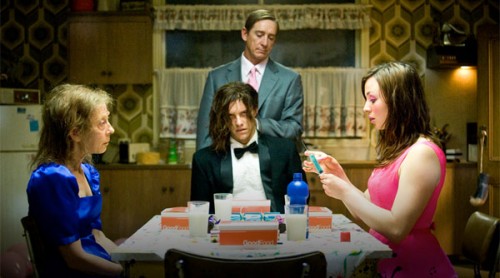
The background music is kept sensibly low, with appropriate points of interest. One particularly fine example comes at a time when Brent, tied to the chair, has not yet been subjected to any physical harm. On denying Lola’s advances, her father calmly places a hammer on the table. This small action is accompanied by a short, sudden spike in the music’s intensity, conveying an ominous, subtle sense of panic as Brent eyes it off.
DVD Extras:
On the disc are the usual extra features, such as cinematic trailers, director’s commentary, stills galleries, and the like.
The standout features include the director’s previous short films, Advantage and Ben. Both are in a similar vein to the main feature – disturbing, character-driven stories, and are quite good, if not slightly confusing.
Of particular interest is a short behind-the-scenes documentary, dubbed “The Super Awesome Featurette: A Runner’s Story”. From the perspective of an oft-overlooked crew member, the piece follows the runner Tommy, as he buzzes around the set bothering people with his phone camera. It’s an entertaining look into the processes of filmmaking. One scene has Xavier Samuel (Brent) and Robin McLeavy (Lola), in full bloody makeup, drinking coffee and mucking around with each other and Tommy, in jarring juxtaposition with the film. Definitely worth a look.
Overall:
As I started by saying, we shouldn’t let our assumptions about Australian cinema as a whole cloud our judgement of individual films. Whether or not you enter into the film with that kind of negative generalisation in mind, The Loved Ones will deliver a satisfying experience on most levels, despite some setbacks in undeveloped characters and irrelevant subplots. The film’s most noteworthy success is its navigation of the territory of torture-horror, while expertly avoiding the immature trap of “torture porn” that the likes of Saw and Hostel succumbed to.
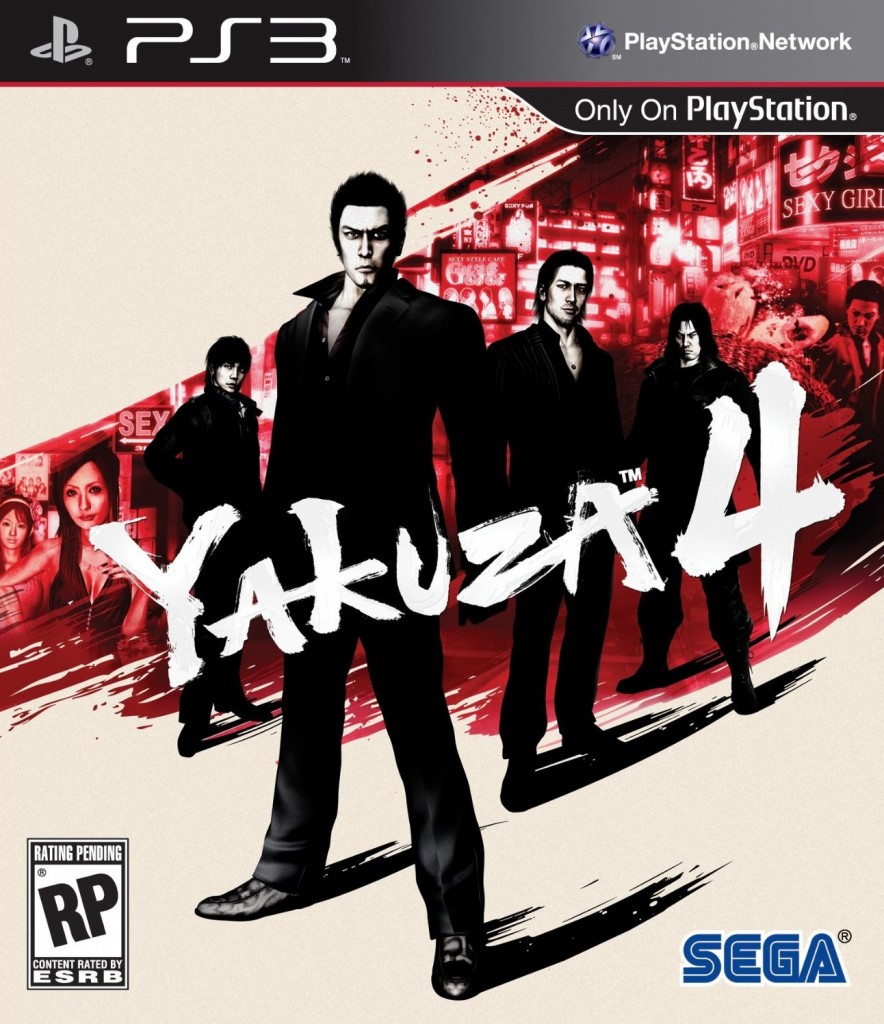
Yakuza 4 Publisher & Developer: SEGA Platform: PlayStation 3 (Reviewed) Release Date: March 15th 2011 Price:$59.95 US , £49.99 UK, $99.99 AUS
Overview:
The Yakuza franchise is something of an oddity in the world of games today. The series has an extremely large following in Japan and despite nearly the whole series featuring only Japanese voices with English subtitles has accumulated a large following overseas. The Yakuza franchise may only be around five years old but SEGA brings us Yakuza 4 and with it a few changes to the formula and plenty of new things that we have yet to see in an international release. The question is, has enough been changed between Yakuzas to make Yakuza 4 stand out on its own?
Story:
Yakuza has always been a game with a very driven storyline that brought it many of the fans it has today. Of course the most recent game, Yakuza 3 only had players taking control of Kazuma Kiryu but this time Yakuza 4 lives up to its name in more than one way. Rather than having only one protagonist the game instead has four different heroes that take the stage at different times in the story.
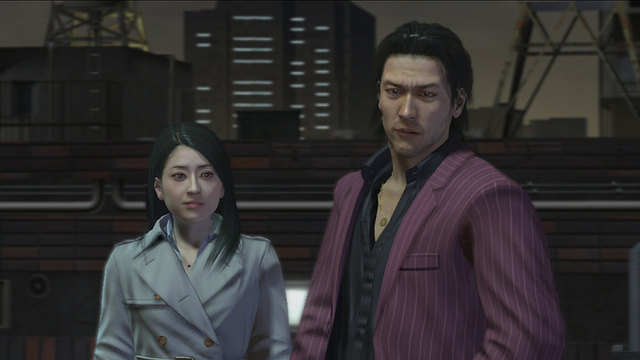
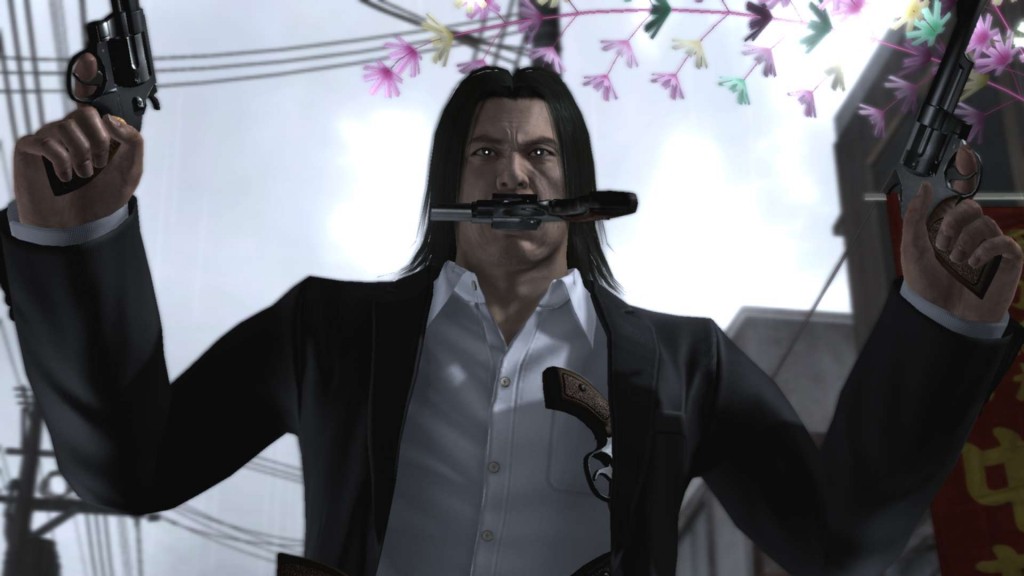
Players will step into the role of Shun Akiyama, a loan shark with mysteriously charitable loans, the recognizable Kazuma Kiryu of course, Masayoshi Tanimura a cop who has corrupt ties to the underworld, and Taiga Saejima, an ex-Yakuza hitman who is finally out of jail and looking into a case of his own. It is worth noting that newcomers to the series shouldn’t feel too worried about jumping in to the series because there are a number of videos that explain key plot points for the first three Yakuza games.
Each of these four characters has their own separate storyline which weave into one another’s throughout the actual game itself but the direct correlation between these stories is only noticeable near the end of the game when everything starts to intertwine. The best part of a story however isn’t the ending, but the journey and that is certainly what Yakuza has in spades. The stories are complex and emotional with plenty of twists to leave the player guessing as to what will really happen next. Which means of course that you will find it hard to put down your controller simply because you want to find out what is happening next. That is until you stumble upon the character’s side stories of course.
Each of the four characters has their own separate side stories to go along with their main storyline. For example Akiyama has the ability, being as he owns his own Cabaret Club, to scout and train girls to be Hostesses in his club. This feature as well as the other side character’s missions, which include training a fighter, gang battles and police disputes not only help tie-in to the character’s personality but provide plenty of things to do in Yakuza 4.
A story is only as good as how it is told however and unfortunately Yakuza 4 has a few setbacks in this department. The story is told through various voiced cutscenes that pop up here and there, but unfortunately everything else is not voiced and instead is delivered as text boxes. There are a few occasions where the game will cut from a cutscene, into a few text boxes, and then return into a cutscene with zero actual change. This means that players may find themselves a bit bogged down at times with text and will have to watch out for skipping important information as they tap away at the X button which feels like something that should have been left in the past many years ago.
Graphics:
Like past games Yakuza 4 takes place in Kamurocho which is based on the real world Shinjuku’s red light district. Shades of Yakuza 3 are everywhere in the game and it is quite obvious that plenty of the environment will seem maybe a bit too familiar as you travel through the streets. So familiar that it feels almost confining despite the addition of a handful of new areas such as the rooftops, back alleys and sewers to explore. One thing I did notice however was the inclusion of bits of Japanese culture included which may not appear familiar to the average gamer but when I noticed a billboard on the rooftops of popular website Nico Nico Douga it was a nice realism tie-in as well as other various Japanese websites sporadically placed around the city.
Despite a mostly recycled environment the characters themselves have top notch expressions and considering the vast narrative that Yakuza 4 tells this is a must. SEGA has utilized something known as Cyberware 3D scanning technology and Magical V-Engine which has allowed the characters to have realistic looking facial emotions and responses to the story giving them a more realistic feel. When cutscenes can reach up to being ten minutes long easily without a break this helps smooth out what sometimes can be a bit too long of a break from gameplay.
Audio:
Earlier I mentioned that the story is divided into spoken word through cutscenes and written text for everything else. Unfortunately the game itself does not have an English Dub so that means that all of the voices are still in Japanese and the only way to understand what they are saying, unless you know Japanese of course, is to read the subtitles that are displayed under the cutscene itself. In the end it means that there is sure plenty of reading involved.
Regardless of the reading however the Japanese voice casts sound splendid and the voices accurately match the character they are playing as with no oddities mixed in. The game’s background music is mostly forgettable except for a few areas with interesting music such as the Cabaret Club.
Gameplay:
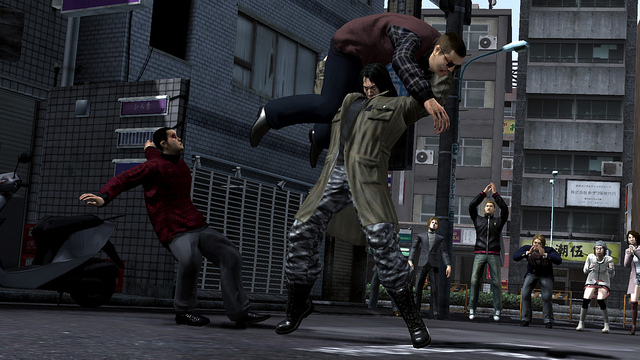
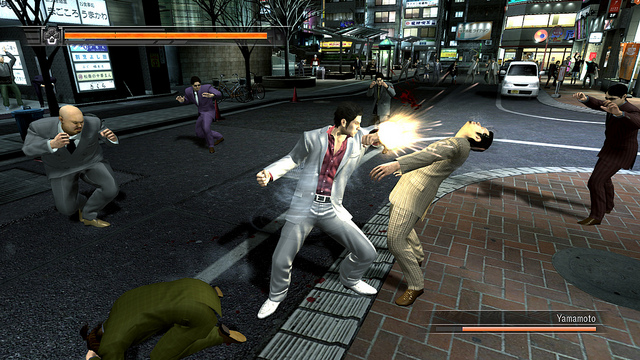
As you walk around the streets of Kamurocho you will find yourself in quite a lot of fistfights. The majority of combat takes place through fists alone with guns being a rarity. Well… fists and anything you happen to pick up off the street that is. Combat has been made a bit smoother since the last iteration of the series and this is evident with how easy it is to string together combo attacks and leave your foes in a bruised and blood pulp on the ground.
As you pound away at the enemies you will fill up a Heat Meter which will allow your character to perform brutal finishing attacks ranging anywhere from a punt kick to the side of the face to using whatever weapon you picked up in a very painful fashion. My favorite is the sword finisher which you will have to find out for yourself. The final blow of any battle is done in slow motion to emphasize the finale of the fight. Afterwards you will be given experience points that may level you up and give you the chance to unlock more skills.
Of course there is more than fighting to be had on the streets of Kamurocho. Lots more. Characters can heal up by buying food or drinks of all kinds from many different minimarts that are surprisingly well detailed and also partake in perhaps one of the game’s many sidetracking options. Players can choose to enter arcades and play claw machine games or even games within the game itself, as well as pachinko parlors (a slot machine type gambling game).
One of the more noticeable and perhaps best mentioned diversions from the main story is the inclusion of the cabaret clubs to Yakuza 4. Originally censored from the Yakuza 3 release this is the first time gamers outside of Japan will get to access these for the first time. In this mode the player can, by playing as Akiyama, you can change everything about the girls you are training to be the No.1 hostess from her hairstyle, clothes, how much makeup she wears and more. As any of the other characters, or even as Akiyama, you can choose to instead spend time with the various girls at the clubs.
Cabaret Clubs (another name for hostess or host bars) are places in Japan where clients can spend time with girls (or guys depending on the club). There is no nudity involved in the game or likewise as the girls are mostly there for the character to either get a massage from or talk to and try to romance each of the girls.
With the large amount of distractions and side missions that can be done there are a ton of things to do in Kamurocho outside of the main storyline. Players can gather locker keys to unlock lockers around the area and get the items inside, train or romance the hostesses, train fighters and even more which adds plenty of length to this already lengthy title.
Overall:
Yakuza 4 has it all upfront. A few new additions to the series which we have never seen before, a new deep storyline with four different characters’ lives intertwining around the events and even plenty of distractions from the main quest. On the other hand, much like most dealings in the underworld, it all is a front for the fact that the game feels dated with the very familiar environment and the fact that despite a great Japanese voice cast, much of the game is unvoiced and relies on plain textboxes.