Nevermind that June 7th release date that EA and Suda 51 announced a few months back for Shadows of the Damned. In an event in San Francisco, Grasshopper Manufacture announced that the game will instead be seeing a June 21st release. This place sit two weeks after the original release for unknown reasons. But two weeks of extra polish is always a good thing, if that is what this delay is for.
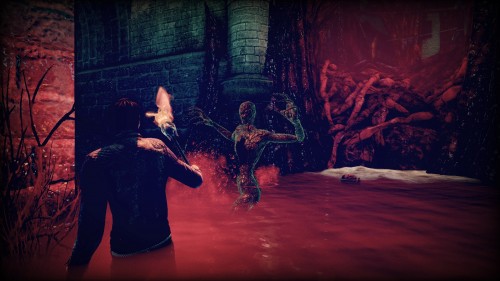
Shadows of the Damned is going to be a very bizarre third person shooter with plenty of horror themes. The names on the development team lead to quite a strong backing already with Shinji Mikami, Suda 51 and Akira Yamaoka being on the team. Meaning that fans of any of those men should already have their money in hand for when the game releases, despite Alice: Madness Returns, another horror based game, being released shortly beforehand.
Looks like Mario & Sonic are going to be teaming up again to bring children the Olympic Games this year, or perhaps next year as no release date is currently known for the title. But either way this is now the third Mario & Sonic Olympic Games game ever since they started the franchise back in 2008. The logo above for the game also contains the London Olympic Games’ logo above it.
Mario & Sonic at the London 2012 Olympic Games (long name) is going to be released for the Wii and most importantly for the 3DS. There will be new events added to the Wii edition of the game including soccer and horse riding as well as something called Dream Events. The 3DS version of the game unfortunately has not seen any actual game announcements but will contain over 50 different events that can be played. It will be interesting to see this family friendly game on the 3D handheld when it arrives some point in the future.
One of the most interesting things about Prototype 2 was the fact that for some reason or another the protagonist changed. Instead of playing as Alex Mercer you will be playing as James Heller and in the latest video the developers explain why that is. Because nothing says overpowered enemy like one that you created yourself.
The video explains that James Heller lost everything in his life, including his family. Now he has been infected by Alex Mercer himself and is out for revenge against Alex. Besides the story explanation we also see some pre-alpha footage of the game. It most certainly is pre-alpha because the game isn’t even slated for release until some point in 2012.
If you turned on your Playstation 3 or your PSP today you may have noticed that the PlayStation Network is down at the moment. Both SCEA and SCEE have acknowledged the problem and have stated that the PSN is down for maintenance at the moment. Though due to the fact that this was not announced and only mentioned after the system went down, it means that other circumstances are involved. They recently released an update that the PSN will be down for either one or two full days before the service is up and running completely.
The exact reasoning for the outage is unknown and it also comes at a very unfortunate time as both Portal 2 and Mortal Kombat released on Tuesday of this week. Meaning that if you wanted to play with your friends on the PS3 then you are out of luck at the moment. We will keep you updated if any more news is released by Sony about these outages.
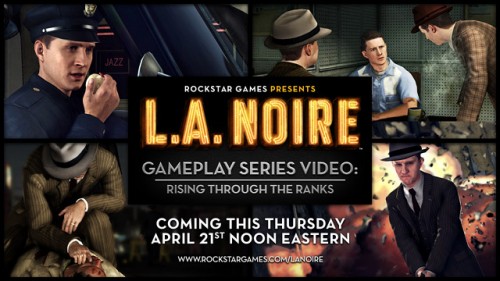
There’s now less than one month until L.A. Noire is available for PlayStation 3 and Xbox 360 (May 17 in the US, May 20 in Europe and Australia).
L.A. Noire’s latest gameplay video, “Rising Through The Ranks”, takes adeeper look into the world of Detective Cole Phelps, and the various partners you will work with as you rise through the desks of the LAPD. The video outlines the game’s ranking system, the use of ‘Intuition Points’ to help solve a case, and provides information on how to tackle street crimes or ‘Unassigned Cases’. The video is created entirely from in-game footage. L.A. Noire will release on Playstation 3 and Xbox 360 on May 20 in Australia and New Zealand.
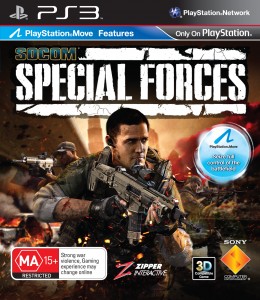
SOCOM: Special Forces arrived on the PlayStation 3 yesterday, the latest instalment of the multi-million selling, critically acclaimed SOCOM franchise. In this title, player pick up their guns as an elite commando unit on a covert operation in the depths of Southeast Asia, with just six days to capture the leader of a militant terrorist organisation known as Naga, which is attempting to destabilise the global economy. Players get the latest high tech weaponry, intelligence and air support at their disposal and it is exclusive to the Playstation 3. With intelligent AI, a major focus on teamwork and issuing strategic orders and stealth, SOCOM: Special Forces comes with 3D support and Playstation Move features, as well as a deep online multiplayer mode, with co-operative multiplayer, including options such as custom missions and the ability to create your own co-op campaign. Are you ready to take command? Expect a Capsule Computers review soon!
Sony Computer Entertainment Australia also announced the following today, and it’s sounding pretty cool!
Ever wanted to see your face in your own personalised videogame trailer? Now’s your chance, so grab your webcam soldier, it’s time for you to move into the action. What are you waiting for? Visit ‘SOCOM Warface’ at www.facebook.com/PlayStationAU
I dunno about you guys, but Im picking up my webcam for this, and while Im at it, I might grab a copy of SOCOM: Special Forces as well!
Here’s this week’s releases which go live this Friday:
(Go Series: Tower of Deus, Nintendo DSiWare, Gamebridge , 200 Nintendo DSi Points)
(Valet Parking 1989, Nintendo DSiWare, Zordix, 500 Nintendo DSi Points)
(Ubongo, Nintendo WiiWare, Korner Entertainment, 800 Wii Points)
Anything of interest to you all this week? It’s not a particularly interesting release schedule, that’s for sure. Ubongo is a puzzle game based on a board game popular in much of Europe in countries like Germany and Sweden, Valet Parking 1989 sees you direct cars into their parking spaces with your utmost precision, and Go Series: Tower of Deus is a simple 2D platformer. Will anyone be picking any of these up?
Warner Bros. Interactive Entertainment today announced that Ryan Neal, 18, from Bury St. Edmunds, won both the UK and European Mortal Kombat Tournaments, bagging himself an Arcade Machine, Championship Belt and trip to Chicago to visit NetherRealm Studios, developer of the game. Congrats Ryan, undoubtedly a deserved winner, fending off competition and securing himself some fantastic prizes in the process.
Taking place at the UK’s largest consumer electronics show, ‘The Gadget Show Live’, the competition was held in front of thousands of gamers at Mortal Kombat’s spectacular ‘Fight Arena’ stage in the Over 18 Gaming Zone. Players entered by participating in qualifying rounds taking place throughout March and April at various gamestation and GAME stores throughout the UK.
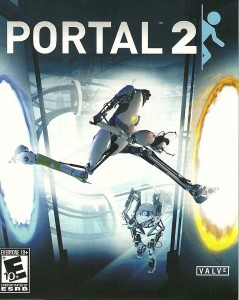
Portal 2 Developer: Valve Publishers: Valve & EA Genre: First-Person Puzzle/Platformer Price: $59.99 (PS3, Xbox 360) $49.99 (PC) Platform: Xbox 360, PS3 (reviewed version), PC Buy Now ($64.90) US Buy Now ($92.00) AU
The original Portal was a masterpiece of game design. Featuring puzzles which ranged from clever to damn-that-was-clever and comedy blacker than any mesa, it offered gamers a short but sweet trip through Aperture Science’s Enrichment Center. On top of all that, it was also initially released alongside Half Life 2 (and its episodic expansions) and Team Fortress 2, making it a part of one of the best deals ever conceived. This gives Portal 2 a lot of high expectations to live up to. Can the formula behind Portal be expanded for something even greater? Can it stand on its own as a full-price retail release? Will it be plagued with sequel-itis? Here’s the rundown.
Story:
Portal 2 actually features two entirely separate campaigns, one for the socially maladjusted single-player type, and one for the overly dependent cooperative types. While these two tales are tangential to some extent, players won’t know how exactly they tie into one another until they’ve completed both.
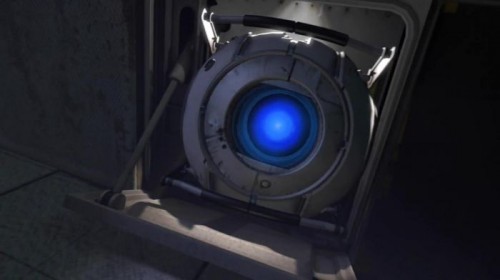
The single-player campaign stars Chell, the protagonist of the first game, who has been in stasis ever since a Party Escort Bot recovered her following the ending of Portal. Upon being awoken, Chell finds herself in what looks like a cheap hotel room as a robotic voice guides her through a standard exam to check for side effects to the hibernation. Shortly after, she is put back to sleep only to be roused once more by the delightfully awkward (and delightfully British) voice of Wheatley. Wheatley is a robotic personality sphere who wants to help Chell escape from the facility. A significant chunk of time has clearly passed since you went to sleep as the cheap motel room has become quite dilapidated and the “relaxation facility” is in a state of meltdown (hence your current escape plan).
Wheatley definitely does not remind me of Guilty Spark. Nope, not a bit.
Unfortunately for Chell, this escape takes her right back to the enrichment center where she needs to recover the Portal gun in order to get out of the Aperture facility. During this trek our duo stumbles upon the deactivated GLaDOS, and through a mix of incompetence and circumstance turn her into a reactivated GLaDOS. From here on out the science-loving, fake-cake-offering dictator of the enrichment center is back in charge, sending Chell through a series of increasingly deadly tests. Meanwhile, Wheatley attempts to find a way to get Chell and himself to safety and shut down the test-obsessed bot once and for all.
While this is as far as I can describe the story of Portal 2 without letting slip some heavy spoilers, I will say that there is much much more to it than this. This sequel is far from just a retelling of the original and will offer players a first-hand look at the history of Aperture Science, its deranged founder, Cave Johnson, and the loveable GLaDOS herself. It will also include potatoes, a bird, deadly deadly neurotoxin, and a bit about the moon. If that sounds like it makes no sense, just play the game. I promise it’s excellent.
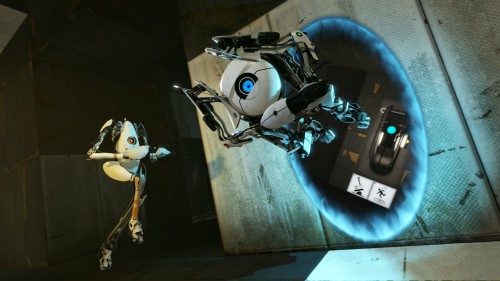
The coop campaign features Atlas and P-body, two cooperative testing units who were designed to run through specially designed enrichment center facilities that no fleshy meatbag could have hoped to solve. GLaDOS guides them through these tests as training for their real mission: to find and rescue a vault full of humans. There isn’t much more to it than that. Atlas and P-body simply go through chamber after chamber solving tests and helping GLaDOS recover “unimportant” blueprints and pass codes that don’t really mean anything. I’m sure it’s all entirely innocent, right?
While it may sound barebones, there is a lot of humor in the coop campaign as GLaDOS praises one partner while reprimanding the other, or offers backhanded compliments and insulting comparisons to the imperfect human test subjects these two were designed to replace. The ending is equally entertaining when players finally reach the conclusion of Atlas and P-body’s journey and are greeted with a credit sequence to rival Still Alive.
P-body (left) and Atlas become the best of buddies throughout their campaign.
Gameplay
In order to describe the gameplay of Portal 2, it is important to talk about what has been added to the original formula. The things that have been carried over from the first game, the portals, momentum flinging, buttons, cubes, turrets, all still function in the same basic way as they did previously. The new elements to the puzzles, however, will drastically change the way players will be thinking with portals from now on.
One addition, which is actually more of a substitution, is the use of lasers in Portal 2. These can be reflected and redirected using mirror cubes in order to activate parts of a puzzle or to burn away certain obstacles. These seem to have replaced the energy balls from the original Portal which would often bounce around a chamber out of control and end up murdering the player thanks to a misplaced cube. These new “thermal discouragement beams” won’t kill a player immediately, but will simply knock them back a little to keep them from passing. The aptly named aerial faith plates will launch players across a room like a catapult, sometimes toward victory, other times toward certain death.
Also added to Portal 2’s arsenal of tests are the hard light surfaces, which can be used as bridges to walk across or shields from turret fire. These are essentially beams of light which the players can traverse when the need arises. The excursion funnel, another new testing apparatus, is a gravity field which will slowly move players (or objects) in whatever direction it is aimed. The combination of these elements offers some really surprising test chambers and allows for segments which can be equally mind-blowing as a player’s first experience with portals.
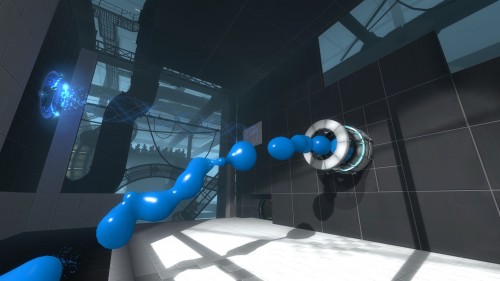
Finally, the last additions to GLaDOS’s toolbox of testing equipment are the gels. Repulsion, propulsion, and conversion gels can all be used in conjunction with one another in order to reach one’s destination. Repulsion gel (blue) acts as a trampoline-like surface which will allow for higher jumps or enable the players to bounce off of walls. Propulsion gel (red) reduces static friction and allows for inhuman running speed. Compared to these two, conversion gel (white) may seem a bit boring at first. It will convert any surface onto which it is painted into a nice blank canvas for portals. While it’s not quite as exciting as running faster than a speeding bullet or leaping tall buildings in a single bound, it proves quite useful when you’re given the ability to paint an entire room with portal-ready surfaces.
Repulsion gel is just one of the new game-altering mechanics in Portal 2.
The difficulty in Portal 2 is curved perfectly, starting out with simple explanatory puzzles which will introduce new elements throughout the game. Towards the end, some of the puzzles are devilishly tricky, and there were several rooms where I was forced to sit and think for a good deal of time. Other times, the answer was all too simple but I was off on the completely wrong track. Much like the incinerator escape segment from Portal 1 where I didn’t know how to open doors so I spent about an hour attempting to portal fling myself hard enough into one to bash it open, when your mind is trying to find a spot for a portal or the right place to put some repulsion gel, often the simplest answer eludes you.
On coop as well, the difficulty will ramp up in each section as you get used to the new tools that are given to you. I personally played through the coop campaign first and while I don’t think it really makes much of a difference, I would probably recommend doing it that way if you can. The reason for this is that during the coop campaign, GLaDOS explains the gels, discouragement beams, hard light surfaces, and excursion funnels as you encounter them, whereas the single player campaign does less hand holding and expects you to figure out each new element. Really the game can be played in either order as the basics of these devices are easy enough to figure out while the advanced techniques are always difficult to master.
The only thing missing from the game is the inclusion of the advanced chambers and challenges from the first game. These challenge rooms would increase the difficulty significantly for each test or task you with completing a chamber using the least portals, footsteps, or time. In Portal 2, you can replay each chapter of the game from the main menu and they still offer the option of adding developer commentary, but there is no hard mode or advanced stages to be seen. The game still maintains a good deal of replayability, and players can challenge themselves or their friends to master each level, but there is no built-in way of tracking such things.
Excursion funnels acts as a force which can move things through portals.
Presentation:
The graphics in Portal 2 are pretty much what you would expect from a AAA title on the current generation consoles. The clean white interiors of the Aperture enrichment center are now stained and aged, with walls falling down and plants growing where the facility has been neglected during your years and years of hibernation. Without GLaDOS to keep things running smoothly, Aperture Science has pretty much gone to hell. You know, more so than previously. The textures and gritty detail is more reminiscent of Half Life 2’s City 17 than the testing facility of Portal.
The animation is excellent in Portal 2, and while Chell is the only human around (and is mostly invisible except for the rare peek you’ll get through your own portals), the robot inhabitants of the enrichment center all move realistically, with tons of moving parts and rotating spheres. The facility itself also features some smooth animation where GLaDOS is literally rebuilding the place before your eyes. Panels will shift around in order to create a ramp or to fix a wall and the robotic arms supporting them will struggle after years of inactivity. Of equal quality although quite opposite are the times when parts of the facility are destroyed, as untended supports fail or machines malfunction. Watching a floor collapse beneath you or a walkway crumble under the weight of a toppled pillar is rather impressive.
The sound team at Valve that was behind Portal 2 really did an excellent job of bringing the facility and its robot workers to life. One small touch which I really appreciated were the unique sounds which would play while you were using some of the test elements. Aerial faith plates, propulsion gel, and repulsion gel each have a sort of subtle theme that plays while the player is interacting with them. This adds to the soundtrack’s ambient score by reflecting your actions through sound. Some puzzles also add layers to the soundtrack as a particular test chamber approaches completion, especially in chambers where there are several devices that need to be activated at once. This gives players and audio cue as to how close they are to finishing a test, and a small aural reward once everything is in place.
Lasers now activate puzzles in the clearly deteriorating Aperture enrichment center
The voice talent of Stephen Merchant as Wheatley (who also co-directed the British version of The Office, talk about talent), the eternally gruff J K Simmons as Aperture’s founder, Cave Johnson (probably best known by gamers as J Jonah Jameson from the recent Spiderman films or by me as Mac MacGuff from Juno), and Ellen McLain as the delightfully deranged GLaDOS (McLain, apart from singing opera, voices Team Fortress 2’s announcer and the combine overwatch in Half Life 2) all provide fantastically comedic performances. The humor in Portal 2, much like in its predecessor, is delivered entirely deadpan and is unapologetically dark. After the fourth time GLaDOS calls you fat it still doesn’t lose any of its charm.
Finally, fans of Still Alive, the closing song from the first game, will be pleased to hear that Johnathan Coulton composed a follow up for the single player credits of Portal 2 which matches both the catchy tune and the wit of Still Alive. The coop campaign also gets its own ending credits, with its own little surprise for players.
Final Thoughts:
Portal 2 is absolutely superb. I had very high expectations for the game because of the success of its predecessor and as the release date approached I was becoming increasingly prepared for disappointment. It was completely surprising, however, that Portal 2 was right on the verge of surpassing the original. The feeling of surprise and wonder that was first offered by flying through Portals may have faded, but an equal feeling of wonder is here in the presence of all of the new additions. Valve has really changed the ways in which you can play the game by adding all of these new modifiers to the basic portal-cube-button formula. The story has its own share of surprises and everything comes together to create one spectacular package of a game. Almost every game marketer uses the word innovative when describing their games today, but few of them deserve the moniker as much as the Portal series. If you had any interest in the first Portal, or if you just enjoy having your puzzler puzzled and your funny bone tickled, you owe it to yourself to play Portal 2.
This Capsule Computers Interactive Software Evaluation Unit gives Portal 2:
Rather than spoil the ending of Portal 2, let’s revisit Still Alive and bask in the auto-tuned voice of Ellen McLain.
Genre: Live Action/Action/Adventure Produced by: Nikkatsu Director: Takashi Miike Starring: Sho Sakurai, Saki Fukuda, Anri Okamoto, Kyoko Fukada, Katsuhisa Namase, Kendo Kobayashi Running time: 107 minutes Language: Japanese with English subtitles Available for purchase at:Madman Online Store ($29.95)
Overview
I’m not a fan of live action films. There, I said it. Something about the tacky outfits, the casting of people who really don’t fit the role of playing someone who is so perfect in drawing, and the special effects which appear as just that – effects – doesn’t appeal to me. Take the failed Dragon Ball movie, the terrible attempts at a Sailor Moon live action, and [insert all the other terrible live action titles here], and there really shouldn’t be any reason for me to pick up another live action film again…except now, there is.
Yatterman may just be able to renew my faith in what I see as a largely unpopular genre in the Western world. The film is very anime-esque, yet even more powerful than that is the fact that it’s possibly the weirdest yet genuinely enjoyable and light-hearted film that I’ve seen in a long time. With plenty of “what the…?” moments, and even more moments of laughter and exclaiming “that’s so awesome!”, Yatterman really did come out as a film that caters to both the kid in the adult and the adult itself.
Plot
The plot originates from its namesake, the animated Yatterman, but Takashi Miike specifically said he was not trying to take the animation and simply throw it on to the big screen. Thankfully, Takashi’s storyline is simple and really allows the audience to focus on what really matters: the cool visuals and the awesome characters.
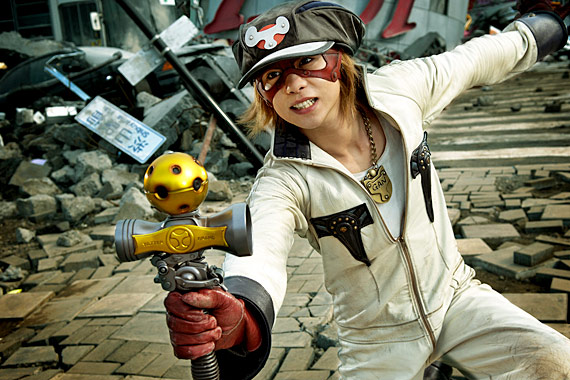
Gan Takada (Yatterman #1, played by Sho Sakurai) and Ai Kaminari (Yatterman #2, played by Saki Fukuda) are a couple who work in a toy factory in Tokyoyo by day. However, at night they transform into superhero duo Yatterman. Accompanied by their mechas Yatterwoof and Toybotty, Yatterman fight crime and stop evil from occurring all over the world. Their thieving enemies, the Dorombo gang who work under the ‘God of thieves’ Skullobey, are currently on the hunt for the four pieces of the Skull Stone which – when united – are said to create a miracle. One day, Yatterman come across a girl, Shoko (Anri Okamoto), whose father has gone missing after searching for the Skull Stone, and together with Shoko they must find a way to stop the Dorombo gang before they find all the pieces and take over the world.
Yes, it sounds like one of those superhero films you loved when you were a child. The storyline is really so simple and easy to follow so there’s nothing really unique about it; at the same time it’s incredibly engaging and hilarious. From the underlying love story Gan and Ai to Shoko’s search for her own courage, there is something for every single viewer of all ages – except kids, because there’s also a ridiculous amount of sexual humour. The best part is that Takashi Miike took the great elements from a 1970s anime and made it current with tons of pop culture references – think Indiana Jones costumes – so the modern audience can enjoy everything Yatterman has to offer without feeling like they’re watching a kid’s show.
Characters
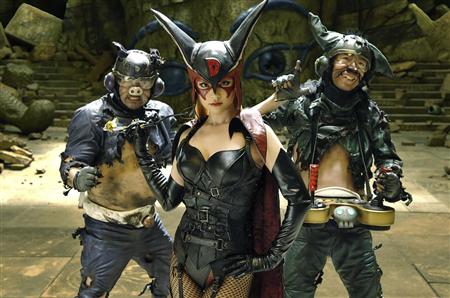
The film’s main characters are Yatterman #1 and #2, Shoko, and the Dorombo gang consisting of Lady Doronjo (Kyoko Fukada), Boyacky (Katsuhisa Namase), and Tonzura (Kendo Kobayashi). Each has their own unique personality traits which adds to the quirkiness of the film, and this is probably one of the few films I’ve seen where I’ve found almost every character funny at some point.
I have to say Boyacky and Tonzura are probably my two favourites from the film. Those two are the classic goofballs in any Asian film, television series, or anime, and they provide plenty of entertainment across the two hours. Boyacky is a little bit more sex obsessed, which makes him perfect for anyone who enjoys a little bit of perverted humour; I also loved watching his good old fashioned attempts at hitting on his love, Lady Doronjo. Tonzura is slightly more random and more of a support character, but he has his funny moments too.
Most of the women in this film were slightly irritating, though. I liked Lady Doronjo, but Shoko and Yatterman #2 are two of the dullest characters I’ve ever come across in any Japanese film. Shoko’s search for courage is touching to some degree, but Okamoto’s acting is overdramatic and quite obviously just acting. Yatterman #2 was also kind of pathetic and needy with Yatterman #1, which is a shame because I like Fukuda as a person. It’s quite a shame because the film had a lot of potential for funny moments with Shoko and Yatterman #2, but Takashi Miike instead kept them flat, needy, and overdramatic which took away slightly from my enjoyment of the film.
Visual and Audio
The DVD’s back cover says Takashi Miike is an “Oriental Tarantino”. I completely disagree: if we’re comparing him to Hollywood directors, this dude is the Asian equivalent of Tim Burton. In fact, if Burton were to make a live action film based on an anime, I think it would probably look just like this.
The set design was – first and foremost – absolutely spectacular. I adored Lady Doronjo’s bathroom, and places like Tokyoyo and Ogypt (yes, that’s supposed to be Egypt. Told you this film is awesome), have their own Yatterman flair: Ogypt had massive sphinxes with anime-style cat faces on them. What was equally as great, however, was the costumes. Lady Doronjo and Yatterman had costumes which made them genuinely look like they’d popped straight out of an anime; even better though was Skullobey’s massive skull head which must have been a pain for the actor to wear.
As stunning as the set design was though, the animation was equally incredible. There was one particular moment where Tonzura went into a ‘daydream’ sequence of him in a cartoon-esque scenario, and his face is superimposed over an anime body. Yatterman truly managed to surprise me with brilliant and innovative graphics which brought the world of anime into the world of reality without managing to look tacky.
The sound effects were also great, but what I really found to be enjoyable was the soundtrack. This film is filled with remakes of the Yatterman theme song, as well as a few musical elements where the Dorombo gang or Yatterman will spontaneously burst into song. Again, it’s reminiscent of those 80s and 90s anime shows, but Takashi Miike modernized the soundtrack to keep it up to date with its new audience.
Extras
When I opened up the “Extras” menu, I instantly was excited: “Making of Yatterman” and “cast and crew interviews” were displayed in front of me and I thought I would be entertained for another hour or so. Ten minutes later, it finished.
The “Making of” is really very misleading, because it only shows a very little snippet from the production aspect of the film, and none from pre-production or post-production. The interviews were great: I liked hearing Takashi Miike speak about the adaptation from anime to film (he provides excellent insight into what he wanted the film to be), and even better to see an interview with Sho Sakurai, the actor who plays Yatterman #1. The only thing is this: when you enjoy DVD extras, it can suck when they end too early and these ones definitely ended far too early.
The theatrical trailer is included in the DVD as well, but this really didn’t stand out to me and after 30 seconds of the trailer I stopped the disc. The trailer isn’t half as spectacular as the film, and I would rather find another minute and a half of the film to watch again rather than view the trailer.
Final Comments
Overall, Yatterman was a highly enjoyable film which was engaging in both its plot and its visual elements. While I probably wouldn’t watch it again, this film did provide me with a great experience and plenty of laughs. It’s a must-see for any fan of the original 1970s Yatterman, or for any fan of live action in general. Oh, and Takashi Miike…please do a collaboration with Tim Burton in some crazy East-vs-West film. We’d all love to see it.




 Wheatley definitely does not remind me of Guilty Spark. Nope, not a bit.
 P-body (left) and Atlas become the best of buddies throughout their campaign.
 Repulsion gel is just one of the new game-altering mechanics in Portal 2.
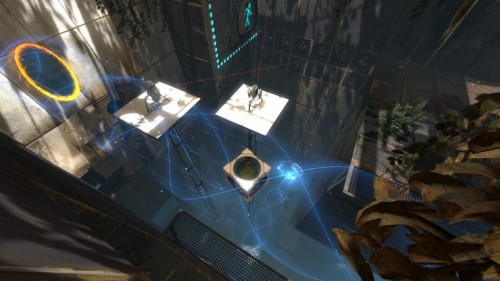 Excursion funnels acts as a force which can move things through portals.
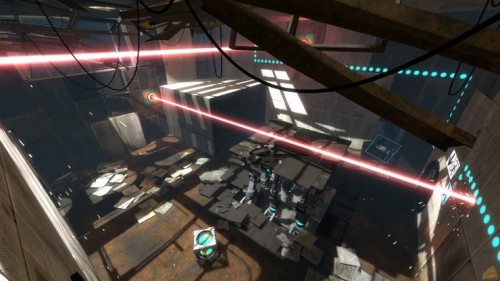 Lasers now activate puzzles in the clearly deteriorating Aperture enrichment center