This week we wrap up E3 week with our in-depth discussion on all major platform holders and how their press conferences went. We rate ’em and declare a winner. I bet you’ll never guess who we decided on…
Cast: Alexis Ayala, Dustin Spencer, Jed Bradshaw, Adam Tabor, Michael “Spike” Marr, Luke Halliday
Thanks for listening and let us know what you think! 🙂
Send all your video game or podcast questions, hints, suggestions and feedback to [email protected] Thanks for listening. Copyright Capsule Computers Pty Ltd – All Rights Reserved
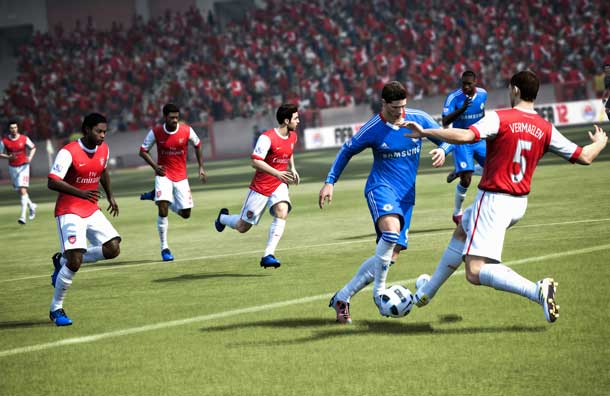
FIFA is always known for its commentators, and EA is boosting up the broadcast booth for FIFA 12: Alan Smith will join noted commentator Martin Tyler as the second voice for this year’s title.
This is my way to subliminally get you all to support Chelsea.
Alan Smith is a former English footballer who played as a striker for Leicester City and Arsenal. During his time at Arsenal, the team won the FA Cup, two League Championships, and the UEFA Cup Winners’ Cup. He is well-known now as a co-commentator for football games, and commentated on the 2011 Champions League final alongside Martin Tyler.
Martin Tyler is the iconic voice that FIFA players hear in the game, and this pair in the booth will be an interesting addition to the game. FIFA 12 is due to be released on September 27 in the USA and September 30 in Europe and Australia.
The Legend of Zelda Ocarina of Time is one of the most highly regarded games in video game history. It is also a game that is known to be confusing at times (Water Temple), so it’s a no-brainer that a guidebook may be required by some gamers who want to fully complete this game, or are just plain stuck. This is where Prima come into it.
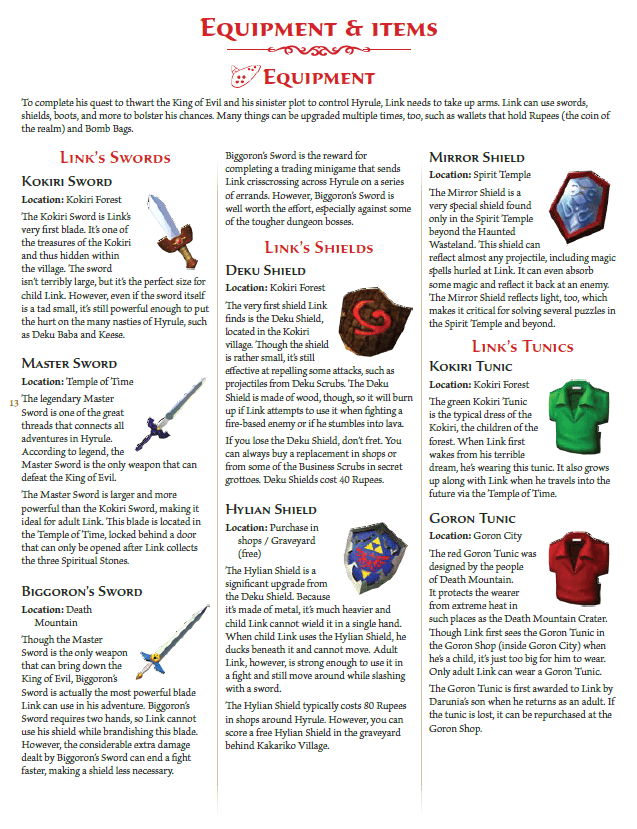
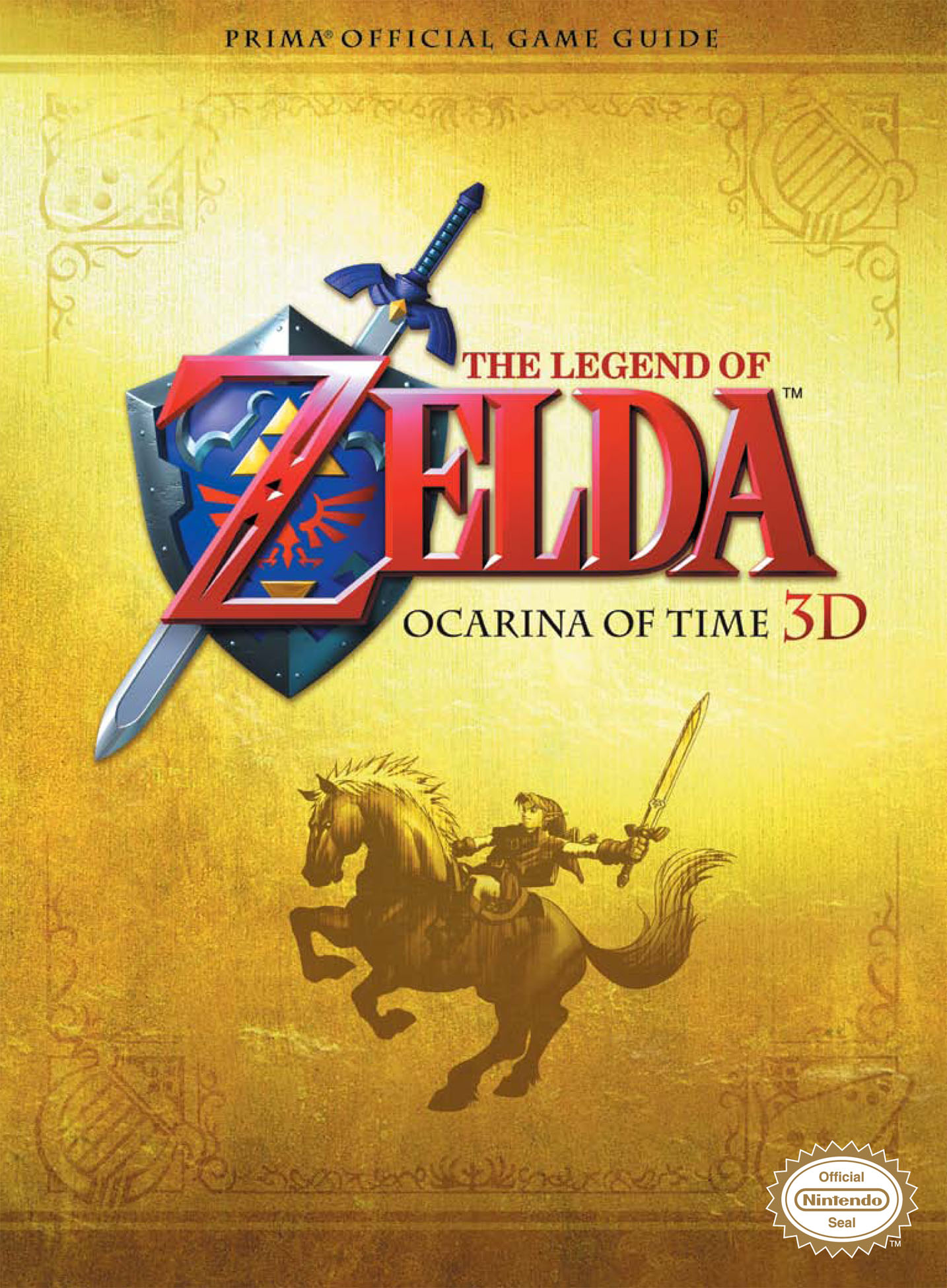
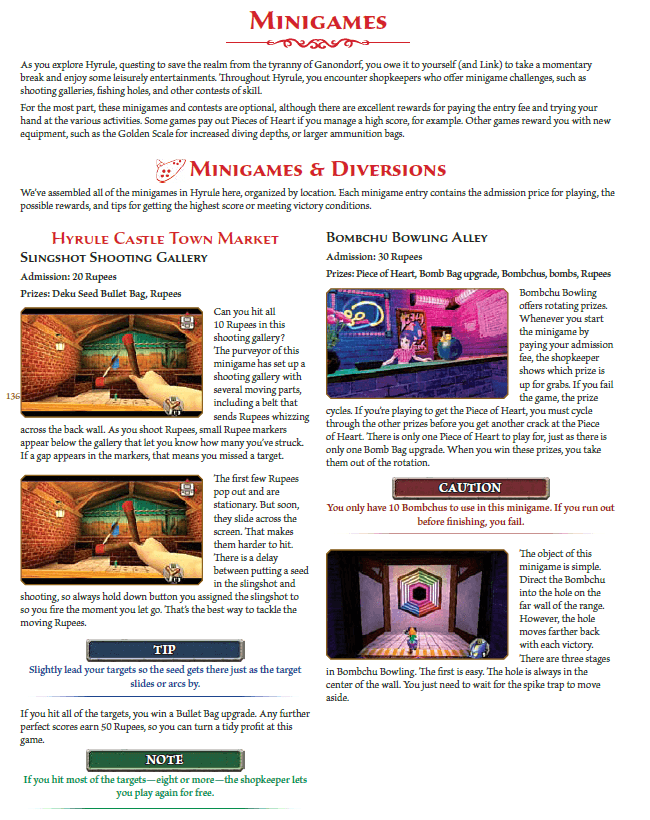
Prima Games have released the The Legend Of Zelda Ocarina of Time 3D guidebook as a companion to the 3DS version of the game. The guidebook covers almost every aspect of the game, in a fashion that some would call ordered. It details the game through the course of Ocarina of Time and moves into Master Quest walkthrough afterwards. The guide is fairly comprehensive when it comes to the secrets and strategies, as well as optimal routes through dungeons. I did however notice that there was no mention of a secret image of Link that I found behind a few crates in the Gerudo valley.
Most of the Guidebook is incredibly light on details, probably to avoid spoilers, but that can sometimes make it a little hard to discern the purpose of going to a particular location other than ‘you have to’. The book seems to be written with returning players in mind, with it being a little hard to understand and utilise for a newcomer coming into the game. Though, I did enjoy some of the survival tips the book offers “As Phantom Ganondorf flies between paintings, it releases a shock attack. To avoid it, back into a corner of the room. It will never touch you back here.” It’s something like this that I wouldn’t have thought about doing that can save you a few hearts in what is (potentially) a tough battle.
The book is full of screenshots that are of a pretty good quality. I wonder how they got these screenshots and I would like to have one of whatever device they used to capture the images. Speaking of quality, the cover of the book, I feel, would have benefited from being comprised of a harder material, as opposed to this cardboard like nonsense. It is incredibly odd that a game as big as Ocarina of Time didn’t actually have this feature. However, this could actually be a throwback to the original guidebook which was made of a similar material. The paper is standard glossy magazine-like paper which adds a nice texture to each page and makes the package seem a little more valuable. At the end of the guidebook, consumers will be pleased to find that there is a very nice poster awaiting them at the end.
There’s a section in the guidebook that features a checklist of which Gold Skultullas you’ve found. The only problem is (if you value the quality of your book) you probably wont want to checking any of the boxes next to any of the Skultulla locations within the book.
The book is segregated into sections which clearly define and separate each section into its own content. The book moves from the Introduction to the great Deku Tree and then to everything else in a kind of order that works. Unfortunately, as I stated earlier, some sections of the book can be a little difficult to understand for newcomers to the series. I remember one of the other editors telling me of their woes in trying to understand what to do and where to go and how they couldn’t work out what the book meant. This problem is greatly noticeable at the section of the book that covers the Death Mountain Trail. It tells you to run up to Goron City, then go into Goron City and then to exit and throw the bomb flower at Dodongo’s Cavern. This is completely weird as it leaves players that are closely following the guide confused. If I were to do a literal run of the game from page to page of the guidebook, I would simply not be able to progress past this point.
The book is adorned with nice illustrations that decorate the page, like the Heart Containers atop the page that fill as you progress through the book, there is what I believe to be the Harp of Ages on the bottom left corner of the left hand page and the Ocarina of Time on the top right of the right hand page. It’s the little things like these that help to bring life into the book and put it into its own. I found that these, in combination with the other decorative imagery, made the book feel particularly Zelda and that is always a good thing.
Overall the Prima Games guidebook to The Legend of Zelda Ocarina of Time 3D for the Nintendo 3DS is a solid package for all players who either require guidance or love to collect memorabilia based on the franchises that they love. The book is presented in a passable manner, with highly decorated pages within. While the book can be a little confusing in some parts, it is mostly coherent and as spoiler free as possible. If you still have a surviving copy of your original Ocarina of Time guidebook, I’d still say to pick this copy up, if only for collectable purposes.The official Nintendo Seal adorns the edge of the cover of this book, which is an indicator of the quality of the comments that reside within.
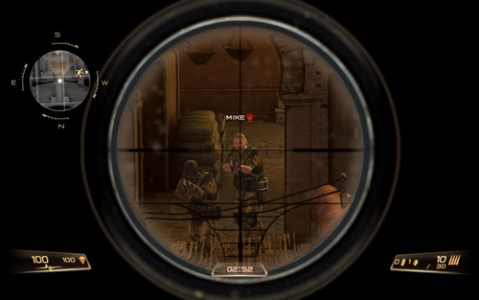
Modern Combat: Domination Developer: Gameloft Publisher: Gameloft Genre: Multiplayer FPS Platform: Mac Release: June 15, 2011 Price:$12.99
Overview:
I’ve been a Mac user for a great many years now, and as such I had all but given up on playing games on my machine. But within the last year or so not only have we received Steam for Mac but now we have the juggernaut of the App Store right on our very desktops. Having any old App Store isn’t a big deal but with the gold rush of iOS development, game developers now have a pavlovian response of seeing money symbols when they hear the word App Store associated with Apple. In this mad rush for position, Gameloft has done quite well for themselves. With the new Mac App Store, Gameloft has delivered Modern Combat: Domination, an online multi-player FPS in the vein of Counter-Strike or the Call of Duty series. With such a mad dash for something to be recognised, does it hold up?
Mechanics:
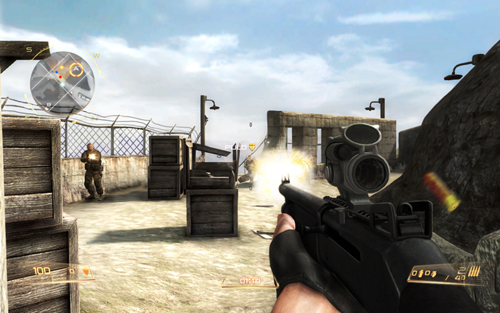
If you’ve played a FPS in the last 10 years you know what to expect control wise from MCD so I’m not going to dwell on it. Controls are smooth and solid with no lag that I picked up on during my play time. I was using a mouse and keyboard which ran smoothly and the game comes with controller support, which I didn’t get the chance to try out myself. While predominately an online multi-player FPS, you do have the option of playing all the maps by yourself with bots so you can get familiar with the layout so you’re not diving in blind when you play online. Tragically, the single player bot A.I. is pretty terrible. But to be fair, that’s not the focus of the game so it’s really not the end of the world. The real meat comes with the online multiplayer. There’s 6 different play modes with up to 16 players at once. All your favourite game modes are there with Capture the Flag, Boom & Bust, Deathmatch, Extraction, Escort and Domination.
The map design was pretty solid, if a tad small, and while the gun selection was pretty standard, they all handled really well. You have to buy and unlock weapons with in game currency and levelling up. However, you have to purchase the weapons you use for every round. This usually winds up with you using lower tiered weapons with all the heavy hitters hardly being used because of the gamble. I found it a little hard to find a good amount of people to really match up with. Bots helps a bit filling in spaces but nothing can really replace going up against another live person. As I mentioned before, there was no lag and the servers were all rock solid with no hiccups during my play sessions.
Presentation:
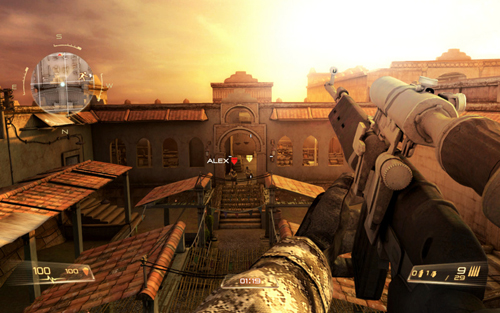
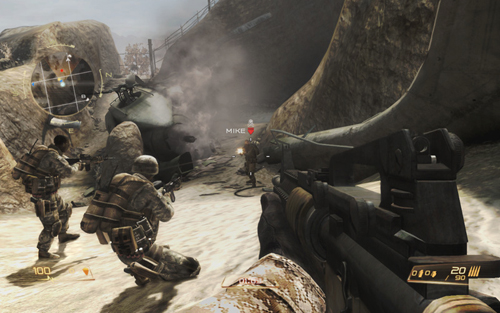
I was running the game on a 2.66 GHz Intel Core i7 with 8 GB of RAM and had absolutely no issues with performance and graphically it held up to the PS3 version. This is really where Gameloft shines, they have great technology and it really shows with how the game performs. The colour pallet is what you’d expect from a war based FPS with lots of browns and greys but the graphics are crisp and looked great running on my machine.
Where the game truly shines is the music and sound design. Really, this is where the game is better than it has any right to be whether it’s with fantastic ambient noise, the sound of your footsteps running through the sand or a bullets whizzing by you and hitting the wall. The guns all sound great and the score is a stand out. I can’ really say enough good things about the sound design in Modern Combat: Domination.
Conclusion:
Let me be frank here, if your metric for comparison with Modern Combat: Domination is Call of Duty: Modern Warfare then obviously there’s no comparison. CoD looks, sounds and plays better, not to mention that it has a full single player campaign as where MCD is multiplayer only. But if you consider that MCD is a mere $12.99 and CoD had a drastically larger development budget then your opinion of the game will change considerably. For that price point I couldn’t recommend MCD enough if you’re looking for an online multiplayer FPS. Especially on the Mac, where hardcore titles are still is in short supply. So if shooting guys in the face on your Mac is your thing than you could do far worse than Modern Combat: Domination. So click that download button and lets get trigger happy.
We’re back with the Capsule Computers Podcast Episode 010. We’ve got a smaller show for you this week as we’re doing a quick wrap up on what we thought of E3 2011. We cover a little bit of what we’ve been playing and get into Microsoft, Sony and Nintendo’s showings for the year. Find out what we’re looking forward to and what we think of the Nintendo Wii U.
Thanks for listening and let us know what you think! 🙂
Send all your video game or podcast questions, hints, suggestions and feedback to [email protected] Thanks for listening. Copyright Capsule Computers Pty Ltd – All Rights Reserved
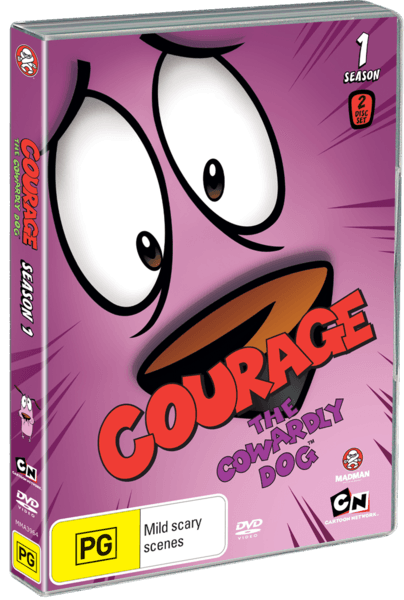
Genre: Animation/Black Comedy/Kids Produced by: Cartoon Network Running Time: 291 minutes Available for purchase at: Madman Online Store ($24.95)
Overview
Sometimes, truly great cartoons take a lifetime to appreciate. These are the cartoons that, when seen through the eyes of an eight-year-old, seem bizarre and nonsensical (remember listening to Vengaboys’ song Boom, Boom, Boom and thinking people just wanted to hang out in a room together?), but as we grow up, something in our brain clicks and we say “Ahhh…so that’s what it all meant!”
I’ll admit it: as a child, I found Courage the Cowardly Dog lame, confusing, pointless, and most of the time, it was just plain creepy. However, after life walloped me with a hefty dose of growing up, and then privileged me with a love of cinema, television, and animation, I found that I viewed Courage’s adventures through a completely different lens the second time around.
Plot
Courage is a small, fuchsia dog that was abandoned as a puppy. He was found and adopted by Muriel, a lovely elderly woman that lives with her husband Eustace on a farm in the middle of Nowhere – quite literally. Courage is, despite his name, absolutely terrified of everything and everyone; the smallest movement or slightly paranormal event can make his eyes pop out of his head and send him shaking. However, this doesn’t serve well for him because Nowhere is plagued with strange happenings: monsters, aliens, demons, insects, and things that go bump in the night. When Muriel and Eustace are in danger, it’s often up to Courage to muster up his…well, courage and find some way to save the day.
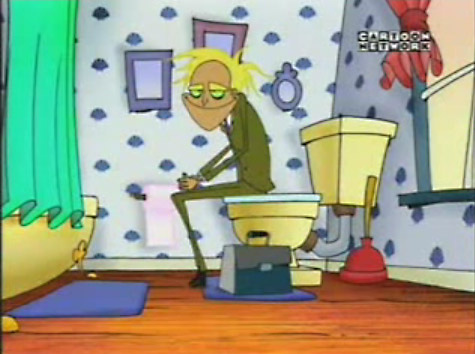
The aptly-named Freaky Fred…so, so, so freaky.
As per all of Cartoon Network’s classics, Courage the Cowardly Dog works in episodes of about 8-10 minutes. Each episode houses its own little storyline, and is designed to exist as a standalone segment so they can be broadcast at anytime and will still make sense. The shorts are varied in quality, but as this is the first season of Courage there is a clear creative progression: I found the further I watched into the season, the more overwhelmed I was at how intelligent the series was with its intertextuality and psychological implications that many children wouldn’t understand at the time. One notable episode was Freaky Fred, where Muriel’s nephew Fred visits their home. Fred has a fetishistic obsession with shaving hair (although children would just think it’s a regular ol’ obsession), and tries to shave Courage’s fur. The narrative was told in a voice-over, and was so reminiscent of Edgar Allan Poe’s poem The Raven that I actually got chills down my spine. Here, Dilworth really proves that children’s shows can be for adults as well, and, once he finds his stride, the series offers so much density in regards to knowledge and parodies.
The narrative, of course, centres itself around black humour – which, I believe, I didn’t know existed until I was in my teens – and it takes a comedic approach to otherwise dire situations. I do remember that as a child, however, the black humour didn’t register and the show was just genuinely terrifying. While Dilworth features wonderful moments of randomness just to keep the kids laughing, for children that don’t register the difference between black humour and horror it can be a frightening and daunting experience to watch Courage the Cowardly Dog. Upon revisiting it as an adult though, the true genius of the series clicked in my brain – I am glad I had the experience of watching the show as a child and then the chance to watch it a decade later and appreciate it fully.
Characters
Cartoon Network always has featured as few main characters as possible in order to fill up their limited time with stories about the protagonist. Courage the Cowardly Dog is no different: Courage, Muriel, and Eustace are the only consistent characters throughout the series – although, true to form, Dilworth has thrown in a few recurring baddies just for good measure, such as Katz and Dr Le Quack.
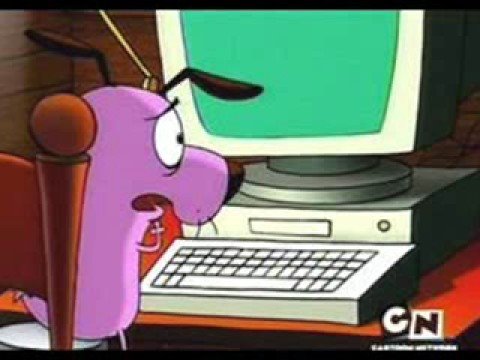
Sometimes you have to refer to your computer for help. I’m betting he wasn’t Wikipedia-ing anything.
Courage himself is the one thing that keeps the story going. He’s the small, bright coloured dog who’s adorable yet cowardly, and naïve yet houses an overactive imagination. Courage often curls up in a ball on Muriel’s lap, and is always willing to help her – but he’ll probably get terrified every step of the way. He’s the sweetest pet and even when he gets scared all the time – a less than desirable trait in a dog, I would imagine – he is still so likeable for his big heart.
As the central figure, I’d have to say he truly is one of a kind, and that’s his core appeal. He’s always going to save the day, but how scared he gets while doing it is a completely different story. In other words, Courage is the quintessential metaphor for the subtle lesson addressed to every member of the audience: no matter how terrified you are, you can still find the courage within yourself to do what’s moral, what’s right, or whatever it takes to protect the people you love.
Muriel Bagge is a package deal with Courage: a grandmotherly figure that cleans, cooks, takes care of her family, and is never judgmental. She is always ready to help Courage or Eustace out, she scolds in a loving and polite manner, and she is so stereotypical that she embodies every single grandma figure in the history of cliches. If Courage is (wo)man’s best friend, then Muriel is a dog’s best owner. Whilst she is a constant character, she’s one that nobody ever tires of because she treats our favourite fuchsia dog so well and is so morally unwavering. With that being said, Eustace is Muriel’s antithesis: a mean old man who is constantly mocking Courage, and is so lazy and cruel that sometimes you just wish Courage would bite him in the butt. He occasionally has his redeeming qualities, but for the most part he’s the one that balances out the loveliness of the Bagge home.
The recurring characters are a delight to see, and in fact they give the show an overall consistency that otherwise would have been lacking. All of the villains are quirkily evil, but it’s because of that trait that their presence is so welcomed throughout the series. Dr Le Quack has to be the best one though: he uses his hypnotic skills for his own personal gain, and is a comedic mirror of the greed and exploitation often found in the world.
Audio and Visual
While the shows from the classic Cartoon Network period all seem to maintain a sort of stylistic cohesiveness about them, Courage the Cowardly Dog stands out. The show is slightly darker than the others in terms of colours and animation (although Courage’s bright pink fur helps to balance that out) and Nowhere as a setting is as depressing as it sounds. In fact, whenever there were flashes of colour in flowers or in the sky, it was such a welcome relief to my eyes that I paused the show to enjoy the variation in palette. I do feel that because the show was a black comedy, the animators felt more free to express themselves visually – and it was a welcome sight from other cartoons like Johnny Bravo and Cow and Chicken where everything is so consistent it’s boring.
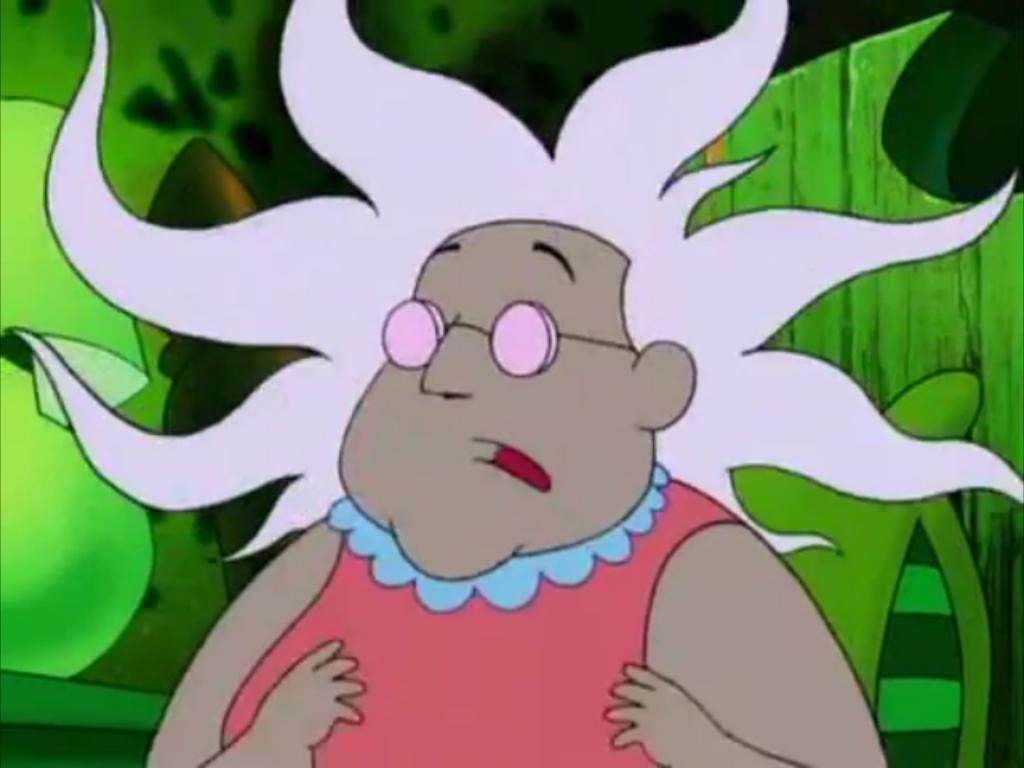
Muriel as a demon…thing.
One of the best features of the animation occurs whenever Courage is trying to warn Muriel or Eustace of something. Of course, he can’t verbally communicate with them; instead, he creatively metamorphoses into an impersonation of whatever it is that’s threatening them. The animators went wild with these impersonations, and they pulled it off spectacularly: each animation is a great way of communicating the show as a visual element rather than a show that is about constantly talking.
Audio-wise, the show has excellent voice-acting and SFX, and an average soundtrack. Eustace and Muriel’s voices couldn’t have been picked better – it’s as if their voices were picked first and the animation drawn to suit them. Courage’s voice is sometimes odd, but for the most part it suits the cowardly nature in him. The most iconic lines of Courage’s – “What do I do? What do I do?!” and “Either something’s up, or my name is [insert some ridiculous name here]…and it’s not!” – wouldn’t have been the same without Marty Grabstein’s great interpretation of Courage’s tone, pitch, and accent.
The SFX work synonymously with the rest of the show, and always contribute to the atmosphere of the segment. However, the soundtrack was a little bit of a hit-and-miss. While the music was often very well-orchestrated, sometimes it felt a bit choppy. Even as the opening credits cut out, it’s very obvious that the cut had been done mid-word and it sounds too amateur for the rest of the series. Of course though, a show like Courage the Cowardly Dog can’t be perfect, and it is better that it fell on soundtrack than anything else.
DVD Extras
The DVD came with no extras, which is a major disappointment. I do know that Courage the Cowardly Dog Season Two comes with the original pilot from the What a Cartoon! Compilation, but as far as special features go there was absolutely nothing.
Final Comments
Courage the Cowardly Dog is one of the most intelligent and hilarious cartoons that I have seen for a long time. When I first received the DVD, I wasn’t sure if I was going to have to force myself to watch the series one gruelling episode at a time. However, I was pleasantly surprised and have discovered that some shows deserve a second chance (and after a decade, I think it’s a warranted second-go) to make their way back into your heart. Either this show is great and I loved it, or my name is Princess Consuela Banana-Hammock…and it’s not.
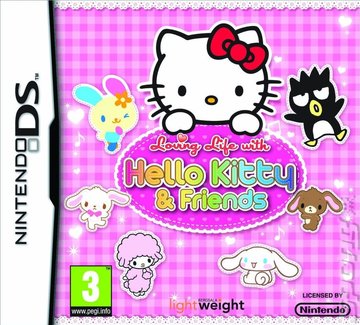
Loving Life with Hello Kitty & Friends
Publisher: Rising Star Games
Developer: Bergsala Lightweight AB
Platform: Nintendo DS
Genre: Mini-game/Girly
Released: 17th June
Hello Kitty is a brand that has built up into an iconic powerhouse over the last couple of decades, with merchandise ranging from school supplies to packaging. It has even had its own anime television show for young children. While it goes without saying that Hello Kitty invests most its time in appealing to young girls, this hasn’t stopped previous videogame outings on the Nintendo DS because with the console’s casual audience, there is obviously an audience of young schoolgirls for it.
In Loving Life with Hello Kitty and Friends you take on the role of Kitty and the whole gang’s in tow to join in on the fun: the rabbits of assorted colours, the pink sheep, the penguin and the floating fairy people. Before you’re wowed by even more of my encyclopaedic knowledge of the Hello Kitty characters, it is worth saying that I’m both too old and the opposite gender to the target audience of the game, which is why it’s worth me giving an outlook on the game from both perspectives.
The game is broken down into five numbered tabs, with each one taking you to a slightly different area of the place where Kitty must call home. The first of which, obviously, is Kitty’s home, or more specifically, her room. Here you can fine-tune your outfit by changing you clothes and adding accessories like bags or necklaces, or even indulge in a spot of interior design by choosing the furnishings, carpet and wallpaper that suits you. Unfortunately, the options are quite limited and redecorating your room only allows you to select a new piece of furniture in place of an old one, not move it around and reorganise the layout of the room. The clothes are similarly limited as there are only a handful of different outfits which are then repeated in many alternative colours.
On the other hand, you can add to your wardrobe and your belongings with some retail therapy by visiting the fourth tab. Tab 4 is the ‘Let’s Go Shopping’ tab, which plays host to four shops: the Home Interior Shop, the Sanrio shop, the Picture Shop and the Clothing Shop. Each provides you with something to add to your room or your outfit, with home and fashion accessories available for purchase using the in-game currency of ‘Puros’.
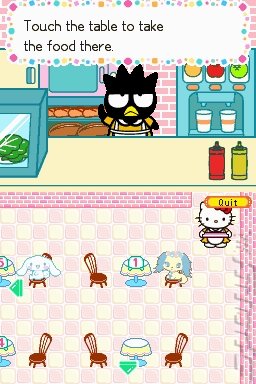
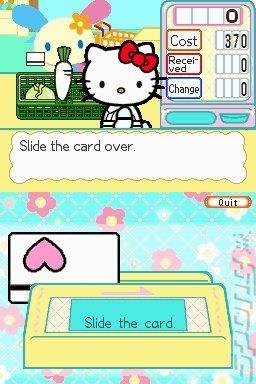
Which leads me on to tabs 3 and 4, the ‘Let’s Work’ sections of the game. The second tab is where a small market is located – it’s small in that there’s only three shops: a restaurant, a flower shop and a supermarket. Work elements of the game are the first part to introduce mini-games, with each one handled by some sort of mini-game. Some of these carry an accommodating time limit such as the flower shop mini-game in which you must select the right path while walking through a garden to find the correct flower, while others carry no time restrictions, like the supermarket game where you can freely scan items through the till and enter the necessary numbers to earn your Puros reward. In respect to the time limit, it has been well-designed to suit the typical player, a young and inexperienced gamer who will probably just be learning the ropes with this being one of their first games.
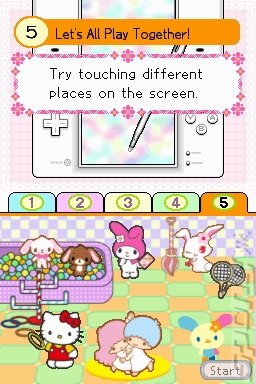
The other work tab sets you to work in the food court in the Hot Dog Shop, the Fresh Juice Shop, the Sandwich Shop, the Ice Cream Parlour and the Fast Food Restaurant. More mini-games ensue, with a mini-game for each stall, again accompanied by a monetary reward for passing the challenges. The final tab is the ‘Let’s All Play Together’ area, offering up an extra six mini-games (Tag, Concentration, Fly on a Broom, Catch the Right Ball, Let’s Dance, Ring Toss), taking the grand total up to 14. These mini-games vary in length, with some of the more recognisable games like Concentration, a match the symbols card game played against the AI, proving more enjoyable than some of the more obscure shorter games. For example, the Tag game was over in about 3 seconds flat due to the confined ball pit space the game takes place in meaning your friends end up running into you.
All the mini-games suffer from the same faults in that they don’t change. There is no increase in difficulty, meaning there’s little difference playing them a second time around aside from changes in combinations in the sequence-based games, which makes repeated plays tiresome and undesirable. The graphical style is clean – if ambitionless – with a series of static screens presented mainly using a colour palette of pinks, pale blues, white and yellow. The sound would have been passable if not for the squeaky screeching narrator who exclaims “Let’s Play…” every time you click on something, which likely even cause six-year-old girls to turn their volume down/off. It’s not a bad game for first timers due to a forgiving level of difficulty, but even the most inexperienced players will have seen everything it has to offer within two hours of play and would be hard-pressed to extract any more entertainment out of it beyond this point.
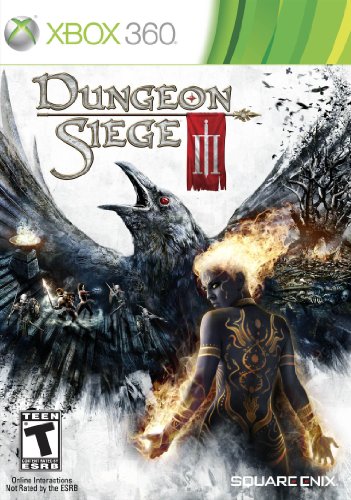
Dungeon Siege III Publisher: Square Enix Developer: Obsidian Entertainment Versions: Xbox 360 (Reviewed), PlayStation 3, PC Release Date: June 21st 2011 Price: $59.99 US, £49.99 UK, $109.99 AUS
Overview: Many years ago, Gas Powered Games developed the first Dungeon Siege title. Since then Dungeon Siege II was released and both of these were PC exclusive. With Dungeon Siege III we see the franchise’s debut on the home console, as well as a new development team as Obsidian Entertainment and Square Enix have teamed up to bring this dungeon crawling experience to everyone that wants it. Now dungeon crawling RPGs have become a rarity, especially on consoles. Does Dungeon Siege III have what it takes to possibly revive this genre?
Story: The story takes place in the Kingdom of Ehb which was founded by the 10th Legion many years ago. The Kingdom of Ehb was prosperous for many years, until the murder of the King. With the King dead, the Legion was blamed for the failure and a woman named Jeyne Kassynder has raised the people in a revolt against the 10th Legion. Jeyne, the leader of the Church of Azunai wields strange powers and under her lead, the people have brought the 10th Legion to the brink of destruction. Only a few of the Legion’s descendants still remain, and they have been gathered together by a man named Odo in an effort to restore the Legion to its former glory.
Players are given a choice at the beginning of the game to choose between four different members of the Legion. The four characters that players are given the choice to play as are named Lucas Montbarron, Anjali, Reinhart Manx and Katarina. Each has their own backstory and will have unique moments throughout the game that will change depending on which character you are playing as. This choice certainly helps create a great way for players to replay the game without feeling like they have done everything once already.
The only thing hindering the replay value is the lack of a New Game+ option which is truly a disappointment because after finishing your first playthrough with a fully powered character, and then being forced to play as a level 1 again is going to drive some people away from replaying the title again.
Being the third title in the series, Dungeon Siege III’s storyline has a few references to past events in other Dungeon Siege titles. Thankfully however, no actual knowledge is needed of the other Dungeon Siege games and there is a plethora of lore and texts to unlock which will help explain certain things as well as expand the DSIII universe.
Now besides the main storyline, there are also a number of choices to make in the game. However these choices aren’t very engaging because a number of the games main dialogue choices actually don’t have any bearing on the game itself outside of providing the illusion of choice. A few decisions you make may affect things in the future, but for the most part you will find yourself ignoring side dialogue simply because it is the same thing you’ve heard plenty of times before.
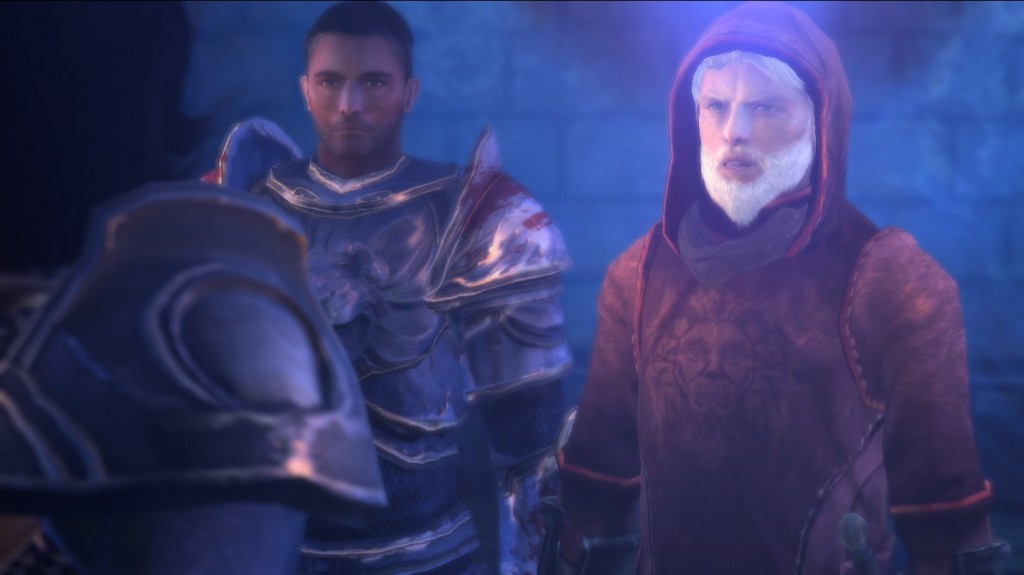
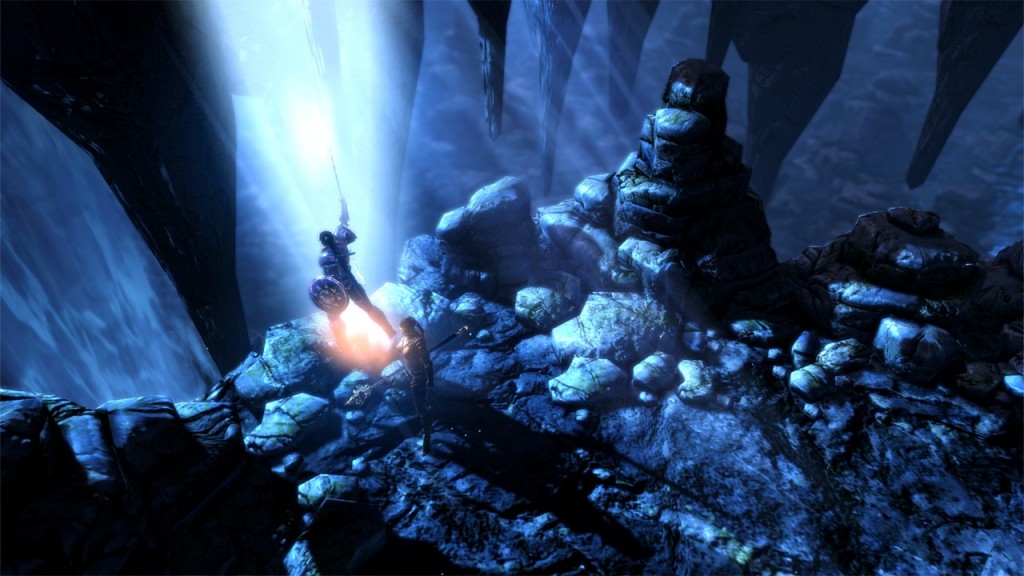
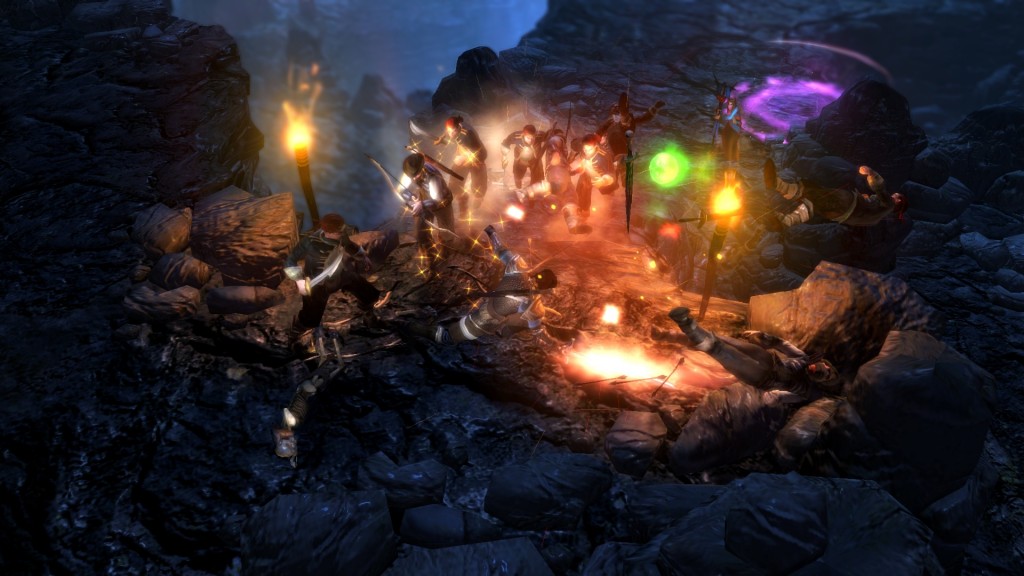
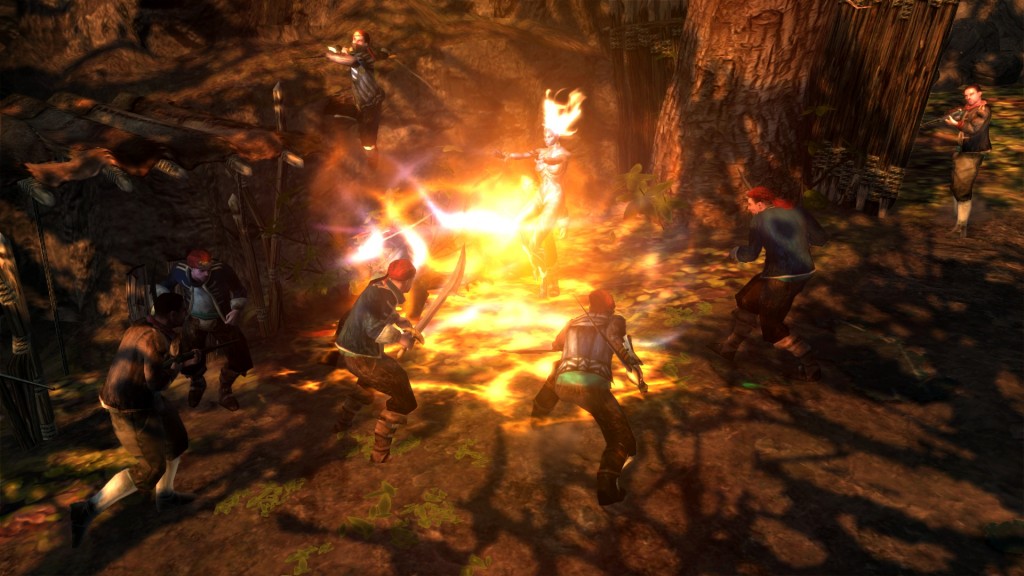
Graphics: Any good dungeon crawler needs some variety in their levels, and Dungeon Siege III delivers that well enough that you will not find yourself walking through similar areas often. The environments themselves are very well detailed and you will usually not have to worry about loading times simply because of how well the maps are streamlined together. Normal combat flows well without issue and the effects of the spells you cast are impressive in appearance.
The character models are decent looking and look as well as one would expect in a current generation title. There is a small issue with the way that loot appears on the ground however simply because, with the high view of the camera, it is difficult to see at times. Also as far as the loot goes, there are a number of items which will appear to look the exact same no matter what variety of them you pick up, whereas more diversity in the appearance of the equipment would have certainly been beneficial.
Audio: The musical score of DSIII is rather impressive. The soundtrack focuses entirely on fantasy styled music which fits perfectly with the dungeon crawling genre. The music is certainly one of the best touches to the game and the battles sound good as well, with gunfire and swordplay sounding as realistic as possible.
Unlike the music and sound effects, the voice acting is very disinteresting. The people that were hired to perform the voice work couldn’t sound less interested in the rolls that they are playing. The fact that there is very little emphasis or put into their performance you will find yourself feeling that the whole story is becoming dull simply due to the voice work. The problem persists throughout the game, even with main characters in the storyline and not just NPCs.
Gameplay: Since players are able to select one of four different characters to play with, each one of them has a unique way of playing. There are long range focused characters as well as those who are strictly melee and players can base their character selection to their playstyle. The character’s playstyle is well varied, with Katarina being a personal favorite of mine due to the introduction of her magical guns to the fray of swords and sorcery.
Besides the style of play and the weapons they use, each character will have unique loot to their character. Every character can wear a ring or an amulet but every other item they can equip will be unique to their person, with other loot showing up as a gray outline.
Any dungeon crawler needs to have a lot of different loot. Dungeon Siege III provides this wonderfully. The amount of loot you will obtain can be anywhere from a few pieces of gold dropped from your enemies to a small rainstorm of items coming out of a chest. There are certain weapons that are obviously better than others, and these are highlighted in either Blue or Green depending on their strength.
Players are given the ability to “transmute” items they don’t want in their inventory. The transmutation option will instantly get rid of an item and provide a couple of gold pieces instead of the true worth of the item. Because of this option players can spend a lot of time in their inventory comparing statistics and benefits between different pieces of equipment before finally settling on what they wish to use and what to get rid of.
Now Dungeon Siege III also contains an upgrade and leveling system for the characters. These level ups are based around the abilities that players can learn. Every character will have six unique offensive abilities and three unique defensive ones. Players can learn a new ability once every few levels and if they use a certain ability enough in combat, it will become Empowered. This means that it will gain a permanent upgrade that will make it stronger or more beneficial to the user.
Besides the abilities there are also the Proficiencies. You will obtain proficiency points every time you level and they will be used to upgrade your abilities in one of two ways. There are limited amounts of proficiency slots for each ability which means you will have to choose the best way to upgrade your favorite ability to help out your playstyle. Finally we have the Talent tree. The player can upgrade each talent up to five times and they can improve their character through passive upgrades. The amount of character customization may appear thin at first but it is actually quite well done, with a lot of diversity available for those who wish to mold their experience the way they wish to.
Dungeon Siege III has the option to let players play online, with up to four players playing at once. There is a fatal flaw here however. If you join another players game you will not be able to take your favorite character with you, nor any of the other characters you worked on upgrading as partners. Instead you will be tossed into the game and forced to pick any of the characters that haven’t already been selected. Then you will not be able to take any of your loot, gold or experience back to your own game and this is likewise for those who join your game.
Players have the option of playing offline, privately or public. The problem with a public game is that you will often get people who join your game and will simply leave immediately if they find you are not in a part of the game they enjoy. Also, due to the way that the camera forces the player to have a high view point (practically top down) the camera completely fails during four player co-op. It will become shaky and will struggle to follow the action, often forcing players to fight at the edge of the screen or spasming between characters.
There is the option for drop-in co-op which is enjoyable for those who want to play with their family or with a friend that has stopped over which is a nice touch. Otherwise you will have an AI partner always that will assist you during combat, usually as well as any other player could.
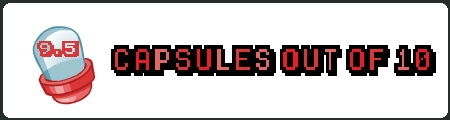
Overall: Dungeon Siege III is a rather enjoyable game for the most part. Those coming to have a true dungeon crawling experience again will not find themselves left wanting after they are done with the title. An average playthrough of the game will run around nine hours until completion. Though there are a decent number of sidequests to help distract from the main storyline as well as the amount of replayability that the title offers to extend total playtime. Unfortunately the stunted multiplayer aspect means you will often be better off only playing with trusted friends or locally. Dungeon Siege III provides an adequate experience but never goes above and beyond to really set itself apart and live up to its namesake.
I give Dungeon Siege III:
A copy of this title was provided by the publisher for reviewing purposes.
If you don’t already know about ThinkGeek, I feel very sad for you. This store is one of the most awesome stores I have ever come across and it fits just perfectly into my weekly nerdy niches. I mean if you write ‘nerd store’ or ‘geek store’ this is the first result! So please let’s check out this store with me.
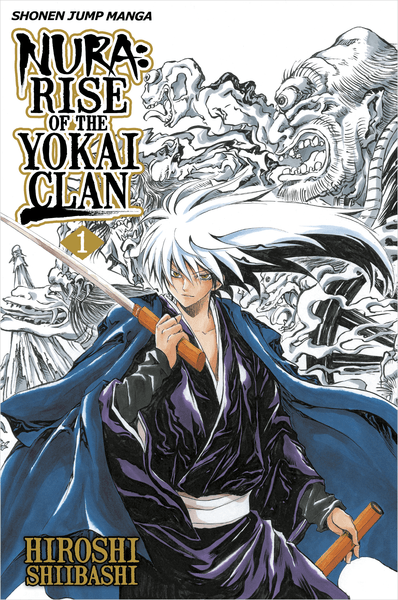
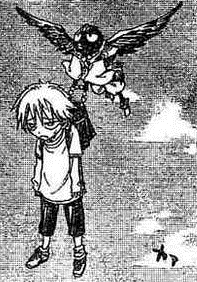
Nura: Rise of the Yokai Clan volume 1 Tag Line: Becoming the Lord of Pandemonium! Author: Hiroshi Shiibashi Release Schedule: Bi-monthly (every 2 months) Publisher: Viz Media Release Date: 10/4/2011 Available for Purchase at: Madman Online Store ($14.95)
Overview:
Most manga have growing pains when they first start off, with the first chapter usually being the most interesting for the first 10 or so chapters. These first 10 or so chapters are the most critical point in a manga series – the make or break point. If you don’t get off to a good start, your manga will fail and will be cancelled from serialization in it’s respective manga magazine. In order to save themselves from such a fate, the first 10 or so chapters are usually vastly different to where the series will eventually go. So that makes it extremely difficult to judge how good a series potentially can be or will be. Most tend to drag their feet and build a popular formula that will last for several chapters until they know they have built enough of a following to try something different without risk of cancellation.
That is exactly the case with Nura: Rise of the Yokai Clan volume 1. The majority of the volume is dedicated to a tried and true formula, excluding the first and last chapters. This creates a sense of the story dragging it’s feet without much in the way of development outside of the first and last chapter. Not many series can successfully pull this off and many haven’t survived the dreaded first 10 weeks. However Nura has succeeded and moved on to be rather successful. Read on to find out why.
Story:
Nura follows a story many of us may have seen before but in an unusual setting that at first may catch you off guard. You have the hidden world of the Yokai (Monsters), that has been kept secret from humans for centuries. It is an interesting setting and provides something not often seen done. Although the concept of Yokai is something that is so thoroughly engraved into the Japanese culture lexicon that it may not be as much unfamiliar ground as it is for us Westerners.
The storyline itself is somewhat of a mash up of ‘Reborn’ and even of a dash of ‘Bleach’. But I have to say it feels as though it very greatly draws inspiration from ‘Reborn’. Particularly in it’s titular character Rikuo Nura, whom is essentially Tsuna Sawada with Yokai blood. Both want nothing to do with the world thrust upon them (Yokai dynasty for Nura and Mafia family for Tsuna), yet both have a side of them that comes out in dire circumstances that is calm, cool, collected and ready to take up the mantle no questions asked (Night form Nura and Hyper form Tsuna). If Shiibashi was not influenced by Reborn in any way I would be extremely surprised.
The first chapter of the volume introduces us to the world of the Yokai and our hero Rikuo Nura who is set to become the third Supreme Commander of the Yokai clan. It does a good job at introducing things to us and is the stand-out chapter of the entire volume. However from there on out, right up until the last chapter we are privy to school based comedy about Rikuo’s classmates exploring supposedly haunted places. It’s rather dull and drags on at a snail pace, with little to no character development besides 2 of Nura’s yokai friends enroll at his school who get a bit of development. But it’s nothing to write home about.
The succeeding point of Nura is it’s potential. I can see it developing into far greater and more interesting arcs. I can also see myself investing in these characters with some time. The volume ended with what seems to be the beginning of the first story arc. This is a great sign for the series moving forward.
Characters:
It’s difficult to judge the characters so early on, we haven’t seen a lot about them apart from Rikuo. Unfortunately the characterization isn’t on the same level early on as such greats as ‘Hunter x Hunter’ and ‘One Piece’ were. But there is enough potential to fill a truck.
I found myself particularly interested in Rikuo Nura’s night form and his grandfather Nurarihyon. They both are shrouded in a fine veil of mystery and I definitely want to know more about them. I can’t say the same really about any other characters and I am already beginning to find Rikuo a little irritating in how stupid he can be in his normal form (inviting an exorcist into your house full of your Yokai family? Seriously Rikuo?).
Though as I said there is a lot of potential here and for this volume it did good enough of a job to make me care about what would happen to these characters.
Artwork:
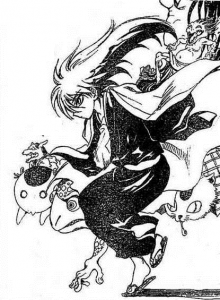
Probably the most defining part of this series and in particular this volume is the great artwork. I love the character designs and overall art-style of this volume although it can feel rather cluttered when a large portion of Rikuo’s Yokai clan are shown in all their hideous glory.
The first chapter struck me as both visually verbose, yet painstakingly detailed. From the wrinkles upon Nurarihyon’s brow to the unrequited poetry of sakura petals blowing gently in the wind, Shiibashi has put a great deal of effort into his artwork and it truly shines through.
The only thing I can hold against the artwork is the ugliness of it at times. But that is to be expected, I mean this is a series about yokai. I percieve it as perhaps an intentional juxtaposition to the beautifully drawn human characters. The yokai are by definition ugly, evil creatures who lurk in the shadows, with the goal of only bringing ‘kyofu” (lit. The Fear). Whereas the human’s are the innocent untouched canvas who can either become dark or stay pure. It’s rather brilliant for Shiibashi to be able to convey that with artwork, but he does so masterfully.
Conclusion:
Nura: Rise of the Yokai Clan volume 1 overall does a great job conveying what this series is about and where it could potentially take us. Although it may suffer from growing pain this volume, it seems to have great things to come with the beginnings of the first main story arc forming in the final chapter.
I will definitely be checking out volume 2 of this series and consider it too be one of the best new manga series I have read in a fair while. With interesting characters and concept Nura will undoubtedly take us to some interesting places, we just have to sit tight and wait patiently to get there. If you enjoy Reborn or Bleach this may be up your alley and I definitely reccomend it to fans of the Shonen genre or action manga in general.