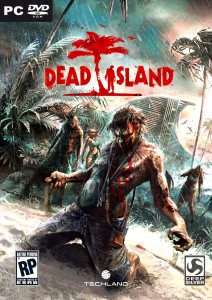
Deep Silver’s upcoming zombie RPG Dead Island has been gathering quite a lot of attention for a brand new IP, largely due to the fantastic backwards teaser trailer released in February. Naturally, I was intrigued as to how the game would play, and if it would feature as strong a focus on the characters and drama as the trailer implies.
Zombie games have been done to (un)death, and individually, most of the features of Dead Island have been done somewhere else before. Being a first-person perspective, it controls like Left 4 Dead. With a focus on melee combat, it plays like Dead Rising. And with open world exploration and character interaction, it even feels a little like Fallout 3.
But combining all these elements together into an RPG is what gives it its own personality.
The most obvious deviance from the zombie genre is the location. A bright, warm, sunny, tropical paradise may seem an odd choice for a survival horror game, but it works really well, both mechanically and narratively. As one of the characters aptly puts it, it’s a fairly heavenly place for hell to break loose.
The fictional island of Banoi is naturally isolated, meaning players probably won’t be dealing with the standard military quarantine storyline. The infection has spread throughout the island, but can’t really go anywhere now. This is all speculation, but it seems like the military has no real reason to go and save people: the island effectively quarantines the infected by itself. So with presumably no rescue coming, and being separated from safety by much more than the usual military-imposed quarantine zone, survival seems hopeless.
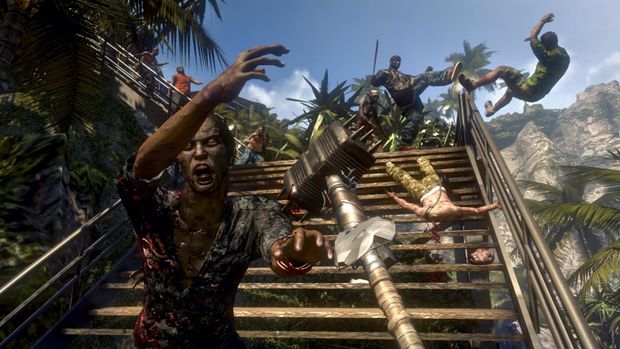
That isolation also serves the gameplay mechanics well. Guns are few in number and ammunition, so the player must rely on whatever will pass as melee weapons. After all, why would a tropical resort, with no prior history of visitor zombification, need firearms?
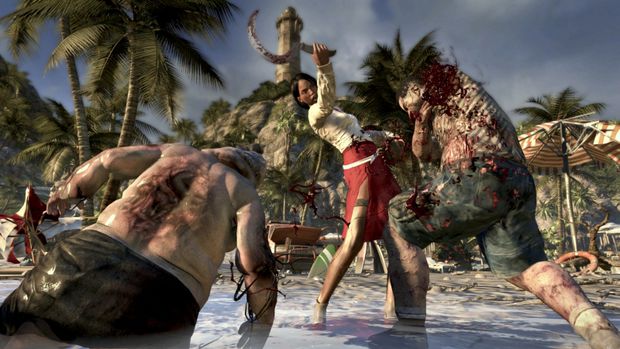
This melee focus brings combat in nice and close, maintaining a constant tension and urgency – especially when a horde is closing in. Survival feels like a real challenge, which is often lost in games that allow you to stand back and mow through thousands with a machine gun.
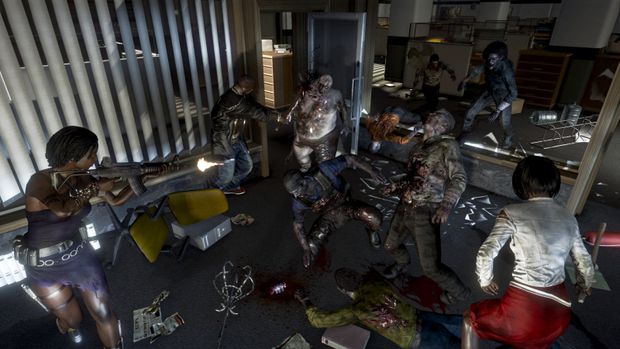
Co-op play has also been announced, and judging from our single player session, my assumption is it will play like a less structured, open world Left 4 Dead. A promising prospect.
In the hour-long preview session we got to play, the game was mostly linear, but this apparently only applies to the first few missions. In that time, the central mechanics and characters are introduced, so tight reigns are held on the player. The freedom to explore the open world begins once the player reaches a Hub location.
Regardless of which character is selected, at the beginning players find themselves waking up in a hotel room with a sense that something is terribly wrong. Stepping out into the abandoned corridor, fears are confirmed as you make your way outside, past bodies and blood, guided by a voice on the radio. After being attacked by a group of people the voice describes as “infected”, you wake up in a lifeguard shack with other survivors, and are soon tasked with finding more permanent shelter.
The developers are highlighting the importance of character development and narrative, but from my limited time with the title, I’m unsure of the extent of this. As far as I could tell, it amounts mostly to some fairly archetypal player characters, who “develop” during the game in terms of their abilities. This is fine for an RPG, but in a narrative sense, the characters don’t seem to matter.
Also unclear is how big an impact the player will have on the narrative. RPGs generally provide alternate methods of completing quests, or give the player key choices that affect how the story pans out. Nothing has been said about this, which leads me to think each quest will be based on a simple success/failure dichotomy.
It’s too early to tell how it will work, but there is definitely room for some interesting narrative devices, if they choose that direction.
Perhaps the worst thing about the characters is the appalling Australian accents. Badly impersonated Australian characters are the bane of every true blue Aussie’s existence, and Dead Island, being set somewhere near Papa New Guinea, has them in spades. Seriously, just hire Australian actors.
The code we tried wasn’t the final version, so a few bugs still presented themselves. Some zombies would slide around on their bellies, or “teleport” slightly, and the lip-syncing during dialogue was way off. Thankfully it’s nothing that couldn’t be fixed before the release date, and nothing game-breaking if it got through anyway. Although the guy playing next to me swears he was on the island from Lost: after walking down a little jetty, he turned around to find that the island had completely vanished behind him.
I’m still not completely sold on the hype surrounding the game, but it definitely looks like an interesting take on the tired zombie genre. The melee focus and unique setting will help it define itself as something different. It may not be as groundbreaking as they want you to think, but it still looks to be very enjoyable nonetheless. Check it out when it lands in September.
Over the years, Chillingo have been the top dog of the mobile market, publishing some of the most successful games on the platform. Chillingo are now headed to the hive with Pollen Count, a game where the player must control bees and safely lead them to their destination while collecting pollen from flowers. We have seen similar titles released in the past with this formula, but Pollen Count offers a bit more chaos to add in an extra challenge for the player. How does this bee directing game live up to Chillingo’s heavy hitters of the past? Here is my review for Pollen Count for the iPhone.
Gameplay
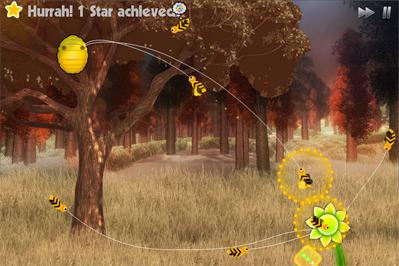
Picture yourself in a scenic field, with the grass blowing back and forth. A small bee who lacks map skills then flies into the picture, on a mission to gather pollen for his hive. That is the main concept of Pollen Count, as you now must trace this bee a path to travel which will take him to a flower. After he has filled his load, you then must trace a line to direct him to a hive at the top of the screen. Sound overly simple? That is where you would be wrong as there is a ton of strategy involved that can lead to both glee and sheer frustration.
As you progress in a level, more bees enter the picture, where you then must direct them to different flowers by tracing each an individual path. If two bees happen to collide on their journey, the game quickly ends and the player must restart the game. Due to the scarce amount of flowers, the player must constantly make sure each bee is quickly escorted to the nearest hive or bee house to keep up with the pace of the randoms that fly in. The more bees that are safely escorted, the more stars that are awarded at the end of each level.
This formula is used throughout the game, but new gameplay techniques are added throughout to mix it up a bit. Some bees will only land on certain flowers, which means the player must keep that in mind while directing traffic. Other bees are much faster and require quick action to get them to their appropriate destination. I found things in a short time to get quite chaotic, but if the traffic control of our insect friends isn’t enough for you, obstacles soon enter the picture to up the challenge even more.
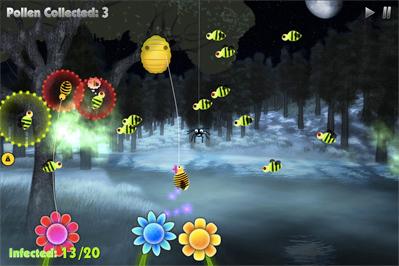
Spiders that rob your swarm of pollen, zombees that infect bees at a touch, and even hungry birds start to come into the picture just a few levels in, which is where the difficulty curve takes a turn into the tedious. I admit that Pollen Count has some addictive and rather simple gameplay for the most part, but having around 15-20 bees on the screen that can all kill eachother at a touch mixed with these extra dangers can lead to the whole game feeling cluttered and frustrating. It’s not like these tasks are impossible, but I just found all of these events happening at once to be a bit too much for the iPhone’s smaller screen.
Those who are competitive are in luck however, as an online leaderboard has been added in so players can try to aim to tackle a high score. Other modes can also be unlocked which involve a 3D racing experience of sorts and a survival mode that boasts a ton of “zombees” that are out to infect. While both modes are rather small, each offer a nice incentive to progress throughout the 22 levels within the main game.
Graphics/Audio
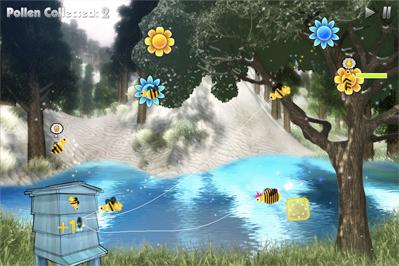
The finest feature of Pollen Count are the beautiful and realistic backdrops that can be seen within each level. As all of the action is happening with your cartoon bees in the foreground, this peaceful and fully animated atmosphere remains a visual delight with several different locations displayed throughout the game. I also must say I didn’t notice any slowdown or framerate problems whatsoever, and with all the chaos that can ensue at once, it was a pleasant surprise to see Pollen Count never miss a beat with it’s animation-heavy gameplay style.
The music is also a top notch production within this game as well, as each melody perfectly blends with the backdrop to give off a relaxing feel, which makes this casual title stand miles above many of it’s contenders in the market on presentation value alone. There is a lot of buzzing in the game which can be nerve-wrecking during hectic situations, but considering this title revolves around bees, most shouldn’t mind this given the concept of the game.
Overall
Pollen Count has an addictive traffic-directing formula with a solid gameplay engine in tow that can lead to hours of fun. While I enjoyed the overall experience, I can say that it felt that Pollen Count’s casual appearance is just that of looks alone and the sudden difficulty curve after just a handful of levels is sure to scare off those who are looking for a more pick-up-and-play title. Either way, with a unique layer of strategy buried within and a stunning presentation, Pollen Count is sure to serve anyone well who are looking for a unique and chaotic challenge where the rewards are as sweet as honey.
Genre: Period Drama Director: Kenji Mizoguchi Featuring: Chojuro Kawarasaki, Yoshizaburo Arashi, Utaemon Ichikawa Running Time: 241 minutes Available for purchase at:Madman Online Store ($34.95)
Overview
Truth be told, I’m not a major fan of period dramas, or what the Japanese call jidaigeki. Most have clichéd storylines, overused cinematography, and barely any historical validity to justify their place in a “period” of any sort.
Kenji Mizoguchi’s The Loyal 47 Ronin (otherwise known as The 47 Ronin) is, at heart, a period drama; however, there are several aspects of it that shine out as something more. It’s impossible to pin down exactly what about this film captures the heart – perhaps it’s the silent film era-esque movements, the powerful yet minimalist soundtrack, or the beautiful acting – but in this 1941-2 jidaigeki, there is something far deeper than just a period drama.
Plot
The narrative begins in the Shogun’s court, where Lord Asano attempts to murder Lord Kira. His attempt fails, however, and Lord Kira is ordered to commit harakiri (also known as seppuku, where the samurai commits suicide by slicing their stomach). As a result, his team of samurai are rendered masterless and become ronin. One of the samurai, Kuranosake Oishi, cannot let the death of his master rest in peace; together, he and a group of ronin plot to avenge Lord Kira’s death and kill Asano.
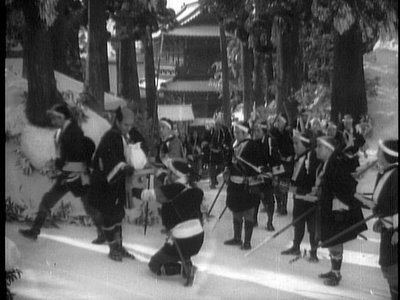
The murder attempt that started it all.
The film is divided into two parts, with the first originally released in 1941 and the second in 1942. Based on a true story – you can actually visit the graves of the 47 ronin in Japan –, The Loyal 47 Ronin tells a tale of honor and sacrifice that is poignant on more than one level. While the story may not be the most unique, the way Mizoguchi executed it ensures it is told in the most powerful manner it can be. The film does move quite slowly – think of it as a very old Harry Potter and the Deathly Hallows Part 1 & 2 where the first part is more of a background/build-up and the second part houses the majority of the narrative movement in the film. However, the slow movement allows us as viewers to gaze at the beauty of the movements and of the scenery within the film. It may not be everyone’s cup of tea but the plot is executed in a manner that best suits the rest of the film’s stylistic elements, and I believe Mizoguchi pulled it off splendidly.
Characters
If it has one, the film’s main character would have to be Kuranosake Oishi, the leader of the ronin. Kuranosake reflects a certain love and loyalty towards his late master that most would envy, but also has a part of him that is so innately human – unlike so many other fictional characters. Kuranosake is perhaps one of the most well-rounded characters I have ever come across in a film, and one of the most touching to watch. Chojuro Kawarasaki delivers a striking performance and captures the character so well it is almost as though he is the ronin, which is a difficult feat considering the history he has to live up to.
What a majority of the film looks like: groups of men running around.
However, aside from Kuranosake, The Loyal 47 Ronin makes its protagonist a collective, which can be found in the group of ronin. The two masters, Lord Kira and Lord Asano, are merely catalysts for the tale and feature very little in the film (but by very little, I do mean at least ten minutes each). The group of ronin do share traits that make them worthy of being in the film though; largely they reflect the tales of persistence, loyalty, love and honor that are communicated through Kuranosake and the narrative. Each of the actors does a great job at conveying their love for their master and their desire for revenge, and although they can be a tad overdramatic at times, the ronin made a very solid performance as a team. With that being said, the overdramatic movements and reactions of the ronin do genuinely contribute to the silent film-esque aspect of the film, with its exaggerated gestures and largely visual tale.
Audio/Visual
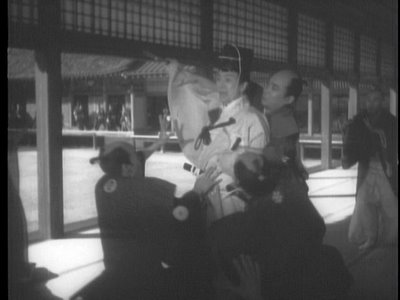
And speaking of visuals, what a film this is for black and white cinematography. In the old days before talkies came along, filmmakers had to rely on large movements and expressive facials and body language. Even though The Loyal 47 Ronin is a talkie, it takes elements from the silent era to make the most of the image on the screen. The characters move with a definitive fluidity to them, and navigate around the sets as though they actually inhabit those spaces in real life; in saying that, Mizoguchi commands all the characters to have a strong presence on camera through their exaggerated collapsing, or exaggerated emotional trauma.
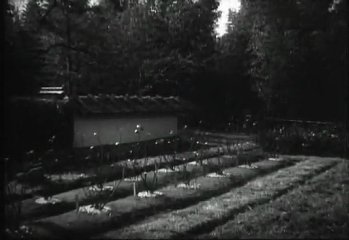
Mizoguchi also found a wonderful backdrop to accompany the great character movements, and the film is layered with great contrast as well as stunning props. It’s true that in The Loyal 47 Ronin, each shot tells a story – combine the indoor-outdoor balance of the samurai’s living quarters with the picturesque trees around the location, and the story is indeed a pretty one.
Beautiful visual backdrops are littered throughout the film.
The audio, on the other hand, is worlds away from the overdramatic movements and high contrast of the visual aspects. Mizoguchi made the right decision in not overwhelming the audience, and The Loyal 47 Ronin features a soundtrack that leans towards the more minimalist in films. The soundtrack is subtle (with plenty of string instruments) and only comes in when absolutely necessary, which ensures viewers spend more time looking than they do looking and listening.
Of course, since the film was made back in the 1940s, audio quality is not of the highest standard; however, I watched the entire film with subtitles anyway (as a large majority of viewers will). Often, the speech sounds like a bit of mumbling rather than coherent sentences, but the audio is unfixable and we have to make do with what we’ve got.
DVD Extras
The DVD contains an audio commentary by Dr Adrian Martin, the Senior Research Fellow in Film and Television Studies at Monash University. While audio commentary is great, three hours is too much to sit through again – even if the film is visually and narratively wonderful. Additionally, I was very disappointed this film didn’t include a booklet with some historical background on the real forty-seven ronin tale in Japan. All in all, the special features are nothing to get excited about, but it’s nice to have if you feel compelled to watch the film again with an Australian voiceover.
Final Comments
The Loyal 47 Ronin is a beautiful piece of Japanese black and white cinema that really doesn’t get the attention it deserves. With a great set of characters, wonderful cinematography, and a narrative that is touching (although slightly clichéd), Kenji Mizoguchi really couldn’t go wrong with this one. Even if you don’t really like period dramas, it’s most definitely worth giving this jidaigeki a go.
Bleach: Soul Resurrección Developer: Sony Publisher: Nippon Ichi Software America Platform: PlayStation 3 (Reviewed) Release Date: August 2, 2011 Price: $59.99 US – Pre-Order Now!
Overview:
Usually when you hear about a game being localized for North American release by NIS America, you will probably guess that that game is going to either be a strategy RPG of some sort or at least be a basic RPG. But this time NIS America has brought something new to North American shores in the form of Bleach: Soul Resurrección. Not only is Bleach: Soul Resurrección outside of the normal game type for the company, but it is also their first anime franchise title. How does NISA’s first venture into a more action styled game turn out?
Story:
Bleach: Soul Resurrección follows the story of the Bleach anime itself and joins Ichigo, his friends and his fellow Soul Reapers in the fight against Aizen, his Arrancar leaders and a massive army of Hollows. The story is spread out across 14 different story chapters that focus on advancing the main plot of the game, taking our heroes from the fights in Hueco Mundo to the Fake Karakura town.
The game follows the Bleach anime/manga storyline very closely. As such, lovers of the anime (such as myself) will find the most enjoyment out of the happenings in the chapters. Unfortunately this can be a problem for everyone else. Little is said about the actual storyline to explain what is happening at any given time nor is much backstory actually given. This means that anyone wanting to play the game without being even vaguely familiar with the Bleach storyline will be left out to dry.
For everyone else who has knowledge of the happenings of Bleach and know what a Bankai is then you will be happy to hear that the game is extremely true to the storyline, although it does jump around quite a bit and skip over smaller battles. There are countless important fights that occur in the show that are translated right into the game. This means that you can fight Grimmjow with Ichigo as many times as you want and take on the Arrancars with the various captains from the 13 Court Guard Squads.
As I mentioned before the storyline is spit up into individual chapters and, although some unlock only after completing another level but thee are also times where multiple chapters will be unlocked, allowing players to have a little bit of a choice as to how they progress through the story. The majority of the story is told in the narrated dialogue before each chapter begins, which is a bit of a disappointment since having cutscenes or even clips from the show itself.
There is some dialogue between the characters themselves as you advance through a stage by defeating enemies, but the problem here is that you will never actually see the other characters on screen except for a little picture showing which one of them is talking at the time. The dialogue is handled much like a Dynasty Warriors game, though the characters don’t even appear on the battlefield which makes the whole interaction feel unattached and generic, even if it does provide story as you go through the levels.
Graphics:
As a viewer of the Bleach series nearly since it began, it should be easy to take and pick apart the various problems with the way the characters look or how their Bankai or Resurrección looks. The problem here is that there is nothing to pick apart or question. Bleach: Soul Resurrección does such a great job with the character designs that even avid watchers of the anime will find trouble finding anything inconsistent with the show itself.
The overall art style used for the game is that of cel-shading which is visually appealing and hold a perfect balance between too anime-like and too-different and providing just enough of a change to make the 3D designs of the characters and they not only retain the anime aesthetic but are overall pleasing to look at. The standard enemies are more diverse than you would usually find in a standard hack and slash such as this, but after a few chapters you will still end up feeling like the enemies are very repetitious.
The background and level designs however are a bit bland in appearance, but this can be also accredited to the source material from the anime itself. The environment of Hueco Mundo was never very brightly colored or decorated. The environments were lifeless, full of white sand, dead trees and black skies, and this is replicated quite well in the game, but it still feels bland. There are a few times that the player will play in the normal world which look decent enough but they can become just as repetitive as the rest of the gameplay levels as you make your way through each chapter and extra missions.
Audio:
Those who are eager to hear what language dubs will be available in Bleach: Soul Resurrección will be happy to hear that the game indeed comes with both the English and the Japanese dubs of the series. This is a great addition to the game and fans of the series will be able to pick exactly who they prefer to listen to, with purists able to pick the Japanese dub and those who enjoy listening to the English version as well.
I played throughout the game sampling both versions of the dub and you can see that these voice actors did a great job and actually had to have enjoyed their work when they handled these characters. The voice work itself is superb, but there is a bit of a problem when you consider how it is implemented.
The fact of the matter is that, throughout your time playing the game, you will be hearing a lot of commentary from your allies when you are playing through a level. This is fine at first but the problem gets much worse when you are treated to practically the same lines of dialogue often enough. This is heightened by the fact that every single time you use a special move of some sort, or even do a simple dash you will receive the same lines of dialogue again and again.
Now while it may be true that in the anime itself the characters will shout out their special move’s name when they use it, but that is usually spaced out and made bearable. But the problem with having this in the game itself is that you will be using your special moves quite often, hearing the same thing again and again that it may drive you crazy after only a short time.
On the other hand the background music itself is very well done. The music is fast paced and it is very enjoyable to listen to, especially when you are plowing through countless Hollows. Some players may also notice that the opening song to the game has been changed. This is apparently due to licensing problems, but it still works quite well with the new instrumental opening.
Gameplay:
Now I mentioned only once so far throughout this entire review that the game had something similar to Dynasty Warriors, but now I’m afraid that there may be a bit more of that in the upcoming description. But before you move your mouse away from this screen you should keep reading. Bleach: Soul Resurrección takes that standard hack and slash formula and does something that hasn’t been done in an extensive library of games from that series. It makes it fun.
Bleach: Soul Resurrección is a third person hack and slash game, which means that players will be taking control of their character and defeating waves of enemies at a time as they advance through a level. The standard layout for the level follows a sort of repetitive pattern however. Gamers will usually pick their level, be treated to a bit of storyline and then fight many weaker and mid-leveled Hollows before they reach either the end of the area or reach the boss they are supposed to fight.
Now while some people may find this a bit too linear in perspective, the fact that this game is based around an anime series is actually very beneficial in this regard. The reason this is beneficial is because this captures the nature of the anime itself rather well, though those who aren’t looking for a true-to-show experience may find it a bit boring that these story chapters follow the same formula.
Players will be using a rather simple set of controls to deal out the damage to the Arrancars and Hollows in their way. There are your standard attack buttons, jump and dash buttons and special attacks. Also what type of shōnen series would this be without a way to power yourself up in the middle of battle. This is handled through an ignition gauge that periodically fills up as you fight with enemies, take damage or pick up items that boost it.
Players can enter ignition mode by pressing the L2 button and it will allow their selected character to enter a super powered mode for a period of time. For example, Ichigo will place on his Hollow mask and become a temporary Vizard. Other characters will boost their power in different ways, usually story related to that character themselves. A second press of the L2 button will drain the ignition gauge fully and unleash the characters’ signature attack and do extreme damage. This signature attack is so powerful in fact that it casually is a bit imbalanced during boss fights, usually draining their health significantly and taking away the challenge a bit.
While this may sound like your average run of the mill hack and slash beat em up at first, once you get into the game it is anything but. Perhaps it is because of the familiarity of the characters themselves, but it is also because of the vast majority of fighting styles and techniques that each playable character has. There are no characters that will be using the same type of attacks or power ups, which not only spices up the combat but also provides that extra layer of authenticity.
Outside of the story mode, you will also find Mission Mode which provides up to 28 different unique missions that allow the player to take any of their unlocked characters through the mission of their choosing. The missions range from easy to very hard and can be used to not only pass the time, but also level up your characters. These Mission Mode battles are enjoyable and, considering the leveling up aspect, many players will be spending a lot of time earning experience, otherwise known as Soul Points.
The Soul Points are green, tiny floating fires that fly towards your player as you defeat enemies and destroy the environment. These Soul Points are the bread and butter of Bleach: Soul Resurrección as they are your only method to level up your characters. In-between missions you can spend Soul Points in an upgrade board that can buff up the characters attack power, HP as well as other things.
Despite all of this however, Bleach: Soul Resurrección still can begin to feel repetitive after a short period of time. The fact of the matter is that, even though there is a lot of familiarity with the characters and uniqueness to their fighting styles, the game is more or less still a hack and slash game that can become boring and repetitive if played for an extended period of time.
Overall:
Now, Bleach: Soul Resurrección is far from a perfect game. It still feels repetitive even though the combat is certainly enjoyable in small portions, the story mode itself is a bit limited in actually telling the story and those who do not already have knowledge of the series will be mostly lost on what is happening and the background visuals can be bland. But even with all of this, Bleach: Soul Resurrección still manages to stand out from the crowd as far as hack and slash games go. There is a ton of detail placed into the character designs and honestly it can be a genuinely enjoyable game with endless replay value due to every unlockable character being able to level up. Mainly this is a game based off of anime franchise that is widely popular in the United States, and you know what? It does a great job for those fans of the series. The characters and their voices are instantly recognizable and fans eager to get more out of their Bleach experience should look no further than Bleach: Soul Resurrección.
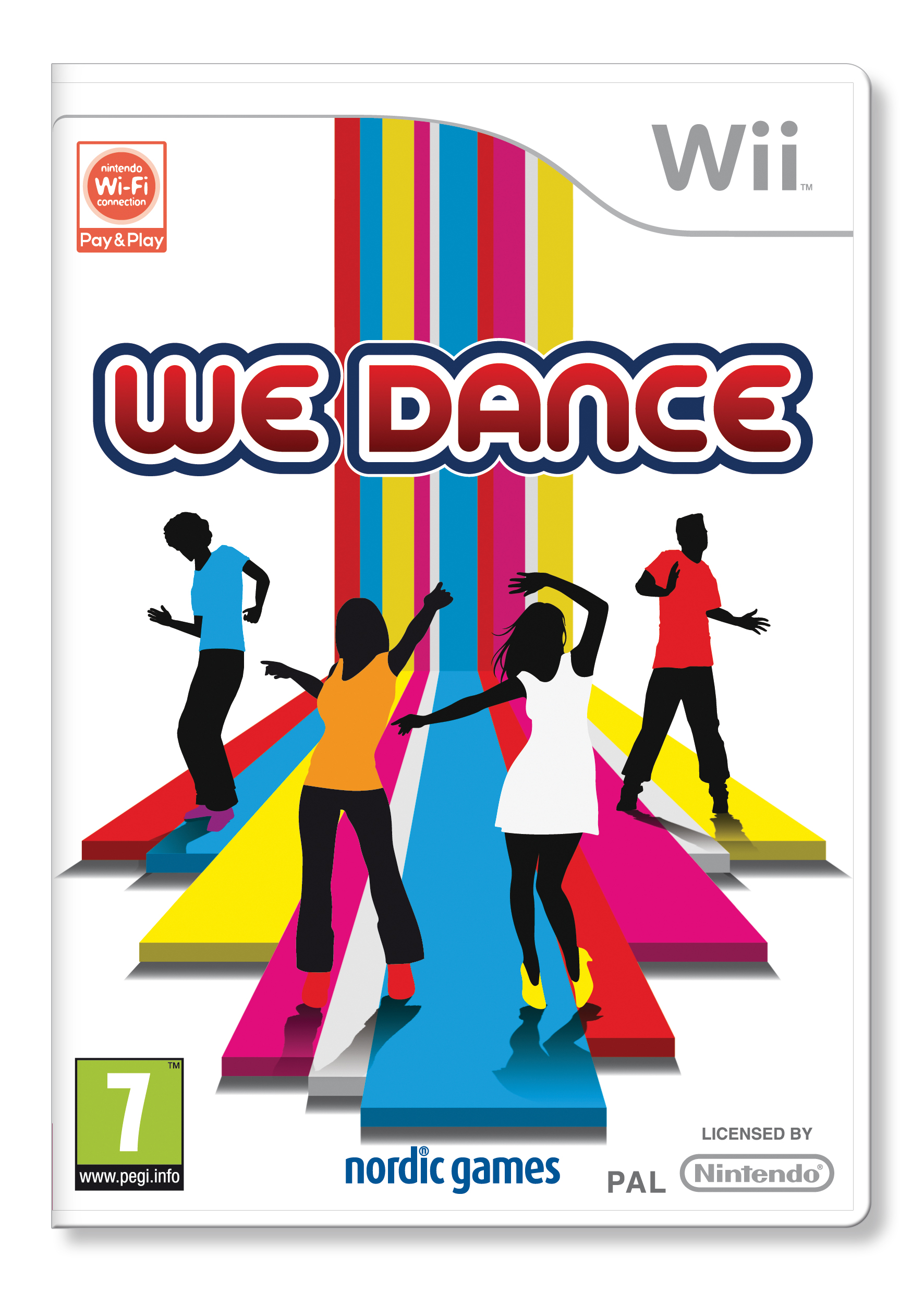
Nordic Games’ extension of the ‘We Sing’ brand which applies the ‘We’ to dancing is set to hit shops on 2nd September according to their latest statement. They are looking to use their knowledge of making an easily accessible music game gained from We Sing to create a similarly straight-forward dance game that will get the whole family off their feet and onto the dance floor.
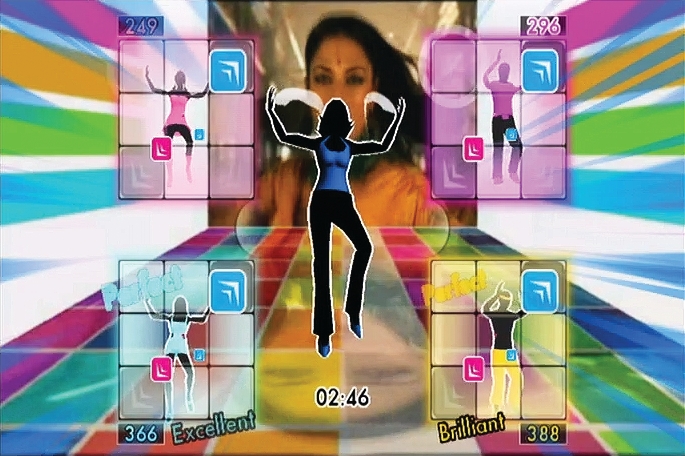
Nordic Games attended their first E3 this year and were pleasantly surprised as how well received the game was, with genuine enthusiasm from players who plucked up the courage to perform. We Dance includes three different styles of play – using the Wii Remote, using the dance mat accessory (such as Nordic Games’ “Star Mat”), or a combination of both. In addition, a 40-strong setlist brimming with popular dance tracks shouldn’t disappoint when it’s released.
To fully appreciate the entire tracklisting ahead of the game’s launch, Spotify users can click here to access the official We Dance playlist.
This week we talk about the Capsule Computers Community Night on XBL where we played Halo: Reach with everyone, discuss some game news, talk about what what we’ve been playing and end on our least threatening game villains.
Cast: Alexis Ayala, Philip Federico, Dustin Spencer, Michael Marr, Luke Halliday
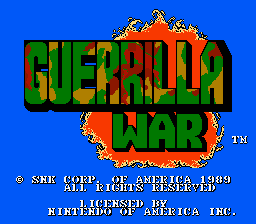
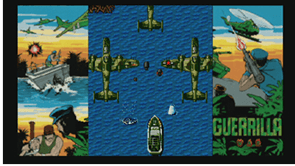
Game: Guerrilla War Publisher/Developer: SNK Playmore Consoles: PS3(Reviewed), PSP Price: $2.99 Genre: Top down shooter
SNK Playmore has released 8 classics onto the Playstation Network and so far, they have all been fairly decent games, although many of them desperately need a paint job and some updated gameplay. Nevertheless, for 20 year old games, they hold up on par with some of the games of today.
Guerrilla Wars is most likely the most popular of the 8 games released and it is available to Playstation Plus members for free. If you buy or receive one copy of the game, then it will be available to play on both the PSP and PS3, as is standard with all Minis on the Playstation Store.
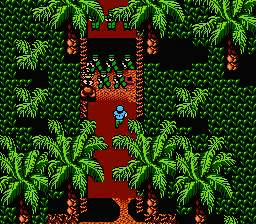
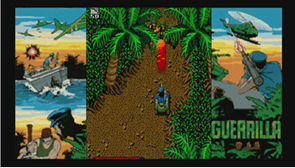
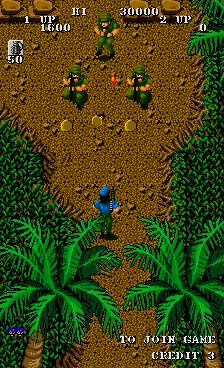
As with most games released in 1987 , Guerrilla Wars does very little to be praised in the graphical department. Everything is pixelated and the colors and textures are very basic. Nevertheless, this game’s graphics rise above those of Athena or HAL 21 (2 other games released by SNK on PSN). Character models especially look like they could, in some instances anyway, be substituted in iOS games or other modern games.
Unlike the previous arcade game that Guerrilla Wars originally was, this game only costs $2.99 and there is no quarter slot on the PS3 to continually feed it. Nevertheless, that doesn’t change anything in the gameplay department. This is a top down shooter where you must use your guns and grenades to fight a bevy of dangerous combatants. You will die, a lot. From the constant grenade spam (think World at War) to the awful boss fights, there will be a lot of cursing and raging as you play through this short little game. The “one hit and your dead” mechanic also seems a bit unfair, although the fact that you have unlimited continues and can up the lives counter to 5 does work in your favor. There is 2 player coop available if you need some help too.
Although the game does have a super high difficulty curve, it does offer some fun and slight strategic gameplay for those willing to give it a try. As a matter of fact, I would say it is one of the better games released by SNK so far. You can pilot tanks, pick up enemy weapons (flame thrower for the win!) and wreak havok with the reliable control system. Featuring the ability to auto aim in the options menu, it is gratifying to mow enemies down as you liberate an island. Although the story is nearly invisible it is enjoyable to finally meet the final boss and have your revenge (after 8 million deaths anyway).
In conclusion, Guerrilla Wars is the classic game that many people remember and it is the highlight of the 8 games released so far on PSN. If you have Playstation Plus, it will offer a nice respite from all that modern stuff. For the price of a couple of candy bars, it may offer some delight to others who own a PSP or PS3 as well, especially seeing as how you can accomplish one good deed for the day by freeing some hostages throughout the game!
When I originally read this article I decided to do some research but got bored reading biased research and stories taken out of context. The arguments for and against the influence of violent video games has been long standing and will more than likely continue till the end of time. Even recently within Australia, there has been a push from many states to include an R18+ category, as well as the banning of the latest Mortal Kombat due to gratuitous violence levels. So who better to voice his opinions on the matter than John Carmack, one of Id softwares founders. Carmack has been there from the beginning of FPS and violent franchises, being involved with the ground breaking Doom, which followed on from the Operation Wolfenstein phenomena.
Standing in total defence of violent games, Carmack is quick to comment, “There is more evidence to show that violent video games reduce aggression and violence”. He goes on to mention studies relating violence in games to cathartic type behaviour. Using QuakeCon as an example, Carmack believes a cross sectional study would reveal a much more placid crowd at the gaming convention. The technical director dismisses much of the hype surrounding the correlation between violent games and gamers aggression, clearly not losing any sleep over the matter to say the least.
Personally I do think violence in video games has an effect on our brains and anyone who argues differently doesn’t have a leg to stand on. If any gamer was hooked up to a neurotransmitter and played violent games one would of course expect certain centres within their brain to be active. What we are forgetting is if the same gamers were playing Fifa soccer, one would expect, as studies have shown that the SAME centres are activated sometimes at more intense levels. Think of the reaction that Soccer itself brings out in crowds. The countless riots and fences of iron to separate violent crowds all brought upon by a sporting event. Has anyone ever talked of banning Soccer or all sport for that matter simply because it brings out violent tendencies in some people? I grew up in Australia as a child with every kind of toy gun I can think of. The result, someone who believes all guns should be banned worldwide. I also grew up with cartoons where coyotes were massacred day in and day out by a bird, and ducks had their beaks blown backwards by redneck hunters, yet I feed feral cats and love all animals.
On the question as to whether violent games affect younger minds, that’s a different issue and all I will say on the matter is “RESPONSIBLE PARENTING”. If you couldn’t bothered as parent to check what rating the game YOU are buying for your child has then it’s not the industries issue, it’s yours. So in a nutshell I have no issue with violence in video games no matter how disturbing it gets. My parents taught me right from wrong, something that the video game industry can’t change. Reading other gamers comments I’m confident their parents instilled the same values.
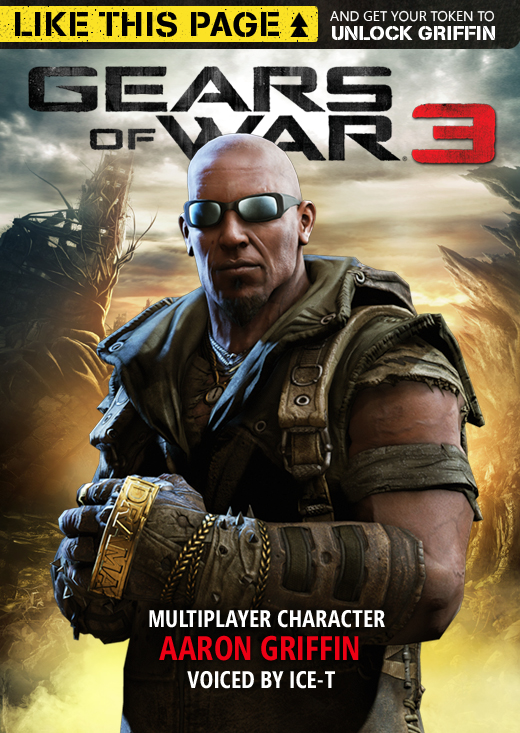
Everyone, in order to unlock the playable character Griffin in Gears of War 3, as played by Ice-T, you must act quickly and like the games Facebook Page.
Liking the facebook page will give you a token to use the character Griffin in multiplayer. So make sure you do this quickly as I have no idea on how long it’s going to be up.
Gears of War 3 now has aFacebook page for everyone to like and follow for the latest Gears News, or you can follow us here at Capsule Computers where we are sure to be mirroring, or maybe even have exclusive, information.
Overview:
There are types of games that lend themselves to mobile devices and there are types that simply should not see the light of day on them. The platform itself is still relatively new territory for gaming when you consider the mediums long history. So you’d be excused for thinking that it the platform is still finding it’s footing. Unfortunately though until it does find it, games such as Mad Wheels will pile into the virtual landfill known as iOS gaming.
Gameplay:
Let me start by saying that Mad Wheels isn’t necessarily a bad game, it’s just not even close to being a good game. On a functional level, it works. But on the grand scale of things, Gamaday clearly had no intentions of creating anything other than a functioning racing game. They never seemed to strive for anything more and thus, Mad Wheels is mediocre by every sense of the word.
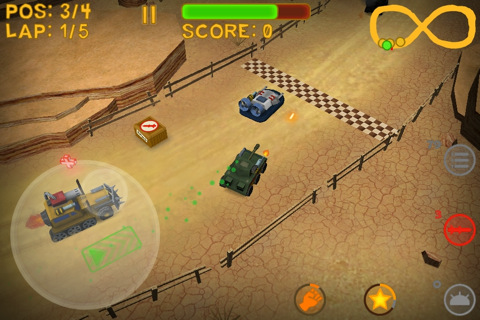
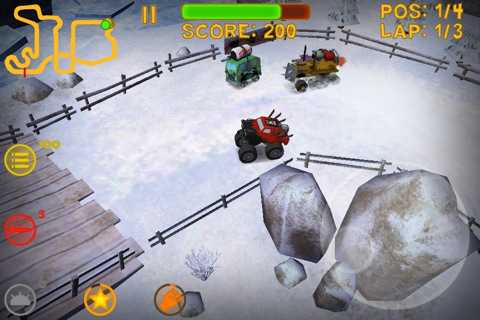
The game as you can tell from it’s title is a racing game. It is for the iOS and as you most likely know, racing games don’t have the best track record (pun intended) when it comes to the iOS. Mad Wheels just adds another to the list.
The control scheme is put simply, a mess. It is impossible to master this often unresponsive control system, which requires one thumb to steer your vehicle with an on screen control stick and the other to tap tiny icons to use weapons. This would work if both of these controls would respond properly. They either do not respond at all or respond late, which in a game such as this is just not acceptable.
The racing itself is bland, awkward and unenjoyable. There is next to no incentive to continue playing and is more likely to turn a player away than to maintain their attention. Even for casual play this is pushing the human minds attention span to its up most limits.
That isn’t to say the game is all bad, there was potential here. It would have been half decent if even an ounce more care was put into it’s development. As it stands the game feels and plays like a freeware title, which is never a good thing when you are trying to sell it to a large market. It’s a shame because the game does show signs of potential, if it had only had more care put into it’s creation.
Visuals:
The graphics of the game are decent and do the job they need to do, however they are quite bland. The visuals do not stand out in any significant way from the sea of other racing games for the iOS, but on a functional level, they work. It looks like a racing game, thats all Gamaday tried to do and it is all they achieved.
There isn’t anything too impressive here and that doesn’t just speak for the visuals but the entire game in general. It’s very lackluster and most definitely required more nurturing during the creative process.
Audio:
The music for the game was average and didn’t even try to leave an impression. It did what it had to do and called it a night. Perhaps they were playing it safe? Whether that was the case or not, it is unfortunately mediocre and forgettable.
With a game called Mad Wheels I expected some more exciting music to justify it’s title. Instead the game subjects you to the soundtrack of nearly every other racing game for the iOS, random generic rock music. It’s just sloppy and ultimately disappointing.
Conclusion:
All-in-all, Mad Wheels is a game that doesn’t strive for to much, and rightfully so achieves very little. It is a basic racing game that doesn’t always work the way it should. It is playable but little more. I will reiterate one last time, this game could have been much better. It had a great deal of untapped potential which is evident throughout the game but it never even seems to grasp for anything other than proper functionality.