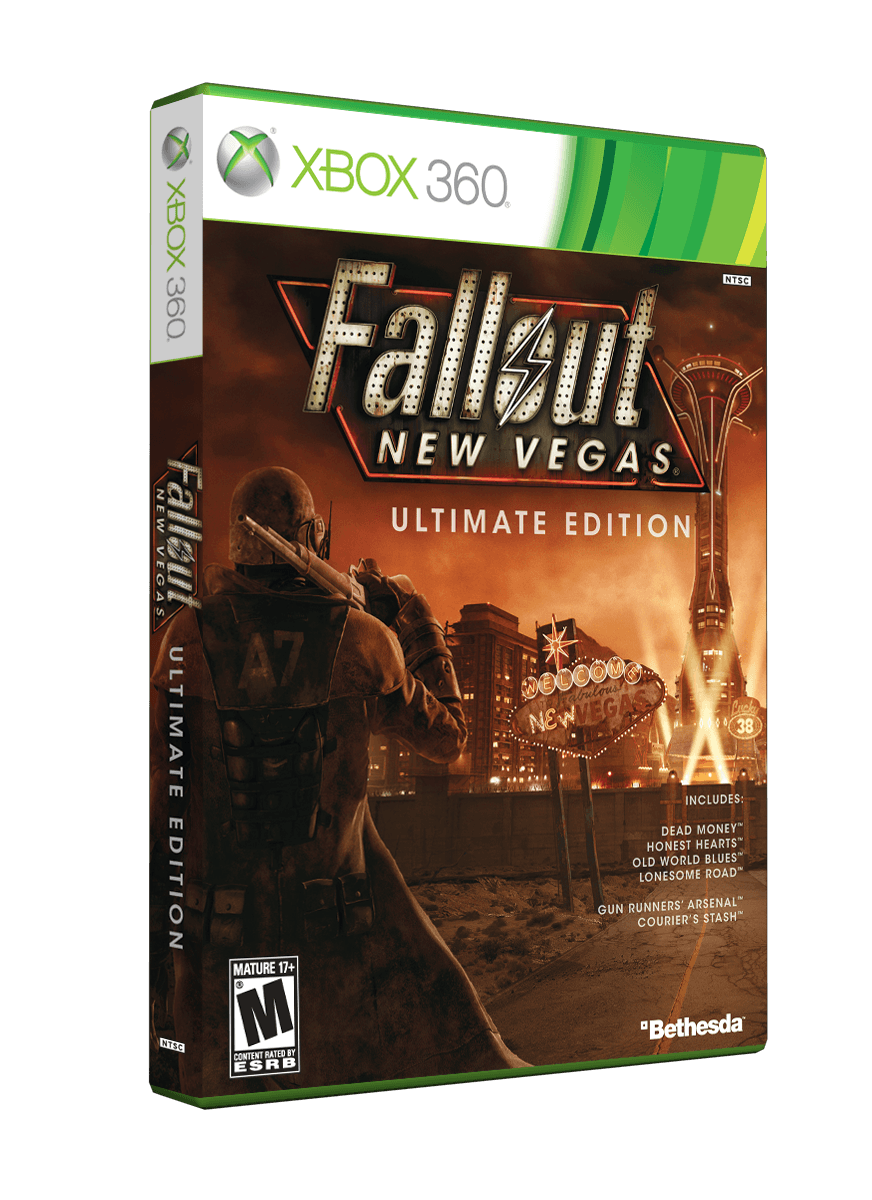
We all knew that it was only going to be a matter of time until Fallout: New Vegas would receive some sort of special edition, but thankfully for those who purchased all of the content separately, the wait has been a long one. Today Bethesda revealed that they will be releasing a Fallout: New Vegas Ultimate Edition in North America and Europe on February 7 and 10 respectively.
This Ultimate Edition will include all of the past DLC packs, which means you will receive Dead Money, Honest Hearts, Old World Blues and Lonesome Road as well as the weapon packs Courier’s Stash and Gun Runners’ Arsenal. This ultimate edition will cost $49.99 for the Xbox 360 and PS3, and $39.99 for PC. This is quite literally a massive amount of content added to what is already a massive game.
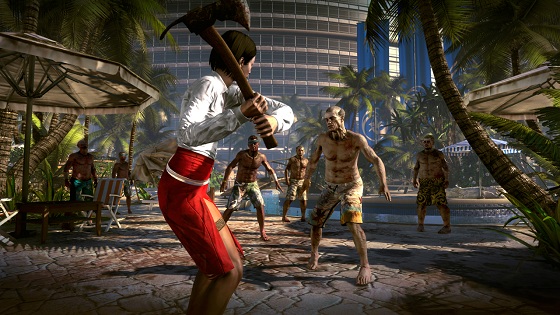
Those who have been keeping an ear to the ground in case of a Dead Island sequel have finally heard a few rumbles. Siliconera reports that the developer of the zombie filled Dead Island, Techland has recently trademarked a new title called Dead World. The company has not announced anything at this time and has declined to comment on any possible sequel.
Dead Island did quite well at retail which means that a bigger and larger scoped game such as a Dead World rather than and Island would provide fans with a much more massive experience. Of course at the moment this is all speculation, but perhaps this will turn out to be a reality.
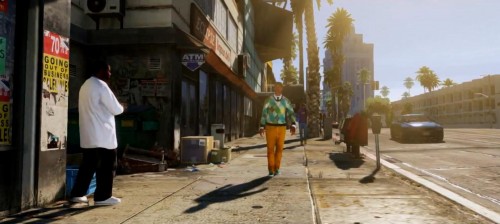
It has been a long three years since the last full Grand Theft Auto game (not including Grand Theft Auto IV’s episodic expansion packs) was released back in 2008. Having played and finished almost every single Grand Theft Auto game ever (yes even the original top-down Grand Theft Auto 1 and 2, and the handheld ones as well Grand Theft Auto Advance for Gameboy Advance and Liberty City Stories and Vice City Stories), it is safe to say that I was quite eagerly excited for the big unveil of Grand Theft Auto V’s debut trailer on Rockstar Games’ official website – and it certainly did not disappoint.
For those of you who have not seen it yet, the next instalment of the Grand Theft Auto series is set in a familiar location – Los Santos, San Andreas aka Los Angeles, California its real world counterpart. So just what can we expect from Grand Theft Auto V? Well if its predecessors are anything to go by, a pretty damn good game! But let’s look at it more closely. Throughout the years, each instalment of the Grand Theft Auto series has pushed the limits of player’s expectations on what a game and consoles are capable of.
Grand Theft Auto III gave us an entire city to wreck havoc in and subsequently its sequel Grand Theft Auto: Vice City, showed us how a period setting and colourful location could make an already great concept even better. Two years later, Grand Theft Auto: San Andreas again exceeded our expectations, showing us what ‘scale’ could do to a game. Players were given not one, not two but three city and the entire state of San Andreas to explore. This truly gave players an open-world to experience, one that was remarkable without any load screens between each city.
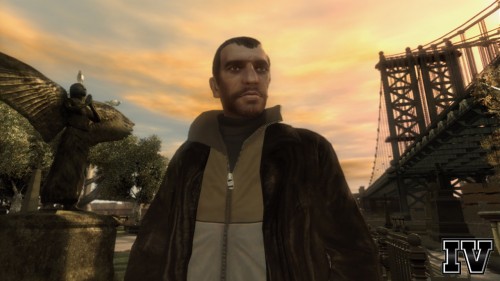
Grand Theft Auto’s jump to the current generation of gaming brought with it a serious tone, and ‘serious’ isn’t usually a word I would use to describe Grand Theft Auto. Grand Theft Auto IV saw a rebooting of the video game series. From the closing lines of Grand Theft Auto IV’s debut trailer, Niko Bellic memorably state “…Perhaps here things will be different” and yes, yes they were. Gone were all links to previous Grand Theft Auto games and gone was the excessive ridiculousness that highlighted Grand Theft Auto over-the-topness.
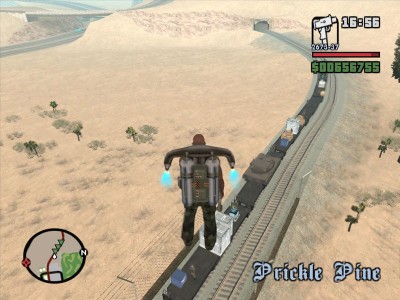
Grand Theft Auto IV ushered in a new era seeing in a return to a revamped and far more realistic Liberty City, with a storyline considerably more mature and serious than ever before. All humour was not lost however, there were of course the occasional dick and 69 jokes but considering that in Grand Theft Auto: San Andreas, you could jetpack across a city, base-jump out of a building and shoot up a place with a mini-gun dressed in a gimp suit; Grand Theft Auto IV felt lacking and somewhat disappointing in my option.
However with all this said, all of Grand Theft Auto IV’s short comings in its single player could easily be made up for in its multiplayer offerings. Multiplayer was a major selling point for Grand Theft Auto IV and the next big thing in gamers’ minds. Whilst multiplayer wasn’t entirely new for the series as it did appear in Grand Theft Auto: Liberty City Stories and Vice City Stories for the PSP, it was bogged down in a logistical nightmare.
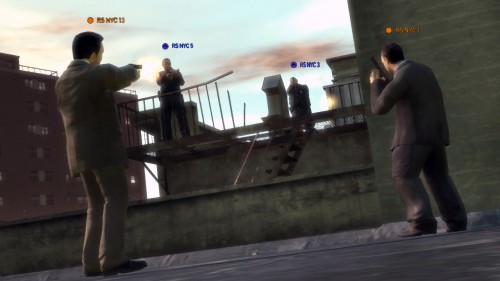
You need at least five other players with their own copy of the game and their own PSP just to play a full match in multiplayer, and good luck trying to find that. Grand Theft Auto IV was the first time that gamers could easily access Grand Theft Auto multiplayer. And it was here that the most fun could be had, as players were given a sandbox for them to make up their own rules and scenarios to play in. Everyone vs. the police, yes please! See who could last the longest with a six star wanted rating, check! Fortified a hospital and fight off police, yeah we will!
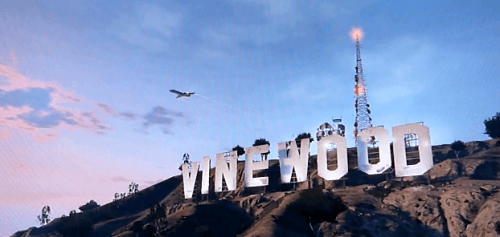
So with all this in mind, just what can Grand Theft Auto V give to us that we haven’t already seen and done before? Baring in mind that this game has only recently been announced and the first footage of the game has only just been released, the following will is only going to be wild speculation. But nonetheless, judging by Grand Theft Auto V’s debut trailer the game is looking fantastic, with top notch graphics no less. And it appears that Rockstar may even be returning to the ‘classic’ Grand Theft Auto of yesteryears going by a few hints in the trailer.
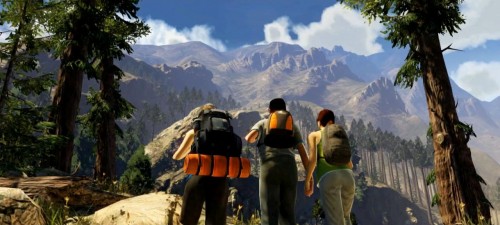
So far Rockstar Games have only shown us Los Santos, and as well all know this means that the game will be set in San Andreas. But does that mean that the will only take place in Los Santos and what about San Fierro and Las Venturas, the other two major cities in San Andreas? Grand Theft Auto V’s trailer does hint to other locations. A small bit of the countryside is shown and if you look close in one of the outdoor scenes I’m pretty sure Mount Chiliad is shown in the trailer. Planes are also shown which also hints towards multiple cities. Perhaps Grand Theft Auto V will take a bold move and include the two other cities along with two new playable protagonists, much like Grand Theft Auto IV did with its episodic content: The Lost and Damned and The Ballad of Gay Tony.
Buyable properties are also hinted in the trailer, with a ‘For Sale’ sign being hammered in front of a house. Buyable properties were a major gameplay feature in Grand Theft Auto: Vice City and were available in Grand Theft Auto San Andreas. In Vice City, player had to purchase properties to expand their criminal empire and these assist properties provided the game with extra missions and were some were even vital to game’s overall storyline. Perhaps we will see a similar interrogation of this system in Grand Theft Auto V.
The Grand Theft Auto games have always been a mix of an above average shooter and an above average driving gaming that has been put in a sandbox world. This formula has lead to pretty decent gameplay and overall has from some pretty damn good game over the years. However, Grand Theft Auto V needs a good overhaul of both its shooting and driving mechanics to really stand out again. Case and point – Try playing Grand Theft Auto IV on consoles with auto-aim turned off…it is frustrating, the game wasn’t not designed for tight one-on-one combat.
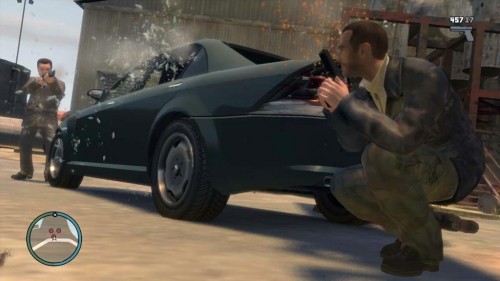
The inclusion of a cover system in Grand Theft Auto IV was something new and different to experiment with. And while it had its single player highlights, Gears of War this was not. Grand Theft Auto IV multiplayer exposed the flaws of the cover system, it was simply a hassle and impractical to use in open environments. And where to began with driving…just take a look at the next time you’re racing in Grand Theft Auto IV’s multiplayer, chances are that 85% of players will overturn, spinout or crash within the first turn of the race. Grand Theft Auto V will certainly need to have tighter and more focused controls.
But with all this said, I’m glad to see that Grand Theft Auto V has been finally unveiled and that we will be returning to Los Santos. With no release date announced, it may in fact be another long wait till we actually get our hands on this one. But all in all, a new Grand Theft Auto game is defiantly good news and I look forward to spending another 40+ hours in San Andreas.
Stay tuned for more Grand Theft Auto V news as it comes
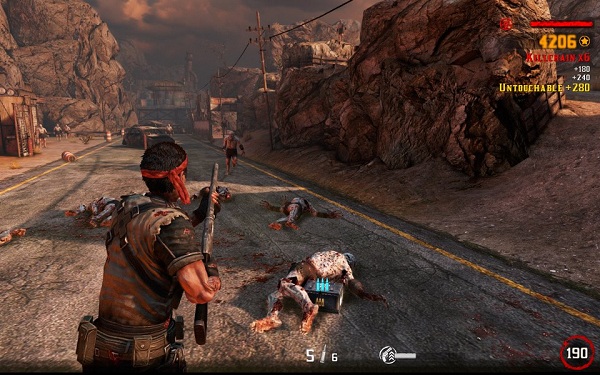
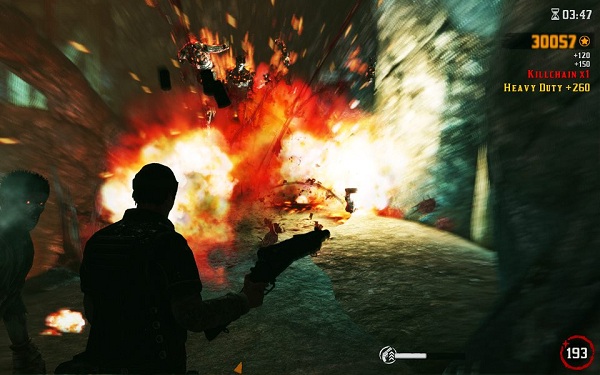
Released just over a week ago and already receiving much praise for its original art direction and unique take on survival shooter gameplay, “The Haunted: Hell’s Reach” is stirring things up for the whole zombie game genre. The project and its team are a force to be reckoned with. Excited to get an insight into The Haunted’s growth from humble beginnings to critical acclaim, I caught up with the game’s original creator, game and art director, and programmer, Michael “Hegi” Hegemann, and here’s what he had to tell me;
Capsule: The Haunted started out as an excellent total conversion for the already rich and fertile Unreal Tournament modification scene, but earned high praise and status (congratulations by the way) when it won the 2009 Make Something Unreal contest. What was that like for you guys?
Michael Hegemann: That was a really great success for us and without the contest it would not have been possible to make this game. Something like that will probably never happen again. It was great to see former team members getting more recognition and being hired for their work on The Haunted. The contest times are unforgettable and everyone who has been part of the project can be proud.
Capsule: The survival shooter is something of a crowded genre as of late, and many other titles also feature our good friends the undead. What personally do you guys think you brought to the table with Hell’s Reach?
Michael Hegemann: I think the unique combination of weapon combat, melee attacks and movement along with the unique style is what sets us apart from the other action games out there. We are not a big IP and therefore can take more risks and try out new things. Then we have cool game modes like Demonizer where each dead human player is turned into a demon and can spawn and play the monsters by himself.
Capsule: The use of colons in the title makes me think you guys want to make more games in the universe of “The Haunted”, is there a real possibility of this or is this just wishful thinking on my part?
Michael Hegemann: Of course there is a possibility, I don’t think we will ever turn this into a epic franchise like Uncharted and others, but who knows what the future will bring. Let’s finish Hells Reach first and bring it to console players around the world on Xbox360 and PS3. Then we can talk about The Haunted: Social Slaughterhouse for Facebook!
Capsule: I don’t doubt that the project has been something of a journey for you guys, so I’m dying to know; what was it like developing The Haunted, both as a mod and then an indie game, and what were the biggest challenges and victories along the road?
Michael Hegemann: It was really one hell of a journey with a lot of ups and downs. For me, things have become a bit quieter as the foundation of the game is done and it’s much more about the details of Game Design wich is Gerhard’s territory. I weighed in on all art and game world things. Overall I’m still happy about the consistency of everything after all these years and despite it being a real arcade game. The mod times were pretty cool, it was amazing how this project grew from a small and personal game to something this big. I’am thankful that I could experience the development time together with such a great team of people and with all the creative peak-states especially during the mod years where the style was defined and new features or weapons came to life on a daily basis. It was extremely hard work but the reward of seeing it evolve is just unexplainable. The biggest challenge is always finishing something, the last 20% takes 80% of the time. Great victories were winning big in every contest phase including the grand finals and then getting a publishing deal in 2011 and then finally releasing the game. Thanks to the founders of KTX Software and THQ who made that possible. The coolest thing however is when people really love the game and give us feedback.
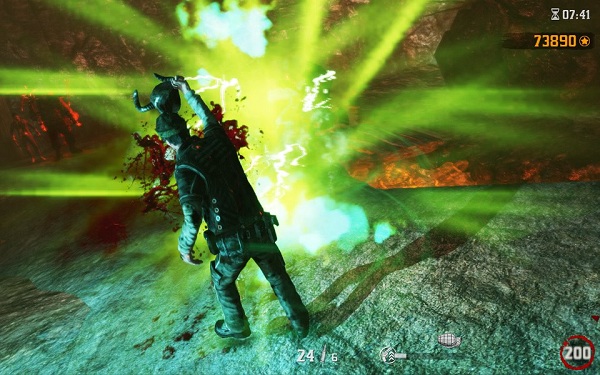
Capsule: One of the very best aspects of Hell’s Reach is its art and graphics. Staggeringly detailed environments, wonderful particle effects and fantastic use of colour grading all make it as great to look at as it is to play. Who in your team is behind the magic and where do they get their inspiration from?
Michael Hegemann: Thanks, it’s all about style and gameplay. I have done the Art Direction and laid all the groundwork. The small and highly talented team of artists then made the idea a reality and here we are. Quite a few people said it’s influenced by the Dark Tower universe, especially the first book, and it is. The style that is so perfectly described is so distinct and memorable that it sticks with you, but it kinda feels like drawing an image through 50 sheets of paper when people get a Dark Tower vibe from the game.
The locations are seperated into gothic style and western/modern style environments. This allows us to have a lot of consistency but also allows us to be very varied. The music also has been specifically composed to fit these scenarios, wich adds another layer of individualism. The goal was that the style is somehow remarkable and unique, rather than trying to be realistic at all costs. Once you see it, you know exactly what game it is.
The scenario is also heavily influenced by the horror and action films aswell as tv shows that most gamers of our generation watched as kids. It’s like “Evil Dead meets the A-Team in Mid-World”. Heavy metal and rock music also had it’s influence on the style.
Despite the influence of past decades on Hell’s Reach, the game looks modern, but hand-crafted and unique for it’s genre.
Capsule: Last, but certainly not least, the Steam store page for Hell’s Reach promises “free future updates and DLC”, without giving away too much, what upcoming stuff can you tell us about?
Michael Hegemann: We dont know yet what that DLC will be, but most likely an extra map or two.
We at Capsule Computers would like to thank Michael for taking the time to answer our questions, and we wish him and the rest of the team all the best.
If you want to track updates and DLC for The Haunted: Hell’s Reach, you can do so on Twitter.
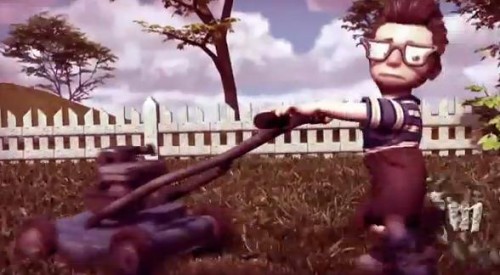
It’s that time of the week yet again. Finally gracing the Nintendo 3DS/DS with it’s presence is Zordix AB’s 1950’s Lawn Mower Kids for $4.99. We have detailed the indie mowing sim quite a bit in the past, but these odd yet passionate developers seem pretty content that this is one mowing experience you won’t soon forget.
Also on the eShop is Balloon Kid, the Game Boy equivalent to the NES classic, Balloon Fight. This retro gem is priced at a low $2.99. House is back a new medical mystery on the DSiWare in House M.D. – Episode 4: Crashed, which can be purchased for $7.99 and Zelda fans are also in luck as “The Legend of Zelda Main Theme Medley” has been added to Nintendo video, which should be a nice appetizer for Skyward Sword.
Fans of the WiiWare also have some nice Gnomz to chew on this week, with the game “Gnomz” that allows players to battle in 25 arenas and discover magical power-ups, flying elephants, rainbows and glowing reindeer. Interesting concept..and priced at 1000 Nintendo points.
So which one of these titles has your interest this week?
If you were a gamer growing up in the 90’s, you more than likely had a favorite mascot from the generation that you still stand behind as of today. Capcom fanatics are still ever-passionate about Mega-Man, Mario and Link could still sell anything with their famous logos and names attached, and good ol’ Sonic is still speeding along due to his passionate following. I was always the odd man out growing up though, as my favorite mascot was the ever cheerful Kirby. While many icons of the industry have showed a fierce amount of evolution in terms of visuals and more challenging gameplay, the Kirby series has went a different route and focused more on re-invention by sticking the pink fluff into titles that fully utilized the technology of whatever platform they were released for while keeping the same charms that made the mascot a household name. There is no doubt that those games were fantastic additions to the series, but I have hungered for years for a completely traditional Kirby game with no gimmickry or strings attached (Don’t worry Yarn Kirby, I still love you).
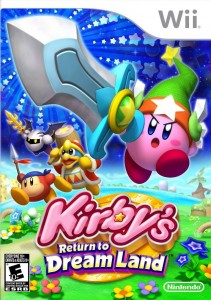
After over ten years of being put on the back burner, Kirby is finally ready to fully return to his ability copying roots that made him such a star years ago with Kirby’s Return to Dream Land. This brand new adventure adds in a few new features that have never been seen in the platforming romps of the past, but aims in a bigger way to re-capture the magic that Kirby Super Star and Dream Land 3 brought us over 15 years ago. It’s quite an ambitious task for the little pink fluff, but thankfully the final product delivered more than this Kirby fan could have ever asked for. Without further ado, here is my review for Kirby’s Return to Dream Land.
Story
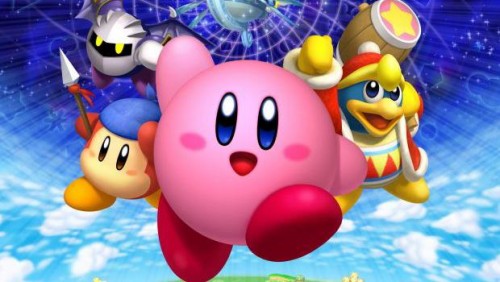
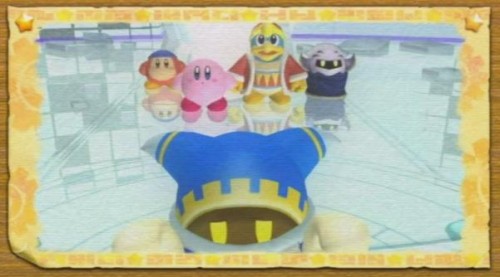
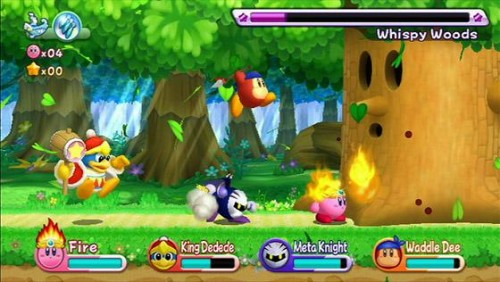
Kirby’s Return to Dream Land starts out with Kirby, Waddle Dee, and King Dedede playfully chasing eachother over a delicious cake while Meta-Knight partakes in some reading. Soon after, a large alien ship interrupts these casual events when it crash lands on Planet Popstar, leading the quartet of characters to drop everything and go investigate. The “Kirby Krew” find a small alien aboard the fallen vessel, who explains that his ship is now wrecked and 5 crucial pieces are scattered about the colorful world. Without much hesitation, the group decide to assist and set out to recover these ship pieces so the alien can safely return home.
As you could probably tell, the narrative here stays true to the light-hearted nature of the series. This is in no way a bad thing though, as there is so much personality in the entire plot that one doesn’t have to emerge themselves in any deep details or jaw-dropping cinematics to easily tag along on this delightful adventure. Find ship pieces and make an alien happy. That is your mission, and Kirby and his friends seem so thrilled to be helping that it’s hard not to want to achieve this objective for them.
As players trek through Planet Popstar, they are treated to many classic enemies from the past such as Bronto Burt, Broom-Hatter, and many past mid-bosses that have not appeared in a Kirby title for quite some time. It isn’t all about the old though, as new enemies have made their debut in Return to Dream Land and as one would expect, they fit in perfectly in the upbeat and familiar locations. Yes, this game is loaded with fan service and new treats for those who have followed the series, but as always the game retains it’s inviting quality for newcomers, allowing everyone to benefit from all of Dream Land’s charms and personality.
Gameplay
As I mentioned, Kirby’s Return to Dream Land is about the purest form of a Kirby title we have seen since the days of the Super Nintendo and a platformer at it’s core from beginning to end. Being on the Wii, a system that is known for adding in some kind of motion-controlled mechanic, my biggest worry was that this game in particular would have some form of gimmick stapled into it, just to fit with the platform. Thankfully, that is not the case though as for the most part, everything stays simple in terms of control and players will be able to waddle through Dream Land with just the Wiimote turned sideways. As always, Kirby can jump and inhale air to float for an infinite amount of time, run by double tapping the forward button, and perform a quick slide to glide out of danger. These commands are performed without error and are so easy to execute that just about everyone shouldn’t have much of a problem in mastering the basics in just a few minutes. Let’s be honest though. You probably don’t care much to hear all about that though. This is the game where abilities return, so let’s start talking about Kirby’s most famous trait. The suckage.
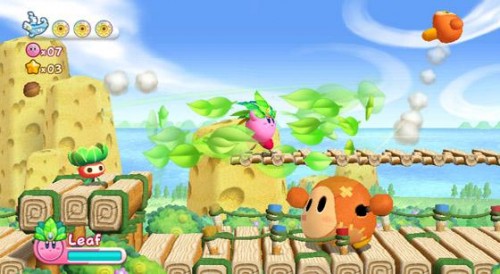
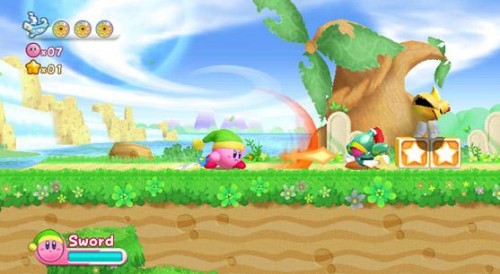
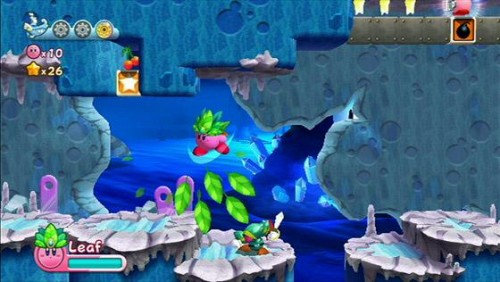
At the touch of a button, Kirby can instantly suck in an enemy into his large mouth. When the same button is hit again, our pink fluff fires their remains out in star form, which can be used as a damaging projectile if needed. An upgrade to this old feature also lets Kirby now consume even larger enemies and even pieces of the stage by waggling the Wiimote while inhaling. As always, whenever the player hits down to swallow a particular enemy, their powers are absorbed and Kirby dons the look and abilities of his former meal. Many of the trademark techniques such as Rock, Needle and Sword Return, but with extra moves offered for each depending on the combination entered. For instance, if you inhale Needle foe, you can stab all enemies around you by hitting the action button, or hit an alternate combo to take off in a pointy spin-dash or form one large spike to nail an enemy up above. This large amount of variation makes each ability much more rewarding to use and keeps the gameplay constantly changing, making for no feelings of repetition during the entire experience.
To go along with the over 20 abilities Kirby can possess come the many stages within the game. Much like Kirby’s Adventure, Return to Dream Land is broken down into a handful of worlds. Each of these locations vary in theme and are made up of 5 standard stages and one boss room at the end. HAL could have easily gotten away with just running with a setting change and still kept the game fresh due to the how the gameplay changes up for each world, but I was very impressed to see just how different each level felt from the next. The basic objective of each level is to collect all of the energy spheres you can while passing through star doors until you reach the end. Sometimes you will have to find a key or defeat a boss to make it to the next star door, but the game rarely breaks away from the classic concept of “reaching the end” that nearly every traditional title in the franchise has offered.
What does change up quite often though is the level design. Nearly every stage feels distinct due to the mass amount of gameplay changes that players will encounter. At times, Kirby will go through one level in classic form, just swallowing up and defeating enemies along the way. Other moments however offer up some swimming, controlling Kirby as he is sucked through a wind tunnel, and having to steer as you parasol safely to the ground, just to name a few. All of this variation is perfectly paced and fits into whatever stage you may be on, which is kind like entering that last missing puzzle piece. The Kirby series as a whole is quite known for offering up brilliant level design, but I honestly felt that Return to Dream Land excelled in this area even more so as each new stage brought new ideas to the table, making progression even more rewarding as a result.
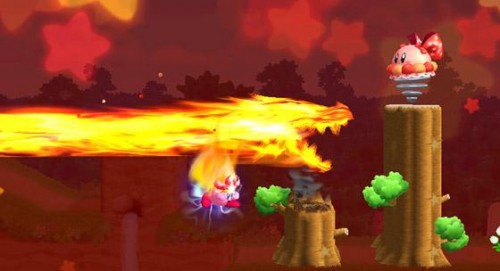
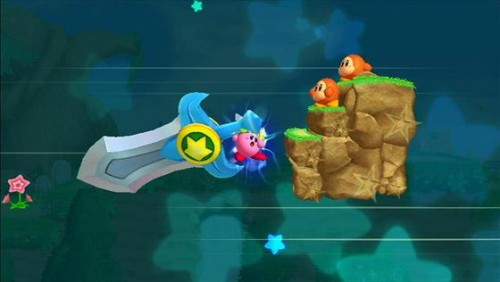
There have also been new additions this time around. If you happen to see a glowing enemy, Kirby can inhale their powers and gain a Super Ability. These work almost the same as standard techniques, but with a much more powerful result. If you get the Sword, Kirby will lash out a blade 10 times his size and use it to destroy any enemy in sight as well as the environment. Others include the likes of turning our pink hero into a giant snowball to roll through all foes in your path, taking on the power of a beam where you can control giant orbs, and launching a blazing stream of fire that is sure to burn everything to a crisp once executed. Yes, these attacks are as awesome as they sound and since they are not a common occurrence, it can feel pretty special to stumble upon a shiny foe and unlock his (or her?) epic secrets. These Super Abilities usually lead to yet another new feature, Star Portals. Nearly every other stage has one of these mysterious areas where the player is thrown into a world without color and must run from an aura before it crushes Kirby flat. It’s quite a hectic change of pace, but a welcome change considering the rewards that await at the end of each one of these events.
The most promoted new feature however lies in the game’s multiplayer. I am sure many remember New Super Mario Bros. famous multiplayer mode, and Return to Dream Land is very similar as other players can take the roles of Waddle Dee, Meta-Knight, and Dedede (or just four differently colored Kirby) and play through the game in it’s entirety with four player co-op. There is a lot of teamwork that can be done in this mode and each new protagonist feature their own distinct styles, giving a great reason to call up some friends to join in on the action. We all know how co-op modes usually go though. Someone leaves and the game just doesn’t feel the same playing solo as many challenges cannot be reached as they are exclusive to multiplayer participation. Luckily, this is not the case for Kirby as the co-op is just an addition and takes nothing away from the single player experience. All of the stages are well designed to handle four players at once too, so no one should feel any crowding due to all of the players being on the screen at the same time.
After it was all said and done, I completed the entire game in around 7 hours. Since it’s a Kirby game in general, most will not find a lot of challenge if they just breeze through. Yes, the simplicity is still there, but that doesn’t deter Kirby from putting on a fantastic show from beginning to end. Seasoned gamers who are looking for a test of wits though will find one in trying to 100% the game though, as trying to track down each one of the 120 energy spheres can be quite a test in itself. Bonus areas also open up as the game is completed, offering certain challenges for specific abilities and a mix of fun little mini-games to kill some time with. If all of that wasn’t enough, a much harder version of the entire story mode can be unlocked, which gives bosses new fighting tactics and offers a more hectic style of play.
Visuals/Audio
If you have ever stared at fireworks in awe or ever seen a fantastic light display that made your draw drop, that feeling is exactly how I would compare the visuals in Kirby’s Return to Dream Land. The entire world is brightly colored and reeks of charm and cuteness the entire way through. It’s that kind of warmness that can make even the angriest gamer feel calm after just a few minutes time and yet another endearing quality that the franchise has been built upon. Each model for every character in the game is polished as well, giving off some of the best visuals the Wii has seen to date. Minor animations also go a long way to bring out Kirby’s care-free personality as well, with Kirby surfing or ice skating through Planet PopStar when donning the appropriate hat. No, you won’t get a 1080p masterpiece, but players should definitely expect their eyes to be taken on a marvelous journey that is full of wonder and quirky Kirby charm.
The soundtrack is also a pleasant affair, with past tunes returning in classic and redone form that are sure to make Kirby nuts dance for joy. Each track matches whatever level you may be on as well, so if you are gazing upon a starry backdrop amongst the clouds, you will hear a tranquil song bring the environment to life. There is quite a variety in all and even though I still prefer the music Epic Yarn had to offer, HAL certainly made sure sound was just as an important feature for Kirby’s return to the Wii. Nothing has really been done to Kirby’s voice, but those little squeals of joy and concern still capture his puffy personality well and keep everything light-hearted, no matter how serious the situation is at hand.
Overall
I don’t think there is much doubt that the Nintendo Wii has had a very slow year in 2011. With that said, I feel like this game completely redeems the slow period and gives any owner of the platform new reason to get their console back as a prominent piece of their gaming setup. Kirby doesn’t try to push any limits or change up everything you would expect from a platformer in this adventure, but instead offers what feels like a relaxing vacation from the AAA blockbusters that we have seen so prominently released. 15 years ago, video games weren’t meant to make you have deep thoughts or make you chuck your controller in sheer frustration, they were simply around to entertain. That is what this title is all about. 100% care-free fun with a mascot of the same mindset. Kirby’s Return to Dream Land is this generation’s balance at the other end of the scale, and quite possibly the best Nintendo Wii game to date.
Rising Star Games has today announced the signing of two new Gaijin Games titles, BIT.TRIP COMPLETE and BIT.TRIP SAGA.
Both COMPLETE and SAGA offer an amazing collection of six celebrated indie BIT.TRIP games, and will be available to buy in Q1, 2012, on platforms Nintendo Wii and 3DS.
The six games featured:
BIT.TRIP BEAT marks the beginning of CommanderVideo’s epic journey BIT.TRIP CORE is the second instalment in CommanderVideo’s soul quest BIT.TRIP VOID continues CommanderVideo’s epic journey BIT.TRIP Runner marks the first fully character-based adventure for CommanderVideo BIT.TRIP FATE is the penultimate chapter in the six-part BIT.TRIP series and will leave you wondering what’s next
The BIT.TRIP series comes full circle with BIT.TRIP FLUX, CommanderVideo’s final adventure
All that’s left to say is thank you, Rising Star Games. Bringing this excellent compilation to European soil is much appreciated and will hopefully open up the games to a new audience who haven’t downloaded any of the titles digitally.
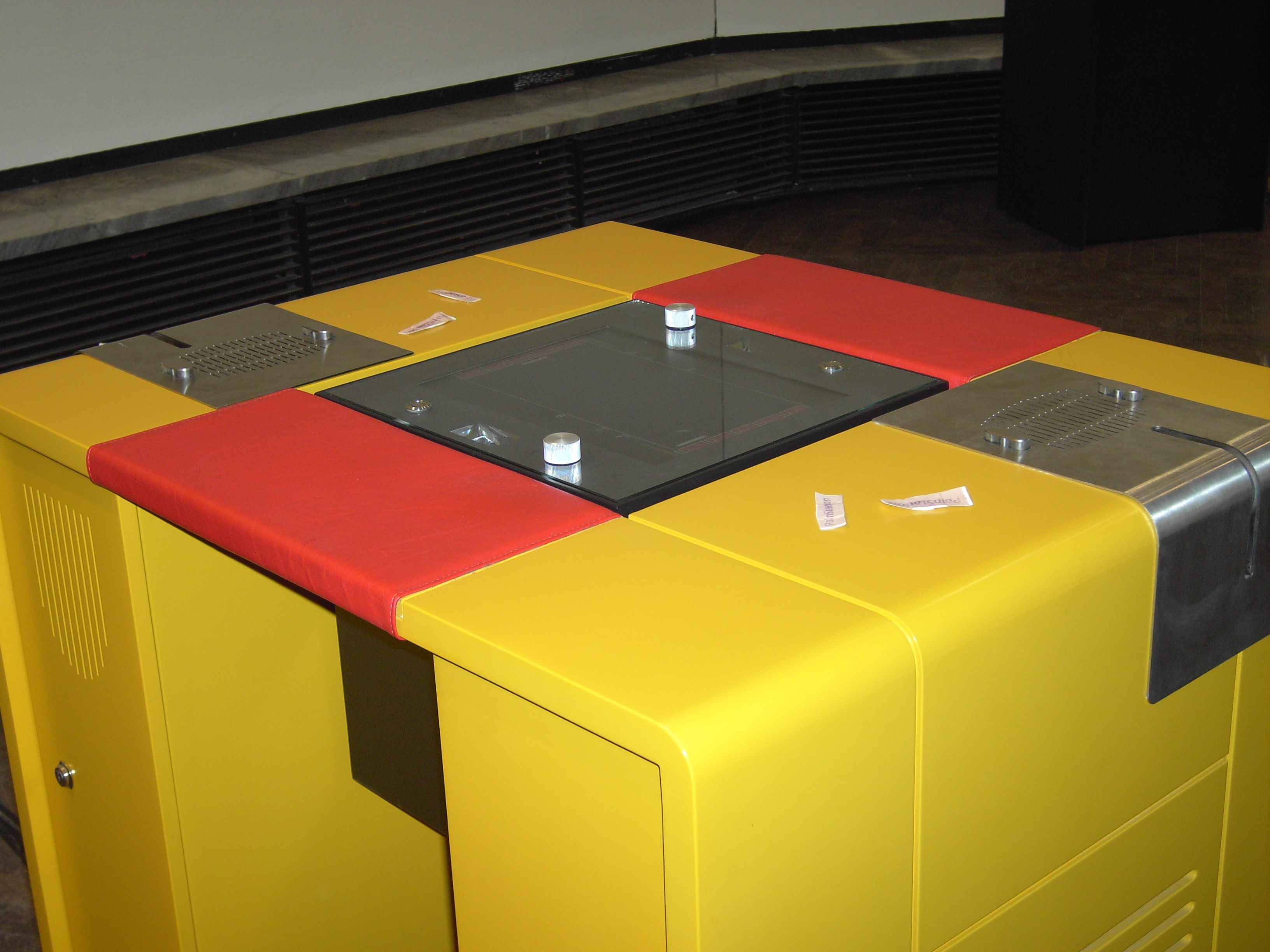
I recall reading about this when it was first released many years ago, and call me sick and twisted but it always stuck in my mind as a cool concept with many social issues rooted deeply in its ideology. So without further ado I bring you the ultimate in sadistic gaming; The Painstation. The arcade gaming console (which has NOTHING to do with Sony and the Playstation brand), is an interactive device first designed by 2 student s in cologne and having several upgrades since, that delivers various degrees of pain to opponents while playing a simple Pong based game. Sounding cool yet? Well it gets better.
Players place their hands in the PEU or Pain Execution Unit (Yeah sure I’d put any body part in something called a Pain Execution Unit but anyway), which provides sensory feedback and can administer heat impulses, electric shocks and comes complete with a miniature wire whip. Removing your hand from the device counts as an automatic forfeit.
According to the team, initial legal issues as well as design flaws made a commercial unit hard to produce but they eventually got there adding various features and twisted benefits along the way. Safer whips have replaced the old wire mechanism which left large open welts on players (although much to their delight), and intensity meters can change the electrical output. The unit has also become more comfortable to players and taken on a more current feel and look.
One could only imagine the consequences if this unit made its way to the retail sector, I think DOCS and related child services would need to increase their staffing. Yet it does push the boundaries between what some might call pleasure and others would refer to as sick deprivation. Would you give the painstation a go or do you think its creators need a psychiatric evaluation?
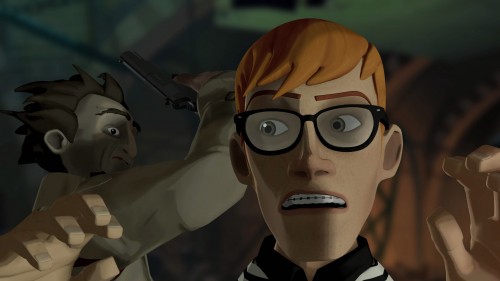
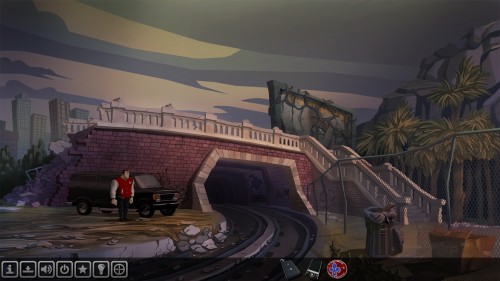
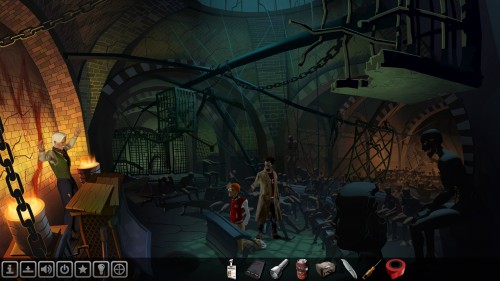
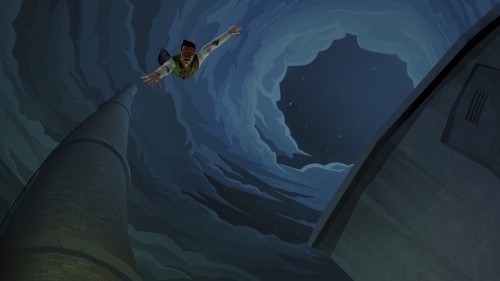
Pendulo Studios (the studio who released such titles as the trilogy Runaway and The Next BIG Thing) announced their latest release, Yesterday. They’ve offered up a few screenshots and the graphics are looking pretty slick, with that cool stylized feel alone with interesting looking scenes.
The story is set in New York City, where beggars are disappearing and being found burnt alive. Along with these mysterious disappearances, Y-shaped scars have started to form in the palms of unrelated people. No one seems to be interested in these events except for Henry White and Cooper (two of the three playable characters, the third being John Yesterday who has a wiped memory).
I’m sure that this adventure will turn out to be just as enthralling and intriguing as the last. More information about the game will be revealed in the coming months so make sure to keep tuned to the site, we will definitely keep you up to date as the information comes out.
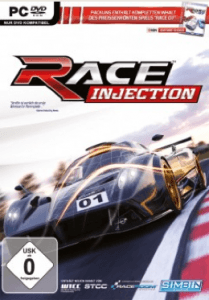
Namco Bandai has partnered up with SimBin Studios for the PC game, RACE Injection. RACE Injection takes the formula of RACE 07 and features from the Formula RaceRoom, WTCC 2010, STCC The Game 2, GT Power and Retro expansion packs. All of these things have been taken and mixed around to give us RACE Injection, which now has 85 individual car models in 43 separate car classes, and over 450 highly detailed skins. Not only is there a huge range of vehicles, but over 40 tracks from around the world and more than 60 different track configurations.
The RaceRoom online platform is put into great use in RACE Injection, letting up to 25 players race in online multiplayer games, with ghost racing feature letting players challenge their own and their friends’ lap times.
RACE Injection will be available on PC on November 18. If you’re into realistic racing, then this is definitely one to take a look at when it comes out.


 We all knew that it was only going to be a matter of time until Fallout: New Vegas would receive some sort of special edition, but thankfully for those who purchased all of the content separately, the wait has been a long one. Today Bethesda revealed that they will be releasing a Fallout: New Vegas Ultimate Edition in North America and Europe on February 7 and 10 respectively.