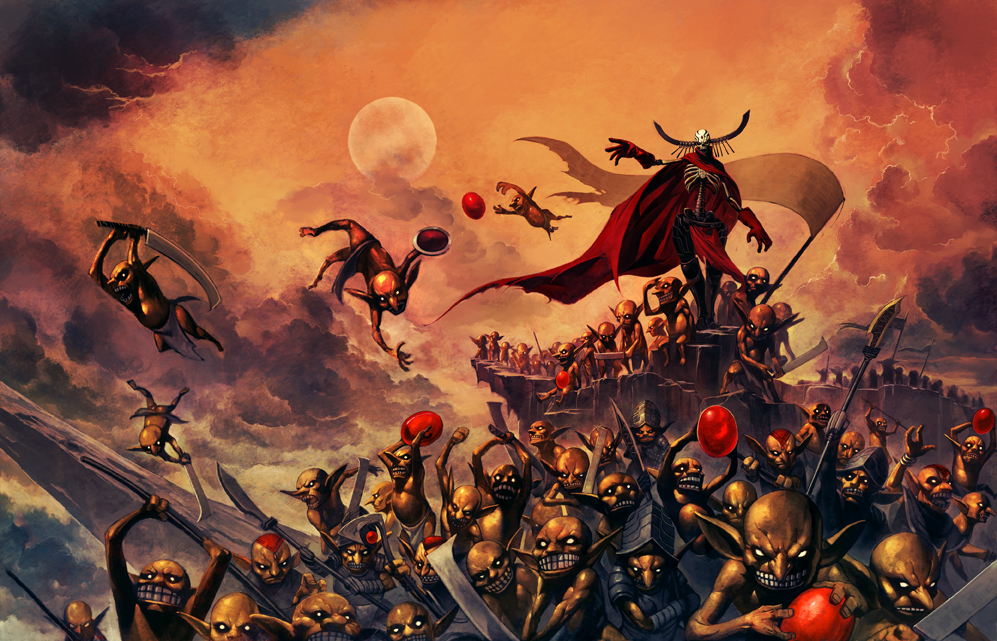
Oh dear, the King of Hell is back, willing to show his journey to reclaim the Hellish Throne. Square Enix, the developers of Army Corps of Hell, present a new batch of screenshots and artwork for the now Playstation Vita launch title in North America. Surely it will also be a launch title for Europe and PAL territories as well.
Army Corps of Hell follows the former King of Hell. I say former because he has been ousted. His job is to now reclaim the throne that he has lost. You control an army of goblins, ranging from warriors, wizards and lancers, all with their own strengths and weaknesses. The screenshots cover these goblins, as well as some interesting monsters. There is also a few pieces of artwork at the end.
Army Corps of Hell is an exclusive to the Playstation Vita. It will be released in Japan on December 17, 2011 and in North America on February 22, 2012.
Silicon Studio, the developers behind the Playstation 3 game 3D Dot Heroes, also has a focus on middleware. One of the game engines, Orochi, has support for native PC and Playstation 3 development, with ports to other consoles possible. Now, Silicon Studios have announced that Orochi will now support the Playstation Vita, as reported by Andriasang.
So what does Orochi actually contain? Orochi is considered an all-in-one engine, with over forth development tools and twelve libraries. These tools and libraries help with elements of game design such as physics, AI and graphics. It is one of the mos popular middleware due to the abundance of Japanese support documents, which must be a rarity for the Japanese. Usually, they must deal with Western engines or develop internal ones.
What also makes Orochi an useful engine is its cross platform development. With the addition of the Playstation Vita, developers will have a quicker time to convert Playstation 3 games for Playstation Vita and vice versa. That means, if developers choose to use Orochi, it will be quite easy to release games for both platforms, pending approval from Sony Computer Entertainment, of course. Cross platform multiplayer between home and portable console should be much easier to implement as well.
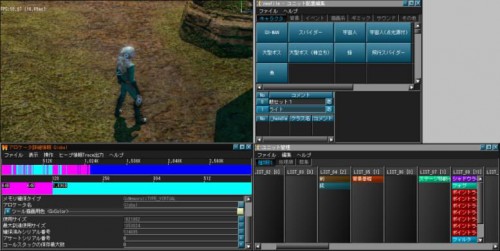
For what Orochi looks like during development, check the screenshot below:
For more on the game engine Orochi, visit the official page.
So our favourite little hygienic swamp alligator has gotten an update from Disney mobile, and it looks like they are turning up the heat! ‘Boiling Point’ features twenty new levels, new collectibles and a new way to play with the power of steam! Convert steam to water and vice versa to solve the new puzzles. With this new update there are now 120 levels in Where’s My Water, so if you haven’t already gotten the app it’s definitely worth it.
Check out Swampy’s Facebook page HERE and the new trailer below! Swampy’s just about the most lovable creature ever, which isn’t the biggest surprise given that it’s from Disney.
Where’s My Water is available on iPhone, iTouch and iPad $0.99 HERE or on Android for $1.01 HERE
Who doesn’t love trading cards? I know that when I was younger, I had a shoebox full of trading cards. But shoebox no more! No, for this years generation, we have iPhone apps, the newest being Cabals: The Card Game.
Cabals has a game board mechanic and is a cross-platformer with online multiplayer. Cabals is a two player game with both players using their own deck of cards with special units and abilities. Using your wit and tactical skills, you take on the opposing player and see who is the better player.
There are four different ‘cabals’; Danann Covenant, Bearclaw Brotherhood, Vril Society and Order of Zahir. Danann’s are jazz-age withces, Bearclaw are shamans who command the land, spirits and Slavic people, Vril’s are technological geniuses, and the Order of Zahir has a strong control over the art of alchemy.
The initial release includes 70 cards and 4 cabals, with a new 30 cards in an update. This will also be followed by an introduction of two more cabals.
Cabals is sure to be an immersive and rather interesting game, so it’s definitely something to take a look at.
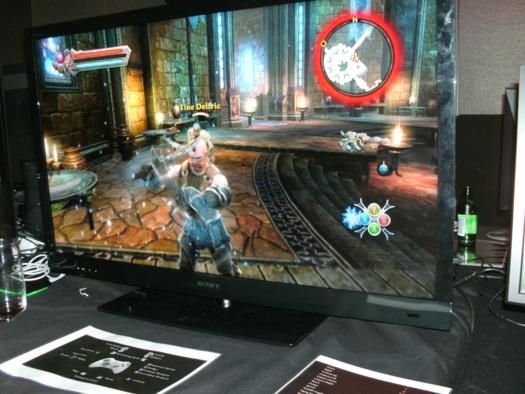
Earlier today at a secure location hosted by EA, us here at Capsule Computers managed to get some hands-on time with the upcoming Kingdoms of Amalur: Reckoning video game for the Xbox 360, Playstation 3 and PC platforms. The video game in question is an Action Role Playing Game developed by Big Huge Games and 38 Studios and is published by EA.
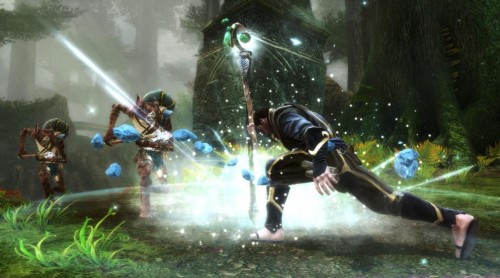
My session began with a character that was proficient in both arcane magics and close range melee combat. Daggers and Staves are two of my favorite pieces of fantasy weaponry. So I took this character and ran around for a little bit, hoping to get to practice some combat. Before long, I had encountered a small group of these small wooden creatures with leavy masks, kind of like the Koroks from WindWaker. These creatures, though, are called Boggarts; and they’re very scared of fire. I took the time to learn the controls of the Xbox360 version of the game with these creatures and before long kind of got the controls and flow of the combat.
Using one button to use my firey staff of death (note: this is not the staffs name) and then laying in the pain with my daggers at close range, I found that the Boggarts were dying very quickly. I needed a further challenge, so I hit the start menu to see what the games difficulty was set to. It was on Casual, so I ramped it right up to hard and let me tell you, hard mode is -really- hard. I found myself being owned by simple woodland creatures, like wolves and bandits, and was forced to seek refuge elsewhere. I soon found myself in the front of this kind of tower, library thing with barricades around it and a whole platoon of soldier looking people. So I did what anyone who wanted to get the most of the combat in this game would do, I switched on a mode that allows you to attack civilians and other friendlies and engage with them in combat.
Combat in this title feels very similar to Fable and other similar Action RPGs, such as The Witcher 2. When I first engaged with this troupe of soldiers, I found myself getting owned quite easily and was forced to scoff health potions as my health waned. This forced me to think about the fight more tactically and engaged in a tactical retreat and engaged, after a fair distance, the fastest unit to approach me. After a long, but satisfying, firey, yet, eviscerated fight, I found myself ready to enter the building before me.
Unfortunately for me and my health, the guards within the compound were not very impressed with me after I had cut their staff outside into pieces, and/or charred their remains. This means that as I entered the building, they would attack me on sight. I could have left the building at any time, but I saw it as a challenge that needed to be conquered, so I instead proceeded into the building, rolling through the guards attacks and getting my backside handed to me the first few attempts. For some reason, I could not get enough of the combat in this game, it was so fluid and it was an incredibly tight experience. It was also incredibly fun.
After a few more attempts at cleaning out the location I was residing in, I had finally got it done. I had won. I was the supreme victor of this room, on Hard difficulty. Still hungering for further challenge, and a slight ounce of curiosity, I headed to a nearby town to see how difficult it would be to eradicate an entire town of people within this game.
One of the features I enjoyed in this game, was the Destinies system. Essentially, what the system does is it allows you to change your class based on how you want to play. The more you level your character and distribute points, the different kinds of classes you can unlock. Each class has their own combat efficiencies, but I found my favorite to be the Rogue Destiny. This destiny made my attacks with daggers much more effective and matched my playstyle much better than any of the other available Destinies at the time.
By the time I had found the nearest town, Gorhart I believe, and eagerly engaged with the Guards of the town. What I was surprised to find was that when I initially hit one of them, they would first try to arrest me. This brings up a prompt similar to the one found in the Elder Scrolls series. Go to Jail, Pay the Fine or Refuse (these are not verbatim). Seeing that my fine was fairly large, 24k gold, I decided to continue my slaughter. What I was not expecting, as these guards were pretty alone, was for the entire cities guard to become hostile and march over to my position. My first reaction upon seeing such a large force advance on my position was one glee. However, glee was soon morphed into fear, as the guards were very difficult to kill. I had considered lowering the difficulty, but, where’s the fun in that.
Before long, and after a few deaths, I had devised a winning strategy. Kill the ranged guards, run and roll around the town until there is a considerable distance and then kill the fastest units. This tactic performed surprisingly well, but was still slightly inadequate. Especially once they get you cornered. However, if you kill enough enemies, you generate points into your Reckoning guage. Filling this meter allows you to utilise a special mode that can really bring on the carnage. Enemies nearly stop while this mode is active and you can wail on them as hard as you like for as long as the mode is sustained. While also in this mode, you can engage in certain special attacks that appear as button prompts, once you engage in a special attack you mash the prompted button as fast as you can. This better you do in this regard, the cooler and more stronger the attack (or at least that’s the impression that I got from it).
After wiping the town out a few times, I found that guards were continually coming out from a nearby tavern. I entered and a bar-fight ensued.
Now by this point I was all out of potions and my thumb was tired from mashing so much during my massacres, but I didn’t relent. I found the most powerful looking goof in the bar and started a fight with him. However, fate was not on my side when he and a few of the town guards got me cornered and unable to evade to safety. I died there. One more death on my road to conquest.
Fortunately, my save was nearby, so I was able to re-enter the bar and re-engage. I had deployed my usual hit and run tactics in this much smaller location and ended up in an upstairs area. This allowed me to easily funnel any troops that wanted a slice of my pudding and also allowed me to carve up anyone foolish enough to climb to the top.
Kingdoms of Amalur: Reckoning was an amazingly fun game to play. It lends the best parts of The Elder Scrolls and Fable and combines them into a gripping experience that is so much fun to play. Unfortunately, during my run, I was too caught up with causing mischief that I didn’t follow any of the quests. I may also have cackled maniacally a few times and taunted the AI out loud. I haven’t been that gripped with a single player game in a while and will definitely be picking this up at launch.
Mission Impossible: Ghost Protocol seems to be completely departing from the rest of the franchise, with the stress placed on ‘Ghost Protocol’ instead of ‘Mission Impossible’, concentrating on the actors apart from Tom Cruise that are in the movie, and of course bringing a lot more comedy to the movie than previously advertised ones.
This latest clip from the movie is an embodiment of that, with no Tom Cruise and a whole heap of humour that is so Simon Pegg that it ain’t even funny. Except that it is funny.
Is this all some ploy to get a whole lot more people interested that long ago lost interest in the 15 year franchise? Probably. But hey, judging by my interest instead of snide comments, I’d say it’s working.
Is it also working on you? Or do you need some more convincing before you spend your dosh?
Mission Impossible: Ghost Protocol comes out in theatres December 21, 2011.
It seems that the Unity engine is becoming quite popular. Unity Technologies, which is the company behind the development tools, has revealed that they have reached 750,000 registered developers and users. Last year, around this time, it was revealed that the user count was at 250,000 users. This is an increase of 500,000 users. A great increase in what seems to be a great game engine that is cost-effective (i.e. it is free for the basic model).
CEO David Helgason was ecstatic at the numbers in a statement he made,
“We’re amazed at how rapidly Unity continues to grow in popularity globallyThe continuing growth of the platform demonstrates that when provided with excellent tools, developers will embrace them in numbers that surpass anything anyone imagined.”
The Unity Web Player also saw an increase in installations. Last year, that number was 40 million. This year, it has doubled to more than 80 million. Unity is becoming a growing force in game technology and it seems that it is only going to get better for the company.
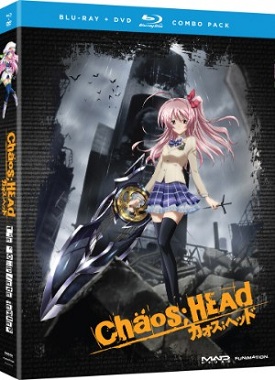
Chaos;Head Studio: Madhouse Studios Publisher: MADMAN / FUNimation Release Date: November 29, 2011 Price: $59.95 – Available Here
Overview:
Anime come from many different inspirations. There are those that were created originally, some that were adapted from a manga and even from visual novel games. Visual Novels are mostly only seen in Japan and focus on telling a story as the player reads through various conversations as if they were reading a book.
While most of these visual novels don’t see a whole lot of publicity outside of Japan, some accumulate quite a large following. One such visual novel is Chaos;Head which was developed by 5pb. and Nitroplus which was released originally in 2008 on the PC then was also adapted to the 360 console a year later. In-between those two years an anime was created for the visual novel and has now been brought over to North America courtesy of FUNimation. How does this visual novel translate to a twelve episode anime? Let’s find out.
Story:
The story of Chaos;Head follows a young man named Takumi Nishijo. He is a high school student at Suimei Academy, but there is something a bit odd about this man, and that is the fact that he resides in a shipping container on the roof of a building and barely ever leaves the container except for whenever he has to occasionally attend class. He is so much of a recluse that he actually created a chart of how many days he can miss and still pass.
To make things a bit more sad for Takumi, he has absolutely no interest in being involved with 3D women or even real life in general. Takumi does everything he can to avoid his younger sister Nanami and everyone at school except for one friend named Daisuke Misumi and spends nearly all his time playing PC games. This is only made worse by the fact that he has created an imaginary girl who is modeled after all of the anime figurines he has in his home/container. She can best be described as a cheerleader who constantly tries to perk him up and encourage him to keep up with his current hikikomori lifestyle.
However all of this changes quite quickly as he receives a strange message from someone named The General on the internet displaying a horrible murder scene of a man and a pink high school girl standing nearby. This murder is just another in a string of grotesque murders known as “New Generation Madness”, the only problem here is that the murder hasn’t happened yet. Trying to remain unfazed however, Takumi tries to go about his day normally closing himself off from the world. That is until he stumbles across that very murder scene the next day, seeing the same pink haired high school girl holding one of the murder weapons and staring at him.
After running away from the scene of the murder, Takumi goes to school the next day to discover that this pink haired girl is actually a member of his class who is also one of his longtime friends. The problem here is… he has absolutely no memory of who she is. As he tries to avoid the confusion around him, the police start to investigate the murders with him in their sights and a number of other female classmates who all seem to have quite unique personalities begin paying him a lot of attention. Can Tatumi discover the truth about the world around him while avoiding the police?
Well not really, because the story does an amazing job of being extremely confusing at times. The story can be very difficult to follow at times, because a lot of occurrences in the world of the anime aren’t visible to everyone, usually only to the girls themselves and Takumi and considering the way that Takumi already has been suffering from delusions before he even meets any of these strange girls. This makes it hard to tell whether he is actually seeing the secrets of the world that few know unfolding before him or if it is just one giant delusion his reclusive mind has created.
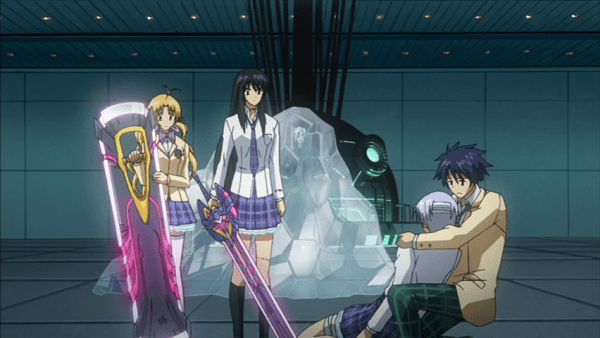
In fact the series jumps around so much that it would be difficult to even classify the genre that it would fall into. The first half of the series is more of a mystery thriller, while a massive information reveal halfway through the series marks the switching point of the series into one that is more about girls controlling Di-Swords and fighting against a conglomerate with bad intentions in mind for the world. To make things a bit more confusing, a number of plotholes are left wide open and not explained well enough to really make a lot of sense on their own. This can leave viewers with lots of questions after finishing the series, even if they watch the show multiple times trying to understand what was never explained.
Visuals:
Now seeing what studio worked on bringing Chaos;Head to anime fans everywhere, one would believe that the quality would be excellent throughout the entire series. However, it seems that Madhouse chose not to live up to their expectations and have delivered quite a few generic looking designs. Each of the characters in Chaos;Head are rather unique looking, but only from one another. In fact the various female characters all have the appearance of harem archetypes, with Takumi being the only one with noticeable differences from your standard main character.
To make matters worse, there are a number of times that the character design and the artwork as a whole take a dive in quality. While this may only happen every so often it is quite noticeable. There are a few redeeming elements however, for example the Di-Swords all look amazing, both when they are in non-boot form and are booted, this is especially true whenever they are used in combat which is unfortunately not very often. Another redeeming feature is that whenever Takumi has a delusion of his own the quality usually jumps up another level, though this is usually accompanied with some rather enjoyable fan service moments.
Audio:
For those eager to hear Chaos;Head in English you will be happy to know that FUNimation has provided a complete English dub for the series, but for those purists out there they have also retained the Japanese voice track for either comparison or for people to choose which one they want to listen to more. The voice actor who handles Ayase Kishimoto, Stephanie Sheh, has also done a great job with performing the inserted songs that the character performs. Out of the two I found the English voice cast better fitting with the characters, which is quite a surprise considering the fact, as a whole, Chaos;Head’s character archetypes fall heavily into harem-like characters but avoids it just barely with the amount of mystery and delusion involved.
Those who choose to listen to the Japanese language won’t find any issue with the subtitles either, as they are both easy to read and easy to understand. The opening song of the series is called “F.D.D.” and is performed by Kanako Itō which sounds well enough for an opening song but could be easily forgetabble. The ending song “Super Special” by Seira Kagami is actually quite a nice lighthearted tune and features mostly English lyrics with a few Japanese lines here and there, making it the superior between the OP and ED songs though some of the English lyrics sound a bit like Engrish.
Extras:
As is standard with a FUNimation release, Chaos;Head comes with both a clean version of the opening and ending songs. However as I mentioned earlier the ending song animation doesn’t benefit at all from having a clean version, in fact it is almost detrimental as the animation shrinks itself to the left of the screen to make way for where the credits should have been. Besides that there are also trailers for upcoming and past releases from FUNimation. Unfortunately there are no other on-disc bonuses which are a bit of a detriment to the release considering this is the complete series in one package with no extra bonuses whatsoever.
Overall:
While Chaos;Head may have quite a lineage behind itself, unfortunately the anime adaptation has quite a number of flaws that hold it back from being great. The quality of the animation as a whole dips too often for comfort despite high points whenever a Di-Sword is concerned and has quite a confusing storyline that jumps around too much and leaves multiple plot holes that can simply leave viewers wondering about multiple things.
If anything, the short number of episodes is a huge detriment to the title as it feels like most of the storyline was rushed and bunched together into an unfocused mess that doesn’t explore the potential that the series has with its plot. Still, FUNimation has done an amazing job with the dubwork and Chaos;Head is a unique enough anime it could warrant attention as there aren’t many series out there like it, if only things didn’t seem so rushed and underdeveloped.
It’s not every video game studio that can claim to have a new property with thousands of years of history penned by R.A. Salvatore, creatively helmed by former-Bethesda designer Ken Rolston, and visually created by the acclaimed artist Todd McFarlane. It’s also not every studio that can claim to truly create a deep RPG experience while maintaining an open world full of life and including a great, fluid combat system.
Kingdoms of Amalur: Reckoning has got some big names behind it, and from my short couple of hours with the game, I can safely say that it does also deliver in the design department. EA took a big chance in funding a new franchise among what seems like an endless stream of sequels, spinoffs, and remakes, and so far it seems that 38 Studios and Big Huge Games have more than converted the risk into reward.
At the outset of the game the player is quickly thrust into the world of Amalur via a cutscene which details the how a race of elves has spent the last decade converting from peaceful denizens of the universe, into an angry, mass-murdering mob under the leadership of a new king. The catch is, death doesn’t affect them, and though they’ve been held off for most of the past ten years, humans and friendly elves are losing numbers where the enemy seems to have infinite respawns.
Somewhere in that conflict, you die. Game over.
As your body is dragged to what is apparently a trash chute, you get to customize the race, appearance, and name of your dead character, and then it’s down the chute you go.
Queue you vigorously shaking off a pile of dead bodies and stepping onto the stone floor of an underground cavern. Turns out the trash chute was part of the Well of Souls, a machine that can bring back the dead, but you’re the only experiment that has succeeded thus far.
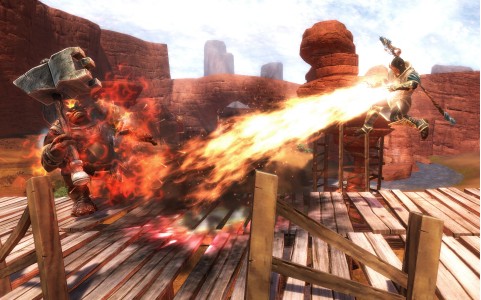
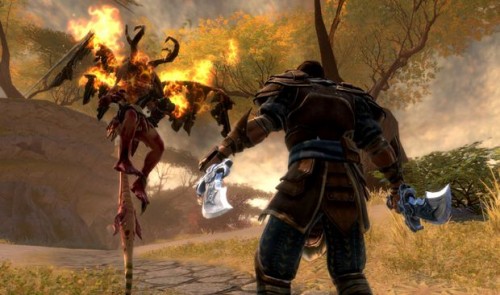
Now you may have noticed that it’s the beginning of an RPG and I wasn’t asked to choose a class. Rather, I played through an extended tutorial that led me through a siege on the Well of Souls. Throughout this experience, the game showcases stealth combat, magic, shields, and swords. You can sneak behind enemies with daggers, for instant stealth kills, or blast through them with fire and lightning, or simply run into a room, slashing at everything in sight, knowing your armour will protect you from the brunt of enemy attacks. You can map two weapons to your character, and you can easily switch between them mid-combat in order to wreak havoc in different ways, and your character’s magic abilities are mapped to the face buttons. This is no Dragon Age. There’s no pausing and selecting abilities, it’s quick and frantic, built around strategy and a fair bit of button mashing.
Being the cheeky person I am, I opted to go for a mix of all three play possibilities, as many games punish players who take the middle road. So upon exiting the tutorial, out stepped a stealthy elf daggers on his side, fire-staff ready to go, and all dressed in heavy armor, and, believe it or not, this strange hybrid worked exactly as I’d wanted. This was helped by the destinies system, which you are introduced to as you escape the Well of Souls.
The system essentially allows you to create your own class. You can put points into Finesse, Might, or Magic and each will unlock different bonuses. You can then unlock different fate cards which will also skew to one of those playstyles. However, you can mix and match as you please, and the fate-cards available to change depending on your Destiny selection. So if you like playing your way, the game’s completely supportive of that. And if you’re not happy, you can always visit a Fateweaver, who will refund your destinies for a bit of gold.
Now I’ve barely scratched the surface here. Kingdoms of Amalur: Reckoning is an open-world game, and playing it for a couple of hours is no way to do such a game justice. Aside from the main storyline, there are side-quests everywhere. It seems everyone in Amalur has got a problem, and most of the time, they’re fun problems to solve. On top of that, simply setting out and exploring can lead you to treasure troves in the wilds, as well as dungeons full of enemies and loot. The combat was fluid, and as my strangely equipped character flung electricity through the air, infiltrated bandit-ridden caverns, and became quite a smooth, persuasive talker, I felt like Amalur was really a world that I could see myself spending hours upon hours in.
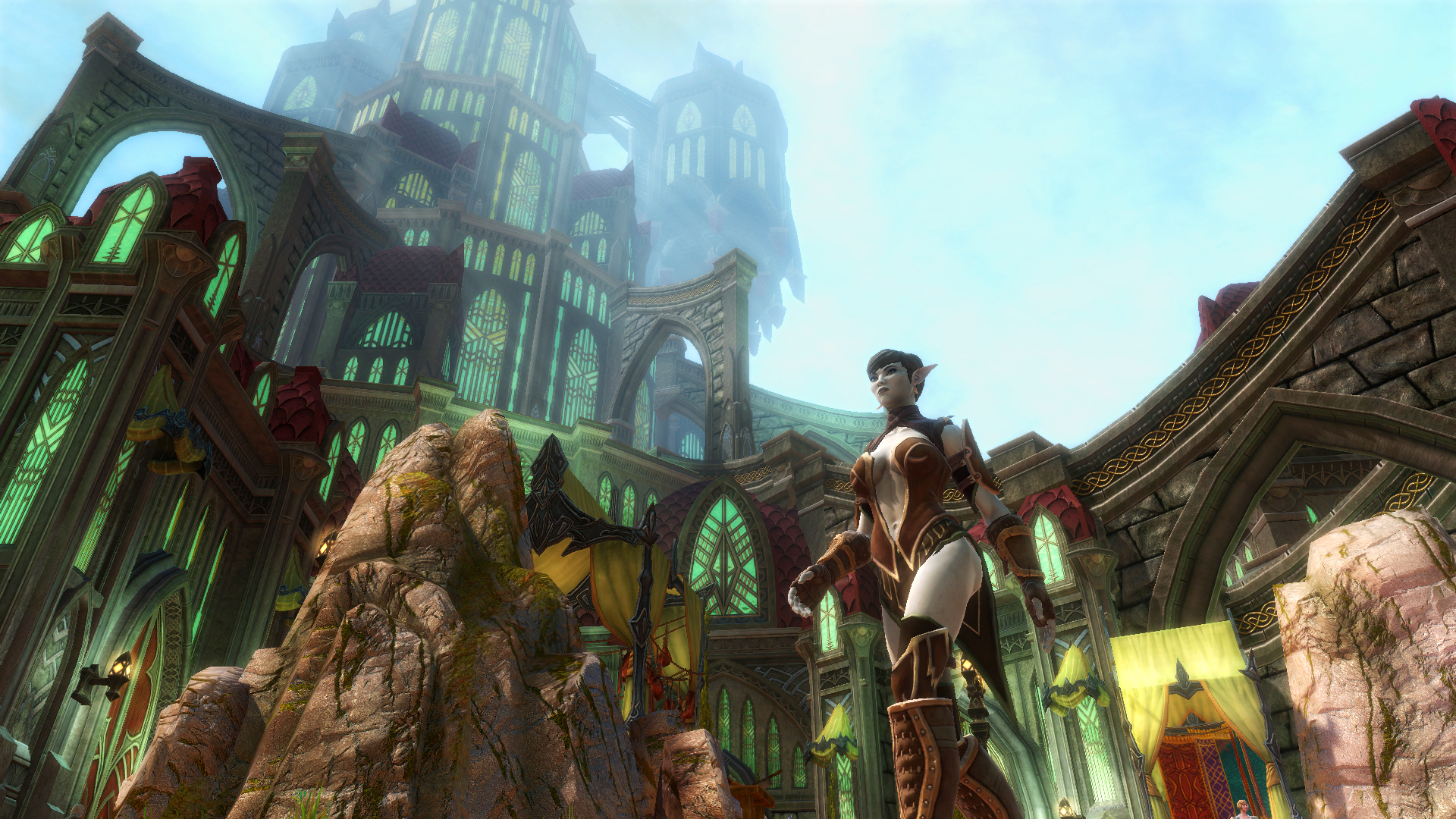
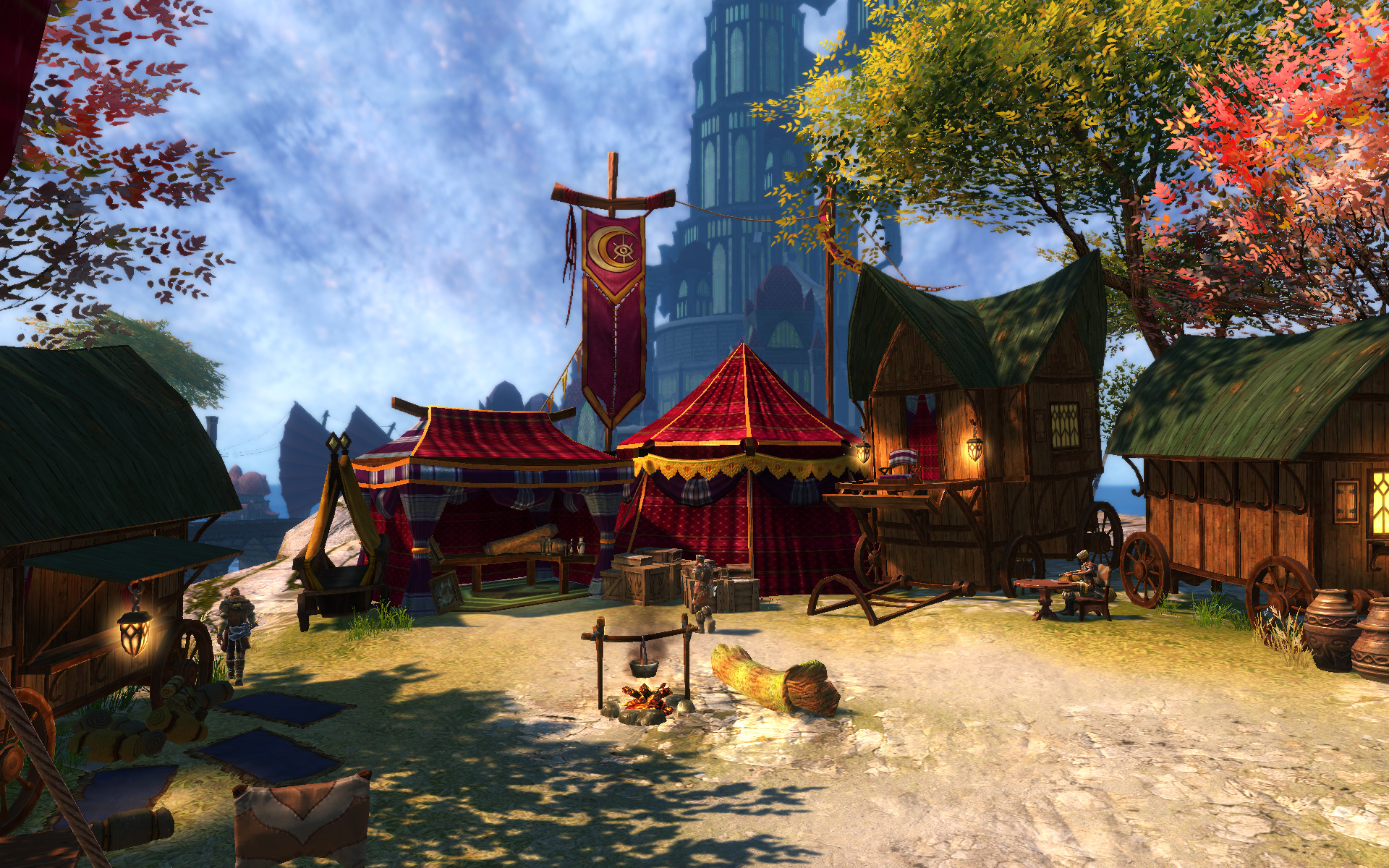
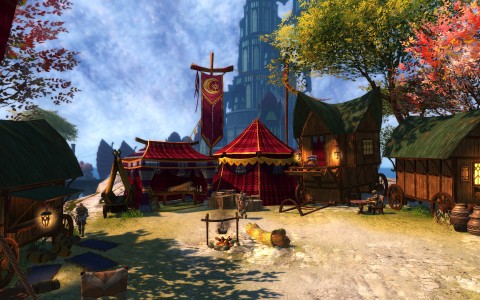
This is complimented by an art-style which is almost a blend between realism and cartoon. Everything in the world buzzes with life, whether it’s fireflies flying up from grass, a plant shriveling as you harvest it, or the light streaming in from over a cliff. As I managed to get my hands on to both the PC and Xbox 360 versions of the game, I can absolutely confirm that the game looks markedly better on PC. Where the Xbox relies of the atmosphere created by the art-style to cover up some of its hitches, I couldn’t help but notice murky textures in quite a few of the locations. Such issues were non-existent on PC, but what was impressive were the fluid character animations which both versions maintained. If the game were to be judged on animation alone, it could pass off as God of War or Darksiders.
There was another cross-platform issue, though this time the problem was with the PC. The controls just feel so much better on Xbox, and though PC gamers can adjust keys as usual, there’s still something left to be desired from the mouse and keyboard.
So the verdict on which platform was best? Much like my hybrid character, I’d go for the mix: a high-end PC with an Xbox 360 controller plugged in was definitely the optimal experience.
Whichever way you play it, Kingdoms of Amalur: Reckoning is shaping up to be a massive RPG, complemented by a great art style and exciting combat mechanics. We’ll all have to wait for February 9th, 2012 to get our hands on the game, but I, for one, can’t wait to see more.
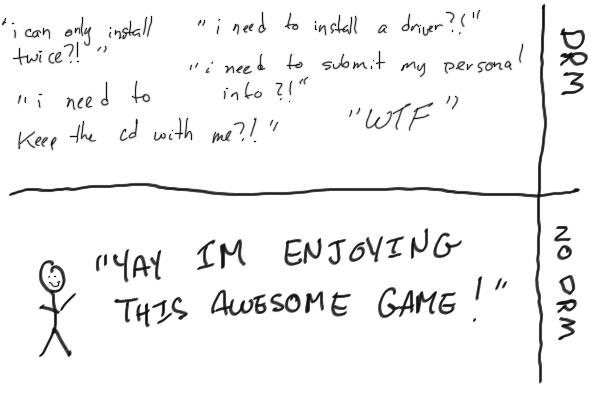
“I do not believe in forcing anyone to buy our game. If they do not want it and they pirated it, it means we did not have the right offer for them – maybe the price was too high and they will buy it later on a year or two after the release when it will be more affordable.” – CD Projekt CEO and Co-founder Marcin Iwinski (known for The Witcher 2 amongst many many others). I found this first a bit suprising that anyone so well known in the industry would utter these words despite the undeniable truth behind them, and secondly I think it raised an interesting and highly debatable topic regarding the differing retail price of video games across their various platforms and modes of sale. Speaking to PC Gamer recently, Iwinski shared his uber intelligent views (and no im not being sarcastic), regarding the use of DRM as an anti-piracy measure. More importantly though is that he seems to understand the very simple notion that 1 million pirated copies does not equal 1 million lost sales, something everyone else seems to forget.
In an nutshell, the use of DRM as an anti-piracy measure has proved time and time again to be absolutely useless when it comes to stopping pirates playing your game illegally, and also inconveniences, and in many cases reduces the functionality for legitimate users who purchased your game. Iwinski admits that pirates have always been his main competition, and rather than try and fight a losing battle, decided the best plan of action was to offer loyal customers something the pirates can’t; tangible extra content, a plan that has been met with much success. Soundtracks and walkthrough guides, making of DVD’s, stickers and figurines to name a few have all been used to boost the appeal of legally bought versions. As a rough estimate, Iwinski believes The Witcher 2 has been hit by at least 5 million pirates, but is careful not to relate this to lost sales. His calculations were suprisingly leniant and highly accurate, and even with such punishing figures still believes in putting money and time into finding ways to reward legal customers rather than wasting their time trying to punish pirates, which has little success. When asked about other forms of protection such as that used by Bohemia in Take on Helicopters, where pirated copies of the game slowly degraded, Iwinski, although positive was also realistic, stating “Ultimately it will (also) be cracked”.
When looking at piracy, Iwinski firmly believes that you can “convince almost any gamer to buy legal games if only you have the right offer for him/her. Piracy must be looked at on a cultural level, something Iwinski and his team have definiely not overlooked, carefully taking into consideration variables such as disposable income, and how games are traditonally consumed in that country or community. Using the Witcher 1 enhanced edition as an example, it shows that even a year after its initial release, by offering customers something else of value (most sold at around $40) and looking after them, they will support you. He goes so far as to say he is happy that so many pirates enjoyed the game so much that when they could afford it they decided to purchase a legal copy. Simply a mature approach to the issue of piracy, and one that most importantly will not inconvenience or exclude any loyal customers wishing to get the full experience from your games. There is however no real way of knowing how many people who actually had pirated it went on to purchase it legally.
This brings me onto my next topic of debate which is the enormously varying prices of retail games within bricks and mortar stores as well as online, and how much gamers really think they should be paying for those AAA titles. Marketers have always been using expensive price points to give the perception of quality, and I think its come the time when the majority of gamers can see through this thin veil of empty promises. As out wallets become as thin as some of the storylines and gameplay in many of todays popular franchises, many gamers are quite obviously seeking alternatives judging from recent studies into piracy through torrents. Many are turning to online stores, especially ebay where new releases can be found for up to half the price even on the day of release. Others still are delving into piracy, tired of paying premium dollar to help fund useless anti-piracy measures that usually detract from their own experience.
I understand the enormous amount of hard work and money that goes into bringing to market the games we spend so much of our time enjoying. The talents of the developers and everyone behind the scenes is uncomprhensible, yet I still cant justify the $100+ price tags asked of us gamers for a new AAA title. So I ask you all, what are your games worth to you, taking into account the amount of pleasure they give you in relation to the cost of your other forms of entertainment? Maybe I’m wrong and you all feel these prices are in line with what is on offer, but I honestly believe there is a price point way below the current being asked that would increase profits and reduce piracy. There are so many things that could be done but in reality any money you get for it from a pirate is money you otherewise wouldnt have ever seen.
I want to leave you all with a note on pirates and the categories they fall, from wealthy professionals with families to schoolkids with too much time and not enough money on their hands. I’ve been involved with gaming before the release of any consoles and I’ve seen companies fighting piracy with NO success for over 25 years. I’ve grown up with gamers that to this day have owned illegally pretty much everything ever released, yet also spend twice the amount of money on consoles, games and accessories than the average avid gamer. Any game they played through and enjoyed are purchased and left sealed, a tribute to the quality of the game and the development team alike. Any games they decide are not for them are deleted for no other reason then they have no further use, and nothing is lost or gained by either party involved. Yes you can hire games and check them out but thats still $10 lost on something you might not want. If you do decide you enjoy it and decide to purchase it, I cant remember a service that puts that $10 towards the game. What I guess I’m trying to say is there is no typical defintion of a pirate, they come from all walks of life and would encomplass many within your circle of family and friends to one extent or another.
There seems to be a massive cultural shift towards a very nonchalant attitude regarding online piracy, in unregulated markets such as Russia as well as in highly regulated Western countries. Those who arent able or willing to download material themselves are still ethically and morally fine with either purchasing it or receiving it from friends. Many of my friends have recently told me of these buses that turn up to their worksites but instead of selling food they are packed to the roof with pirated material at 70% of the price of the retailers. Saying that I also know that people download games as they simply dont have the money to buy them or dont want to, so really, there was no chance of your studio ever seeing any money from them regardless of how cheap the game is or whether they download it or not. This I would imagine is a very small group and as Irwinski notes not worth worrying about.
Piracy and those involved in reverse enginerring, circumventing and such related activities have and will always be a huge part of the gaming phenomena. For every $1 you put into fighting piracy, the commuinities behind these guys will produce $2. For every hour of manpower you put into developing a new security system they will find 2, even if it means hacking a 25 hour day somehow. Sony learnt this in two ways, firstly in their court case against Geohot whose entire bill was footed through donations from various groups and individuals worldwide, and secondly in the continued relentless attempts which seem to have gained more vigour as of late, to break the PS3 security yet again. Microsoft also have had a thorn in their side from day one, in the form of the infamous and exceptionally respected coder C4Eva, who to this day continues to find ways to remove any and all security settings Microsoft can implement on the 360 consoles and games. If you were a business that was consistently throwing money into a project that never gave results wouldnt you surely after over 20 years abandon it or get it right. Anyway, thats it, enough of a rant, but thumbs up to Marcin Iwinski for boldly going where no man has gone before, let the pirates do as they please, and spend the money rather on giving those who respect what you’ve made a little something more.