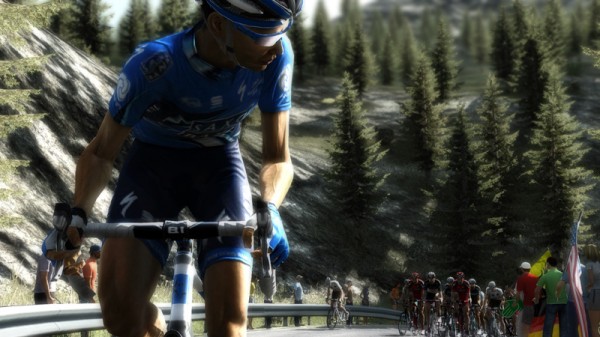
Following on from the success of Tour de France 2011, Cyanide will be releasing a new version this year for Xbox 360, PS3 and PC.
The Tour de France console game is packed with improvements and new features. This year’s edition will also include a multiplayer mode, allowing players to now race with and against their friends. With brand new teams and models for riders, as well as more detailed scenery and improved graphics, the Tour de France aims to establish itself as a top game.
As well as Tour de France 2012, Cyanide will also be releasing Pro Cycling Manager 2012. Both games are expected to be released in June this year.
Confrontation Publisher: Focus Home Studios Developer: Cyanide Platforms: Windows PC (Steam) Release Date: April 5th, 2012 Price: £29.99 (BUY NOW)
Overview
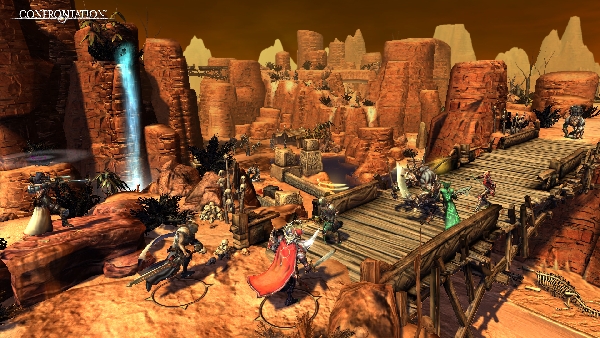
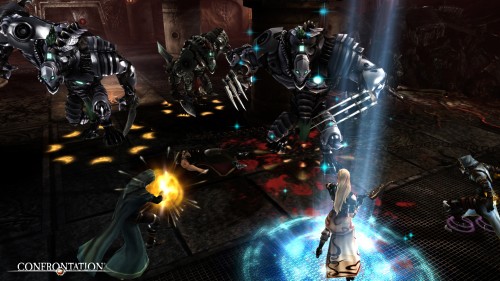
Confrontation is based on, and styled after the Rackham’s miniatures RPG of the same name. You’ll be moving your units around, attacking bad guys and triggering special abilities. The game features the “pause and play” mechanic, letting you make key tactical decisions in the heat of battle.
Story
Rag’narok, the war of the age of darkness has come to the world of Aarklash. In it, four factions — represented by the banners of Griffin, Scorpion, Jackal and Wolf — are facing off, battling for supremacy, or possibly the end of the world as they know it. You start off controlling a squad of Griffin’s best, investigating the technological advances the Scorpions are experimenting with.
Unfortunately, this story is not well conveyed during the game. Before each dungeon, a big block of text is displayed, and read aloud to you. This text is pretty dense, with lots of unfamiliar people and places spoken about, which is simply difficult to wade through. Every one of these pieces of story is pretty long, too, making it a hard slog to read through. The voice-over work for these texts is bland and generic, sounding more like a newsreader than an actor playing a character and making the world come alive.
These story pieces do set up each level, if you pay attention; but very little of this story pervades into the gameplay itself. Sure, it affects the milieu, and the types of enemies you will fight, but apart from that, you’re pretty much killing dudes until the game tells you you’ve completed the dungeon.
Gameplay
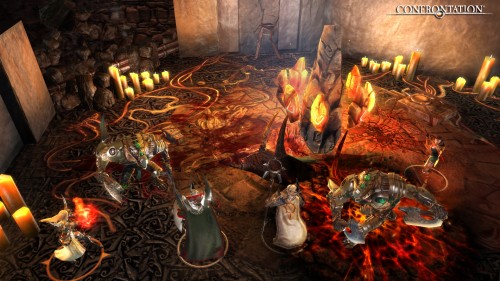
Much like many other RPGs, you control a party of up to 4 characters, each with their own strengths and abilities. As you progress through the game, you may cut to a completely different group of characters, and back again, giving you a good bit of variety, discovering what kinds of spells and special actions are available in the game. If a two groups join up at a later point, then at special “Rest” points (or before a level), you can pick and choose who will be in your party. There are 12 unique characters (or classes) for each faction, letting you really choose which direction your party will take.
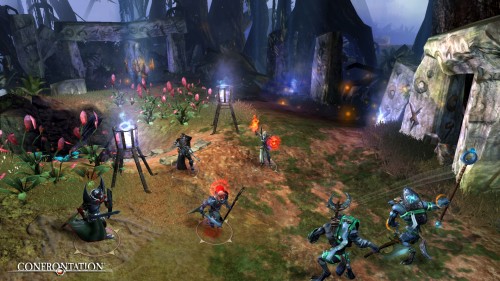
The controls are straightforward; select by clicking on a unit or dragging a box around them, and right-click to move, attack an enemy, loot a box or flip a lever. The up to 6 abilities for each character are displayed with their other status details in the bottom-right when they are selected, in 2 rows of 3, all clearly colour-coded to show what kind of ability it is, as well as marked with a fairly descriptive icon to make it easy to remember which ability does what. These abilities correspond to the QWE and ASD keys for the top and bottom lines respectively. This makes playing the game super easy, and leaves you time to focus on the strategy and tactical orders you wish to give your squad.
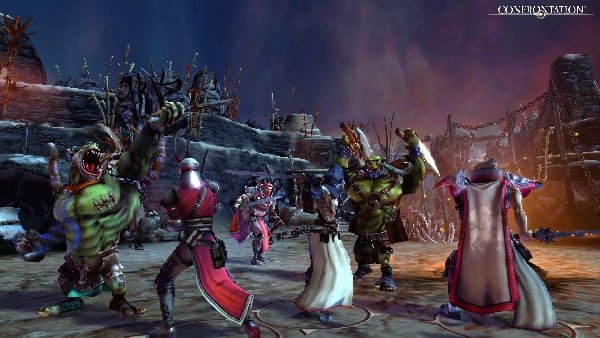
This brings us nicely to the battles themselves. When facing an enemy, you can use abilities and give commands in realtime, but you can also tap Space to pause time. Once paused, you can still zoom, rotate the camera and move around the battlefield. But now you have time to analyse the situation and plan your strategy accordingly. You can use an ability at the perfect moment to maximise it’s effectiveness. You can also queue up commands by holding the Shift key while making them.
Any command you make may be denied because the unit cannot reach their target, or it doesn’t have enough stamina, etc. to perform the particular action. Some actions can give you more stamina for health, for example; or moving further away from your target may allow you to charge against them.
Unfortunately, these commands are not taken into account when you queue up any commands that rely on those previous to it to be available. For example, you don’t have enough stamina to perform “Action A”; so you queue up the command to drain some health in exchange for gaining stamina; you may think you can, at the same time, queue up “Action A” that uses that new-found stamina, but you can’t. You have to go unpaused, wait for the unit to get it’s needed stamina boost, and then use “Ability A” separately. This is a minor quibble, but it’s really the only thing putting a wrinkle in the otherwise pristine combat system.
As you explore the dungeons, you may pick up weapon and armor upgrades, talismans to add little bonuses to your units by attaching them to their weapons and armor, and bandages to do a little in-battle battlefield medic duty. As you beat bad guys, your party picks up XP, which you can then spend on the character’s stats, which in turn affect the effectiveness of different groups of abilities, or just straight-up strength under fire. All this adds up to a robust, though largely unexplained, upgrades system, and lets you decide which of your team should be the Tank, and which should be the DPS.
Sometimes the pathfinding can be a little flaky, characters tripping on a wide open gap, or moving as if through treacle when “too close” to another character. But as movement itself isn’t an essential part of combat, these little issues are forgivable.
Audio & Visual
For the most part, the audio is crisp and clear in Confrontation. The sound effects are good quality and do a good job of accenting the numerous abilities and assorted combat noises. Each move or regular attack command is accompanied by a bark of acknowledgement by the unit in question, as in most RTS-style games, though these feel a tad heavy-handed, and over-played; some of the male characters have deep gravely voices, others with slimy-sounding mumbles. These voices grate at first, but eventually blend in to the background as you play.
As I mentioned above, the narration between levels is just as heavy-handed, and feels like a generic “we have to do something to keep the player interested in the story rather than skipping past the huge block of text” approach. This is a shame, as the story is very in depth and detailed.
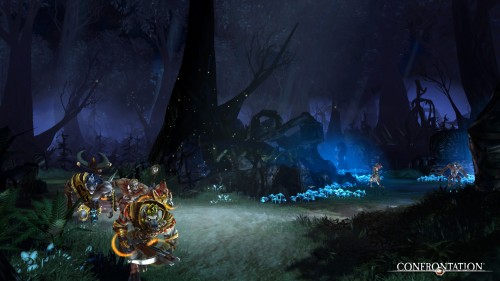
The graphics in this game are very high quality. The 3D models are detailed and varied between characters and enemies, and their animations are pretty good, though most of the action tends to become a chaotic blob of units mashed together wailing on each other with swords and axes. During cutscenes, the walk-cycles do become wobbly and jagged, however, though during regular navigation of the dungeons this doesn’t seem to be an issue.
The 2D art, also, is rendered beautifully, showcasing the superb monster and character design. The interfaces, too, look amazing, from a graphical perspective. And they work fine… though their layout often feels off somehow. The message boxes that pop up from time to time during a level, too, look hacked together and not designed very well.
Overall
All-in-all, this title feels like game itself is very well designed and made, but a lot of the User Interface side of things have not been made with the same level of care. It very much feels as though they were made by two separate groups of people, who never worked together to bring one cohesive, consistent level of quality and design to the whole experience.
For this reason, I have given it a good mark, but not as good as if it had been the same high production quality throughout.
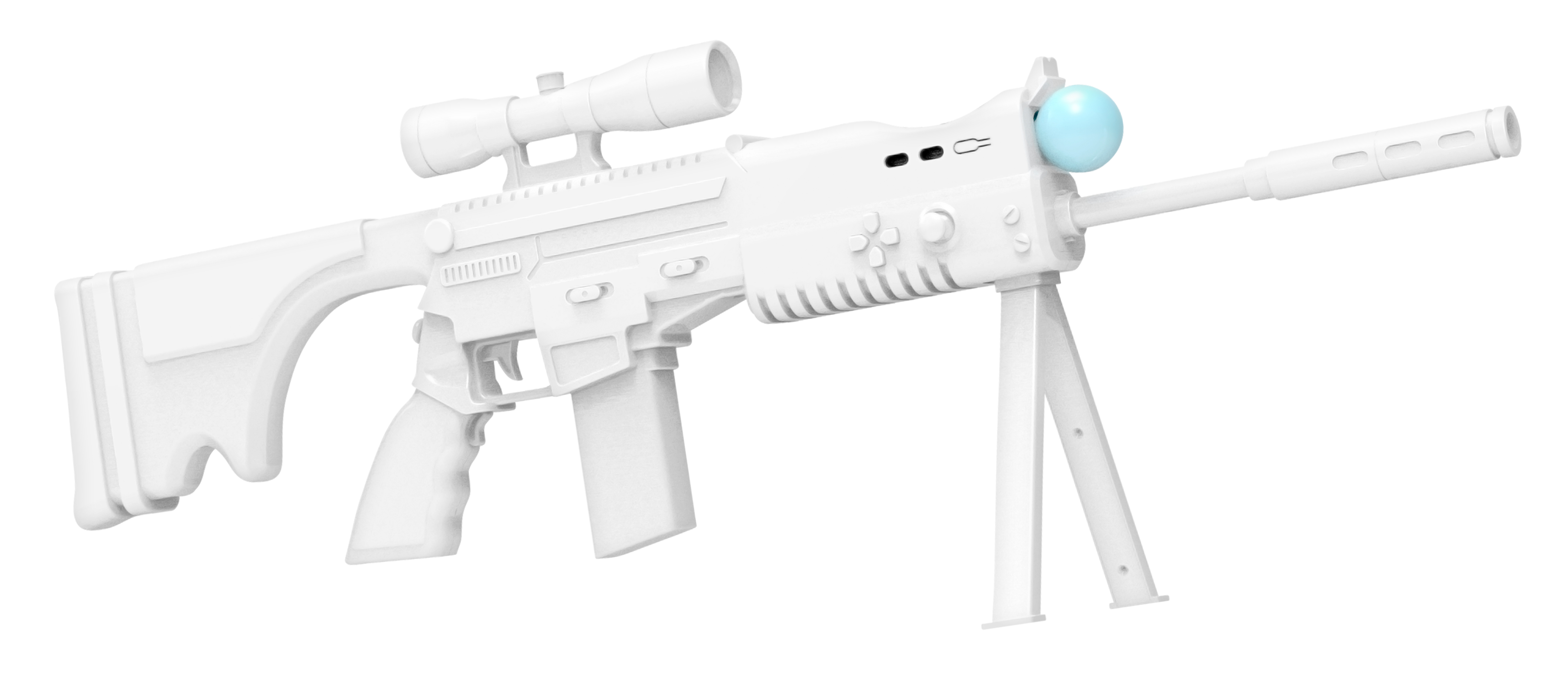
Something for true hardcore FPS lovers, as a new peripheral, which is an actual authentic controller in the form of an Assault Rifle that will add a new element of skill and tactic to your much loved titles. The gun, named the 3rd Earth PS3 Wireless Controller is an actual replica gun controller that works with all PS3 and PS3 Move shooting and first person shooting games. Just to re-iterate, this is not just a shell like all of the Wii add ons and gadgets, this is a functional controller for the PS3 that has taken on the shape of an Assault Rifle as well as a housing for the Move range.
The gun will be instores in mid June 2012 and features all of the normal functions and controller options of a standard PS3 controller with the additonal touch of a new intuitive layout featuring –
– Directional Pad, Analogue Sticks and Action buttons.
– Triggers and Vibration functions as well as tilt sensors and Wireless 2.4GHz technology.
The gun also features dual mode to choose between using it as a standard controller or with the Move as well as a built in Navcom controller for when in Move mode, allowing for a real sniper rifle feel to it. Available only in white on release the 3rd Earth Wireless Controller will cost $79.95 and be powered by 2 x AA batteries not purely off the power of the PS3 console so get some chargers ready and on the go.
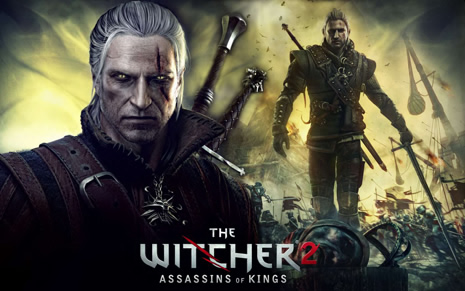
Some news for all you Witcher fans and I know there are hoards of you out there, as CD Projekt Red have announced the Witcher interactive comic book has been released for iPad and iPhone users. I havent played a whole lot of the franchise due to the immersive nature of it and time constraints but from what ive seen it screams graphic novel all over it. Enter the comic book universe of the Witcher and cast your spells to defeat grand scale monsters as you immerse yourself totally into the Witchers intuitive and unique environment.
The comic book rendition of the Witcher which is a free download, and follows The Witchers contract with the werecat. Are the motvational forces behind Geralts employers honourable or has he walked into something from which good and evil are hard to tell apart. So get downloading, and complete your Witcher experience as you enjoy the game either on XBox 360 or PC.
Apple users can also buy the Witcher for Mac computers through the Steam portal.
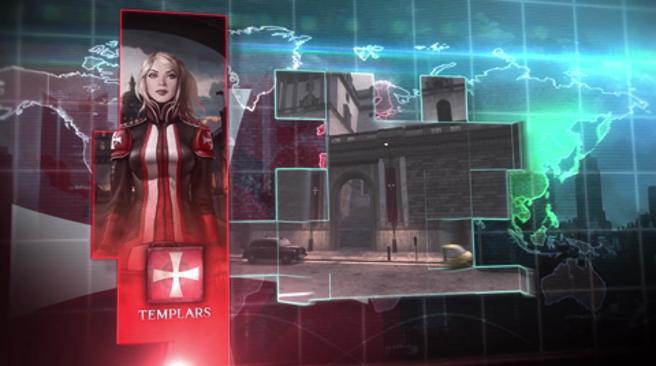
Drawing upon the popular conspiracy theories surrounding several secret societies and grand evil schemes of world domination that the world seems to be oblivious to, EA is working on a new MMO based role playing game where you take part in this Secret War between these organisations.
In this game players will get to spread the influence of their chosen secret society, and compete with other societies for influence and power. The game will require players to take a personality test to determine which secret society they belong to. These societies include the Templar, the Illuminati, and the Dragon. The game will also allow players to recruit their Facebook friends as agents and deploy them to different countries.
Publisher: EA Sports Developer: EA Tiburon Platforms: Xbox 360 (reviewed), PS3 Release Date: Out now! Price: $89.00
Overview:
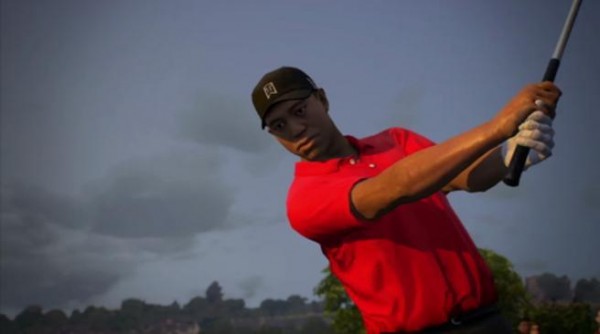
Golfing game fans haven’t really received too much excitement in terms of progress in the Tiger Woods PGA Tour series, so when you see the integration of Kinect as well as the new Total Swing Control, it would appear the series is attempting to stop flat-lining and catch up to the quality that many other sports games enjoy. Unfortunately for Wii fans, this is the first time since 2006 that they will not be joining in on the…excitement. At least good ol’ Tiger is back on the cover. Anyway, enough stalling let’s get this review underway! Gameplay:
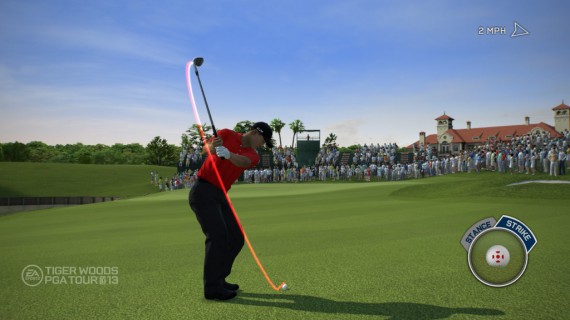
So aside from integrating Kinect, which appears to be not quite as successful as it is silly, the biggest change in gameplay is arguably the new Total Swing Control. You now control the entire set up of the shot, and your shot success is dependent upon the speed and movement of the left control stick . For example if your backswing is too fast or you don’t quite move the stick in a straight line, your shot will vary accordingly. There are no longer preset shots but you do get some guidance from your caddy in addition to the “ideal” backswing appearing as you take the shot. It does make the game much more challenging which is definitely a positive, however getting the hang of it takes some time and there’s not really much help from EA Sports for that.
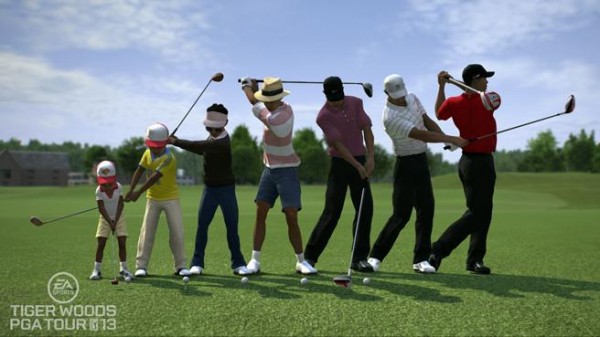
The other big addition for the series is the “Tiger Legacy Challenge”, which in theory sounds like a really great mode and sort of takes what 2k sports did with MJ in NBA 2k11 but goes one step further and adds in his childhood as well. Whilst you get a really good idea about the life of Tiger in his innocent days, as well as some future possible scenarios, the mode is far from perfect. The difficulty of the challenges naturally increase as you progress through his life but that doesn’t mean they get more enjoyable. What’s more frustrating is that if you fail to complete the task you have to restart the entire stage, and there’s almost no advice on how to improve your mistakes.
Despite this mode however the gameplay definitely has improved and the other modes, although not much different from previous versions, are adequate and there is still a bit of fun swinging to be done. The Career Mode is solid, and your character development depends on how well you manage to master the Total Swing Control. You unlock coins and pins as you keep playing, however the amount of coins needed to unlock some of the items seems pretty ludicrous. Instead of following PGA 12 and making gamers pay for new courses, you can “apparently” unlock courses with coins yet the developers haven’t seemed to have really grasped this whole concept of “giving gamers what they pay for”. Only 16 courses are available to use when you start the game, and you can unlock them (although only for rent) for a hefty sum of hard earned coins. If you can’t be bothered to earn these coins you can pay for them with real money in bundles, or complete the Gold mastery tasks. Making us pay for these courses is outright ridiculous and shameful by EA Sports, which given the amount of joy they bring me through their other games is a really upsetting thing to have to say. Unless you’re lacking a life, or you’re an absolute freak at this game, you won’t complete the Gold mastery tasks too easy (or quickly), so if you want the other courses you will most likely need to pay for them.
Online Country Clubs is a great way to make some fast coins as the more you and your fellow club members play, the more you earn. For the most part as well the online runs smoothly enough and definitely helps bring up the weaker sides of this game.
Visual:
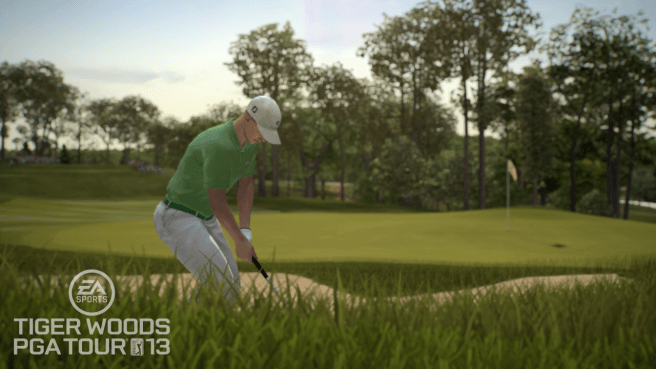
The graphics for the game are very solid, including courses and character likenesses, not to mention the environments in the Legacy Challenge. The menu layout is pretty standard for an EA Sports game and very little to complain about there as it’s very intuitive and easy to navigate for the most part. The only real visual/graphical issue that emerges is when the frame rate stutters, which happens a bit more often than one would hope for. Furthermore, there are a few graphical mishaps such as texture disappearance on the courses. These two problems detract from the otherwise smooth and well-produced visuals.
Audio:
I suppose it is a golf game, right? You can’t really expect too much in terms of a soundtrack as it just wouldn’t fit with the persona of the sport. The relaxed backing music they have included however is pretty suitable and most importantly isn’t annoying, yet. The commentary in the gameplay however does get extremely repetitive, and they seem to think you’re the next Jack Nicklaus even when you hit a pretty average stroke. But to return to my original point, it’s golf, how much commentary do you really need?
Overall:
Total Swing Control has definitely given the game a much needed kick, extending players a far greater level of control over their shots (as the name would suggest…), and providing a good framework to work with for future installments in the PGA series. What brings down this game substantially is the disappointingly obvious greed by EA that blares through with the “disguised” downloadable content, making people pay just to unlock the basics that should come included with the 90 odd dollars you forked out for the game. What’s more is the Legacy Challenge, albeit a nice attempt to illustrate the ability and biography of Tiger Woods, really needed a bit more effort to improve it’s “fun factor”. I feel EA played it way too safe when approaching this mode, and perhaps even the game in general. If you’re a golf fan, I have no doubt you’ll still have some fun with this, but if you aren’t a big golf fan, this isn’t the game that’s going to change your mind. So overall, it was a reasonable swing by EA Sports, but unfortunately it’s rolled into the rough (you didn’t think I’d go the whole review without a corny golf metaphor did you?)
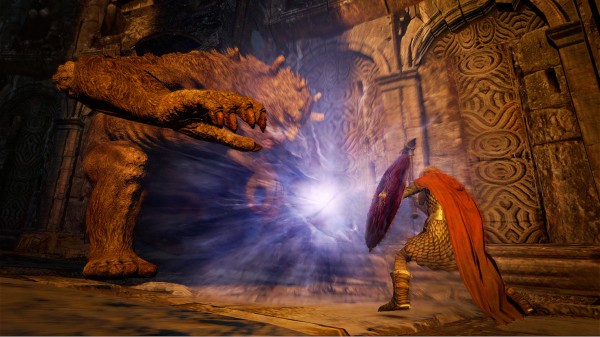
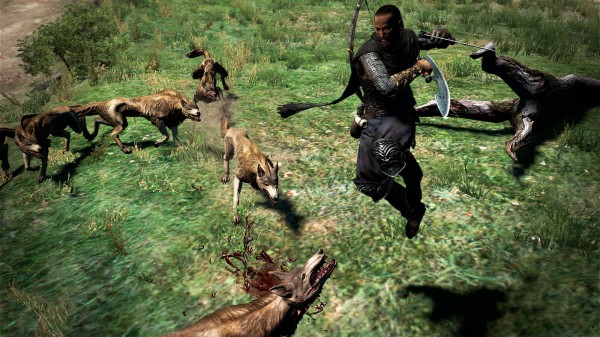
Dragon’s Dogma treads the fine line between single and online multiplayer in the most original and different way that an Action RPG can.
Sitting down with director Hideaki Itsuno, it is impossible not to like him. He’s energetic, super animated, and obviously in love with his job. And why wouldn’t he be? As a director at Capcom, he’s headed a fair few teams that have released some genuinely classic action games (such as Devil May Cry 2-4). And Dragon’s Dogma certainly has the ability to become a classic.
Coming up with the aspect that sets a game apart from all the others of the same genre is the most important part of development, and Capcom has certainly brought that different element to Dragon’s Dogma in terms of the Pawn system. You have a main controllable character and three Pawns in your team, which includes your main Pawn and two others that you have effectively borrowed from other Dragon’s Dogma players. And that’s where it gets interesting.
Every time you check into an inn during the game your Pawn and their stats are uploaded onto the server, allowing them to be ‘hired’ by anyone else. Why would you want this to happen? Well for their service your Pawn receives Rift Crystals, as well as being able to receive presents or messages from the player who has borrowed them. These items are added to your account the next time you check into an inn, so the goal is to make your Pawn as desirable as possible. You can also advertise your Pawn around, using social networking such as Facebook and Twitter, and have automatic access to your PSN or Xbox Live friends’ pawns.
To hire a pawn you can find them on the streets, or can enter the Rift through Rift stones and do a more specific search, for level, vocation, gender, and so on. It is free to hire a pawn equal or below your level, but as they have higher levels they begin to cost you Rift Crystals.
Being in the Rift can also show you the top 100 ranked Pawns, as well as ‘special Pawns’ which are recommended by Capcom themselves. You select five Pawns you’d like to enter the Rift, then pick which ones you’d like to hire. You can only have three at a time though, so don’t think you can get greedy and have a whole Pawn army behind you.
Your main Pawn will be your constant companion throughout the game, and the only Pawn whose abilities and vocations you can control. At the beginning of the game you create both your main character (the Arisen) and your main Pawn. The range of customisable options is huge, and sort of reminiscent of the huge amount of customisation options you see in games like The Sims. Everything from scars, to making them blind with permanently shut eyes, to having two different eye colours, to their build and their posture. The only aspect which might cause some sadness is that your main character must be human. The same of your Pawn, though they only appear human, they’re more just a humanoid race that loves being subservient to humans. With your Pawn you can adjust their personality, making them aggressive in battle, helpful to others, or have them scout ahead. These aspects can be changed later on in a ‘Knowledge Chair’, if you’ve decided your original choice isn’t quite so fitting with your fighting style.
There are also nine vocations to choose from, which might factor into your character build. Making your character larger causes their blows to have more power, so the obvious vocation is a hack-and-slash fighter, while having them small makes them quicker on their feet, so a Climber would work better. Never fear, these vocations can also be changed with a quick visit to an inn.
Upcoming 3DS puzzle adventure title, Shifting World, is set for a release in North America on 24 April 2012, which is pretty much less than a week away. To entice 3DS owners, a new gameplay trailer has just been released as well as some updates on the game’s official website.
The new gameplay trailer shares a bit of the game’s story but it essentially serves as a tutorial guide, highlighting the game’s control scheme and the gameplay mechanics. It’s a fairly comprehensive video and you can watch it below. The newly launched official website of Shifting World has some more images, videos, and story details, all of which you can check out here.
Look forward to a full review of this unique adventure title on Capsule Computers soon.
Sadly, studio closures are a regular occurrence in the current industry, particularly here in Australia. It’s not all bad though: developers displaced by closures usually continue their profession, with many starting their own studios.
Such is the case with new independent studio Three Phase Interactive, led by former Blue Tongue employees Paul Baker, Chris Burns and Drew Morrow.
Launching today in Melbourne, the team’s thoughts on going indie echo those of a lot of devs who do likewise. “It’s so exciting that we can get back to (our) DIY roots and just focus on making a game together and bringing it to market without all the red tape and organisational overhead of a large studio,” said Technical Director Paul Baker.
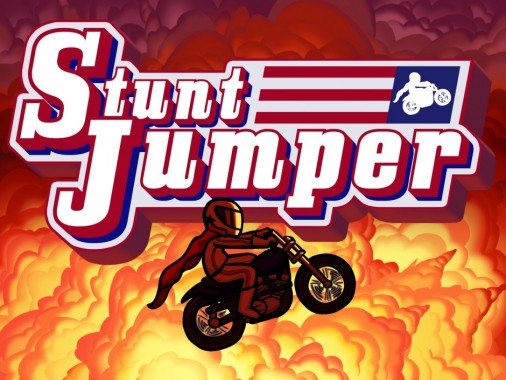
The team have also unveiled their first project: an iOS game titled Stunt Jumper. Due for release in mid 2012, the game features physics-based stunts, in a cartoony visual style. But Trials this is not, as vehicles can be modded with rocket engines, ejector seats, parachutes and the like. We’ll be keeping an eye on this one.
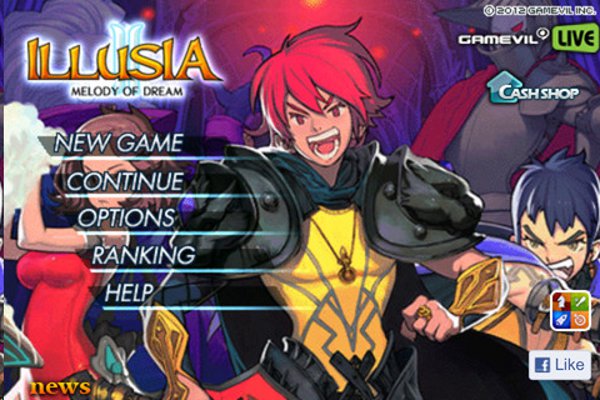
GAMEVIL has just released a trailer for one of their newest games, Illusia II: Melody of Dreams, which you can check out below. The trailer doesn’t supply much, but it is a sequel, so really only newer features need introduction. The features mentioned in the trailer are a Defense Mode and a Match Play Mode.
On the App Store page though, additional features include 3 characters and 20 new skills, 4 new worlds, and new weapons and armor. These additions are sort of standard though for sequels, so the newer modes of gameplay are probably where the most interest will fall. Be sure to check out the game in the App Store HERE.