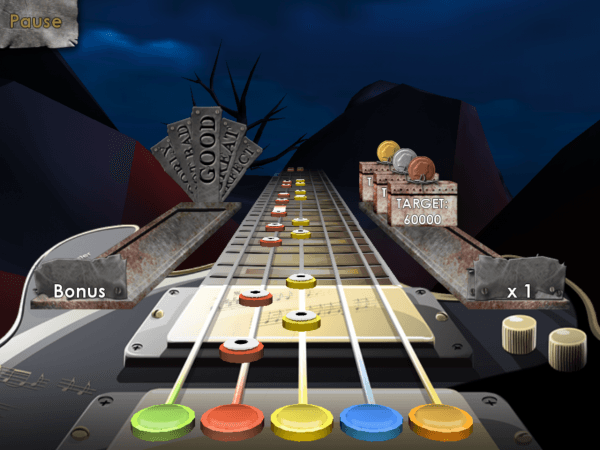
BulkyPix announced two new games for the iOS devices today. Music Master Chopin comes in two flavours depending on your preferred instrument. Music Master Chopin: Classic allows players to get behind a piano and tickle the keys. For those who prefer a harder sound, Music Master Chopin: Rock lets players shred their way through Chopin’s works. The games features the familiar Guitar Hero/Rockband style game play with 26 unlockable tracks, four difficulty levels and 70 pieces of information about Chopin’s life and work that is rewarded after each successful level. The games costs $5.49 AUD each, so rock out to Chopin here. No word when the Classic version will hit the App store so stay tuned to Capsule computers for the latest info.
We sat down with John Newcomer the Director of Game Design at MumboJumbo to talk about their new game Angelica Weaver: Catch Me When You Can.
What type of game is Angelica Weaver: Catch Me When You Can?
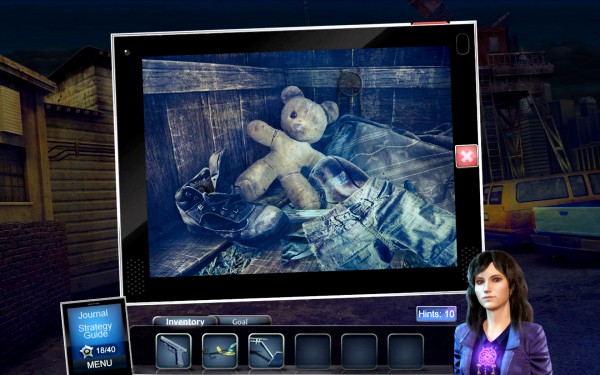
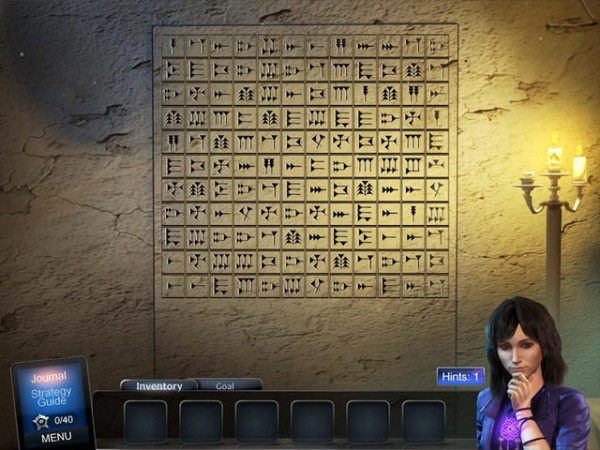
Angelica Weaver: Catch Me When You Can is an adventure-crime drama with a gripping storyline involving murders in the past and present. It features 3D elements seamlessly integrated in over 150 realistically rendered backgrounds, unique story-driven puzzles and a captivating main character you work with to catch the killer.
What inspired you to create Angelica Weaver: Catch Me When You Can?
The resurgence of adventure games along with the popularity of paranormal crime-solving television shows. We thought a realistic crime solving game with supernatural undertones would be fun.
Tell us about the Angelica Weaver character:
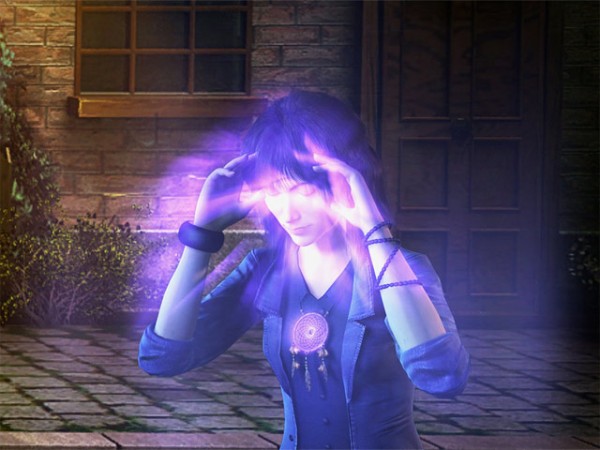
Angelica is an unconventional detective on Chicago’s special task force who is called in when forensics and traditional police work hit a roadblock. In addition to her superior observation and deductive skills, Angelica has the ability to experience a victim’s last sights, smells and feelings. She knows where a victim fell even at the coldest of crime scenes and still connects to their lingering spirits. Her link with the dead allows her to jump back and forth between murder scenes on the streets of historic London and present day Chicago.
What was your process for writing the story?
The story and gameplay are completely intertwined. I did intense research to find historical murders to give our story credibility. I needed a depth of victims and suspects to support a full-length game, and environments that lended themselves to layering in puzzles that fit the storyline and action. London of 1888 works as an interesting contrast to present-day Chicago.
The story is a thinly veiled rendition of Jack the Ripper with unnecessary violence discarded to make Angelica Weaver a casual thriller. What intrigued me was using the suspects as characters and figuring out how their various occupations would provide entertaining settings for the clues, puzzles and overall adventure. Some actual Ripper locations are included, but we also needed locations at convenient distances for smooth gameplay.
How is Angelica Weaver: Catch Me When You Can different from earlier MumboJumbo games?
While similar to our Midnight Mysteries series, which blend fantasy with historical fact, the Angelica Weaver: Catch Me When You Can storyline incorporates paranormal crime solving in both modern day and historical settings. To support the two time periods and the integration of 3D elements, the art style, gameplay and storytelling are more complex.
With our Samantha Swift series, we touched on making the title character a predominant feature, but with Angelica Weaver we’ve taken it a step further. She is animated in the HUD and steps out to interact with victims at crime scenes throughout the game. She also relays clues and observations to the player through voice over.
We included several new game features that help pace the gameplay. The tutorial system is more refined, and we streamlined the way the inventory is displayed. We also separated character comments that help further the story from general commentary, which was put into “black bar text.”
Were there any notable ideas in the conceptual phase of Angelica Weaver: Catch Me When You Can that were great on paper but cut later?
It took a lot of thought to develop ideas that would most appeal to our target audience for Angelica Weaver: Catch Me When You Can. What I think may be fun to play does not always match what our customer thinks will be fun to play. If you don’t put on your customer hat, think of new ideas and play through the game from a customer’s perspective, you lose… game over.
Initially, the story had details on more victims and suspects, with more weight on historical accuracy. We determined that having too many names to keep track of added confusion and took away from the gameplay.
What were the biggest challenges the team faced in making Angelica Weaver: Catch Me When You Can?
First, ensuring the more complex art style (merged 2D and 3D components) made the game more compelling and aided story telling. Secondly, the quantity of puzzles required to sustain a full game and bonus chapter. Creating puzzles that are fresh, fit the story, entertain the player, and are valid for a variety of skill levels, requires tremendous collaboration of the design, programming and art teams.
What feature in Angelica Weaver: Catch Me If You Can are you most proud of?
I am most proud of the overall entertainment value of the game. If I were to break that into a feature it would be how the story and gameplay are married together.
Crunch in video game development is notoriously demanding. How does the MumboJumbo team cope?
In the end, it comes back to our love of games. It’s fun to complete something you are proud to have associated with your name. The core team has been together for over four years, making it easy to get into a rhythm that pushes us through the end.
What games do you play outside of the projects you are working on in the office?
My favorite game is, was and ever will be chess.
What is your favorite part of creating games at MumboJumbo?
Seeing the game design storyboards come to life in the playable builds.
Angelical Weaver: Catch Me When You Can is out on PC and can be purchased from Big Fish Games here. A big thank you to the team at MumboJumbo for taking the time to answer our questions.
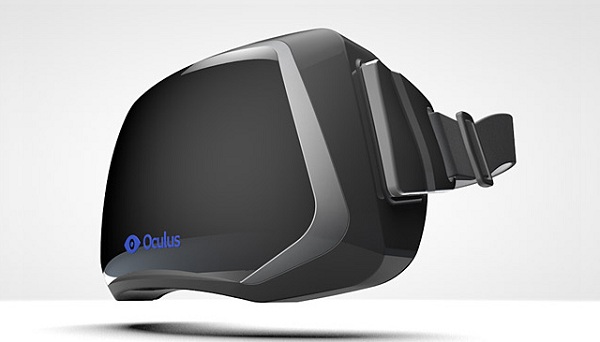
Since the announcement of Google’s Project Glass this past April, and the demonstration of the Oculus Rift at E3 in June, community interest in virtual reality headsets has reached an all time high. Now, Valve has thrown their hat into the VR ring.
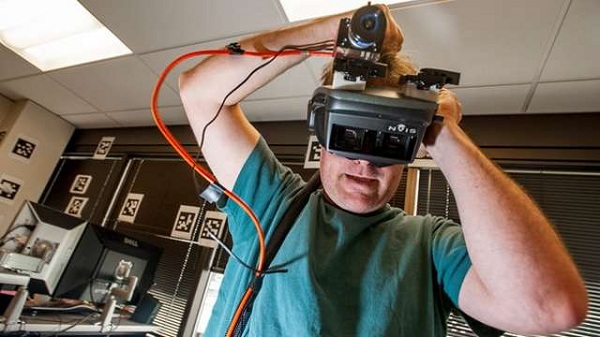
In a special New York Times feature, an NVIS headset which was demonstrated by Gordon Stoll, engineer at Valve, is described as “a boxy set of goggles that looks like a 22nd-century version of a View Master.” Project leader Michael Abrash truly believes that, with their planned virtual reality glasses, in a mere three to five years “credible augmented reality games” will be available to us.
The Oculus Rift May Have Some Competition
Although Valve are very excited for the realisation of these plans, they may not actually create the hardware themselves as “it’s ultimate goal is to share its designs freely.” Abrash states that “we don’t particularly want to be a company that makes hardware in large quantities. It’s not what we do.” To read more from the 3 page feature, visit The New York Times.
It looks like a representative from High Voltage Studios, the developers of The Conduit, has teased some info regarding the Wii shooter series. While answer questions on GamerFAQ’s, the representative said the following:
“We haven’t forgotten about Conduit over here, either. I would expect some new Conduit-related news before the year is out.”
This isn’t the only franchise the guys over at High Voltage are working on. They are currently working on Zone of the Enders: HD Collection (which was originally developed by Kojima Productions). While no one knows what the news is, we can only hope that it will do better than The Conduit 2 did.
Since Dead or Alive 5 was announced only one new character has officially been revealed for the game besides two crossover characters from Virtua Fighter 5. While the new male character Rig may be a bit of a crowd pleaser, it has been revealed that a new female character will be included in the game as well.
Her name is Mila and she is a mixed martial-arts fighter who apparently is a huge fan of Bass Armstrong as she petition’s Tina for a few pointers in her fighting style. The video revealing Mila can be seen below, though it is worth noting that it may be removed at some point thanks to the fact that it was leaked ahad of Tecmo Koei’s official unveiling. Will this feisty redhead be given a swimsuit to match the rest of the female cast’s? Probably, but we shall see.
When Nintendo launches Pokemon Black and White Version 2 in North America there will be a special treat for those who pick it up early. Anyone who happens to play these games between October 12th, the release date, and November 12th will be able to gain access to a “Mythical” Pokemon which is called Genesect.
Players will be able to obtain Genesect through the Nintendo Wi-Fi connection in the US. As for Genesect itself, the bug/steel type Pokemon can be seen to the right, with it looking like a cross between a tank and a strange purple bug. Then again, most recent Pokemon already have strange appearances so this one will fit right in with the rest.
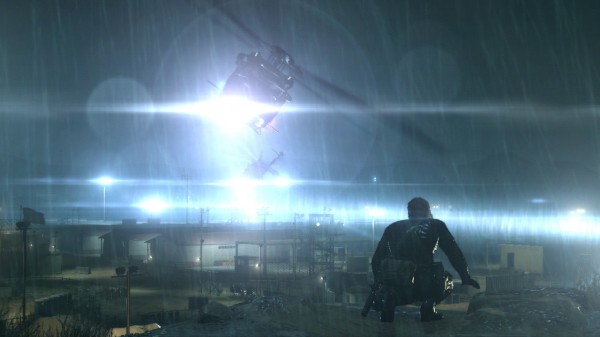
Not much is known about Metal Gear Solid: Ground Zeroes since it was first shown off during PAX Prime earlier this month besides the fact that the game will be open world and will feature an old version of Snake. However in an interview with Eurogamer Hideo Kojima revealed a few more tidbits about the title.
As gamers play the game, the world will change from day to night and vice versa and some of the changes between night and day will be adjusted “enemy troop patterns” and more. Unfortunately for those of you hoping that Metal Gear Solid: Ground Zeroes would avoid having loading screens similar to MGS4, well… it doesn’t.
You may have heard about a beloved little title called Shantae: Risky’s Revenge which was previously released as a DSiWare game and most recently on the iOS. Well if you still haven’t been able to play this stellar game yet or don’t have anything to play it on, you may just get your chance because WayForward, developer of the title, have submitted the title to Steam’s new Greenlight service.
For those who don’t know, Greenlight is a system that will allow certain games to make it to Steam that never would have had a chance before. It is a bit strange to see that the game has appeared on the Greenlight service instead of just as an immediately purchasable submission, however you can do your part by voting on the Greenlight page for Shantae: Risky’s Revenge here, though a Steam account is necessary.
Blast A-Way Developer: Illusion Labs Publisher:Illusion Labs Platform: iPhone (reviewed), iPad Release Date: 5th September, 2012 Price:$5.49 Available Here
Overview
Blast A-Way is an indie physics-based puzzle game with some interesting concepts, hidden collectables aplenty and a cute visual style.
Sound familiar?
Indie ideas often seem to sprout from similar seeds, but the results usually feel varied enough to keep things interesting.
Gameplay
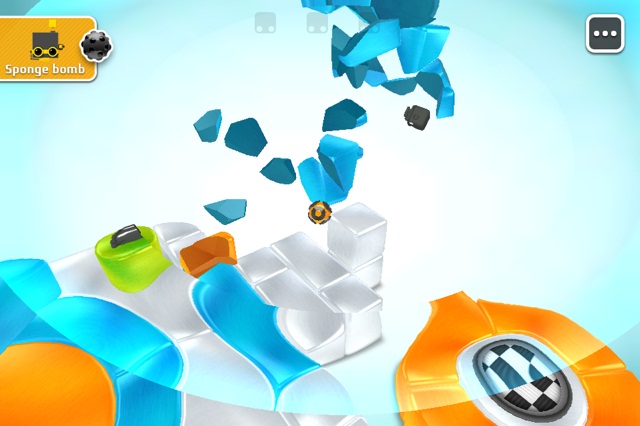
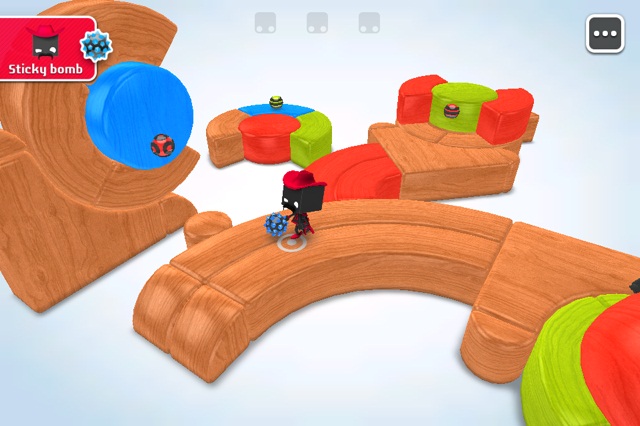
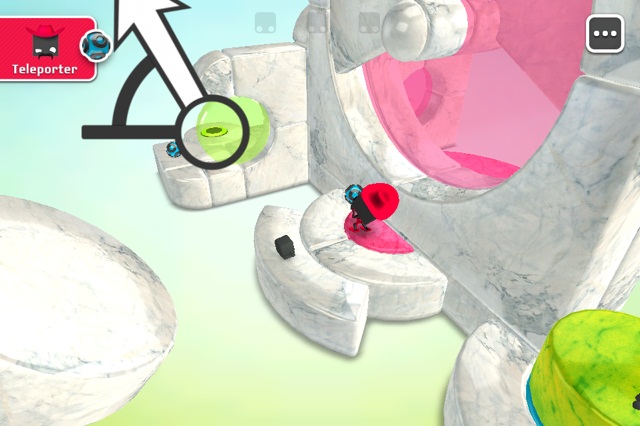
Players navigate little robots through brightly-coloured, tightly-designed levels, in search of “Boxies” – littler robots – on the way to the exit. Doing so involves the use of ball-shaped, colour-coded bombs, teleports, “rebuilders” and the like, while geometric shapes in the environment are coloured to indicate which balls can interact with them. Blue cube in your way? A blue bomb will take care of that. Need to get over to that red platform? Use a red teleport.
From this basic framework, clever design allows interesting puzzles to emerge. You may need to change the colour of elements, swap between two characters, or rebuild something you had to destroy earlier. Each level is presented cleanly, leaving the challenge to arise in determining the best order to undertake actions.
That said, you shouldn’t ever find yourself hopelessly unable to reach the end. Give it a few minutes of braining and old fashioned trial-and-error, and the answer will usually present itself quickly. It mightn’t entirely satisfy hardcore puzzlers, but it’s a wise feature of a game on a platform designed for short-burst sessions.
As per standard procedure, grabbing the optional collectables – in this case the Boxies – is where you can sink larger amounts of time. Sometimes you’ll net all three Boxies out of necessity on your way to the exit, while others require extra steps in the action chain.
Unfortunately, navigating levels can be a problem, especially at first. Traversing the three-dimensional environments requires turning and panning the camera, and the distinction between the two is rather fiddly. Sliding your finger across the terrain will pan the camera left, right, forward or backward, while to turn you perform the same motions, holding your finger in the white void around each level.
You’ll get used to it, but it might put off some people before they reach the point of acceptance. I can’t help but feel that the game would be better suited to PC and/or consoles, via Steam, Desura, XBLA or PSN. Controlling the camera with a mouse, and the character with the keyboard seems more intuitive. Although to be fair, drawing a path for the character with your finger is very satisfying, a movement I’m surprised we don’t see more often.
Visuals & Audio
As mentioned, each level is surrounded by empty white space, which makes a clear distinction between level and void. It may sound bland, but what it loses in perceived prettiness is regained in efficiency: you’ll know instantly what you can and can’t play with, and won’t be distracted by unnecessary background dressings.
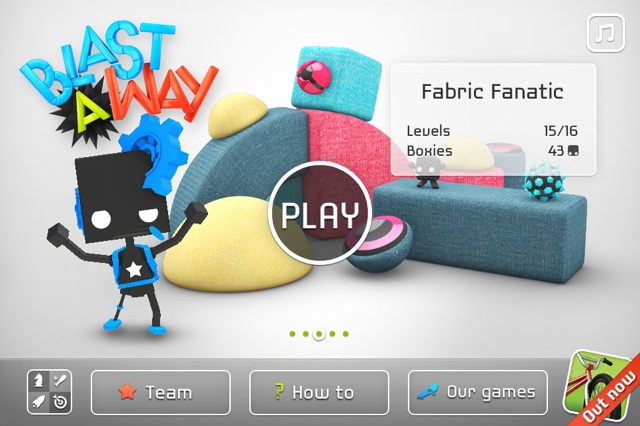
And besides, the team have obviously dedicated their visual attention to the important bits – the levels themselves. Each “world” of sixteen levels is composed of a different material: wood, metal, fabric, stone and plastic. It means little in gameplay terms, but it gives each setting its own feel.
That kind of differentiation should have been given to the balls you use to get around. The pattern on them tells you if it’s an impact bomb, a sticky bomb, a sponge bomb, a teleport, etc, but the designs aren’t obvious enough. Picking them up becomes the best way to figure out what each one is, but you can’t always do that.
The environments are little more than textured building blocks, so you’d expect the characters to step in to fill the game’s personality quota. Despite being robots that wear cowboy hats, mustaches, sunglasses, or have cogs lodged in their heads, the player characters don’t contribute much. The stars of the show are those little Boxies – damn they’re cute! They’re basically just cubes with legs, but I think it’s their tiny voices that get me. calling for the player’s attention or thanking you for saving them, they remind me of the classic Worms voice.
Accompanied by a soundtrack of cheery tunes, the game is nicely presented, all up.
Overall
Blast A-Way followed the recipe closely, putting its own spin on things when required, but the final product tastes a little… bland. It’s technical, clever and cute, but lacks a true spark.
Were it priced as an ordinary iOS game, it would be easier to recommend, but the premium tag might make some hesitate. Again, that’s a sign of an ill fit for the iOS platform: five bucks would seem a steal for the game, were it on Steam.
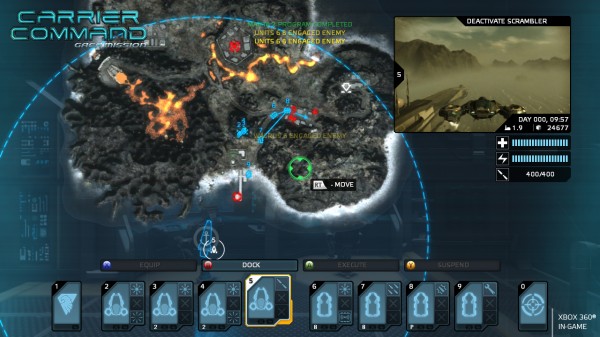
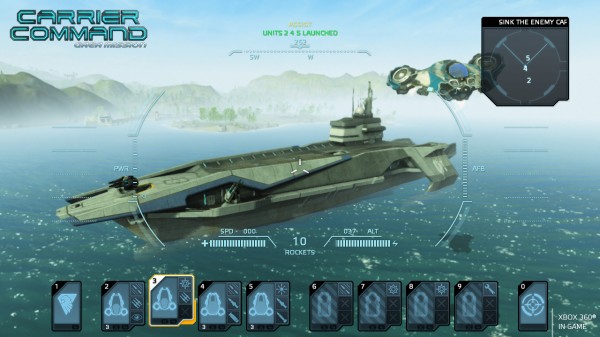
Carrier Command: Gaea Mission is the modern take on the classic Carrier Command game from way back when. It is a game that easily combines strategy elements with some amazing action filled gameplay and some even cooler looking visuals. It’s obvious that the team behind the game must have been fans of the classic, considering the amount of care that they’ve taken to create an excellent follow-up to an old favourite. In this preview of an unfinished build of the game (version 0.7.x IIRC) we take a look at how the game is currently looking.
For those of you that are unaware of the Carrier Command legacy, it really doesn’t matter with this game. All that you really need to know is that there is a war going on and that you must use your limited resources intelligently in order to best your foes on the battlefield. However, I will admit, that the opening mission in the storyline is a little misleading as to the games actual content.
What I mean by this is that the opening level sees you running around mostly on foot through a bunch of scripted and predetermined parameters that almost reflect negatively on the game. However, this quickly changes once you head inside some old station of some kind where the game starts to feel a bit more like Doom. Not so much with the whole demons killing everyone thing, but more with the general atmosphere of the level. Fortunately this opening level is pretty quick and sees you capturing your Command Carrier, your portable base that you take with you to capture islands and defeat enemies.
Now obviously the game is called Command Carrier, so it’d be a bit suss if you didn’t at least encounter one right? Well in this game, you capture one and then you sail it to conquer the world. It’s actually quite impressive with the things you can do with it. For one, it’s a Carrier ship; which means that it can carry units. This is important for later when you’ll be invading other islands within the game. It’s also a portable research station and a losing condition. Don’t let it die.
If I was to liken this game to another game, it would definitely be to the old Battlezone (IIRC) games. This is because of the similarities in play that the games share in common. For example, as anyone who has played Battlezone will tell you, vehicles are plenty important to use in capturing points. In Carrier Command, this is no different.
In fact, in this game, it is much more beneficial to capture islands that can produce units than it is to destroy them and then rebuild them. Yes, in Carrier Command you have the option of simply destroying an islands command center, thus enabling you to place your own in the old ones spot, or you have the option to send in a hacking unit to simply take control over that islands command center, transferring all control over units and factories to you.
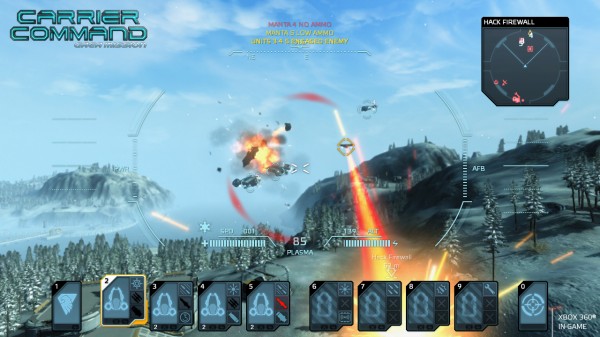
What’s cool with these units is that you can control some of them, whilst others are automated. For instance, you have a bunch of robotic drones guarding your islands that will automatically do their best to protect it against intruders. In fact, anything that you are not directly controlling can be attributed to some kind of AI guidance. For example, when flying in one of the aerial units, you can assign your three other ones to assist you in the sky. What’s even more fun is that you can automate some units and then control them whilst they’re still moving automatically. This can make for some interesting watching.
Apart from the main campaign, there is also a mode called Strategy Mode. In Strategy Mode, players pretty much play through the game without a storyline. What happens in this mode is that you start with your Command Carrier and you must capture and defeat all of your opponents islands. When I first went into this mode, I figured, you know, it’d only take a few hours to do. Nope. It’s long. This is a good thing.
I think that having a second gametype with a serious amount of longevity is a good thing for a game to have. I mean, what kind of fun could you have just bum-rushing through a strategy game where you have to outsmart your opponent? Not much. Having things take time gives players some room to actually plan and strategise; which is a lot more fun than a rushed and assured victory each and every time.
Visually this game is looking pretty decent. For some reason I don’t think it’s doing that distance blurring effect thing properly, but everything still looks pretty amazing. I’m not going to lie though, the game does not stress the PC any visually. In fact, my current two year old PC cake-walked the game. This, however, does not mean that it is a visual atrocity. It just means that players expecting something like Crysis-Field-20,000 will be disappointed.
Overall I’m actually quite pumped to see how the full version of this game will turn out. As a preview pre-release code, it is incredibly fun to play and aside from a bunch of bugs that are likely to be ironed out before release, I’d say that this is definitely one of those games that you’d have to at least play once or twice. However, the Strategy Mode will have you returning for more and more. Be sure to check out this game when it hits the Xbox 360 and PC later this year.



 When Nintendo launches Pokemon Black and White Version 2 in North America there will be a special treat for those who pick it up early. Anyone who happens to play these games between October 12th, the release date, and November 12th will be able to gain access to a “Mythical” Pokemon which is called Genesect.