North American anime distributor confirmed at the Sakura-Con convention that it will bring recently aired anime Psycho-Pass to Blu-ray and DVD in Spring 2014. Additionally the director’s panel revealed a second season could be possible but only if the show gets enough support, presumably in Japan.
Psycho-Pass is a sci-fi crime anime set in the future, where Japan has implemented a system that makes it possible to instantly measure a person’s state of mind and personality. This data is then used to assign a matching occupation to every individual, but it also determines ones criminal tendency effectively removing a court-based justice system. The story focuses on Shinya Kougami, an enforcer tasked with enacting the will of the system and his supervising inspectors.
With over a year left until we see the release, Funimation are yet to confirm pricing and details.
The first promotional video for the upcoming anime adaptation of popular Japanese RPG series Hyperdimension Neptunia has been streamed. It is due to be aired in July 2013 under the title Choujigen Game Neptune The Animation.
The anime seems to adapt the events of the first game but adds in several new twists. Neptune finds herself in an alternate dimension where the three land continents differ from their original versions and where a new goddess, Iris Heart, rules Planeptune instead.
Choujigen Game Neptune, as it’s known in Japan, has surprisingly continued to sell well overseas with Hyperdimension Neptunia Victory serving as the latest and third addition to the PS3 game series. Using personified consoles the games serve as a parody of the gaming industry itself.
The publisher has recently unveiled Hyperdimension Idol Neptunia PP, Hyper Goddess Faith Noir: Extreme God Black Heart and a remake of the first game, Hyperdimension Neptunia: Rebirth 1 all for the PS Vita.
Check out the anime trailer below, featuring the song Dimension Tripper by nao.
Dédale DeLuxe Developer: Sergey Mohov Publisher: Sergey Mohov Platforms:PC (Reviewed), Mac, Linux, iOS Release Date: July 18, 2012 Price: $2.99 – Available Here
Overview
Have you been looking for a puzzle game with some bite? Do you like supporting indie developers as they try to bring their own unique ideas to the video game landscape? Are you a fan of butterflies? Then perhaps you should check out Dédale DeLuxe. Read on to find out more.
Gameplay
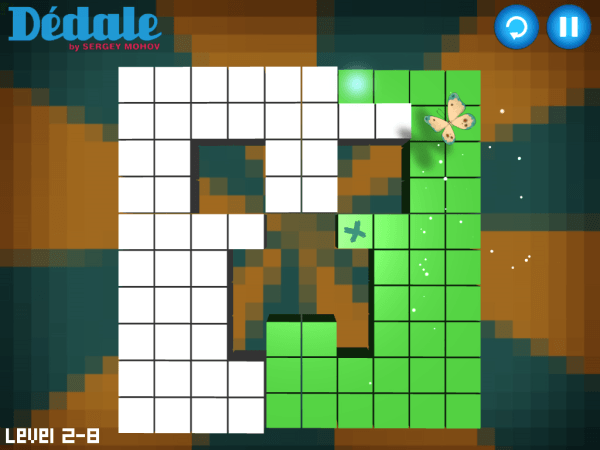
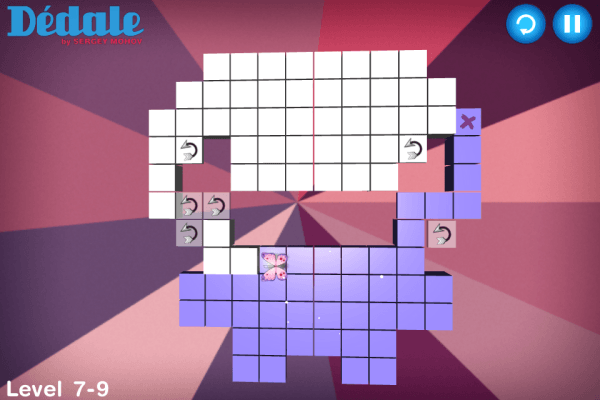
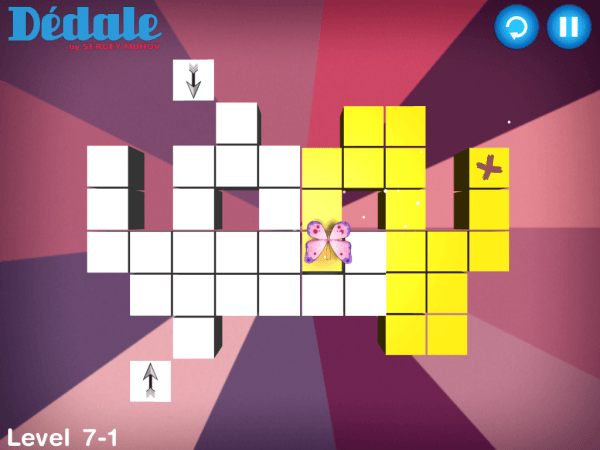
In Dedale DeLuxe, you will be helping a butterfly escape from various mazes. The game is deceptively simple in design. Each level starts with a layout of white blocks on the board. You’ll pick a starting block on the stage by clicking on it, then you’re off to the races, so to speak.
As you move your mouse from the current square to an adjacent one, the new square will effectively get “pressed down” and change color. The object of the game is to press every single panel on the stage to leave. If you leave even a single panel raised, you’ll have to start over.
As you progress through the game, new block types will be introduced for you to contend with. The game does a great job of slowly introducing each new concept to you then really turning up the heat once you’ve built some familiarity with it. It keeps things interesting and brain twisting without every feeling unfair.
The game has seven worlds, each named after a spice or flavor. Each world contains fifteen levels to work through. Some of the more interesting levels are shaped like popular video game pixel art you may recognize, such as the creeper from Minecraft or a space invader. If each of the 100+ levels aren’t enough for you, you can always dig into the “Dédale-O-Matic” and have a level randomly generated for you.
The game does include a few little knick knacks to help you progress. There is a hint system built into the game, but it feels woefully inadequate given the difficulty of some of the levels. There can be a few dozen tiles visible to start on at once, and the hint system will simply point out a single tile to choose. After you begin playing, hints are disabled. If you do get stuck and can’t figure a level out, you are granted the ability to skip two levels over the course of the game, but a large exclamation point is put on that level until you complete it.
Visuals Dédale sticks to fairly straightforward visual design and has a much more striking appearance for it. The background for each world sticks to a simple pattern with only a handful of colors. This helps give the game some visual pop without distracting from the game.
Audio
There isn’t a ton of sound design that needs to go on with a game like this. Given the name of the game (Dédale is French for “maze”), the distinctly French menu music is an understandable fit. Once you’re actively playing a level, though, the music shifts to tunes that are far more relaxed and soothing, like something you would hear at a massage parlor. As you play the game, the sounds of piano keys being struck with each pressed tile is pleasant enough, but they play in a random tune so you never get the satisfaction of finishing a song.
Overall
Overall, Dédale is a good puzzle game. The art style is simple and to the point, which helps accentuate the gameplay. As you’re playing the game, the audio helps drive a sense of relaxation but the menu music could have used a different choice. The level design is where this game truly shines though. Dédale does a good job of introducing you up to new concepts while devilishly twisting your mind in the process. If you’ve been looking for a good, inexpensive puzzle game, you should give Dédale a look.
Capsule Computers review guidelines can be found here.
The 5th Okinawa International Movie Festival has just wrapped up this years 8-day comedy focused event with a closing ceremony which featured an impressive fireworks display ending.
This years festival broke major records for the Okinawa International Movie Festival with record-setting attendance of 422,000. This is the highest number of admission in the past 5 years of the festival.
Barfi an Indian film won the special jury prize ‘Golden SHISA Award. Taiwanese films Chinese Zodiac and The Happy Life of Debbie won the Uminchu Prize Grand Prix in Laughter and Peace categories.
This is undoubtedly a phenomenal fifth year for the Okinawa International Movie Festival which paints a bright picture for years to come reminiscent of the dazzling fireworks display that ended this years event.
Episode 15 of CC: Anime is nowlive. Each month, thanks to our good friends and sponsor Siren Visual, we will be giving away a prize in a monthly competition held through CC: Anime.
To win, listen to the podcast for the question and once you have an answer email it in along with your name and address to[email protected]. At the end of the month, a winner will be randomly selected from the pool of entries. The winner will then be announced on the next podcast.
This month, we will be giving away a copy ofTiger and Bunny Part 1, on DVD thanks to our good friends at Siren Visual. If you have yet to listen to CC: Anime you can do so here.
Listen to the podcast and then send your answer in along with your name and address to [email protected] Good Luck!
Welcome to a monumental episode of CC: Anime, Capsule Computers Anime Podcast! In our fifteenth episode, the CC: Anime crew discuss the latest anime and manga news, the Spring 2013 season, answer your questions and talk it up with special guest Guardian Enzo. We also have a prize giveaway of Tiger & Bunny Part 1 on DVD thanks to our sponsor Siren Visual, find out how to enter here.
Cast: Luke Halliday, Travis Bruno, Benjamin ‘Linkage Ayexe’ Webb, Jahanzeb Khan and special guest Guardian Enzo
We hope you enjoy CC: Anime Episode 15, be sure to let us know what you think.
Guardian Enzo is the man behind the blog Lost in America and a regular contributing writer for the wildly popular Random Curiosity. He is considered a pillar of the anime community with many turning to Enzo for his in-depth analysis and insight. Providing anime watchers with his weekly reviews on a plethora of ongoing series, Guardian Enzo is a passionate writer who is highly regarded by anime fans across the globe.
J.U.L.I.A Developer: Cardboard Box Entertainment Publisher: Lace Mamba Global Platforms: PC Release Date: Out Now Price:$19.99 (Available Here)
Overview:
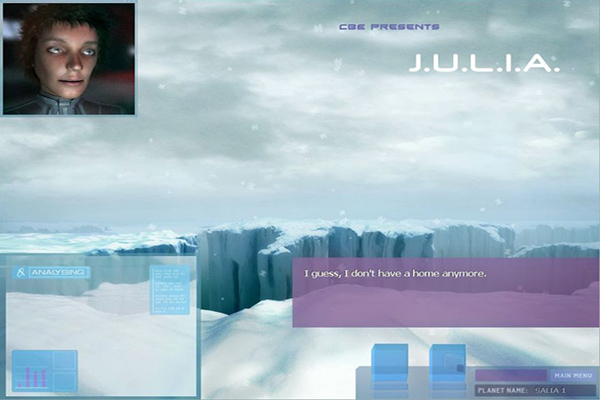
J.U.L.I.A is a mix of a text adventure game, filled with puzzle mini-games, describing itself as a narrative driven title. It asks if the player is ready to step into the spacesuit of Rachael Manners’ and to utilize an ingenious MOBOT to explore six vast, unique planets and to explore and uncover all its wonders. From reading this description alone one might think this game would be highly captivating, however for the modern games fan this may not hold true.
Story:
The story begins with Astrobiologist Rachael Manners waking up in a cyro-chamber to find herself alone on the spaceship with no explanation as to where her entire crew has vanished to. Her only companions are the damaged ship’s Artificial intelligence J.U.L.I.A, and an exploration drone named MOBOT. Rachael’s first concern is naturally to find out the fate of her crew.
After repairing the ship well enough for space travel, she explores different planets throughout the solar system, using MOBOT to do the physical exploration while she commands from the ship. Looking for clues and answers on each planet to help to solve her questions. J.U.L.I.A is able to be sympathetic to Rachael’s plight and is often the voice of reason. Likewise MOBOT shows a remarkable sense of self preservation and dry sense of humour for a character voiced by a text to voice programme.
Gameplay:
As opposed to what you might expect in an adventure game, in J.U.L.I.A you are only ever presented with text based interfaces which are intertwined with various puzzles to solve. It’s a very old school approach to modern adventure gaming, (reminiscent of the educationally used game ‘Granny’s Garden’, if anyone remembers that?) and one which will not appeal to the majority. However, puzzles in J.U.L.I.A are plentiful and widely varied in both type and difficulty, although none are all too challenging. Clues can be found scattered around the planets, and noting some of the information down at times is necessary, since there’s no form of in game notepad that records this for you.
The game contains no puzzles which require you to store items for later use, and although you can instruct MOBOT to pick up items, their use is available only through the text-based options in context. Logic puzzles range from decoding problems to creating upgrades for your ship to advance in the game, using a template to help connect circuits with a limit on the amount of pieces used. The range of puzzles does an okay job of keeping the experience fresh, even if the puzzles are never particularly challenging. There is one puzzle which may be difficult and this is during a particular math based challenge, but the game offers to do all of the calculations for you, leaving you to simply input the solutions.
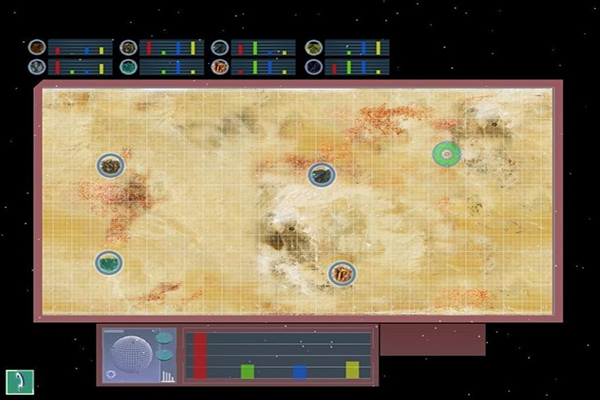
Most of the puzzles are generic for the genre, such as opening a locked door by connecting wires. One repeated mini game is harvesting resources, which involves moving a cursor across a map of each planet to match a template graph of material composition to another graph which represents the actual raw material below. After the starting planet is explored, any of the six planets are available to explore, however access to another planet may depend on completing another, so the game is pretty linear overall.
Visuals:
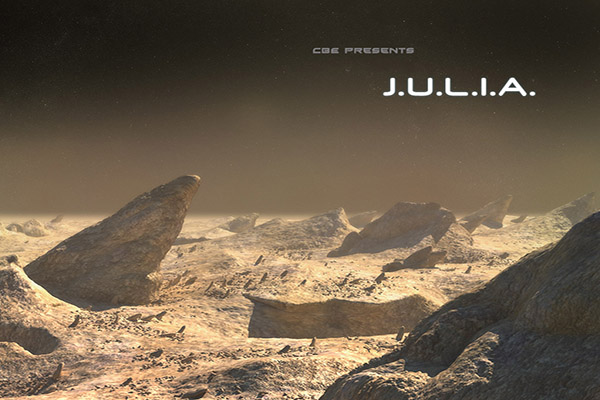
The graphics in J.U.L.I.A are not bad at all, however most of the scenes the player gets to see are split up into multiple still images in an attempt to facilitate the text-driven adventure game play, with the rest devoted to MOBOT’s heads-up display. As a positive, each planet in the game has a different look or distinctive feature, from an icy world to one full of rocky spires which soar above the clouds, to a vibrant jungle planet filled with alien architecture. The textures make each still scene look real, with variety ranging from rippling water covering one planet to the desert sand on another.
The cut scenes are also pretty pleasing on the eye, many including MOBOT exploring and Rachel’s probe travelling to different planets. The character models in the game are only usually seen in a small dialogue box when the characters are speaking and thus aren’t the greatest. Aside from the three main characters, other characters include a few aliens which look suitably extraterrestrial and are different enough from each other to easily differentiate between them, and several dead bodies. Although the latter is never graphic, merely suggestive, like legs sticking out from behind an obstruction.
Audio:
The voice acting in J.U.L.I.A is okay, but with two out of the three main characters being artificial intelligence, it was never going to be incredible. Subtitles are used throughout the game and can’t be turned off, but dialogue can be clicked through. Lip synching is virtually non-existent, with lips even continuing to move after the voice has stopped. Mobot is voiced by a computer (the TextAloud program), but still manages to sound like a human reading a computer part. There are plenty of other sound effects that fit the diverse environments such as water rippling or birds chirping. This background music varies wildly from technical machinery beeping in tune to tribal chanting and Eastern strings, and this helps the music to not become overly irritating, but nor is it anything special.
Overall:
J.U.L.I.A is certainly not for everyone, and those with short attention spans used to fast paced game play may become bored by this title. Completion of J.U.L.I.A requires little more than light brain work and however much time you’re willing to sit through it in a single session. The game can be completed in as little as seven or eight hours if you rush through it. Players will rarely, if ever, find yourself truly stuck and the game’s highlights offer almost zero interaction. The game is not all bad, and it game can be relatively relaxing, if not a tad mind-numbing to play. If you are interested in the retro feel of the game, and want to reminisce of games made many years ago then you would possibly enjoy this title. However, for others J.U.L.I.A would simply be a way of passing a few hours. If you are looking for a challenging puzzle game with a gripping storyline then it would definitely be wise to look elsewhere.
Capsule Computers review guidelines can be found here.
This week on Anime Say! I return with a review of Hunter x Hunter’s ‘Yorknew City’ story arc. The ‘Yorknew City’ arc is known as one of the darkest and most complex stories in the Hunter x Hunter series. What did I think of the arc? Watch below to find out.
Got any questions for Anime Say? You can send me a tweet on my official twitter or alternatively drop me an email at [email protected]. I will do my best to respond to your tweets and emails as well as try read some out on the show.
What do you think of the ‘Yorknew City’ arc? Let us know in the comments section below.
This certainly came from nowhere. Just recently, it was announced that a remake of Double Dragon 2 will be headed to the Xbox Live Arcade, titled Double Dragon II: Wander of the Dragons. Now this same title did surface back in 2011 – but has just re-appeared and looks to be ready for release.
Yes, your guess is as good as ours, but I am all for a 3D rendered remake, as long as there is some quality behind it. Will it beat Neon? Well, I kind of doubt it, but you never know as stranger things have happened and the concept of a remake is certainly refreshing. You can pick this title up when it launches on April 5th for 1200 points.
I Get This Call Every Day Developer: David S Gallant Publisher: David S Gallant Platform: Mac, Windows (Reviewed) Release Date: December 21st, 2012 Price: $2.00 or more (Pay What You Want) Buy it Here
Overview
David S Gallant used to spend his day working for a call centre in Toronto. Then he made I Get This Call Every Day to blow off the stress from his day job. His boss fired him for this game in twist of life imitating art. I Get This Call Every Day an interactive fictional version of the idiotic and annoying customers he used to handle on a daily basis.
Story
I Get This Call Every Day is a simulated choose your own misadventure simulating life as an office drone in a call centre. Anybody who has had the unfortunate experience of having worked or currently working in a field involving customers will appreciate the game. The game only features one caller with a variety of possible endings. The caller is believable, ranging from an obnoxious youth to grating idiot. The player’s own possible responses range from new at your job polite to burnt out completely rude.
Gameplay
I Get This Call Every Day works like any piece of interactive fiction. The game gives you one of several options to select, the narrator reads the chosen line and then the caller responds. The controls are simple, extremely usable, and do not suffer from any difficulties. One of the biggest problems with the game is its length. The game can literally be played in ten or so minutes if the player patiently sticks to the script of a polite call centre employee and suffer the caller with grace and serenity worthy of a Zen master. The game is worth a few replays just to see all of the ways it is possible to be fired. It appears that the game keeps some sort of strike mechanic running. If enough incorrect actions are taken, the player is unceremoniously fired by email. Unfortunately, each firing is rewarded with the exact same curse with no response to the nature of the firing.
Visuals
I Get This Call Every Day looks like it was made in Microsoft Paint and drawn with a mouse. Creator David S Gallant stated that the art style started in the original mock ups of the game but was maintained because the ugly “art seemed to fit … [because] the game presents an ugly situation.” The art style actually contributes to vibe that this game was made by an angry and frustrated employee blowing off steam during or between calls.
Audio
It is blazingly obvious that David Gallant suffered worked as a call centre employee. The lines he delivers as the employee roll off his tongue like a well-practiced machine. The caller’s voice is believable and manages to hit the right tones of indignation and stupidity without becoming a caricature.
Overall
I Get This Call Every Day would make a great Flash game. But asking for even $2.00 is an extremely steep price for the game. The game can be completed in a short period of time and the replayability only doubles the 10 minute length of getting the most polite ending. Trudging through the same painful conversations to see how the other endings work out gets painful quickly. On one hand, the game proves its point about how terrible Gallant’s job was as a call centre employee. On the other hand, Gallant was being paid to endure this torture handle callers, the player is paying to endure stupid callers. After the first call, the game goes from funny to agonizing. For the full price, I cannot suggest buying the game for the sake of enjoying a game. The purchase of I Get This Call Every Day will most likely be more for the buyer than a purchase for long term personal enjoyment. The reasons to buy ths game might be to balance karma after accidently driving a call centre employee insane or to simply to support Gallant in his freedom new life. However, buying I Get This Call Every Day for face value is not recommended.
Capsule Computers review guidelines can be found here.












 Guardian Enzo is the man behind the blog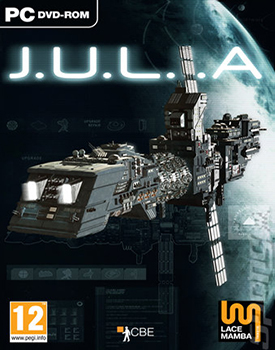



 This week on Anime Say! I return with a review of Hunter x Hunter’s ‘Yorknew City’ story arc. The ‘Yorknew City’ arc is known as one of the darkest and most complex stories in the Hunter x Hunter series. What did I think of the arc? Watch below to find out.