A new study finds links between the reduction of anxiety and depression with the use of casual games, like Bejeweled, Peggle and Bookworm adventures.
In a study conducted between ‘East Carolina University’s Psychophysiology Lab and Biofeedback Clinic’ and ‘Popcap Games’; comes evidence that suggests a link between the reduction of psychological problems, such as anxiety and depression, with casual games like Bejeweled. The study itself featured ~60 randomly selected participants with around half featured as controls. To quote the study –
East Carolina University’s Psychophysiology Lab and Biofeedback Clinic today revealed the results of a year-long randomized, controlled clinical study that measured the efficacy of so-called “casual” video games (CVGs) in reducing symptoms of depression and anxiety as a co-morbid condition. Nearly 60 subjects, half of whom served as controls, all meeting the criteria of clinical depression, participated in the study, which involved three family-friendly, non-violent puzzle games: Bejeweled 2®, Peggle® and Bookworm® Adventures. (All of the games are made by PopCap Games, underwriter of the study.) The hypothesis was tested using state-of-the-art technologies including psychophysiology, biochemical and psychological measurements, and found an average reduction in depression symptoms of 57% in the experimental (“video game”) group. The study, the first such research ever to measure the efficacy of video games in reducing depression and anxiety, also found significant reduction in anxiety, as well as improvements in all aspects of mood, among study subjects who played the casual video games.
Dr. Carmen Russoniello, Director of the Psychophysiology Lab and Biofeedback Clinic at ECU, and also the overseer of this study, points out that casual games have a positive effect over these psychological issues. He shares his findings –
“In my opinion the findings support the possibility of using prescribed casual video games for treating depression and anxiety as an adjunct to, or perhaps even a replacement for, standard therapies including medication. Remarkably, these games had both short term (after 30 minutes of game play) and long term (after one month) effects when compared to the control group. Equally important, the data supports the hypothesis that casual video games contain intrinsic qualities that, when played, provoke physiological and biochemical changes consistent with positive changes in mood and anxiety.”
An estimated 20.9 million Americans suffer from some kind of mood lowering symptoms and around two thirds of those suffer from major depression. – National Institute of Mental Health (US).
For more information, check out the study results here.
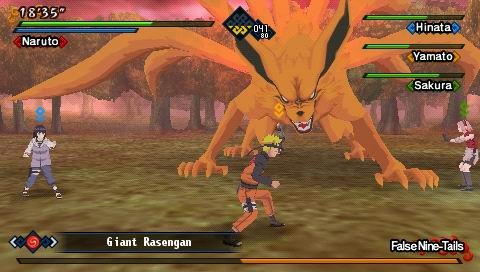
Feeling a little down because your favorite yellow haired ninja hasn’t been around since November of last year? Then cheer up because the demo for the latest Naruto Shippuden game is available right now on the PlayStation Network to download onto your PSP. This way you can get a taste of what Naruto Shippuden: Kizuna Drive has to offer before it comes out on March 22nd for $40.
The demo itself will give players the chance to play as Naruto, Sakura, Kakashi and Shikamaru to battle against the opponents that they put you up against. But the most interesting bit of news is that a new trailer was also released for Kizuna Drive which says that the game will feature a completely seperate storyline than what is featured in the show and looks like it will place players up against Fake Tailed Beasts.
Kizuna Drive will allow players to go through this unique storymode as well as a free battle mode where you can build a four man team of your own and do battle against enemies. The appeal of this mode is the fact that you can team up with three other friends to fight together wirelessly.
From now on when you see a popular App that happens to be free on the Appstore then you better check the fine print because Apple has just approved the ability to allow Apps to charge a subscription fee to let you even access the content inside of it. The App Store previously allowed in-App purchases through your iTunes account and will now also allow subscription fees to be charged as well.
There has been no word as to how many games will actually be using this subscription based method of transaction but it could be dark times ahead for anyone who enjoys taking Farmville with them on their phone or simply enjoying something like Lil’ Pirates on their iDevice.
CEO Steve Jobs said this during the approval of the subscription fees:
“Our philosophy is simple — when Apple brings a new subscriber to the app, Apple earns a 30 percent share; when the publisher brings an existing or new subscriber to the app, the publisher keeps 100 percent and Apple earns nothing. All we require is that, if a publisher is making a subscription offer outside of the app, the same (or better) offer be made inside the app, so that customers can easily subscribe with one-click right in the app. We believe that this innovative subscription service will provide publishers with a brand new opportunity to expand digital access to their content onto the iPad, iPod touch and iPhone, delighting both new and existing subscribers.”
Hackers beware, Sony isn’t about to just let you have a field day anymore on their console. The PlayStation 3 has unfortunately become one of the most notoriously hacked consoles of this generation considering the fact that Sony and the Hackers of the PS3 are always at war with one another. It seems that Sony has finally had enough of trying to simply patch the holes in their console and are bringing the PSN bans out. Read their full statement below:
Unauthorized circumvention devices for the PlayStation 3 system have been recently released by hackers. These devices permit the use of unauthorized or pirated software. Use of such devices or software violates the terms of the “System Software License Agreement for the PlayStation 3 System” and the “Terms of Services and User Agreement” for the PlayStation Network/Qriocity and its Community Code of Conduct provisions. Violation of the System Software Licence Agreement for the PlayStation 3 System invalidates the consumer guarantee for that system. In addition, copying or playing pirated software is a violation of International Copyright Laws. Consumers using circumvention devices or running unauthorized or pirated software will have access to the PlayStation Network and access to Qriocity services through PlayStation 3 system terminated permanently.
To avoid this, consumers must immediately cease use and remove all circumvention devices and delete all unauthorized or pirated software from their PlayStation 3 systems.
Sony is currently going to allow anyone that has any unauthorized additions to their consoles and hacks a chance to remove their unauthorized content before they ban them. However once that time period has passed they will begin banning players just like Microsoft has done for years on the Xbox 360. Will this solve the problem or just make it less prominent?
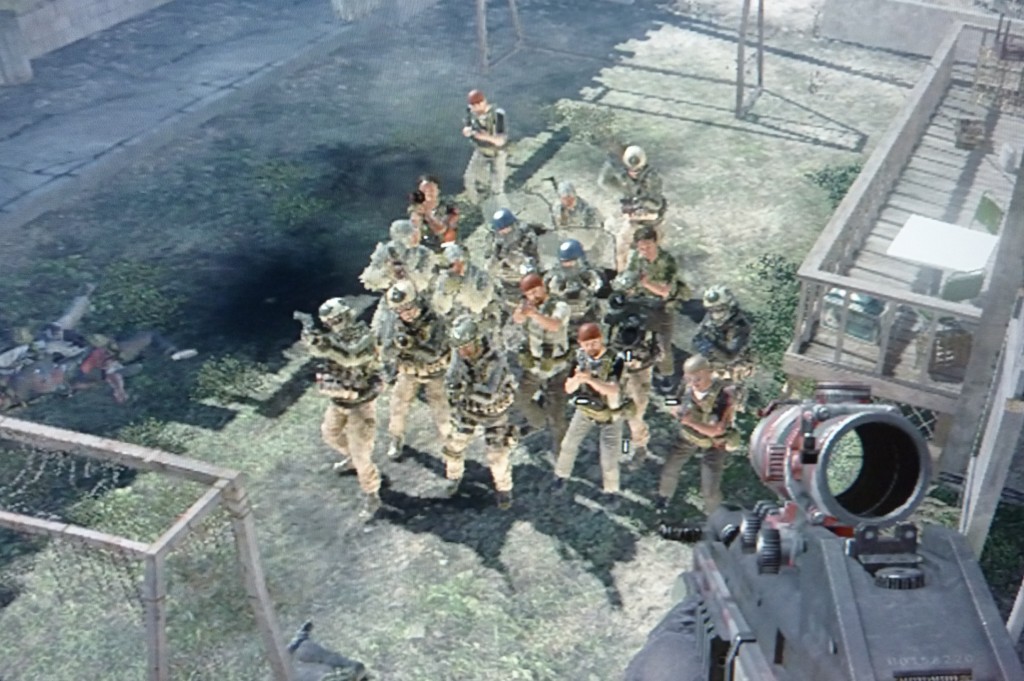
Even though everyone’s eyes are turned to Black Ops there are still plenty of people who are playing Modern Warfare 2. Of course with any online game, some of those people happen to be hackers who take advantage of holes left open by the game’s designers and use these to their advantage. There have been a number of ways that this has been approached but in the end it falls to the publisher to work out the kinks.
Infinity Ward has announced that they will be bringing a new security patch to the Xbox 360, PS3 and PC version of each game. Now exactly what will be patched is being left to the imagination but hopefully it will solve at least some of the hacking and cheating issues which plague the game, especially on the PlayStation 3 version of the game. Speaking of which….
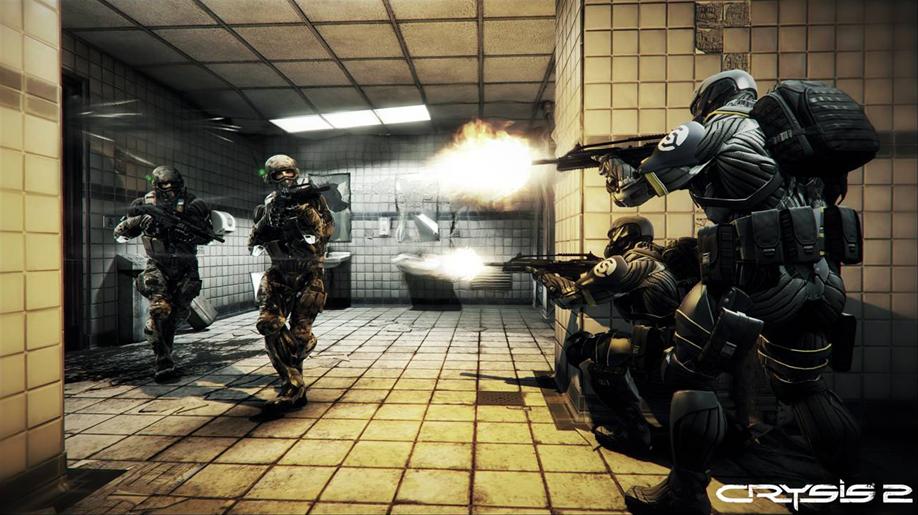
Crysis 2 multiplayer demo will be available for download from EA and other partner sites on March 1. Good news for PC gamers who thought they missed out getting their hands on the demo which was earlier released onto Xbox Live and PSN in January. The PC demo will include a new map “Pier 17” along with the map “Skyline” and two game modes “Team Instant Action” and “Crash Site” which were featured in the console demo. Crysis 2’s multiplayer puts players into the game’s signature Nanosuit giving them the power to be faster, stronger and invisible in this new multiplayer experience.
Download Crysis 2 Multiplayer on March 1 at crysis.ea.com
Crysis 2 is set for a March 22nd release date for PC, Xbox 360 and PS3
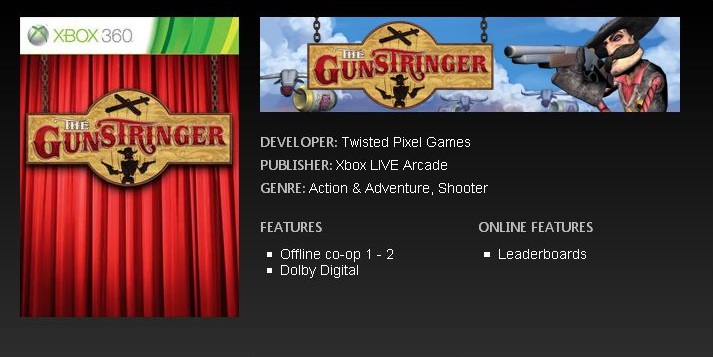
When The Gunstringer was announced earlier in the month there was no mention of how Twisted Pixel’s latest game would be released to the public. Everyone was too happy to hear about the fact that a good looking Kinect game was being developed. But the distribution method may have just been revealed ahead of time thanks to a mistake on Xbox.com’s part.
Seen above is a shot of what appeared on Xbox’s website momentarily before the mistake was taken down. We see that the title is listed as an Arcade game only which means it would be the first American created Kinect game for the XBLA. There has been nothing official said by either company yet but it would not go beyond the realms of possibility considering Twisted Pixel has only released Arcade games so far.
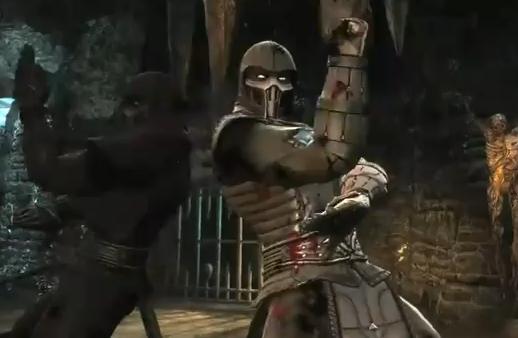
We still have about six weeks to go until the release of Mortal Kombat, but eager fans now have a trailer showing off the mysterious and popular Lin Kuei, Noob Saibot. Now if you have played Mortal Kombat Deception, you were probably aware that it was revealed that Saibot was actually the original Sub-Zero which was thought to be dead after the events of the first title in the series, later becoming a wraith and the character he is today. When it comes to having a rich backstory in the series, Noob Saibot stands above just about all others due to how complex he has been built up since debuting in MK II as simply a “new warrior”.
As for the trailer itself, it appears Noob has all his classic moves, all fully re-animated into the game’s brutal style, cracking ribs and teleport-slamming opponents into the dirt. I am thrilled to see that Saibot made the cut myself, now I am curious how his storyline will evolve once more in the series. For now though you can check out the trailer below for yourself to see the shadow assassin in action.
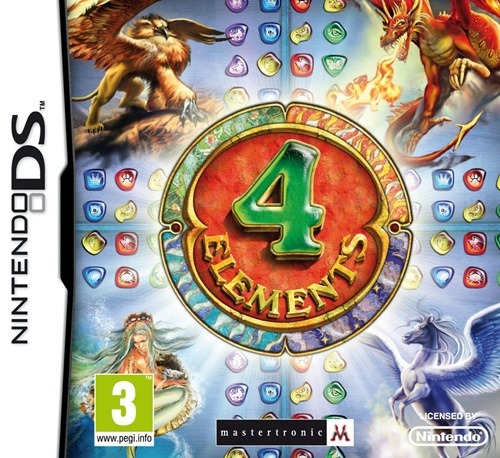
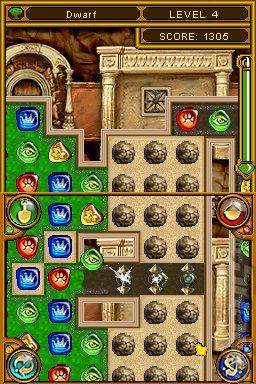
4 Elements Developer: Playrix Entertainment Publisher: Mastertronic Platform: Nintendo DS Genre: Puzzle Released: February 4th
As puzzle games go, 4 Elements offers a rather more rich, diverse story when put into perspective in a comparison with a traditional puzzler. Where most casual puzzlers are content to provide little more plot than combining a series of coloured tiles in order to make an already chirpy character smile, 4 Elements tells the story of a magical fairytale realm left in turmoil as a result of the four elements, Earth, Fire, Water and Wind. What was once a blooming kingdom now lies shrouded in a dark cloud, bitten by a cold freeze and with trees and other life perishing. It has now fallen upon you to complete these puzzles to recover the pages of the magic elemental books and meet with the wise old mage to restore the mystical land.
While the storyline doesn’t play a huge part in the game (with casual puzzling making up the majority of the title) the setting presents an interesting change from your average casual title. All manner of mythical creatures such as dragons, phoenix and elves make appearances, with this fantasy influence impacting the art-style and in-game soundtrack accordingly.
It seems 4 is the magic number in 4 Elements; there are four different ancient books of magic, each of which are split into four pages which are then broken up into four levels to be completed in order to restore the page; each match-3 game board is filled with pieces of four different colours, combos of which filling up the gauges of four different power-ups; and finally, the game will take you around four hours to fully complete. When you do the maths, four elemental books, each broken up into four pages which are then divided into four sections makes a total of 64 levels. This may sound like a lot, but when you take into account that each level takes approximately 5 minutes (with early levels taking less time and harder ones towards the end of the game taking slightly longer) it’s suddenly much less vast.
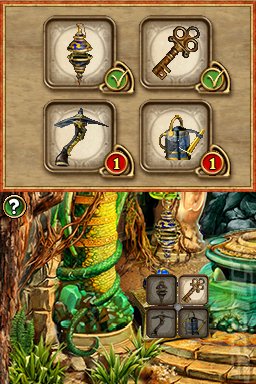
However, 4 Elements is actually a puzzler in every sense of the word because as well as these 64 match-3 levels, it combines other aspects of the puzzling genre through hidden object searches at the start of every book, and spot the difference games concluding each page. The spot the difference games in particular are well suited to the DS due to the dual screens displaying each image separately – ideal for spotting the differences. The hidden object sections also work well by making use of the touch screen interface, even if the grainy visuals of the DS do make it harder to locate the items.
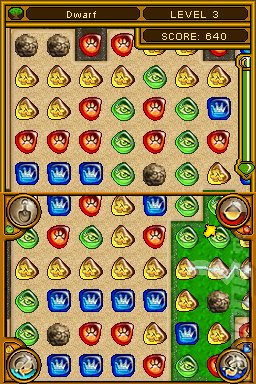
Fortunately, both of these bonus puzzle aspects of the game are short, so if you don’t like them then it’s not a problem. Primarily, 4 Elements is a match-3 puzzler in which you must carve out a path for liquid to flow from point A to B. Using combos of at least 3, you must form lines of the same colour, with chains of 5 pieces and upwards causing explosions to clear more of the game board. There is also a time limit for each challenge represented by a vial of green slowly draining away, although this only comes into play towards the end of the game on the more demanding puzzles. It is basically as simple as it sounds: easier puzzles towards the beginning make the game accessible for people of all ages/skill-levels, and a progressive difficulty curve ensures more accomplished gamers won’t get bored.
There’s also a number of in-game obstacles that must be overcome while playing, further upping the difficulty in the later levels. These can range from boulders blocking the way which need to be dealt with, barriers needing destruction from arrows positioned around the level, or even just a more complex level structure helps to increase the level of difficulty, all of which are challenging additions by the developer which help to create a more gripping experience. They also allow for a more tactical approach on what would have otherwise been quite simple and straight-forward.
4 Elements is essentially a toned down version of a popular PC game of the same name, and for the most part, it has made the transition well. Although grainy graphics of the handheld are a step backwards from the home computer original, the DS’s features like the touch screen and dual screens work so well with the game that it’s hard to picture the game without the use of the DS. The fairytale setting is an interesting deviation from the puzzle game template, which despite not having a huge impact, provides a welcome change nonetheless. There’s something for everyone with match-3 missions of varying difficulty, as well as extra tidbits of hidden object hunting and spot the difference thrown in. Unfortunately, it’s a bit too short and once completed, it tenders little/no replay value. Plus, in essence it is just a port of a PC game selling for a fraction of the price of this latest DS release.
Pros
Solid mix of puzzling
Simple to play, making great use of the DS’s features
Fairytale storyline provides an interesting change of scene
Bite-sized levels make it ideal to play on the move
Cons
A tad short
Grainy graphics at times
Technically just a port of an aged PC title which can be picked up a lot cheaper nowadays
After hearing the title ‘Chocolate Tycoon’ one might expect to find another storefront based simulation, where the basic structure of the game consists of purchasing furniture, waiting for meals to cook and accumulating money. If one were to expect this from Chocolate Tycoon, they may be surprised by how much more the game has to offer. Com2uS’ newly released game, Chocolate Tycoon, is a time-management game driven by a solid narrative. The game combines the goals associated with simulation games and blends in elements of role-playing by creating a fantasy theme and story line, the selling of chocolate to the villagers of the Kingdom Choco, and becoming the best ‘chocolatier’ in the Kingdom.
Gameplay
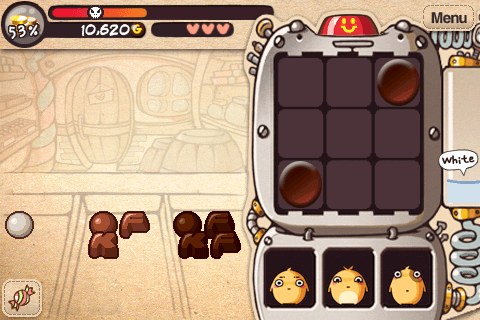
At its most basic level, Chocolate Tycoon is a simulation of a chocolate store. Much like other tycoon titled games (Ice Tycoon, Fruit Juice Tycoon), this portion of the game involves the buying of ingredients and other elements in order to make chocolates, which is exactly what you would expect from a game of this title. However, the ‘store’ isn’t an actual shop, but rather another game in itself based on reflexes and timing. Chocolate ingredients appear to the left side of the screen for you to collect. Below this are small chicken type animals called ‘chokis’. The Choki’s are fed ingredients and produce chocolate in white, milk or dark flavours. The customers are then fed different types and numbers of chocolates according to their preferred tastes. While this whole process can be a bit repetitive, as the days pass you gain more customers who are pickier with what chocolate they are served and the difficulty gradually increases with each new customer. When the timer runs out the shop is closed and the day has ended, you can either choose to take part in wholesome night time activities such as investing and breeding Choki or reopen the store and start a new day. As the challenge increases, making and selling chocolates becomes a pretty entertaining little mini-game within Chocolate Tycoon.
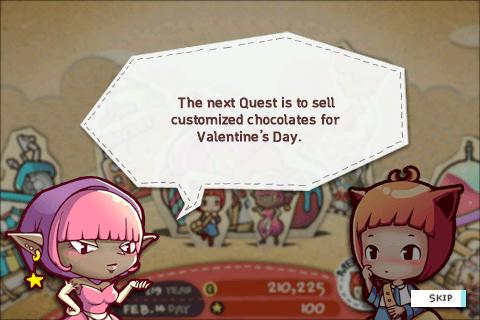
Alongside all of this there is a bit of a role-playing element to the game, where your ‘mentor’ or other characters in the game will assign quests for you to complete with rewards that help improve the quality of your chocolate and business. This portion of the game really helps push forward the over all narrative of Chocolate Tycoon – the quest to become the best chocolatier in all of the Kingdom Choco. The quests are not too difficult, usually the characters just ask you to visit another shop or location and do small favours for people. Nonetheless, these missions really add a fun element to the whole game, especially when delivered by terrifically designed characters with sharp personalities.
As the game processes you are able to learn new chocolate designs that earn more money than the basics you start off with. While you can collect designs through presents that are given with successful chocolate selling during the game or by buying them from the store, learning them is a different story. There are two options for learning a new design, either by paying using a currency of stars to the design workshop (the fast way), or by taking part in a mini-game where you need to trace the outline of the design (the fun way). So far I have always opted to take the fun way, and it has proven to be pretty entertaining each time. However, when doubling up on designs the process of tracing the same design can be a little tedious. Thankfully, you can alter the chocolate designs after learning, adding in different ingredients such as nuts and syrups. The user-design aspect of the game is set up similar to the old Microsoft paint program, starting with chosen design as a template, with additions automatically inserted with a press of the icon. Because of the pixel-design interface it is also really easy to draw your own designs on top of the chocolates you are going to sell – which is a neat little addition to the game!
Graphics and Audio
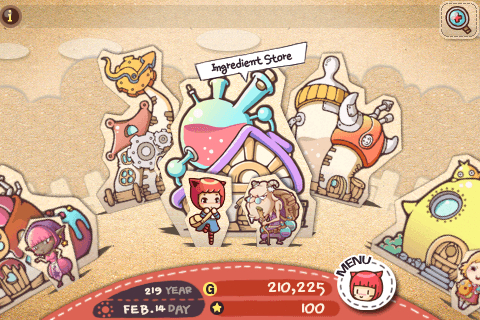
One of the first things I noticed when playing chocolate tycoon were the amazing graphics. From the title screen to the intricate diorama-esque construction of the game world, Chocolate Tycoon is graphically sound in every way. I really love the overall design of the world. The buildings are constructed in a pseudo-medieval fashion, which really adds to the role-playing aspect of the game. Not to mention the bizarre characters you interactive with and sell chocolates too. Each character is uniquely designed, matching their occupation and personality in a comical fashion.
The main conversations between characters sound like a fast-passed telephone conversation, which I find to be a funny little addition, especially for some of the characters that are a little rude throughout the whole game. There are few interesting little sound effects throughout the game that give it a nice cartoon-like quality, a good example of which are the reactions to selling chocolate like ‘cooool’ and ‘I’ll be back!’ Overall the graphics and audio pair together well to make it seem like a little interactive cartoon.
Conclusion
Chocolate Tycoon completely beat my expectations of a chocolate selling game. The means of producing chocolate and maintaining the store are unique and engaging. Where other reflex games for the iDevice lack in a strong narrative, Chocolate Tycoon picks up the slack in this department and really brings the storyline home with their graphic and audio design. While the conversations and world exploration come across as a bit of an interactive cartoon, the inclusion of quests adds some much needed goals and structure to the game, pushing past the typical simulation goal of making a profitable business.