Four years ago Sega brought the world a little title by the name of CRUSH to the PSP. The game had you literally “crush” the 3D environment, which quickly transformed the game into a puzzle platformer of sorts. Someone at Sega have apparently seen the potential for the title on 3DS, as the company announced that they would be bringing the puzzle/platfomer to the 3DS.
The crushing effect opens new areas and paths that were previously blocked and in order to move through the player must transition between the two while dodging enemies and obstacles. The 3DS version will also have many extra features such as StreetPass functionality, allowing players to leave gifts for friends to collect in-game.
“CRUSH3D gives all gamers a chance to experience this critically acclaimed concept in full 3D,” said Gary Knight, Senior Vice President of Marketing of SEGA West. “With features specifically designed for this exciting new platform, CRUSH3D is right at home on the Nintendo 3DS.”
You can check out the shiny new announcement trailer below and this interesting platformer isn’t too far away as CRUSH3d is scheduled to release September 6th in the U.S. and September 9th for Europe and Australia.
Earlier today Namco Bandai officially announced Soulcalibur V but didn’t give a whole lot of details about what the game would actually contain. Sure there will be new battle mechanics and a new protagonist but nothing was really said about the storyline. That is until a bit later when they revealed that Soulcalibur V is set seventeen years after the events that happened in Soulcalibur V.
Patroklos will be the main focus of the game and he is the son of Sophitia Alexandra. From the character art seen to the right it looks like he will be using a short sword and buckler similar to that of his mother’s, and that he will be wearing quite formal looking attire at that. Also released was the announcement trailer which you can see below, which tells us that the game will be out some time next year for the PlayStation 3 and Xbox 360.
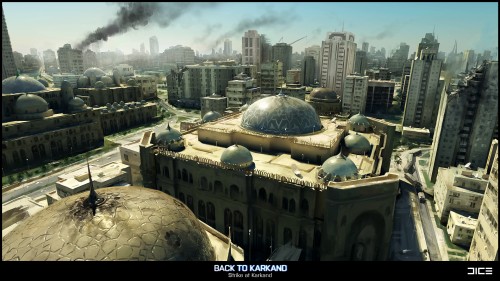
DICE has today released the first images and more details on ‘Battlefield 3: Back to Karkand’; a free downloadable bonus for player who pre-order the limited edition version of the game. Using the Frostbite 2 engine, this multiplayer map pack contains re-mastered and re-imaginings of Battlefield 2’s fan favorites including: Strike at Karkand, Gulf of Oman, the Sharqi Peninsula and Wake Island.
The pack will also include classic Battlefield 2-era weapons and vehicles, complete with unique rewards, achievements and trophies. An interview with Lead Designer Niklas Fegraeus, can be read over at Battlefield.com to give players an overall idea on how these new maps will play out.
Battlefield 3 is set for release later this year and will be available for Xbox 360, Playstation 3 and PC.
Operation Flashpoint: Red River Developer: Codemasters
Publisher: Codemasters
Platform: Xbox 360 (Reviewed), Playstation 3, PC
Release Date: April 21, 2011
Price: $59.99 (Available HERE)
Premise:
Is it possible to simulate realistic military combat scenarios that attempt to combine intense first person shooter action with team-mate tactics based gameplay? That middle ground is what people in the game industry refer to as Tactical Shooter. Combining elements of FPS gameplay with those of real time strategy is a daunting task. Likely to impress many fans if the formula succeeds. Likely to lose many more if it doesn’t. In an FPS market that’s dominated by “soloist” shooters such as Halo, Call of Duty, Medal of Honor and Half Life, developers will need to think cleverly about how to implement these elements to help the game sell. Operation Flashpoint: Red River is the latest installment in the Tactical Shooter series developed and produced by Code masters. Does the game deliver on what the genre promises?
Story/Campaign
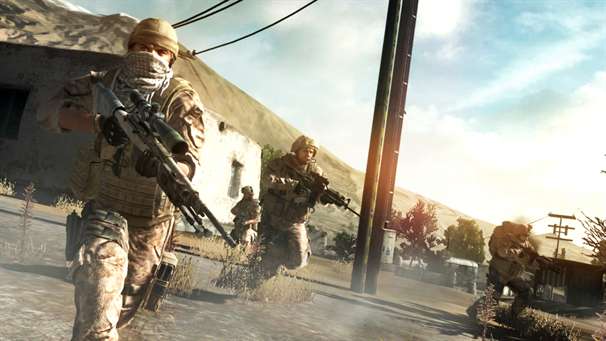
For those who haven’t yet guessed, the story of Red River is not anything too foreign to the first person shooter genre. War has erupted in the middle east. In the ensuing civil unrest, America and its allies have mobilized their troops in a bid to halt the radical actions taken by multiple extremist militant groups. As part of the elite team Bravo squad of the Outlaw-2 Battalion, your mission is to enter the midst of the conflict in the newly war-torn nation of Tajikistan. The extremist presence has been considered a matter of great importance to the military higher-ups, and your squad is sent in with the intent to stamp them out entirely. However, the Tajikistan insurgent presence has also caught the attention of another army. Geographically located to the East of the border of Tajikistan, China has been on the receiving end of insurgent attacks for some weeks. While they’re all too happy to see the insurgents dealt with, the People Liberation Army starts to become suspicious of the US Marine Corps’ activities. When these two armies collide, a new , greater conflict emerges which could very well see the balance of power shifted in the world. So long story short, the responsibility of protecting the free world falls upon your actions, and those of the rest of your team. (Which, subsequently, are also yours.)
The story opens with a rather strangely egotistical wrap-up of America’s presence in the middle east for the past 40 odd years. The introductory video is basically a slide-show of major events, such as the gulf war, 9/11, and the crushing of Saddam Hussein’s regime. Additionally, given recent events, what I found particularly funny while starting up was the consistent mentioning of how the US forces are still looking for Osama Bin Laden whose “still holed up in some cave somewhere”. The video also provides some background information to the current state of the middle-east campaign, and how the Chinese are subsequently dealing with their own extremist problems. However, again, I do have to stress the HIGHLY egotistical nature of the soldier’s rant. There’s a difference between being patriotic, and being downright insolent. Either way, it still achieves the purpose of outlining what players need to know in regards to the plot.
In looking at the story, I have to admit that it’s nothing too original to the gaming industry. One fallback that I find with many first person shooters these days is the fact that many games involving America and a war tend to sensationalize the idea of going into battle with the same old enemies. If it’s not an enemy from the middle-east, then it’s China or North Korea. If not them, then guerrilla groups in Africa, or armies from Russia or Germany. While the shift in enemies about halfway through the game keeps the story kind of fresh, it’s something we’ve all tasted before. While it is a daunting task to face off against the might of one of the largest militant countries on Earth, it still follows the age old “struggling and succeeding against impossible odds” storyline we’re used to seeing, coupled with the “brotherhood of soldiers” subplot that evolves as your unit integrates more closely with other teams. Understandably, in attempting to create an accurate simulation of modern day warfare situations, creativity in story is limited to an extent. My point is, to those who play this game, story-wise, don’t expect anything too original.
Gameplay
Red River’s predecessor: Dragon Rising, which was released in 2009 had a myriad of problems gameplay and story wise that was met with pretty harsh scrutiny by the wider gaming community. A barely relate-able plot coupled with an overly busy HUD screen, complicated control systems and a downright stupid AI system brought down the experience for a lot of people. Having said that, it’s nice to see that Red River has attempted to rectify some of those problems. However, the keyword in this sentence is: “ATTEMPTED”. By all means, the game is a good deal more playable than the previous installment, but it still features a number of similar problems. Minor annoyances on their own, but frustrating when complied.
The core gameplay is more or less the same regardless of whether one selects to play in a single player game mode or in a co-operative campaign. The player must select one of four Bravo team member roles to use during missions. The specific classes include rifleman, grenadier, scout and auto-rifleman. Each class comes with a different set special abilities, weapons and equipment. Obviously players should be inclined to choose a class that matches their play style. Master snipers will want to go with Scout, whereas up-close and personal berserkers will probably choose the auto-rifleman. The grenadier is the class for those who love to see things go “boom”, and the rifleman rounds out the group as both the jack-of-all-trades and team medic. Regardless of which class you choose to take, the player will always have indirect access to most of the ally AI abilities by use of the tactical command function. While one cannot explicitly say want one wants (such as healing from the rifleman) during the heat of battle, the allied AI is a far sight more intelligent than that of Dragon Rising. Using commands such as calling for a specific solider, or your entire unit to follow you will cause your allies to stick very close behind you and take necessary actions when the situation warrants it. Additionally, the command function also allows the player to select out a specific squad member to perform a certain action. (For instance, in an area where you’d be expecting heavy armored resistance, it would be smart to place your grenadier in an ideal ambush position.)
One surprising addition to the gameplay was the introduction of an in campaign experience system. By executing certain orders, and making kills in certain ways (for instance, headshots and multiple rapid kills) the player character accumulates XP to put towards additional skills and upgrades not only to the soldiers themselves, but also their weapons and equipment. Similar to the way in which Call of Duty implements an experience system in competitive multiplayer, XP gains in campaign mode reap some serious advantages, including enhanced precision and enhanced battlefield and radar awareness. Having said that, point allocation should be considered carefully. Different classes benefit better from different upgrades. If you tend to play the role of sniper in your group, unlocking advanced explosives may not be the best idea. One of the issues involved with the XP system is that the game assumes that the player will be capable of making a majority of the kills to rake in a majority of the XP to upgrade. With each level successively increasing in difficulty, and enemy AI increasing in general viciousness, players who are unable to nail a substantial number of enemies in previous engagements will find themselves at a disadvantage at later stages. In this sense, the allied unit AI is perhaps a little TOO smart. During the first few engagements of the game, I found that I was only able to kill a minority of the enemy units, while the allied AI squads and team-mates dealt with the rest. While I was happy to receive the fire support, it also meant I was unable to obtain some much needed extra XP for a then-essential precision upgrade. To put it simply, the AI downright steals your much needed kills. Never thought I’d be yelling “kill-thief” at the game itself. Happens in Left 4 Dead however. Seems to be a trend in co-op oriented games. The issue is that the kill stealing will actually have a negative effect on your game, besides the damage to player ego. Many players will get a little frustrated at how little of the action they see in opening levels. Admittedly, it did put me off to a degree, and set a slightly sour mood as I progressed through later levels.
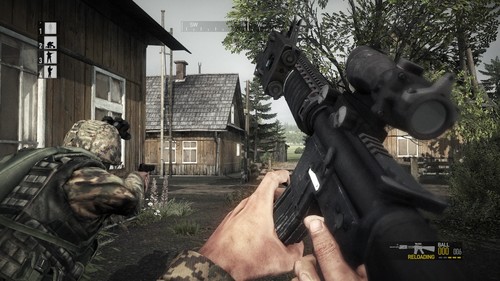
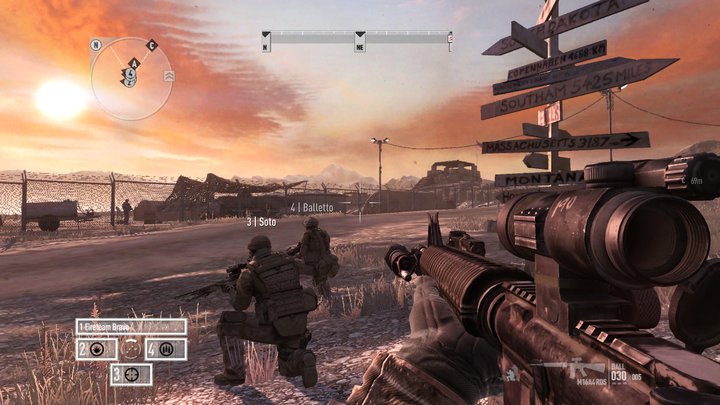
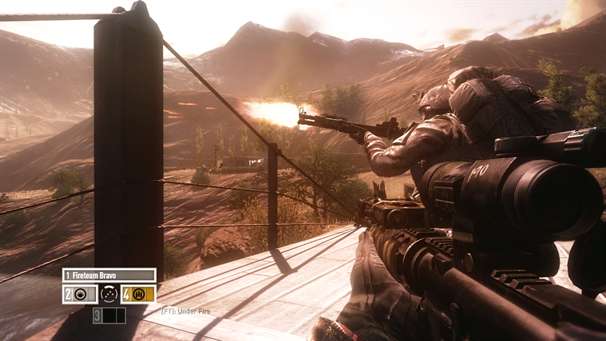
One major complaint and area that I found had not been improved over the previous game was the cluttering of the Heads Up Display. Even looking at the sample HUD in the manual does not make gameplay look appealing. The HUD has too much going on at once. While this may be less of an issue for PC gamers who are able to hotkey many of the on-screen functions to suit their play-style, for console gamers, the HUD is just one big ugly mess. While it’s understandable that Codemasters wanted every asset to be known to the player, so many items on the one screen can really confuse the heck out of players. The worst of all is when you have to bring up the “team command” function to give orders to your AI teammates, which take up a large majority of the player’s central sight, including the targeting cross-hair. Attempting to give specific orders to your fellow squad members while in the heat of battle is not an easy task. While it’s probably accurate to the working conditions of many of our fine soldiers, it does not make for a pleasant gameplay experience. It’s made all the more worse by how easily your soldier can be wounded and even killed by a few wayward gunshots. While certain elements are pretty self explanatory, like the radar, compass and equipped weapon slots, other aspects will really begin to make the player feel over-encumber visually. Of particular nuisance are the Rendezvous markers, team objective markers, personal objective markers, team chatter, bleed meter and even the score counter. That said, these features do not make the game unplayable. In fact, when you are able to correctly execute a brilliant team tactical maneuver, it’s all the more sweeter. However, this combination of slight annoyances will take even the most seasoned of gamers time to adjust to.
As for explaining controls, most of the functions are pretty self explanatory, and your standard fare for first person shooters. However, the large number of functions that are available in the game can only be activated by use of “hold” functionalities on certain buttons. For instance, In a long range firefight, I may wish to swap my weapon’s firing mode from burst, to single shot. To do so, I must hold down the X button, which consequently also serves as the reload function. If playing through so many rounds of online FPS gaming has taught me anything, it’s that some gamers aren’t a patient bunch. The notion of having to hold down a button with different functionalities will undoubtedly seem painful. Additionally, the ever pain staking command radial (which comprises the “tactics” part of “tactical shooter”) must be navigated by use of the D-pad. Having to interchange between D-Pad and Left control stick will seriously disrupt the players flow of gameplay, and immersion within the game will be lost to a degree.
The gameplay however is not all doom and gloom. As previously stated, Red River is a SIGNIFICANT improvement on Dragon Rising. The AI’s of both enemy and allied soldiers is significantly more balanced than that of the previous installment, with allied AI’s able to take their own initiative to take down enemy targets or protect certain key assets. However, this new AI scheme seems to be mixed in its effectiveness. While they are able to fight and take cover with a reasonable degree of effectiveness, movement control can be a huge pain in the hind quarters. For instance, when our entire 4 man squad was pinned down behind in a small building by enemy gunfire, I seemed to be the only one attempting to fight back. The other three were out of the line of fire, but just seemed to be standing around, enjoying their little desert outing. Once we got out in the open though, things got really weird. While naturally, my character became a magnet for enemy bullets, all three of my teammates were able to nail a majority of our enemies at range before they did me any real serious damage. For some reason, the AI is able to excel at long range combat, but struggles in tight quarters.
Bear in mind however that you will only really need to worry about command functions and allied AI in a single player game. Prospective players should note that Red river DOES support up to 4 player co-op, either online or via system link. As a result, gameplay elements are likely to experience a significant change, the most particular of which is the elimination of fears regarding AI action as well as losing the need for the tactical command radial. If nothing else this proves that Red River is in a league similar to that of Left 4 Dead and Borderlands, in that it is a significantly different game to play as a group as opposed to alone. So if you want to try it for REAL, get a few mates together with a few copies to go at it. If nothing else, it proves that Red River was cleverly designed for extended use and longevity. On the flip side however, the game features a COMPLETE omission of any form of competitive multiplayer. So, for gamers that look to get satisfaction out of the thrill of beating another player to an untimely virtual death, this might not be the game for you. “Stand Together” is the tag-line, and I can’t help but feel that such a declaration can’t help but entice fans of co-op gameplay.
Graphics and Sound
Graphically, the game is not what you’d call unplayable. In fact, the rendering on the environments was downright impressive. The game provides a real sense of depth and distance. The player can experience a real sense of being part of something much larger. The wide and detailed landscaping work most certainly works in the game’s favor. The large open areas do provide a strong sense of freedom to choose which direction you want to take, while being kept in the confines of linear mission progression. The environments are immersive, but objects and coloring are a different story.
In the opening level of the game, many player will definitely start to get frustrated over the brown smeared color theme that dominates the landscape. Sure the first level is set in a desert, but when almost everything in the visual path is smeared a different shade of brown, combat can become difficult. Lighting features are also highly mixed throughout the game, with some areas being well lit for a fire fight, and other areas being overcast and hazy. It makes it very difficult to differentiate the enemies, made all the more worse by the overly busy HUD display. It’s a commonly known tactic for a visuals in many “realistic” first person shooters to cover many of the color schemes in brown to augment the “real” feeling, but in this particular instance, it’s severely detrimental to the gameplay experience.
On the other hand, the soundtrack and voice acting cast of the came really helped lift the mood of the game. War is supposed to be a horrible, depressing event in any human’s lifetime. However, the characters, dialogue and musical score really help set the tone and pace of the game. The sound provides what is essentially the spirit of the game. The voice acting is particularly impressive in the humor factor. Adding an overly aggressive staff sergeant to the character list provides a human like personality to the game. The basic story told by it is this: The allies are here. Enemies are here. Allies are here to screw over their enemies. Although, one issue I do have with the voice acting is in regards to the overly expansive use of military jargon in conversations. As a man who has never served or studied elements of serving in the armed forces, some jargon that appears to be used in-game gets pretty confusing, especially when it relates to your goal or mission. In regards to ambiance in music, the light background music against sound effects really effectively augments the sense of struggle we are used to seeing on the media from the middle-east. By drowning out music with the sound of gunfire, players can really feel what being in a place like this is all about.
Overall
Having played both 360 available Operation Flashpoint games, I can most certainly say that I would DEFINITELY prefer to play Red River over Dragon Rising. The game has improved in leaps and bounds, no questions there, but there are a few minor issues that perhaps should have been reconsidered in the development process. The visual elements are by far the most annoying issues within the game, and at times, controls seem clunky and unrefined. While tactical shooters may be a difficult genre to master, there is so much more that Red River could have been. I suppose what disappointed most was what Red River COULD have been. I’ve played and enjoyed Tactical Shooters like Rainbow Six: Vegas and G.R.A.W, and I can tell that the OF series is attempting to gain similar acclaim, but tid-bit annoyances will keep making gamers compare with more pleasant previous experiences in the genre., there’s a lot that could have been done better, but a lot that was done right too. The only real way to test for sure is to give it a go yourself.
I’m a big fan of Naruto and Bleach so I’m excited to say that NGames has released more details of “Chapter II: Revenge of Aizen” . This update of Pockie Ninja’s Naruto/Bleach inspired MMO will include new gameplay features and improvements to the browser-based brawler.
The story continues on with Aizen still hiding away in Las Noches. Rumour has it that he has opened Las Noches’ 10 remaining levels, which means more challenges for the Ninjas! Also, an unknown gang of baddies are planning to seize the power of the Ninja! New gameplay features include: new secret ninja skills, the introduction for pets to learn skills of their own, new general and exclusive pet skills, a new pet tracing feature, increased Las Noches floors of challenges, new maps and levels and more.
Interested in seeing the new skills in action? Check out the video below!
Bethesda has released a trailer for their upcoming Fallout: New Vegas DLC. Honest Hearts will place players in Zion National Park, Utah just as the war between local tribes and the New Canaanite missionary begins to reach its peak. Among all of this warfare however a man of legend is lingering among the shadows and from the look of the trailer, he isn’t going to be staying in hiding anymore.
The Burned Man, rumored to still be alive among Legion forces is indeed still alive in Honest Hearts. Joshua Graham has been revealed and given his own screenshot to prove his existence. The DLC will be released next Tuesday on May 17th for the Xbox 360 and the PC, with the PlayStation 3 version of the DLC going to be made available as soon as they can make it available. It will run 800 MSP or $10 depending on your platform of choice.
With L.A. Noire releasing next week we can expect that the gaming community won’t have a whole lot to do besides sit there and play it like crazy. But the revelation of a new add-on for L.A. Noire revealed from the latest Xbox Live release schedule is bringing up a few questions. These questions come from the fact that there has been no word about the DLC from either Microsoft or Rockstar.
Called the Rockstar Pass it will be released the same day as the game for 800 MSP. The pass could be some form of Project Ten Dollar that has been headlined by EA but it wouldn’t really fit into the world that is L.A. Noire. It’s been speculated that it is the whole package of pre-order DLC that Rockstar mentioned would be available for separate purchase after the game comes out. This revelation is a bit confusing and we have contacted Rockstar to find out more.
Puzzle Bobble (Or Bust-a-Move in some regions) is a ball-popping puzzle adventure that has been around since the early-mid 90s. The game features cute dinosaur creatures that take control of a kind of ball-launcher used in an effort to rescue their friends and defeat boss monsters. The game features a whole lot of challenging single player levels as well as even extra fun challenges.
Bosses, when will they learn?
Gameplay
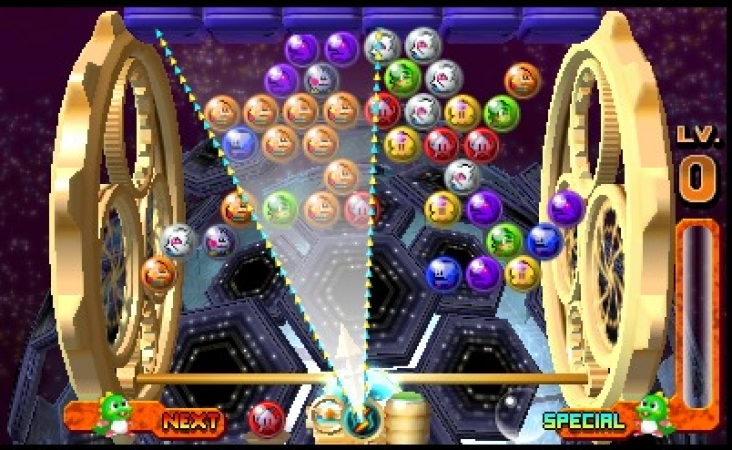
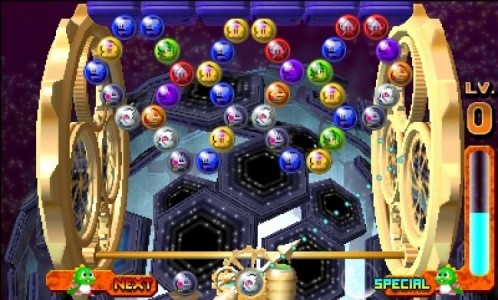
The gameplay of Puzzle Bobble Universe is quite simple; players control a cannon-like device that allows them to fire a coloured ball towards other coloured balls in an attempt to shatter them all and claim points. The main priority in the game is to match these coloured balls 3 or more times so that you score points and advance in the game. Points are primarily used for gaining high-scores to try and defeat as a personal challenge to constantly get better.
And the Lasers were fired that day.
The main puzzle mode takes you on a set path of levels set on various worlds. Each level is known by a certain name, such as “Moonbase”, and each level has a set number of 10 rounds for players to complete, including one extra boss level where they must defeat a boss monster by shooting it with these bubbles. Each level also has an additional challenge of recuing your dinosaur friend via collapsing a key bubble by matching a set of bubbles surrounding the key bubble. The challenge in this is that if you collapse the bubbles a stack behind it and cause the next few rows to collapse, you’ll lose the key because you haven’t popped that bubble.
The way the game works is that you match coloured bubbles to each other to make them pop/shatter. Any bubbles that are connected but are not of the same colour and are not connected by bubbles of another colour will fall under the gravity (I guess?). So say I have a row of green bubbles and just under them are a purple and red bubble, if I pop the green bubbles, I will lose the red and purple bubbles, but not get points for them. Though, utilising this feature in a strategy you could possibly beat a level a lot quicker by sacrificing your score.
Connect the colours to make them burst!
And in a game like this, speed is also a key element in beating a level. As time progresses, the level begins to collapse, possibly because the bubbles aren’t there to hold it up anymore. If any bubbles touch the bottom of the playing field it is game over and you must start the entire puzzle again from the beginning. So players are constantly weighing up their options, whether they should take the extra points; or whether they should sacrifice some in order to not lost the entire level. But a smart player will utilise all of their options in a level if they need to.
For a puzzle game, there are a fair few power-ups and abilities that players can utilise. The first is a kind of bullet-time like thing, where the game world slows to a halt and you can fire an assortment of bubbles onto the field to try and make some combos. The more combos you make, the more points you get. If you fail and just spam balls over the place though, don’t fret, as the balls fired in this mode pop instantly; as soon as the event finishes. Players can also use a wide range of abilities, which build as you fill a combo-meter on the side. One such ability changes all bubbles to a specific colour in a given radius, another is a laser that clears the field of all bubbles in a radius.
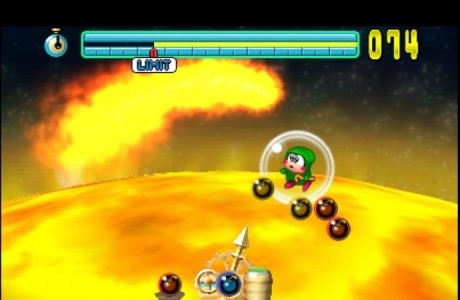
In some challenges players can utilise special bubbles that are on the field to do some pretty amazing stuff in their assistance. These are known as gimmick bubbles and have some pretty serious effects. These bubbles only appear in the challenge mode though.
This guy 😀
The other gameplay mode that is open to players in this game is Challenge Mode. There are three types of modes in challenge mode, 100-sec. Bubbles, 300-sec. Bubbles and Nonstop Bubbles. Each mode is pretty self-explanatory. In 100-sec. Bubbles, players go from round to round to score the highest score within 100seconds. The same thing is in 300-sec. Bubbles, players go from round to round in 300-seconds to achieve the highest score. In the last mode, Nonstop Bubbles, players go from round to round until the bubbles touch the bottom of the playing field, causing a player to lose. All of these challenges are quite fun and can suit a time-frame that players have to play in; like taking a 5-10minute dump at work.
Puzzle Bobble Universe has an inherent strategy and puzzle element, which depending on the user, may make the game incredibly challenging or just simply challenging. This is not for gamers that lack problem solving skills.
Graphics
Puzzle Bobble Universe has a very basic design, but is also graphically quite pretty. Each of the dinosaur characters are beautifully drawn and coloured, the cogs to the side of the cannon device rotate in and out of the screen when the 3D is turned on and each bubble has its own colour and symbol. In fact, this game probably has the 3D since launch.
This looks amazing when it’s popping out at you!
The 3D in this game is incredibly well done, with the 3D not appearing just in the screen, but also outside it. It’s amazing seeing one of the cute dinosaur creatures floating a few centimeters above the screen when you complete a combo or when you get a score screen after a round and it just hovers above the action. It’s so great.
Audio
Puzzle Bobble Universe features a really simple soundtrack, but this does not mean that is ugly or of low quality. It just means that the tunes themselves are slow and simple.
The simplistic nature of the background tunes creates a peaceful kind of feel to the game, despite it being based around destruction. Popping bubbles is destroying them, no? Anyways, the music seems to act in a way to calm your mind in order to have players to be bale to think out the problem and work on a solution without too many distractions. The music does not become insanity-inducing, but I dopn’t think every kind of gamer is going to enjoy the same tune being repeated ad nauseam throughout a level either.
Saving these guys is a challenge on each level.
Every time a player pops a bubble it plays a simple, yet, rewarding effect that keeps them going even more. While a game of this type has a high potential to become boring and repetitive quickly, these sound effects help to keep an addictive element within the game.
Ultimately, Puzzle Bobble features simple audio that is also elegant, but also has the potential to annoy some users, especially if they suck at some levels.
Overall
Puzzle Bobble Universe is a puzzle game that involves players popping bubbles to save their fellow dinosaur friends and defeat boss monsters. It has possibly the best 3D on the 3DS device so far, as well as some really puzzling level design as well as excellent audio. While I feel that asking full-price for this game might be stretching it a little, anybody who does buy this game will find that it is both entertaining and difficult. It also provides great amounts of nostalgia to anyone who grew up gaming in the 90s.
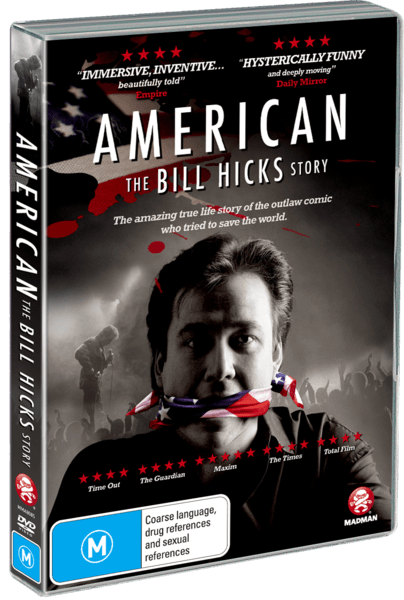
Genre: Documentary/Animation Produced by: American the Movie Featuring: Kevin Booth, Dwight Slade, John Farneti, Mary Hicks, Steve Hicks, Andy Huggins, David Johndrow, James Ladmirault, Lynn Hicks Running Time: 102 minutes Available for purchase at: Madman Online Store ($29.95)
Overview
Okay, okay – I’ll admit it: before I picked up this DVD, I didn’t know too much about Bill Hicks. I knew the dude was a comedian who did a lot of satirical sketches, and I had randomly seen a few of his clips on YouTube. The real complexities of his life, though, had never been a topic that piqued my interest, and (being an Australian/New Zealander who is more of a Dane Cook/Russell Peters fan, anyway) Bill Hicks had never really popped up in anything I watched.
However, when I finished watching this documentary, the first thing I did was jump straight to the Extras and watch all of the rare footage from his career. I then jumped on YouTube, desperate to find any sketches that Hicks did because I was just that fascinated by him as a comedian. I may have entered the documentary with a naïve intrigue, but I left it with a new understanding and appreciation for a man who passed well before his time.
Plot
True to form, the film details Bill Hicks’ life story and is narrated by the ten people who knew him best. While other documentaries require over-dramatization, narration, and plenty of embellishments in order to translate into a feature-length film, Bill Hicks’ life seems to be perfectly summed up by his friends in the 102 minutes they were given.
Hicks as a young adult, performing sketches.
Hicks was drawn to comedy from an early age, having been inspired by Woody Allen, and began performing stand-up comedy with his friends from the age of 17 at the Comedy Workshop in Houston. When he graduated high school, he moved to Los Angeles to pursue his dream of being a professional stand-up comedian, and became a regular at the Comedy Store where other comedians like Jay Leno have also performed. Wanting to push the boundaries of comedy, Hicks began taking drugs, smoking, and consuming alcohol but these quickly began to interfere with his act and he quit alcohol and drugs. Hicks went on to be featured in HBO’s One Night Stand, and performed in the UK, Ireland, and Australia as well. He was diagnosed with pancreatic cancer in 1993 and passed away in 1994.
While Hicks’ story could have been told in any number of ways, the way that the production company American the Movie chose to narrate it showed a unique style which did the comedian justice. The film intersperses narration by Hicks’ friends and family with videos from Hicks’ stand up performances to create a blend of ‘show’ and ‘reminisce’ which is a welcome change from the standard narrator-interview-video rut a lot of directors get caught up in. The addition of his friends and family’s memories of Hicks really made me feel as though I was flipping through a scrapbook instead of watching a documentary, and certainly personalised the feel of the documentary just that little bit more.
While his story couldn’t really be written well, as such, parts of it most certainly were selected and edited together well for maximum impact and narrative charm. Nothing felt like it was just thrown in for the sake of taking up time, and it really worked together in a cohesive structure which did the man justice. At times, the photographs and the narration by Dwight Slade did seem a touch too corny, but overall it was a minor blip in an otherwise smooth ride.
Visual
The visual aspects are what really hit it home for me. While I am no stranger to documentary films, I’ve become more or less accustomed to guerrilla style docos which use handycam techniques, or corny films with slow motion shots with stereotypical “insert-moving-quote-from-subject-here” voice-overs. It’s been rare that a photo-documentary can really capture the essence of the moments it’s trying to portray, and even rarer that the animated photos can connect to and strike an emotional chord in its audience, but American: The Bill Hicks Story may have just won me over.
The film looks like a collage translated into a movie.
The key for the film’s visuals is that it’s simple, yet incredibly effective. The style is reminiscent of collage which has been turned into film: the photographs are cut out and animated in front of a background to create a kind of static movement. The photos are anything but dull though: while initially staring at a screen of photo after photo seemed dull, the animators really let their creativity run wild and explored new ways of depicting scenes that were described. In one scene where Hicks’ experience with mushrooms is being described, the animators took a photograph of him and two friends sitting on the beach and managed to translate it into an almost ethereal experience where I felt like I was being exposed to the feeling of taking mushrooms. I’ll admit, this type of creativity is often hard to find or express in documentaries, but the photo-doco was the perfect medium to describe Hicks’ life.
However, the photographs are also balanced with videos to give the viewer a break from imagining scenarios. This really works to the film’s advantage: there is plenty of footage of Hicks doing sketches and also of him both as a child and an adult. The video really brings the photos to life, and complements the photo-doco style of the film perfectly – there is a great sense of yin and yang visually and it really was a pleasure to watch.
Audio
If the photographs and the video are the yin and yang of the film, then the audio is most definitely the chi. Most of Hicks’ story is told through voice-over narration from his family and friends, which means that the audio is incredibly important in doing his life justice. The voice-over is well-edited and provides a great verbal accompaniment to the photos and videos. However, one of the pains of only using voice-over is that it can get confusing when three men are speaking in a row and their voices and accents sound the same. In standard documentary, there is an initial shot of the interviewee/narrator before the film cuts to photos or videos; American: The Bill Hicks Story doesn’t have that luxury and it really did render some parts confusing. Also, some of the audio from Hicks’ stand-up routines is not that great, but subtitles can be selected and it really doesn’t impact the overall experience of the film.
The audio is the chi to the visual’s yin and yang.
Unlike the voice-over narration, the music and sound effects was absolutely perfect and I couldn’t flaw any of it. While the use of sound effects really was minimal except for added emphasis to photos or narration, they were all appropriate and really contributed to the vibe of the scene. Going back to that mushrooms scene I mentioned earlier, the sound effects and music in that was so perfectly done that it enhanced everything the animators did. The music is also noticeable but not intrusive, which allows the story of Hicks’ life to get through to the audience with just the right degree of emotion.
DVD Extras
I’m always a sucker for the Extras on DVDs, and I pretty much had a field day with American: The Bill Hicks Story. There were actually so many extra features that I actually had to take a break from watching, get a coffee, and start again. The DVD is packed with deleted scenes, Hicks’ audio journals, animation scenes, trailer and audience reactions, featurettes, and rare/unseen footage from Hicks’ career.
The extras are definitely worth watching, especially the rare footage and animation scenes.
The best extra is, of course, the rare footage. After watching the documentary, my appetite to watch Hicks’ sketches grew and it was great to be able to move straight from the doco to some clips from his career straight away. The featurettes were also a cool little extra that had me entertained for a while, although I have to say that coming from the awesome visual style of the photo-documentary meant the standard shots were a little bit dull. The audio journals are also very hard to sit through after coming from such a visually powerful film, but the deleted and animation scenes were absolutely wonderful. The audience reactions were also a nice touch that really put the icing on the American: The Bill Hicks Story cake.
Final Comments
While I began this film clueless and blasé, I sure as hell did walk away feeling like I had truly watched a great documentary on a great comedian. There are a few tiny hiccups here and there, but the experience of the film is definitely one worth watching. You’d be forgiven for not knowing who Bill Hicks is before the documentary started, but after watching this you sure as hell won’t forget his name.
Oh, L.A. Noire, I am going to miss writing news about you and being excited about your release. Rockstar have announced the official launch trailer for their May 17 (US)/May 20 (AUS) release title will be available tomorrow morning on the L.A. Noire website.
The trailer will be made available at noon Eastern Standard Time, and will be the final trailer before the game is released in less than ten days. While the details of the launch trailer have not been revealed, judging from L.A. Noire’s previous trailers we can most certainly say it’s going to be great.