

Home Blog Page 5234

Stay Dead Review

Stay Dead
Developer: BruceFilm
Publisher:
Playstos Entertainment
Platform:
PC
Release Date:
July 4th, 2012
Price:
$9.85
Available Here

Overview
You know why I love video games? How they get me excited enough to play them and write about them so regularly? It’s because there’s still so much that can be experimented with. The medium feels very fresh, and there’s always something new being done.

Stay Dead eschews one aspect of video games that is never questioned: computer generated images. Instead, the characters are represented by actors and the scenes are filmed and cut together in a Quick Time event format, where your success or failure in pushing keys in the right sequence dictates the next clip of video that plays.

It’s a very interesting experiment, but how well does it fare as a game?

 

Visuals & Audio
Video games have flirted with live action video sequences before: the whole FMV (full-motion video) craze of the early ’90s left a sour taste in the industry’s mouth, but that was mostly because the average computer at the time couldn’t really render high quality video at the rate required for a game to flow well. Now, it’s not really an issue, but the legacy of the FMV game still makes people assume it’s a terrible, unimplementable thing.

Stay Dead is ironically named then, for its insistence that FMV not stay dead. The characters are portrayed by actors rather than animated likenesses, and the player’s actions dictate which scene is shown next.

Thus far it works quite well: each action is displayed from a different camera angle,  which serves to hide the fact that the character’s movements wouldn’t line up perfectly. As a result, the action flows well, rarely missing a beat between shots. Not only that, it provides an appropriately cinematic feel.

Unlike its early 90s ancestors, the video quality is actually pretty good. This is no backyard student film: the production values are reasonably high, with evidence of high-end cameras and equipment.

Unfortunately, despite being presented well, the production has a rather high level of cheesiness. The acting isn’t fantastic, presenting some  of the fakest-looking fight scenes this side of a WWF marathon. Particularly bad is a fight with an enemy named Iblis, where the two characters essentially cuddle on a wrestling mat in a car yard, until one flips the other over in an attack that looks about as painful as a back massage.
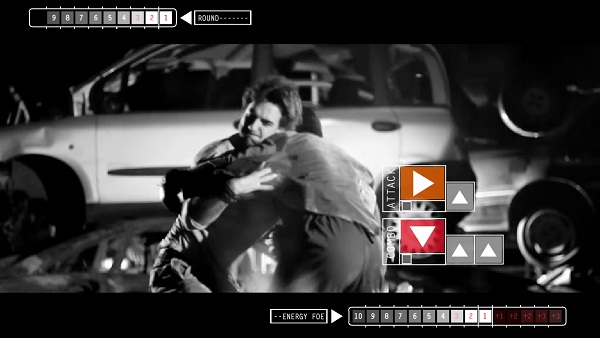
It’s interesting then, that perhaps the realism of live-action highlights the faults in the scene. We expect a higher level of realism when we see something live-action, and so corny acting is harder to forgive. If this was animated in the standard CGI, the stiffness of the character movements might not be as noticeable, or at least, would be easier for developers to fix. And obviously, animated characters don’t need to worry about hurting each other.

It sounds like a Confucius saying, but maybe in the game’s pursuit of realism, they sacrificed realism… or something like that.

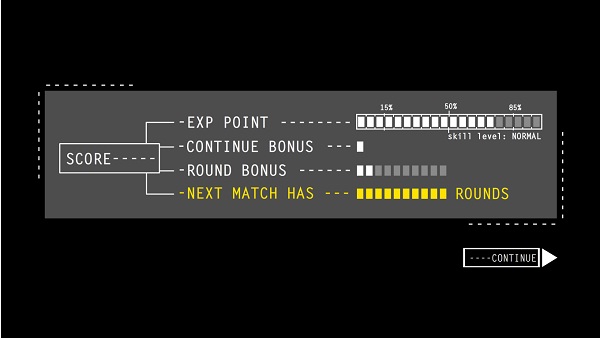
The visual aspect that’s most lacking is the game’s UI. The menus are horrible to behold, comprised of grey blocks of text riddled with spelling and grammatical errors.

While it’s far from perfect, Stay Dead’s visual style is quite unique, and may have opened up a new genre for others to expand on.
 

Gameplay
QuickTime Events often appear among lists of things most hated by gamers. There’s nothing wrong with them in theory, it’s just that we’ve seen them done so badly so regularly that they seem irredeemable. But believe it or not, they can be implemented quite well, and when the occasion calls for them, they can be a legitimate gameplay mechanic.

Stay Dead is essentially all QuickTime Events: players are tasked with pressing buttons in time with on-screen prompts, giving it the flow of a rhythm game, in a fighting game framework.

In each fight, you must deal at least ten points of damage to defeat your opponent. This is done by stringing together attacks and combos, with the result determined by your ability to hit the correct key in time. A prompt will flash up on screen to tell you which to hit and how (tap, hold or press repeatedly), and depending on the complexity of the sequence, success will let you deal one, two or three points of damage to the opponent.

Each fight consists of ten Rounds, meaning you have ten opportunities to attack, aiming to inflict ten damage to your opponent in that time. If you mistime your attacks, you fail to inflict damage, and waste a Round.

It’s an interesting way to handle health: the battle is over after ten rounds, whether the player has scored more or less than ten.
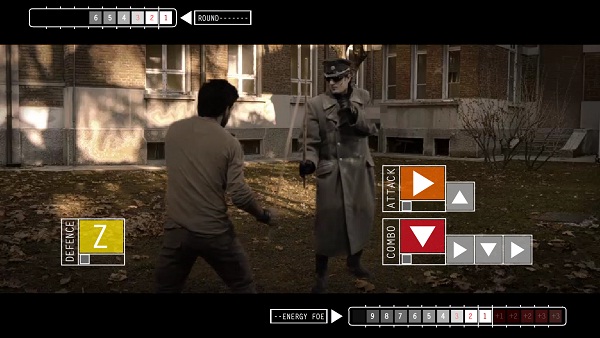
The combat actually flows quite well. Each round, you choose to go on the offensive or defensive. Offensive, you can perform a basic attack or a combo. There’s usually only one key stroke to a basic attack, which deals a single blow, but of course, breaks you even by using a round. A combo is harder to achieve, but lets you deal multiple points of damage at once, while only spending one round.

Choosing to go on the defensive for a round can turn the fight around to your favour. The enemy will attack, and if you successfully avoid them, you can counter-attack for greater damage.

Rather than straight-up wasting a round if the player misses while attacking, it leaves an opening for the enemy, forcing the player back onto the defensive. Again, successful dodging allows for a counter-attack, meaning a failed attack can still be salvaged, if you defend well.

This system leads to a pleasing flow of attack-defend-attack during battles, which is a better use of QuickTime events than most.

But of course, the gameplay isn’t as free as the standard fighting game, or indeed, most games. QuickTime-heavy games often attract a lot of questioning about whether they should even be called video games. It’s due to a perceived lack of interactivity, that player input doesn’t amount to anything, and they might as well be watching a film. That discussion is appropriate in some cases – Telltale’s recent Jurassic Park game was largely focused on QuickTime events, with the outcomes often unchanged, whether the player succeeds or fails.

Thankfully, Stay Dead avoids this pitfall, applying some solid gameplay mechanics to this structure that gamers are quite wary of.

Unfortunately, it won’t take you long to “finish” the game. There are only four enemies to battle, but to face the master you need to beat all four in a row, and do so with a certain amount of skill – scraping through the fights won’t be enough. Getting through to the final boss is actually quite difficult, and beating him is even harder, but chances are your interest will have waned before then.

Overall

You know what they say: everything old is new again, and reviving the FMV format and applying some modern design principles to it makes for an interesting product.

It may not have the longevity of a lot of games, or the level of control that people may be looking for, but Stay Dead should be appreciated for what it is: an interesting cross-media experiment.


6-5-capsules-out-of-10


W.E.L.D.E.R. Review


W.E.L.D.E.R.
Developer: Highline Games
Publisher: Ayopa Games
Platform: Mac (reviewed)
Release: 28/6/12
Price: $5.49 – Available Here

Overview

The iTunes App store is full of word games. Word searches, word puzzles, words with friends, enemies and Siri. Then there is W.E.L.D.E.R., short for Word Examination Laboratory for Dynamic Extraction and Reassessment. Published and Ayopa and developed by Highline Games, a start-up formed by ex-Rockstar New York staff, there were high hopes being brought to the table (or desktop, rather) with this title. The game has faired pretty well on the iTunes App store, but what happens when this iOS word game leaves its App format and becomes a Mac game?

Gameplay

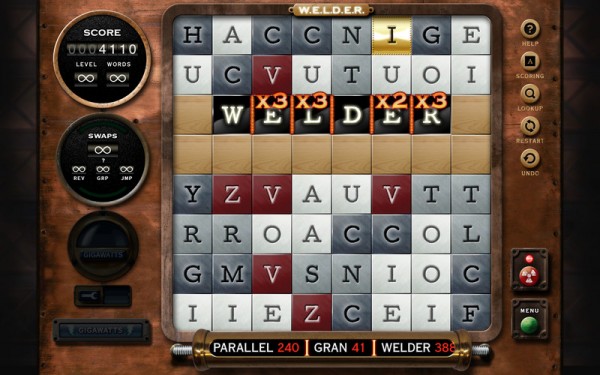
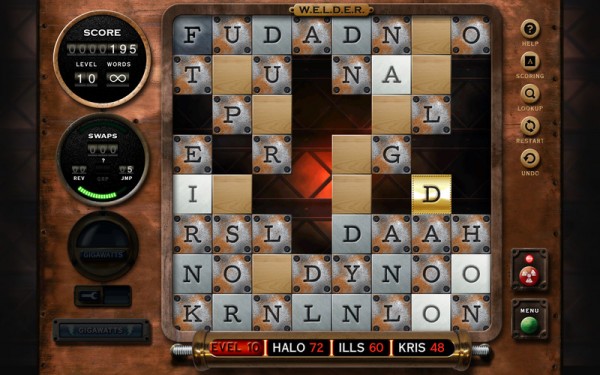
The gameplay is very simplistic. There are a bunch of metal tiles with letters on them, which need to be swapped around in order to make words comprised of four or more letters. Amongst these metal panels there are wooden ones, which can have any letter imprinted on them. Sounds simple enough, right? Well the challenging part is, you only have so many ‘swaps’ you can use. As the levels progress (there are 12 in total), you get less swaps to complete the puzzle. However, you eventually earn new swaps to change tiles in new ways. At first swaps can be done only with tiles that are next to each other. Moving a letter across the board uses up precious swaps and means that you become ever closer to finishing your game. Of course, every time you gain 250 points you get new swaps – but that isn’t such an easy task. New swaps like jump swaps, which allow tiles to be swapped across the whole board, or reverse swaps that allow a string of letters to be turned around, become helpful as you progress through the game.

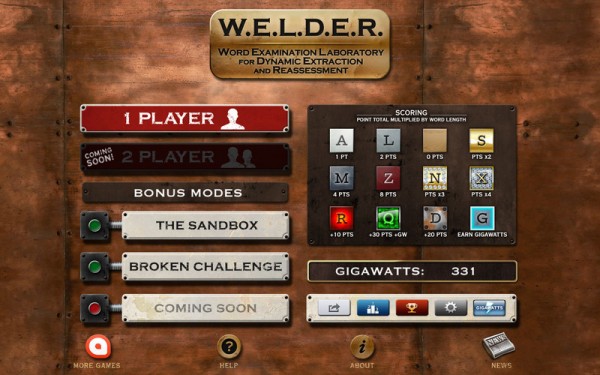
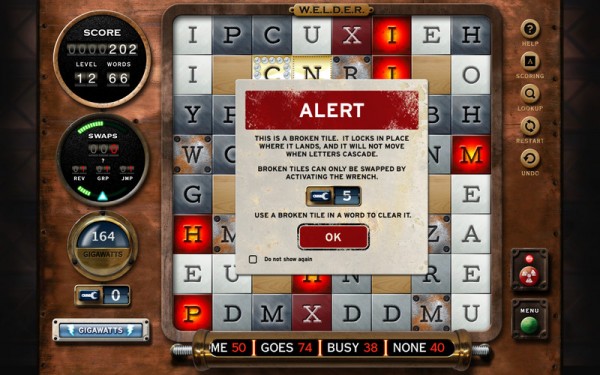
But this is all in the standard game mode. There are also two more game modes in W.E.L.D.E.R that you can unlock. Sandbox mode has unlimited swaps, and allows you to construct words uninhibited. The other type of game mode is the Broken Challenge. This features limited swaps, like normal mode. However, this time around there are a bunch of ‘broken’ tiles. Broken tiles can’t be moved, even when words are made underneath them – doing so will just cause gaps in the board making it even hard to form words. The only way to get rid of them is to construct a word around them, using that lettered tile. This provides an adequate challenge, although it can become rather taxing and tiresome very quickly.

I should also note, a nice feature of the game is being able to close the App and then come back and be where you left off. Although, I often close the game out of frustration and don’t want to come back to a game where I have one swap and no near by letters to form words. But there is always the chance to start fresh in the level you managed to reach before your game ends, which is good if you find the first few levels too easy. Overall there are a lot of features in the game. There are a huge amount of tiles to utilise for scores, numerous ways to move the tiles around the board; there are gigawatts and a whole other manner of things. In short, there is a little too much going on which doesn’t ultimately effect the challenge or mechanics of the game. As dressed up as it is, it’s still just clicking to form words – the game does have very limited appeal.

Visuals and Audio

There isn’t all too much to say about the visual style of W.E.L.D.E.R. It has an industrial feel too it, which is matched by the music and sound effects, but more about that in a moment. There is very little to say about the actual board, it has different styles of tiles, some of which can look out of place given the ‘factory floor’ setting of the game. But on the plus side, the interface is well constructed. Granted, there is a lot of information that doesn’t come into play all that much – the swaps being the primary focus for attention. However, the information that is there is useful and is presented well to help the game progress. As for the audio, clicking tiles, moving tiles, and hell, just doing anything in the game results in mechanical noises. In the background there is a whirring machine-like noise that pushes the game’s theme forward. The industrial setting works, it fits the game and the constructing of words. But ultimately, it doesn’t add anything extra to the game; any other theme could fit and probably work just as well.

Overall

If you like word games, then this is sure to give you some sort of enjoyment. I can also see the game working well as an educational game. However, I don’t feel like W.E.L.D.E.R really cuts it as a desktop game. Despite how popular it was as an iPhone game, the act of opening and playing it on a desktop computer becomes a bit of a chore. Sure, the interface has been updated to fit with the aesthetics of a larger screen and the input of a mouse, but it just doesn’t cut it in this case. Think of W.E.L.D.E.R. as akin to those card-based games that come free with your PC – they may have provided some enjoyment when you first got your computer, but they are seldom opened these days.

5-0-capsules-out-of-10

Worms Revolution Classes in Session

These Worms Revolution developer diaries are churned out quick lately. We’re already up to the third out of five, and the latest discusses in a bit more detail how the class system will work, and touches on the customization options the Worms series is known for.

It’s been thrown around a lot that Worms Revolution will feature four types of worms: the standard Soldier, the support class Scientist, the nimble Scout and the beefcake Heavy. We’ve been told before how they differ, but now we get to see their advantages and disadvantages in action.

The ability to customize your team has been a staple for a few games now, and this dev diary also touches on how Revolution handles it.

Watch the video below.

 

New Party Wave Trailer and Screenshots


Mistwalker Corporation released a new trailer and a bundle of new screen shots, artwork, and character animations for their new game Party Wave. Party Wave is an action surfing game featuring bright and colourful comic style characters with innovative touch controls. Players will need to direct their surfers into a wave to begin surfing, then help their surfers stay on their feet and prevent an embarrassing wipe out! No word on the exact release date as the game is currently awaiting approval from the Apple for the iTunes App Store. No launch price has been announced either. Stay tuned at Capsule Computers for all the latest on Party Wave!

Anuman Interactive Bastille Day Sale

Anuman Interactive has launched a special operation to commemorate Bastille Day. Bastille Day celebrates the storming of the Bastille prison on July 14th, 1789, marking the beginning of modern France and the First Republic. In honour of Bastille Day, Anuman is beheading the prices of their “Hidden Object” packs for 48 hours. From July 14th to 15th, the following packs will be on sale.

– Hidden Objects – 2 in 1 – Jules Verne Pack (iPhone) : only $0.99 instead of $3.99
– Hidden Objects – 2 in 1 – Jules Verne Pack HD (iPad) : only $0.99 instead of $5.99

 Hidden Objects – 3 in 1 – Adventure Pack (iPhone) : only $1.99 instead of $4.99
– Hidden Objects – 3 in 1 – Adventure Pack HD (iPad) : only $1.99 instead of $7.99

– Hidden Objects- 3 in 1 – Crime Scene Pack (iPhone)only $1.99 instead of $4.99
– Hidden Objects – 3 in 1 – Crime Scene Pack HD (iPad) : only $1.99 instead of $7.99

– Hidden Objects – 3 in 1 – Thriller Pack (iPhone) : only $1.99 instead of $4.99
– Hidden Objects – 3 in 1 – Thriller Pack HD (iPad) : only $1.99 instead of $7.99

– Hidden Objects – 4 in 1 – Romance Pack (iPhone)only $2.99 instead of $4.99
– Hidden Objects – 4 in 1 – Romance Pack HD (iPad)only $2.99 instead of $7.99

Follow Connor through the streets of Boston in latest Assassin’s Creed 3 trailer

Assassin’s Creed 3 is already looking like it will be the best Assassin’s Creed game to date, bringing with it a number of upgrades and changes to the formula which so far have looked like massive improvements. Now at E3 there were three gameplay segments shown to the press, one of which was a naval battle shown during Sony’s Pre-E3 event, another was some wilderness exploration which has already been released to the public and finally some Boston free-roaming.

Today that Boston gameplay was released to the public by Ubisoft and it has also been given commentary by Creative Director Alexander Hutchinson. The video itself contains everything you’d expect from a title such as Assassin’s Creed 3 and more. Check it out below.

Assassin’s Creed 3 co-op mode announced as Wolf Pack

It seems that Assassin’s Creed 3 has everything a gamer could possibly want nowadays as not only will it have the series’ previous online versus mode but it will now also have a co-op mode. The mode itself is called Wolf Pack and will allow four players to work together as a team.

This team will take down twenty five waves of targets that have to be assassinated, with each assassination becoming more difficult. To make matters more pressing, there will be a timer applied so players will need to take down their targets fast. For the most part, the game will still reward players with points depending on their killing skills and targets can be tracked via a HUD compass.

Nightwing and Cyborg throw down in the latest Injustice: Gods Among Us trailer

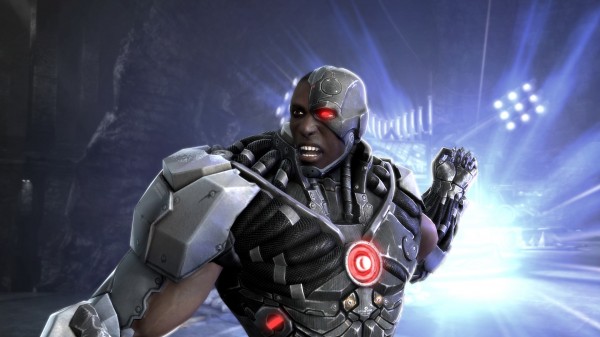
Injustice: Gods Among Us has gotten quite a lot of news lately to go with the San Diego Comic Con. First it was revealed that Cyborg and Nightwing would be joining the game’s super hero roster and then we also saw a slew of images appear showing how the characters would end up looking in the title.

Now we have a new gameplay trailer which shows off most of the already announced fighters beating each other down as well as Nightwing and Cyborg in action near the end. Those curious about what the game’s storyline will have to offer can also check out the second trailer below which give’s a bit of a hint as to the title’s premise.


[pro-player width=’530′ height=’253′ type=’video’]http://www.youtube.com/watch?v=-pxqYHVV94w&feature=player_embedded[/pro-player]

Gears of War: Judgement drops on March 2013

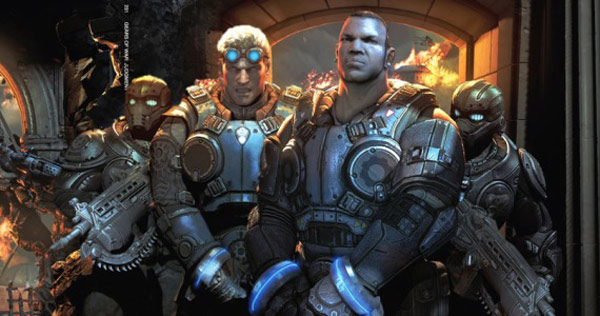
In Gears of War: Judgment players will be stepping into the boots of Baird and Cole as they make their way through events that occur before the main Gears of War series. Before now, the release window for the title was simply sometime in 2013 but today Epic Games Director of Production Rod Fergusson narrowed that release window down to sometime in March 2013.

It is worth noting that the studio behind Bulletstorm, People Can Fly, is primarily working on developing the title while Epic Games is collaborating with them. Still, from what we have seen so far of the game it will certainly please fans of the series to see the game continue, albeit in prequel form.

Update: Epic has narrowed down the release date to an exact date of March 19, 2013.

Halo 4 Limited Edition Xbox 360 bundle revealed

It seems that the rumors about a limited edition console being released alongside Halo 4 weren’t simply rumors but actual information leaks. Today Microsoft’s online store placed up their information about a special Halo 4 themed Xbox 360 which will be released next to the game this November.

The package itself can be seen above and will come with two fancy wireless controllers, a bland black headset, Halo 4 the game and a fancy themed Xbox 360 with a 320 GB hard drive. The console will run you $400, so it is actually a decent deal for those who need to upgrade their console and also want to get Halo 4.