When you think of Forza Motorsport, what comes to mind? A pretty standard racing game with a very mute colour palette? Well that’s what some would say, but the Forza Motorsport series has always been more than that. It’s a racing game that bridges the gap between hardcore racing fans and the casual player.
The franchise is known for it’s simple controls. Heck, the game can be played simply by holding down the trigger and steering with the analogue stick. It is really that simple, but there is always the option to make things more challenging for the hardcore fans looking for a challenge. So how does Forza Horizon fit into all of this? What does it do that hasn’t already been done in Forza Motosport? Well pardon the pun, but it broadens the franchise’s horizons.
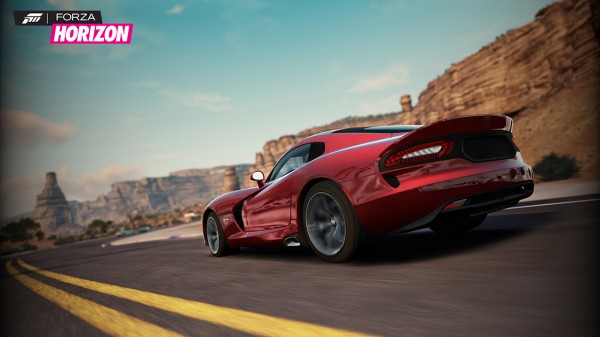
Gone are the pure and pristine visuals that feel more sterilised than anything and in it’s place is rough and tumble aesthetics with a visual flair unlike anything that has graced the franchise thus far. For starters it is far more colourful and has a greater level of personality behind it all in comparison with past instalments in the series. There is so much more spunk, I’m honestly surprised that it is even a Forza game. I’ll let the screenshots speak for themselves in this regard.
Gameplay wise, not much has changed. Races still feel essentially the same, with the simplified control scheme that anyone can play mixed with that addictive nature of Forza racing that has become something fans of the series are now accustomed to. It’s something difficult to put your finger on, but the game has a way of sending you into a somewhat euphoric state. You don’t just play this game, you feel it. This is something you don’t find in a game too often and Turn10 Studios have mastered it over the years.
Now while races aren’t that different perhaps the biggest and most exciting change is the fact that Forza Horizon is actually an open world game. That’s right you drive around within an open world and accept a variety of challenges along the way, in particular races. One thing that I found particularly striking about this game is it’s similarity to Burnout Paradise, another open world racing game. I was surprised to discover that Playground Games (the developers working alongside Turn10 studios) actually was composed of former Burnout developers. This influence was evident and I can say as a fan of Burnout, this was nothing but a positive in my eyes.
If you are interested in an open world Forza game, then Forza Horizon will probably be worth a look in. If you have never tried out the Forza franchise but enjoy games like Burnout than you’d be well off checking out Forza Horizon. I thoroughly enjoyed the game myself and look forward to it’s release.
Worms Revolution Developer:Team 17 Publisher:Team 17 Platform: PC (reviewed), XBLA, PSN Release Date: October 10 (Europe/USA), October 11 (Australia) Price: Available Here
Overview
“More like Worms Evolution, amirite?” I said to no one in particular, when I first saw the game. My awful pun felt appropriate at the time: it looked to me like little more than a graphical update of the basic formula.
Sure, it was pretty, and Worms is always fun, but visuals can only carry you so far when Worms Reloaded is still fresh in the memory.
Then I heard about the worm classes. And dynamic water. And physics objects. And Matt Berry.
I still wasn’t convinced they were game-changing factors, but I was intrigued. Does Worms Revolution earn the right to call itself a revolution?
Gameplay
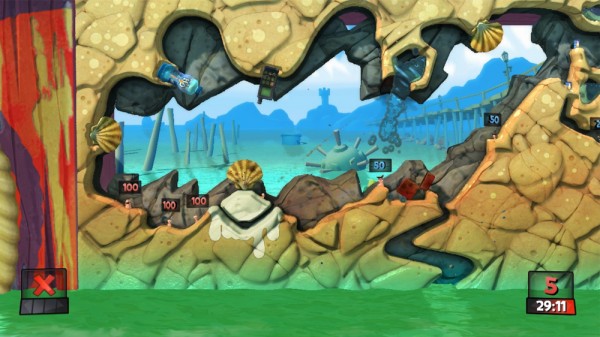
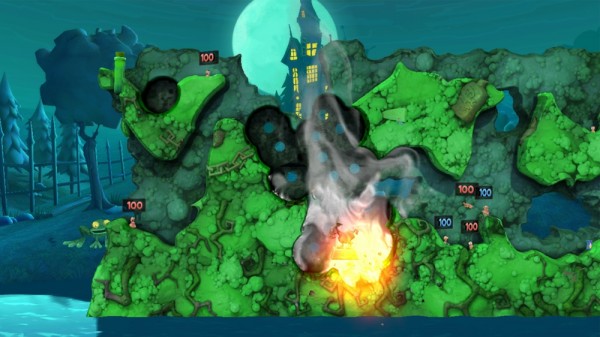
Basic worm warfare involves two or more teams of the dirt-dwellers battling it out across randomly-generated landscapes or ready-made landmarks, using bazookas, grenades, banana bombs, exploding sheep, gassy grumpy grannies, their own disembodied fists, and anything else they can throw or shoot at each other.
Worms Revolution keeps this structure intact, spruces it up with a shiny new engine, and attempts to revolutionize the formula with new features of varying importance.
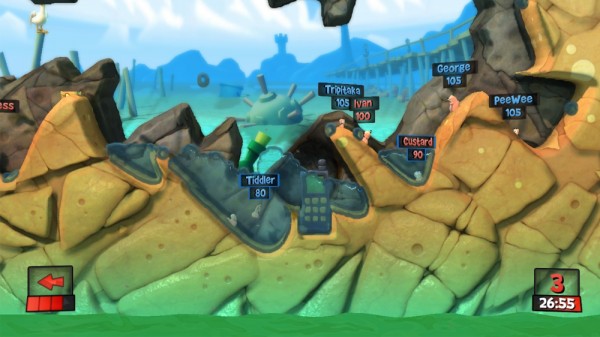
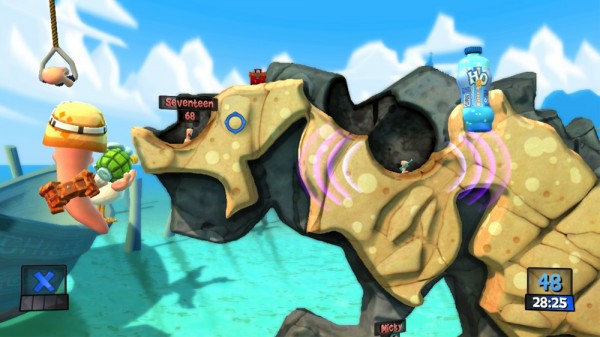
The worms now come in four distinct flavours, varying in attack power, damage resistance, mobility and special abilities. Your standard worm is the Soldier: average in most areas, this is the type of worm you’ve been playing with in previous games.
The Heavy is a chunkier fellow, who’s as good at taking damage as he is at dishing it out. His “big bones” make moving around the landscape difficult – not good when he’s struggling to climb that slight incline, but handy when an enemy’s attack would send a lesser worm to the bottom of the ocean.
The Scout is the anti-Heavy: small in stature and nimble in nature, he’s good at getting around and finding hidey holes other worms can’t reach. He’s more susceptible to damage though, as explosions will fling him further.
Lastly, the Scientist shows brains can trump brawn. Support is his specialty, as he heals his team each turn, and puts that spectacular noggin to use increasing the strength of technical weapons, like air strikes and sentry guns.
The classes open up new strategies while aiding existing ones. The Scientist, for example, seems designed for a Darkside playstyle: hide him away in an underground lair, defended by his strengthened sentry guns, where he can heal his team each turn and use his powered-up air strikes to attack from safety.
You can build your team out of any combination of classes, unlocking additional worms for your roster with coins earned in the single-player portion of the game. In practice, the four classes aren’t drastically different, but taking advantage of the subtleties can tip the tide of battle, and dictate how you position your worms and attack enemies.
Mastering classes is a fun addition, but the real game-changer is dynamic water. It might not sound like much, but its inclusion opens up a whole host of new strategies. Water’s always been a serious hazard – it’s hard to swim without arms and legs, after all – but besides the ever-present ocean swallowing up any worm that falls into it, water can now appear
naturally on landscapes, or be called into battle from a range of new aquatic weapons.
This dynamic water reacts to the game’s physics, flowing logically while retaining an element of unpredictability. It will pool in crevices, wash hapless worms downhill, and can slowly drown them if left submerged. Blasting open a natural dam to flood a crowded area is an effective (and fun) way to deal huge damage over time, or for more immediate kills, water-based weapons can function as long-range prods, pushing worms into danger.
Less integral but no less fun are the new physics objects embedded in the terrain. Once dislodged, they will roll around, creating useful cover or annoying obstacles. Some can be broken open to unleash further havoc, in the form of water, poison gas or ‘splosions. They’re fun to play with, and several new weapons give you increased powers over them, but they still feel somewhat under-utilized.
Learning the details will take some time, and the single player campaign is the best place to start, for Worms veterans and n00bs alike. The first eight missions take you through the basics of movement, combat, classes, water, etc, before throwing in some challenging battles to test you. The new Puzzle mode asks you to find creative solutions to simple problems, and requires a type of thinking not normally employed in Worms.
The single-player modes are a handy introduction to the game’s new and old elements, but playing with AI enemies doesn’t compare to human opponents. Traditionally Worms is equal parts skill and luck, but the AI messes up that balance by almost entirely removing luck from the equation. While you might spend a few turns using trial-and-error to land that grenade within damage-distance of an enemy, the AI will near-perfectly bounce it, roll it and time it to detonate next to you, on the first try, with extremely frustrating frequency.
Conversely, they won’t see the value of a weapon crate inches from their face, or the danger of rising water. Players may take a turn to collect an enticing loot drop, or high-tail it to higher ground when the rising water of sudden death mode begins to lap around their ankles. But the idiot-savant AI will resist these basic self-preservation instincts, and will likely spend the turn before they’re swallowed up by the ocean firing off another perfect shot at a distant enemy.
Other times, their behaviour is downright unexplainable. In one match, an AI opponent had an opportunity to devastate one of my worms, sitting between two oil drums near the sea. A well-placed stick of dynamite would have triggered a swift death, but this worm had his own master plan. He thought about it for two-thirds of his turn, before dropping next to his target, prodding him for a total of zero points of damage, then, presumably out of shame, dived into the ocean himself.
As expected, the single player modes are mere preparation for the meat of the game: playing against human opponents, who provide a great mix of skill, luck, logic and trash-talk.
One of the greatest pleasures offered by classic Worms is watching your friend’s face as you gently prod his last worm into the sea. Same-room “hot seat” multiplayer has always been a key feature, but Revolution has strangely reduced the ease and detail of playing with friends on one machine.
In every other Worms game we’ve owned, each of us in the household would have a team, and certain friends would make their own as well.
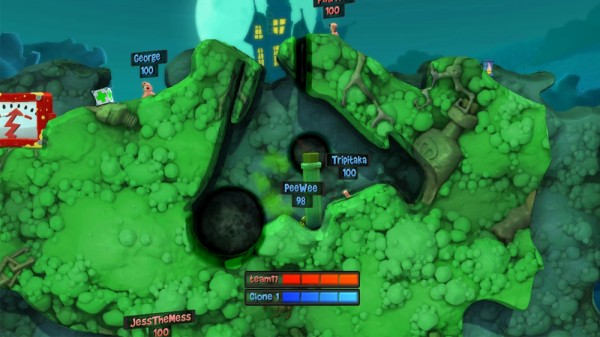
Now you can create one and only one, and the team name defaults, uneditable, to your Steam username (having reviewed the PC version, I can’t say whether this is true of the PSN/XBLA versions, but I expect it is). If friends want to join in, they have to play as clones of your team, although thankfully they can select different load-outs of worm classes.
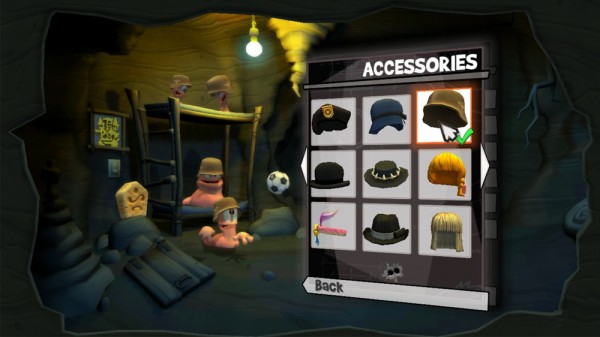
Customizing your team’s appearance is another series staple now suffering from over-simplification. Where you could once dress up your worms with multiple costume pieces, worms can now don only a single item of clothing. A hat OR glasses, not both. It’s probably not going to bother the majority of players too much, but it seems odd to backpedal on such a regular feature of the franchise.
Fortunately these issues are largely limited to the front-end: after navigating the awkward menu system and setting up a game with reduced customization and team options, it plays like a dream. The problems are easily forgiven amidst the formula’s fun, and playing multiplayer online (something I missed out on, there being no community before the game’s official launch) may alleviate them entirely.
Visuals & Audio
Worms have always been very expressive, particularly in the 3D titles. Revolution blends that with the gameplay of the 2D games, creating a strong sense of personality.
As such, worms will scream when a grenade lands next to them, beg when a crosshair is aimed at them, point and laugh at enemies when they miss a shot.
The voice sets exacerbate the charm. This time they’ve been given a bit more variety, with multiple sayings for each event – a relief, given it normally begins to grate after hearing the same line every turn.
The IT Crowd’s Matt Berry is perfectly cast as Don Keystone, nature documenter and narrator of the single player modes. His cocky, smooth voice fits the ridiculous Worms aesthetic well, lending an air of undeserved authority to the proceedings. It’s a shame the script often fails to give him something interesting to say, but his smouldering vocals can wring humour from the driest of lines.
Overall
A couple of puzzling steps backward are easily countered by some large steps forward in intriguing directions. Classes, dynamic water and physics objects are creative new vessels of fun, deepening existing strategies while allowing new ones to emerge.
Dipped in a Matt Berry-flavoured aesthetic, Worms Revolution is different enough to entice fans back into the weird world of Worms, and familiar enough to remind them why they were fans in the first place.
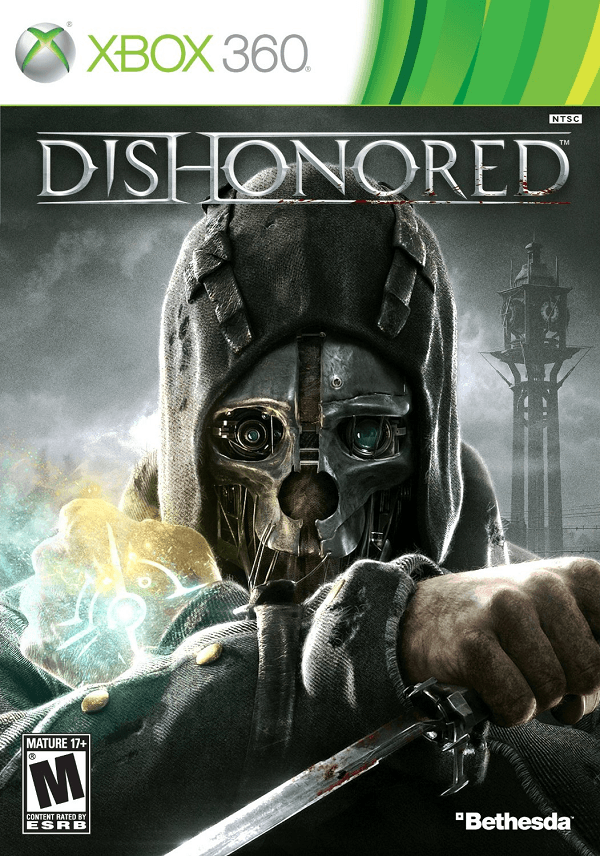
Dishonored Developer:Arkane Studios Publisher:Bethesda Platforms: PC, PlayStation 3, Xbox 360 (Reviewed) Release Date: October 9, 2012 Price:$59.99 – Available Here
Overview: The freedom of choice is something that many games try and portray when they are advertising themselves to the world, but usually these choices are limited to very specific actions which will vary little from what everyone else playing the game experienced. However Bethesda and Arkane Studios have brought us a game that may offer true player choice in the form of Dishonored. Should gamers choose to play Dishonored or should they decide otherwise? Let’s find out.
Story: The industrious city of Dunwall may have once been the most powerful nation in the empire thanks to its technological boom and whaling industry. However those prosperous days are in the past as a terrible plague called the “Rat Plague” has swept upon the city like the Black Death, dooming the poor to be isolated and left to die as their loved ones fall to the plague.
The Empress ruling Dunwall is not blind to the nation’s plight however and has sent her trusted bodyguard Corvo Attano to seek help from other nations in battling the plague. Corvo is a man close to the Empress’ heart and a devoted protector to both her and her daughter Emily. Players step into the boots of Corvo upon his return with bad news for the Empress. Unfortunately his early return has placed him right in the middle of an assassination plot he has no chance of preventing.
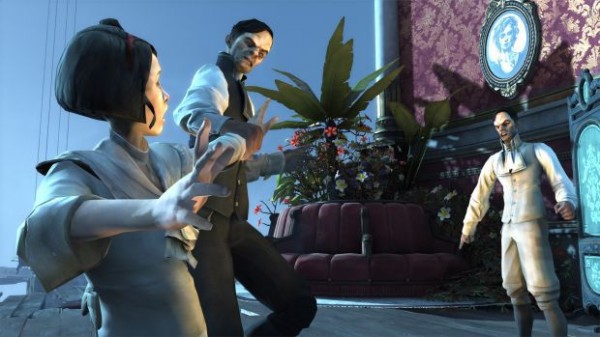
Instead Corvo is made to watch as his Empress is murdered in front of him while Emily is whisked away by the same assassins. Being the only one left at the scene, Corvo is quickly blamed for the murder of the Empress and sent to jail. After escaping jail through the help of a group of rebels, Corvo is visited by a strange being known as “The Outsider” who grants him supernatural powers, eager to see what the man will do with his abilities. Now that Corvo has the means to track down Emily and put an end to those who planned the Empress’ assassination, how will he handle the situation? It is up to you to decide.
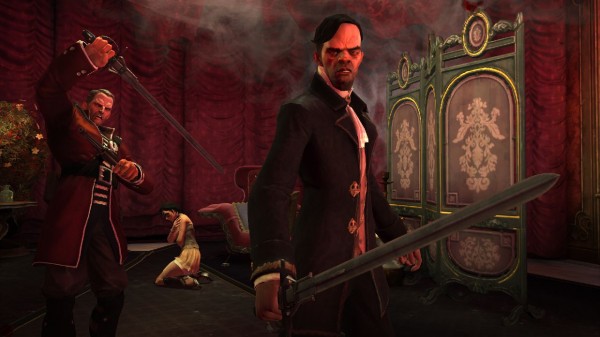
While Dishonored may be a classic story of revenge where the player must systematically hunt down every member of the plot to find out their true attentions, the story is also told amazingly well. The dismal city of Dunwall provides a perfect setting for this classic tale of revenge. It also helps that player choice works its way into the storyline as well, providing a number of different options for the player to take as they play through the story.
While nearly every mission you are sent on involves assassinating one or two targets, there are other routes that can be taken and even a few additional side-quests to interact with at the same time. There are numerous ways to complete a mission, some of which don’t involve even a single drop of blood being spilled, though perhaps some of your targets may have wished for death after they discover their fate.
In the end, Dishonored tells a vivid story of Corvo’s revenge against political usurpers and it accomplishes it by not only sticking true to a number of standard plot-devices but providing a powerful setting, characters the player will come to feel close with and clear villains that only become darker as the player investigates the world around them.
Visuals: Dishonored features a rather artistic visual design, though this design does appear dated in a number of areas. The title features large amounts of texture pop and blurry objects. Thankfully this isn’t too much of an issue however considering how stylistic the game is with its steampunk designs and its Victorian England appearance.
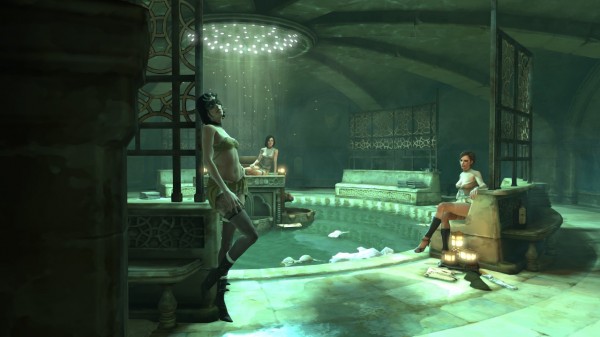
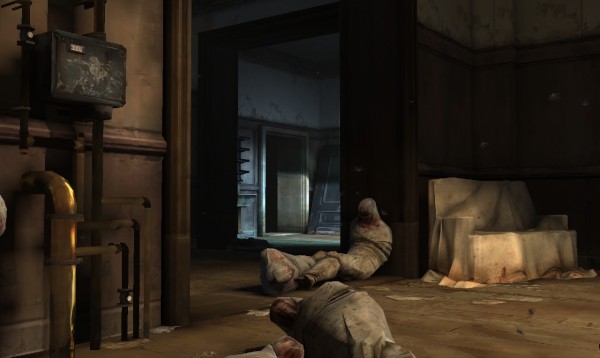
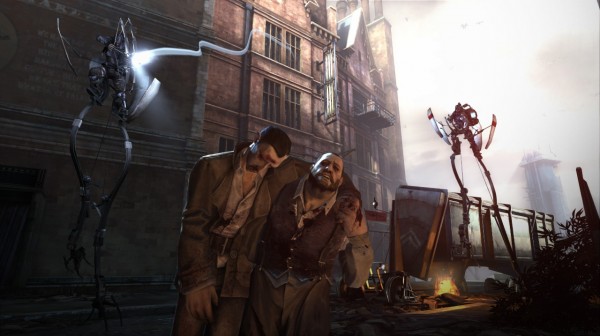
The characters themselves are similarly stylized, though some of their faces appear slightly warped. Thankfully the character animations are fluid both in combat and standard motion. As far as environments go, Dunwall and the various environments the player will venture through are handled so well that gamers will feel the desperation and squalor that the city has devolved into, with corpses littering the streets and entire buildings condemned due to the plague.
Audio: One thing that helps contribute to the fact that Dunwall feels so atmospheric is the fact that the audio work is amazingly well handled. Guards talk nonchalantly as they continue on their routes, survivors cry in hidden areas, rats scurry through alley ways, eating anything they come across and more, all set to some rather eerie background music.
It also helps that the title features some rather impressive voice work done by the various characters the player will come across. These voice actors all do a great job with their characters, especially when it comes to the voice actress for the mysteriously deranged Granny Rags and many other members of the main cast, especially the voice of one certain object the player carries with them everywhere.
Gameplay:
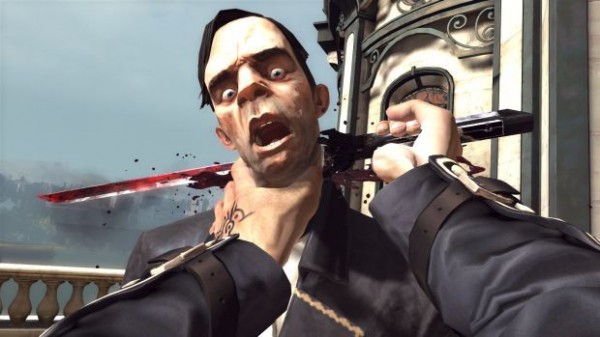
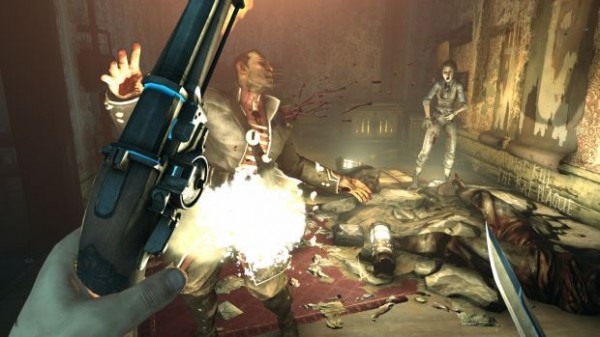
Players will see the world of Dishonored through the eyes of Corvo as he sets off on each of his missions, however exactly how you choose to take on these missions is entirely up to you. You can either choose to be a murderous whirlwind of magic, bullets and swordsmanship, a stealthy assassin killing only those blocking your way to the target, or even a man of mercy.
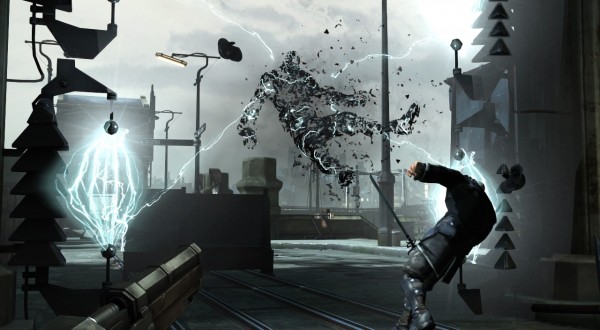
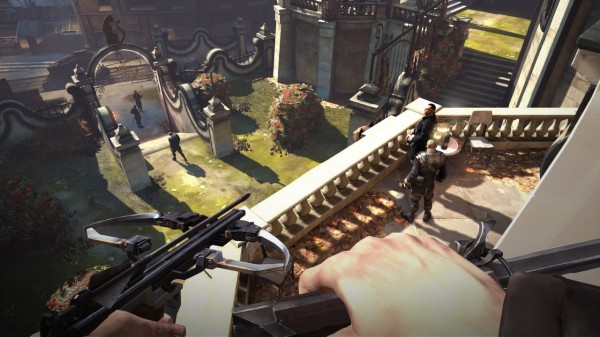
Dishonored doesn’t stop there however, as they have also provided a wide-ranging arsenal of weaponry and magical abilities to use at will. Corvo will be able to use a number of special abilities such as short-range teleportation, wind-blasts, possessing animals or even people and even summoning an army of rats to sick on your enemies. Outside of these special abilities granted to you by the Outsider, the player also has a number of more mundane weapons at their disposal such as a multi-purpose crossbow, pistol, explosives, traps, and of course his deadly assassin’s blade.
Each piece of your equipment is upgradeable through the rebel’s scientist, Piero, who will provide various upgrades to your gear and weapons for a price while magic is upgraded by collecting runes. These runes are very easy to find however thanks to a special heart that points to the exact location of each Rune and Bone Charm that is in an area. However it only shows where these objects are, not how to get into the area, creating some rather tricky moments of exploration. The aforementioned bone charms provide various bonuses to Corvo’s skills and a limited number can be equipped at any given time.
For every mission that Corvo ventures out on, there are a number of ways to go about practically everything in each mission. There are always multiple ways to enter an area and sneak past guards. If you feel like possessing a fish and entering a building through a storm drain that is just as legitimate as sneaking through an open window on the building’s top floor or breaking down the front door with a blast of wind and death. While some routes are obvious to take, such as climbable air ducts, if you choose to sit ten people down and have each one play through the same mission, you will likely find at least five different routes taken by these individuals.
Choice doesn’t end in exploration either, they also have a number of ways they can approach combat, or lack thereof. Stealthy players can choose to sneak around enemies and sleep-darting or choking out anyone who may be in their way while those looking for bloodshed can plant a wire-trap on a rat, possess the rat and run it into a group of guards and create a mess of blood and flying limbs.
Those who choose to enter full frontal combat will find themselves at a bit of a disadvantage however, thanks to the fact that enemies are quite intelligent despite Corvo’s supernatural skills. Players can use two weapons at any given time, their sword and a pistol, bow, bomb or spell though it is worth noting that those entering into sword combat will find the enemy AI quite adept at swordplay. They will block and dodge your attacks gracefully, making parrying and counter attacks essential to winning a sword fight.
It is actually amazing that Arkane Studios managed to find such a balance between offensive and stealthy capabilities for Dishonored. Not only is the combat tight and visceral, the stealth system is refined and requires thought as players can be discovered by searching guards easily if they choose to simply hide in the shadows rather than teleport out of the area or possess a guard or rat and sneak out of the area.
That being said, while players can choose to take whichever route they feel like, Dishonored feels like it lends itself to be played stealthily and with a nonlethal approach. There are always ways to take down your assassination targets non-lethally and it simply feels much more satisfying to play as a stealth game, though it is also just as fun to slaughter everything in sight.
The game does feature an interesting system called the “Chaos” system which changes a number of things in the game depending on your actions. Becoming a merciless murderer can lead to a more difficult game later on, as the plague becomes more of an issue thanks to the increase in dead bodies and NPCs may look down on Corvo’s blood splattered path. High levels of Chaos can be reduced by playing missions stealthily and players can still kill a number of people per mission without worrying about the Chaos level rising above low.
The various choices and options that Dishonored provides players helps provide an amazing level of re-playability which does help as the game can be blown through in around seven hours if you choose to simply ignore all elements of stealth and side-quests. However those playing the stealth route can find upwards of fifteen hours of game time here and still find more ways to go about a mission in their next playthrough.
Overall: Dishonored does something rare in this video game industry. It sets itself above the standard game by not only bringing excellent stealth and combat mechanics combined with an enjoyable storyline set in a dilapidated city riddled with plague and corruption, but also doing it in such a way that the player will always feel like they are in control of what they are going to be doing next. Gamers can choose how to tackle any situation in Dishonored and feel gratification in doing so. There are simply no other games on the market that do what Dishonored does, making it a game many will be talking about in the years to come.
Death in video games is always handled differently. Some games you may simply respawn at the closest checkpoint, reload your gun and try again. Others may make you restart with fewer supplies or even back at the start of the level. Death has always been a motivation to succeed in games, as we humans detest failure. Check out more recent years and you can really see the trend towards more inventive ways to die.
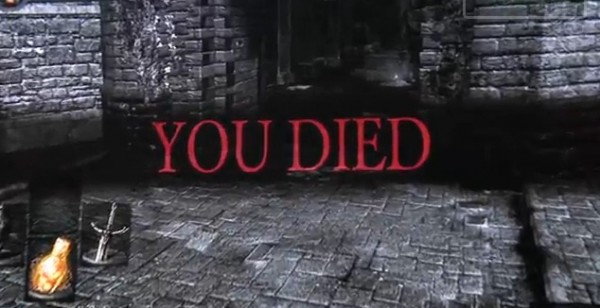
Demon’s Souls was among the first to take up the mantle of current-gen actual gaming death. In it, failure means to start the entire level again, weaker than you have begun it and facing stronger enemies. Each death carried immense weight and by using such a system the game unconsciously makes the player experience anxiety and even fear, despite it not being classed as a horror game. The fear of death conflicts with our desire to explore, to know what the next challenge will be and to see if we can best it. You could charge in now, already tired from the first half of the level, or retreat, spend your souls and return another time, but with all the previously vanquished enemies returning to life. It was utterly brilliant at its risk versus reward gameplay; you don’t want to continue but a part of you really does. When you do die however (when you fail), your next attempt is weighted with the burden of that previous failure and the knowledge that further death will cause even further pain next time around. What do you do?
Dark Souls (the sequel) definitely continued this trend. Especially with those Basilisks in the sewers of The Depths. They scared me more than anything I’ve ever faced in a game to date. Death to them meant absolutely terrible life upon respawn unless you could find a cure. Even just thinking about them makes me shudder.
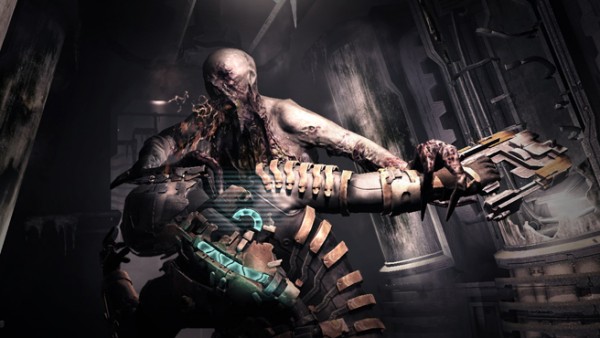
Dead Space 2 itself was a game in which death meant little as you returned alive with all of your ammo and health, but the actual experience of death was the true psychological test. Dead Space 2 featured many, many different animations of death; your character being ripped to pieces by a Necromorph, an airlock shutting on Isaac’s chest or a creature cutting off your head and then dragging your body off screen.
Before the game was available to the public I had seen a press release in which a new enemy type was shown off. The entirety of the video was simply Isaac dying to this creature in full view of the camera. The thing would rip off his helmet after a struggle, throw up repeatedly into his mouth and then let go of him as he died of throwing it all back up again. This animation absolutely horrified me. Whenever I was playing the game after its release and I saw that particular creature I would back into a corner and do everything in my power to prevent it grabbing a hold of me. The power of the experience of death and failure itself easily outweighing the actual death of my character.
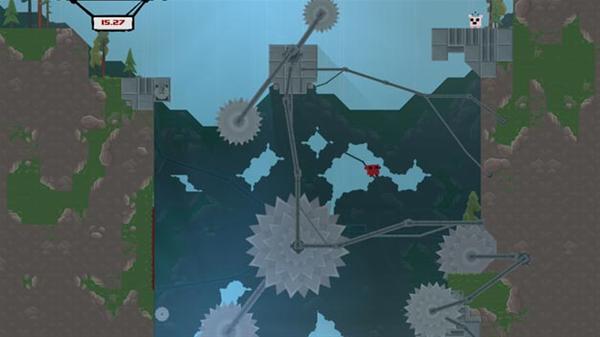
Death doesn’t always have to be a bad experience however. Indeed, in Super Meat Boy, the end result of many deaths in this tricky platformer is often a comedic one. Once you finally finish a level, all of your past attempts are shown playing out exactly how you failed, en masse. This could mean a dozen falling down a hole that you just couldn’t time the jump for properly, many others being crushed and still others landing on the deadly saws that the game is so fond of, all at once. This helps to make the player feel better about their final victory and gives them encouragement to have a crack at the next level.
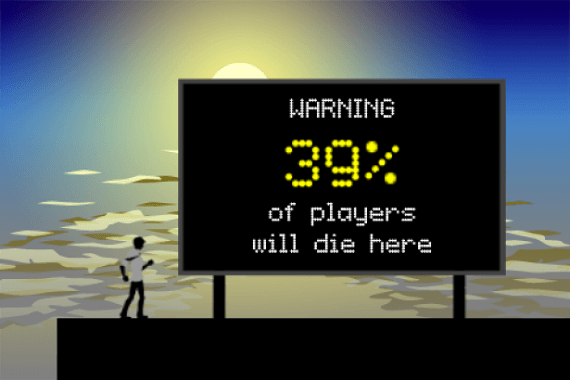
Another game that death holds a unique challenge is One Single Life. In this game by Fresh Tone Games, your job is to leap across the gap between two buildings, which gets wider with each success. That’s it. No tricks or deceptions. Mistime your jump however, and your character will plummet to his death. Game over. No more lives to attempt it again, you’re finished. Uninstalling and reinstalling the app allows you to play the game once more for that one shot at beating the challenge nobody else can (even though that’s technically cheating). That in itself is the biggest hook of the game, rather than the actual experience. Can you beat what everyone else quits on? At the start of each level is a billboard that states the percentage of players that have died on that particular jump, adding a real sense of unease and tenseness. A truly unique attempt at designing death if there ever was one.
Death in video games can make or break the experience. Too soft and the player breezes through without worrying about any of the challenges you’ve set them to face. Too hard and you risk losing the player to frustration before they’ve seen your game through to the end. These are only a few examples of how designers have dealt with the concept in games but there are many more to be found. With new releases happening nearly every day, it will be interesting to see death’s overall development across each genre, and how it will ultimately continue to affect the true experience of each video game that uses it.
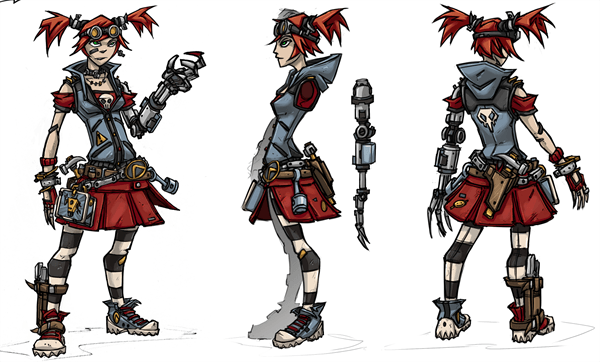
Borderlands 2 Game Designer John Hemingway recently spoke in an interview about a skill tree unique to the DLC only fifth class of the game, the Mechromancer. Stating within that it was for the people who “suck at first-person shooters” but want to help their friends out in the game. That wasn’t what sparked the incredible fan reaction however; it was more so because of his description of the abilities, “for the lack of a better term, the girlfriend skill tree” says Game Designer John Hemingway.
Fan reaction to this statement was noticeably less than positive. Many gamers casually threw around terms of ‘sexism’ amongst the chaos, but these arguments seem to be unfounded. One is reminded of the absolute bombardment of IO Interactive after their CGI Nun Trailer was released; in which impractically dressed female assassins were taken out one by one by the lovable Agent 47.
Gearbox Software’s President Randy Pitchford rejected the popular disapproval of one of his leading game designers and explained the info on Twitter, stating “The future DLC Mechromancer class has a skill tree that makes it easier for less skilled coop partners (any gender!) to play and be useful.” Personally defending Hemingway by adding, “There is no universe where Hemingway is a sexist. All the women at Gearbox would beat his and anyone else’s ass.”
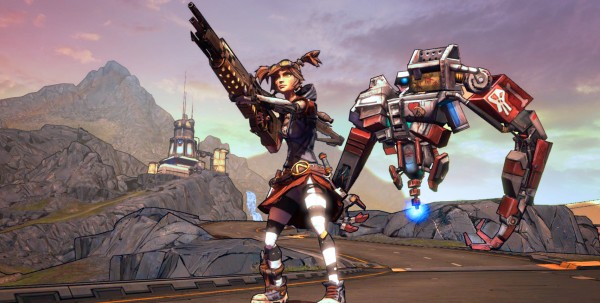
The fifth playable character of Borderlands 2, the Mechromancer has been marketed as mainly a support style class. It is intended for anyone who may not be ‘gamers’ themselves but merely wish to help out their friend or relative within the game. By adding such a class, Gearbox can appeal to a whole new market of potential players, vastly increasing consumer accessibility. Sounds like a pretty good deal for all involved.
The Mechromancer class will release mid-October as a free download if you are a Premiere Club Member or for $9.99 (800MS) if you didn’t pre-order. Hopefully with slightly less fan outrage…
2k Games had an impressive looking booth at this years EB Games Expo held in Sydney, Australia. The booth had a showcase of the latest and upcoming games from the publisher. These games were: XCOM: Enemy Unknown, Borderlands 2 and NBA2k13.
What was interesting about this booth is that the company was only showcasing products that have either been released recently, or are coming out incredibly soon. To be honest though, I don’t think there’s really anything else they could have shown.
I remember when we spoke with 2k Games Aus. rep Allan Moore about the booth and he was telling us a story about this girl that literally ran to the booth to play Borderlands 2. It’s stories like those that really exemplify the power of the 2k brand with gamers of today. It also turns out that that particular attendee already owns Borderlands 2.
For me though, the most exciting thing at their booth was the XCOM: Enemy Unknown station. The version of the game they had set up was the same build as the demo; but that didn’t matter. This game is so amazing that you would have regretted not playing it at the expo if you had the opportunity to.
Overall 2k had a fairly busy booth the entire day and they were showcasing some amazing games, in particular XCOM. It just goes to show that when you’re a respected brand in gaming, you really don’t need to bring out upcoming codes for games to be popular.
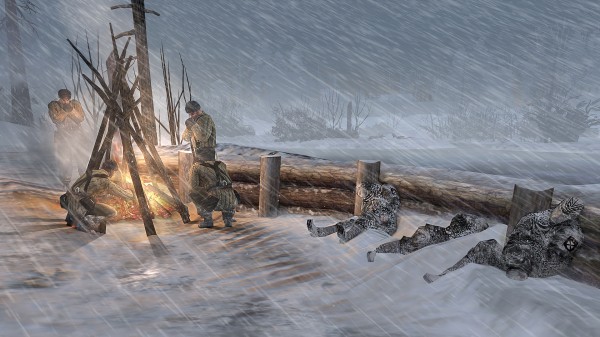
This weekend at the EB Games Expo held in Sydney we were able to get some hand-on time with the upcoming Company of Heroes 2 video game created by Relic and being published by THQ. Company of Heroes 2 is the sequel to the award winning Company of Heroes released in 2006 and is a strategy game franchise that tries to capture the tactics of war, rather than massive armies shooting at each other. The build of the game that we were playing was clearly marked as a pre-alpha build of the game, so anything we have stated in this article may not be a factor in the future. This is how the game plays currently.
I want to talk about the overall look and feel of the game so far. It is clearly evident that this is a sequel to the first Company of Heroes because the way it looks and plays carries that feel of the first title. If you’re someone that has played the first game, picking this game up you’ll feel at home almost immediately.
What makes this franchise unique is that you don’t really control individual units within a group, rather, you control squads of troops across the battlefield. What makes this game play differently to other strategy games though, is the use of cover. If you move your mouse around the battlefield whilst you have a squad selected, you’ll notice that a group of circles appear when placed near cover, this is where your units will spread if they’re moved into this location.
Cover is incredibly important to the Company of Heroes experience, as I quickly learned when I tried to use StarCraft II tactics to lure out enemies. I should have known better, but it’s been around 5 or 6 years since I played the first game, so yeah. Another thing that is important is flanking. I remember fighting this one group of enemies with a machine gun next that would keep one of my squads pinned. This was torture as I couldn’t get anyone out there to lob a grenade onto the gunner to take out the nest. Fortunately I had a squad further back that was not pinned, so I was able to run them around the situation and lob a grenade to take out the gunner. I was able to then take the rest of my units in and capture the area.
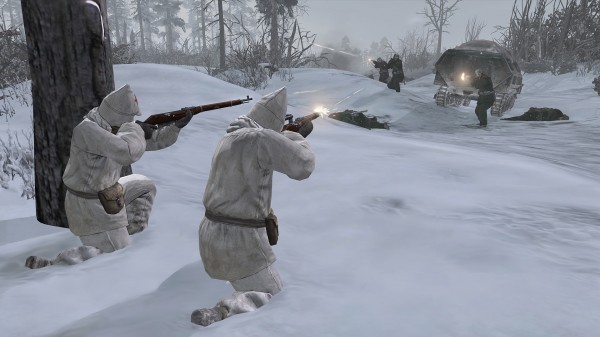
I’m not entirely sure if this was in this build or not, but one of the quirks of Company of Heroes 2 is a kind of warmth system where if you’re units are in the cold for too long they freeze to death and die. Unfortunately for my play through I was unable to determine if this was present. I was either good at keeping my units warm, rushing through too quickly to see it kick in; or my units were being killed way too quickly for it to be relevant. There’s also the possibility it wasn’t in the pre-alpha build of the game.
Overall I absolutely enjoyed my time with Company of Heroes 2 and can’t wait to get my hands on a more completed version of the game. This is definitely a game that strategy fans everywhere will enjoy. Heck, I think that most gamers will enjoy this. THQ and Relic are doing a great job so far with it and it looks like it might be able to rival the original.
The Parrot Zik headphones are a pair of headphones designed by a famous designer in France named Starck. They are an amazingly stylish pair of headphones that look great whether placed over your ears or hanging around your neck. However, are these the right pair for you? We will hopefully have given you enough information in our review to assist you in that decision below.
Now, with these headphones, the first thing you’re probably wondering is, what is it that makes these special? Well, these headphones feature many things that make them quite cool. These include features like wireless technology – making them cordless, Near Field Communication for tethering purposes, the ability to listen to audio through the headphones from a Bluetooth enabled device and the ability to fiddle with various media functions with the headphones themselves. I will be talking about some of these later.
The first feature that I want to talk about though, is the Parrot Audio Suite compatibility. Essentially, the headphones are able to connect to a device that has Bluetooth, like a Mobile Phone or iPod Touch and synchronise with the media player. However, what this app does is it essentially allows you to alter the sound of the Parrot Zik to your own liking. The App appears on both the Android and iOS marketplaces. The functions of this app are quite cool, you’re able to activate and deactivate noise cancellation (something that still feels like voodoo to this day), equalise your audio levels and, of course, use this cool concert hall effect feature.
The Concert Hall effects are pretty cool to fiddle around with. You have a small amount of options to choose from, such as Jazz Club, Concert Hall and Quiet Room. What these settings essentially do is they alter the audio levels of the music, as well as allow you to align simulated speakers in a 180 degree arc. This is designed to create a more natural sounding audio experience, tailored by you for you. However, what I found with this is that is pretty hit and miss in regards to listening to varying artists and genres.
What I mean by this is that I personally listen to a broad spectrum of musical genres, from J-Pop to Power-metal, and while one setting may make one genre sound absolutely amazing (Concert Hall with speakers right in front of you with Orchestrated stuff), that same setting can make the next sound absolutely horrible. What this means is that you may spend half of the next song adjusting your speaker placement just to get the right sound. I simply found it more convenient to turn the Concert Hall effect off whilst listening to a variety of genres, which is most of the time. I would love to see an update in the future that allows you to have preset configurations for varying artists or genres.
One thing that is absolutely amazing is the devices gesture based touch panel system. On the right ear you are able to control most aspects of your media player just by swiping it the right way. For instance, running your finger up and down your ear will adjust your volume, whilst swiping backward or forwards will allow you to skip songs. Just tapping the panel will allow you to play and pause music. I have to say that this interface is amazing. I ahve pretty much all the gestures down to muscle memory. I’m sitting here on my PC using my gaming headphones and keep trying to swipe my ear to change song. I remember when my Zik first ran out of batteries and I had to switch to a pair of earphones. If you just pictured me walking down the street, swiping my ear whilst I was wearing a pair of flimsy earphones then you have won a cookie. I wonder how long it will take me to break this habit?
Unfortunately for the devices App is that it gives you it’s own equaliser settings. What makes this unfortunate is that it will probably conflict with your own equaliser settings. It actually took me a while to figure this out and was almost ready to send the device back for being broken. You see, when both the equalisers set in, it kind of distorted everything (even with concert hall turned off) and sounded really, really bad. However, when switching my own EQ off, the sound was fine; and of course, when I used the phones EQ and turned the Zik’s off it sounded fine. I feel that this feature is kind of redundant as you’re probably already running your own EQ settings already if you’re someone inclined to mess with them. However, the Zik’s are much easier to find in comparison to the default player for Android. So switch this off if you’ve got your own settings already.
I think that at the end of my week of fiddling with settings, I had settled on the following configuration for myself. Active Noise Cancellation – On, Concert Hall – Off and Equaliser – Off. Other people will probably have a different experience to myself with these settings, so have a fiddle around with them and find the best combination for your own needs. I know I sound harsh here, so I’ll equal it out and say that when listening to stuff from the same band, I definitely have the Concert Hall effects on because it’s usually safe to do so.
The Parrot Zik isn’t a particularly heavy pair of headphones, regardless of how they look. When I first saw them, I figured they’d probably be these heavy monsters that would weigh my head down or something. Not so. However, what I found strange was that if I left them on my head in the same spot for too long, my head would begin to itch under the top bridge thing. This is wearing them for well over two hours at a time though.
Speaking of hours and time, these are wireless headphones, so they must obviously run on some form of power that is surely to deplete. And they do actually deplete. You see, life as a member of the gaming media means that you will frequently be outside of the house and attending gaming events and visiting publishers. Sometimes I’m out of the office for 4-6 hours at a time. It’s hard to play games when you’re outside… Anyway, I found that the Zik would often die on my way home due to my excessive usage. However, I am definitely a power-user here. An outlier. Someone that does not have a normal usage habit. So your own experiences may vary. Just know that at around 4-6 hours of use, they will die. Turn them off when they’re not on your head.
Speaking of that, when the Zik is placed over your ears, they detect the presence of your ear through some kind of black magic and will resume any song that may have been paused. Conversely, when taking the headphones off, the device will automatically pause whatever it was that you were listening to. This means that you don’t have your own private music radiating out at any person that you may be speaking to, which is always good.
Active Noise Cancellation is absolutely amazing, especially if you’re like me and don’t particularly want to have to listen to the people around you talking in drunken slurs and meandering about nonsense. With this on, it’s goodbye morons. However, there is a problem with these as well. The problem is also it’s strength, you can’t hear people at all. Also if you talk with them on, you probably sound slurred yourself. I remember this one time the magnetic panel on the side fell off for the third time and I couldn’t hear it fall off or hit the ground. I was about to get on a train when this nice girl tapped me on the shoulder and informed me of the panels demise. She had actually been trying to get my attention vocally for a few moments before getting a little more physical. Not good.
There isn’t usually a problem with that panel, I think I’ve knocked it off with my bag or something every time it’s come ajar. However, I’d suggest either stronger magnets or a locking mechanisms on future revisions.
The audio quality of the Zik headphones range on the good side of quality, but not on the best side. What I mean by this is that they are clearly superior to their closest competitor – Beats by Dre. – but are inferior to headphones designed by pros. I have a test for audio that I put all my headphones through, it’s called the White Reflection test. This is where I play Two-Mix’s White Reflection and determine how piercing the high pitched dings are. With these headphones, it felt like they were being dulled, whereas every other pair I’ve had, they’ve always shrieked. It also felt like the bass was weaker in one ear in comparison to the other, which was uncomfortable on some of the more bass heavy stuff (some Galneryus songs clearly demonstrated this, I can’t remember which song it was but there’s this one bit where the bass alternates speaker and the left was clearly more suppressed). This is nothing major though, but some people might find it a little uncomfortable.
The last thing I want to talk about is some of the things that I’ve noticed with my particular combination of headphones and device. I’m running a Samsung Galaxy S2 with the 2.3.5 firmware (not upgrading until something stops working) and noticed a few particular quirks. Most prevalent of these seemed to be a kind of buffering effect between actions and what I was hearing. For instance, my phone would show a song as playing milliseconds before it would reach the headphones. I have insane reflexes so this might not even be noticeable to most people, but it was certainly there. As another example, I’d swipe the headphones, then I’d have to wait briefly for the next song to begin. It’s hard to explain, but the reason I think it’s a buffer is that sometimes early on during a song, it’ll cut out slightly as if it’s collecting more data, and if I checked my phone after this, it’d be slightly de-synchronised between what I was seeing and hearing. Another quirk like this is that sometimes the headphones and phone would randomly unpair. This is highly unlikely and I have only experienced it twice. I’ve also noticed it randomly pausing songs too, which is more prevalent than the de-synchronisation.
Despite some minor issues and the one with sound quality, these headphones are leagues ahead of their major competitor and are superior to most headphones that I have listened to in the past. If you’re someone that wants a trendy pair of wireless headphones that will make the Dre drones droll then these are the pair for you. However, if you’re a hardcore audiophile and not too fussed on aesthetics, there are superior headphones out there and you probably already have a pair of them.
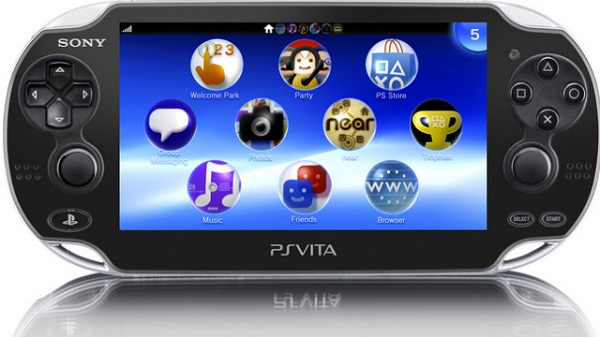
With a massive booth, SCE Australia brought out a stellar line up of games to the EB Expo over the weekend. Sony’s Playstation Vita had a more even representation of first and third party publishing. While there were games that have already seen a release on the Vita, several upcoming titles such as Street Fighter X Tekken, Need For Speed Most Wanted, Silent Hill: Book of Memories and Super Monkey Ball: Banana Splitz were also present in Sony’s booth. In this article, I divulge into some of these titles that will hit the Vita in the next six months. Other upcoming titles, such as Assassin’s Creed Liberation, have already been covered, so they won’t be on this list. What was disappointing was the no-show of New Little King’s Story. A niche title, yes, but Persona 4 Arena did make an appearance, so there was no reason for the Konami Vita title to be left out.
When Street Fighter X Tekken was announced for the Vita, it was natural for the world to gasp. Now that the console versions have passed release, the focus is on the Vita version as it nears release. The Vita version includes the most characters on card as it contains an additional 17 characters on top of the initial character list. The Vita version is what you would expect. It is identical to the console version, right down from gameplay and graphics. Expect cross play functionality with the Playstation 3. I did try out a few of the additional characters, including the Americanised version of Megaman and inFamous protagonist Cole McGrath. Play this game with the d-pad, as it is one of the best d-pads out there for fighting games.
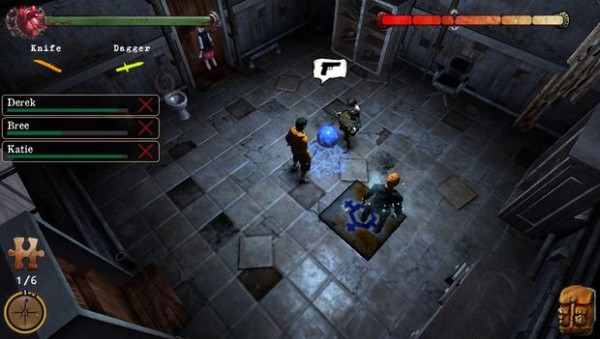
Silent Hill is notorious for setting an eerie atmosphere and its survival horror gameplay. That doesn’t seem to be the case for Silent Hill: Book of Memories. I got my hands on the game and walked away feeling somewhat disappointed. The game is more focused on action and exploration. You create your own character before entering a dungeon separated by walkways and rooms. You are permitted to hold two weapons at a time and they will either wear out (melee weapons) or run out of ammo (ranged weapons). The level was quite repetitive, involving exploring one room, find items, defeat enemies and repeat. There was some variation, like finding a room with a ghost and following it or finding puzzle pieces to unlock another part of the dungeon. Overall, it was missing what Silent Hill is: a purely survival horror game. Book of Memories played out like an dungeon RPG rather than survival horror.
·Need For Speed is all about fast cars. Most Wanted brings that and high speed pursuits to the Vita. I did check out the PS3 version of the game for comparison and I can say that, from what I had played, it is very identical to its console counterparts. There will be a free roaming area where players can choose any vehicle they pass. The open world is littered with cops ready to hunt you down as soon as you speed past them. As for the gameplay itself, each car feels realistic and not like the previous Most Wanted’s style of arcade driving. Credits can be earned after completing events, as well as car parts to improve any car. It is unknown if the PS3 and Vita versions will connect with each other, but I hope this is the case.
·Super Monkey Ball: Banana Splitz is going to be an excellent edition for any Vita owner. I got my hands on a few levels using the Vita’s motion control scheme to move AiAi through the course. For those who want some practice, these beginner levels are the best place to start. An indicator on the screen will show you if the Vita is centralised or tilted in a certain direction. The motion controls are actually fun to use, but they are not forced upon. The left analogue stick is available before entering the series of courses. Of course, the courses are quite wacky and also very colourful and fun to navigate through. Mini games will also be available. This is a Vita game worth looking out for.
With a massive booth, SCE Australia brought out a stellar line up of games to the EB Expo over the weekend. Both the Playstation 3 and the Playstation Vita had a strong showing from Sony’s first party studios and third party partners. Sony’s Playstation 3 line up mainly consisted of their upcoming first party offerings, such as Playstation All Stars Battle Royale, Ratchet and Clank QForce, Little Big Planet Karting and much more. Of course, a few third party games had also made an appearance, some already covered by others, like Metal Gear Rising: Revengeance. In this article, I divulge into some of these titles, both first party and third party, that will hit the PS3 in the next six months.
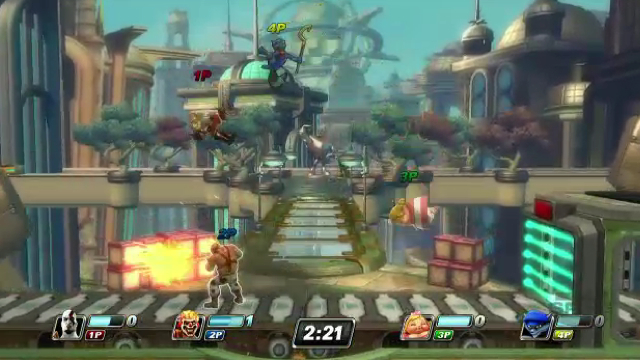
While I did get my first taste of Playstation All-Stars Battle Royale at the Playstation Playground last week, the characters on offer was quite limited. That same demo was there to show off cross play to the masses, as well as the progress of the Vita version. However, there was a second station available. This station had all 20 launch characters available for selection. In my battle, I chose Dante of Devil May Cry fame in a fight with three other players on a level inspired by the Uncharted series. The action was intense as Dante uses close to mid range attacks. In terms of the actual gameplay, the core mechanics are set in stone, so not much changed in terms of core gameplay. The level looks crisp and sharp, as well as the character models. While many would dismiss it as a clone, it feels different enough to warrant a look at. I had enjoyed both experiences of All-Stars over the two weeks and it should impress when it comes out in November.
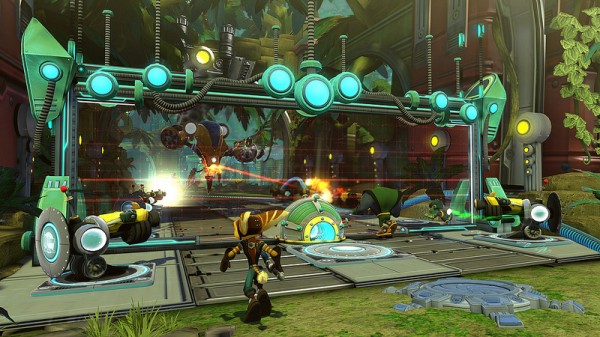
Ratchet and Clank QForce made its playable debut in Australia. The first thing I noticed is the change to the more traditional action platforming of the series seen in the PS2 trilogy, but with some additional gameplay elements I have not seen in a Ratchet and Clank game. In this particular level, the dynamic duo must defend a base from some intruders using turrets, barriers and mines. Each element costs a certain amount of bolts. Weapons are obtained by unlocking machines rather than purchasing them. Another interesting addition is Ratchet’s rocket boots. Holding the R2 button sees Ratchet speeding through the level. Going back to the series roots after All 4 One is definitely a positive sign. I was disappointed not to see the Vita version, though.
Little Big Planet Karting also made an appearance. I was able to try out one race with the new Move steering wheel peripheral. The game itself blends in classic karting gameplay with elements from the Little Big Planet series, especially the creative side of things. In terms of actual gameplay, the core is pure, classic karting. During the race, players can collect the bubbles from the series to score points, as well as using different weapons to give you the advantage in the race. The Move wheel does look and feel quite big. But it is easy to handle. The Move itself was quite responsive and accurate to my movements.
When Vikings Attack might not be a game you would be aware of, considering it is a PSN title. However, it is a game worth looking at. This PSN game, coming to both the PS3 and Vita, has you control a group of people and throwing various objects at groups of Vikings in various locations. Objects that can be thrown have weight limitations, which mean smaller groups can not carry a car, for example. Hitting multiple enemies gives you bonus points. Stealing thrown items is also possible with a quick dash, providing the group is big enough to hold the item. Both versions of the game are identical, which would mean one copy for both PS3 and Vita, similar to Soundshapes. Cross play will also be possible, but there was no demo showing this.
Epic Mickey 2 is going to be an interesting game. The demo was set in various locales such as Mickey’s house. I took the reigns of Mickey Mouse and went on a short adventure. Mickey will be equipped with the paint bush again and it is his job to use that brush to navigate through the world around him. This time, he brings Oswald the Rabbit, a foe, as his ally. The 3D platformer does look good with the cartoon style. The Move controller is quite responsive. Moving the motion controller around moves the camera as well as control where the stream of paint (or thinner) will hit. Elements from the first game, like painting platforms for progress, are back. It was a great demo and something worth watching out for.
If you have played Rugby League Live, then it would be no surprise that Rugby League Live 2 is basically more of the same with more competitions. While the authenticity of the game is quite impressive for the sport of rugby league, the controls felt a little stiff and the Al was still a bit clunky. Even selecting players while on the defence is still a little off. The amount of competitions from the two biggest rugby league countries is quite impressive, but there are only three international teams available. This is a little disappointing, considering there is a World Cup in the sport. It looks quite decent and the commentary isn’t as choppy as before.


 When you think of Forza Motorsport, what comes to mind? A pretty standard racing game with a very mute colour palette? Well that’s what some would say, but the Forza Motorsport series has always been more than that. It’s a racing game that bridges the gap between hardcore racing fans and the casual player.