
Home Blog Page 2597

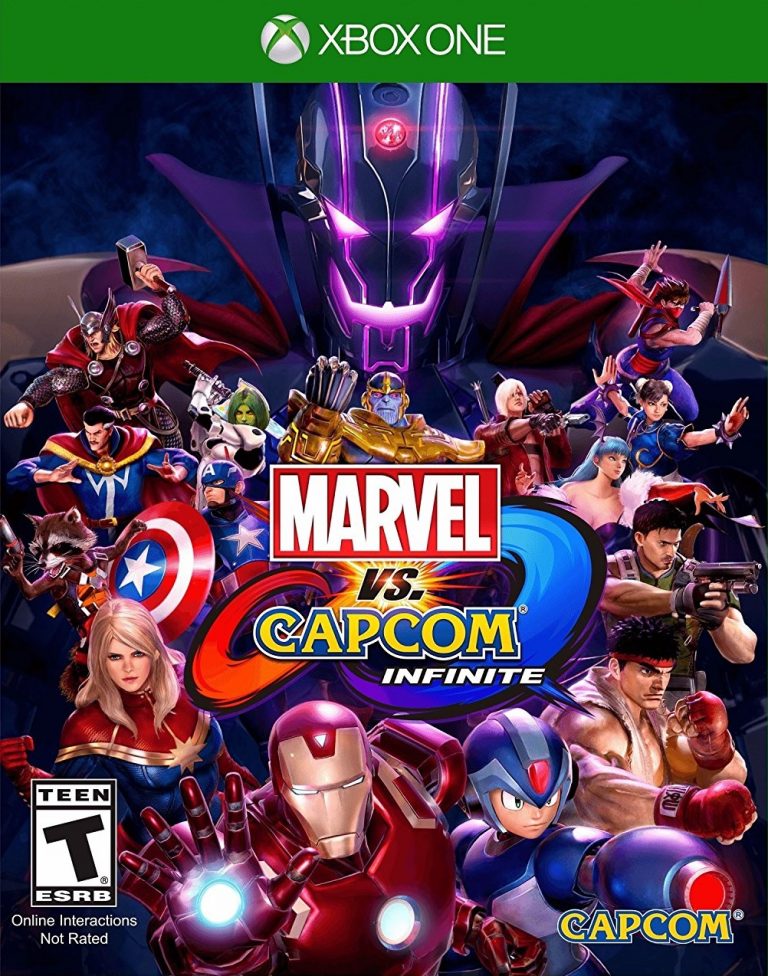
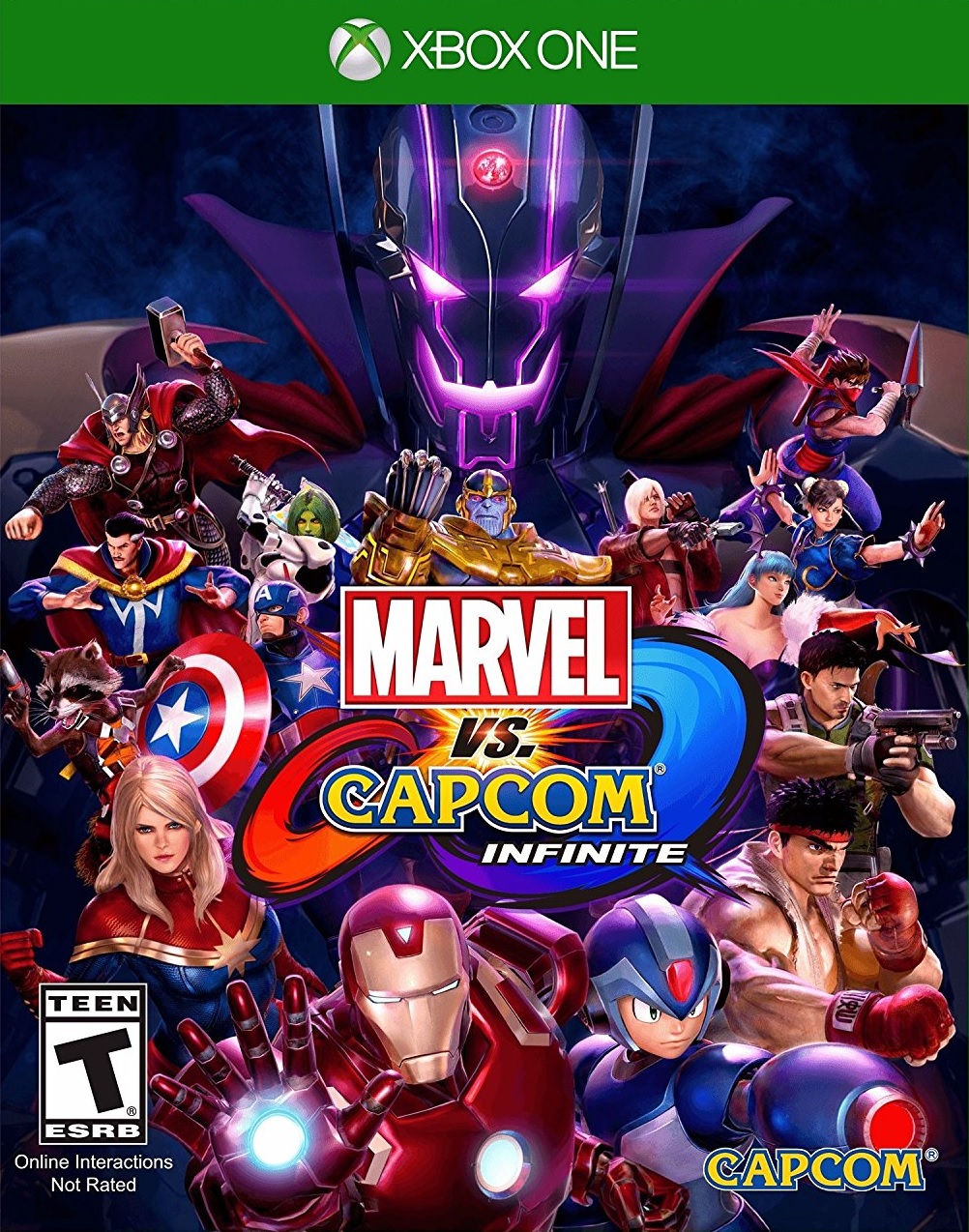
Marvel vs. Capcom: Infinite Review

Marvel vs. Capcom: Infinite

Developer: Capcom
Publisher: Capcom
Platforms: Xbox One (Reviewed), PlayStation 4, PC
Release Date: Available Now
Price: $59.99 USD – Available Here $99.95 AUD – Available Here

Overview

Most video game crossovers tend to rely on combining characters that are owned by a specific company with very few titles taking the risk of bringing in a completely different company in an attempt to blend their characters together. One crossover that manages to do this quite successfully happens to be Marvel vs. Capcom and after some time the franchise has returned for its twentieth anniversary with Marvel vs. Capcom: Infinite. With Capcom trying out a few new things with this entry, should fans look forward to picking this one up?

Story

Fans of both Marvel as well as Capcom’s various series will be happy to hear that there is a story mode available in this game and although it only lasts a few hours, it does serve to explain, at least a bit, about how these two worlds have merged and why certain characters have ended up where they are. Despite an incredibly rough opening chapter the story does grow into something that fans will get a kick out of thanks in part to Frank West and other more comedic characters as they make various quips about their situation.
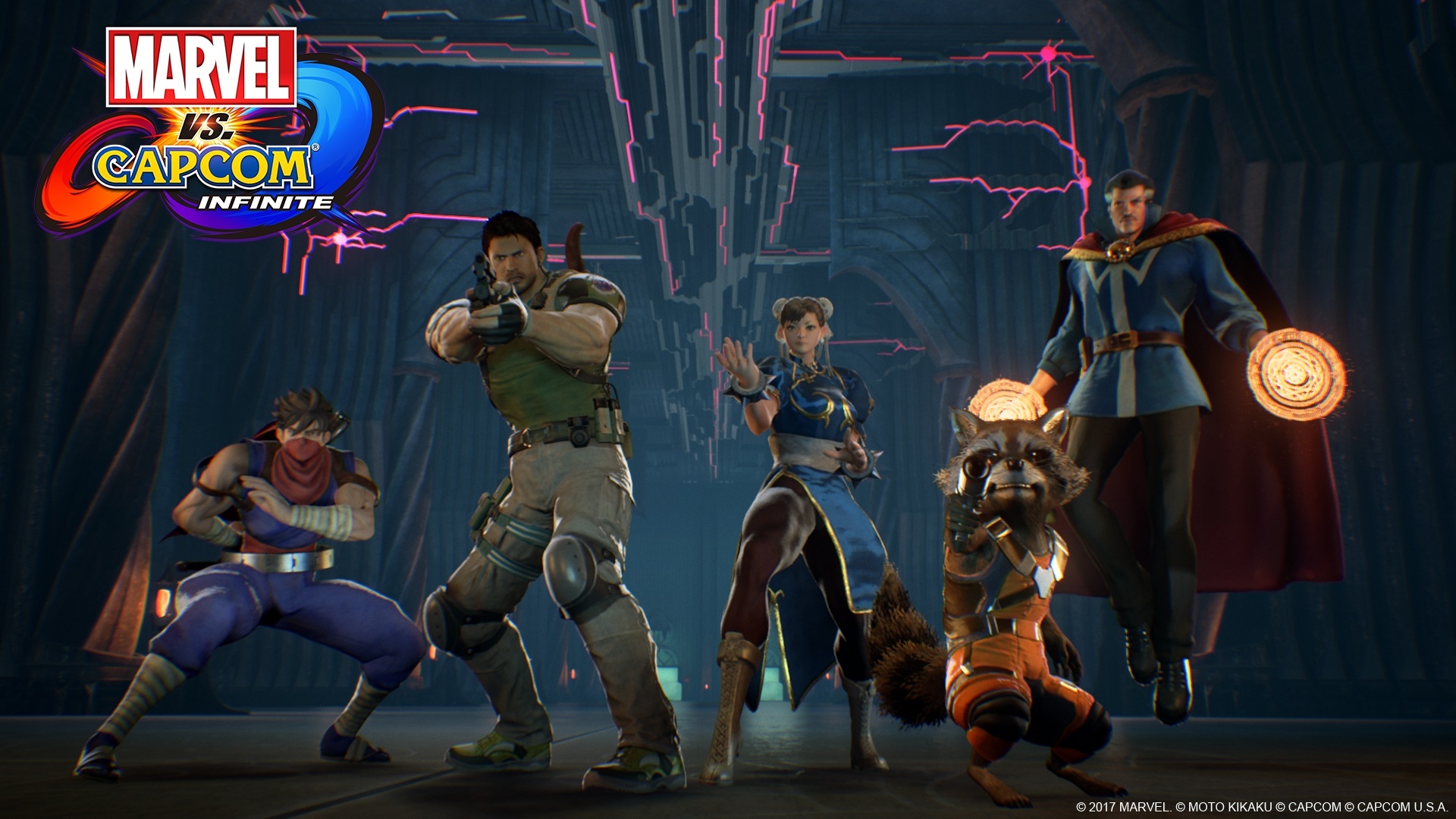
That being said, not only does the story resolve poorly but the potential for character interaction is barely tapped, meaning those who are expecting some unique character pairings will end up being disappointed, especially since far too many fights involve faceless drones. In fact, despite Marvel vs. Capcom: Infinite featuring an arcade mode the company has decided to completely avoid giving even the slightest bit of extra story here as there are not even ending cards offered for the characters used to complete the mode as in previous entries.

Gameplay

One of the first things that players will notice is that Marvel vs. Capcom: Infinite has dropped the three character teams as well as some of the other mechanics that players are familiar with such as Assists that allow your allies to provide a wide-range of moves on a cooldown. Instead the teams are limited to only two characters but now players will be able to select one of six Infinity Stones to bring with them into a fight.
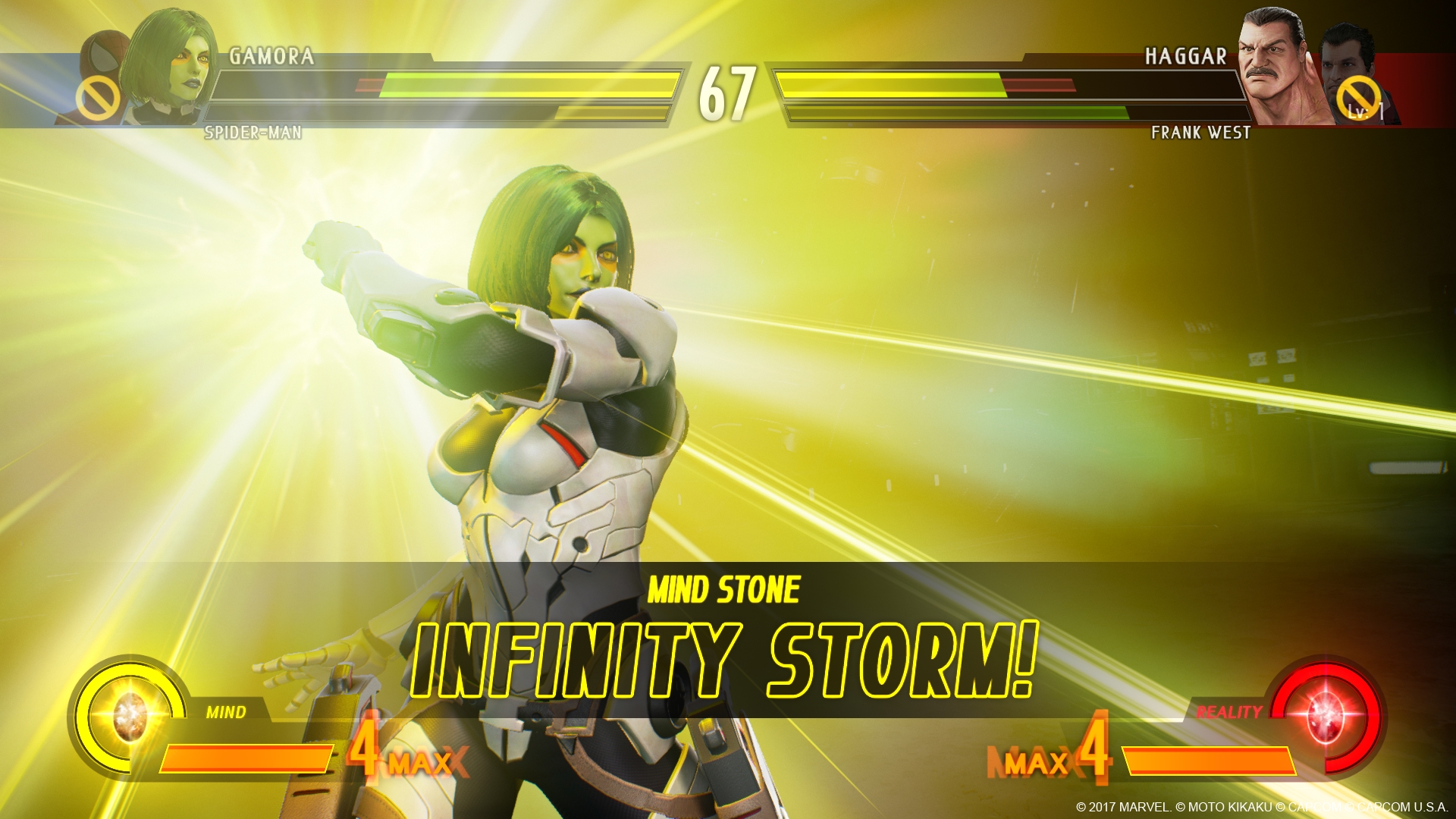
Each of these Infinity Stones provides players with two new abilities that can be used during a fight and add an extra layer of strategy to help out your team. Each stone has its own unique power such as the Time Stone being used either to close a distance quickly or perform a quick crossup as its “Infinity Surge” ability and giving your characters a massive speed boost when your infinity gauge fills up, allowing the use of an “Infinity Storm.” Each stone has abilities such as this, with the Mind stone refilling your Hyper Combo meter and allowing a stunning grab, Soul Stone reviving a downed team member, and more. This type of experimentation can create some unique combinations and adds extra depth to character selection. That being said, each stone has weaknesses of its own so players shouldn’t find it too frustrating when it comes to finding ways to counter their usage.

As for the whole dropping of assists, players will now have the ability to trigger “Active Switches” that allow for your partner to be swapped in immediately even while you are still in the middle of a combo, regardless if you are in the air or even performing a Hyper Combo. This means you can easily chain together some exciting looking combo attacks and, if you have the meter for it, unleash a devastating storm of Hyper Combos. This allows for team compositions that would otherwise be thought completely weak being able to chain together unique combos that make them more than worthwhile in the long run, rewarding players for experimenting.
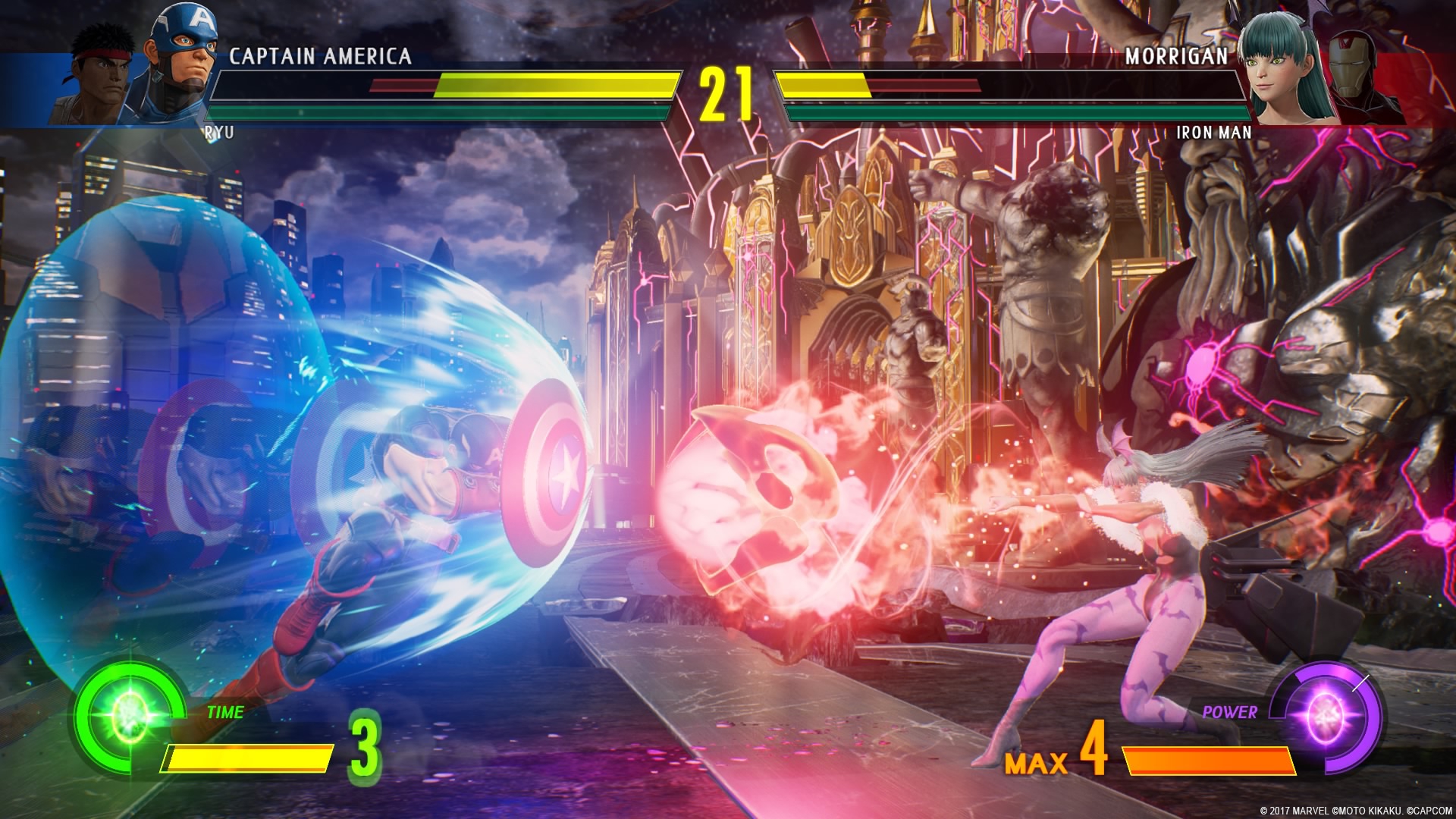
That being said, despite the ability to mix together your teams’ combos in new and unique ways and the ability to use Infinity Stones to accent your skills, it is worth noting that the thirty character roster is the smallest that has been included in a Marvel vs. Capcom game since 1998 and although plenty of fan favorite characters have made their return alongside a handful of fresh faces, there is a glaring lack of other characters from signature franchises on both sides of the field though. What is on offer will keep most fans of the series playing, especially since a large portion of the roster has also been reworked in various ways to help fit in with the new styles of combat and increase the accessibility of the game.

In fact, accessibility is given a decent amount of focus in Marvel vs. Capcom: Infinite as new players have a variety of tools at their disposal here. The game features auto combos that can be pulled off by pressing repeatedly pressing the light punch button to perform a decently damaging auto combo and there is even the option to allow for easy hyper combos to be performed if you so choose. This option can be turned off in the settings and, at least in my experience turning off auto hyper combos felt essential to give myself extra freedom, and even then these assists don’t swing things heavily in the players favor. These shortcuts instead are meant more as a way to give newcomers a chance to ease into characters and learn certain move chains as high level play still requires the same level of skill as before.
Nowhere is this more apparent than in the game’s “Mission Mode” that doubles as a tutorial of sorts. While the game does feature the bare minimum of modes required for a standard fighting game, a practice arena, a barebones Arcade mode, simple matches against the AI or a friend in couch co-op, the Mission Mode is where you’ll be able to spend time learning various special moves and how to chain them together. Each member of the roster is given ten missions alongside the standard tutorial missions and these tend to be incredibly difficult at first so be prepared for some frustration here as you try to learn just how to perform certain move cancels and more with little obvious explanation.

Outside of the aforementioned story mode and the various single player modes, the time most players will be spending their time is in the online section of the game.  Players have the option of selecting from a standard set of options such as ranked matches, player matches, and creating/joining lobbies to simply play with others in a more organized way. There is also a Beginner’s Lounge meant to be a place where fresh players can take part in ranked battles against other equally fresh players though this unfortunately is rarely the case. It is also worth noting that you can also opt to have the game search for online opponents while taking part in the training mode as well as while you make your way through the arcade fights, keeping your downtime with the game to a minimum.
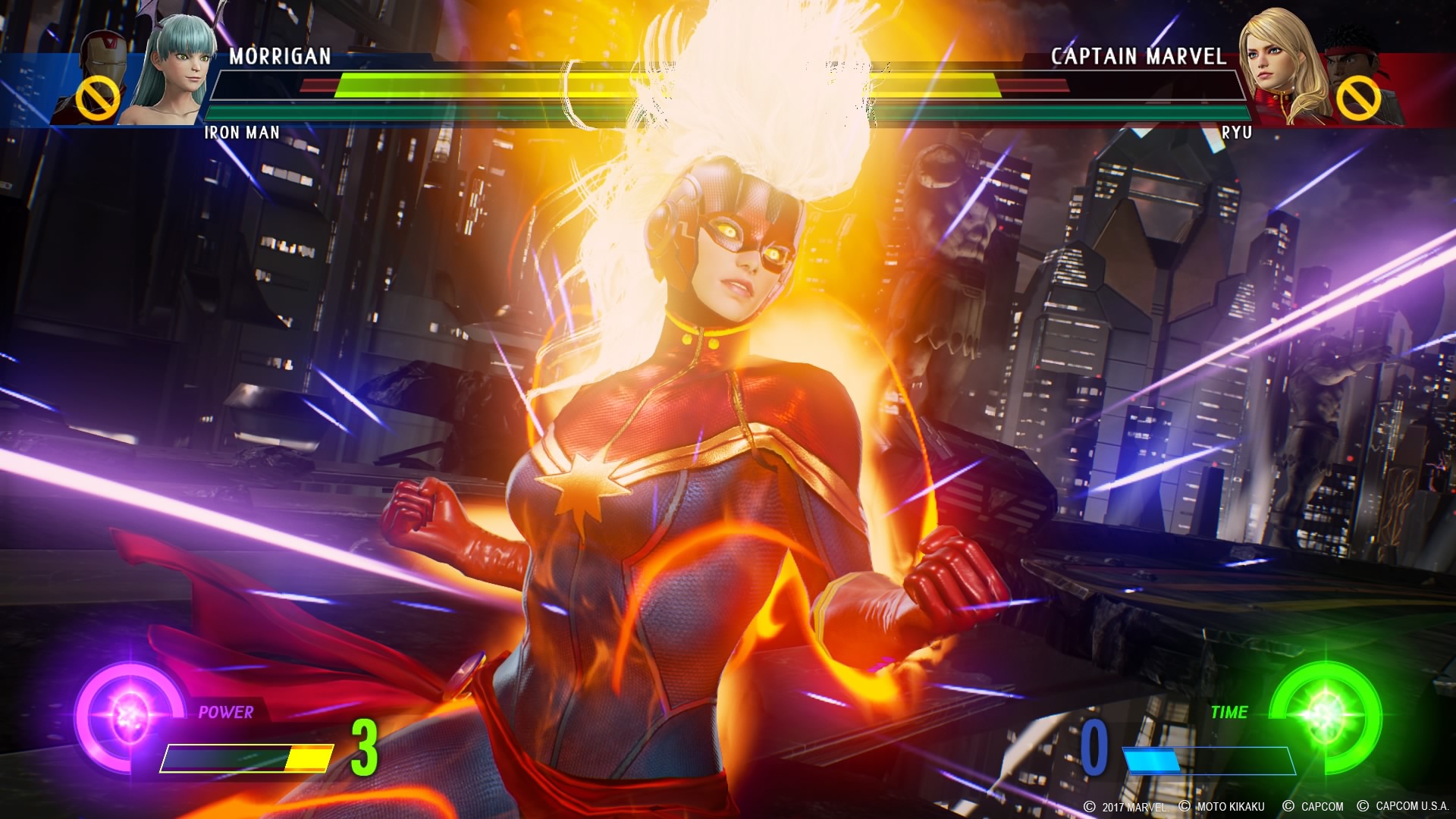
This is something that ends up being quite necessary as there have been more than a few times while playing that it took quite a bit of time to find a match even with the search parameters set to the widest available outside of the aforementioned lobbies. It is also worth noting that Marvel vs. Capcom: Infinite features some rather long load times for a fighting game, with the worst times being during the story mode, though even the simplest matches in arcade can take quite some time to load.

Visuals & Audio

Looking at Marvel vs. Capcom: Infinite it is difficult to believe that it is even a game that has been released years into this current console generation without being a port of a mobile title. There is a complete lack of artistic direction when it comes to the characters as certain ones, such as Rocket Raccoon, Nemesis, Firebrand and Jedah, look quite detailed and unique but look far different from nearly everything else on the roster, especially when it comes to the rest of the human cast.

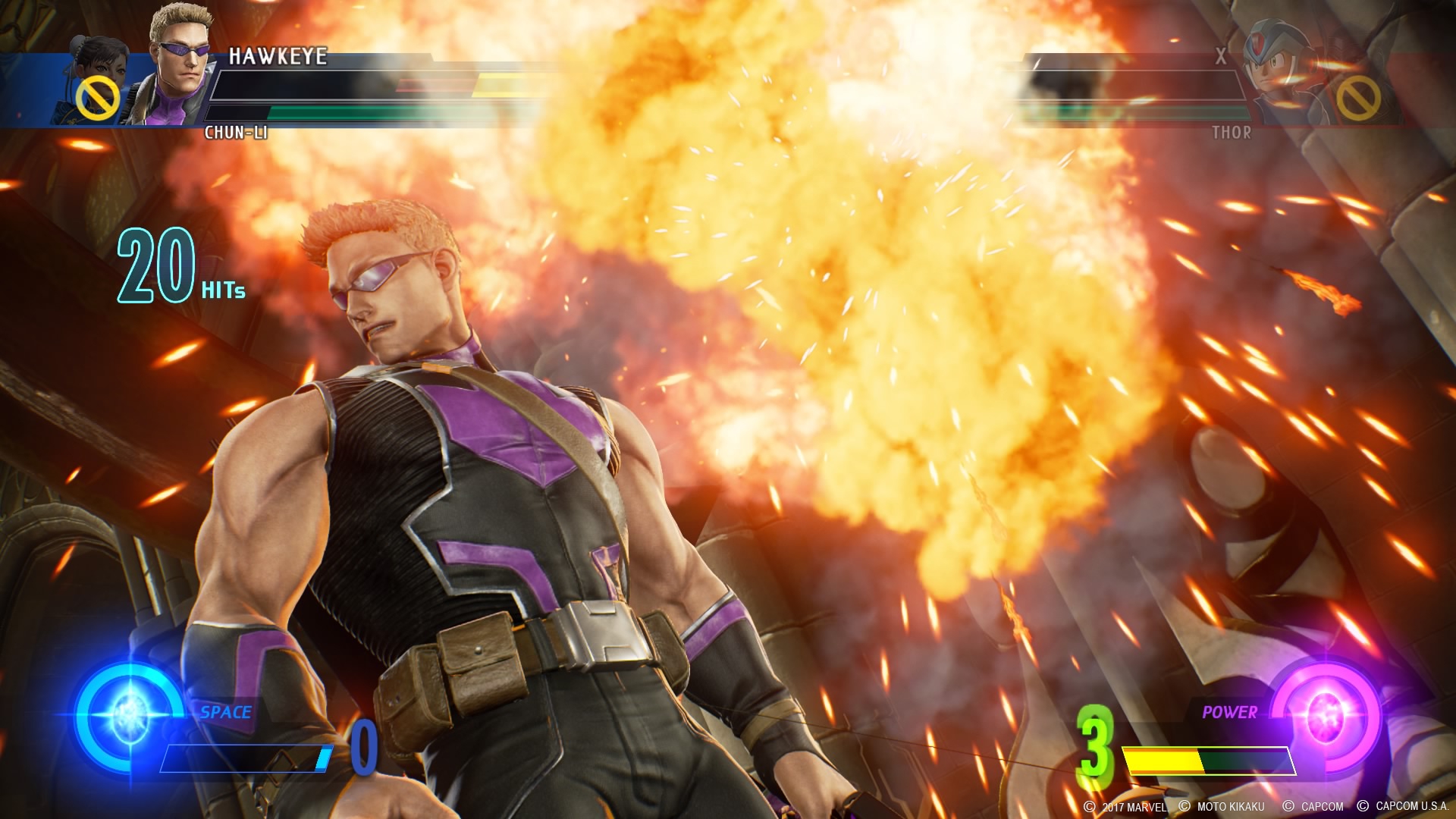
Rather than use a comic style like previous entries, a more realistic looking approach has been taken for the designs of the human characters and almost across the board they look incredibly bad. Frank West, Morrigan, Chris Redfield, and many more look like knock-offs compared to their usual facial appearances and even the body models of the likes of Hawkeye and Spiderman are woefully designed with awkward body design looking horrible both in the game’s story scenes and even during the actual gameplay where even some Hyper Combos have suffered a drop in quality. In fact for the majority of the stages players fight in there is little going on as players fight against a  nearly static background that, while imaginative with the way certain stages are melded together, lack the type of impact of a modern fighting game.
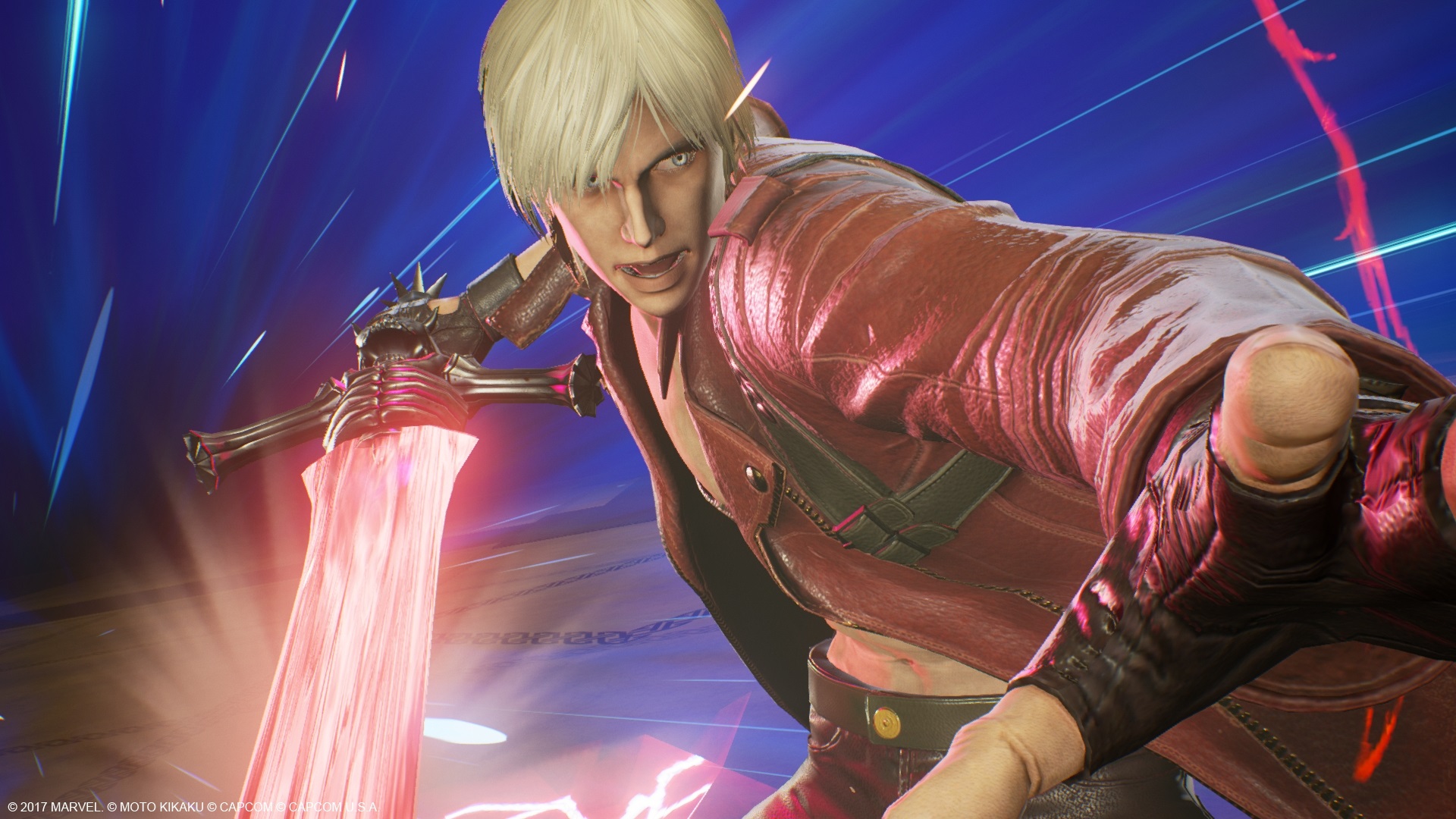
To make matters worse, outside of the fights even the main menu appears to be as done as simplistic as possible, giving them a generic feeling, though the background does mimic your fighter card which can be nice. Along those same lines the themes that are used for each character have taken a noticeable dip in quality as players will find it difficult to even remember most of the background music that is used throughout the game. Thankfully the voice work is at least handled well with the numerous voice actors fitting well into their roles.

Overall

Marvel vs. Capcom: Infinite features a refined combat system that introduces a number of new features, such as the fast paced Active Switch system and the modifications available with the Infinity Stones, to excite returning players while giving newcomers a helping hand with assists, but there is a bit of a tipping point where production values do come into play and with woeful character designs applied to an already middling offering of a roster, poor attempts at stage design, a disappointing soundtrack, and story details that may give longtime fans some laughs here and there but leave others disappointed, even appealing combat mechanics begin to fall to the wayside.
Steven Universe Season Three Review

Steven Universe Season Three

Studio: Cartoon Network Studios
Publisher: Madman Entertainment
Platforms: DVD (reviewed) / Blu-ray
Release Date: September 6, 2017
Price: DVD $34.95 – Available Here / Blu-ray $39.95 – Available Here

Overview

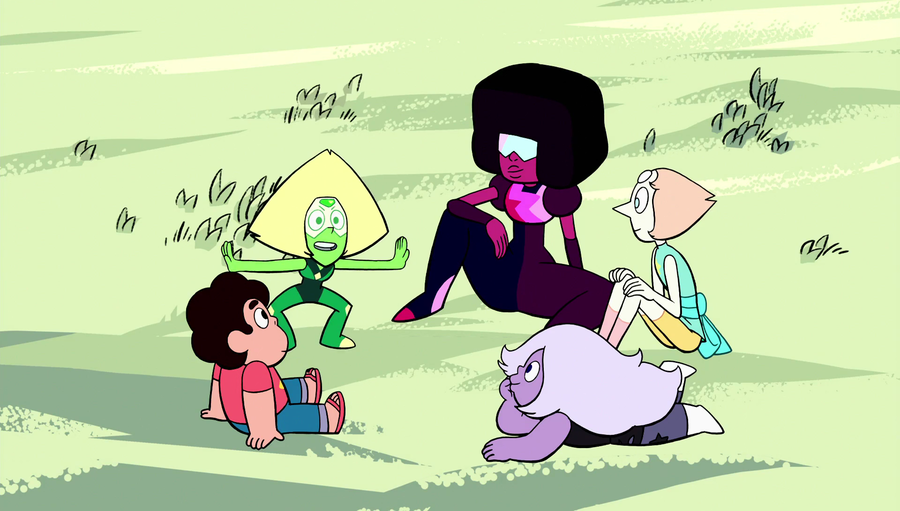
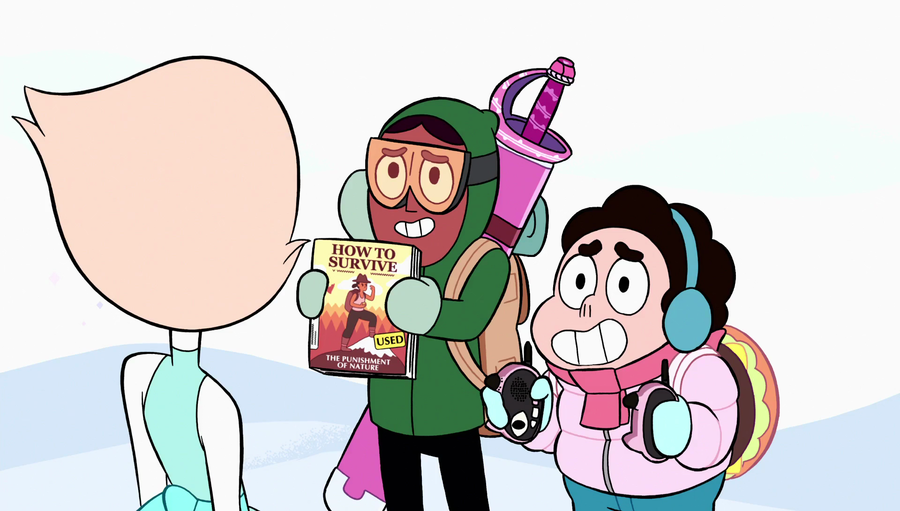
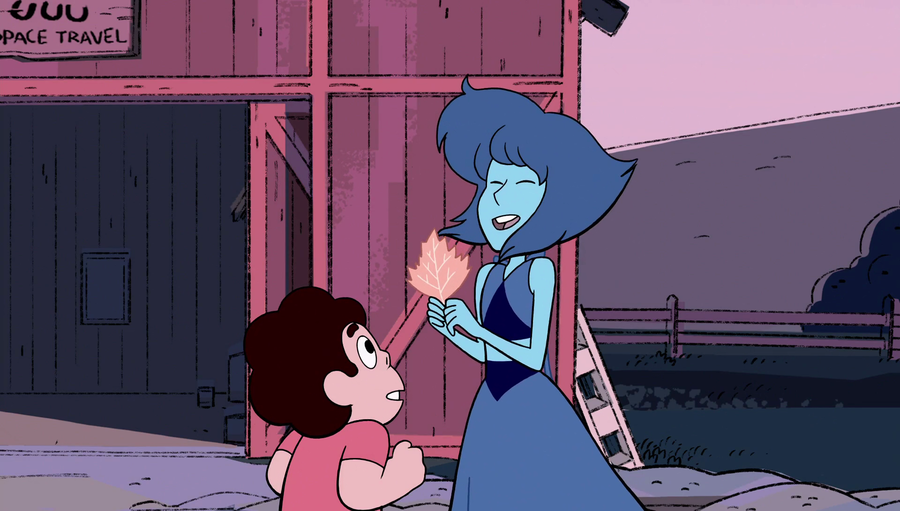
During a bizarre dream, Steven discovers Malachite on a remote island and informs the other Crystal Gems. Together, they are able to split Malachite apart. Steven takes Lapis Lazuli to the barn so she can live a new, free life with Peridot. A ship full of Rubies arrive at the barn, leading Peridot to believe that Yellow Diamond wants to capture her for her blatant insubordination, but they are only after Jasper. Jasper has her own plans, and Amethyst wants to defeat her. Meanwhile, Connie goes on her first mission with Steven and Pearl.

Story

Steven Universe is one of the most intelligent and thoughtful shows out there, and a large part of its continual success is the development of its main and supporting characters. Lapis Lazuli has been trapped and tormented for months on end, but she is able to open up to Steven and begin to understand the natural beauty of Earth instead of remaining angry. She is conflicted both about what she wants to do and about her feelings regarding Jasper, although she understands that their forced relationship as Malachite must never be restored. It takes her a while to accept Peridot when Steven tries to convince Lapis Lazuli to live with her in the barn, but she comes to understand that the people around her genuinely care about her. Peridot had already become a great addition to the series in season two, and seeing how strongly she cares about Steven and his planet and how hard she tries to help Lapis Lazuli feel welcome makes her inclusion even better. Back in Beach City, we learn more about Greg and his relationship with Rose Quartz, and Sadie and Lars’ relationship becomes the focus of an episode in which Steven attempts to make everyone think that Lars is a nice person. All of these characters demonstrate how people interact when they respect and care about each other, all while making powerful and often subtle statements about important issues. They all act in believable ways that make them relatable, and seeing relatively ‘normal’ events in Beach City between the more plot-heavy episodes rounds this series out in the best way.

It was inevitable that Peridot’s act of insubordination towards Yellow Diamond was not going to be the end of the Crystal Gems’ issues with the homeworld, but for the most part, Jasper is the biggest cause of trouble for everyone. The ship full of Rubies looking for Jasper is a problem, although they are relatively harmless and surprisingly manipulatable. Unfortunately for everyone, Jasper is extraordinarily strong, and when Steven and Connie end up face-to-face with her on the duo’s first mission together, they are unable to defeat her. It is not until they fuse into Stevonnie after Amethyst suffers a humiliating defeat at the hands of Jasper that they can properly defend against her and send her away. Amethyst is devastated at how useless she ended up being, bringing up her problematic feelings of self-loathing, but she realises that she does not have to compare herself to Jasper. The serious events still present an opportunity for the characters to learn and grow, although Steven learns some unfortunate facts about the Gem War in the final parts of the season. Things may end up getting a whole lot worse for him and the Crystal Gems, but with Peridot and Lapis Lazuli on their side and Connie demonstrating her knowledge of sword-fighting techniques thanks to Pearl and how to survive in nature thanks to an informative book, Earth stands a very good chance against Yellow Diamond.

Visuals

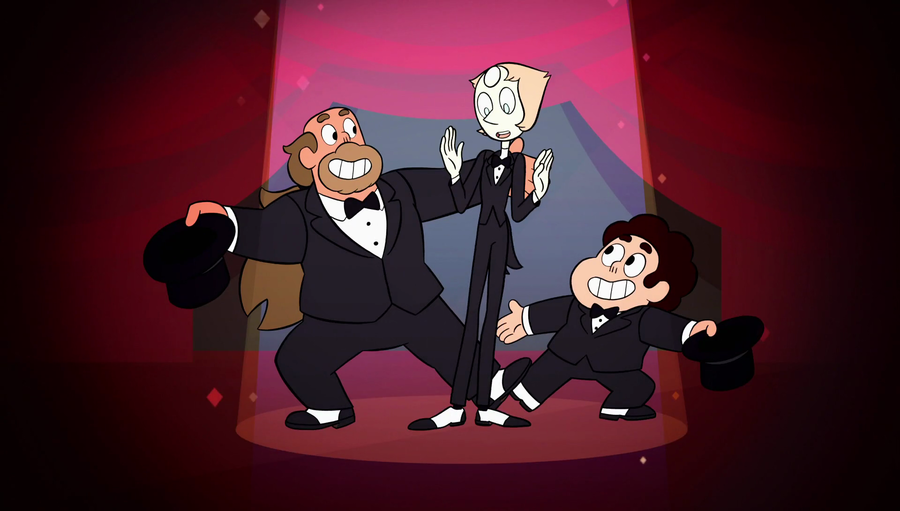
The animation is a fluid as ever. “Mr. Greg” features a fantastic dance sequence with Steven, Greg and Pearl, “Hit the Diamond” features a fun baseball match involving five Rubies and “Kiki’s Pizza Delivery Service” features crazy nightmares about pepperoni pizzas, particularly the cheese topping, but this series is always engaging even in its weirdest moments. Watching everything that happens never ceases to be fun, and there are so many things in this season that will almost definitely put a smile on one’s face. This is entertainment in its best and most meaningful form.

Audio

The music continues to enhance the series with its combination of beats and ethereal sounds. The voice acting and singing is once again outstanding; Pearl inadvertently reveals her feelings about Rose Quartz to the Universes in a deeply personal song, and both Steven and Greg have many great songs throughout the season. Jennifer Paz is excellent at portraying Lapis Lazuli’s changing personality and makes her lazier moments at the barn hilarious; humour and emotions are conveyed perfectly by all of the voice actors. It remains impossible to find any element of the audio that does not work.

Extras

Several animated shorts are included on the second disc. These feature lessons from the Crystal Gems about certain topics, Steven unboxing a wacky bag for the internet and more. Despite being short, they are entertaining and worth watching after finishing the final episode of this season.

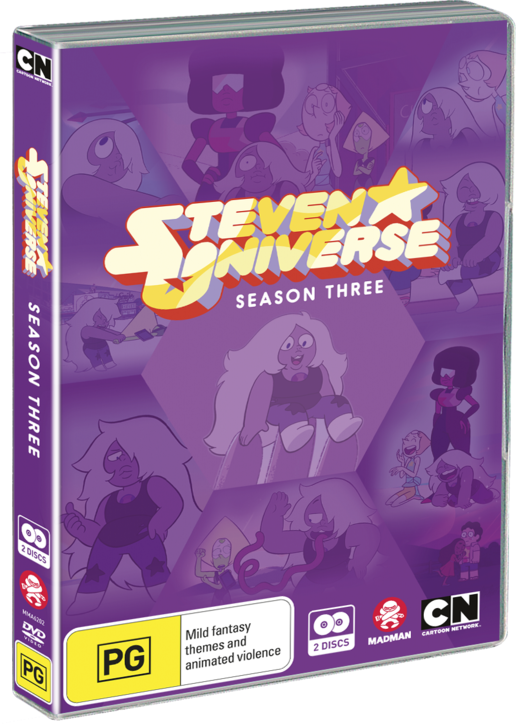
It may be worth noting for some that although the back cover states that there are 25 episodes, there are technically 24 episodes in season three; “Bismuth” is twice as long as normal episodes and is counted as two episodes. The inside of the cover lists 25 episode titles, but this is due to the final episode of season two being listed for an unknown reason. Fortunately, only the packaging contains errors; there are no issues with the discs themselves.

Overall

Steven Universe‘s ability to balance plot-driven drama with sweet character-driven episodes is fundamental to its success, and that balance is maintained despite the threats of Jasper and the Gem homeworld lurking in the shadows. Steven still has time to help out the citizens of Beach City, and Greg Universe is incredibly supportive of Steven and all of his friends. There are some powerful moments with Pearl and Lapis Lazuli, and Peridot is positively outstanding in her devotion to her new friends. Life is starting to become serious for the Crystal Gems, but none of the characters ever lose their moral compass, and they face each new challenge head-on. What happens next is anyone’s guess, but the wait for season four will undoubtedly be worth it.

Capsule Computers review guidelines can be found here.

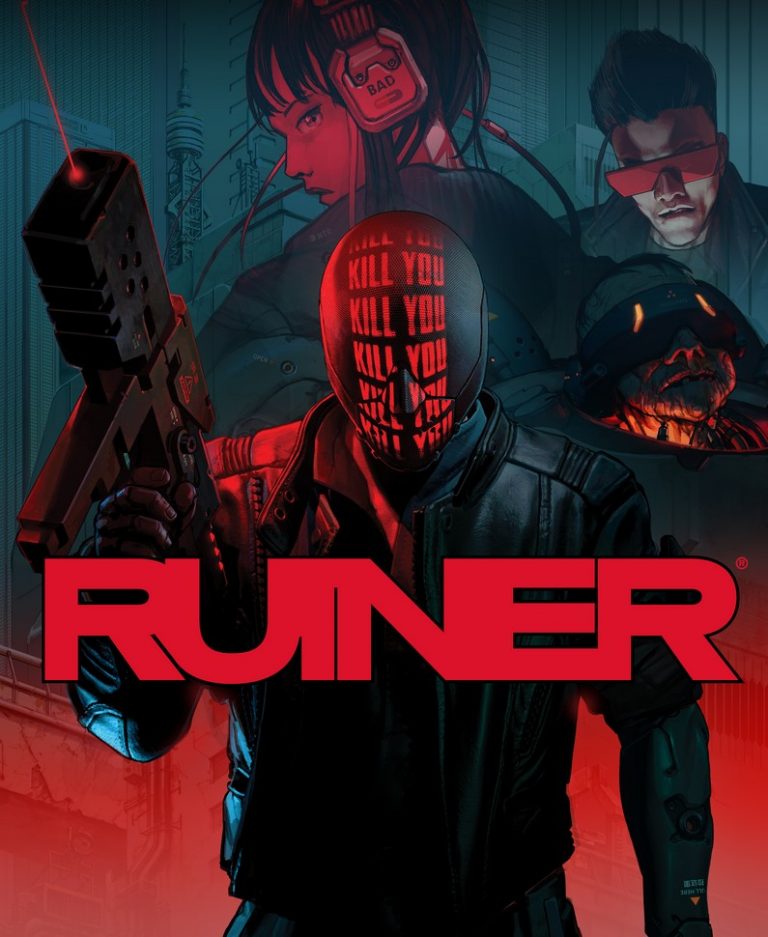
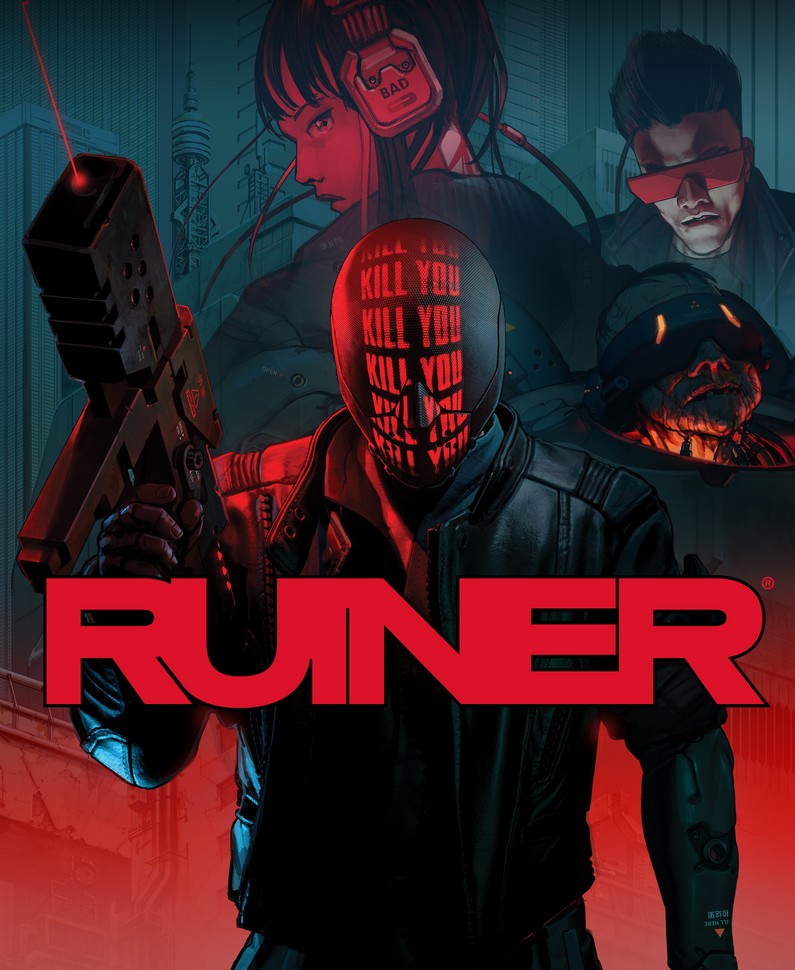
RUINER Review

RUINER

Developer: Reikon Games
Publisher: Devolver Digital
FormatPC (Reviewed)
Release Date: 26 Sep 2017
Price:  $19.99USD – Available Here

Overview

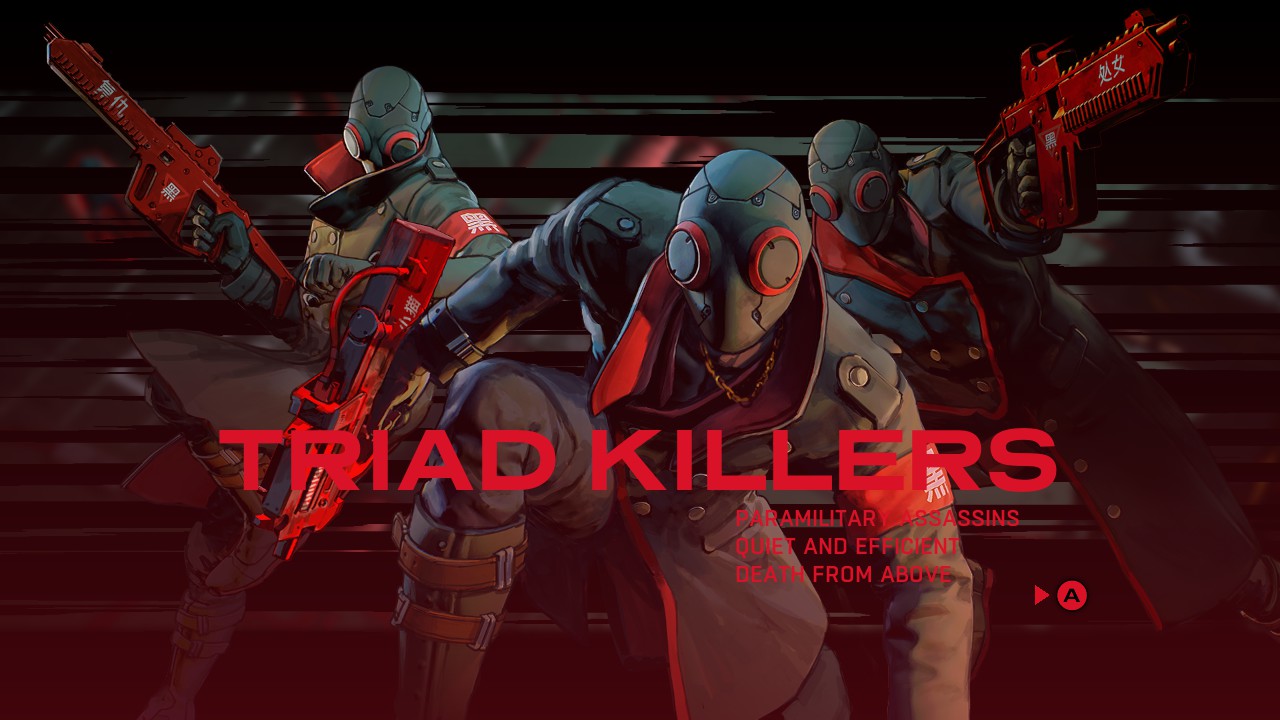
One of the good things about indie releases is that they manage to breathe some fresh air in stale or otherwise not so popular genres. Top-down shooters are a good example. We’ve all have some playtime in Alien Swarm (mostly thanks to the game being free) and there were some nice, fun surprises like Nuclear Throne and Nation Red. However, we could write off the majority to the “play and forget” pile. Until now. Not only that the RUINER is here to stay and reign as the undisputed king of fast-paced, top-down shooters but it is also a serious contender for one of the best indie releases in 2017.

Story

You play as an unnamed, violent sociopath set on a quest to retrieve his kidnapped brother from the clutches of the ruthless HEAVEN corporation. In this Orwellian future movements and actions of every citizen are tracked with a citizen chip and rewarded with so-called karma points based on their good behavior. Obviously, this would be a big problem for our character if it weren’t for the mysterious hacker friend who supplies us with a custom chip. It helps with keeping us off the grid and most importantly, enables us to go nuts on our murderous rampage as we get closer to our brother whereabouts.

Gameplay

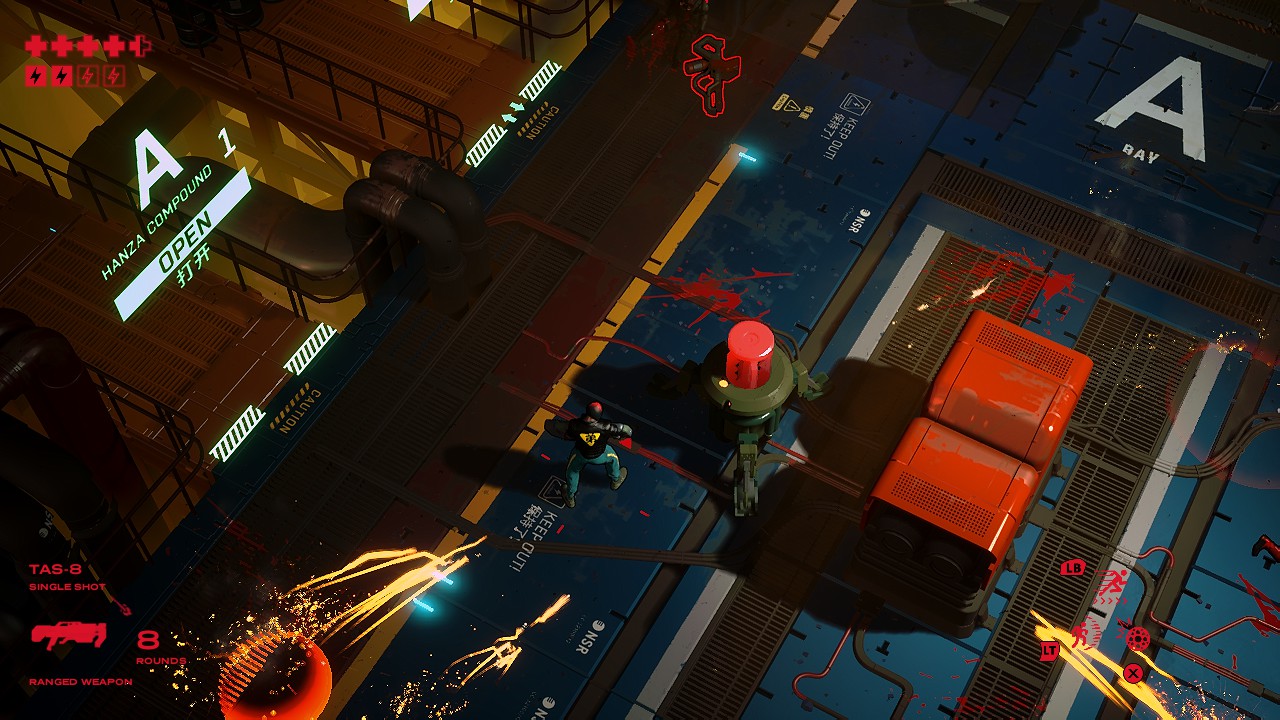
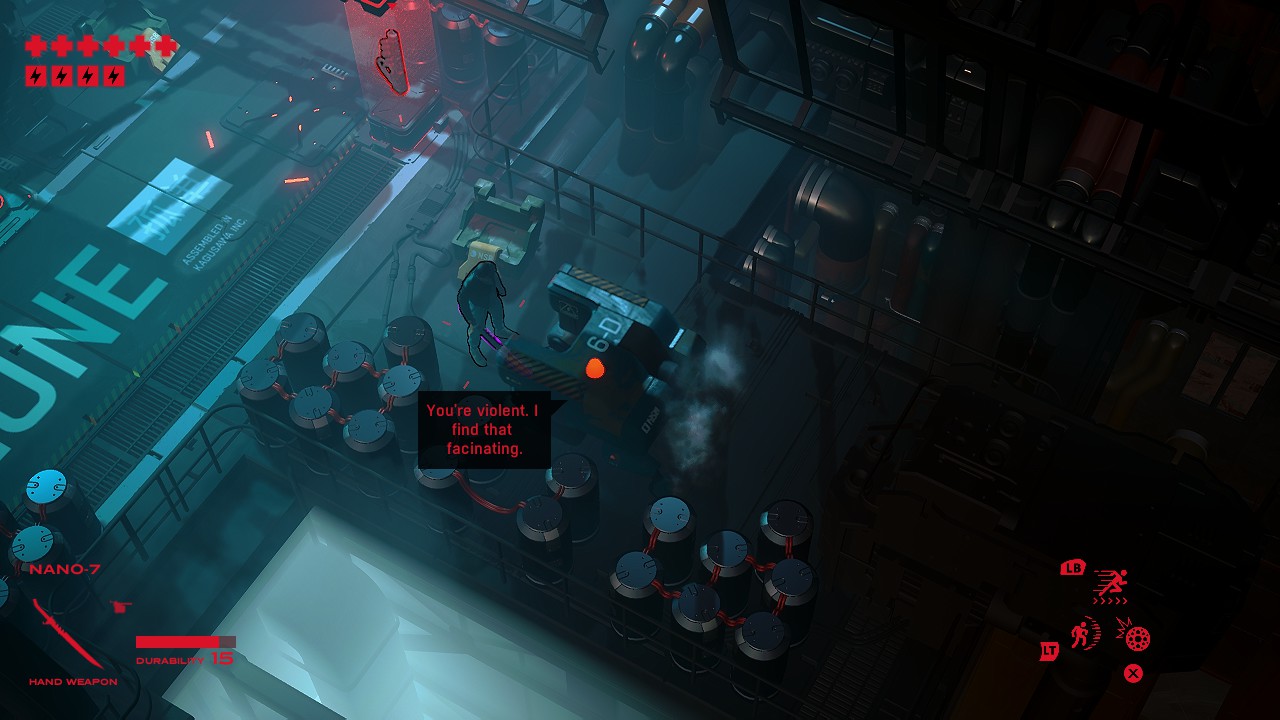
Now, what to write here that it doesn’t turn into a small novel praising the gameplay? The variations in taking down enemies, the skills, freedom of movement and the feeling of being a total badass after you clear the room of a dozen of enemies is what makes RUINER so damn good. The above-mentioned karma points are the backbone of your progress. You get them for disposing of enemies, opening boxes, recycling weapons and they’re vital for unlocking new skills.  One of the most useful skills (and something you’ll use 90% of the time) is the dash ability. In the heat of the battle sometimes just evading enemies left and right doesn’t cut it. Dash enables you to teleport closer or away from the enemies before they can react and take them down with a melee or a ranged weapon. You’ll always have your trusty metal pipe and a RUINER gun (along with the starting dash and shield skills) but the real joy is in experimenting with plenty of other guns found in the game (and on the bodies of enemies you leave behind). What’s interesting about skills is that not even one of them feels like a filler or something you’d skip while leveling. Every single of them introduces a new angle on the combat. Something as simple as hacking the enemies significantly changes the strategy you’ll employ on the next encounters. Circling around the enemy and holding the hack key will make him fight for you and draw the attention of enemies towards him, leaving you to focus on the smaller group and easily take them down.  And that’s just one of the many. There is a whole arsenal to choose from frag grenades, stun ones, charged melee attacks or deploying a special shield that stops the bullets and slows the enemies down while they pass through it. Still, with the plethora of skills at your disposal, the great thing about RUINER is that you never feel like an overpowered beast mowing down everyone like Rambo. It’s still fairly easy to die if you’re not paying attention. As you progress, you’re introduced to new enemies with their unique attacks and strategies. Some won’t shy away to use their own shield and dash attacks and some stationary ones are just there to drain your health & energy if you’re near them. If you ever feel like you’re dying too much at a certain point (or a boss) the good news is that you can reassign those learned skills at any time. Some enemies with grenades and shotguns won’t even let you get close to them before they mow you down in 2-3 shots? Simple, just pause the game and reassign the skills points to let’s say….slowing down time, dashing towards them with a shield on and taking them down with a charged melee attack before they can even react.

Visuals

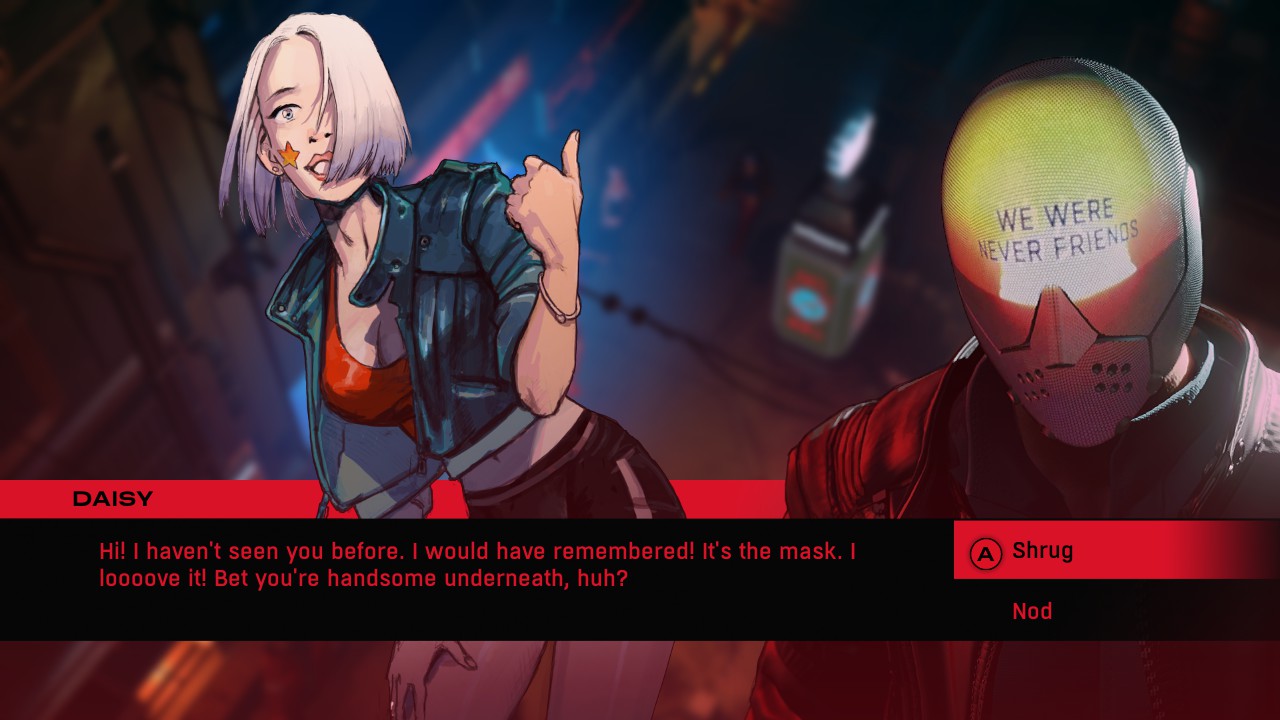
All that addictive gameplay is spiced up with a beautiful art style and character designs I’ve seen yet. As you rampage through the slums of HEAVEN every once in a while you’ll revisit the charming Rengkok city. It acts as a hideout from the regime and it’s filled with interesting characters, with some of them who will give you optional quests if you decide to snoop around. Rengkok itself feels like a mix of Kowloon city and Deus Ex environment. The art style, in general, has a touch of cell shading with an occasional emphasis on monochromatic red & blue based on the locations. It gives the levels strong, neon vibes and it a pretty good incentive to making you take screenshots way more than you intended. God knows how many times I died at certain boss waiting for its beam attack just because it was an opportunity for a neat wallpaper.

Audio

Unbelievably fun gameplay, gorgeous art and what else? The amazing tunes, of course. The one that can go head to head with the adrenaline-fueled ones from Hotline Miami games. The soundtrack has some acclaimed artists on its tracklist, notably Susumu Hirasawa from Paprika and BERSERK fame. The music does a great job in enriching the environment. Usually, you’re followed with the eerie cyberpunk ambient while exploring the levels and the next moment it can switch to the high-octane electronic beats once you’re ambushed with the dozens of goons.

Overall

Every once in a while, there is a game that sneaks through the pile of traditional, sort of speak. Sometimes it has barely noticeable buzz prior to the release. While the presentation is promising, there is far more under the hood and you end up getting way more than you expected. RUINER is a game that speaks for itself in terms of quality, gameplay and it’s dangerously close to redefining the genre it’s in. But most importantly – it’s too damn fun. It’s not only one of the most enjoyable indie releases but it’s already my personal game of the year.  No game should be allowed to be this fun.


Capsule Computers review guidelines can be found here.

Nintendo News: Nintendo Details DLC Coming to Fire Emblem Warriors for Nintendo Switch

0

Nintendo News: Nintendo Details DLC Coming to Fire Emblem Warriors for Nintendo Switch

REDMOND, Wash.–(BUSINESS WIRE)– Fire Emblem Warriors, launching for the Nintendo Switch and New Nintendo 3DS family of systems on Oct. 20, is a game overflowing with action-packed content. But fans who want to expand their adventure can do so with a host of paid DLC options that begin launching this year. All DLC can be purchased separately for both Nintendo Switch and New Nintendo 3DS systems.

Fire Emblem Warriors launches for Nintendo Switch, as well as New Nintendo 3DS, New Nintendo 3DS XL and New Nintendo 2DS XL systems on Oct. 20. A special-edition bundle of the game will launch exclusively for the Nintendo Switch system on the same day at a suggested retail price of $79.99. (Photo: Business Wire)

  • Season Pass (Oct. 20, $19.99): The Fire Emblem Warriors Season Pass includes all three DLC packs, which become available as they release. Each DLC pack is filled with new playable characters and weapons. By purchasing the Season Pass for either the Nintendo Switch or New Nintendo 3DS version, players will receive a bridal costume for Lucina.
  • DLC Pack #1 (Dec 2017, $8.99): The content in this pack is inspired by Fire Emblem Fates.
  • DLC Pack #2 (Feb 2018, $8.99): Many of the characters and items in this DLC pack hail from Fire Emblem: Shadow Dragon.
  • DLC Pack #3 (March 2018, $8.99): Fans of Fire Emblem Awakening will love this DLC, as much of the content is themed after the classic game.

More details about each DLC pack will be revealed in the future.

The Fire Emblem Warriors game is compatible with the new Chrom and Tiki amiibo figures, which both launch on Oct. 20. These, along with other compatible Fire Emblem amiibo figures including Marth, Ike, Robin and Lucina, grant players weapons or materials when tapped. Up to five different compatible amiibo figures can be tapped per day.

Fire Emblem Warriors launches for Nintendo Switch, as well as New Nintendo 3DS, New Nintendo 3DS XL and New Nintendo 2DS XL systems on Oct. 20. A special-edition bundle of the game will launch exclusively for the Nintendo Switch system on the same day at a suggested retail price of $79.99. The special edition includes the game, premium character card set with slip case, a double-sided poster and a three-CD music set.

For more information about Fire Emblem Warriors, visit http://fireemblemwarriors.nintendo.com/.

KOEI TECMO EUROPE UNVEILS GAMING PLATFORMS FOR UPCOMING TITANIC ACTION GAME A.O.T. 2

0

KOEI TECMO EUROPE UNVEILS GAMING PLATFORMS FOR UPCOMING TITANIC ACTION GAME A.O.T. 2

Don The Omni-Directional Mobility Gear And Experience The Gripping Events From Season 2 Of The Worldwide Anime Hit, Attack on Titan

Hertfordshire, 25thSeptember 2017 – KOEI TECMO Europe is excited to unveil today that A.O.T. 2, the sequel to 2016’s titanic action game, A.O.T. Wings of Freedom, is currently in development for physical release on the PlayStation®4 computer entertainment system, and Xbox One, the all-in-one games and entertainment system from Microsoft, Nintendo Switch™, and digitally on Windows PC via Steam®.

A.O.T. 2 delves deeply into the fascinatingnarrative of Attack on Titan’s second season and offers players exhilarating action and new challenges, as it introduces the newly improved omni-directional mobility gear offering advanced freedom of movement and targeting precision to counter enhanced Titan movements.

Players will be able to try their new moves against these fearsome Titans as they control characters from a Titan-sized roster! Outside of battle they will be able to deepen their relationships with their fellow squad-mates while gaining greater insight into life within the walls thanks to more advanced RPG elements.

While more information about the game’s release date, narrative, and new mechanics will be unveiled in the coming weeks, KOEI TECMO released a new selection of in-game assets which further showcase famous scenes from the anime and character interactions outside of battle.

To keep up to date with the latest news on ‘A.O.T. 2’ please visit the official site at www.koeitecmoeurope.com/aot2, Like www.facebook.com/koeitecmogames, and Follow us on Twitter @koeitecmoeurope

ABOUT KOEI TECMO EUROPE LTD.

KOEI TECMO EUROPE LTD. is a publisher of interactive entertainment software for current generation consoles, handhelds and digital download content based in Letchworth, Hertfordshire, UK. The company is a wholly owned subsidiary of KOEI TECMO HOLDINGS CO., LTD., headquartered in Yokohama, Japan. TECMO is best known for the Dead or Alive® and Ninja Gaiden®series. KOEI is best known for its Dynasty Warriors® and Samurai Warriors® franchises. On April 1, 2009, KOEI TECMO HOLDINGS CO., LTD was established as a result of the TECMO, LTD. and KOEI Co., Ltd. merger. More information about KOEI TECMO EUROPE LTD and its products can be found at www.koeitecmoeurope.com

Divinity: Original Sin II Review

Divinity: Original Sin II

Developer: Larian Studios
Publisher: Larian Studios
Platform: Windows
Release Date: 14 September 2017
Price: $44.99 USD – Available Here

Video Review

Overview

After the success of Divinity: Original Sin, Larian Studios turned to Kickstarter once again to bring a sequel to their highly regarded RPG to life. After over a year in Steam Early Access, Divinity: Original Sin II is out on Windows PC. The game boasts an even larger world that before and new features like four player co-op, split-screen multiplayer, and a Game Master mode for unlimited adventures.

Story

Divinity: Original Sin II is set centuries after the original game. Anyone with a hint of Source power are being hunted down and imprisoned after the leader of the Magisters, Bishop Alexander, declares them to be a danger to society. The writing in Divinity: Original Sin II is top notch. The dialogue is flawless. Like a good fantasy title, each character has their own personality that is influenced by their race’s culture without becoming a bumbling stereotype. I love the fact many NPCs will have very different conversations depending on which player character initiates the conversation. The story is engrossing, even for players who are new to the franchise. The time gap between the two games is great enough that missing out on (or forgetting) the events of the previous game does not detract from the sequel. The story contains some mature themes at times, but always manages to handle it in an equally mature manner. Even characters role-played as bloodthirsty psychopaths seem dangerous and unstable without becoming edgy, attention seeking annoyances.

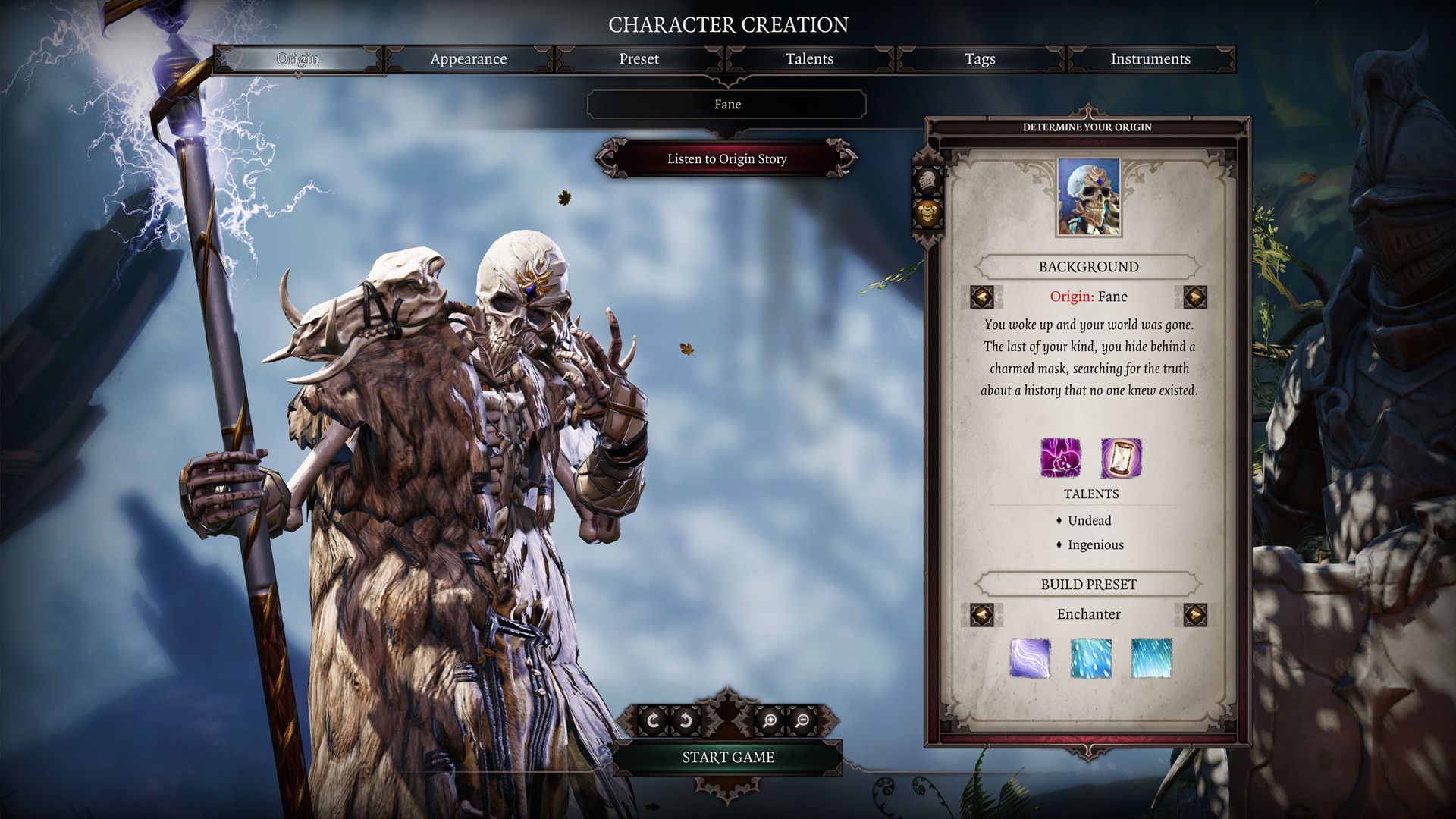
Divinity: Original Sin II offers players a choice of six characters with their own unique origin story or a custom character. The six origin character stories are varied in nature, making it easy for players to find a character with a story that interests them. Having six, well written origin characters can understandably make selecting a character to start with a bit of a challenge for some. Luckily, the all the origin characters can be recruited as companions so players can easily experience all six character’s stories in a few playthroughs. Players do not have to worry about sacrificing party balance for characters they want to play with either, since players have the option of adjusting character classes right at the beginning.

Gameplay

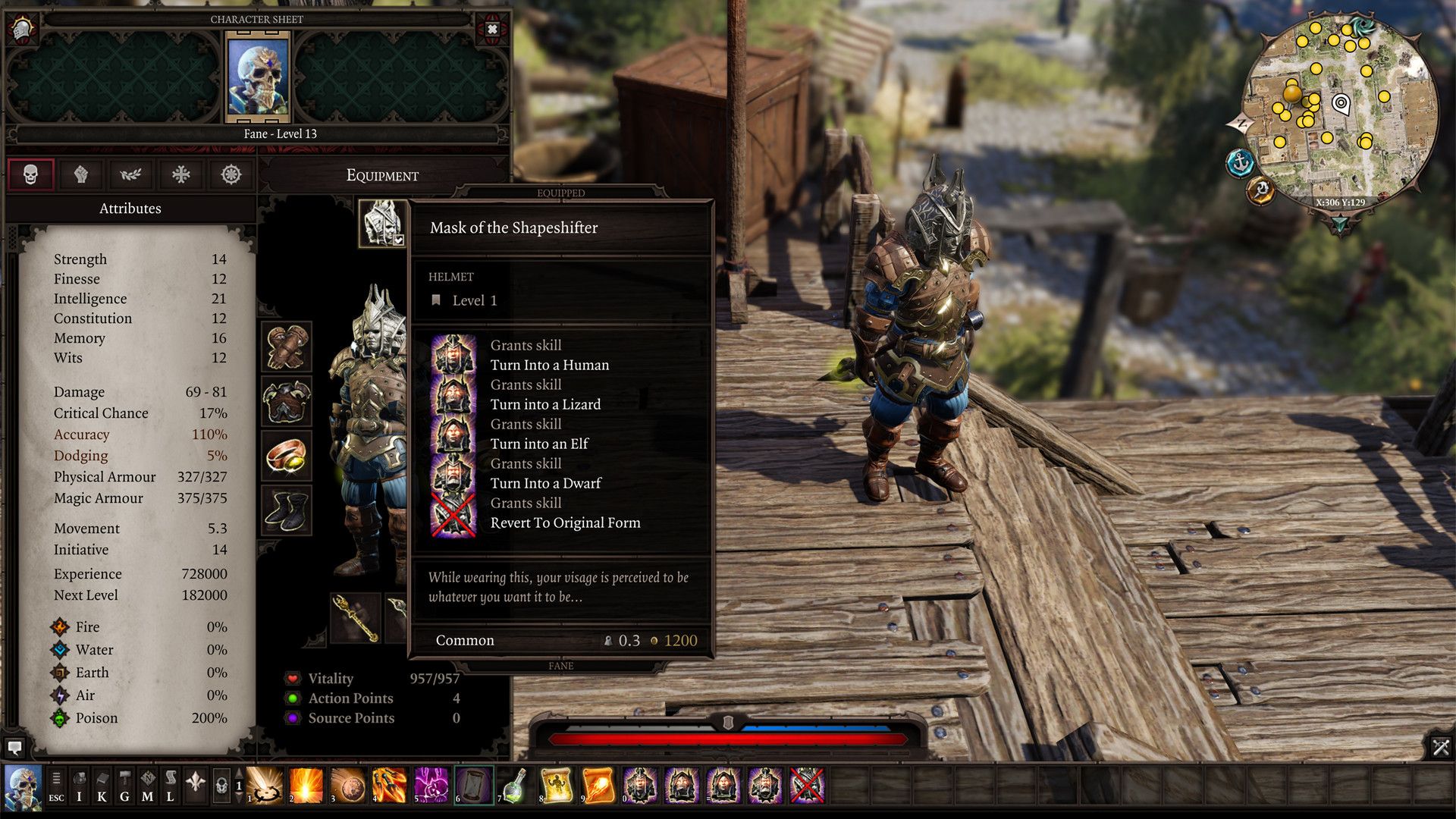
Divinity: Original Sin II is a turn based tactical RPG in the same vein as classic computer RPGs like Neverwinter Nights. Character creation is about as simple or as detailed as a player wants it to be. Upon choosing one of the six origin characters or a custom character, players can opt to jump right into a game by picking starting class. Otherwise, power gamers can go nuts and adjust every skill point and stat to their min/maxing hearts content. The game’s format is similar to more recent d20 systems. Each character has a set of basic attributes that all other stats are calculated from. Each level awards players two extra attribute points and an ability point that can be spent on combat or social abilities. Additionally, players get a talent point every five levels. Unlike abilities and attributes, talents provide special effects that generally shy away from modifying stats. It may sound a bit much for absolute RPG newbies, but it actually strikes a good balance in complexity. The system is deep enough to provide some reward for creating good characters without being overly punishing to those who don’t feel the need to power game.

The scope of Divinity: Original Sin II’s world is incredible. The world feels absolutely alive with NPCs who do more than just fill space. Many have small side quests, provide hints, and react to the changing circumstances in-game. I really like the fact almost every character in the game participates in trading even at small scale as it gives players a little extra incentive to just chat with everyone. There are a lot of quests in the game. They are interesting, have a huge variety of objectives, and often have multiple solutions. I’m absolutely thrilled that many quests can be solved peacefully.

The crafting and rune systems is a simple, approachable affair. Players simply throw the desired materials into the window and hit the craft button. If the recipe is valid, players get their item. If not, no harm or foul. The crafting and rune systems may not be very deep, but it definitely makes up with its vast size. Everything from food to skill books can be made. Weapons can gain a variety of buffs from runes that can benefit a well tuned party.

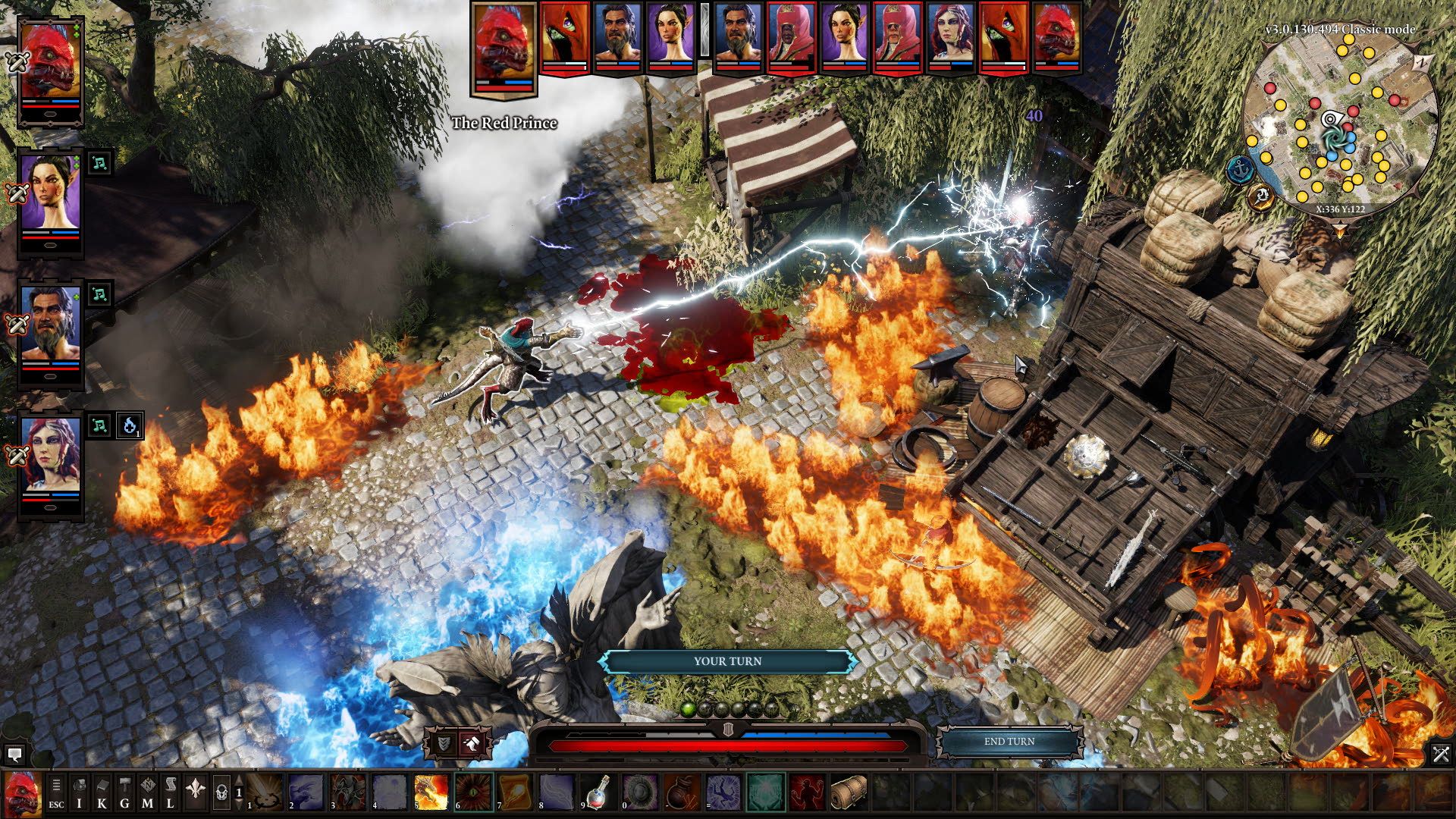
Combat is a challenging, yet rewarding. Divinity: Original Sin II uses a turn-based system that requires a lot of strategic thinking from players as status effects, elemental damage, and positioning play a key role in combat. Many environmental effects and status effects have synergies with a variety of elemental damage. For example, an area can be cleared of poison clouds with a quick rain spell that also applies the wet status to characters and puddles on the ground. A follow up lightning skill will dish out even more damage and electrify the water for the next few turns, applying the shocked effect to anyone who walks through the puddle. Add in friendly fire and combat becomes incredibly punishing at high difficulties.

Probably the only thing I can really find wrong with Divinity: Original Sin II is its high difficulty level in the first hour. Keeping up enough health to stay alive in the first bit is a real challenge as resurrection scrolls and health potions are quite pricey. The moment players are able to get a bedroll of their own to heal out of combat and a character with a permanent heal skill makes all the difference in the world. There are a lot of bed rolls scattered around the early areas of the game, but no clear recommendation to have characters top up between fights by resting. I think a few pop up reminders to rest on a bedroll while characters are in the Fort Joy area would have made a huge difference.

The control scheme for Divinity: Original Sin II is excellent. The game offers both mouse and keyboard and controller support right out of the gate. The controller support is an absolute must for the game’s split-screen co-op mode. The UX is simple and clear. The menus are easy to figure out and to navigate.

New to the series is the Game Master mode. As if the game’s already giant campaign isn’t enough content, creative gamers can use the Game Master tools to run their own custom campaign with their friends. Much like standard pen and paper RPGs, the game master runs the campaign, guiding players through their adventures. The GM mode is laid out in a self-explanatory way. While the mode lacks an in-game tutorial, it doesn’t take long at all to figure out the very basics. Considering the challenges of running pen and paper RPGs online, Divinity: Original Sin II offers a unique alternative to GMs looking to implement a more video game experience for their table top group.

Visuals

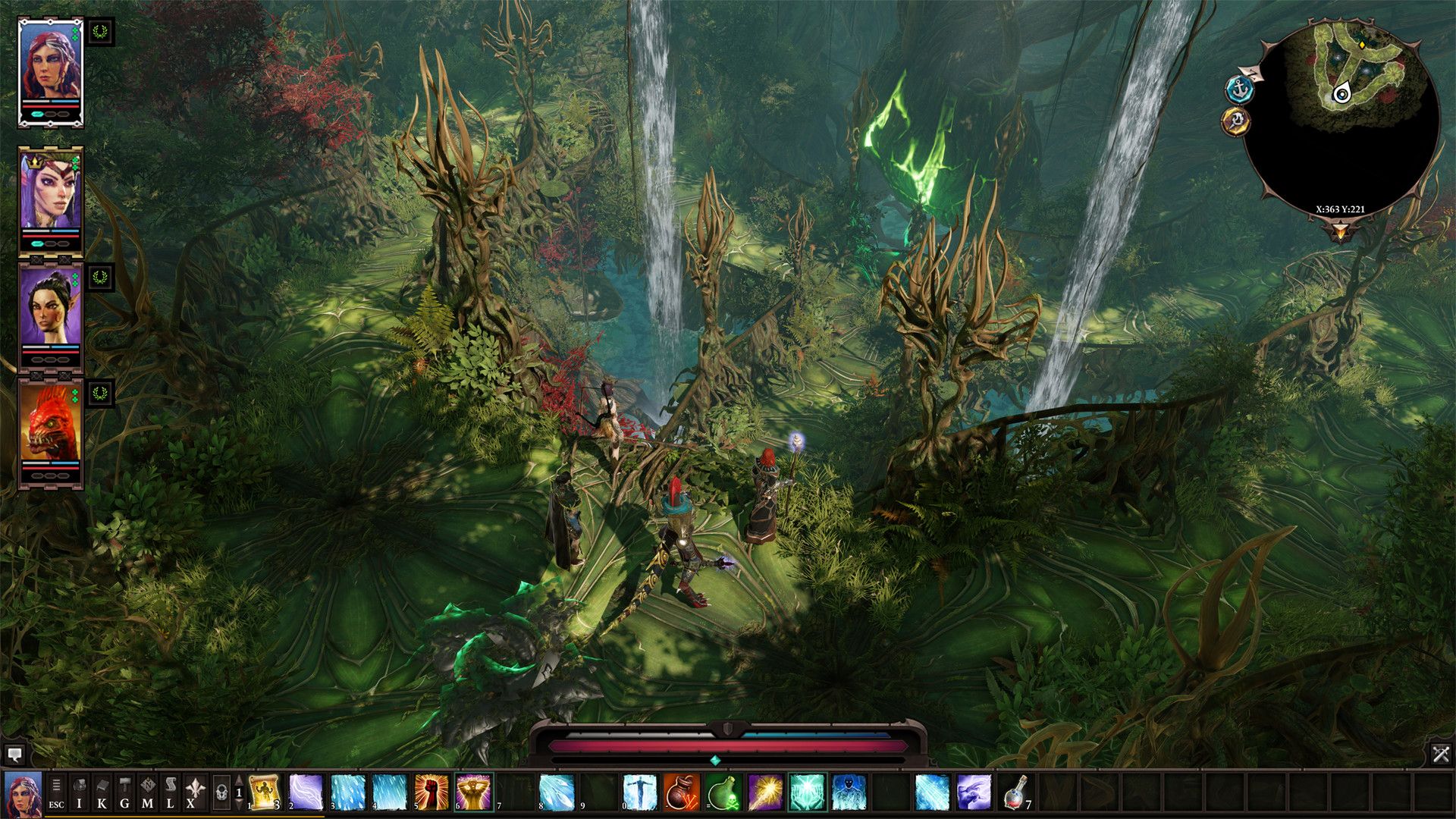
Divinity: Original Sin II delivers an excellent visual experience. The art style is high fantasy that does not shy away from bright and vibrant colours. On the technical side, the textures and models look great. The animations are solid. In my testing, I had no issues with the game.

Audio

The audio in Divinity: Original Sin II is stunning. For starters, the entire game is fully voice acted, from the main characters down to the most minor animal that can only be spoken to with the right talent. The voice acting is generally the sort of quality you would expect from an AAA title from a major publisher’s holiday release. The sound effects are enjoyable. The soundtrack is a masterpiece that deserves to be listened to outside of the game. Video game music fans will definitely enjoy having this soundtrack in their collection. A seemingly minor, but impressive part of the soundtrack is the part of the character creation process that offers players a chance to choose the soundtrack’s lead instrument from four options. I think it is a great way to help set the tone for a character.

Overall

Divinity: Original Sin II deserves a game of the year win. After years reviewing video games, it is rare for me to find a game I want to keep playing the moment after I finish reviewing it due to the intense nature of playing games critically for extended periods of time. To my great surprise, I feel a real sadness as I type out these final words of my review, knowing that another game for review will soon come to take away me away from Divinity: Original Sin II. The game is so close to perfect with its excellent writing, solid gameplay, beautiful visuals, and amazing audio that I just want to keep playing. Divinity: Original Sin II is a shining example of why it’s great to be a PC gamer in the golden age of PlayStation and Xbox.

Capsule Computers review guidelines can be found here.

Guild Wars 2: Path of Fire Expansion Launches

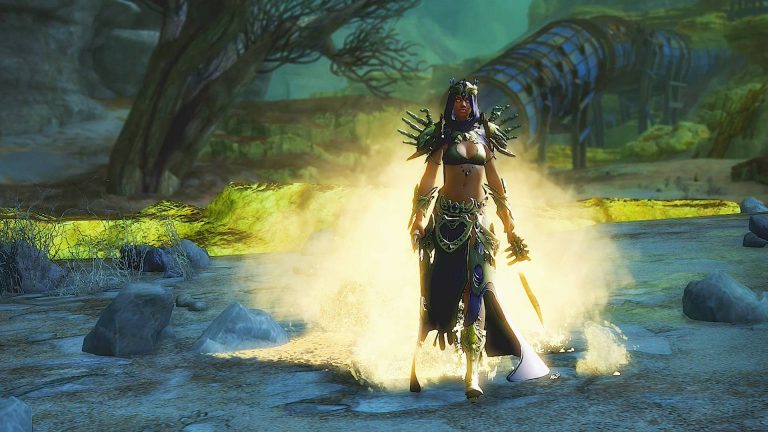
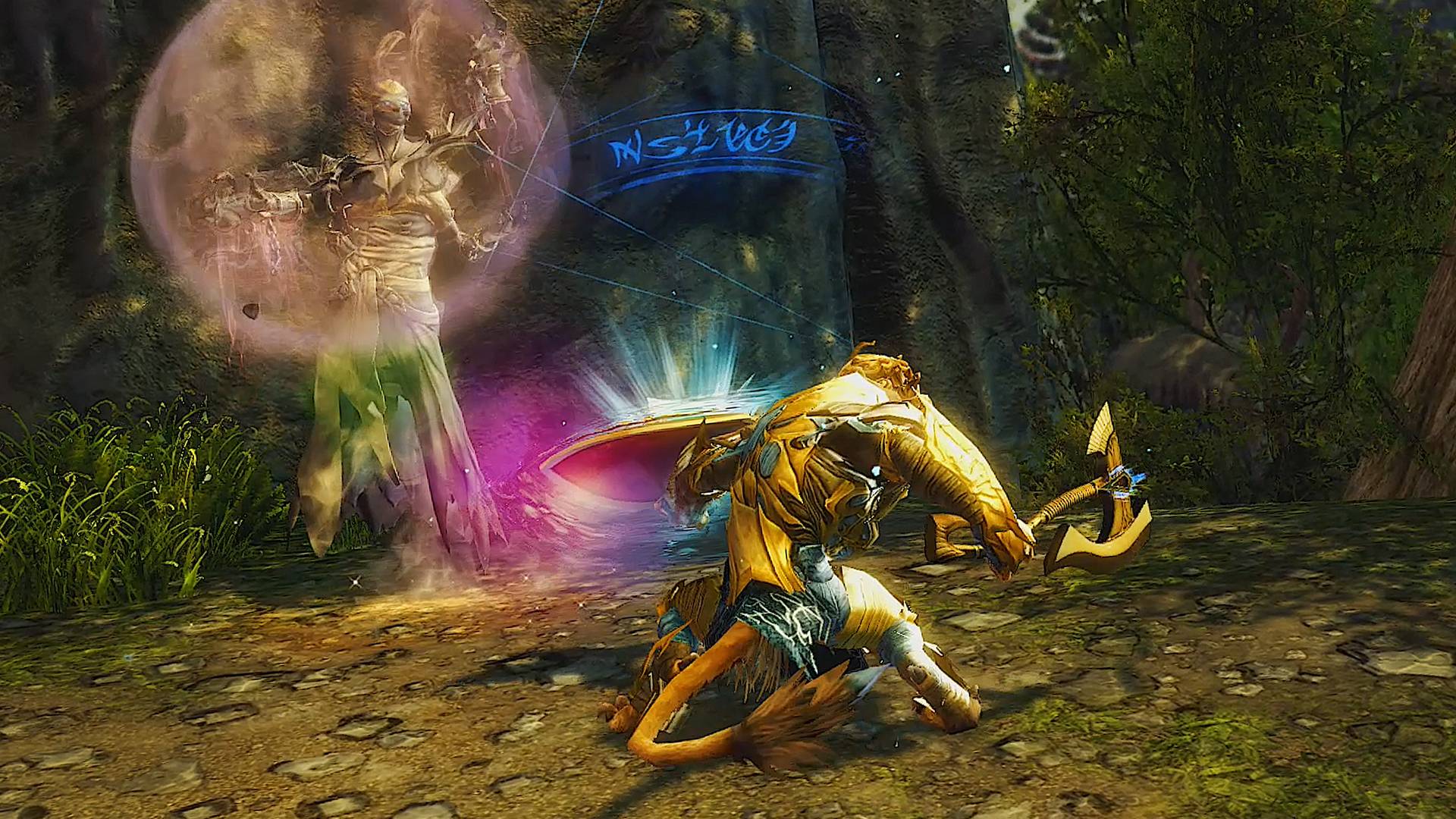
ArenaNet and NCSoft released the latest expansion for the long running MMO Guild Wars 2. Path of Fire is the second expansion for the game and introduces brand new features to the game. Previously, the main method of transportation was teleporting to set waypoints and either walking or gliding the rest of the way. Path of Fire introduces mounts for the first time, but with a twist. Instead of simply being a nameless mode of transportation, the four types of player mounts are companions that each have their own special trait. Additionally, each of the nine professions in the game are getting elite specializations that put a new spin on the profession.

Just in time for Guild Wars 2’s fifth anniversary, Guild Wars 2: Path of Fire fittingly takes players back to Guild Wars: Nightfall’s setting in the Elonian desert. The god of war and fire Balthazar has laid siege on the Elonia and the Crystal Desert. Tyria’s heroes have been called to the front to put a stop to Balthazar and his army.

Guild Wars 2: Path of Fire is available now at digital and retail stores in North America and Europe. While Guild Wars 2 itself is now free to play, Path of Fire starts at $29.99 USD and comes with a free level 80 boost for one character.

Super Beat Sports Coming to Switch on October 12

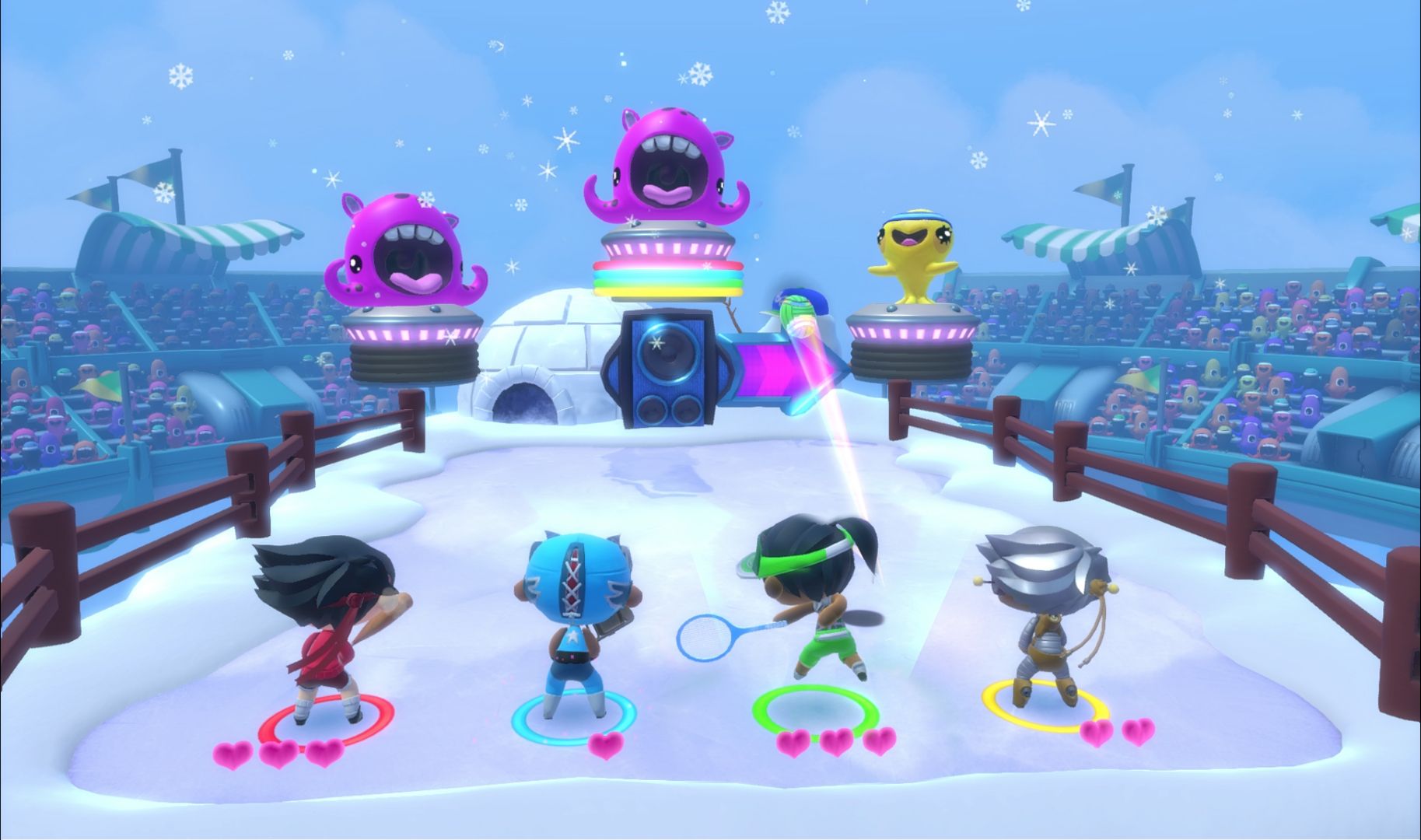
Harmonix (Rock Band 4) has finally put a release date on their newest IP. The veteran music game developers will be releasing Super Beat Sports on the Switch on October 12. The game will be a Switch exclusive. Super Beat Sports features a series of sports-inspired, rhythm based mini-games with adorable graphics and a catchy beat. Players will use the Joy-Con to swing, volley, and hit to the rhythm of the music as a group or solo.

To introduce gamers to Harmonix’s musical takes on popular sports, Harmonix is releasing a series of trailers that re-imagines the game’s five mini-games as real life activities. Whacky Bat was revealed last week. This week brings us Net Ball, a weird tennis inspired game with a touch of beach volleyball. Trailers for Rhythm Racket, Buddy Ball and Gobble Golf will probably follow in the coming weeks.

https://youtu.be/vyzNKlKBdz8

Bluehole, Inc Accuses Fortnite of Ripping off Playerunknown’s Battlegrounds

Bluehole, Inc, the Korean developers behind the massively popular Playerunknown’s Battlegrounds (PUBG), has issued a statement accusing American developers Epic Games of ripping off PUBG with the latest Fortnite updateFortnite is launching a new 100 player Battle Royale PVP mode on September 26th. Bluehole, Inc alleges that Fortnite has a similar UI, gameplay, and structure as PUBG‘s battle royale experience. The Korean company says they were pushed to act when Epic Games repeatedly referenced PUBG in their communication with both the community and the press.

Bluehole, Inc is finding itself in an awkward position as they are currently licensing Epic Games’ Unreal Engine 4 for PUBG. Bluehole, Inc is being quiet about their next step besides issuing a public complaint via press release. Taking Epic Games to court may be in the cards. Bluehole’s Vice President and Executive Producer Chang Han Kim, hinted to the possibility with his choice of words when he made it clear that Bluehole is collecting evidence about the similarities between the two games.

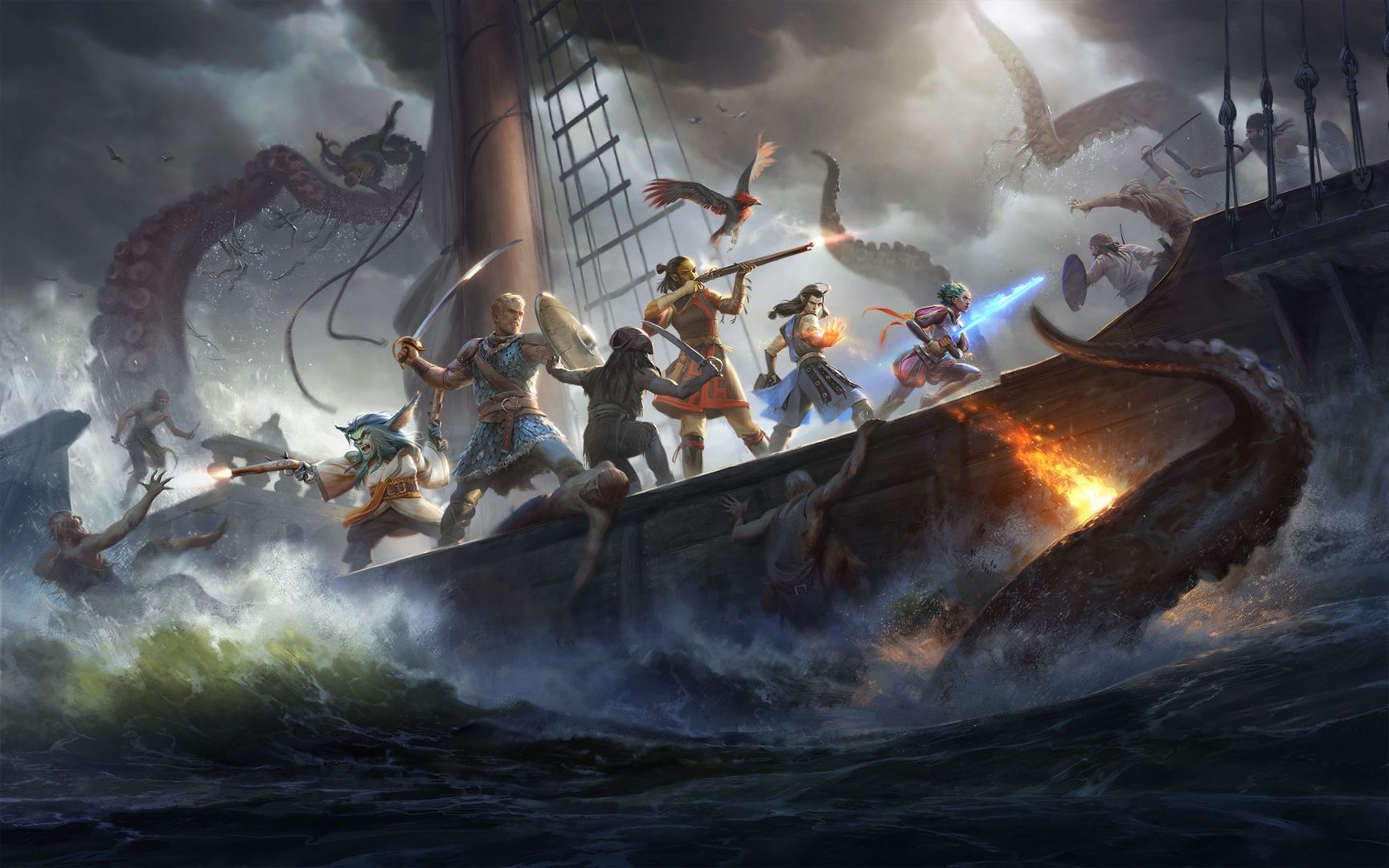
Pillars of Eternity II: Deadfire to be Published by Versus Evil

Obsidian Entertainment has announced they will be working with indie publisher Versus Evil to release Pillars of Eternity II: Deadfire. The game is set to arrive on Linux, Mac, and Windows in 2018. The first game, highly regarded Pillars of Eternitywas published by the much larger Paradox Interactive. Obsidian Entertainment CEO Feargus Urquhart released the following comment:

We are thrilled to be working with the team at Versus Evil on Pillars of Eternity II: Deadfire, the first sequel we’ve ever made into one of our own IPs. Partnering with a team that is as passionate as we are about making Pillars of Eternity outstanding has already been such a gratifying and exciting experience. We know that Steve and his team will treat Deadfire right and help us make it the game that our incredible fans and generous backers expect and deserve.

Pillars of Eternity II: Deadfire is a massive expansion of its predecessor. The game boasts a larger world, a more complex story, and a companion relationship system. Set in the Deadfire Archipelago, players will explore the exotic islands in a quest to save their souls from eternal damnation by hunting down a god.