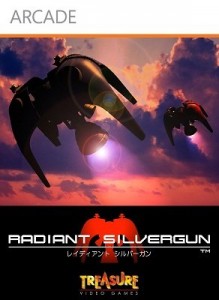
Radiant Silvergun Platform: Xbox Live Arcade (Reviewed) Publisher: Microsoft Studios Developer: Treasure Genre: Top Down Shooter/Bullet Hell Release Date: September 14, 2011 Price: 1200 MS Points
Overview
Radiant Silvergun was originally released in 1998 for the arcades and then ported to the Sega Saturn with additional anime cut scenes. The game introduced a unique idea of combining puzzle elements with the vertical scrolling shooter style-as if the Bullet Hell genre wasn’t chaotic enough! Radiant Silvergun has now been given the high definition treatment and has been ported over the Xbox Live Arcade, with additional modern features such as online co-op. Whilst the genre does appeal to quite a niche audience, Radiant Silvergun attempts at going beyond that to include some unique elements creating a unique shooting experience.
Story and Presentation
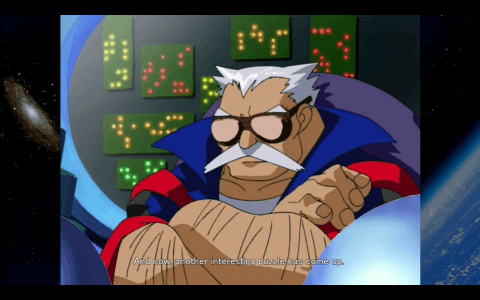
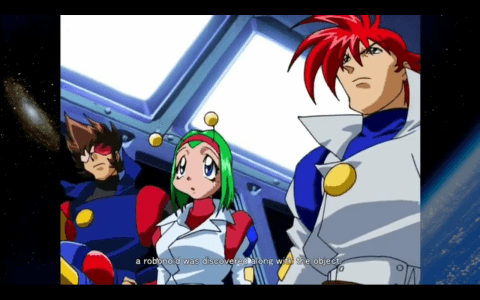
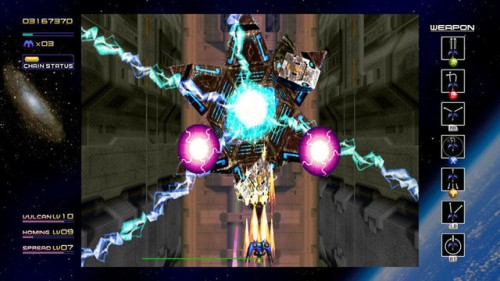
While a plot is present in Radiant Silvergun, it’s barely understandable and very hard to follow as it is told very poorly. Thankfully though, this isn’t a story-driven game. The anime cut scene introduction looks wonderful and vibrant in colour, making a great visual start. Unfortunately, the voice acting is only in Japanese, no English dub has been provided, the subtitles have been poorly translated and appear very small, at times painful to look at. In fact, all text is a pain to read in Radiant Silvergun, as the selected font is very small and very unappealing to look at. Radiant Silvergun runs in it’s original 4:3 ratio, with the rest of the screen filled with various wallpapers you will care little for. It seems quite unnecessary in this modern age of gaming and there isn’t an option of choosing otherwise. The sprites have been completely redrawn and presented in beautiful HD, ridding of that ugly pixelation, but for purists wanting to re-live the classic experience, the option to play with the original sprites is also available.Best of all is arguably the soundtrack, it amplifies the experience and just blows you away. A wonderful highlight.
Gameplay
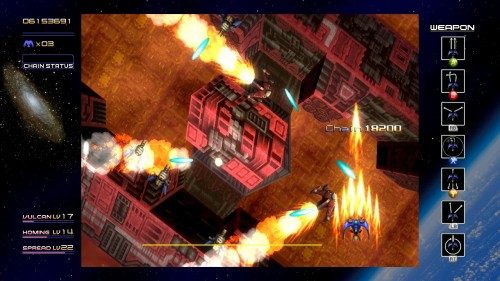
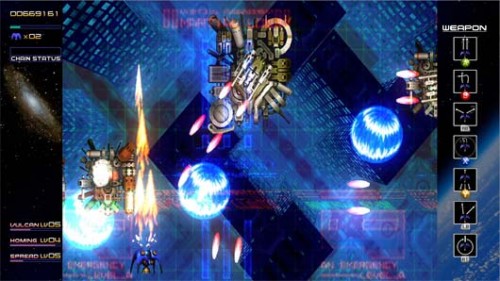
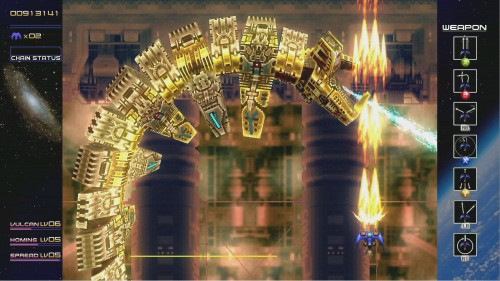
At first look Radiant Silvergun may appear as a cliché addition to it’s genre, but there’s two clear innovative features that completely turns the entire gameplay upside down. The most important one is instead of the typical ‘collect power ups as you go’ routine, Radiant Silvergun gives you everything from the start, and it’s all quite easy to control. The more you use a weapon the more experience it will gain and eventually upgrade. Each of the 7 weapon is unique and useful in different situations, and the variation is actually quite good. Among them all, a noteworthy weapon is a laser-sword quite weapon, which yes-makes no complete sense, but is quite useful for eliminating surrounding enemies and bullets! The second feature thrown into the gameplay to mix things up is a colour-coded combo system, where consistently shooting enemies of the same colour gives you bonus points, giving players the option to play with a more puzzle-based strategy in mind. Unfortunately, this will be short-lived for most players as the nature of the genre is to blow up everything in sight. While the experience system works and does provide a fresh feel to the game, this sadly does not and is easily forgettable in time.
There are two main modes of play: Arcade and Story Mode. These two play exactly the same, except in Story Mode you are able to save your progress in upgrading your weapons for next time. Yeah, that’s it. It’s easily the better of the two, and therefore there isn’t any real incentive to play Arcade Mode unless you want more of challenge, which you won’t, because Radiant Silvergun is insanely hard. Even on the easiest difficulty setting! So expect to die a lot, and playing those same damn levels over and over and over again, even when you don’t want to. This leads to very repetitive gameplay as your playing the same levels all over again constantly. Sure it’ll be easier the next time after you’ve upgraded in Story Mode, but that’s hardly an incentive to keep playing, although it does mean a new experience almost each time, and does give a tiny extra layer of strategy to gameplay. This title is most fun however, during local co-op. Again, this is exactly the same but with a minor difference-a second player can play at the same time. This makes the experience a way more fun to play, and is highly recommended as it provides the most enjoyment Radiant Silvergun has to offer. There is also X-Box Live Co-Op, but this is down right terrible. It can take forever to find a match, and personally I’ve never seen a match that ran smoothly. Each time was uncomfortably slow, and no fun at all. In fact the quality is so terrible Im surprised Treasure even decided to include it in the game in the first place. A major disappointment, as if it did run as smoothly as the local co-op, this could’ve been an amazing selling point for Radiant Silvergun.
Verdict
Radiant Silvergun may of been a hit back in the days of the Sega Saturn, but it’s past it’s prime now. This isn’t to say it is a bad game, as it does have some bright moments, but I wouldn’t call it the best of it’s genre. Radiant Silvergun does however sport some interesting unique features that are worth checking out however if your a fan of the genre. While the colour-combo system is a bit hit-and-miss, the experience system and varied weapons do create a unique experience which can feel rewarding. Radiant Silvergun is at it’s best during local co-operative play, and at it’s worst whilst in co-op via X-box Live Arcade. Single Player although will keep you occupied for a few minuets but most will tire of it quickly, and Im sure many gamers will be turned off by it’s extremely hard difficulty.
PROS
Unique weapon upgrading system
Choice between new HD sprites and classic Retro Sprites
Awesome soundtrack!
Local Co-Op
Great selection of very different weapons for different situations
CONS
Screen ratio is only available as 4:3
Xbox Live Arcade Co-Op is basiclly unplayable
Colour-Combo system is kind of pointless
Almost all modes play exactly the same, little variation
The Gunstringer Developer: Twisted Pixel Publisher: Microsoft Release date: September 13, 2011 Price: $39.99 – Purchase Here!
Overview:
There is something that can be said about a video game developer that, when mentioned, can make people laugh simply due to their reputation. One such company which has reached these ranks with their games is Twisted Pixel. Nearly every title that they have produced over their relatively short developing lifespan has been quite a well-received hit and also delivered plenty of laughs.
However since Twisted Pixel’s first step in creating games in 2009, they never actually have released a game that has stepped beyond the digital storefronts of the Xbox Live Marketplace. However that has all changed as the company has finally released a full retail title for the Xbox 360, which is also their first title to make use of the Kinect motion tracking feature. How does Twisted Pixel’s style of gaming translate to a full title… especially one that is focused entirely around the Kinect?
Story:
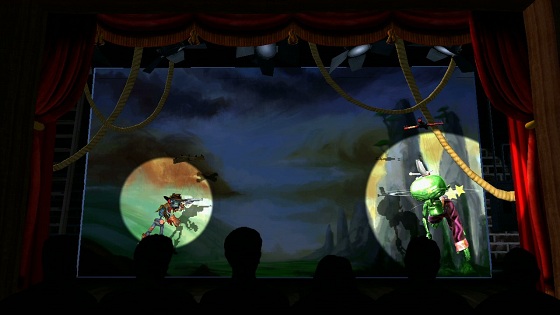
The Gunstringer takes its storyline in a rather odd direction immediately. The whole storyline for the game takes place on a stage of a theater where the crew is holding a live puppet show for those in attendance. Your role is that of the puppeteer and must control the Gunstringer on his quest.
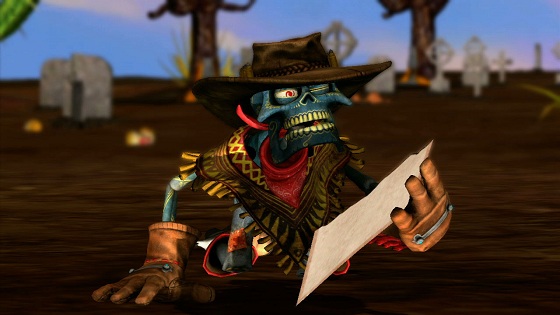
What quest is he on you ask? Well one for revenge of course. As you raise the Gunstringer out from the grave he immediately sets out to take revenge against his old crew that betrayed and left him sleeping in the bottom of a shallow grave. The whole experience is a rather simple revenge story and each area will have the Gunstringer seeking out a member of his old posse and eliminate them and the lord help anyone who comes in your way.
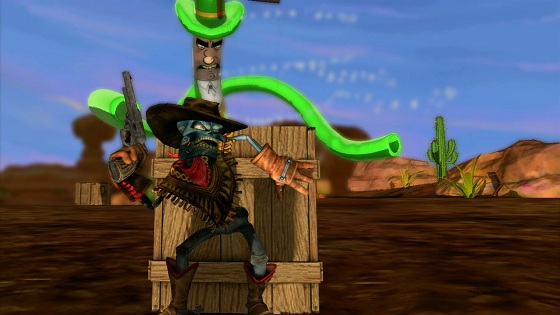
Since this is a Twisted Pixel game that may sound a bit too standard, and of course it is. Your old crew ranges from a wavy tube man to a samurai cowboy made out of jade to a man with a literal barrel for a belly. This is only the tip of the iceberg for some of the bosses you will fight against which of course means that there is plenty of humor just for these bosses alone.
Besides that there are always plenty of jokes and references to past famous Western movies that will help keep players not only laughing but also trying to remember if they have ever seen that specific Western movie. The jokes can be from roughly anywhere on the board, ranging from simple situational jokes or those about the enemy you are facing, to those relating to cross-breeding. Sure the game is rated T for Teen so none of the jokes are very raunchy in nature but that doesn’t mean there aren’t plenty of hints at some more dirty jokes for those who are old enough to understand them.
Graphics:
The title never truly lets you forget that you are simply the puppeteer of a marionette in a stage show, as you will occasionally see the audience in the background or a realistic hand come in and affect something in the environment. Everything that is realistic looking is done with FMV or full motion video and is absolutely flawless. None of the FMV sections are too obtrusive and they blend quite well with the game, providing not only a unique atmosphere but a unique experience as well.
Outside of the FMV sections everything takes a sort of cartoonish look to itself. The visuals are very bright and contain colors from all over the spectrum. There is a certain aesthetic used here that makes everyone look like puppets in a show, which admittedly they all are. The stage and environments are well varied and have a nice look about them. There are occasionally flashback moments where you will be looking through the screen as if watching everything through a yellow filter, making it feel like an old Western when everything was shown in sepia.
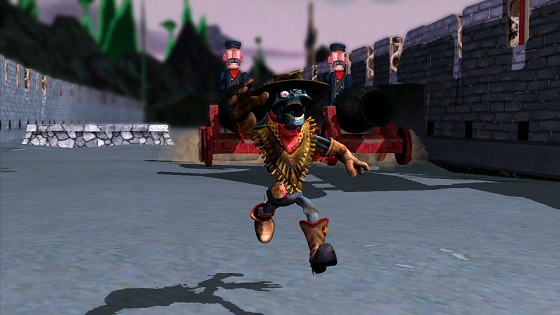
Something that deserves special mention is the character design. The Gunstringer himself certainly has a distinct Western feel about him that provides a real crusty cowboy appearance and the boss characters, as I’ve said before are quite weird on their own, are extremely well done. The wavy tube man is absolutely hilarious and he is the very first boss you go after, letting you know that the experience you are in for is far from the norm.
Audio:
None of the characters in the game are given a voice and you know what? None of them need one. This is because you are given a very skilled narrator who sounds as if he was actually a person living in the West when it was young. The narrator sets the mood perfectly and his deadpan delivery of jokes is usually what makes them all the more hilarious. His tone fits the Western setting perfectly and his drawl will have players loving to hear him talk.
Though if you don’t always want to listen to the narrator, you don’t have to. One of the many bonus features, which I will go more in-depth with later, that can be purchased is commentary tracks from special guests that will are able to be bought and listened to rather than the actual story. This includes the Red vs. Blue creators Rooster Teeth, the Twisted Pixel team themselves and much more. The commentaries are absolutely hilarious and it is worth playing through a level more than once simply so you can listen to the commentary after purchasing it and hear what they say next.
Besides the commentary the sound effects sound relatively accurate, though the audience who is watching the whole thing will always let you know how you are doing. They will cheer for you when you perform a great task or boo whenever you end up getting hurt and it helps immerse the fact that you are just the puppeteer for a show. While this usually would disenchant from another experience, The Gunstringer’s strange setting is all the better for it.
Gameplay:
As a Kinect only title, The Gunstringer makes full use of the motion control peripheral and nothing is left to the controller. The player will be able to navigate the menus through the usual means of hovering their hand cursor (which delightfully looks like the Gunstringer’s glove) and select whichever option they want.
Once you enter into the game, the controls are rather simple. You must move the gunstringer around using your left hand and you do so similar to if you were controlling an actual puppet. Simple sliding left and right usually works but you need to pay attention to the strings holding him as they usually tell you how far you may need to slide your hand to move him one way or another. Jumping is simply done by lifting your left hand as if you were pulling a puppet into the air as well.
Your right hand is going to be the busy one however, as you will be using it to lock onto various targets and shoot to kill. Players can lock on up to six targets at a single time simply by passing the aiming reticle over them, then shoot by jerkign your arm back as if you were actually shooting a gun. Imagine when you were a child and made your finger into a gun shape and went “bang bang” and that is exactly the motion you will be making. Sure you don’t have to actually make your hand into that form but it is certainly a delight to stand there making pew pew sounds every once in a while.
The game is more or less a strict on rails game where you have to jump over obstacles in your path or avoid them by moving left and right. There are occasional moments where you need to hide behind cover and can shoot by pulling your left hand one way or another. There are also a few moments where the game will change dimensions and be similar to a 2D game, or when you acquire a second weapon and can let both hands do the shooting and rain lead down on your enemies, or especially when some boss battles occur usually involving interesting firefights that involve avoiding incoming attacks and then slamming your puppet into them to stun and shoot them.
The Kinect doesn’t have many issues picking up your motions, usually being quite accurate. That isn’t to say that it is perfect though. There are a number of times the game may think you are firing your gun even though you haven’t which can sometimes be a pain though not too much of a problem. This is also a problem when you must jump through certain areas which can hurt or kill you and the game fails to pick up the jump at the right time. While annoying at times, these mishaps are usually few and far between. Plus the game even has a lefty mode so you can switch the controls around if you prefer using your left hand for shooting, making things more comfortable for southpaws.
While guiding the Gunstringer past obstacles, over jumps and also shooting bad guys you will need to maintain his health, though this usually isn’t a problem. There are usually a lot of health pick-ups scattered through a level and when acquired they fill your health up completely. This makes the game pretty easy on its normal setting and only challenging at a few small parts.
This is one of the issues that can be had with The Gunstringer. The game features a relatively short, albeit funny, story which can be completed easily within a weekend though your gun arm may be a bit sore afterwards. The story doesn’t change very much but the length may lend itself to the fact that The Gunstringer was planned originally as an XBLA release.
Still, there are plenty of things that will keep a gamer coming back to play through every level at least a few times. One of these key things is the aforementioned Commentary that can be bought in the Bonus Store, which add a whole new commentary which is worth listening to. Plus there is a literal ton of stuff that can be unlocked in the Bonus store. This includes various modifiers to the game which can make it more fun or different, bonus videos, concept art, galleries and a whole bunch of unlockable stuff. These things are unlocked with money that you accrue playing through a level and given as your score for that level. Of course there is also the Hardcore mode but that is perhaps recommended for only the most diehard gamer because if you do happen to die, you die very hard all the way out of the game to the Xbox Dashboard.
Another thing that can always extend your fun is having another play join in. Nearly the entire game is fully co-op compatible, meaning you and a friend can play pretty much the whole game together. The second player only aims their gun and shoots at things on screen with no real character, meaning Player 1 still controls the character. The interesting thing about co-op is that it is completely seamless, a player can walk into the Kinect’s range, raise their hand to play, shoot a few enemies and leave and the game won’t skip a beat allowing them to enter in and then drop out as if nothing happened.
Overall:
There are many games that can be said to be an experience deserving a Kinect purchase, but most of these don’t have the content to back it up. Twisted Pixel’s The Gunstringer on the other hand has plenty. The title has a very enjoyable story and single player mode, though short, can also be joined by another friend at the drop of a hat making it a great game for friends to play or a family even.
Plus that doesn’t even cover the extra content that is bundled with The Gunstringer. First there is the Fruit Ninja game which comes free with purchase as a download code. You can find my review of Fruit Ninja here and also remember it is bundled with an already great game. Also there is an entirely FMV DLC that is completely free called The Wavy Tube Man Chronicles that only adds to the hilarity and provides a nice little bonus to a game already packed with content.
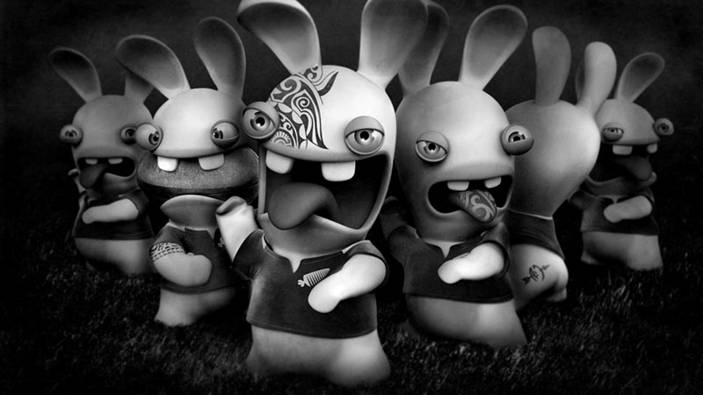
I have to extend thanks to Ubisoft for brightening up a rainy Saturday with this gem of a video! Those Raving Rabbids get everywhere, and now it’s the Rugby World Cup’s turn for some barmy little bunny action. In honor of this years Kiwi hosts the Rabbids have got their own, shall we say, unique, version of the All Black’s haka.
The next title in the popular party game series is due for release in November this year, and Raving Rabbids Alive and Kicking is the first to be developed specifically for use with the Xbox 360’s Kinect. It’s such a perfect match of hardware and IP it’s a wonder it’s taken this long for the game to materialise, and from the media released so far Alive and Kicking looks set to be a great bit of multiplayer silliness.
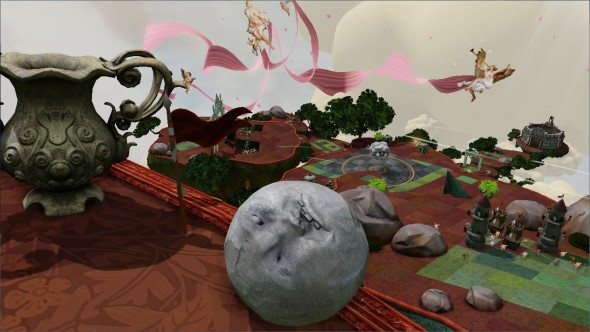
Anyone who read my previous article will know quite how impressed I was with Rock of Ages, and after having written it, I did what I usually do, and try to set up an interview with the creators. Indie Developers being Indie Developers always seem to have enough time for their fans, and ACE TEAM were no exception. Here’s what they had to say during our chat earlier this week;
Capsule: The premise for Rock of Ages is a pretty unique one, and incorporates elements from other genres in ways that had previously been unexplored by anyone in the games industry. Where did your original inspiration for Rock of Ages come from, and how did it advance from concept into finished product?
ACE TEAM: Shortly after we finished Zeno Clash for the PC, the studio gathered to brainstorm all sorts of concepts of what we could do for a completely new game. We wanted to again bring a unique and unprecedented game to the industry. This time we wanted to create something that had an arcade feel and a strong multiplayer component while still keeping a fresh artistic approach.
We let our imagination fly through a couple of weeks where everyone started compiling their own ideas (most which were not much more than doodles on napkins or simple sketches). Those game ideas included other ambiguous game concepts. Eventually we settled on this very simple scheme of rolling a boulder past obstacles placed by your adversary. We weren’t sure if it would be turn-based or something else, but the concept seemed entertaining and had a lot of possibilities. We knew it was going to be a game that we’d have to continuously test and reformulate during development, because it was unlike anything we had previously played. And to date we continue to support the game by listening to the community and releasing updates and tweaks. We still think there’s a lot of space to improve upon with future releases.
Capsule: As I pointed out in my previous article (linked), there’s something very reminiscent of Monty Python about the game. Is there some deliberate homage going on in Rock of Ages, or is it just a case of great minds thinking alike?
ACE TEAM: It’s no coincidence. At ACE Team there are several Monty Python fans and we knew Terry Gilliam’s animation style was a perfect fit for the game. An interesting anecdote is that during the development we learned there was a company already doing a Monty Python game for Facebook. We found about this from one or two game blogs that posted the news and it was awesome to read user comments that were posting that they thought that Rock of Ages was the Monty Python game.
Capsule: Art and music were a big part of your previous title; “Zeno Clash”, with your studio creating some strikingly original and actually rather twisted stuff for the game world, and this unique presentation is also evident in Rock of Ages. Where do your art and music guys get their ideas from, and who/what are their big inspirations?
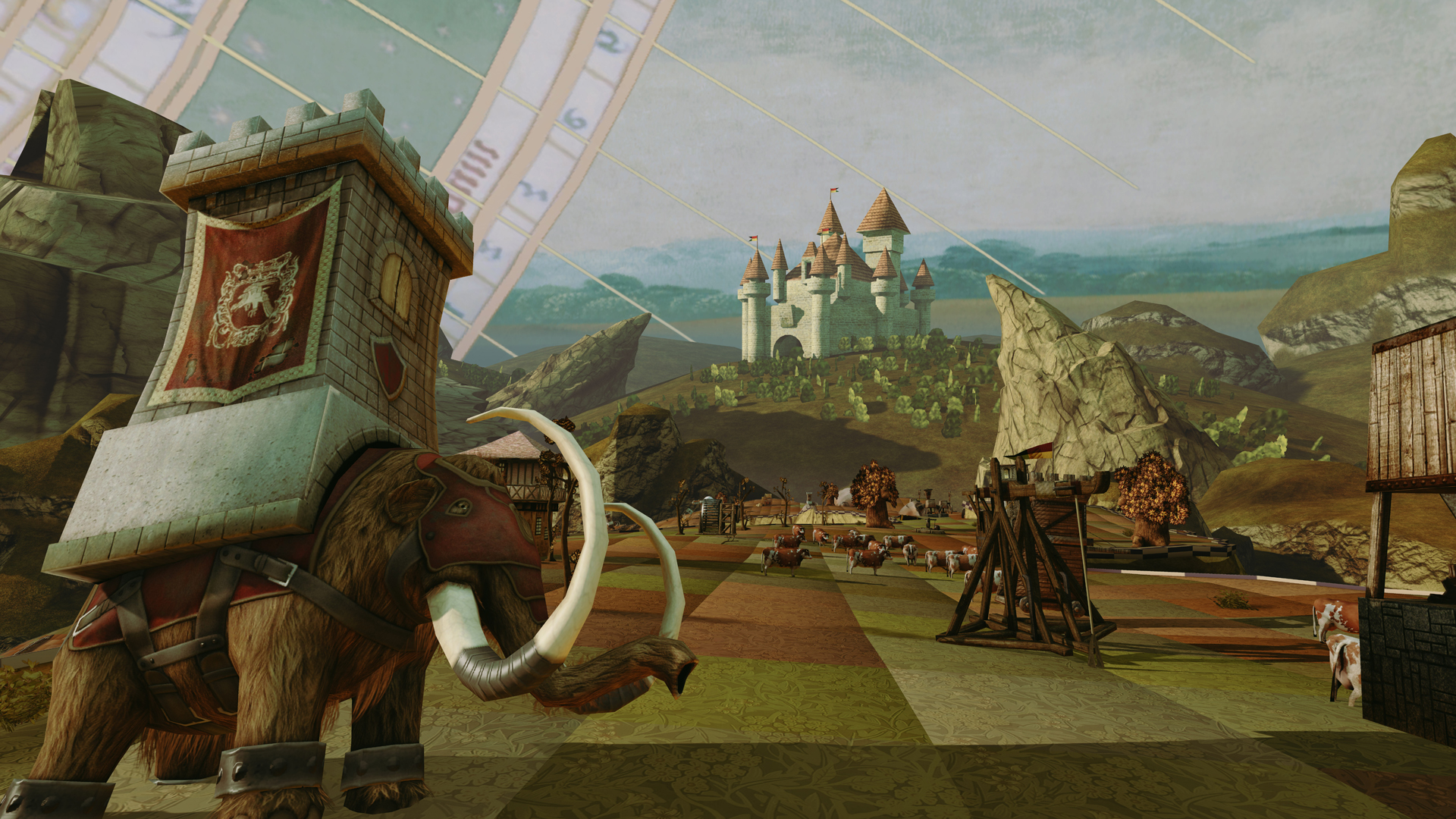
ACE TEAM: We’re a small team so everybody puts a share of their own input to the artistic process, but the overall direction is overseen by Edmundo Bordeu, our Art Director. It was an interesting challenge to convey the different art periods in the environments and the music while retaining the humorous feel. The sources of inspiration were easier to find than for Zeno Clash, because we only had to look into art history. For the music we also wanted the players to relate to the different periods of history with music pieces everyone had probably heard before, so many of the tracks include brief portions of famous masterpieces. This was a great challenge for Patricio Meneses (our composer), who had to blend original composition with existing classics. He did an excellent job and everyone is very happy with the result.
Capsule: Your studio has proven itself to be very adaptable and, well, a bit avant-garde. We saw you jump from an already experimental first person beat ’em up game to an even more perplexing RTS rock rolling strategy thing (you can see I’m struggling to classify the game) in only two commercial titles. Where do you guys see yourselves going next?
ACE TEAM: We want to be able to continue creating fresh new intellectual property, but we also want to elaborate and perfect game concepts we’ve already created, so I expect we’ll probably divide our efforts so that we can revise our previous designs and see how we can improve them. For Rock of Ages we feel that we’ve only tapped into a small part of the game’s potential, so we’re very eager to continue experimenting through future releases. We are already working on our next big project, but it’s a little early to say what it’s about.
Capsule: The formula for Rock of Ages is also actually rather convoluted; combining elements of RTS, racing, chess, monkey ball, to name a few. Perhaps it’s just me, but I’m dying to know, under what genre would you guys class Rock of Ages, and has this changed since the projects birth?
ACE TEAM: We knew the game would not fit into any of the existing genres, so we’ve always called it a “hybrid”. We didn’t try to artificially adhere to any of the preset genre formulas; we just borrowed what we thought would be fun.
For Zeno Clash we kind of had the same classification problem because it didn’t fit with the ‘FPS’ tag, so some people started to call it a FPB (first-person-brawler). I’d love if the same happened for Rock of Ages, so instead of answering your question I’m going to wait for the gaming community to come out with its own acronym. 🙂
Capsule: Rock of Ages is clearly a game with a huge amount of potential for downloadable maps and content, and probably even more experimental things, seeing as there’s actually an awful lot you can do with such a simple and elegant gameplay paradigm. Are we likely to see much downloadable content in the near future?
ACE TEAM: Absolutely! As I previously mentioned we definitely want to continue to add upon the existing gameplay mechanics. We believe that in its current state Rock of Ages can be the starting point for new ideas that will take the game in new directions. Hopefully we can build an online community around it. We’re closely monitoring what the fans have to say about it; what they like and what they don’t like. We’ve already released two or three patches on the PC to address balancing, but the more fun stuff is yet to come, so everyone should stay tuned for future updates.
We at Capsule Computers would like to thank ACE TEAM for taking the time to answer our questions, and as always, we wish them the very best for both current and future projects.
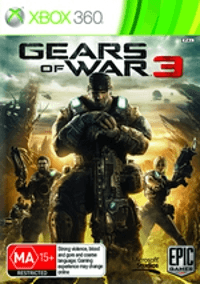
Gears of War 3 Developer: Epic Games Publisher: Microsoft Studios Platform: Xbox 360 (reviewed) Release date: September 20, 2011 Price: $59.99 (Available HERE)
PREMISE:
Anyone that owns an Xbox 360 console will have no doubt heard of the Gears of War series. It is one of the few video game franchises in existence that has spanned its entire story-life or series over the span of the single console generation. In that awkward halo-free time period after the initial release of the Xbox 360 and the subsequent release of Halo 3 in 2007, hardcore gamers had to tie themselves over with something, and the very first Gears of War game most certainly filled that void. It sated the bloodlust of the shooter-loving gamer, and yet was original and innovative for its time. And while Halo still stands as the major Xbox 360 exclusive series, Gears of War most certainly brings up a very close second, and is often considered the modern standard to which third-person shooters are held.
The appeal of the Gears of War games has often been attributed to many different things. The deep, engaging storytelling, the gritty visual style, the polished flow of gameplay, the dark sarcastic sense of humor, and not to mention the sense of pure satisfaction that comes from tearing an enemy limb from limb with your gun-mounted chainsaw. The events of Gears of War 2 showed players a new side to the Gears Universe that had a dramatic impact on the story and the whole war, but left some loose ends hanging. And after that voiceover teaser left at the end of the last game, there was no doubt that at least one more game would be needed to finish things. With the introduction of so many new in-game elements and the calls of the fan base for yet another instalment, Gears of War 3 has come into existence. So exactly how well has this latest addition to the Gears family stacked up? And has it learned to evolve as an ongoing series is expected to?
STORY/CAMPAIGN
The ending of Gears of War 2 was a bittersweet one for many players. Following the final battle in which the heroes of Delta Squad sank the last human stronghold on the planet Sera, Jacinto, it appeared as though the war may have been concluded. The human COG forces were successful, Delta Squad survived the encounter, and the water was flooding down through the planet to wipe out the Locust forces as well as the emerging Lambent. However, a severe harrowing was found to be leaning over every player as the game concluded. The Locust Queen was no doubt still alive, and the Lambent were not going to be disposed of so easily. The final part of the game features a voiceover by Marcus’ father, asking for his help.
It is now two years later. The human race of Sera has been reduced to wandering nomads. Civilisation has all but been abandoned. The COG forces are now even fewer in number, and survival in the world is a day to day challenge. Although the Locust horde was more or less defeated, the mutated more vicious Lambent have arisen to take their place. Forced to separate their numbers for the sake of survival, the COG forces have split into two groups. The military centred COG forces have taken to the sea, while the civilian population has made an attempt to recolonise on mainland areas. One of the game’s leading characters Anya Stroud states that the whole world is now “Stranded” making reference to people who must fend for themselves in order to survive.
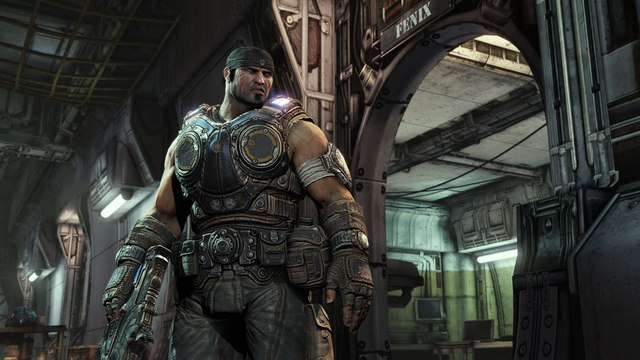
It is at this point that we see our protagonist, Marcus Fenix, receives a strange message from a former superior officer. He learns that his father, whom both he and the players assumed was deceased, is in fact alive and being held captive by the Locust, and that he has discovered a way to destroy the Lambent. However, the message is damaged, and with Baird, the team’s engineer out on a recon mission, Marcus has to wait for his return to decrypt it. However, it is at this point that their ship Sovereign, is attacked by a large Lambent force, in what can only be described as a full scale invasion of the surface. As the players, we knew it was coming eventually. With the Locust mostly out of the way, the Lambent have nothing standing between them and the surface world. For humanity to have any chance at surviving this new war, it may all hinge on Marcus finding his father to put a stop to everything.
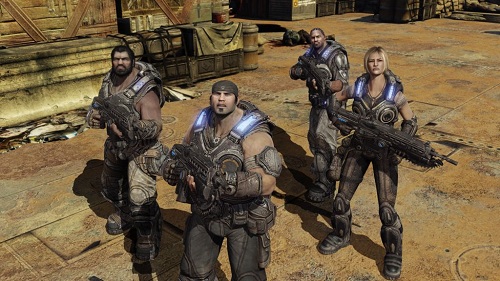
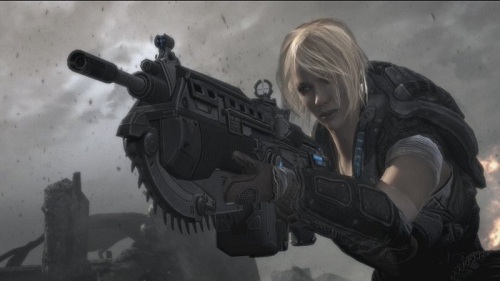
So once again, Marcus must join up with Delta squad members Dominic Santiago, Augustus Cole (Cole Train) and Damon Baird to take the fight for survival back to the enemy. However, this time, they are also joined by their former advisor Anya Stroud, and several new COG troops, namely Jace Stratton, Samantha Byrne and Clayton Carmine. One of the interesting features of Gears 3 is in fact, the existence of TWO teams. One led by Marcus, the other by Cole. Within the opening stages, many players going through the single player campaign will be happy to learn that they will not be stuck as playing as only Marcus for the course of the game. It is also interesting to note that the developers also put a vote out to the public prior to the game’s release regarding whether or not the new Carmine should die, as is Gears tradition. The results of the vote were never officially released, but a play through of the game will reveal to players the result of that vote.
The story does a very good job at picking up where everything was left after Gears 2. Although two years have passed in the story of the Gears Universe, players are still able to see that their much loved characters have tried their best to get on with their new lives. It feels like very little time has passed at all in the universe, as the main characters still tend to have the same mannerisms and abilities that they had in the previous games. And while some small visual touch ups have been made to the character models, it still feels like coming back to see some old friends. The story itself focuses on the loose ends intentionally left at the end of Gears 2, to not only expand the player’s view of the Gears Universe, but to also conclude the saga of Delta squad. The delivery of the story is performed incredibly well in a balance between both well polished cut-scenes and gameplay sections. Doing so allows the players to feel that they are more part of the story, and that it is not simply being lectured to them. This is how Epic Games has immersed players successfully in the past, and it’s heartening to know that the same has been achieved here.
GAMEPLAY
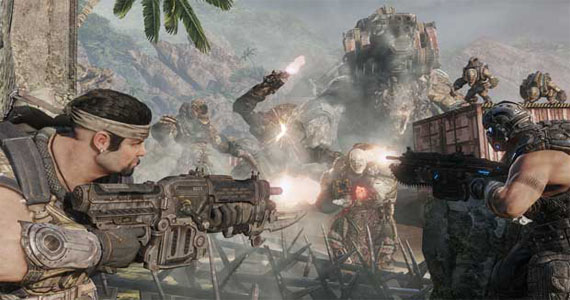
Gears 3 features a multitude of different game modes to appeal to both story-driven, achievement driven and competitive gamers alike. The campaign mode itself features both a stock standard story mode, where players can experience the newest chapter of the Gears Saga, as well as Arcade mode, which the player is able to rake up points for kills to put towards achievements. This is also useful as a competitive tool. This game mode differs very little from the story mode, other than the fact that it will allow players to obtain achievements. Being put that way, why wouldn’t you choose arcade mode? It should also be mentioned that Gear 3 is also the first of the Gears games to allow for 4 person co-op within the campaign. This is a feature we have seen implemented in Halo, Borderlands and Left 4 Dead before, and has often paid off for players looking for a great co-operative story.
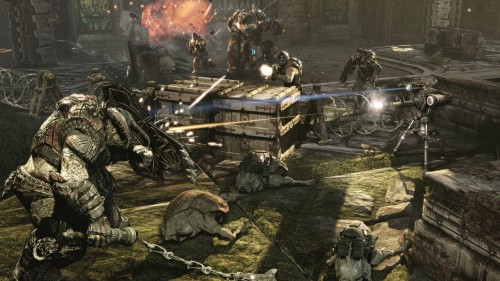
The core gameplay, as the genre suggests is dominated by third person combat, which, for the most part utilise ranged weaponry and explosives. For veterans of the Gears of War games, everything will thankfully feel like familiar territory. A few new weapons and features have been added to the mix, but ultimately the combat has still managed to retain its gritty and brutal nature. Many of the functions have been retained over time, including the character bleed-outs, wall-stick cover movement, the quick-snap reload, targeting functionality and “Press (Y) to look at stuff” mechanic. The opening stages of the game are also kind to newer players, offering not only a well functioning tutorial system, but also a brief documentary style video where Anya explains the events of the previous 2 games.
Players will find that they spend a large proportion of the game running from cover to cover and scrounging for ammo drops. One of the slight drawbacks that must be said for the game is that entering combat situations has become glaringly obvious. Whenever a player moves into an area with a strange abundance of chest high walls, then it’s a pretty safe bet that some form of action is about to take place. That said however, there will be many moments of combat flow that will surprise the player in a similar fashion to the previous games. One might think that the combat nature gets repetitive, but no matter how many times a firefight breaks out, the game continually entices the player to push further and further into the story. Nailing those short, controlled bursts of combat driven fun is what has helped define many of the modern shooters of this day, and Gears 3 pulls it off just as well as it’s predecessors. No matter whether it’s the 1st, or 1000th time you face off against the grubs and glowies, it never stops being fun. And let’s face it, no matter how many times you do it, the Lancer chainsaw is still satisfying.
The only real issue that I had with gameplay in my play through was to do with a few small glitches. In my first play-through, I had joined into a co-op match with a workmate and we proceeded to breeze through Act 1 on hardcore difficulty. However, every now and then, something strange would happen. Between short bursts of cinematics, I would totally lose my ability to take cover. I tested my (A) button on the menu screen and it worked fine. But for some reason the game refused to register my cover action. And this became a small pain on hardcore difficultly, as I didn’t particularly wish for my character’s body to occupy the same physical space as several hundred bullets. (OK, maybe while I was Baird…) Either way, it became something of an annoyance. Once a cinematic was hit however, then the glitch would disappear. I have only run into the problem twice in early stages. The glitch doesn’t affect the core gameplay to a huge degree, but on the harder difficulty settings, it will be the ire of many. Another minor glitch I experienced was the game’s flat out refusal to engage in a cut scene at one point. The cut scene was apparently necessary to proceed through the campaign, so a quick checkpoint reload was required. Thankfully afterwards the cut scene played without drama. Again, not a game breaking issue, but one which I can’t help but feel should have been noticed. Hopefully a successive Xbox live update will amend these issues.
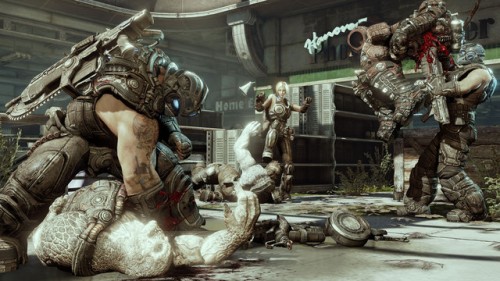
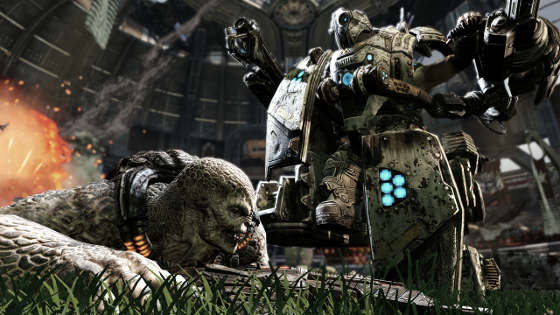
It could be argued that the gameplay mechanics are guilty of remaining static over the course of the series. Very little in terms of combat has altered from the original Gears of War game, and the flow of gameplay has not really evolved. That being said, I think the real question gamers should ask themselves is do they WANT it to evolve? For a series that has spent its entire shelf-life on a single console generation, it is understandable why certain elements have been kept the same. Too many alterations to a much loved series could create just as much criticism as keeping it stagnant. Achieving that balance between series faithfulness and innovation is a VERY difficult chord to strike. And while it’s true that some gamers would like to see a little more originality, for most of us, myself included, will be happy to play through Gears 3 just as we have with the previous instalments. Gears 3 has innovated to a small degree, such as including mechanised walkers and silverbacks to gameplay, but ultimately it still feels like we’re playing a Gears of War game.
AUDIO / VISUAL
In a very similar fashion to gameplay, the audio elements could be accused of not adhering to Darwinism, to an extent. For the most part, the soundtrack and sound effects have remained just as they were from Gears 1 and 2. The same musical tones for the end of combat and new objectives are utilised, and the effects joined onto the menu screens still retain the same feel. The game has also retained many of the musical scores featured when fighting certain Locust and Lambent enemies. However, a few more soundtracks have been added to the mix to help players develop a sense of identity for newly introduced enemies and combat scenarios. My opinions on the voice acting is mixed. While we all know that Marcus’ gravelly voice is something of a trademark, and Cole Train’s “WHOOO!” is pretty much patented, some VA work will end up having the “Slippy Toad” effect of voices. The worst offender is Sam on Cole’s Team. A clear attempt has been made to manufacture a strong Australian accent. The keyword being “ATTEMPT”. Again, a minor issue and nothing game-breaking, but still irritating to a degree. Any otherwise, the game’s voice acting is well written and well appropriated for both action and dark humour.
The visuals on the other hand have clearly undergone an evolutionary change. One of the major criticisms with Gears 1 and 2 was the degree of eye strain that was caused by the running effect against the backgrounds. Additionally, many players had issues with how combat could easily descend into an unbalanced, luck-driven cluster of explosions and bullets. The developers have no doubt taken those notions on board and revamped the visual styling’s of the game. Not only have enemies and characters themselves undergone a visual touch-up and makeover, so too have the environments and special effects. The game does a great job of portraying this distopic view of an alternative future where civilisation is limited and savagery runs amok. However, the best visual touch ups have been done to remove the eye strain from the player. The problem with the brown and black ambience that was layered over previous game environments was that it differed very little in palette from the character models. Attempting to follow character movements over such backgrounds became a challenge and adjustment was required. This time around however, the visuals are now better distinguishable. While the landscape still retains the brownish hue, everything visual now seems to flow more smoothly. A job well done on that I must say.
MULTIPLAYER
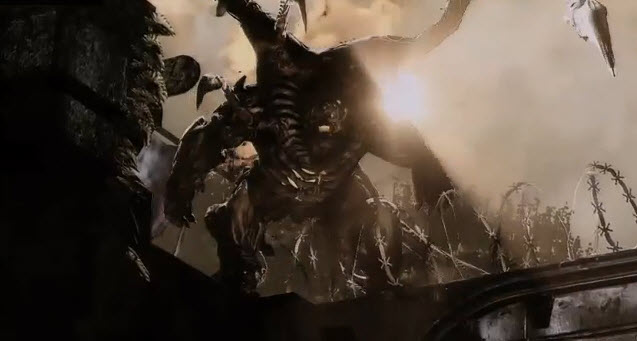
While 4 player co-op has been added to the campaign, it should also be mentioned that another, entirely new game type has been added to the mix in Gears of War 3. Now starring alongside the campaign mode, competitive versus mode, and the survival oriented Horde mode, Gear of War 3 has introduced the brand new Beast mode. And no, this has nothing to do with Beast Wars. Essentially Beast mode is the antithesis of Horde mode. Rather than controlling several COG troops to survive against waves of Locust and Lambent enemies, players can take on the role of the various Locust races to hunt down and kill human survivors. This particular take on the war will no doubt leave many players like myself grinning and laughing maniacally as they shoot, smash and stab their way through the piles of puny pathetic humans. Each match of Beast lasts for 12 rounds, each time increasing in difficulty, but each time providing the player with more Locust races to utilise for destruction.
On the other side of the fence, Horde mode now feels even more intense and high-stakes than it did in Gears 2. New forms of traps can be set for enemy hordes, and the addition of new weapons to the gameplay mix has allowed for many players to come up with new and interesting survival methodologies, whether they be offensive, defensive or explosive. Just as with Beast mode, Horde mode is a great co-operative oriented multiplayer gametype.
For players really looking to test their third person shooter skills, many competitive gamers are likely to grace the online arenas to duke it out over Xbox live. The multiplayer gameplay in versus mode still retains a very similar feel to that of previous games, and still involves the old “random-matchmaking” feature to find a appropriate game for players of different skills.
Overall, the multiplayer feels solid. In my experiences online, Lag factors have been kept to a minimum, and the online gameplay in both competitive and co-operative game types is still raw fun. And while you’ll no doubt get a little peeved at the 12 year old kid screaming profanities in your ear, the multiplayer options now available in Gears 3 provide many of us with the chance to scratch that social itch.
CONCLUSIONS
Gears of War 3 is an insanely enjoyable experience regardless of whether you’re playing single or multi-player game types. The small glitch factors are easily overlooked when it comes down to making a final judgement. As one of the few series that can claim exclusivity to the Xbox 360, Gears of War 3 has performed very well in delivering a well paced third-person shooter experience. It is kind to both veteran and newbie players alike, and the delivery of the story is well executed. It has innovated to a limited extent to retain a degree of gameplay originality, but at the same time remains faithful to the roots of the series. For many gamers who own an Xbox 360 console, regardless of whether or not you are already a Gears fan, Gears of War 3 is definitely a must have title.
Overview
Offering more than rotations, Rotastic is a fun filled adventure that encompasses 7 different worlds that test your skills each and every step. Deadly traps and challenging objectives hinder your progress in your quest to collect the worldly gems. But is Rotastic the gem we are all looking for?
Gameplay
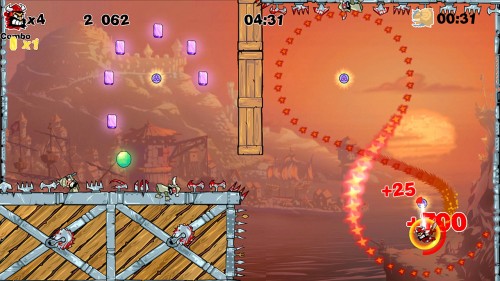
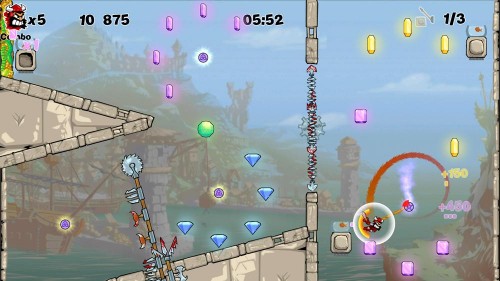
Simple mechanics provide the basis for the entire game. For both campaign and multiplayer, you may rotate around the closest hook by pressing (A). This simple control can be manipulated in many different fashions to provide bonuses to your score. For instance, making a figure 8 between two hooks will provide an additional bonus for creativity.
Additionally, you can change the direction of the rotation using the left and right bumpers. Using the bumpers becomes critical in levels that have traps or bosses that take up a majority of the screen.
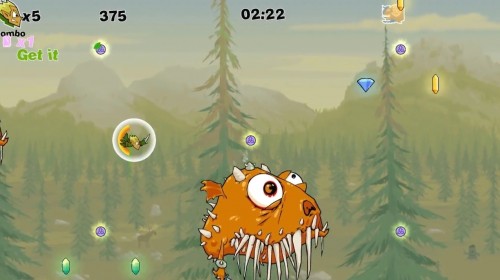
The main objectives change in accordance with each level. Most levels require the player to collect all the gems in order to finish. As a light blue gate opens, the player must pass through it to complete the level. Completing the level quicker will add to the overall bonus and potentially rank you on the global leaderboards. However, some levels just require survival and are better known as boss stages. Giant machines, floating fish, and other obnoxious beings will deny you passage to the next level. While avoiding traps and giant fish, always remember to not fall. Falling beneath the screen will kill you unless the character is attached to a hook. You will receive bonuses for being that risky, but you cannot collect a bonus if you are dead.
A player may attain helm trophies after each level completion. Bronze, silver, gold, and platinum helms are attainable and can be gained by performing unique acrobatics. A timely completion without losing a life adds sufficiently to the total score. Achieve a platinum helm to see how you rank globally.
Most video games utilize a health bar to add layers of difficulty. Unlike most games, Rotastic only provides a shield that can save a character from a collision with a spike or boss character. Hitting a spike after shield deactivation causes death – something I am very familiar with. Moving from one hook to another deactivates the shield and leaves the player vulnerable. Only by grabbing onto a hook for a small duration will the character regain protection.
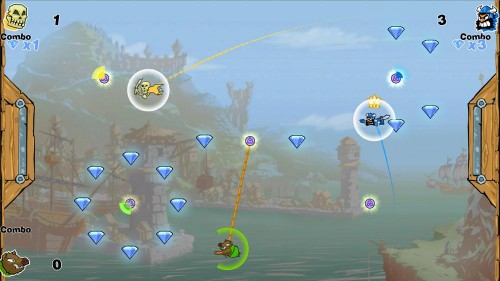
Now I would like to discuss the positives in Rotastic‘s multiplayer. Offering up to four players simultaneously, the available mini-games are exciting and fun. Item Collect is all about collecting enough gems before your opponents. By setting a collection limit, players will fight to the death to reach the required gems.
Deathmatch – on the other hand – provides a thrilling killing experience. By rotating closer to the hook, you are able to cut your opponents rope and potentially send them to their doom! Changing your rotation direction may prove advantageous, but doing so will leave you momentarily vulnerable. An opponent with a full shield will send you flying without proper protection.
The problem I foresee is not having an online feature other than a ranking leaderboard. While four players offline might be fun, you may not have the luxury of playing with three others. Granted the option for bots is available, but an online multiplayer option could improve Rotastic‘s fan basis and offer more playability.
Graphics/Audio
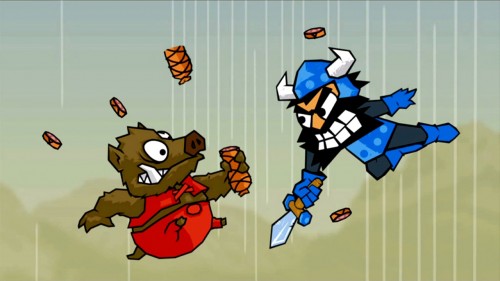
Presented in a 2D fashion, graphically the game is pretty. I would offer another word, but pretty is all I could muster up. A skirt wearing skeleton doing complex acrobatics on a screen trying to kill a sausage eating boar is amusing. And you better not cut that boar’s sausage!
Mimicking the comical nature of the graphics, the audio presents itself in a cartoonish manner. Whether you are falling to your death or on a collision course with a chicken, the game offers funny sounds to keep your enjoyment. No collision is left untouched without audio!
Overall
Delivering an easy to learn gameplay, Rotastic may find itself gaining a wider fan base. The simple mechanics of rotating from hooks is fun and can be manipulated into larger combinations that offer huge bonuses. The leaderboards determine how a player is ranked globally and is available to see after each platinum completed level.
Being an arcade game, I thought Rotastic would have online multiplayer as its most prominent feature. This assumption was not fulfilled. What I was left with was not nearly sufficient, but an offline multiplayer will have to make do.
Rotastic has a great adventure mode that offers you unique objectives and that challenges your skills with nearly 70 levels. Competing to acquire the highest rank in campaign will be the game’s re-playable quality. By providing cartoonish and amusing assets, Dancing Dots created a fun title that anyone can enjoy.
It might have already been released for the Xbox 360, but there is still another version of Child of Eden to be released. The Playstation 3 version has a new trailer, courtesy of Ubisoft which features Lumi, a young girl within Eden, an archive of human history which is attacked by a virus. It is the player’s job to rid of the virus by going through the archives. It also features some video of gameplay, but it doesn’t look any different to the Xbox 360 version. Both games offer support to each console’s respective motion control schemes: Playstation Move and Xbox 360 Kinect, in addition to regular controls. Developed by Q Entertainment and published by Ubisoft, the game is to be released on the 27th of September, which is next week.
For Spike’s (Michael Marr) review of the Xbox 360 version, then follow this link.
On the 29th of September, be sure to drop down to your local game store as two Playstation 3 collections are finally released in Australia. God of War Collection: Volume Two (God of War Origins Collection in North America) and Ico and Shadow of the Colossus Classics HD will be available to own for your PS3 library.
The God of War Collection: Volume II is the second God of War collection to grace the Playstation 3 library after the God of War Collection, which feature the first two installments of the Kratos trilogy on the Playstation 2. Developed by Santa Monica Studios, the collection will include the Playstation Portable titles Chains of Olympus and Ghost of Sparta. Not only has the game been enhanced with High Definition graphics, but also features the ability to display Stereoscopic 3D and includes trophies.
The Ico and Shadow of the Colossus Collection brings two highly critically acclaimed Playstation 2 titles to a new generation of console gaming. Developed by the brilliant minds of Team ICO, both Ico and Shadow of the Colossus challenges players with their unique style of combat, puzzles and strategy. Like the God of War Collection: Volume II, it will support Stereoscopic 3D and trophies. Currently, the same team are working on the highly anticipated The Last Guardian, also for the Playstation 3 and targeting a release sometime next year.
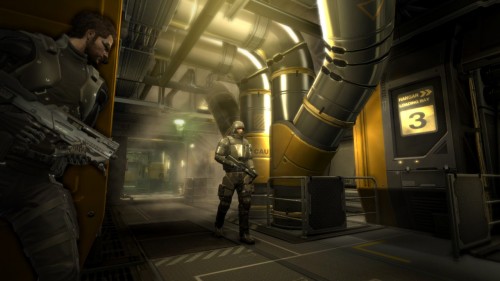
If you were curious about what to expect when Deus Ex: Human Revolution’s upcoming Missing Link DLC is released next month then perhaps you will be interested in watching the below video. Eidos Montreal have provided a small walkthrough video which shows off a little about the game’s starting point and jumps around until after he manages to get his augmentations back.
The whole video is narrated by lead narrative designer, Mary Demarle as she gives us a brief rundown of the DLC. Also she says that the extra content will provide roughly five hours of extra playtime. At first it seems like gameplay is focused heavily upon stealth, but there are always ways around that for our more violent friends huh?
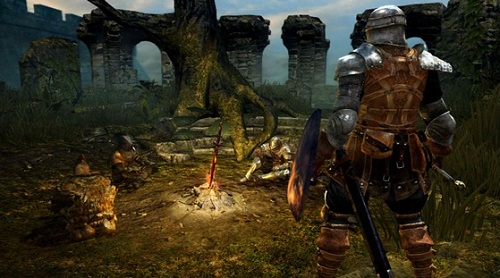
Yesterday it was discovered that when Dark Souls was released in Japan, the game was significantly bugged, including one that froze the game whenever anyone decided to try and play online. From Software quickly jumped on the problem and shut down the online servers and told their fans that they were working on finding out the problem and fixing it.
It seems it didn’t take them very long as they have found the flaws and are planning on releasing a patch next week at some time for Dark Souls. It is great to see that this patch has been made before the release date for Dark Souls in North America on October 4th. Hopefully there will not be such a problem when that date rolls around.