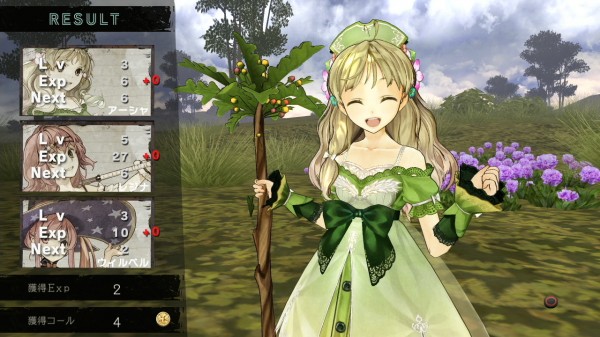
During their Anime Expo panel this weekend NIS America had some good news for fans of their video game releases. The publisher confirmed that they will be releasing an English localization of Atelier Ayesha sometime in the future. The representatives at the panel stated that fans would still need to wait about three or four months to learn more however.
Ayesha was released in Japan last week on the PlayStation 3 and featured a number of pleasing changes to the standard Atelier formula. It is worth noting that Atelier Meruru was released in under a year after the Japanese release, so perhaps Atelier fans will see the game sometime before June of next year.
While THQ has had its share of bad news lately, it seems that the company has avoided being delisted from the NASDAQ (stock market) by performing a reverse stock split. Last week the stockholders met and approveda ten to one reverse stock split. This has condensed THQ’s 70 million stocks down to only 7 million stocks, raising their value from $0.62 to $6.20.
The stock split will go into effect next Monday and it will raise the price well over the minimum $1 required. Now whether or not the company will manage to keep their stock price over $1 will be a question for the future. If you want to help out THQ well, their next game, Darksiders 2, will be released on August 14th.
It was quite a surprising turn of events last week when Seth Killian announced that he would be leaving his role as Capcom’s strategic marketing director of online and community. At the time he did not reveal where he would be going or if his next role would even place him in the video game business.
Well today it was revealed at the PlayStation Blog that Seth Killian will be taking up a roll as lead game designer at Sony Santa Monica. He will begin working on PlayStation All-Stars Battle Royale and with a number of other studios. Killian stated on the blog that “Fighting games are very close to my heart, and as someone that’s spent much of my life with traditional fighters, All-Stars has been a great opportunity to take a step back and rethink fighting fundamentals from the ground up.”
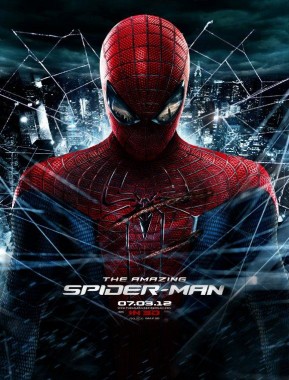
The Amazing Spider-Man Studio: Marvel Studios, Laura Ziskin Productions, Marvel Enterprises, Columbia Pictures Publisher: Columbia Pictures, Sony Pictures Format: Cinema Release Date: July 4, 2012
Overview
The Amazing Spider-Man has swooped into action 5 years after the last series ended with a new cast and crew to revive a barely passed franchise. The new movie has attracted some criticism due to the fact that the reboot has happened so soon after the original, and comparisons are definitely going to be drawn between the two so the question is how does it measure up?
Story
One of the big things when it comes to this movie is the fact that it’s a reboot of a movie franchise that only ended five years ago. However, as Rhys Ifans – who plays Dr Curt Connors and The Lizard – offers this concise and excellent reasoning for the remake:
“If you go to the theatre anywhere in the world, you will see a production of Hamlet every year. The reason that we revisit these plays is not necessarily because they’re good plays, it’s because they speak for a generation.”
The biggest difference about The Amazing Spider-Man and the earlier series is that this one has a far more character-oriented plot. As one can expect from the director Marc Webb, who is a character actor, the focus is on the characters and is a far more realistic depiction of what would happen in the situation of a teenage boy getting super powers. While some may think that it is a grittier version of the story, personally I believe it’s just got that sense of realism that wasn’t present before. Beyond this, I won’t go into comparing the two movies any further because, to be honest, they depart almost completely from each other.
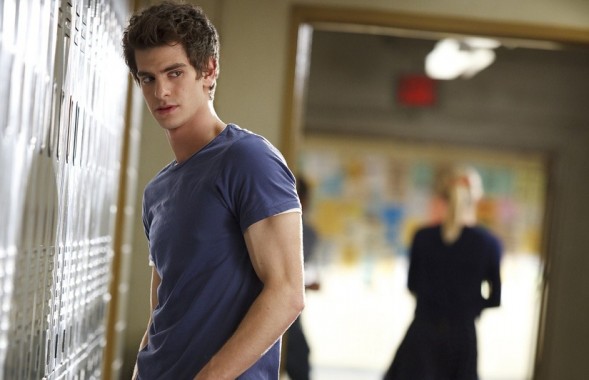
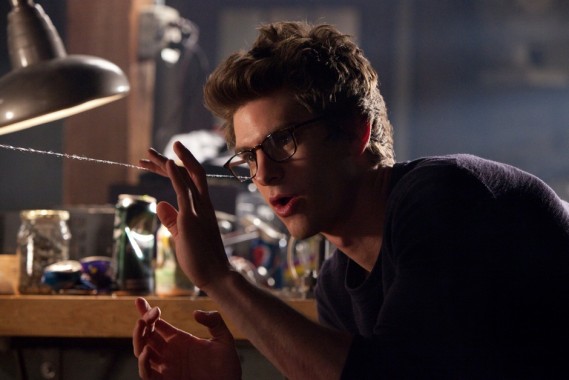
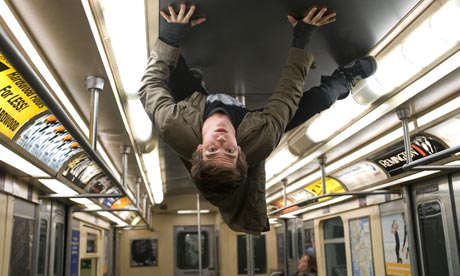
Andrew Garfield manages to pull of Peter Parker brilliantly, as well as the character of Spider-Man. He has a geeky, yet sarcastic and somewhat still confident sense of humour, he manages to pull off the awkwardness of being a teenager and the elation of discovering a set of powers. He takes the audience on the journey with him and brings the character to life with a huge amount of ease.
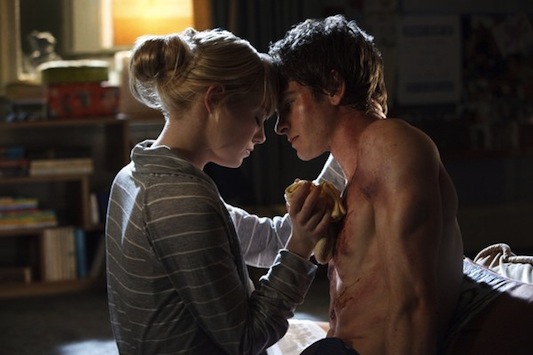
Not only is Andrew Garfield a great Spider-Man, but also his chemistry with Emma Stone, who plays his romantic interest Gwen Stacy, is truly amazing. Their scenes are always amazing, wrought with so many different layers, and are just fun to watch.
The story line is truly an interesting one, and like I mentioned earlier, it’s very character based. Instead of focusing on the super hero side of things, it focuses far more on the characters and each decision that the character’s make feels far more organic and realistic than you see in most super hero movies. Spider-Man is the most human character of the super heroes, being a teenage hero who has so many life issues and has to come up against so many obstacles that affect so many people. The relatable aspect of the story is stepped up a notch with this movie, and it makes the movie even more entertaining and involving to watch than your standard super hero movie.
The fact that it is more character focused may result in some people feeling like the movie isn’t as action packed as they were expecting, although there is no shortage of action sequences. And by character focused I’m not just referring to Peter Parker, but also the side characters. The school bully, Flash Thompson, actually is given far more dimensions than you’d expect in any show that explored high school.
Visuals
The graphics are truly awesome, as one can come to expect from a super hero film. There are some great stunts, and Spider-Man does move in a really interesting way that reflects the whole Spider thing. Andrew Garfield did mention that he studied a lot of athletes and how they moved, which informed the way that he physicalized his performance.
Audio
The Amazing Spider-Man has a great soundtrack accompanying the movie. It manages to match the hugeness and epic nature of the movie, increasing its grandiose nature, as well as managing to touch upon the intimate and quieter moments of the film. Plus, a few choice moments and songs go great with the movie and add to certain parts of the film, in particular when Peter is exploring his powers.
Overall
The Amazing Spider-Man revives a franchise that wasn’t necessarily in need of a revival, but it certainly gives the character something new and fresh. It perhaps doesn’t follow the comic book character canon as strongly as some people may prefer, but it works extremely well as a movie, and the casting and directing is fantastic.
The Amazing Spider-Man is an absolute delight to watch, and really pays tribute to one of the most interesting characters in the super hero universes, and in my opinion is the best Spider-Man movie to date. It is a definite must watch for those who love comic book heroes, as well as those who aren’t that crazy about them.
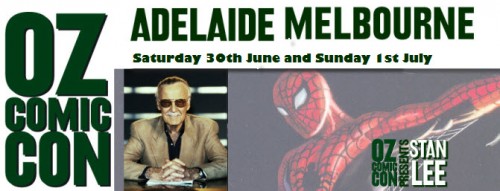
The first impression I had of the Oz Comic Con was ‘oh wow that is the longest line I have ever seen’. The event was clearly in huge demand, and seemed to be somewhat over capacity, given that they could have comfortably fit everyone in a sporting arena. It is no surprise that the turn out was that massive though, with Stan Lee’s appearance, as well as Patrick Stewart, and just the simple fact that it had the name ‘Comic Con’ attached to it. Unfortunately, due to a lack of planning, this meant that a lot of the people waiting out in the Melbourne cold would not get to come into the event. Clearly in terms of numbers the event could have been better organized, but one can only hope that this is catered for in the future.
Once inside, the floor wasn’t terribly large, probably because the amount of interest was underestimated a fair bit, and had a lot of stalls that are also present at other events such as Supanova. There was the variety of fandom merchandise, as well as robot builders, comic book stalls, anime stalls, and of course weapons stalls. There were also video games set up on the floor, with arcade sticks available to play with, as well as an inflatable laser tag tent. All in all, it was passable but could have been improved by expanding the floor, having more stalls, and allowing more people to be able to stand comfortably inside. But, as the first Comic Con, there were always bound to be kinks in the plan.
There were a whole bunch of cosplayers, with more comic book costumes than the usually anime dominated state of these types of events. Some went from simple, to very complex, while others wandered in fandom packs (yes, there was an Avengers group, obviously). As always, it was interesting to see what people had come up with, and there were quite a few people who would stop cosplayers to get photos with them, which is always a good sign.
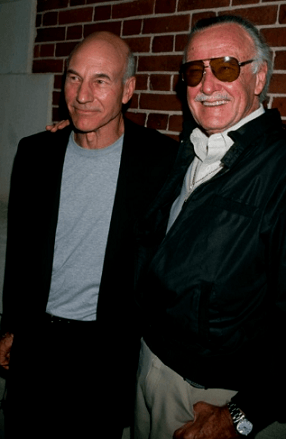
The panels were quite well done, with some interesting talks by people and insights into their work and revealing some stories that people weren’t necessarily aware of. The absolute highlight was, of course, Stan Lee’s panel. Not just because he was Stan Lee, but because he was just a complete delight to listen to. Read about the Stan Lee panel HERE. This was closely followed by Patrick Stewart and his son Daniel Stewart’s panel, which was extremely entertaining and a wonderful panel to sit on, which you can read HERE.
Overall, it was a decent day, and not a bad way to start what will hopefully be a long-standing event with many guests (although the possibility of getting another guest that is as eminent as Stan Lee is quite low) to come. Did you go to Melbourne’s first Oz Comic Con? What did you think? Let us know in the comment section below!
Check out the rest of our Oz Comic Con coverage on the rest of the site, including panels, and interviews!
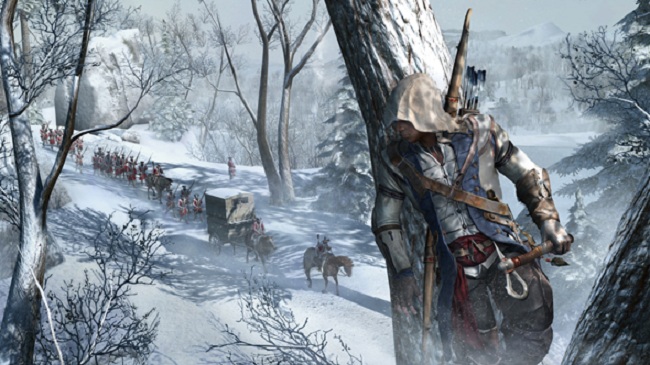
Ubisoft has released a new trailer for their highly anticipated Assassin’s Creed III, just in time for Independent Day on July 4th. The trailer not only shows off awesome gameplay footage with game’s American Revolution backdrop, but also reveals new pre-order bonuses for Assassin’s Creed III.
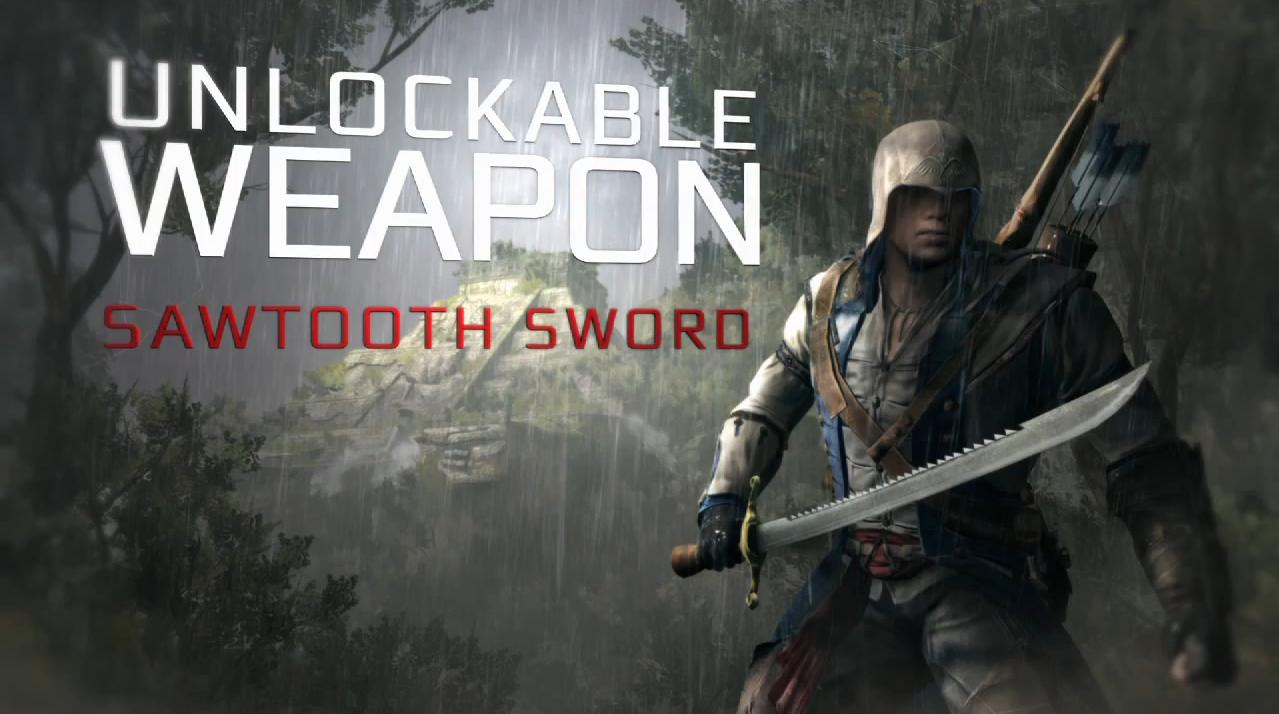
Pre-ordering at Gamespot will allow players access to the single player mission Lost Mayan Ruin and unlocks the Sawtooth Sword.
This offer will most likely be extended to other video game retailers around the world, so stay tuned for more details as they come.
Assassin’s Creed III is set to be released on October 30 for Xbox 360, Playstation 3 and PC.
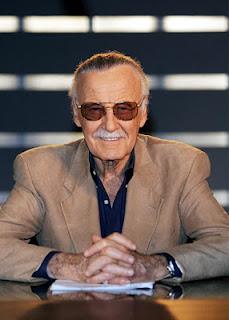
Almost everyone in the world, regardless of background, their dedication to comic books, and how much they know about pop culture, recognizes the name Stan Lee. Immediately once you hear the name you think of Marvel comics, Spider-man, or just a cool looking guy with tinted glasses. The legacy of Stan Lee surpasses any one person, or generation, he is responsible for creating something that has touched so many people, and affected so many, that his name is almost bigger than he is.
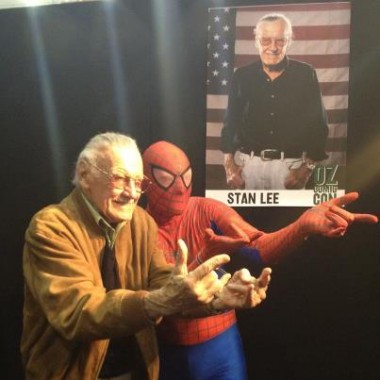
Here at Capsule Computers were lucky enough to be in attendance at the Oz Comic Con 2012 panel for Stan Lee, which was packed right to breaking point, and full of so many adoring fans that the atmosphere in the room was incredible. Somewhere between shock and delirious excitement, it would have been hard to not feel the love in the room.
The thing that first struck me, as someone who appreciates comic books, and loves me some good super heroes, but hasn’t quite crossed into that fan girl stage, was the utter humility and humour with which Stan Lee presents himself. Not only does his name and legacy represent something so much larger than life, but he seems to understand it as well. He was full of self-deprecating humour and didn’t seem to take himself anywhere near as seriously as most of the people in the room did. He, honestly, seemed just as happy to be there as everyone else was.
He had the largest and most active stage presence, his personality seemed to fill up the entire room, and every time he’d answer a question, or finish a story, everyone would burst into applause and cheer him for it. And it was deserved, given that he must have an incredible history around the convention track and that experience really worked well for him.
One example of his humility was when someone asked if he could travel to any point in time where would he go, and he answered back to the beginning when he was working on comics with Jack Kirby and Joe Simon and how Jack Kirby would draw so well that it would actually inspire him to write the amazing stories that he did. While Jack Kirby certainly deserves credit for his art, the fact that as a writer Stan Lee passes the credit onto him for that shows just how humbled and lacking in arrogance he is. Which is quite a feat, given just how many times that weekend alone he must have been told that he was someone’s idol, or hero, or just that he was the most amazing human being.
On the slightly more serious side of things, he also discussed the Disney purchase of Marvel and how that wouldn’t affect the movies that they were bringing out, but instead just give them ‘deeper pockets’ with which to make their movies. This comment of course will incite doubt from the community, but nevertheless, you can’t not believe Stan Lee. After all he is Stan Lee, and he does have his cameos in the movies so he can’t let the movies get Disney-fied.
His cameos were also a subject that he talked about and, in a moment of confidence, revealed to us that he had doubled the Avengers sales just through his cameo. Because people may have missed it, so they immediately bought another ticket just to catch it. Now, I’m not one to normally laugh out loud when watching something, but I can freely admit that Stan Lee had me in stitches.
It was a tragically short panel unfortunately, I could have listened to Stan Lee talk all day, and I’m sure I wasn’t alone in that. Still, however brief a period, it was well worth the time and this certainly isn’t a forgettable experience at all.
Check out the rest of our Oz Comic Con coverage on the rest of the site, including panels, and interviews!
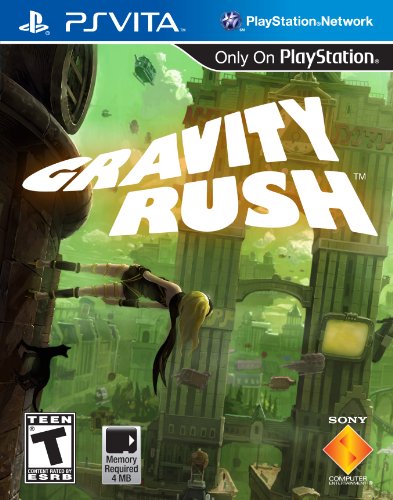
Gravity Rush Developer: Project Siren (SCE Japan Studio) Publisher:Sony Platform:PlayStation Vita Release Date: June 13, 2012 Price: $39.99 (available here)
Overview
Also known as Gravity Daze in it’s native Japan, Gravity Rush managed to become Famitsu’s highest rated Vita game with relative ease. Despite gathering a good handful of impressive review scores, the game has been plagued with a bizarre form of expectation thanks to the position of the Vita in the market place. Is the game good enough to sell systems? Can it save the Vita? Will everyone suddenly declare Sony’s latest venture a blazing success off the back of this one release? Can Gravity Rush change the world?!
So why is Gravity Rush being turned into the Vita’s life support? Because the game is a rare thing for the Vita at the moment. It’s a strong, distinctive and new I.P, which crucially hasn’t already been seen on big brother PlayStation 3. It is impossible to experience this game on any platform other than the Vita; it’s exclusive, it’s fresh, and it’s exciting.
Story
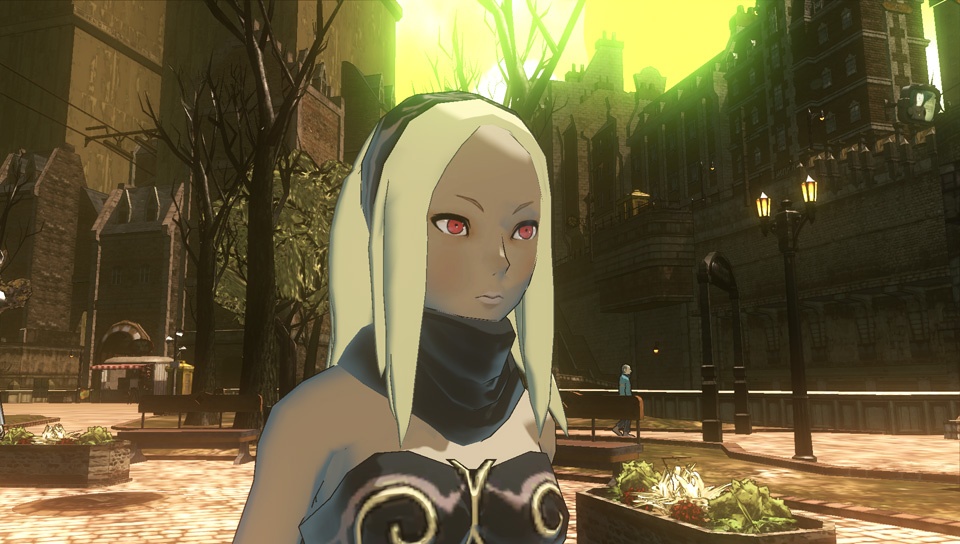
A young woman wakes up in an unfamiliar world, with no memory of who she is or how she got there. The world is Hekesville, a bizarre city scattered across the sky, somehow floating above oblivion and plagued by gravity storms. Getting her bearings somewhat, the girl manages to acquire a companion in the form of a cat. Swiftly monikered as Dusty, this starry feline allows the girl to manipulate gravity and fling herself the sky about like nobody’s business.
Kat, as she becomes, is quickly drawn into a little explained conflict with a group of monsters called Nevi. These amorphous black blobs have invaded Hekesville along with a massive gravity storm, and Kat soon finds herself not only defeating monsters, but putting the city back together and becoming something of a heroine to the locals.
The story is kept light and breezy, with Kat instantly forgetting that she has lost her memory and just going along with all the crazy things that happen to her. She’s a likeable new addition to the Sony first party stable, and actually has a good measure of personality that is warm and charming. Sadly the appropriate comment cannot be heaped upon any of the other characters, with the villains given short shift and supporting characters shipped in and out too briefly to be of concern.
Ultimately Gravity Rush is a superhero origin tale, and as such is highly reminiscent of fellow Sony exclusive Infamous. Not only in the basic tale it’s telling, but in the nature of the super power at the heart of it all.
Gameplay
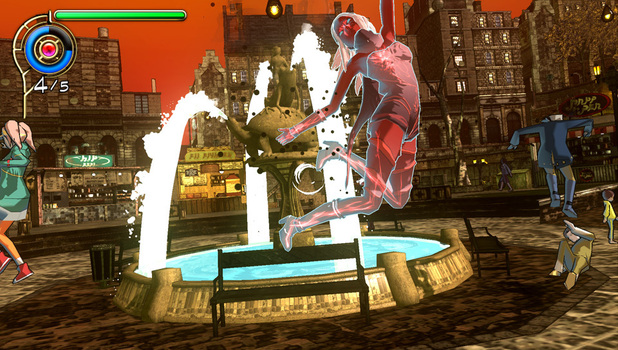
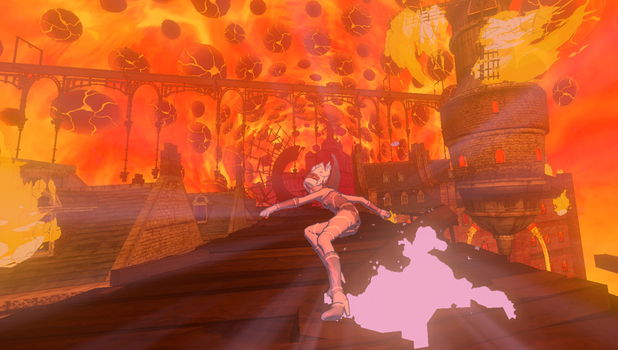
Gravity manipulation is a very complex mechanic to pull off, and Gravity Rush manages it without a hitch. Tap a shoulder button and Kat floats, direct a blue reticule to where you want to fall and tap the R button to send Kat falling through space directed by her own personal gravity field. Hit a wall and Kat will stick to it, and gravity will keep pulling her towards that surface until you change the direction of the field. Exploring Hekesville is a joy, as the city design perfectly complements Kat’s power and is divided into complex and oddly combined levels. Exploration is encouraged by having a generous amount of crystals hidden about the city which can be used to level up Kat and unlock challenge missions.
The constant change of perspective and camera movement takes some getting used to, but it’s a skill worth building. Lots of crashing into walls and accidentally falling off edges will eventually be replaced by the rush of pulling off the perfect manoeuvre. The game title may seem a bit odd at first, but when your careering around the city and pulling off complex turns at high speed it all makes sense.
Maintaining an alternate direction of gravity is timed, but the gauge is one of the many features of Kat’s power that can be levelled up. She can also speed up the ‘rush’ or fall, pull off ever stronger gravity kicks and unlock several highly effective attacks, that although limited in use, completely destroy most enemy opposition if used correctly. This is where the game falters somewhat, whilst the core mechanic is very slick and a joy to use at your whim, when it’s applied to combat and the main campaign things lose a little of their shine.
The missions just don’t do enough to make use of the excellent core mechanic, and boil down to a series of run here, kick that, collect that style episodes. Things take a while to get into gear too- you’ll have to push through collecting furniture for Kat’s new sewer pipe abode to get to the meatier stuff. Things do improve as you delve into the story, with some larger scale confrontations and boss battles doing their best to counteract some of the more bland sequences.
Combat is a solid enough affair, but lets down the game somewhat by being a little bit choppy and unbalanced. If Kat is grounded she’s just not very manoeuvrable and has a limited repertoire, but it’s the special attacks that really mess things up. There are several special attacks that players can unlock, unleashing them at the behest of a red dot that does all of the recharging. The powers lock on to targets and deal a great amount of damage, and it’s all too easy to use Kat’s powers to run away, recharge, then come back and deal out some more hits. Sadly it is preferable to dishing out bland kick combos and missing with gravity kicks – if an enemy moves at all you’re flying kick is wasted. It’s not terrible but it isn’t overly fun either, regular enemy encounters are particularly lacking in thrills.
Unfortunately this does affect some of the extra content on offer to boost the already considerable 20 hour play time. In addition to levelling up Kat crystals can also be used to fix various parts of Hekesville, opening up repeatable challenges in time attack combat or races that can be tried and tried again to grab bronze silver and gold medals. Races are all well and good, but I quickly found my enthusiasm for combat challenges dropping to zero.
Gravity Rush has a great core mechanic – there is no doubt about that. Levelling up Kat gives you ever more freedom and speed and power, and the experience is perfectly matched to the Vita, everything just feels right on the handheld. Sadly combat has been over emphasised in a game that would thrive on platforming and puzzles, and if only the focus had been slightly shifted this could have been the first Vita only classic experience.
Audio and Visual
Gravity Rush has a very distinctive style. Think Nintendo’s Professor Layton crossed with one of the early Final Fantasy titles. Characters have simple anime style designs and the world that they inhabit is part steampunk, part quaint Victorian. The colour palette is a little subdued, but that doesn’t prevent Gravity Rush from standing out in a crowd of games that are either aiming for realism (Resistance, Uncharted) or are 100% bright cartoon (Rayman Origins). The world is beautifully detailed and divided into a number of distinct areas, each enhanced by an appropriate musical theme. As well as the more ‘realistic’ city areas (industrial, night life etc), Kat often finds herself in trippy, more imaginative zones, which inject a little more colour and variation into the level design.
Some of the tunes are pretty catchy numbers and bring a sense of character to the different regions of the city that you gradually discover. The composer for the game, Kohei Tanaka, has worked on a huge number of anime projects and provides a score that fleshes out the world of Hekesville with some real charm and vitality. Sadly there is next to no voice acting in the game, and the sound design bears little to shout about – the music is by far the more powerful force here.
The cutscenes are presented in comic book style, a feature that has been much used and abused in countless titles. Here it is actually used to enhance the game’s style. The Vita’s gyroscope and touch screen allow for a subtle level of interaction with the cutscenes, making the comic book presentation seem much more organic and in keeping with the rest of the game. The Vita is clearly an appropriate home for this kind of story telling, and Gravity Rush showcases that very well.
As a whole the game is highly stylised and, at least when considering the current crop of Vita games, rather unique. It is something fresh and exciting that you haven’t seen before, and that ties in with the new IP to make Gravity Rush a rather pretty package.
Overall
Neither a console seller or a crushing disappointment, Gravity Rush is a game with a great core mechanic held back by a few gameplay flaws. The art direction and game world are engaging , stylish and unique on the Vita, and whilst the story is certainly a little generic, there’s ample room there for further expansion. Kat is a strong lead with a fun power, and if it had been utilised better this could have been that infamous console shifter.
As it is Gravity Rush is certainly one of the strongest titles on the Vita, in no small part because it is a fresh I.P that sits incredibly well on the platform. You can’t get this anywhere else, and that only adds to the appeal. Overlook some problems with combat and the missed opportunities for greatness, and you have a game worth adding to that growing Vita library.
Sony has purchased Cloud based service Gaikai for $360 million dollars. Sony Computer entertainment president Andrew House had this to say:
“Sony will establish a new cloud service that will allow users to instantly enjoy a broad array of content ranging from immersive core games with rich graphics to casual content anytime, anywhere on a variety of internet-connected devices.”
Gaikai CEO says:
“Sony is looking to harness the power of the interactive cloud and to continue to grow their ecosystem, to empower developers with new capabilities, to dramatically improve the reach of exciting content and to bring breathtaking new experiences to users worldwide Sony seems to be going they way of the cloud.”
Could we see Sony bringing an online streaming service similar to Onlive to their next home console ? What do you think about Sony purchasing Gaikai, and what they plan on doing with the service?
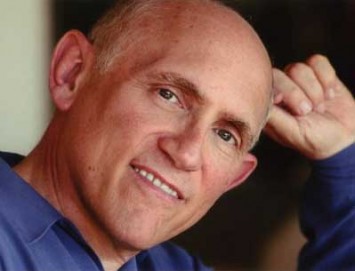
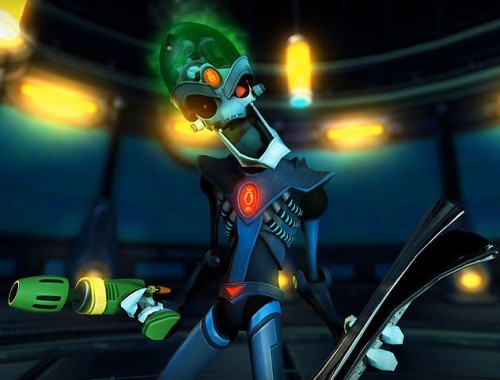
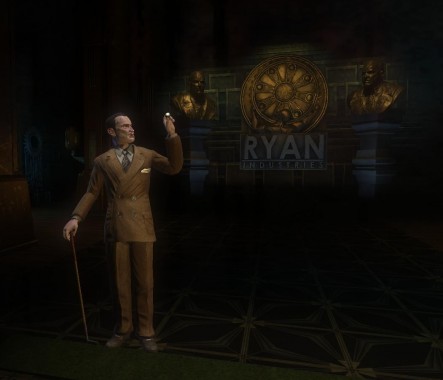
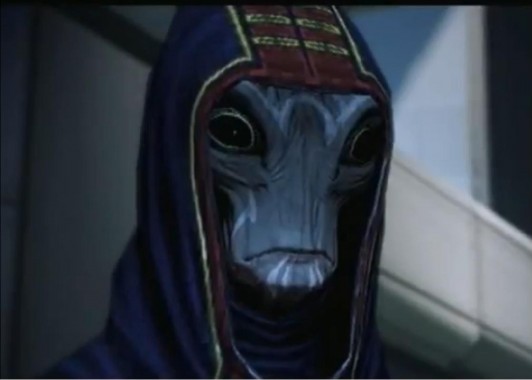
While he’s best known for being the face behind the heavy makeup of Quark from Star Trek, Armin Shimerman has had an illustrious career in theatre, film, television, and more recently, video games. You might remember him as Principal Snyder in Buffy the Vampire Slayer, Dr Nefarious in Ratchet & Clank, the Salarian Councillor in the Mass Effect series, and of course, the enigmatic antagonist, Andrew Ryan, in the Bioshock series.
We caught up with him at Oz Comic Con in Melbourne this weekend, and asked him a few questions about how working for video games compares to other media.
Capsule Computers: Coming from your background, with a long career in theatre, film and television, have you found yourself drawn towards a particular type of character at all?
Armin Shimerman: I have, especially in video games. Because of what I look like, and what I sound like, Hollywood doesn’t necessarily cast me in the role of idealist. I rather like doing those for video games, sort of being the voice of reason, or someone with a point of view that’s very serious. I like that a lot, it’s such a change from the comedic roles I usually play on camera.
Andrew Ryan was a phenomenal treat for me, the writing was as exquisite a character as I’d ever performed, including many of the Shakespearean roles that I’ve done. The monologues for Andrew Ryan were just incredible. I imagine that’s why gamers who play Bioshock are particularly taken with him. It’s an Ayn Rand point of view, and that appeals to a lot of people, especially young people. I was a huge Ayn Rand fan when I was in my teens and twenties, as you get older you sort of lose that, but perhaps a lot of gamers are in that age range. It still appeals to me, when I revisit Ayn Rand, there’s a lot of it that’s appealing, I just don’t believe it’s the be-all and end-all as I once did, when I was a teenager.
CC: How did you move into video game voice work?
AS: All actors in Los Angeles have two types of agents. They have a theatrical agent, for film and TV, and a commercial agent which is for commercials. My commercial agent also covers voice-over actors, and my voiceover agent said to me, will you audition for a cartoon show? Which I did, and I got. The director of that was a lady named Chris Zimmerman, and she also does games, so she asked me to audition for some games. And that’s how my career started, I began to do games for Chris, I learned how to do that sort of work better, and eventually other directors began to hire me.
CC: How does recording for video games differ from film and TV, in your experience?
AS: It’s immensely different, working on camera and working for voice over. On camera you get direction from a director, you get life from other actors to help you believe what it is you’re doing, you have to memorize lines, you have to do blocking, you have to get into makeup, you have to get into costume.
Most actors, myself included, we get a lot of our performance from listening to and watching the other actors you’re working with. But in a booth you don’t have that luxury. You have to use your imagination to think, “ok, how is the other character responding?” Whether you’re right or wrong, I guess it doesn’t make any difference.
Game voices, you’re in a booth by yourself, talking to a microphone and hopefully you’re doing the right thing. The director will sort of give you feedback and clarify some of your intentions, but in the end you have to use your imagination and hope you’re in the right place.
Then its up to the director and the engineers to make it all fit together. It’s a much more collaborative work with the director in voiceover work than it is on camera. On camera, the director does give you pointers, but mostly you’re taking your lead from the other actors.
On the other hand, you don’t have to memorize lines, you don’t have to get into makeup, you don’t have to wear a costume. And you get to do it over immediately. And if it’s not exactly right, they can tweak it with their machinery. Which you can do on camera as well, but it’s a lot easier to do with voice over.
Working in video games, you can do roles that no one would ever cast you for on camera. I certainly don’t look anything Andrew Ryan. And so I get a chance to play characters that I’d never get the opportunity to either on camera or on stage. And that is a great, great delight to me and other voice actors.
CC: How much of the story, art and visual style of Bioshock were you given to help with the performance of Andrew Ryan?
I was given no information except the words themselves. I was given a somewhat sketchy background of the world the game took part in, but no more than that. They simply said this is an Ayn Rand sort of character. I certainly didn’t know the fate of Andrew Ryan, I didn’t know whether he was a hero or a villain – I still don’t really know that.
It was a surprise to me when I finally saw what Andrew Ryan looked like, because of course he doesn’t look anything like me. But I should never have expected that.
CC: So have you seen much of the final character designs, and the art and style?
AS: I have, and it’s exquisite. The success of the game, I believe, is due to one, the graphics, which are incredibly beautiful, and two, the depth of the characters.
CC: Playing the Salarian Councillor in the Mass Effect series, was there a challenge in giving a voice to a character from a species that has a very specific manner of speaking?
That’s actually not challenging at all, understand my background is in Shakespeare. With Shakespeare there are sort of guidelines about how to speak, and not only respecting the verse but respecting the rhetoric, and of course enunciation. So I used all my classical background in order to do the Salarian.
CC: Is there anything on the horizon in terms of video games?
AS: Yes, there is one I did just last week. But they told me I’m not allowed to talk about it yet.




 The panels were quite well done, with some interesting talks by people and insights into their work and revealing some stories that people weren’t necessarily aware of. The absolute highlight was, of course, Stan Lee’s panel. Not just because he was Stan Lee, but because he was just a complete delight to listen to. Read about the Stan Lee panel