
Home Blog Page 5247

Unchained Blades Review


Unchained Blades
Developer: FuRyu
Publisher: XSEED Games
Platform: PSP (Reviewed), 3DS (Coming Soon)
Release Date: June 26, 2012
Price: $29.99 (Digital Only)

Overview:
Even though there is a brand new handheld gaming device circulating the market now from Sony, that new device is almost devoid of a certain genre of game. This missing genre is beloved by a large group of gamers but thankfully the PSP is still receiving plenty of love from developers and publishers behind this genre.

The RPG genre is one that has seen much success on portable handhelds and XSEED Games isn’t about to let the PSP go without at least one more RPG to round out the platform’s library. Now that they have released Unchained Blades onto the PlayStation Network, is it worth your time?

Story:
The world of Unchained Blades is populated by mythical beings and creatures of fantasy and all of these creatures are ruled by a Goddess. However there is a special journey that these creatures can take to meet with the Goddess and be granted any wish they want. Players will take the roll of the most powerful dragon in the land, Fang (all character names can be changed by the player however.)
With his massive strength he was able to fly right to the Goddess and rather than have her grant a wish, he simply demanded that she tell him where the strongest enemy in the world is. As one may expect, this greatly displeases the Goddess, who then curses him by removing all of his dragon powers and sending him crashing to Earth. Here Fang learns about the proper way to reach the Goddess and sets out on a Journey to regain his abilities and obtain his revenge.

Along the way players will come across a number of other allies who all have their own wish to make and join up with Fang in his journey. While the storyline itself is far from original, the characters themselves help make up for the mundane plot. One of the things that makes these characters special is the fact that they two are monsters, such as a golem prince, phoenix girl or medusa.
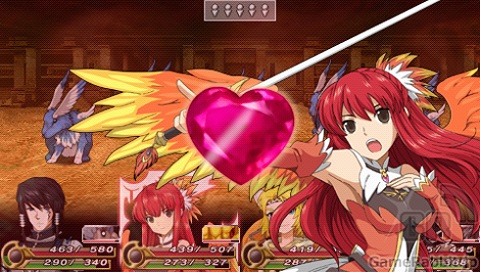
These characters’ interactions with one another are quite amusing and will help keep the story enjoyable, especially when certain characters start to show interest in one another or reveal some hidden sides to their personalities.

Visuals:
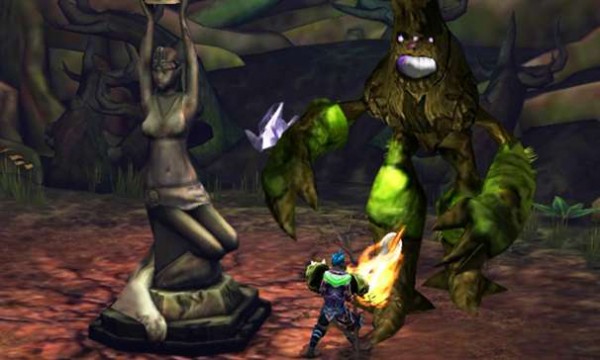
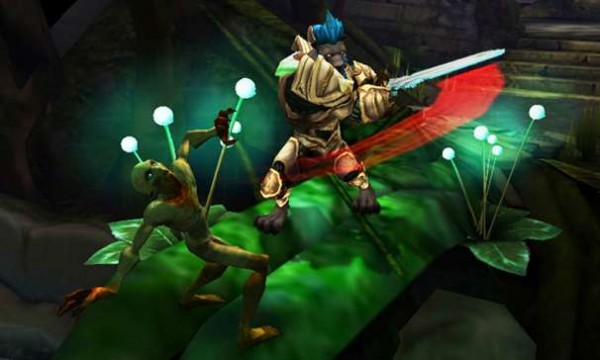
Now one thing that makes Unchained Blades unique is the fact that all of the main characters were actually drawn by different artists. This means that you will see a lot of variety with the character’s basic designs, though they all follow an anime-styled fantasy theme. These individual artists have done a great job with the main characters as they are one of the treats of playing Unchained Blades. In fact, nearly all of the characters you come across, both enemy and NPC are beautifully designed.
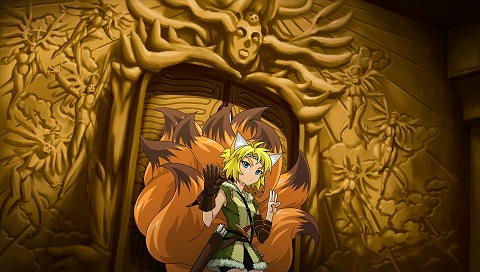
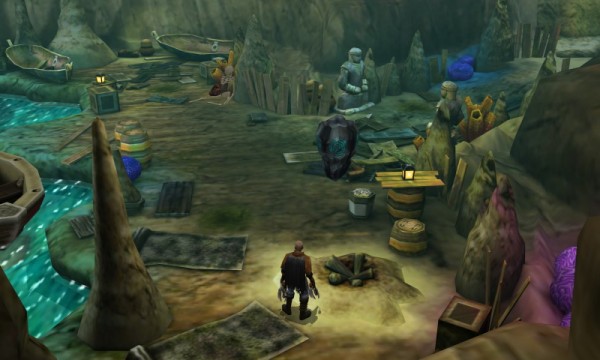
Unfortunately the same can not be said about the actual dungeons you explore. Considering players will be spending a large amount of their time traversing the halls of these dungeons, it would have been better if they were at least a little bit more diverse. Now while each dungeon does follow a certain theme, nearly every single hallway inside the dungeon will look the same as the last, meaning players will often spend hours walking through a repetitive environment with only a few changes here and there.

Audio:
The title features some nice background music that helps accentuate the mood of battle or exploring various dungeons. As for the game’s sound effects, they are serviceable at best. Thankfully Unchained Blades does feature voice work for the main cast, though it is worth noting that not every piece of dialogue between the characters is voiced. When the characters do speak with one another their voice actors perform an adequate enough job portraying each characters’ emotions and personalities.

Gameplay:
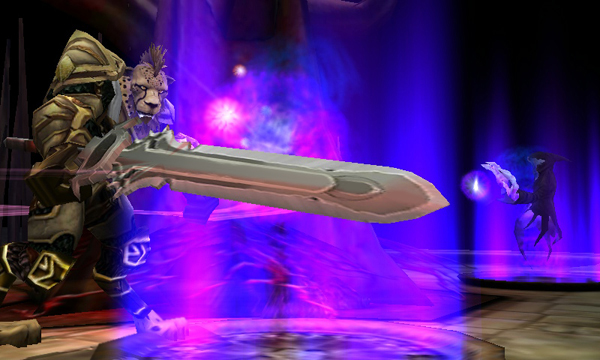
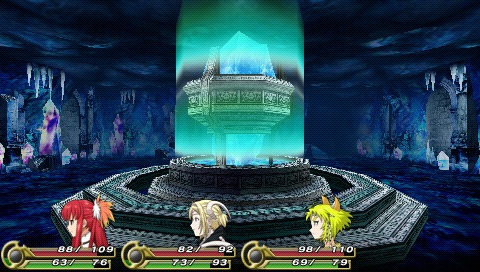
While Unchained Blades may be classified as an RPG, it is a bit of an unconventional title to say the least.  The reason for this being the fact that players will actually be dungeon-crawling through a first person view similar to what was experienced in the classic title Wizardry. This means that as players are advancing through the dungeon they will not see their characters moving, but will instead be walking through an area as if they themselves were there.
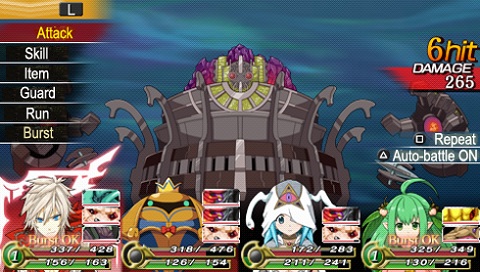
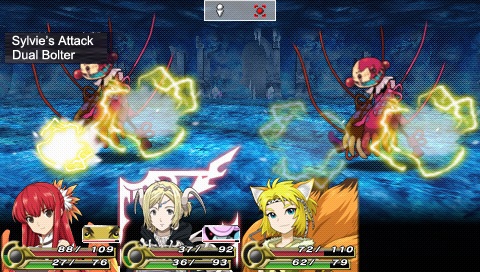
Interestingly enough, combat is also fought in this same first person style.  Players will experience random encounters while walking through a dungeon and face off against a number of opponents which can range from only one monster, to fifteen at a time. These large scale battles can sometimes mean up to three screens full of enemies to defeat, making this turn based battle system a fight for your party’s life.

Now at any given time, players can have a party of up to four main characters which are called “Masters” in the game. These masters possess a special ability which helps spice up the combat and also references the titles name, the Unchain ability. When you are battling against enemies, there is a chance that they will become influenced by one of the masters’ charisma or sufficiently wounded enough the player can unchain them through a simple mini-game, allowing the creature to join the party as a follower. It is a bit disconcerting however that there are many occasions an unchain circle will appear in the middle of your party’s attack turn, meaning some enemies which can be swayed to your side are often killed before you get a chance to unchain them.

Each master can have up to four followers added to each master, meaning that players can actually enter combat with up to twenty members at a time, though followers usually only serve as a method of blocking attacks at random, tacking damage at random or doing extra damage for linked skills. These followers also will have certain “anima” (elements) which can be applied to the Master, allowing them to perform special skills, meaning players will have to micromanage which followers are best for each character given the situation they are facing.
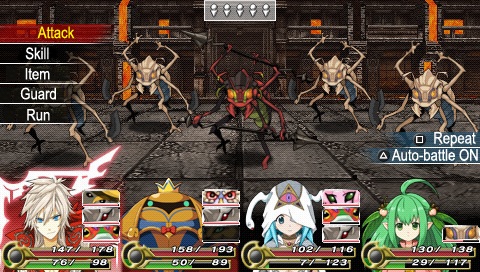
As players battle, their masters will level up as in any standard RPG, and players will also be given a few skill points which can then be applied to a branching upgrade tree which can boost various statistics as well as unlock new attack, upgrade and passive skills. As mentioned before, players will also have to worry about their charisma statistic as well, which levels up separately from their base character level. Performing well in a battle, such as finishing fast, using special attacks or taking little damage will result in boosted charisma while things such as running away, using healing items and other things will drop your charisma level.

Your charisma level affects how many followers you can have, the happiness of said followers as well as improve your chances of instantly allowing unchaining of enemies. This statistic is also affected by answering questions asked by your followers, though a large number of these questions have strange reactions which don’t make sense more often than not.

Managing the mood of your followers as well as switching them out for leveling purposes is almost essential for progressing through the game however, as there are a few moments players may be barred from advancing without competing in something called “Judgment Battles.” These battles are, to put it bluntly, very annoying and can also be a reason for heavy player grinding as they are fought by your actual followers instead of your main characters. In these battles players will simply press various quick time buttons as they scroll past while their followers mash up against the enemy’s followers in comically bad fashion.
These battles tend to be optional, though when necessary they are a drain on players’ time inside the game, as they will need to try to unchain powerful followers which is always an iffy gamble or try to level up weaker followers in their party by grinding further. This is a bit of a hassle already, as often players will encounter difficulty spikes in the levels of enemies they are fighting, requiring the player to return to a previous area and grind for experience points and money to survive the next floor.

It is worth noting that, despite these difficulty spikes, players will usually be able to venture forth without much concern for their well-being thanks to Unchained Blades’ save system. Rather than forcing players to only save in town or at certain points in the dungeon, players can instead save anywhere in a dungeon they please, making risky ventures lose their edge.

Overall:
Unchained Blades takes a bit of a risk being released on the PlayStation Portable a bit late in its life and unfortunately the title does suffer from a few issues such as repetitive dungeons, excessive grinding and slightly questionable follower system. However despite these issues, those eager to pick up a long, engrossing RPG that holds true to a number of old-school mechanics while throwing in new ones to keep things interesting need look no further as Unchained Blades provides a slightly unconventional storyline alongside enjoyable gameplay.
7-5-capsules-out-of-10

Miyamoto Addresses Metroid for the Wii U

During E3, a lot of fans went in thinking we would see a new Metroid game revealed for the Wii U. Yes, Other M wasn’t a huge success, but people still love Samus and it’s easy to see that the franchise would be perfect for Nintendo’s upcoming platform.

It seems that fans are not the only ones with Samus on the brain though, as Miyamoto recently made a statement to IGN on how Metroid would be perfect for the Wii U.

“With Metroid it’s very easy to imagine some interesting implementation for Wii U,” Miyamoto mentioned. “I think that having another screen with the gyro built in really gives you a lot of interesting opportunities for development, and we can bring a lot of our games to life in a completely unique way with that.”

Another name mentioned during the interview was Star Fox for the Wii U, but no further details were given. I personally would love to see Metroid on the Wii U and there isn’t much of a doubt that if done right, it would be a huge seller for Nintendo. Of course, these are just name drops as of now, meaning if a Metroid game were to come, it would be at least a couple years away (unless Ninty already has it in the oven).

Gaming Industry Will Die Without Innovation, Says David Cage

0

David Cage, the boss of Quantic Dream, has theorised that, without the drive for innovation in video game projects, the industry will more or less die in an interview with Gamesindustry International. He believes that more studios should invest in new and inventive projects where originality can be promoted. He expands upon this point:

“I mean this industry will die if it doesn’t try more to be innovative and to come up with new ideas and to talk a bit more–not necessarily serious, but deeper things at some point. It’s great that you can shoot at monsters, and that’s great and it will always be there and it will always be successful, but at the same time, what about giving the choice to people? Give them different options. So if they like that they find it, but if they want something deeper and interactive, they can find that too.”

In the interview, Cage praises Journey from thatgamecompany, which is currently the most successful game on the Playstation Network, calling it “a breath of fresh air.” He calls it as such because of the storytelling and emotion found in the game. He moves on to first person shooters, which represents the exact opposite of Cage’s ideal video game industry. He says:

“How many first person shooters can we create per year? How many can we play per year? How many of them will be successful? Even from a business point of view, does it make any sense? I’m not sure.”

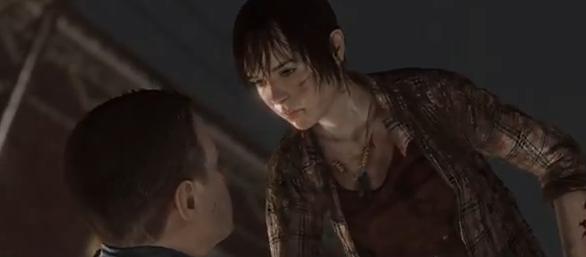
Considering he is the boss of the studio that gave us Heavy Rain and will give us Beyond: Two Souls, it is reasonable for him to address these concerns. With that said, the video game industry is dictated by one group of people: the consumers (yes, you reading this article). It is they who vote with their money and it seems that the most popular genre at this time is first person shooters, more specifically Call of Duty.

I agree with Mr. Cage in that the industry needs to push more original ideas and experiment. I am someone who believes that the video game medium does have the potential to become as powerful as literature in terms of storytelling. In saying that, it seems game studios and publishers won’t push for innovation if the risk is too great. It is definitely a worthy point in the business vs creative debate in video games.

I’ll open the floor to you, readers. Do you believe in Mr. Cage’s push for innovation or is the safe option good enough to keep the industry afloat? Give us your thoughts below.

Activision Leeds To Handle Future Mobile Call Of Duty Games?

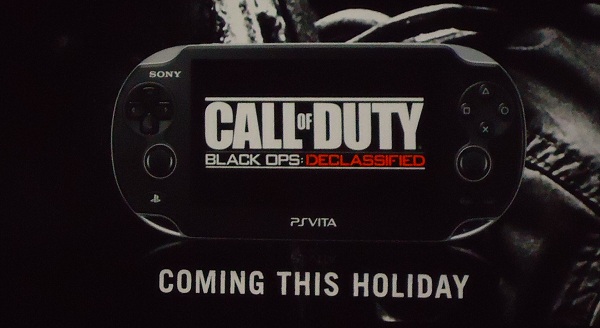
There are reports that suggest that the newly created Activision Leeds will now take care of all mobile and handheld Call of Duty games. This claim was suggested by UK games industry expert Andy Payne, who comments that Leeds will be solely responsible for “all handheld versions [and] iOS versions of Call of Duty” in the future. This will not include Call of Duty: Black Ops: Declassified for the Playstation Vita, which is due out by the end of this year. Activision Leeds was only created in May. This means that, if it were Activision Leeds working on the Vita game, there would be only a maximum of seven months before release, too short for developing and publishing the game.

Payne also notes that the Leeds studio will have access to all Call of Duty assets. This is because the studios who have worked on the series are very collaborative. This means assets can be reused and exchanged if needed. Payne comments again, “The two studios are saying, ‘I need a tank, pull it off from the library’. And those assets are also going to be starting to be used by the mobile team, which is going to be based in Leeds.” The handheld Call of Duty games were previously developed by n-space, while iOS Call of Duty games were developed by Ideaworks.

Playstation All-Stars Director Responds To Smash Brothers Comparison

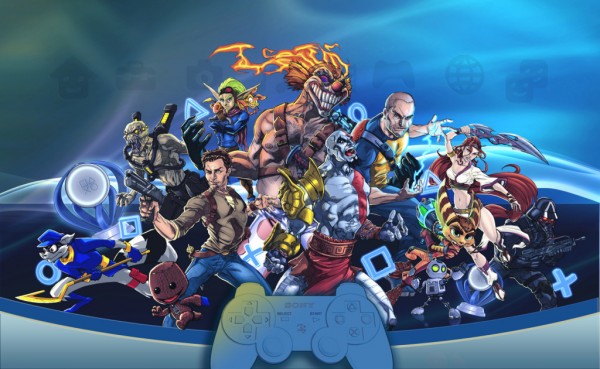
Playstation All-Stars Battle Royale’s appearance at EVO 2012 in Las Vegas included a Q&A session with those in attendance. As expected, one member of the public, who happened to be a fan of the Super Smash Brothers franchise, blurted out the following three questions: why is the game a Super Smash Brothers rip-off, why doesn’t play like Super Smash Brothers and why is the only way to obtain a kill is through a super attack. Keep in mind that the person in question had only played ten minutes of the game before asking those three questions.

Omar Kendal, director of Playstation All-Stars Battle Royale, responded with the following comments:

PlayStation All Stars is its own game. I think that’s really the only way I can answer that. I understand that Smash players – some Smash players, not all Smash players do this – will sort of base how successful PlayStation All Stars as a game is on how accurately it recreates the Smash Brother’s experience. But that’s not really our goal.

Our goal is to create a unique combat experience for PlayStation All Stars that we fully admit borrows from many different kinds of games including Smash, but our goal is not solely replicate the Smash Brother’s experience.

I think based on ten minutes… maybe if you played it ten more minutes you’d have a different appreciation for the game. I just really would ask that players like you, approach it with an open mind.

He then offered the person a session with him so that he could show “what a folly it is to think that supers are the only things that matters in our video game.” Whether the person accepted the offer is unknown. While it is going to be common to compare Playstation All-Stars Battle Royale with Super Smash Brothers, it should be noted that there are differences as well. Besides, there is a market to see Playstation’s iconic characters duking it out with each other, as there is a market to see other universes coming together and seeing who will be the strongest character out there.

Playstation All-Stars Battle Royale will be released on October 23 in North America, October 24 in Europe, October 25 in Australia and New Zealand and October 26 in the UK and Ireland.

Source: Playstation Lifestyle

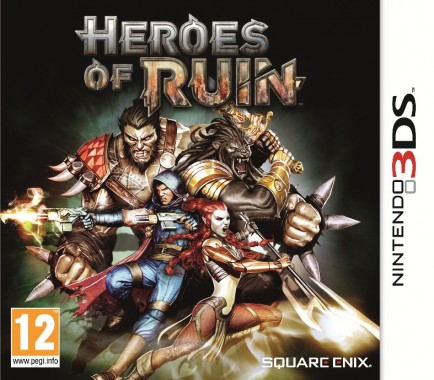
Heroes Of Ruin Review


Heroes Of Ruin
Publisher:
 Square Enix
Developer: n-Space
Platforms: Nintendo 3DS
Release Date: June 15, 2012
Price: $39.99 – Available Here

Overview:
A good idea can only get you so far. Execution is what makes a good idea a great idea. Heroes of Ruin is a good idea, without a doubt. The concept of a heavily online focused RPG for the Nintendo 3DS in theory could make for an awesome game. But in practice does it work as well as it promises? Well that is the thing with Heroes of Ruin, it doesn’t. Heroes of Ruin is a good idea, that never became a great idea and it’s all due to the execution.

Story:
At it’s core Heroes of Ruin is a pretty simple RPG game. There is a world in peril and you are tasked with saving it. That is the plot of Heroes of Ruin in its most simplified form. There is of course a world here with various inhabitants that you will interact with, none of which are particularly memorable. The story in and of itself is essentially non-existent, with next to no narrative thrust and characterisation comparable to that of plank of wood in my backyard. The world is never fully realised and there are no characters that leave any lasting impression beyond you wanting them to shut the hell up. Top to bottom, Heroes of Ruin’s plot elements are as flat as fizzled out Coca Cola. Unfortunately, this is just the beginning of this game’s problems.

Gameplay:
The crux of Heroes of Ruin has to be it’s gameplay. With a story and cast of characters so utterly asinine, the gameplay has a lot to compensate for. It is a crying shame that it falls short in this regard.

Now don’t get me wrong, there is some good here. The online mode albeit problem riddled does have some interesting components that does make for a somewhat compelling gaming experience. But only when it works. How often does it work the way it is intended? About 20% of the time I’d say. But before I go too in depth about the online component, I need to outline how exactly this game works and emphasise one thing – this game is one big hassle.

Immediately upon starting up the game for the first time, the game forces you into creating a ‘Square Enix Account’. Okay fair enough, it makes sense since you know this game is focused heavily on it’s online function. This wouldn’t be a problem, except the fact that it literally does not let you do anything until you make this bloody account. So bad luck if you do not have a computer accessible at the time, you can’t play until you make an account for Square Enix. So essentially the game directs you to Square Enix’s Heroes of Ruin website. Once you are there you set up your account and confirm it with your email. After that you log in to your Square Enix account on the Heroes of Ruin website and grab your 3DS again and scan your exclusive access QR Code, which allows you to link your Square Enix account to your 3DS thus allowing you to play the freaking game. Only one problem, the QR scanner has trouble scanning some types of monitors so if it doesn’t read your monitor, you’d want to hope you have a printer handy to print out the page to scan the QR Code so you can play this bloody game. Like I said, this game is one big hassle.

So after nearly half an hour trying to link my 3DS to my ‘Square Enix Account’ I got to design my character. The character design system is pretty limited and there isn’t much you do to differentiate your character or have any real semblance of individuality, but that’s not too great a problem. Once you have made your character you are ready to go right? Nope.

Next obstacle in the way is navigated the absolutely atrocious menu screen, which provides little to no easy way to do what you want to do, instead over complicating things with confusing control schemes for menus (the thumb stick cannot be used to navigate, only the directional pad or stylus) and poorly worded titles for each mode (hardly defines the difference between joining another persons game and creating your own). After eventually navigating and figuring things out you can either choose to play online or offline. It is here where things fall apart completely.

First of all the single player (offline) mode is just a pain. It is incredibly clear that this game was not built with single player in mind at all, especially when you consider the difficulty of some creatures which just can not be beaten alone and some puzzles that are damn near impossible without a partner. So the single player mode really was not what this game was made for, hence why it is the last option on the menu. The online multiplayer is what it’s all about I suppose. Sadly this is really hit and miss.

When playing multiplayer there is no option whatsoever to choose to play with someone with a good connection with you or someone who is close by geographically, instead you will find yourself paired with players on the other side of the planet to you which ends up resulting in complete and utter lag. As I mentioned earlier, there is pretty much a 20% chance that this won’t happen.

The game itself is simply a pretty substandard Diablo clone and it feels pretty obvious that it was made with the hook of ‘Diablo but on a handheld!’ This wasn’t a bad idea, just an incredibly poorly executed one.

It’s really a huge disappointment because despite these overwhelming problems there is some flashes of brilliance in Heroes of Ruin, glimmering instances where you could believe, even if it were a fleeting belief, that this could have been a great game. This is a game that really could have done with an extra year in development, to add some polish and shine to it. But in the end, money speaks louder than sense once again.

Visuals and Audio:
The disappointment doesn’t end there though, even the game’s aesthetics are significantly lacking in quality. The visuals are as pedestrian as possible and never aspire to be anything more than that. There is no flair to speak of and it all feels like something that any gamer would have seen hundreds of times before. The soundtrack is equally benign with to colour to it’s tracks. Not only that, but the game’s voice acting is utterly appalling. It has to be some of the worst I have seen in a very long time. But that pales in comparison to the soundtrack, which has so felt presence what so ever. It’s as routine as you could possibly imagine and never does anything to warrant an ounce of praise.

Overall:
When the best thing you can say about a game is that is a clone, then there is something seriously wrong. Heroes of Ruin is a perfect example of a good idea poorly executed. It has all the hallmarks of what could have been a great game, but for one reason or another this game was rushed out and ultimately feels half baked. It needed more time in the oven, but it is too late now. What’s done is done and as sad as it is to see potential go to waste, it quite often does. Ultimately Heroes of Ruin is a Diablo 3 clone for the 3DS, with just as many problems and it all falls to ruin under the weight of it’s poor execution. It’s a damn shame to see a good idea like this go to waste, a damn shame.

3-0-capsules-out-of-10

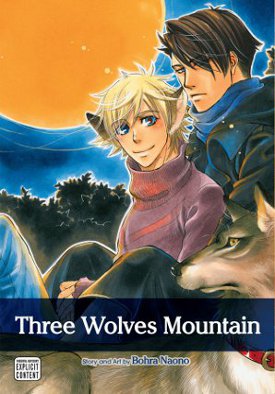
Three Wolves Mountain Review

Three Wolves Mountain
Author: Bohra Naono
Release Schedule: Oneshot
Publisher: SuBLime/Viz Media
Release Date: June 12, 2012
Price: Print $12.99, Digital $5.99 – Available Here

Overview:
Yaoi lovers, and/or those looking to buy something for a yaoi lover, have a lot to pick from in terms of material.  Some feature lots of romance and enjoyment material, while others focus on the relationship and save it for a treat at the end.  Some even have multiple volumes as the story grows, and some are only a oneshot volume containing everything in that particular story.  Three Wolves Mountain is a oneshot volume from author Bohra Naono, who has written more than 20 manga, with this one being the second with an English release.  Does Three Wolves Mountain have what it takes to satisfy that sweet yaoi craving?

Story:
Three Wolves Mountain is the tale of two werewolf brothers, Jiro and Tarou, who go out into the world to learn to live on their own, and instead end up living with cafe manager and graveyard protector Kaya Susugi, whom Jiro falls in love with.  The volume itself is divided into four main chapters, each doing a good job of exploring more and more of the characters and the world in which they live.  They also do a good job of leading into one another now that they are in one volume.

The first chapter is entirely focused on setting up the three main characters of the brothers and Kaya, while each of the later chapters explores more depth of the personalities and grows the relationship between Jiro and Kaya.  The second chapter focuses more on exploring the past of Kaya, while the past of the brothers waits until the third chapter, with the final chapter being mostly a final trial for Kaya and Jiro.  As two of the main characters are werewolves, there is a number of supernatural elements in the volume throughout the different chapters and the rules aren’t simply stated for but introduced as they come up.  Which is nice to see, as to avoid just hammered down the information for the readers in a poorer suited manner.

Each of the chapters is pretty well written, all with adequate climaxes and resolutions that aren’t overly forced or contrived, but focus on the characters really talking and working out their problems.  And since we’re speaking of climaxes, there is one major romance scene in each chapter as well, providing plenty of material for readers to enjoy.

Characters:
The manga is mainly centered around the three main characters of Jiro, Tarou, and Kaya, though mainly Jiro and Kaya, but in the later stories bigger secondary characters do have a big impact on the stories.  The secondary characters are good in that they don’t exist simply to drive the plot, they feel they have a solid existence outside of the stories and the three main characters.  Infact, besides Kaya, the character Aki has the biggest character evolution in the whole volume.

Jiro and Tarou as werewolves are fairly interesting, as Jiro walks around completely human and Tarou walks around entirely wolf for the vast majority of the time.  When full moons roll around, each becomes more like the other aspect of the werewolf, but neither ever becomes what people most attribute werewolves to look like.  However, other than being werewolves, the brothers are kind of flat.  Jiro is more or less simply a child-like character and Tarou is mostly the protective older brother.  It would have been nice to see more depth out of these two, but being a yaoi that might be asking a little to much in the character department.

Kaya evolves quite a bit throughout the manga, and the end of every chapter sees him changing a little more and becoming comfortable and happy with where his life has led.  He’s probably the main character in the whole manga, though it isn’t necessarily centric on him alone.  This is actually a good thing, even though being completely human is would seem to be the least interesting especially with the werewolves, but he is the most interesting character in the manga.  As more and more is uncovered about him it gives Kaya a lot of depth moreover than anyone else.

The vast majority of the secondary characters are family to either Kaya or the brothers and as stated above they do seem to exist beyond just what we see of them in terms of the story.  The relationship of the brothers’ parents is actually pretty interesting, though incredibly sparse, but at least shows that there is a lot more information there that readers can extrapolate for themselves.

Artwork:
The art of Three Wolves Mountain teeters between heavily shaded and lacking shade altogether.  This is a really wonderful art that helps to convey the situations of the scenes.  The more serious scenes feature the heavily shaded art and the lighter or romantic scenes tend towards the stark black and white, all the better to see them with.    The art really works to fit the scenes, and with so much fur to be drawn its good to see that the author didn’t shy away from it.

Character designs are pretty interesting when it comes to the brothers as on the full moon Jiro simply has the ears and tail, while Tarou gets to be entirely human save for his head.  This leads to some interesting reactions to the two by different characters and help to showcase how on the outside of the rest of society they are.  The clothes for the other characters are pretty detailed as well, mostly avoiding the stylized, though there are a few of those such as what the brothers’ father wears looks pretty stylized.  So, it’s kind of nice to see characters looking like more everyday people than in other manga.

In terms of the romance scenes, while nothing seems to be overly censored the vast majority of them avoid the more explicit details, focusing more on not necessarily implied, but less explicit forms of intimacy.  It is still very much adult though, lots of sweat and other fluids, so be sure to keep it from the youths.  There are plenty of the scenes as well, so readers shouldn’t worry about enjoying each too much as they reach them.

Overall:
Three Wolves Mountain provides a lot of entertainment.  The chapters all have interesting stories and each does feature a decently lengthed romance scene.  While a few of the characters are a little flat, Kaya definitely makes up for it in complexity and there is plenty of content to be enjoyed, so lover’s of yaoi should be pretty satisfied.  I give Three Wolves Mountain

9-0-capsules-out-of-10

Ben 10: Ultimate Alien – Hero Hoops Review


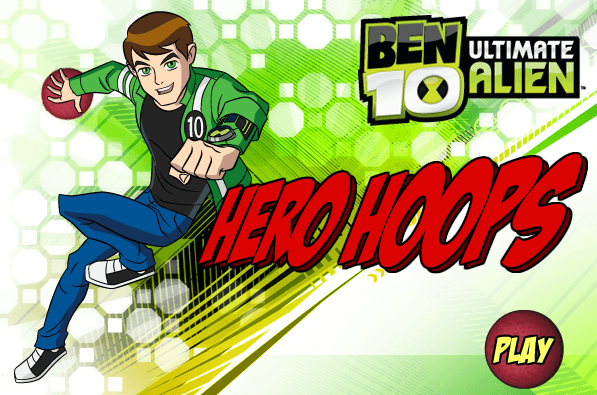
Ben 10: Ultimate Alien – Hero Hoops
Developer: Cartoon Network
Publisher: Cartoon Network
Price: FREE – Play Game Online Here

Overview

Ben 10 is an extremely strong and popular franchise, and in some instances the name may be attached to things without any true reason apart from gaining popularity or attention that it would not otherwise get. So, is Hero Hoops guilty of this?

Gameplay

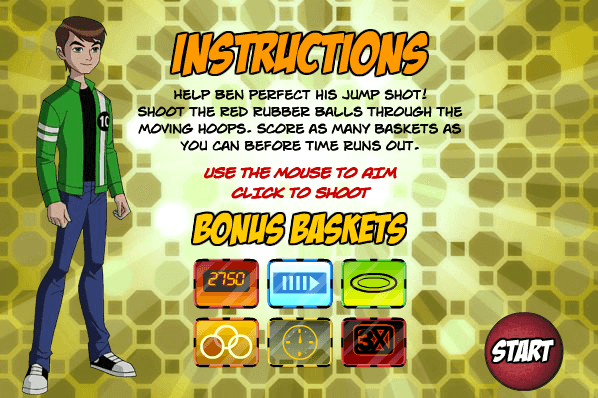
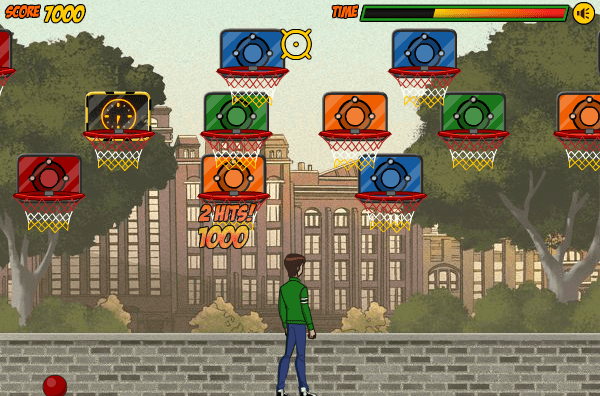
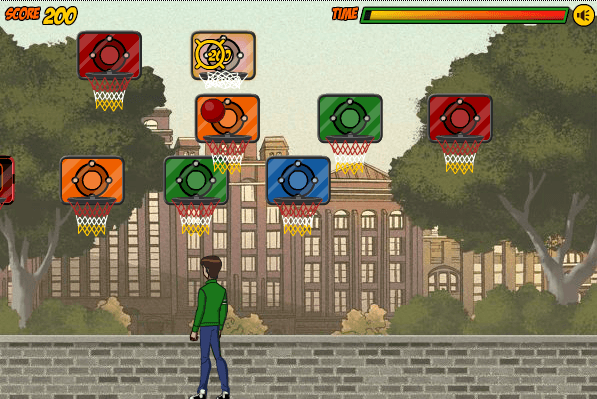
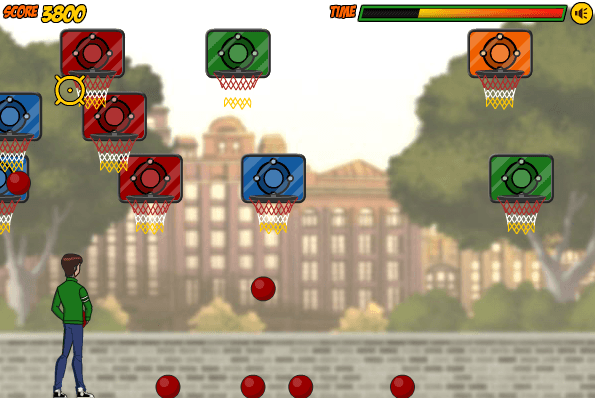
Hero Hoops is a standard flash game, with a simple goal and a count down (which is reminiscent of a health bar, rather than an actual count down). Your goal is to shoot hoops, with three different rows of hoops moving above you, in a sort of ‘duck shoot’ style that you’d expect from a carnival. There are a variety of hoops, which can give you anything from points to certain bonuses that can help you out such as slow motion, giving you extra time, or increasing the hoop size. The colour of the hoops also affects how many points you get, but the higher pointed hoops appear what seems as commonly as others, and it doesn’t affect the placing of the hoops either.

The gameplay is utterly simple, with a point and click shooting system. As per usual, it will take some judgment on your part in terms of where and when to aim for certain hoops, even though you are given a crosshair to aim with (which is very unsports-like, and definitely adds to the ‘duck shoot’ feel of the game). As you continue playing, if you are good enough with your timing then you can even do combos with the ball falling through two, or three, hoops in one go.

The time will last a while, especially if you get the bonus time hoops, and to be honest the game doesn’t actually pressure you that much to try and get points, it all feels fairly relaxed and you may even forget that you’re being timed at all. You will probably start feeling the time a little more if you’re aiming to get some badges for your Cartoon Network account, which you can compare with friends. These badges include getting a three basket combo, getting ten baskets without missing, getting fifty baskets in a single game, or scoring 10,000 or 100,000 points.

Hero Hoops doesn’t have any of the other Ben 10 characters; it’s a very quick sort of flash game that gets you addicted to it but doesn’t have any real depth to it. And in this the game itself doesn’t have much to do with Ben 10, or the franchise, apart from having Ben as the shooter that you control. So if you’re after a game that has any real tie to Ben 10 then this may not be the right game, although it definitely is entertaining and can be something that you waste quite a bit of time on.

With all of the bonuses, and the commonness of the hoops, it won’t be difficult to get a fairly high score in the game, so don’t be surprised if your score skyrockets a bit. It certainly does well for your ego, but if you’re after a challenge you’ll most likely get that if you start comparing to other’s scores, or aiming for combos. Otherwise you might find that the game loses your interest because there isn’t much challenge to it.

Visuals

The game is quite simple looking, without too many flashy things. It’s unsurprising given that there are only three graphic aspects to the game, Ben, the balls, and the hoops. The game is rather simplistic, and apart from Ben’s avatar I can’t see anything else that ties it to the franchise.

Audio

The soundtrack is fairly repetitive, with a certain arcade feel to it. It will keep your energy up while you’re playing but you may also find that it gets on your nerves after a while. Still, this stereotypical soundtrack comes as no surprise.

Overall

Ben 10: Ultimate Alien Hero Hoops has almost nothing to do with Ben 10, apart from having your avatar be Ben. So if you’re after a game that does the show justice, this won’t be it, but that’s not to take anything away from game itself. It is one of those utterly addictive games that you can play regularly without getting sick of it, because the concept is so simple that you’re just in a constant state of improvement.

It’s a refurbishment of an old formula, but that doesn’t mean that it isn’t enjoyable. It certainly is an easy way to while away the hours and if you’re the type who loves to challenge yourself then this game will be right up your alley.

7-0-capsules-out-of-10

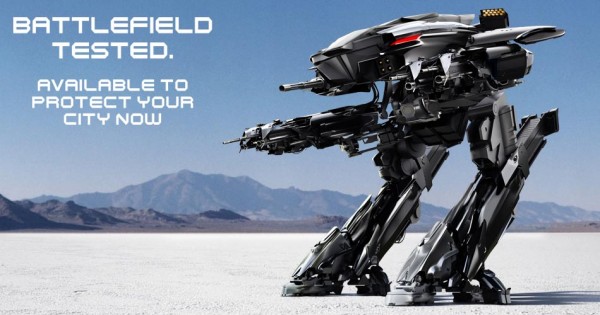
RoboCop OmniCorp Viral Campaign Reveals ED-209

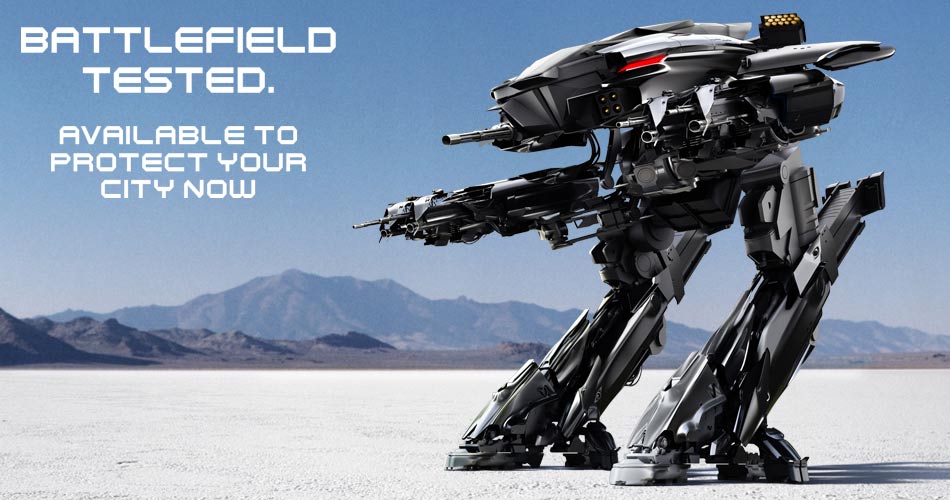
Columbia Pictures and MGM have begun their promotional campaign for the upcoming RoboCop reboot in a very interesting way. A teaser has emerged as an advertisement from OmniCorp, the fictional company that creates RoboCop. The teaser even hints at the RoboCop project as well, stating that they will ‘reveal’ him in the next up coming months, so expect more coming soon! What we do have in the meantime is an awesome look at the ED-209 that fans will remember from the original 1987 film they fell in love with. Many suspect that more information will be revealed at next week’s Comic-Con. Hopefully this is true!

RoboCop is entering production and is aiming to hit theaters August 9, 2013. For more information, check out the OmniCorp website.

Check out the OmniCorp teaser below!

Where’s My Perry? Review

Where’s My Perry?
Developer: Creature Feep
Publisher:
Disney Mobile
Platform:
iPhone (reviewed), iPAD
Release Date: June 28, 2012
Price: 99c

Available Here

Overview
Licensed apps. It’s not a term that fills gamers with confidence. It’s almost common knowledge that games based on properties from film or TV are usually not worth the effort, and iPhone apps based on these are more often than not the bottom of the barrel. Where’s My Perry? is based on The Disney Channel cartoon Phineas and Ferb, and plays pretty much exactly like Disney Mobile’s previous hit app, Where’s My Water? So how does it fare, with that stigma in mind?

Story
It doesn’t need much context, but what you’re given is essentially this: You must help a secret agent platypus travel to an underground lair through vacuum tubes, by manipulating water, steam and ice. I don’t really know what Phineas and Ferb is about, but if this makes sense to you, well… awesome. For the rest of us, it doesn’t really matter.

Gameplay
Of course, it’s how it plays out that’s important, and thankfully, the gameplay makes more sense. If you played Where’s My Water?, you’ll immediately get it: Where’s My Perry? isn’t much more than new puzzles reskinned with a licensed IP, like what Angry Birds did with Rio.

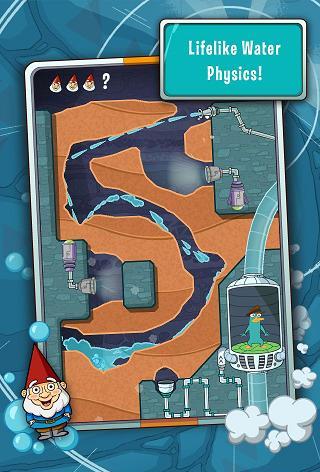
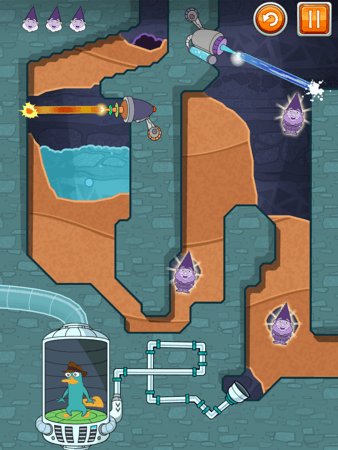
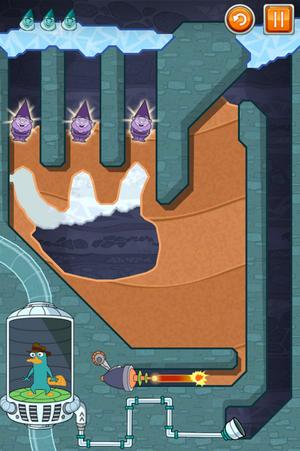
To power Perry’s transport, players need to direct water into a pipe, digging tunnels through dirt by dragging your finger around the screen. The water physics are reasonably realistic, and as such the water’s movements always make sense, but are not always predictable. That’s the best kind of challenge a physics puzzler can offer: if something doesn’t work, it’s because you’re doing it wrong. It’s never the game’s fault. It’s always either that you’ve misjudged how the water will react, or some small imperfection in your plan has altered the outcome. Whichever way a failed attempt pans out, it always has you feeling like the next turn will be a success. If not, surely it’ll be the one after that. Or after that.

That mindset, where victory is always just out of reach, fosters a healthy level of addictiveness that keeps you coming back, but doesn’t frustrate you too much.

This is the core of the game, but a few other layers are placed over the top. As with most games, semi-arbitrary collectables are scattered around: there are three gnomes in each level, which you collect by filling with a certain amount of water or steam. Some levels also have secret documents, buried somewhere in the dirt. Collecting all of these, before getting the water to the exit, adds an extra challenge.

Soon, additional elements are introduced, and it becomes about the relationships between them. Water can be heated and cooled to bring steam and ice into the mix, which bring with them their own uses and physics.

Heat ice and it’ll melt into water. Heat water, and it’ll evaporate into steam. Cool steam, it’ll condense back into water, or cool water, it’ll freeze into ice. It’s basic stuff, but the puzzles built around it become quite ingenious. Heating and cooling sources may be a viscous goo, or a laser. Then throw buttons, hoses and moving blocks into the mix and you’ve got yourself a classic puzzle game.


Visuals & Audio
The presentation is obviously rooted in that of the base show, Phineas and Ferb. I hadn’t actually seen it, but a quick Youtube scan shows that the visual style is quite faithful to the source, and it looks fantastic on the iPhone’s Retina screen. It has the sharp-edged, Flash-animated look of a lot of cartoons nowadays. Dressing up Where’s My Water? in a Disney Channel cartoon works quite well. At best, it increases the appeal to Phineas and Ferb fans, and at the least, it combines the visual cues into a coherent whole that even those who haven’t seen the show will find charming.

The sound design continues the trend, with the show’s original voice cast reprising their usual roles. Perry remains a largely silent protagonist, besides the odd grunt or growl, but his allies and enemies are quite entertaining. Someone will pop up to talk over the radio at the start of a level, or periodically if you take too long. It might be his boss, Major Monogram, dorky lab assistant Carl, or their arch-nemesis, Dr. Doofenshmirtz, but someone will regularly be there to provide a tip or a quip. The writing isn’t bad, either, with these one-liners often eliciting a chuckle.

All together, the Phineas and Ferb packaging increases the game’s appeal, and has interested me enough to want to check out the show.


Overall
If you’re a Phineas and Ferb fan who likes puzzle games, there’s no question: you need to play Where’s My Perry?

If you’re a regular puzzle gamer, who’s sick of Angry Birds, Cut The Rope and all that, Where’s My Perry? is a very worthy successor. The Phineas and Ferb flavour adds personality to the core addictive gameplay, and the whole package will charm the socks off any players.

8-5-capsules-out-of-10