Not only was asecond season of A Certain Scientific Railgun announced today at Dengeki 20th Anniversary Festival, but a second season was also announced for Ro-Kyu-Bu!. Little is known about what the show’s storyline will consist of, though considering the contents of the first season, it will continue to tell the story of the five basketball playing girls and their coach.
Currently the second season is meant to be called Ro-Kyu-Bu! SS with the SS apparently serving two purposes. One as “Second Season” as well as “Shōgakusei wa Saikō daze!” which roughly means “Primary School Girls are Great.” It is worth noting that the first anime season of Ro-Kyu-Bu! was meant to be released by Sentai Filmworks in North America, however the license was returned to the studio and plans to release the anime were dropped with little explanation.
Good news for all of you Misaka fans out there. It was revealed during a special stage event held during the Dengeki 20th Anniversary Festivalthat A Certain Scientific Railgun, also known as To aru Kagaku no Railgun, will be getting a second season.
Currently there are only a few details known about the show, but the name of the second season will be To aru Kagaku no Railgun, or A Certain Scientific Railgun S. More details about the story and the staff that will be taking part in this second season will be revealed in the December issue of Dengeki Daioh which will be released on October 27th. Currently FUNimation owns the license to the first season of Railgun, and they are expecting to release an English dub of the first season sometime in 2013.
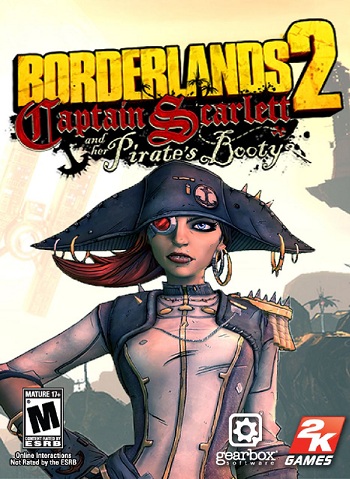
Borderlands 2: Captain Scarlett and Her Pirate’s Booty Developer: Gearbox Software Publisher: 2K Games Platforms:PlayStation 3, PC, Xbox 360 (Reviewed) Release Date: October 16, 2012 Price:800 MSP ($10) – Available Here
Overview: Shortly before Borderlands 2 was set to be released to stores, Gearbox Software announced that they were planning on releasing four expansion packs to the game in the form of DLC. Now that the critically acclaimed Borderlands 2 has been in stores for a little over a month now and some people have already explored everything that Pandora has to offer, Gearbox’s first piece of story-based downloadable content has been released in the form of Captain Scarlett and Her Pirate’s Booty. Is it a worthy download? Let’s find out.
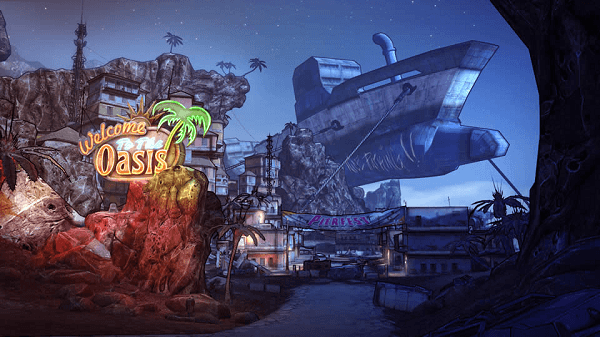
Story: As the Vault Hunters arrive in the city of Oasis via the fast travel system, they will find that this town is probably the farthest thing from an oasis in the desert. While talking to a man who still is living in the decrepit city, you will learn that Captain Blade’s lost treasure can be found somewhere out in the desert and the only way to find it is to team up with an someone who off-handedly mentions how she will betray you.
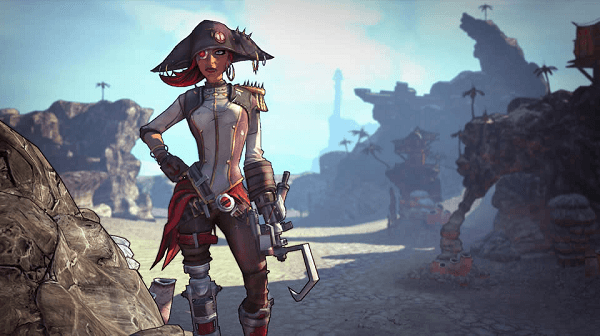
Borderlands 2 continues to deliver memorable characters and as soon as you step foot into Oasis you are greeted by one of the craziest people in the entire game who spends his time talking to audio-logs, a hermit with total obsession over a woman, and the titular woman herself, Captain Scarlett. Each of these characters continue to provide plenty of humorous dialogue, especially Scarlett who cheerfully lets you join her group and search for the treasure, mentioning how you’ll likely find it in a few hours while both her and her crew have spent years looking for it and how she will likely stab you in the back the minute that you do.
Ultimately a few hours is all that is needed to breeze through the main story of this DLC, however a large number of side-quests (though these are fetch-quest oriented) and additional content which will be mentioned shortly have been packed into Captain Scarlett and Her Pirate’s Booty, allowing the DLC to provide plenty of hours shooting pirates and looting their booty.
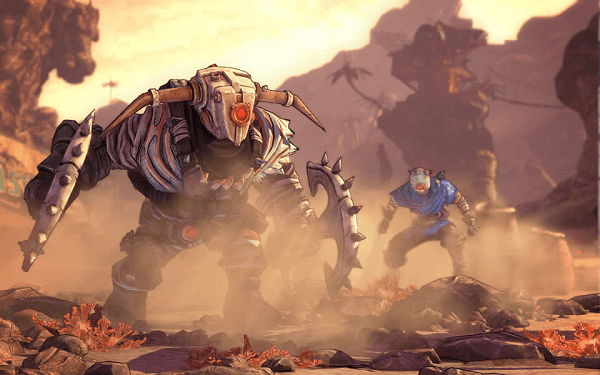
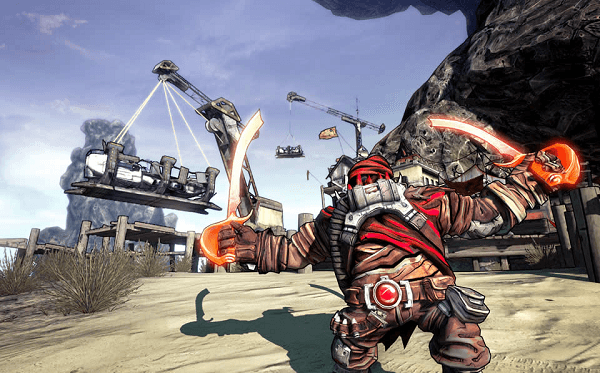
Visuals & Audio: As one would expect, this expansion retains the same visual aesthetic of Borderlands 2 and the named characters within the story are all memorably designed. While a few enemies have been re-used for this DLC, nearly every enemy you encounter will feature a redesign to fit the pirate theme or are entirely brand new.
While the characters and enemies are wonderful, the environments can be hit and miss at best. Players will enjoy sifting through Oasis, but a large portion of the desert is made up of brown environments that gamers will have to slog through until they make their way to some of the more colorful and vibrant areas.
As far as the voices of the new characters are concerned, each one has been given adequate voice work. It seems that special care has been given to the two loony people you meet on your ventures in Captain Scarlett’s Booty, as they sound especially crazy once you meet them. Scarlett herself is handled well, though she forgoes nearly every pirate stereotype as far as dialogue goes.
Gameplay: As players venture out into the sandy wastes they will come across a slew of new enemies waiting to kill them. As mentioned before, a number of pre-existing enemies such as bandits, psychos and goliaths have been changed into pirate versions of themselves, wielding various pirate like weaponry and a number of new combat patterns and buccaneers have also been introduced as pure melee enemies while various sand worms move beneath the ground and attack whenever they rise above the ground.
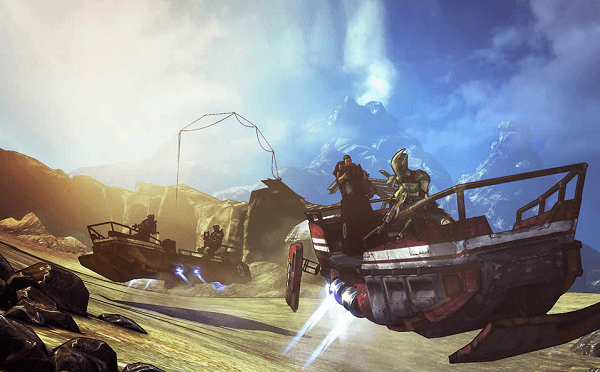
Outside of these new enemies, a new vehicle has been introduced to the game via the sand skiff. These sand skiffs are basically hovercrafts that can be equipped with either rockets, razor blades or a harpoon cannon. They easy to maneuver and can even make it inside of various strongholds, giving the driver an edge over the various foot soldiers in the area.
Captain Scarlett and Her Pirate’s Booty also introduces a new set of weaponry into the game and weapon currency via Seraph crystals. There are a couple of high-level raid bosses that can be extremely difficult to defeat even with four players at a time, even more so than Terramorphous, that players can try to defeat. If they manage to do so they will be given special Seraph crystals which can be used to purchase very powerful Seraph weaponry, relics and shields.
It is worth noting that while there are two very high level raid bosses to be found in this DLC, the enemies in Pirate’s Booty scale to wherever the player is in their run through of the game. Meaning of course that if you were to venture into Oasis while in True Vault Hunter mode, you will face some rather stiff opposition. Newcomers should be warned however that enemies will never drop below level 15, so players will need to have at least a mildly leveled character before searching for pirate treasure.
Overall: Borderlands 2’s already enjoyable gameplay and multiplayer aspects translate only make the new content found in Captain Scarlett and Her Pirate’s Booty all the better. While most of the side-quests players will go on involve simply retrieving and returning items, the persistent humor of Borderlands 2 usually keeps these missions enjoyable while the main storyline provides a worthwhile adventure. With new versions of enemies to fight, a new vehicle to drive, new weaponry to find and some difficult bosses to conquer, Captain Scarlett and Her Pirate’s Booty DLC should be plundered immediately.
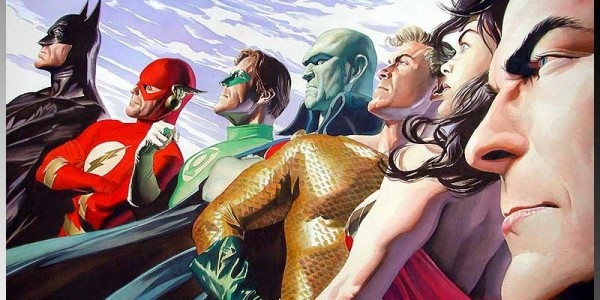
Now that DC knows that a team superhero movie can bring the mega millions, the Justice League movie is being rushed to completion. The release date for the Justice League movie has been moved up to Autumn 2015. DC have had some hit and miss success with their comic-to-movie translations so I’m sure fans will be secretly wishing for a job done well instead of a job done fast.
It is also no mistake that the JL movie release date coincides with the expected release date of The Avengers 2 – a geeks dream! Batman v Cap America. The Man of Steel v the Man of Iron Armour. Hulk v everyone else. Only three short years to go…
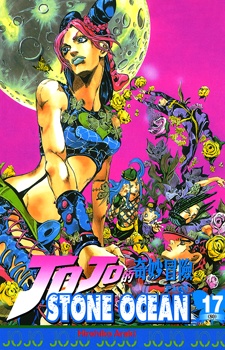
Namco Bandai have revealed that popular JoJo’s Bizarre Adventure: Part 6 – Stone Ocean character’s Jolyne and Hermes will be fully playable in their upcoming fighting game JoJo’s Bizarre Adventure: All-Star Battle.
A bit of information on the inclusion of Part 6 – Stone Ocean characters and settings was confirmed. Jolyne Kujo the daughter of Part 3 – Stardust Crusaders protagonist Jotaru Kujo and Jolyne’s ally Hermes Costello will both be playable characters. Not only that but Green Dolphin Street Prison (a setting from Part 6 – Stone Ocean) will be a one of the stages available.
JoJo’s Bizarre Adventure: All-Star Battle is slated for a 2013 release exclusive to the PlayStation 3. What do you think of the news that Part 6 -Stone Ocean characters and setting will feature in the game? Let us know in the comments section below.
Wadjet Eye Games, in case you haven’t dipped your toes too deeply in the point and click world, specialise in making old school point and click adventure games. From sci-fi noir Gemini Rue to the Blackwell Series to most recent release Resonance, this small developer has proven more than capable of bringing excellent stories to the table.
Primordia is a joint production between Wadjet and Wormwood Studio, and is due for full release on December 5th this year. For this preview I played through the first segment of the game, which ignoring a few minor issues is looking to be in very fine form…
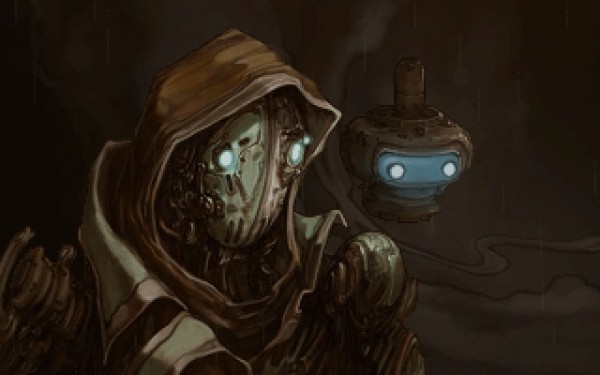
The rather eery looking Horatio, along with floating companion Crispin
In Primordia humans are long gone from the world, elevated to mythical creator status by the robots that now inhabit the planet. The protagonist is Horatio, a largely solitary bot whose only companion in the wastelands is Crispin, a small flying droid whom he built from parts lifted from the junkyard which he roams. When a very malevolent robot steals their power source, the two must set out on a journey to recover or replace it, lest they run out of power and cease to function. Things quickly take a darker turn than that brief summary would suggest, with some creepy characters doing their best to deepen the mystery.
Gameplay is a classic adventure game affair, utilising objects found in the environments to solve problems and progress with the story. Wadjet Eye aficionados will be familiar with the layout and even more so with the two character set up – the voice actor for Crispin is also Joey in the Blackwell Series. The two share similar roles in their games- smart mouth companions who also serve as hint droppers when needed.
The puzzles are just how you want them to be, requiring careful attention to the world and dialogue to come to a logical and practical solution. A plasma blowtorch is perhaps a little overused as a solution to all life’s problems, but Primordia has enough grace to admit it, with plenty of dialogue that isn’t afraid to poke fun at itself.There is some solid voice acting going on here too, with the supporting characters tending to the intensely creepy side of the robot spectrum. The character design is a strong point, with the robotic population allowing a great degree of creative strangeness.
“…beautiful in its own disturbing way.”
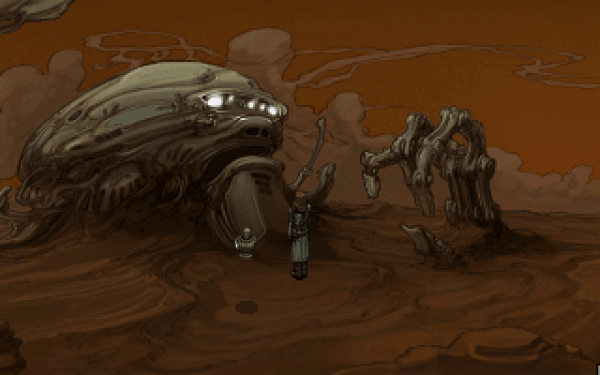
That darker tinge is something that runs through the whole game, with every aspect lending a hand to create an atmosphere that is slightly unnerving. Despite the more classic style of the artwork it is nonetheless beautiful in its own disturbing way, proving that you don’t need a high polygon count to have an impact. Melancholic electronic music, a bleak cyberpunk style, a titan like robot buried so deep in the sand that only it’s Geiger like skull and skeletal hand are visible – it’s all very immersive and highly promising. Horatio himself is an intriguing figure, seemingly unaware of a mysterious past hinted at by other characters. Why does he live apart from the rest of the world? What is so wrong with the City of Metropol that he refuses to return? It feels like there is a very rich story still to be revealed, one that will deal with the end of human civilisation and the creation of an entirely new mechanical one. There are plenty of mythological elements here as well, giving the whole thing a much more epic feel than the more personal stories seen in the Blackwell Series.
Although there are some technical issues to be fixed the game is still a few months away from a full release. Crucially for a point and click adventure it is already displaying the elements that truly matter for the genre – a strong, atmospheric world that you can’t help but want to experience more of, solid character work and a dash of darkness as well as humour. The beginning of Horatio’s story has already hooked me, and pending a perfected technical base come December, the story will hopefully prove itself equally strong in both middle and end.
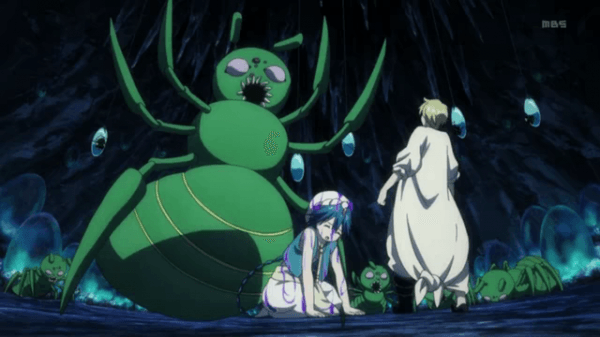
Welcome to my weekly Magi episode impressions. This week, I go through episode 2 of Magi. What did I think of the episode? Watch below to find out. Got any questions for Anime Say?
You can send me a tweet on my official twitter or alternatively drop me an email at [email protected]. I will do my best to respond to your tweets and emails as well as try read some out on the show.
What do you think of this episode impression? Let us know in the comments section below.
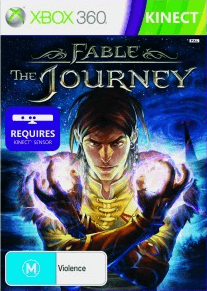
Fable: The Journey Developer: Lionhead Studios Publisher: Microsoft Studios Platforms: Xbox 360 Release Date: October 9th, 2012 Price: $49.99 Available here
OVERVIEW
The gameplay premise behind the original Fable game was ambitious: to create a game that unlocked limitless, unrelenting possibilities, where no two play-throughs would ever be the same. Sufficed to say, the original claim was vastly exaggerated, but it did not deviate from the fact that Fable 1, and the subsequent expansion Fable: The Lost Chapters were genuinely epic games that provided very unique role play experiences. Fable has since prided itself on its system of choice and consequence, and made the series one of the best selling exclusives on the Xbox and Xbox 360. However, the subsequent sequels to the original epic have been greeted with greater and greater levels of disappointment from fans for each successive game released.
Fable has started to become one of those franchises where the players aren’t sure whether they love it, hate it or just shrug at it with a colossal degree of indifference. It was during Microsoft’s 2011 press event when the latest instalment in the franchise: Fable The Journey was announced, with the news that it would be a Kinect devoted title. This revelation was met with no shortage of groans of disdain from viewers around the world, as the Kinect was being increasingly shunned by the gaming masses. Now, in 2012, Fable The Journey has hit the shelves of game stores around the world. There’s no doubt that the odds of receiving a favourable reception from the masses is stacked against it. So how exactly does Fable The Journey hold up in an increasingly sceptical market?
GAMEPLAY
Fable The Journey does quite a number of things differently from the previous titles. First and foremost is the omission of the controller in favour of the Kinect system. This both drastically changes the way the game is played and experienced, but also isolates the playership to only those who already own the camera attachment. Interaction with the game is performed primarily through hand gestures. It comes as a small mercy of sorts (when compared to other Kinect titles like Star Wars), that the whole game can be played from the comfort of your seat, eliminating the need for the Kinect’s standard repertoire of “gimmicky jump” quicktime events and “step-left-step-right” mechanics.
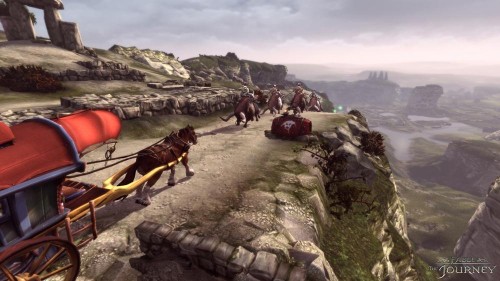
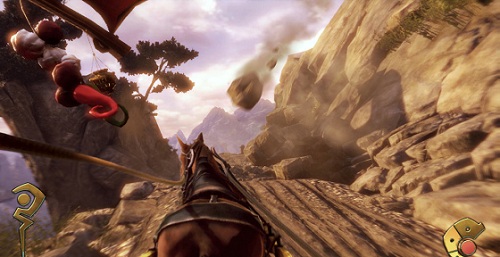
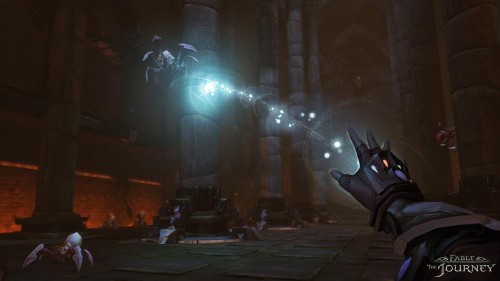
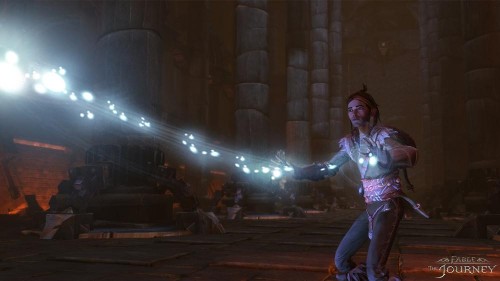
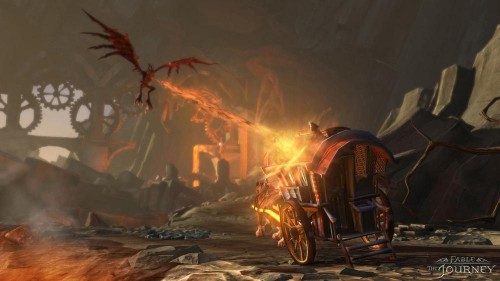
Unlike its predecessors, Fable the Journey is the first of the Fable franchise to utilise a first person perspective. A majority of the gameplay time is divided between horse riding and magic-based first person shooting. The former section is about as interesting as it sounds, though many players will find themselves getting surprisingly immersed when it comes to the movement of the horse and carriage. However, for most players, the REAL game is to be found in the first person magic sections.
Using both right hand, left hand and voice controls allows players to cast and scroll through a small library of available spells to do battle with many of the iconic Fable enemies such as Hobbes, Hollow Men and Balverines. Players generally control Jedi-like push, pull and shield abilities with the left arm, while the right controls offensive spells, like bolt and fireball. Voice commands are efficiently reactive when it comes to spell switching by a simple mention of the spell’s name. It’s not quite as tactical as saying “Garrus, overload!” or as epic as shouting a “FUS-RO-DAH!”, but it works.
These gameplay sections are broken up by mini-games accessible in a rest stop. It is in these intermission areas where the player can help tend to their horse’s wounds, feed it, find treasure, and even do a little smithing. Again, the Kinect directs actions such as pulling down an apple and holding it out to your horse. And I guarantee that no player will be able to open a chest without holding their hands above their head Zelda style and saying “Da-na-na-naaaah!”
Now for the million dollar question of any Kinect game. Do the controls work? Surprisingly: Yes. Unsurprisingly: Just barely. While the defensive and voice commands of the game work very well, there are aim issues to be had with the right hand spell casting, and reaction issues with the horse controls. Early on in the game, the player is made to calibrate their aim by flinging bolts at all corners of the screen. However, there will be many instances in combat where a spell flies exactly where you don’t need it. While a provision has been made in the form of the aftershock ability (which lets you redirect a wayward bolt), the simple inclusion of a targeting reticule would have eliminated this problem. Without a targeting system, many shots are liable to be directed by chance, or auto-aim. On that note, it should also be said that the game isn’t particularly challenging. While difficulty can be scaled appropriately, it just feels like the much of the game is just designed to be passed, with the player having to rely on the accuracy of auto aim when enemies get up nice and close. When they’re directly in your face, you can’t miss, and even this is a problem if you’re trying to use the grab spell on an object in the background. It’s nothing that makes the game unplayable, but it relinquishes a large sense of control. And for an RPG series, that’s a significant drawback.
STORY
Another significant change is the absence of a personalised and mouldable hero. Remember all those nameless traders that wandered around Albion who your old hero occasionally led around and sacrificed painfully at the Chapel of Scorn? Well, that’s you this time. Players take on the role of Gabriel, a young man that lives and travels with a large convoy of travelling merchants. Gabriel is something of a loner and scoundrel within the convoy community (probably a result of you sacrificing his parents in a previous game.) It isn’t long until he ends up accidently separated from the convoy, and he comes across a Theresa, the same blind seer responsible for every Fable plot device for the last 3 games. Recall that dark force you killed in Fable 3? Not dead. It’s back and it’s angry. Gabriel soon finds himself embroiled in the conflict, having to undertake a dangerous journey to find a means to defeat the darkness and preserve the land of Albion.
For all the plot’s predictable turns and overused idioms, it’s nice to see a Kinect game that is as heavily story driven as this. It’s difficult to say whether this game’s story is only strong because of the lore established in the previous games, or if the game is doing a genuinely good job at preserving those stories. Nonetheless, if you’re a Fable fan, it’s certainly interesting to hear how Albion has changed in the space of another 50 year absence.
AUDIO AND VISUALS
True to Fable form, the writing and voice acting work of Fable The Journey carries over that same British style of Monty-Python-esque humour that was so prevalent in the previous titles. Obviously the appeal of this is individual, but I will admit that many of the jokes seemed stale, and rarely got more than a “Heh” out of me. Regardless, the voice roles are well spoken and delivered. The musical score features a similar manner of folkish tracks that are so iconic in the Fable universe.
The visuals of Fable the Journey are the best looking yet. Character models have lost a lot of the gritty realism that was thrust in our faces in Fable 3 in favour of a graphic style that seems more reminiscent of Fable 1. Brighter and livelier colours are featured in much greater detail that any game before it, providing a real sense of fantasy and allure in some situations, and a feeling of dread or adrenaline in others.
OVERALL
Remember when Peter Molyneux said that Fable the Journey isn’t a rail shooter? Well that was an exaggeration because the game is almost entirely on rails. Choosing to go left or go right in a horse riding section doesn’t mean a heck of a lot if you end up in the same destination regardless. Although the story is quite linear and predictable, the fashion in which it is told is done with surprising depth and detail. Make no mistake, this isn’t a Fable 4. The storyline is shorter, and the replay value is nothing like the RPG equivalents, but it certainly does provide a unique and well thought out experience. While the Kinect’s controls are surprisingly well adapted, ultimately this is going to be a game for the fans that already love the franchise and want to delve deeper into the land of Albion.
Dream Eater Merry
Studio: TBS Animation Publisher:Hanabee Format: DVD Release Date: Out Now Price: $47.99 (Buy Here)
Overview
What if your dreams were actually a gateway to another reality? What if, sometimes, the things from your dreams wanted to come out into the real world? Well, this is the concept of Dream Eater Merry.
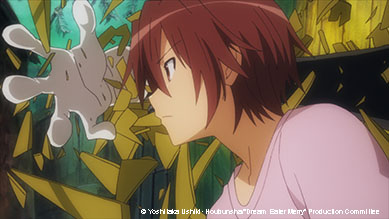
Yumeji is just a normal guy with the unique ability to see the kinds of dreams other people are going to have, but his world is changed when he meets Merry Nightmare, a dream spirit from another world. This other world is the Dream World and she is looking for a way to return there.
Is this concept a well done one? Or is it a little stale? Find out in our review below.
Story
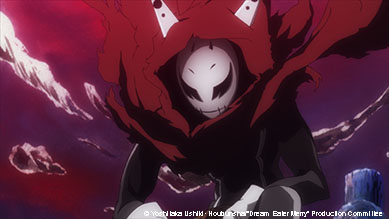
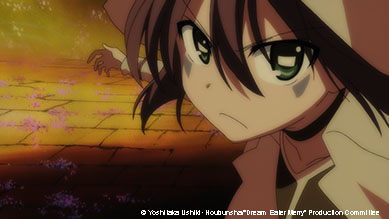
Dream Eater Merry follows the battles of a Spirit from the dream world named Merry. She has somehow ended up on Earth and is searching for a way back to her home in the dream world. Of course, as the story progresses, you do actually learn how it is that she got into the real world. It makes for a pretty interesting story.
What I really liked about the story was how right at the start of the series, you think that it’s pretty much going to be a one way kind of deal. What I mean is that it is initially presented as though its some kind of action show, but it very quickly becomes a little more complicated than just defeating the bad guys each week.
The character progression in Dream Eater Merry is pretty good. The characters at first appear to be quite one-dimensional, but as you advance through the series, you get to know them a little better as they progress through the story. This is always a good thing for a series to have as relatable characters make as remember a series more fondly.
Another thing that I liked was that the combat had an impact on the story. What I mean here is that you see early on that Merry believes that she’s doing a good thing by defeating all of these dream figures. However, this is proven not to be true and that all she is actually doing is murdering them.
Overall the story in Dream Eater Merry is quite interesting and it does a few things that really push it that way. I’d really recommend for anyone to give it a go based on story alone.
Visuals
When I first took a look at the cover of Dream Eater Merry, I really thought that this would be a really generic looking show. I’m glad that I was wrong.
You see there are a lot of elements to the show that are present within the visuals. For instance, each dream demon has their own dreamscape with their own distinctive looks and feels. This adds a real visual flavour to the series, as opposed to just having standard environments which would have only added a standard flavour.
I actually really liked the individuality of each dream represented within this series. I think that each dream realm spoke a lot about the character having them. This isn’t really a direct thing though, you’d have to kind of know what the character is about to be able to see why they have a particular dream. For example, there is one girl who seems pretty normal, but you can see that she’s actually really lonely because her dream has given her a romantic companion. The show shows this visually and it makes the whole situation more personable as a result.
Audio
Dream Eater Merry has an amazing audio component, if you’re watching it in Japanese. I mean, like, the background score and sound effects are all the same between both dubs, but the English really seemed lacking somehow.I’m not going to say the English dub was flat or that there was anything wrong with it, but it just felt like the Japanese dub was much more rich and vibrant, creating a better feeling show. If you’re someone that can’t stand Japanese audio or read subtitles all too quick, you’re not losing anything by sticking with the English dub, I just really preferred the Japanese dub over it.
The background score captures the scene really well in this series. In battles it is quite dramatic and something you’d associate with a fight, whereas in other softer scenes, the audio carries across that feel as well. It’s not perfect, but it’s not something you’d really complain about.
Like most series, Dream Eater Merry hosts a plethora of sound effects. Each sound effect fitted a scene quite well. Not really too much to say here, the sound effects worked.
Extras
Dream Eater Merry lists two extras available within the packaging. These extras are pretty standard in Anime packages, so you might be a little disappointed.
Included with the discs are the Clean Opening and Clean Closing sequences. Fortunately, both songs are quite enjoyable and the animations are really cool to watch. You should definitely watch them.
As for unlisted extras, there are some there. The most notable of which is the reversible cover. The standard packaging of Dream Eater Merry is this pink colour and might look out of place on some Otaku’s desks (not that I care, pink is one of my favourite colours). However, you can flip this onto the otherside to reveal a greener cover, comprised mainly of green. A reversible cover with two of my favourite colours? Heck yeah.
Overall
Overall Dream Eater Merry is an entertaining show that may change your perceptions of your dreams. The storyline is fairly entertaining and far more involved than I actually spoke about (I really don’t want to spoil this too much, which is why I was so tight lipped up there) and it’s strong visuals make this a series that you’ll definitely want to check out.





 Namco Bandai have revealed that popular JoJo’s Bizarre Adventure: Part 6 – Stone Ocean character’s Jolyne and Hermes will be fully playable in their upcoming fighting game JoJo’s Bizarre Adventure: All-Star Battle.