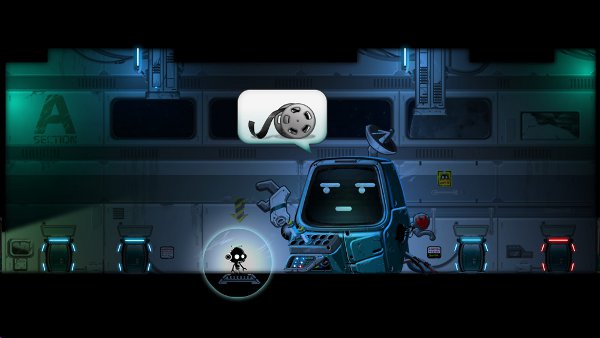
Constant C may have been one of the lucky hundred titles that were chosen for Steam’s Greenlight back in August, but the game is looking at an even brighter future as well. Original developer IGS and 5pb Games have announced that the title will be reaching XBLA in the Spring of 2014.
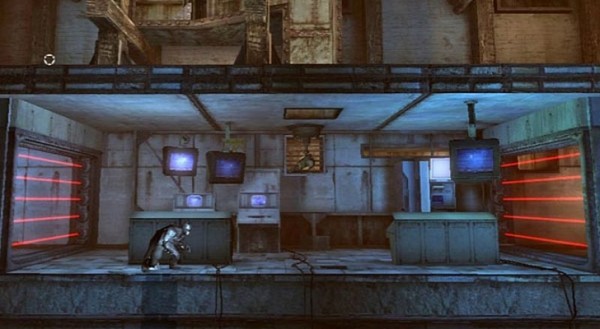
Telling the story of a robot trying to fix a research space station that is frozen in time, Constant C is a puzzle platformer that lets players control gravity, momentum, and time to solve the mysteries of the space station. With more than 100 levels, players will have plenty of challenges to face and now the XBLA version will see enhancements like improved localization.
Those wanting to see more on Constant C can check out the official trailer embedded below. Constant C was previously released for PC, but this newer improved version will be hitting the Xbox 360 XBLA next Spring.
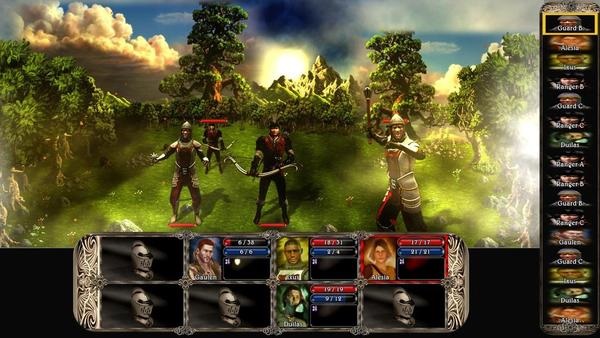
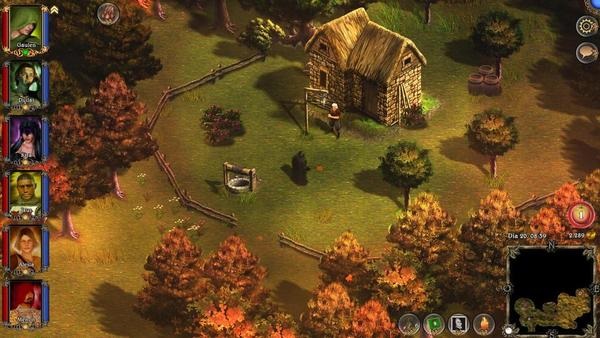
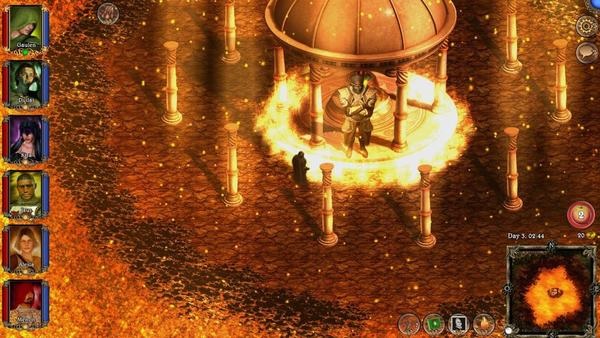
Lords of Xulima is a Turn-Based RPG with the 2D isometric feel of classic games like Baulder’s Gate made by Numantian Games; with a release date set for early 2014 on the PC, Mac, and Linux, but Numantian Games is looking to the crowd sourcing giant IndieGoGo to help them reach their goal and provide even more content to the players.
In developing a game as complex as Lords of Xulima, we needed to make a lot of decisions about what aspects to include and which ones to exclude. Even though we would like to be able to do everything to make Lords of Xulima the best game possible, unfortunately we need to adjust our vision to match our budget. For this reason, we have decided to launch this campaign and ask you to contribute to improving Lords of Xulima.
Lord of Xulima boasts more than 60 hours of gameplay as well as a vast continent to explore, “with different environments and climates”. The landscapes are hand-drawn, keeping with the old-school feel of games like Diablo and Fallout, but with a modern and intuitive interface.
Check out the trailer for Lords of Xulima below and also on IndieGoGo and don’t forget to vote for them on Steam Greenlight.
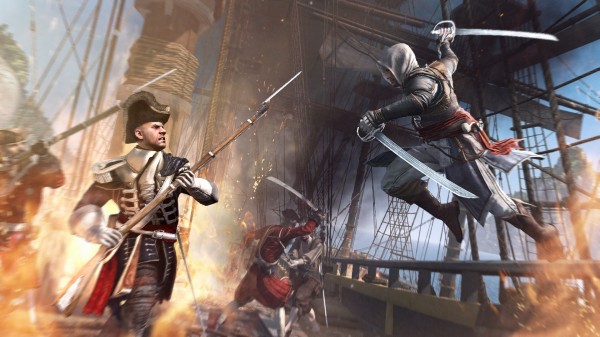
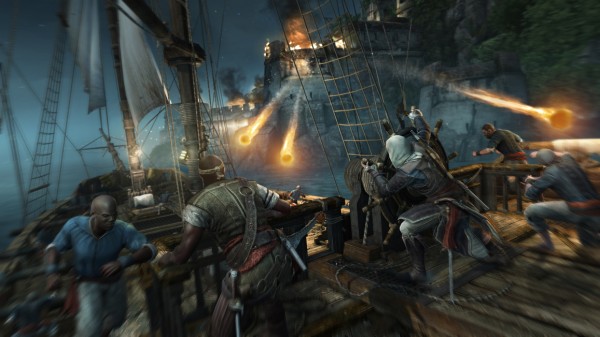
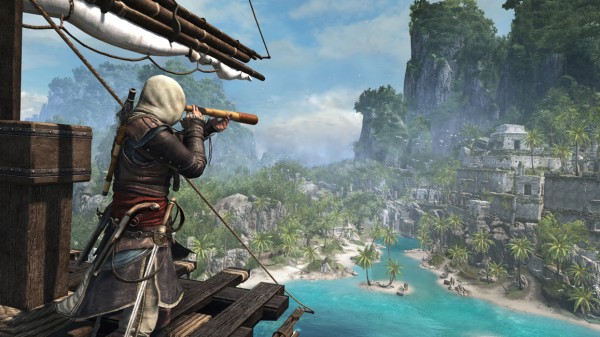
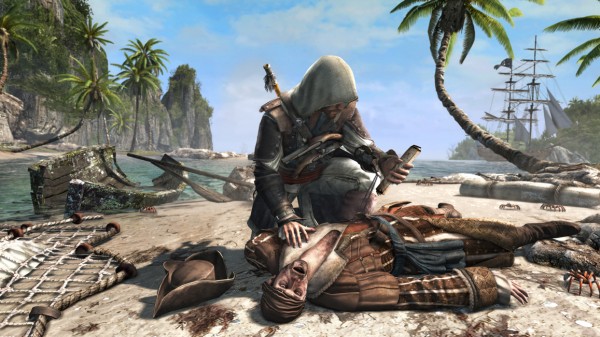
With the days whittling down, Ubisoft has released a brand new trailer for Assassin’s Creed IV: Black Flag and while it still has everything to do with piracy this time they went with a somewhat unique central theme. Showing off all Edward’s tattoos, the trailer focuses on many of them and gives a glimpse of the pirate life Edward has coursing through his veins.
From busting out of irons for some retribution, to leading a boarding party Edward has the very sea within his blood. Not only does the trailer feature some nice action from Black Flag, but it does give a good sense of who Edward is, especially with knowing what all those tattoos stand for.
Those wanting to see the trailer for themselves and check out all those sweet tats can find it embedded below. Assassin’s Creed IV: Black Flag will be releasing at the end of the month for Xbox 360, PS3, Wii U, and PC, and as a launch title for Xbox One and PS4.
To be honest, back in school I never paid much attention in history class (ancient or modern) . So imagine my surprise when I found out World War II was won with simple touch controls and tower defence action over just 21 missions! Introducing Hills Of Glory 3D, a tower defence title with a World War II theme that for some reason thinks boasting it has 3D graphics is somehow still considered a selling point so significant it needs to be included in the title. Hills Of Glory 3D takes no risks in delivering a watered down strategy experience for casual gamers but comes in a nice, polished package for your thumbs to fiddle around with.
Gameplay
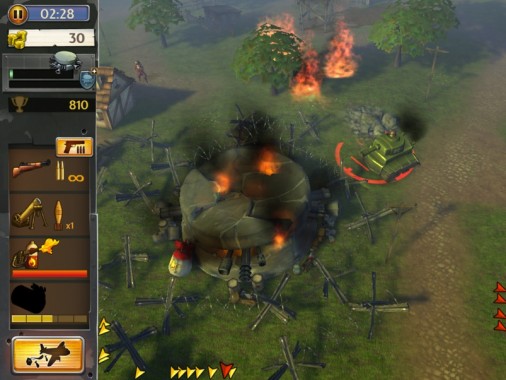
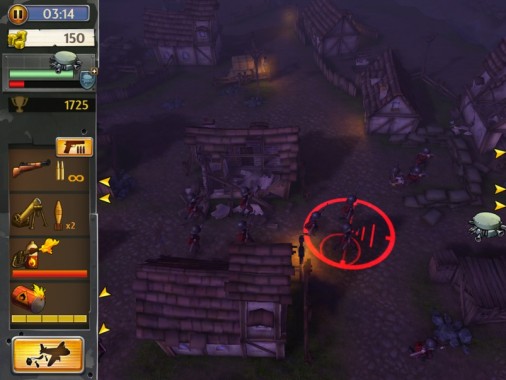
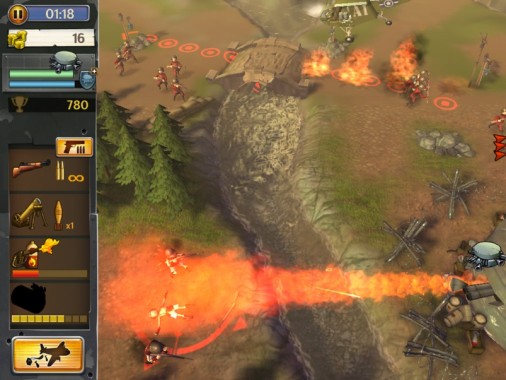
Hills Of Glory 3D is a simple tower defence title. Well, they call it tower defence but you don’t really build any towers or turrets unlike most other titles. Instead, you just defend the base with the weapons you have, making for a much simpler gaming experience. This is a double edged sword however, as while it does take away much of the complexity, the game then becomes a little too easy. It then starts feeling more like a button masher (or should I say screen tapper) with very little strategy required….which kind of defeats the purpose of a strategy game. The simplicity does make it very easy to play though. Players take control of a military base and must protect it against all enemies. Tapping shoots a troop and you can rack up combos. Two fingers can unleash a machine gun, two fingers drops napalm, holding can bring out a mortar, you get the idea. Options and weapons are limited as well as variety in gameplay and what you see is what you get. It may take some getting used to remembering the way to use certain weapons but other than that there is a very small learning curve. Of course I should also note Hills Of Glory 3D is free, so you know the drill of what to expect: waiting to play a game, in-app purchases, advertisements, a strong focus on upgrading & power ups and other generic features.
Audio & Visual
Like many of Chillingo’s published titles, presentation is pretty much as good as it gets on iOS. Graphics are bright, cartoonish, charming and not scared of having some fun. Oh yeah and in case you didn’t guess by the title, it has 3D graphics too! With smooth models, decent animation and nice textures the graphics department of Hills Of Glory 3D is surely a highlight. The soundtrack is pretty much what you’d expect from a military title with drums you’d be more than happy to march along too. Sound effects may not be spectacular but they get the job done. Sadly, voice acting isn’t present which would’ve been a nice touch.
Overall For better or worse, Hills Of Glory 3D is very simple, casual defence title. Without towers or turrets to build, gameplay boils down to tapping on enemies in a variety of ways to defend your base without much strategy to it. That being said, Hills Of Glory 3D could be a good gateway game to the genre for some gamers. With a decent soundtrack and bright visuals presentation is splendid and it’s also a free title, so why the hell not? With that being said, I’m sure most games will be left feeling unsatisfied and wanting more out of their game.
Capsule Computers review guidelines can be found here.
Capture from the EB Live! Battlefield 4 presentation. He’s not usually that stern looking….
EA Australia had a large presence at EB Games Expo 2013, with what was voted as ‘Best Game of Show’ in Titanfall, The Sims 4, FIFA 14 and more. But even more eye-catching and attention grabbing than the fallen mech from the former – in the back corner of the Xbox booth, mind you – was the life-size tank in the centre of the expo hall. And while t-shirts were being shot from its cannon into the crowd, and others lined up to play Battlefield 4, I was interviewing DICE Creative Director Lars Gustavsson. It was a real pleasure to speak with the man on the game, who came to Sydney all the way from Stockholm, Sweden.
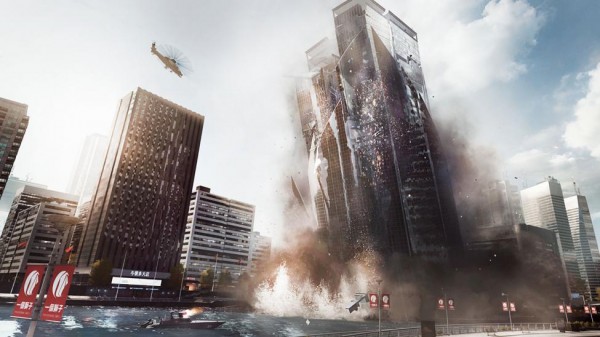
The first thing I wanted to ask about is Levolution. We keep seeing, with the Siege of Shanghai map and all the beta footage that’s been released, the huge tower crumbling into the bay, but just far does Levolution go in the levels, in both single-player and multiplayer?
So we made it very clear to ourselves early on that Levolution isn’t just that epic thing that’s happening, and that it ranges from, on some levels it’s less epic, and on some it’s more epic. But the key thing is that it should alter how you play the level. And equally important – or sometimes even more important – is all the interactive components sprinkled around the world. And then in combination with the networked water – the new water that can change – improved destruction, and a lot of other things, it should make the battlefield more interactive.
But yeah, we truly hope people will use these tools and, just like they’ll have different weapons, different gadgets, different vehicles, they can also use the environment now to seal off entrances, to be warned by metal detectors, to flooding a whole city in order to get it your way! And maybe you’re better at piloting helicopters, then you’ll definitely want that skyscraper to still be there and dominate the skyline, keeping it up there so you can have that control point. While if you’re better at boats and ground warfare, then you’ll want it to go down quickly in order to have it your way.
And then we’ve got Battlelog, which is being overhauled and enhanced, with the second-screen integration thanks to Smartglass and the like. What can you tell us about how Battlelog has been improved?
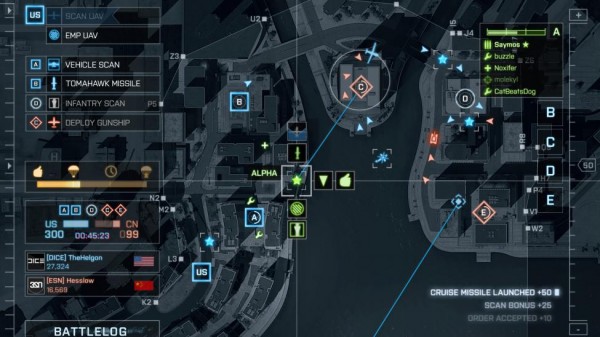
So, what we saw when we shipped Battlefield 3… I mean, we were called crazy by many people for having that integrated on PC. And overall we saw it was a success, but we also saw that it was mainly PC players that got that. So the big focus has been to get it into all platforms for Battlefield 4; to give to the same feel as the rest of the game, but also extend it. You know, we have not only the Commander screen, but the battle screen which lets you overview the map you’re currently playing on so you’re squad leader can give orders on it. And this extra map is something we’ve been asked for, for a long time by the community; to be able to change your loadout, to be able to have your social network there and to challenge friends on leaderboards.
And now, with the Geo Leaderboards… many times leaderboards land somewhere in the middle and it’s not so relevant, but now, you can actually look at the same street where you live, or same city, or same country. So we keep on building this social hub. Before Battlelog, people usually went elsewhere to find the latest news for Battlefield. But now we’ve managed to become the central hub for news, feedback, forums, friends and you now, you can also challenge friends in specific missions and so on. So really building a hub by having it on PC, but also on current-gen and next-generation. It’s a lighter version on current-gen, but full integration on next-generation hardware. So a huge step forward.
Something you just briefly mentioned is Commander Mode, which was last seen – although in a somewhat different configuration – back in Battlefield 2142. Was the whole motivation for bringing it back and revamping it the rise of this second screen experience and it just being the perfect timing for the perfect fit?
Yeah, it started in Battlefield 2and went away with Battlefield 2142. Yeah, I mean the whole reason for bring it back was – well, there’s many reasons… we lost it while we went into the Bad Company era. And looking back, I mean we learnt a lot from that era, but we also lost track of a couple of things that the community really missed. So it’s been a big request from the community to get Commander back. We have upped the number of players in our squads, we’ve introduced a field upgrade system which lets you pick your specific career for unlocks – whether I want to play defensive, offensive and so on – and as you play together, you all go up, but if you get wiped the whole squad goes down. So we’re building a whole ecosystem of teamplay and to get that Commander in-game to work, but also to be able to provide it on tablets, and hopefully make it seamless to players on the battlefield – whether they’re sitting in a cafe playing or if they’re home on their sofa – it’s been a very interesting challenge but we’re very happy with what we accomplished.
We’re also seeing a trend now with what has been revealed for next-gen of the merging of multiplayer and single-player modes. Everything seems to be one cohesive, drop-in, drop-out experience. DICE are also doing some things to blend the two, mostly linked through Battlelog. Can you tell how how you are doing this?
So overall, when we had done Battlefield 3, we got a lot of feedback on the single-player campaign – both positive and in areas of improvements. I mean, the biggest one we took away was that the only thing we had to do was more battlefield. So we stepped back to the drawing board and looked at what elements from multiplayer could we introduce into single-player. So now, you play with a squad; you can use them to engage the enemies. Instead of ‘pick this one up to take that one out’, it’s more of ‘here’s a variety of tools, you do it your way’ where your own kind of battlefield moments start to take shape and you come up with crazy solutions of taking out enemies.
We introduced scoring and persistence in single-player to give you more to strive for, and a lot of new, interesting ways to try and do more and be more. Also, we worked with the story to make it more relevant for you as the player, with good actors… but also, what’s really great to see is that, with a lot of the initiatives that brought over from multiplayer to single-player, we then also started thinking about how to build multiplayer. We saw how we could build drama in Battlefield 3 single-player, and we brought that into Levolution. We had an intern project of building interactive water, and then we said ‘yes, we want that for single-player’.
You can see it in ‘Fishing in Baku‘ where the water kind of wades around you. Then we saw that storming water and said ‘we must do this for multiplayer’ and then said ‘no, we can’t do it – yes, we can do it!’. And then we came up with a design inspired by tanks combatting among sand dunes and getting line of sight – we managed to pull it off. So that, to me, is an enormous pool of potential and crossbreed between single-player and multiplayer. In the end, hopefully the customer definitely benefits from us going at Battlefield from so many perspectives or angles.
I’m more of a single-player admittedly, but when I do get online to play Battlefield 3 or what-have-you, I sometimes feel daunted because I’m going up against guys who have mastered their strategies for each individual map and it sometimes feels like a losing battle from the get-go…
Yeah, you will hopefully be able to try out more things now in single-player first, get a better hang of it… we’ve introduced a test range, where you’re offline and can try out all the vehicle types. So learn how to pilot a transport helicopter before it’s full of players that you don’t want to clash with. You can shoot the targets, customise and so on and try out the things that you’ve unlocked. So hopefully that will also ease people into the game.
And if I’m correct, there’s also been a change to the classes?
Yeah, we have… I mean, overall, we had an overhaul in terms of customisation, both in vehicles and in general we’ve given the possibility of – sort of in racing-game style – when you add a scope to your weapon, you can see what you lose and what you gain in order to see what impact it makes. In Battlefield 3, to be honest, it was very hard to know what new attachment did for your weapon. And I think that’s important to help the players kind of find their way into the battlefield.
And you’ve got the dual-scopes on many of the rifles…
Yeah, we have lots of nifty tools and gadgets. You can have the range adjustments in your scopes… so a lot of depth. And hopefully we’ve done a lot to ease you into game modes with instructional game mode movies. We reworked the whole deploy screen for better accessibility. In customisation, we re-organised unlocks for vehicles, introduced new vehicles classes and so on and so forth. And overall, what goes across the whole game – and you usually don’t talk to media about – but all this hard work has gone into improving network code, input latency, controls and so on. So far, a lot of people say that it feels like a new game, which makes me super happy. That’s usually not something you put on the back of a box, but there’s endless hours that have gone into it.
So the closed beta has been going on for about 3 days now. It’s early, but have you gathered any feedback already? I saw a funny video online of people who had stayed in that skyscraper as it was going down and were mysteriously killed as if shot from invisible sources.
[Laughs] Yeah, there was supposed to be an environment change there that didn’t happen. So overall – I’ve been a part of Battlefield since 1942; the first prototype 14 and a half years ago – we know that, even though we have the biggest QA or testing department ever, and we do double, triple playtests every day, it’s nothing like when hardcore gamers get their hands on it. During the first hours, days, we get more feedback. So with an extremely active forum, we already now have gotten a lot of feedback on drivers, glitches, tweaking, tuning, balancing, so we’re monitoring it closely. And today we’re opening up for the open beta, so it’s going to be super exciting when I get home to the hotel tonight to see if the whole backend and everything holds up.
The last thing I wanted to ask about is the fact that, on the promotional video, your plans for post-launch support show “new content weekly”. That’s obviously a huge, continuous commitment and I imagine that would range from camo and additional customisation amongst the more spaced out bigger expansions and DLC?
Overall, what we’ve learned is that, in the old days you shipped a game and it was over. We always have been trying to keep on updating the game. But, since 1942 with the expansion packs, we’ve always seen that the lifetime for Battlefield games are really long and how our premium was received for Battlefield 3… it was just enormous. So now we have an operations team, that is probably bigger than most game studios, that just work with everything from cheating hacking, maintaining servers and ensuring that you have a good experience, building the new content, expansion packs, working with the community and messaging and all of that. So yeah, it’s a big undertaking and commitment but it’s all worth it. The way that premium and the whole post-launch journey has been on Battlefield 3 – it’s a joy to see, it’s really amazing.
I have to thank you for taking the long flight over to Australia. I can imagine the fatigue and the jet lag, but it’s just been amazing to have so many developers from the studios come down for the event.
Thank you. I mean, to be honest, the honor is all on my side. I’ve said no to most trips on this game, just to be able to finish the game and take care of the family and to ship and sell the game, but – and I’m not sucking up here – you have an awesome community down here. People are extremely positive, and it’s a great event. EA Australia are doing amazing things. They took me for a ride here… we had ‘Dine with DICE’ here with the hardcore gaming community; special dishes, great entertainment. So it’s just a joy to be here. Jet lag… I have no seconds to rest, so as long as you don’t sit down you won’t feel the jet lag.
Thanks to EA Australia and Lars Gustavsson for the opportunity. Battlefield 4 releases for the Xbox 360, PlayStation 3 and PC on October 31st; the Xbox One on November 22nd and the PlayStation 4 a week later, Australia-wide.
Fatal Theory Developer:2 Hit Studio Where to Buy: IndieBundle Here, 2 Hit Studio Here
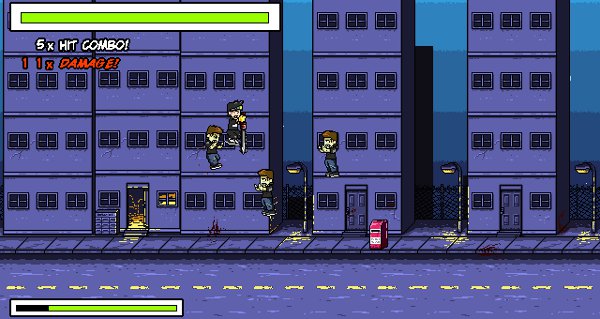
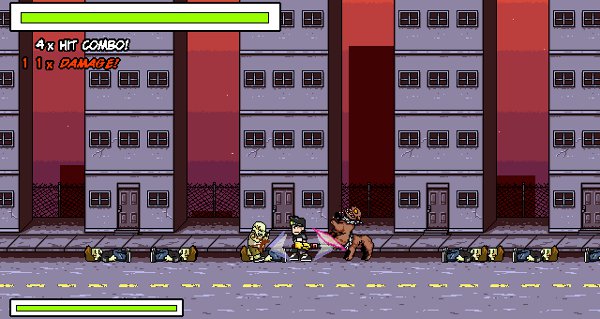
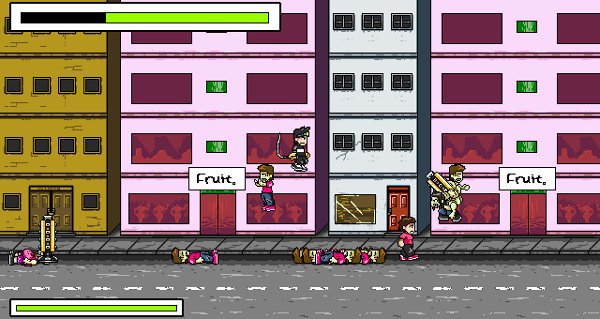
The time of side-scrolling 2D may be long past its golden years, but fans of the style still look back fondly on the hits that made it so popular. Side-scrolling beat ’em ups were particularly popular and there have been plenty of new games that go back to the style, such as the Scott Pilgrim game and even a level of Saints Row IV. 2 Hit Studio is looking to capture the same spirit of these old school side scrolling beat ’em ups with their upcoming Fatal Theory, and we were glad to look at an alpha build to see how it plays.
The first thing to notice about Fatal Theory is that the game does stay true to the 8-bit style graphics of years past, but is still willing to use hand drawn pictures when applicable as well. The story is told through storyboard style with drawn images showing off a much more detailed version of the characters that the 8-bit style sprite characters. This may be for simplicity, but the effect remains none the less of tingling the nostalgia gland pining for these kinds of games.
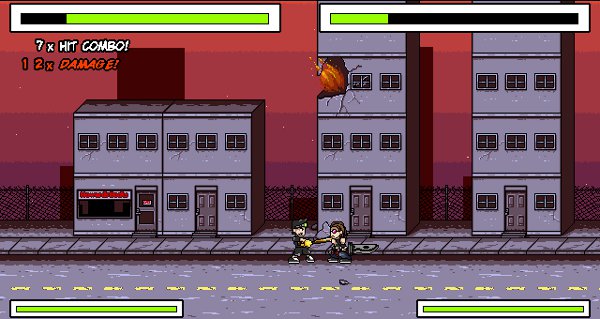
Fatal Theory‘s story starts out pretty basic a kid is playing video games when zombies come invading their town, who hasn’t been there. Obviously the only thing to do is pick up a bat and start bashing away to combat the evil horde and the gameplay is able to the old standards. As the story goes on, main character Nick is able to gain more equipment, going from just a bat to a chainsaw sword and an electric whip to name a few.
But, what allows the game’s combat to hold up so well isn’t just the diversity of the weapons that can be used, but the fact that EXP can be gained to unlock more abilities and special moves with the weapons. The main weapon has a devastating spin attack, but the electric whip when leveled up can throw lightning down the street catching all those in the way. These additions help to give a better depth to the gameplay, keep using a weapon to unlock better attacks or go back and grind past levels to get even more.
Besides the weapons EXP, Fatal Theory does a good job to add in a bit more RPG style elements by purchasing upgrades for Nick himself, though in the alpha build it could take quite a bit of grinding as I was only able to buy a few of the first upgrades, whether this will remain in the final release or be tweaked a bit remains to be seen. There are also allies to choose from, though they were not a big help, but weren’t an inconvenience either. Simply present.
The story from what was available in the alpha is by no means ground shaking. There are some nice interesting elements, but as the game is primarily focused on the combat gameplay this is no strike against them. Interesting turns do come up as Nick goes across the city fighting the undead menace and feels like a nice bonus to the quality gameplay.
Fatal Theory does also do a great job with additional modes outside the story. 2 Player Versus and Arcade are fantastic additions, both in letting friends join in the fray against each other and letting players experience the fully upgraded weapons outside the story. Those looking to get a feel of the different weapons would be smart in trying them out here to find exactly which ones they prefer. 2 Player Versus is also fast paced as players face off matching the fighting games it feels so much like.
While only in alpha, Fatal Theory shows some very promising aspects, certainly there are a few places where some tweaks would be very beneficial, but even as an alpha it’s a very fun game. As the combat and gameplay goes, this is incredibly fun and the fact that it is still a work in progress shows that when it is finally completed it should be one hell of a good time.
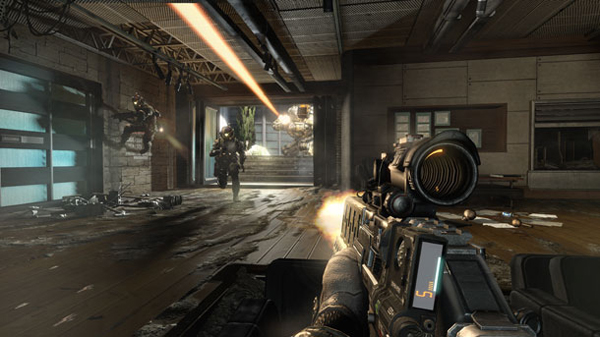
Titanfall from EA is by far one of the most highly anticipated and exciting games of the next console generation, and Microsoft has it all to themselves. The futuristic FPS takes classic shooter elements and mixes them with parkour/free running and some bad-ass mechs. Since It was announced, I have been dying to get my hands on it and see if it is worth all the hype, and at this year’s EB Games Expo I finally got my chance. Long story short: yes. Yes this game is by FAR worth all the praise and hype it has been garnering. Its fluid and dynamic combat is well crafted, perfectly balanced and impeccably executed.
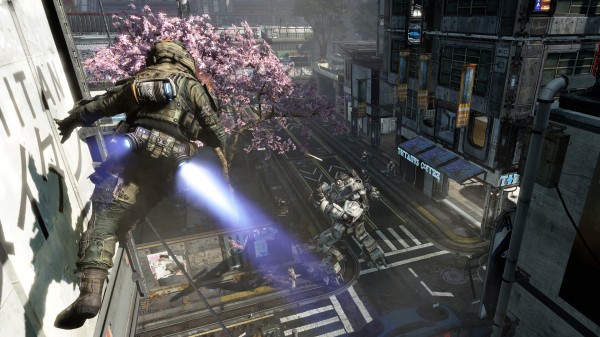
I know one of the many concerns people out there have had is that the game looks like a CoD ripoff with mechs. Well It is officially nothing even remotely close. Firstly, aside from the whole FPS element, the games are completely different. Titanfall makes use of its near-future setting to do some really interesting things with the genre. Being able to double-jump or to run along walls alone are enough to separate them from the more ‘grounded’ shooters, and it adds a whole extra layer of strategy to the battle. You wont find yourself just hiding in a corner and taking pot shots at enemies for easy kills.
The controls are really well designed, and many FPS players will feel right at home. That being said, even if you aren’t an avid run and gun gamer, you will be able to pick them up quite easily and by the time you have gotten your first kill, they will feel like second nature.
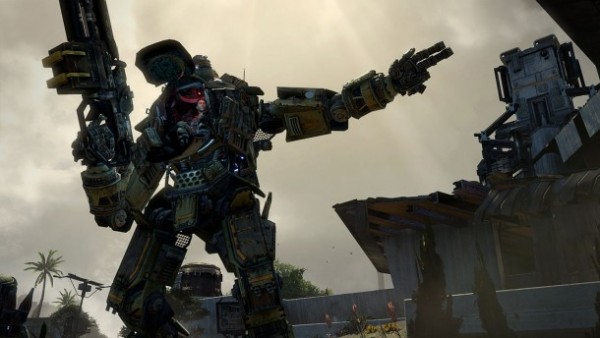
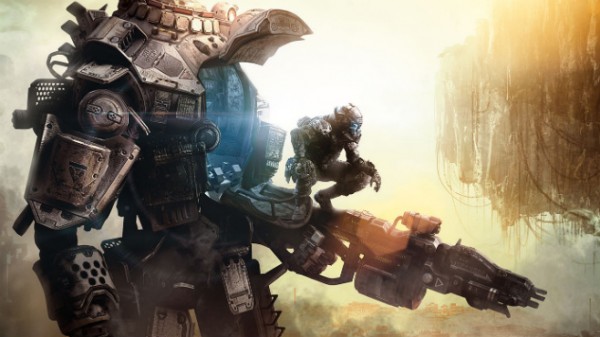
The Titans are obviously the biggest difference between Titanfall and most FPS shooters, and they really do change the game on its head whenever they enter the battlefield. Each player has access to their own Titan, and can choose their loadout and weapon set much like you can with a normal soldier class. This allows a great deal of versatility from the player, as their Titan can employ an entirely different strategy than their soldier (for example, my soldier was a light machine-gunner, while my titan just blew up everything and punched other Titans in the face). It is also good to note that each soldier is equipped with their own anti-Titan weapon, which brings a sense of balance to a game that otherwise would just be giant robots crushing small humans.
Visually, Titanfall is really a benchmark for that the Xbox One can do. The maps all looked awesome, and really resonated that dark and gritty near-future vibe while not relying on the same old trick of “make everything a shade of brown.” Titans all look different from one another, as do the character models. Even the AI characters (who are worth smaller amounts of points for kills) are designed differently so you will notice them at a distance. The Titan animations are some of the coolest things going around right now too, with a variety of different entrance and exit animations, as well as an awesome looking melee-punch attack. The best way to describe Titanfall visually is that “it looks really, really cool”
Another of the concerns players have had is that the experience is multiplayer-only. While I can share the sentiment, having played through a Titanfall battle, I can see where Respawn are coming from with their approach. Each battle fills in a larger campaign, with players picking sides in the ever ongoing battle. Although we didn’t get to see much of the story itself, the way it plays out is really interesting.
What really impressed me was the accessibility of the game. Personally I have never been big on FPS games, getting bored of games like Halo or Call of Duty a few matches in, but Titanfall not only had me hooked, but also had me doing quite well. In a game of 16 players, I managed to come third (even though I was on the losing side) which is an achievement all of itself and really speaks volumes to how Titanfall plays. Obviously as the game releases and more players get their hands on it, the cream will certainly rise to the top, but so far it feels like players of all skill levels will be able to have fun.
Titanfall is a really exciting prospect, and one I can’t wait for when it launches next year. Are you excited for it? Let us know in the comments below and be sure to check out our interview with Respawn Entertainment’s Community Manager, Abbie Heppe here. Remember to stay tuned to Capsule Computers for all the Titanfall news as it becomes available.
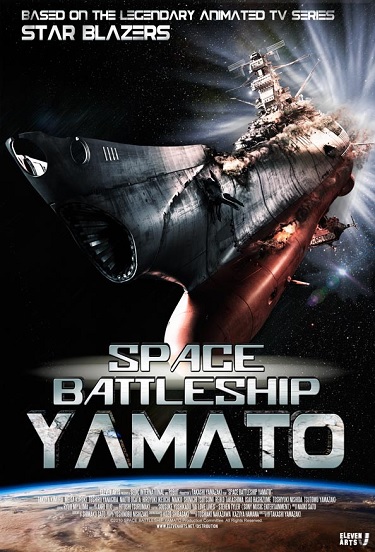
Overview It has been over thirty five years since Space Battleship Yamato debuted in Japan and on the anime’s 35th anniversary a live action movie simply called Space Battleship Yamato was released in Japan. Since debuting in 2010, the movie has had little presence in North America but now three years later it will be an appearance in cinemas in North America courtesy of Eleven Arts. Now that the movie is finally going to be appearing here, is it worth checking out?
Story In the year 2199, the human race is on the brink of extinction. For the past five years humanity has been under assault by an alien race called the Gamilas that have been sending meteorite like missiles at the Earth, causing massive levels of destruction but also turning the planet into an uninhabitable irradiated wasteland. When the Earth Defense Force makes a desperate attempt to take out the nearest Gamilas force near Mars, they suffer a humiliating defeat when it is found that their weapons are completely ineffective.
The only way that any of the EDF forces were able to survive were thanks to the efforts of Mamoru Kodai who used his already damaged ship as a shield to protect the flagship of the EDF as it retreated back to Earth. By sacrificing himself, Mamoru manages to prevent the struggles of humankind from reaching an early end. This is not the end of the Kodai family, as his younger brother Susumu Kodai is looking for useful salvage on the surface of Earth only for a mysterious alien artifact to crash to the ground nearby.
The artifact not only purifies the entire area of radiation, new technology for travel and weaponry, but it also contains the location of a planet named Iskandar which might just have the technology necessary to save Earth and put an end to the Gamilas forces. Despite the loss of his brother and his issues with the EDF, Kodai agrees to join a last ditch effort to save the human race aboard their newly upgraded and final battleship, the Yamato.
It is interesting to note that this live action movie is attempting to take twenty six episodes of material and cram it into a little over two hours long movie and because of that, there is a lot of disconnect at times with what the film is trying to get across. Thanks to some rather formulaic patterns, the movie alternates between action and melodrama at a rather brisk pace and rarely does it feel special thanks to each situation being similar to the last.
That isn’t to say that the movie is boring by any means, though it does become rather predictable. The reason that it doesn’t become boring however is thanks to the fact that so much has had to be crammed into the movie so even when the movie takes some time to slow down and examine a bit of the main characters’ backstory it still feels proper and helps build to a number of poignant moments later in the movie.
Despite the formulaic nature of the movie and repeated situations, Space Battleship Yamato’s live action adaptation has managed to keep almost the entirety of the main storyline together and as an adaptation this is something that is quite essential. For the little development had between characters there still is some emotion there whenever a sacrifice is made and ultimately the action and constant motion of the story helps make the movie rather entertaining.
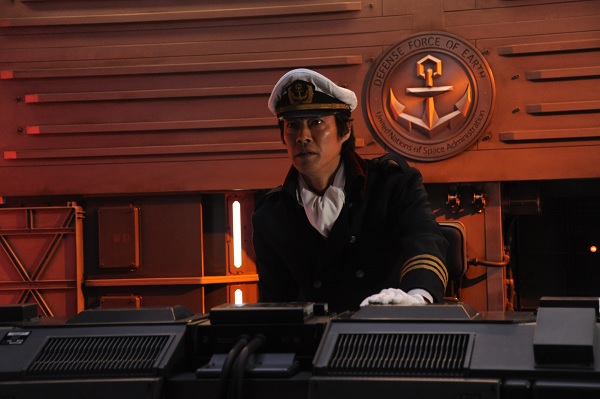
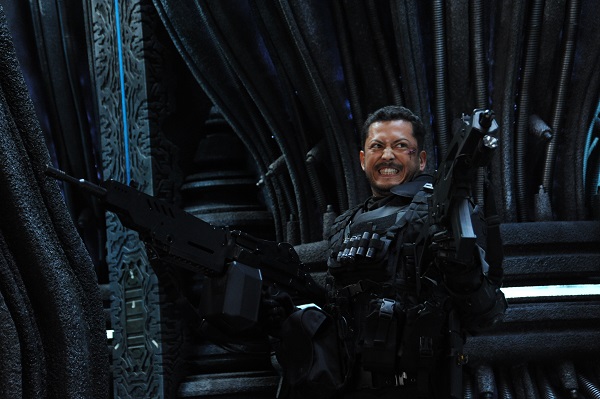
Visuals Now since this is an actual live action review, I will discuss how the actors managed in the movie in this section and while it is great that there is plenty of emotion on screen at any given time, someone needed to tell the cast that there is such a thing as overacting. While there are a few decent scenes where emotions are expressed in a satisfying manner, the majority of the time the actors are so over the top, both in their expressions and body motions, that the acting is particularly laughable more often than not.
It is also worth noting that the director probably needed to spring for a couple of extra cameras to film the movie. Thanks to the camera work, which is almost always handled by a single camera panning over a room of people, or hilariously running up to focus on a face, there is a distinct lack of focus and it also catches too many badly acted background characters simply going through the motions.
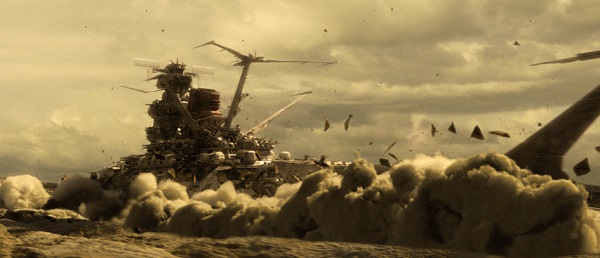
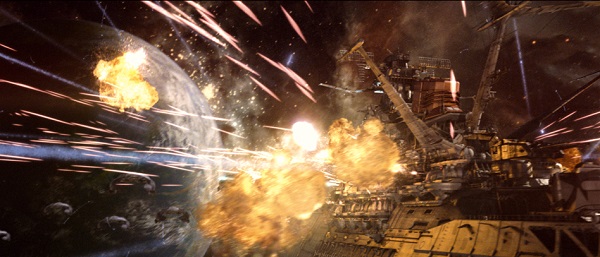
That being said, whenever the focus shifts towards the space battles things take a turn for the better. The various ship designs of both the Yamato and EDF ships and the Gamilas Forces are nicely designed and presented in CGI with some very polished looking battle sequences. In fact, almost every CGI element of the movie is nicely handled, whether it is technology used by the crew members or the way that the action looks from inside their individual fighters, these battles are easily the highlight of the movie.
Audio It is worth noting that this live action movie is not presented with an English dub of any kind and will instead be shown with English subtitles. The subtitles work nicely for the movie but thanks to the aforementioned problems with both overacting and camera usage, it can sometimes be difficult to determine who is speaking in a room full of people at first before viewers understand how each character sounds.
As far as background music goes, the movie has a fair number of tracks accompanying it that are unfortunately, very forgettable. The studio did find enough care to spring for an English song “Love Lives” by Steven Tyler which plays during the ending credits however, giving the final scenes a satisfying emotional punch.
Overall Space Battleship Yamato’s live action film is finally making its way to theaters and thankfully the movie has done a great job condensing the source material into this bite-sized film without losing much of the story. However while the story and action remain impressive, poor acting and camera usage drag the movie down. Still, even with these faults, the movie is an entertaining sci-fi adventure through space that even newcomers can enjoy.
Capsule Computers review guidelines can be found here.
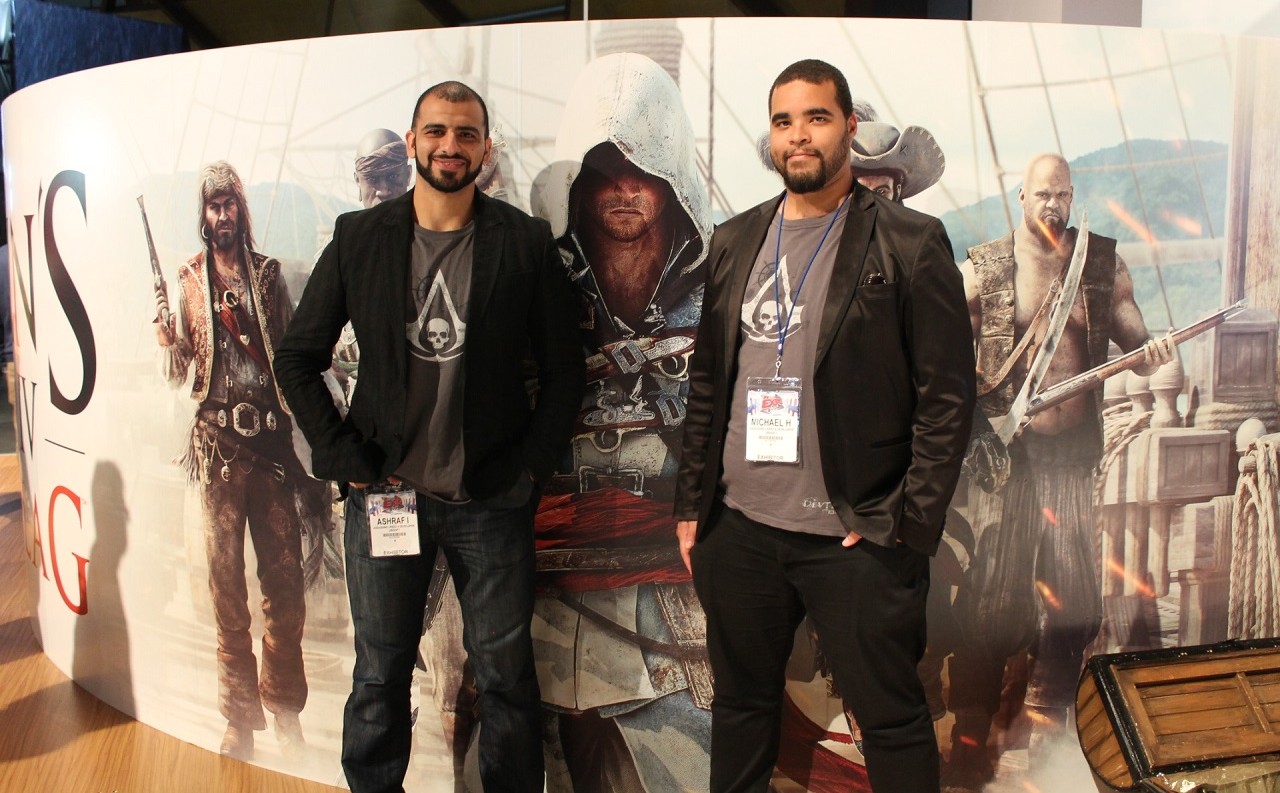
Game Director Ashraf Ismail (Left), Senior Game Designer Michael Hampton (Right)
Thanks to Ubisoft Australia, we were able to interview some very special guests who flew in from across the globe to attend EB Games Expo 2013. Shortly after our interview with Kevin Shortt – Lead Scriptwriter/Story Designer on Watch_Dogs – we spoke to Assassin’s Creed IV: Black Flag Game Director Ashraf Ismail, and from Ubisoft Singapore, Senior Game Designer Michael Hampton. Topics covered included the process of working across multiple studios worldwide, the underwater aspect of the gameplay, how you can discover what happened directly after the ending of Assassin’s Creed III, Edward and how he may be perceived by gamers and more.
So Michael, I understand you had a large hand in designing the underwater sections and gameplay in Black Flag. Tell us about that part of the game and what the challenges were in creating something so entirely new for the franchise.
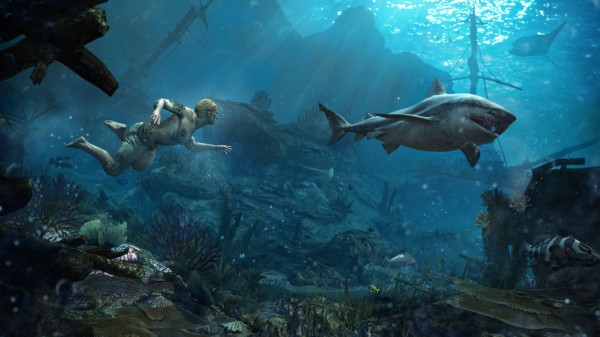
M: Yeah, so obviously there were a bunch of challenges. The main challenge was that we wanted to have the controls feel like it was a natural extension, swimming underwater feeling consistent with traversal on the ground. That was one challenge. The other big driving force and the vision behind it was that we wanted to make the player – the assassin – always so powerful, you know you’re always hunting people, always the man on the ground… we wanted to turn the tables on the player so that when you’re underwater, you’re vulnerable; you don’t have any weapons and you’ve got to use your stealth and your navigation and your wits as an assassin to survive, basically. To survive in this harsh underwater environment, and I think that’s what you’ll find when you play it.
It’s funny, just like with other trends, there seems to be a sudden influx of games with similar concepts that were previously uncharted. But I think exploring that underwater plane lends itself to a new, dynamic experience…
M: Yeah, and it’s pretty cool. We’ve got a bunch of underwater locations; there’s several different chests, and things like big shipwrecks and ruins and these dark trenches, so it’s really interesting.
Backtracking to the original conceptualisation, everybody loved the naval aspect of Assassin’s Creed III, so was that the jumping off point for Black Flag?
A: Not so much, because we started this game over two years ago. So when we started we had prototypes of the naval from AC III, and so for sure we thought that there was something really cool there, there was something promising. At the same time, we were shipping on next-gen – we knew this – so you know, when you think next-gen, when you think new consoles, you also think intuitively ‘I’m gonna play a game like I’ve never played before’. And this thought was actually what pushed us to start thinking about the naval sandbox. So in saying, instead of building just a city, we’ve actually built a world like we’ve never seen before.
And so that’s where the idea of the naval sandbox came in… that with a character like Edward Kenway – who’s actually already been defined before we started; he was gonna be the grandfather to Connor – it all felt like it came together. And honestly, when we began it wasn’t a debate, we didn’t have multiple options, we just said ‘we’re making a pirate game in the Caribbean, early 18th century’ and we just went with it at that point. So seeing the reaction to AC III was super positive… [It just reinforced your beliefs in the direction] Exactly, because we knew we taking a big risk. We were effectively saying ‘we have free-running and the fights, and now we’re going to ram naval combat into that whole system. That’s a very risky thing to do, so we were super thrilled to see that reaction to AC III.
So in the earliest of pre-production, even for AC III when you initially decided to include ship gameplay in any capacity, did you always want to make a pirate game, so to speak?
A: It wasn’t necessarily always planned, although we always wanted to do a pirate game – whether it would be an Assassin’s Creed or outside of Assassin’s Creed – but it’s really tough to do pirate games because you need: naval, you need cities and you need jungle environments. So you need a lot of diversity, and at some point we just felt like ‘okay, we’re at a stage where the foundation is so solid that we can build a pirate game’. We know how to build cities, all of a sudden with AC III we know how to build natural environments, so it was easy for us to build jungles… and then the naval combat; that’s where we put a lot of effort, in ‘how do you make this systemic, how do you make this open-world, how do you have a lot of life in this world’. So it wasn’t always going to be an option for AC to have a pirate game, but honestly, when we started it was kind of slapping us in the face. It wasn’t even a question – I think everybody in the room, when we sat down, it was like ‘we’re doing a pirate game, right!’
I was disappointed when Pirates of the Caribbean: Armada of the Damned got cancelled…
A: Yeah, I was too actually.
Because we haven’t – to your points – had a good pirate game in a very long time…
A: That’s the thing, I always say that there is a reason why pirate games don’t exist, or they’re not very good to be honest. The last great one was either Monkey Islandor Sid Meier’s Pirates; those were the last great ones and it’s because they’re so tough to do, especially if you want to be credible at it. There’s just so much you have to do and you have to do it well. And I feel like AC is one of the only brands that can pull it off, at this point.
So, in Black Flag you’re bringing back the stealthy assassination-focused multiplayer we’ve known for the last few iterations, but we’ve heard that there won’t be any naval multiplayer. Why is that? Were they some major technical challenges involved?
A: No, unfortunately we don’t have naval multiplayer. We had an early prototype way back, and it was quite amazing, but one of the biggest issues we had… okay, when we started the game, we told ourselves ‘we have to ship a really polished, solid game’. This was one of our mandates, internally, to ourselves. And so as the game production went on, we constantly reviewed everything we had in the game and we’d say ‘if it’s not good enough, we either put more effort on it or we have to cut it from the game’, because we couldn’t put the resources it need on it.
And the problem with naval multiplayer was that, when we assessed how much time we needed just to get the basics going, and deal with latency issues, having the progression system and having it so that people can’t cheat the game – because in multiplayer that is a big thing you have to worry about – we just didn’t have the resources to do it in time. And the scope of the game is already massive; this is the biggest AC we’ve ever built. So on top of that, having naval multiplayer… we just didn’t have the resources to do it. Having said that, you know I always tell people, if people love Black Flag and people want to see more naval stuff, I’ll be one of the first to push for having naval multiplayer in some future version of whatever game. So people just have to let us know that they love the game [Laughs].
And Michael, Ubisoft has studios worldwide, practically in every continent. So what’s it like being based out of Singapore, working with the guys back in Montreal and so forth?
M: It’s all about collaboration and communication. It’s the type of thing where you learn very early on that you can’t receive an email and then not send a response for 2 or 3 days, because the turnaround time is just too much and you’re actually stopping people from getting stuff done when you’re doing that. So everybody on the team – a lot of people in Montreal, a lot of people in Singapore – hadn’t necessarily done this type of work before. So it’s just something we learned as the project went on; how to do this, how to do it better. Ash came down I think a couple times to Singapore, and myself and some other guys went over a couple times to Montreal too. So that helps a lot as well. You’re going to have some arguments about stuff, so it’s not always gonna be smooth sailing, but overall, you can’t do a game of this scale in one studio any more – it’s just not really possible, unless you want to wait 6 years for it, which I don’t think our fans do…
A: And if I can just add to that, in Montreal we actually have a team of people that are just purely dedicated to communication and collaboration. So it’s a team with a game designer, production manager, a technical artist and these people, it’s their job that for any studio – including Montreal – if we needed to get info to Singapore or Singapore needed info from us, these people’s sole responsibility was that; to make sure they got the info in a timely manner. So it’s a process that’s been developed… I mean, AC II was the first AC that was actually developed across multiple studios, so we’ve been learning and improving this process for a few years now.
So back in the early days, when the game was rumoured to be in development…
A: Yeah, there were one or two leaks [Laughs].
Just a couple. [Laughs] People thought that this was going to be another spin-off, if only because of the time-gap between main entries in the series. But what constitutes this being a main entry in the series; is it the fact that it’s the first on next-gen and there’s lots of new technical achievements tied to that, is it because we have a new character? Are those things what define this as Assassin’s Creed IV?
A: Those are some of the details, but I will tell you… the main thing, the biggest thing, that having a new number signifies is that the core gameplay experience is gonna change. So with AC III, it was the idea that now we have these natural environments, you have a new hero… you do naval missions – although those were side missions – but you have navigation through those natural environments, and then you have the winter and the seasons. So it really signifies the idea that the core gameplay is changing. In our case, it’s the fact that we have this brand new world unlike anything we’ve built before, naval gameplay is directly part of the core experience, you have a crazy progression system… it’s the first of any AC that actually has a massive challenge curve in the game. So, because we have naval enemies, we have ships that are inanimate that you can upgrade and you can have more canons, more defences. You know, previously we had human enemies and you’re an assassin so you can kill them in one shot. But now that we have ships, we have a progression system and a real challenge in the game. So the pure experience of AC is drastically different, and that’s what signifies a new iteration, a new version of the game.
In regards to the story, people will be wondering – because of the pretty destructive way AC III ended – how Black Flag carries on from that?
A: So, we pick up a little bit after the end of AC III, and there is an arc that is being told so we’re carrying that arc forward. So effectively, in the present day you have a new hero that you play – the idea being that you play yourself, in first person – but you’re an Abstergo Entertainment employee, and you’re researching the life of Edward Kenway and you don’t know why. And you don’t know why Abstergo is; you’re just a guy working for a company. As the story progresses, you realise there’s a nefarious reason behind everything; Edward does something in his life that’s very valuable for the templars of the present day, and this is what they’re actually after. But of course, everything to do with Juno, everything to do with the ‘first civ’ – this stuff is a part of it, and this stuff progresses as well.
We also have a lot of optional content that, if you don’t care about the present day, you don’t have to do. But if you do, you can exit the Animus at any time and you can explore this Abstergo Entertainment place and there’s hours of content in there. You can find out what happened to Desmond after AC III; you can find out a lot of the mythos and the details that, for the people who love that kind of stuff, there’s a lot of info there for you. I won’t ruin any of the surprises, but the beginning is really… we treat the player as a ‘newb’, and this is something that we wanted because, even though this is AC IV, we wanted new players to be able to come in and that’s why both Edward and the present-day character are new and fresh to the assassins-templar feud. But of course, things pick up rather quickly and things go from there.
And how do you think Edward is going to be received? Because we saw with the fan feedback how combative people’s opinion were as it relates to Connor in AC III, but Edward is more brash and arrogant – he’s living the pirate life for Christ’s sake!
M: I mean, overall, I think pirates are kinda fun, so you’ve already got a pretty good attitude about him going into it. But the thing is, Edward is a very real character. No one is perfect; everyone has some internal flaws or difficulties that they struggle with and you’re gonna see Edward dealing with that throughout the game and learning and growing during the story. So I think the fact that he’s so relatable, and you can say ‘maybe I would have done that in the same situation’ or those sorts of things, that will make you feel kind of bonded to him and I think that’s the main thing.
A: I think people are going to love Edward. He’s an amazing character… [He’s charismatic] He is charismatic, he’s very funny; there’s a lot of humour in the narrative and the writing. And beyond that, you can connect to him, he’s human, he has flaws and the story is actually about him figuring out who he is in life, effectively. So you go on this journey with him and I think that’s gonna make people connect with him and really love the character.
M: And he’s a freaking bad-ass! He’s got 4 pistols, and slashing everybody up with cutlasses! I mean, you know, what’s not to like?!
Absolutely, you can’t not love that! Okay, thanks for your time guys!
We want to thank Ashraf and Michael once again for their time, and Ubisoft Australia for making the interview possible, of course. Assassin’s Creed IV: Black Flag releases for the Xbox 360, PlayStation 3 and Wii U on October 31st; the Xbox One and PC on November 22nd, and the PlayStation 4 on November 29th Australia-wide.
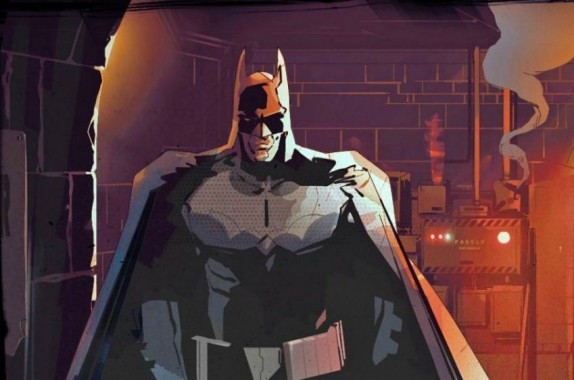
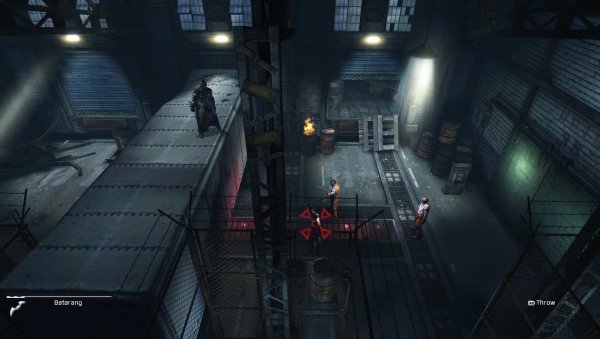
It seems to be the norm now that many companies will release a port of their console game for handhelds to try and grab more customers. Oftentimes these games don’t hold a candle to their console counterparts and are not well received. Instead of following the industry trend for Batman: Arkham Origins, the guys over at Warner Bros. are instead releasing a direct-sequel to the game; Batman Arkham Origins Blackgate. Not much information has been shared about the game, largely do to the fact that its story would give away a lot of the plot of Origins itself. All we really knew was that it is a Metroidvania style game and would have Batman entering Blackgate prison after a wild outbreak. Luckily at this year’s EB Games Expo I was finally able to get my hands on the PS Vita version of the game.
Taking place a few months after the events of Batman: Arkham Origins, Origins Blackgate puts us in the infamous Blackgate Prison, where Batman is forced to quell a criminal uprising. There was only a small section of the game available to try, and it is unfortunate because that section left a less than sweet taste in my mouth.
The game retains the same control scheme as the console series, implementing the Free Flow 2.0 combat system, as well as stealth and gadget use. Instead of a 3D open-world experience however, Blackgate is more of a 2.5D action game. Although the game tries to replicate its console bigger-brother, it falls a little short of the mark as the controls feel sluggish and unresponsive, while the movement often felt a little stiff . Stealth sections weren’t too bad, as you are given the extra time to plan your attacks, but firefights against enemies were far less fun. The sluggishness of the controls made what should have been some of the best parts into frustrating chore-like sections.
Visually, Blackgate was impressive, retaining a lot of the character models and detail that are present in the console version. It is easy to forget how powerful the PS Vita is under its hood, but Arkham Origins Blackgate really shows off its power. Everything is crisp, clear and really looks amazing. I’m not sure how well it will look on the 3DS, but I was definitely impressed by what I have seen so far.
I really wanted to like Arkham Origins Blackgate, and while there are definitely some things to like (the visuals being the most prominent) my time with the game leaves me feeling underwhelmed. As an installment in a game series that redefined fluid action combat, it just wasn’t hitting the right notes. Hopefully once the game officially releases we will see if this was just an early build, a problem with the area, or representative of the full game.
If you wanted to check out our thoughts on Arkham Origins console game, then you can do so by clicking here. Arkham Origins, and Arkham Origins Blackgate are each set to release worldwide on October 25th, with Blackgate dropping on PS Vita and 3DS, so for all the Arkham Origins news as it becomes available, stay tuned to Capsule Computers.