Long awaited feature adds more personalization options while roadmap simultaneously delivers two DLCs
Oberhaching, Germany, June 2, 2025 – Developer Render Cube and Publisher Toplitz Productions are happy to announce that the new update “Plant a Tree” for Medieval Dynasty will be available on June 26, 2025 on PC as well as supported current-gen consoles.
Furthermore, the development team shares an outlook on the next steps on this year’s roadmap with the announcement of two additional DLCs also being released on June 26: Echoes of Nature and Medieval Dynasty Soundtrack Vol. 2.
Plant a Tree Update
The Plant a Tree update introduces the long-awaited feature of freely moving not only trees but also buildings! Now you can fully customize the look of your village according to your own vision and needs. Dreaming of a house in the woods? Found a better spot to settle down? Or maybe you want to completely redesign your village? Now it’s possible! Just approach with your hammer, activate the ‘Move mode’, select a building and drag it to your desired location. Your settlement lacks greenery? While cutting trees, there is a chance you’ll get a seedling, which you can plant wherever you want – take your hammer and place it like any other decoration! These features give you even more freedom in arranging your village and allow you to create the exact space you’ve always dreamed of.
DLC: Echoes of Nature
A perfect complement to the new customisation possibilities is the Echoes of Nature DLC, which adds a set of brand-new decorations – lush trees, flowering shrubs, and stone decorative elements. Every decoration responds to the changing seasons. Watch as your shrubs bloom in spring, grow lush and full in summer, change colors in autumn, and become frost-covered in winter. Pick saplings from the merchant’s stock, plant them wherever you want, and watch as the surroundings gradually take on a new character.
DLC: Medieval Dynasty Soundtrack Vol. 2
Medieval Dynasty Soundtrack Vol. 2 DLC, featuring the Bards Album and other tracks previously unavailable outside the game. Three albums, a total of 39 compositions, and a lot of heart put into every sound.
Three Bards Album (Disc 1)6 joyful tracks performed by the band Three Bards, inspired by the music of troubadours. Perfect for dancing, laughing, and celebrating – just like in a medieval tavern.
Special Themes Album (Disc 2)16 compositions that build the atmosphere of the game world – from the main theme, through character creator music, to village themes and important NPC motifs. Each piece highlights the uniqueness of places and key moments in the gameplay.
Gameplay Music Album (Disc 3)17 compositions designed for exploration and combat. These tracks accompany the player during daily tasks, journeys through forests and fields, and in battles with dangers.
Duration: 2 hours 26 minutes Available formats: MP3 and WAV 44.1 kHz stereo
Render Cube is a Polish development studio founded in 2012. In the initial period of its activity, it focused on outsourcing works, commissioned mainly by other game producers, which resulted in cooperation with, among others, CD Projekt, Techland or Platige Image. In recent years, the company has been focusing on the production of its own games, released on PC and console platforms. The biggest title of the studio is Medieval Dynasty, a unique production that combines the best features of such popular genres as survival games, simulators, builders, RPGs and strategies.The company employs over 30 people and is listed on the Polish Stock Exchange.
About Toplitz Productions
The German-Austrian publisher, whose name originates from the mysterious Toplitz Lake in the heart of Austria, develops and publishes games with “heart & soul” for all platforms. The company consists of a healthy mix of experienced industry veterans and young talents, all of whom are passionate gamers. They enjoy working with creative developers on many exciting titles, such as those from the “Dynasty” and “Giant” series.
Maracas Studio is proud to unveil the very first full gameplay trailer for Fish Stick Protocol, its upcoming chaotic co-op extraction game for up to 8 players. The new trailer finally showcases the complete gameplay loop, revealing how players explore unpredictable dimensions, avoid bizarre environmental hazards, and return with strange artifacts to build out their own manor.
Until now, the tone and world of Fish Stick Protocol had only been hinted at. Today’s trailer offers the first in-depth look at what it feels like to jump into a mission, improvise with your team, and embrace the game’s absurdity.
“We’ve poured so much of our weird creative energy into this game,” says Sophie Schiaratura, CPO and cofounder of Maracas Studio. “The new trailer finally gives people a sense of how unpredictable, strategic, and downright absurd our missions can get. It’s the chaos we love, wrapped in a world you want to explore.”
About the Game
In Fish Stick Protocol, players take on the role of expendable workers tasked with entering procedurally generated dimensions to recover valuable artifacts. These unstable environments are filled with killer plants, dangerous creatures, and bizarre anomalies. Between runs, players upgrade and decorate the galleries of an ever-growing manor that acts as their headquarters.
Open, procedural dimensions full of unpredictable hazards
Persistent and customizable hub area
Physics-driven chaos and emergent problem-solving
Visual style that blends cuteness with gore
No horror, no permadeath, just fun
Localized in English, French, German, Spanish, Korean, Japanese, Simplified Chinese, Polish, and Brazilian Portuguese
About Maracas Studio
Maracas Studio is an independent eight-person team based in Charleroi, Belgium. Founded by industry veterans, the studio creates video games with the ambition to connect players and leave a mark on a generation. Like the maracas, which were once ritual instruments used to awaken spirits, Maracas Studio aims to shake up the video game world through bold, energetic, and emotionally resonant creations.
Coming to Steam and Nintendo Switch Later This Year
Lausanne, Switzerland — June 2nd, 2025 – Indie game developer Sunnyside Games is happy to reveal the first gameplay trailer for their upcoming Metroidvania, Nocturnal 2.
The game is set to launch later this year on Nintendo Switch and Steam, offering non-linear exploration through a city plunged into deep slumber. The main objective: awaken the city from its Sleep.
To break the puzzle of the city of Ytash, players must recover the scattered verses of a forgotten poem and carry the flames across the entire city—relighting everything in their path, from dormant engines to ancient shrines, and burning through obstacles and foes.
Built around fast-paced aerial combat and juggling, the game challenges players to master a burn-out system to progress and defeat the fierce enemies lurking throughout the ruins of this ancient place.
Carry your flames carefully across the island, steering clear of anything that might extinguish them.
Wield your blade to ignite ancient mechanisms and torches, gradually awakening the island god, Ytash.
Collect fragments of a forgotten poem to piece together the tragic story of a long-lost, self-consuming city.
Explore a compact, focused island adventure built around a singular core mechanic—with plenty of secrets waiting to be discovered.
About Sunnyside Games
Sunnyside Games is a Swiss-based company founded in 2013 and composed of sorcerers, artists, and engineers that are working hand-in-hand to create challenging, immersive and well hand-crafted 2D games for PCs and consoles. Previous games from Sunnyside Games include Nocturnal, Towaga: Among Shadows, and The Firm.
Step into a world where reality decays, nightmares breathe, and the dead are never truly silent. PC demo available now on Steam
Barcelona, Spain – 2 June 2025. Publisher SelectaPlay and developer Dark Council Studio are thrilled to unveil a new gameplay trailer for Dark Atlas: Infernum, the upcoming first-person psychological horror survival experience. Premiered during Saturday’s Horror Game Awards Summer Showcase, the trailer tears open a glimpse into the nightmare: claustrophobic rooms, crumbling environments twisted by unseen forces, and grotesque entities watching from the shadows, waiting for your fear to ripen.
Coming to PC, PlayStation 5, and Xbox Series S|X in late 2025, Dark Atlas: Infernum invites players to descend into a world where the boundary between reality and nightmare has shattered. Humanity teeters on the brink of annihilation as memories rot, truths burn, and the skies fall silent. Storms rage across the Earth, leaving behind something worse than death: Imprints, hollow remnants of the dead, staring into the void without purpose or peace.
In Infernum, you’re not just surviving. You’re unravelling. Trapped in a personal purgatory, stalked by the Word, and haunted by the sins of a broken world, your only hope is to escape. But every door you open leads deeper into yourself, and what’s buried there is hungry.
For those ready to confront the abyss, the PC demo is now live on Steam. This is your first step into the infernal spiral, into a place where truth is punishment, knowledge is a noose, and the Corona Radiata is the forbidden scripture that might damn or deliver the world.
About Dark Atlas: Infernum
The world is unravelling. Electrical storms scour the Earth, leaving behind ghostlike remnants called Imprints, silent echoes of the dead, haunting the ruins of cities. Civilisation is burning. And something far worse is coming.
You are trapped in a nightmare where truth is a curse. Hunted by the Word, your memories twist into mazes, and reality decays into ash. The past demands answers. The future offers only torment. And the Corona Radiata, a forbidden book of unspeakable power, is the key everyone wants… including you.
You must escape. Through shadows. Through guilt. Through hell itself.
Key Features:
First-person, single-player survival horror soaked in dread.
Psychological horror, stealth, and intricate puzzles drive a deeply immersive experience.
A rich narrative set in Álvaro Aparicio’s Saga Radiata universe, part of the Dark Atlas meta-anthology.
Spanish voice acting led by Alberto “Láudano” Martínez (Noviembre Nocturno).
A haunting original soundtrack that lingers like a curse.
Collectables and Steam Achievements hidden in the darkest corners, if you’re brave enough to search.
Dark Atlas: Infernum will be released on PC via Steam, PlayStation and Xbox consoles in 2025. Wishlist the game on Steam and PlayStation now.
About Night Council
Night Council Studio is an independent videogame developing company based in Spain. Dark Atlas: Infernum —succesfully crowdfunded on Kickstarter, nominated in the category of Best Narrative, Best Soundtrack and Game of the Year of the VII edition of the PlayStation Awards, selected by the Comunidad de Madrid (Spain) with an economic grant and finalist of the Feelmotion 21 Trailer Awards— will be its first videogame.
About SelectaPlay
SelectaPlay is SelectaVisión’s video games publishing branch. The company works with talented studios on unique video games and helps them publish their titles in both physical and digital formats in Europe and worldwide.
About SelectaVisión
SelectaVisión is a video publishing company founded in 1984. Based in Spain, SelectaVisión’s catalog includes anime and live-action feature films, TV shows, and movies. Publishing both anime classics and the latest Japanese productions since 1997, SelectaVisión has built a long relationship with fan-favorite Japanese producers and distributors, becoming the major publisher of anime content for Spanish audiences.
With hundreds of heartwarming discounts, there’s no better time to refresh your cozy game collection.
Darmstadt, Germany – 2 June 2025. Indie publisher rokaplay warmly invites players of all ages to snuggle up and join the Cozy & Family Friendly Games Celebration 2025, now live on Steam! Running until June 9, this special event brings together a delightful mix of comforting, creative, and family-friendly games, both beloved favourites and charming upcoming titles.
Explore a lovingly curated lineup of relaxed sims, story-rich adventures, wholesome crafting games, and more, all hand-picked to spark joy and soothe the soul. Whether you’re after something solo and serene or perfect for the whole family, this celebration has something for everyone, and at a discount!
Enjoy cozy deals on titles like:
Planet Zoo – 70% off
Travellers Rest – 25% off
My Time at Sandrock – 50% off
And many more indie darlings and hidden gems!
From digging holes with meditative precision in A Game About Digging A Hole, to floating through survival crafting in A-Loft, building your dream park in Jurassic World Evolution 2, or swapping stories in the D&D-inspired Tavern Talk, there’s a friendly, cozy corner of Steam waiting just for you.
But hurry! This heartwarming celebration wraps up on June 9, so don’t miss your chance to discover your next feel-good favourite.
Want more cozy in your life? Subscribe to the Cozy Games Celebration Newsletter for the latest updates, upcoming releases, and wholesome gaming vibes all year round.
About rokaplay
“We make Cozy & Family Friendly games” – rokaplay GmbH, based in Darmstadt, Germany, is an indie games developer and supports other indies in realizing their dream games. Inspired by Nintendo, rokaplay offers cross-platform entertainment for all people of all ages. To them, proactive and transparent communication with their community is a crucial and indispensable part of their work.
EA Sports has officially lifted the curtain on College Football 26 (Pre-order here) – and judging by the debut trailer, this is far more than a nostalgia play. Set for release on July 10, 2025, the sports game marks the triumphant return of college football to the digital gridiron, even beating Madden NFL 26 to launch.
The title boasts 136 fully licensed FBS teams, over 300 real-life coaches, and a jaw-dropping 10,000+ authentic college athletes. Each athlete features their own skill set and upgrade progression, allowing for deep personalization and strategy. With a newly built playbook containing 2,700+ plays, the gameplay promises to be as varied and unpredictable as a real NCAA season.
But College Football 26 isn’t just about stats and licenses, it’s about capturing the soul of the sport. Whether you’re standing in the snowstorm of Penn State’s White Out or caught in the crimson heat of a Tuscaloosa night game at Alabama, every stadium bursts with personality. Custom fight songs, regional music cues, and dynamic commentary help bring each game day experience to life.
A fully fleshed-out career mode allows players to rise through the college ranks and work their way toward the NFL Draft, while fans who grab the Deluxe Edition will enjoy three days of early access and exclusive digital bonuses to kick-start their journey.
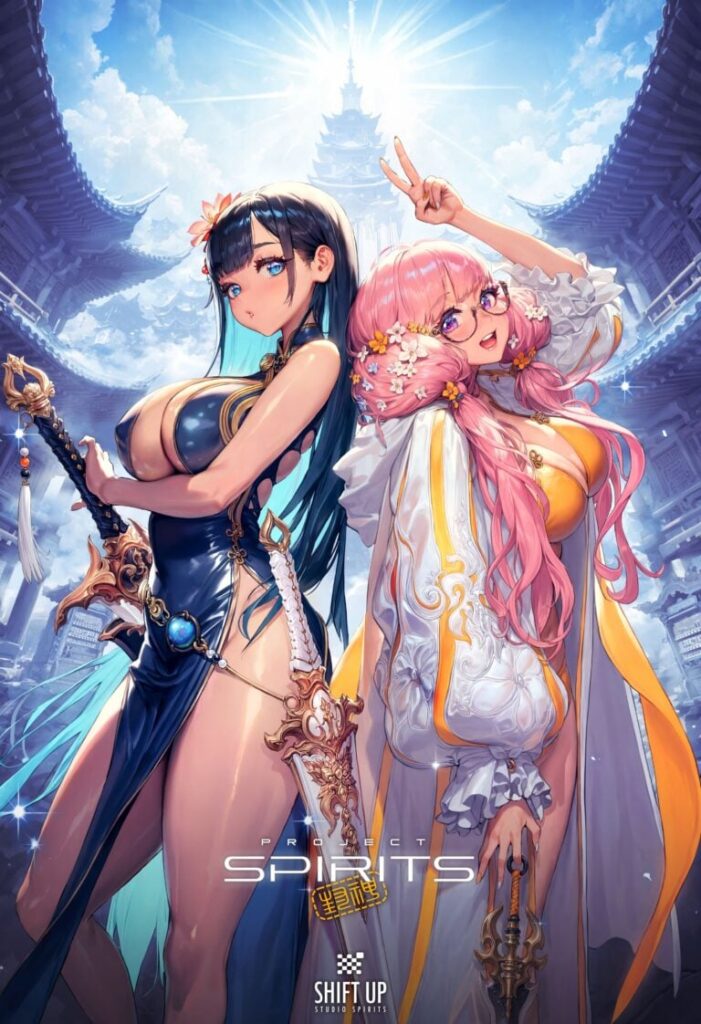
While Sony’sStellar Blade 2 is already confirmed to be in development and the mobile hit NIKKE: Goddess of Victory continues to rake in revenue, Korean studio Shift Up is quietly preparing its next major project. Officially unveiled under the working title Project Spirits (formerly known as Project Witches), the game has now been introduced to the public – complete with its first concept artwork.
Described as a “subculture cross-platform title”, Project Spirits aims to deliver a style rooted in Eastern fantasy aesthetics, blending anime-style visuals with light sci-fi and magical themes. According to Shift Up, this is a completely new IP, envisioned to become a top-tier title in the industry, building on lessons learned from Stellar Blade and NIKKE.
A recent wave of job listings reveals even more about the project’s scope. The studio is recruiting character artists, monster designers, level designers, and writers with experience in JRPGs, open-world design, and Unreal Engine 5. Cross-platform compatibility, including mobile support and crossplay, suggests a Genshin Impact-style formula tailored with a Korean twist.
The first released artwork leans more toward NIKKE’s visual identity than Stellar Blade’s: vibrant anime-style characters, mostly female, set in a fantastical sci-fi world. A 2027 release window has been tentatively mentioned, though more concrete details and a possible trailer are expected well before then.
Polish developer People Can Fly, best known for Outridersand Bulletstorm, has officially canceled two of its in-development titles — including one created in partnership with Square Enix. In a public statement, CEO Sebastian Wojciechowski confirmed the cancellation of Project Gemini, a joint production with Square Enix, and Project Bifrost, a self-funded VR title.
The cancellations have unfortunately led to staff layoffs. According to Wojciechowski, Project Gemini was shelved after Square Enix failed to deliver “a new content rider or clear communication about the project’s future.” Project Bifrost, on the other hand, was scrapped following an internal review that revealed insufficient resources to bring the game to completion.
Despite the setbacks, People Can Fly continues to work on Gears of War: E-Day, in collaboration with The Coalition. The title is currently slated for release on Xbox Series X|S and PC, though rumors suggest it may also be heading to PlayStation 5, following the recent announcement of Gears of War: Reloaded set to launch this August.
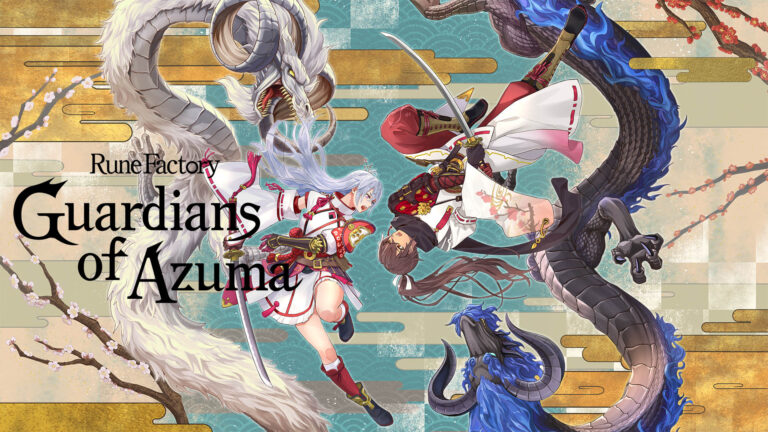
When it comes to the Rune Factory series, Marvelous has found themselves on something of a tipping point for the franchise. The beloved by many series that saw players managing a farm all while venturing out to slay monsters and dive into dungeons was innovating in the same day all while talking to and romancing villagers has been delving into the past as often as it has created new entries, with their latest release actually being a remastered version of their third game following the earlier and more innovative, if less well-received, Rune Factory 5. Now, carefully presenting itself both as a spin-off and continuation while looking to try and change things up more than ever Rune Factory: Guardians of Azuma modifies nearly everything that fans of the franchise might be familiar with in an attempt to appeal to a broader audience, but did they manage to still deliver the core detailed aspects that fans have loved over the years?
Story
Almost fifty years prior to the start of the game a devastating event known as the Celestial Collapse shook the land of Azuma as a colossal object crashed from the heavens and split the land asunder, sending portions into the sky forever and sinking others into the sea. This devastating impact not only destroyed much of the land but also devastated the Runes that help make all living things thrive. With these villages withering and dying, the people began to leave in hopes of finding anything out there beyond the fate of wasting away and it is here in Spring Village that the player finds themselves awakening for the first time. Or the sixtieth time at least going by the game’s calendar as players learn that whether they chose to play as the male or female protagonist, that they crashed through the village temple’s ceiling half a year ago with complete amnesia and have been doing simple chores to maintain the shrine since then.
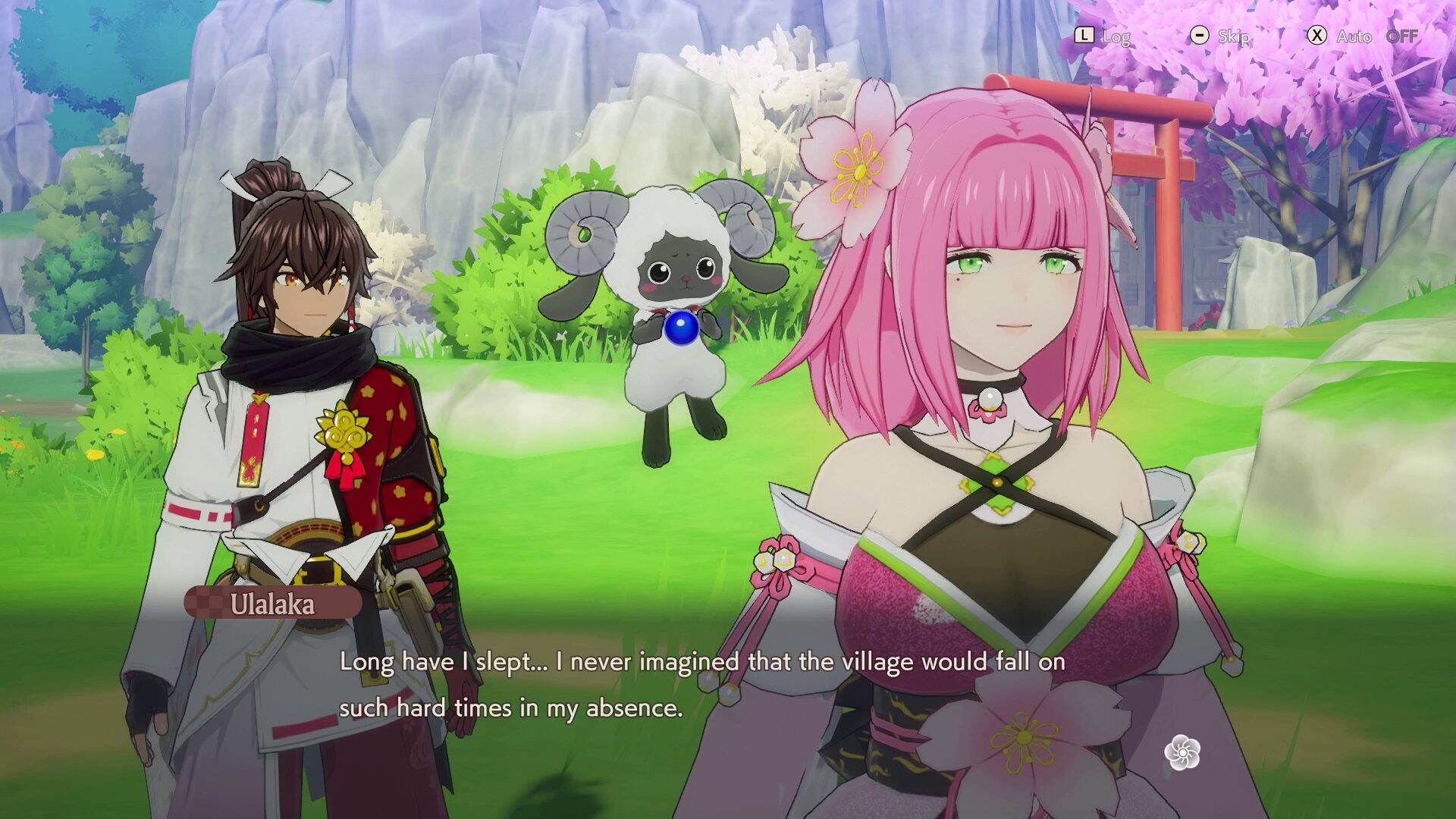
This all changes when the player receives a mysterious dream and awakens to find a sacred relic has materialized by their side in the form of a pink drum alongside a floating wooly with more attitude than any fluffy animal should have. This is of course because while this mascot character might look cute, it’s far more powerful and familiar with the player’s past than they are and when the village comes under attack from a dangerous dragon looking to sap it’s giant sakura tree of the last of its Runes the player fully awakens to their true power, the power of an Earth Dancer. Someone that can revitalize the land with the power of dance and sacred relics, bringing Runes and eliminating the Blight at the same time. After restoring the Spring Village’s Runes and reviving the Spring God Ulalaka from her forced hibernation, it is clear what the player must do, at least at the start, and that is visit every village and bring back the gods that have fallen into disarray all while serving as village chief to each village along the way.
Now, while the core storyline is fairly tame initially, the stakes do grow more dire and feature a few new twists and turns here and there once players get past the “first act” of the game, which we won’t go into for spoiler reasons, but it must be said that the real enjoyment for the story is Guardians of Azuma, just like in most Rune Factory games, are the characters players can befriend and date. Rune Factory: Guardians of Azuma starts out slow, perhaps slower than any of the past Rune Factory entries have in quite some time since rather than revolving the entire story around one location where all of, or perhaps at least most of the villagers already can be visited, players will be visiting four seasonal villages and slowly meeting characters and learning more about the story as they progress through each one.
Ironically, this even slower burn than usual actually works out quite well in Guardians of Azuma‘s case as seeing each new face that appears as the story progresses gives players a chance to get a bit of one-on-one time with most of the characters and learn some of their story through events without feeling like they are being rushed to quickly learn all of the named characters’ personalities all at once. In fact this even allows for perhaps one of the largest rosters of both normal companions that players can befriend and see events about but also romanceable options as well. It is also worth noting that same-sex relations are on the table and were developed right from the get go, meaning that all of the romantic character events feel naturally written regardless of who players might feel like wooing.
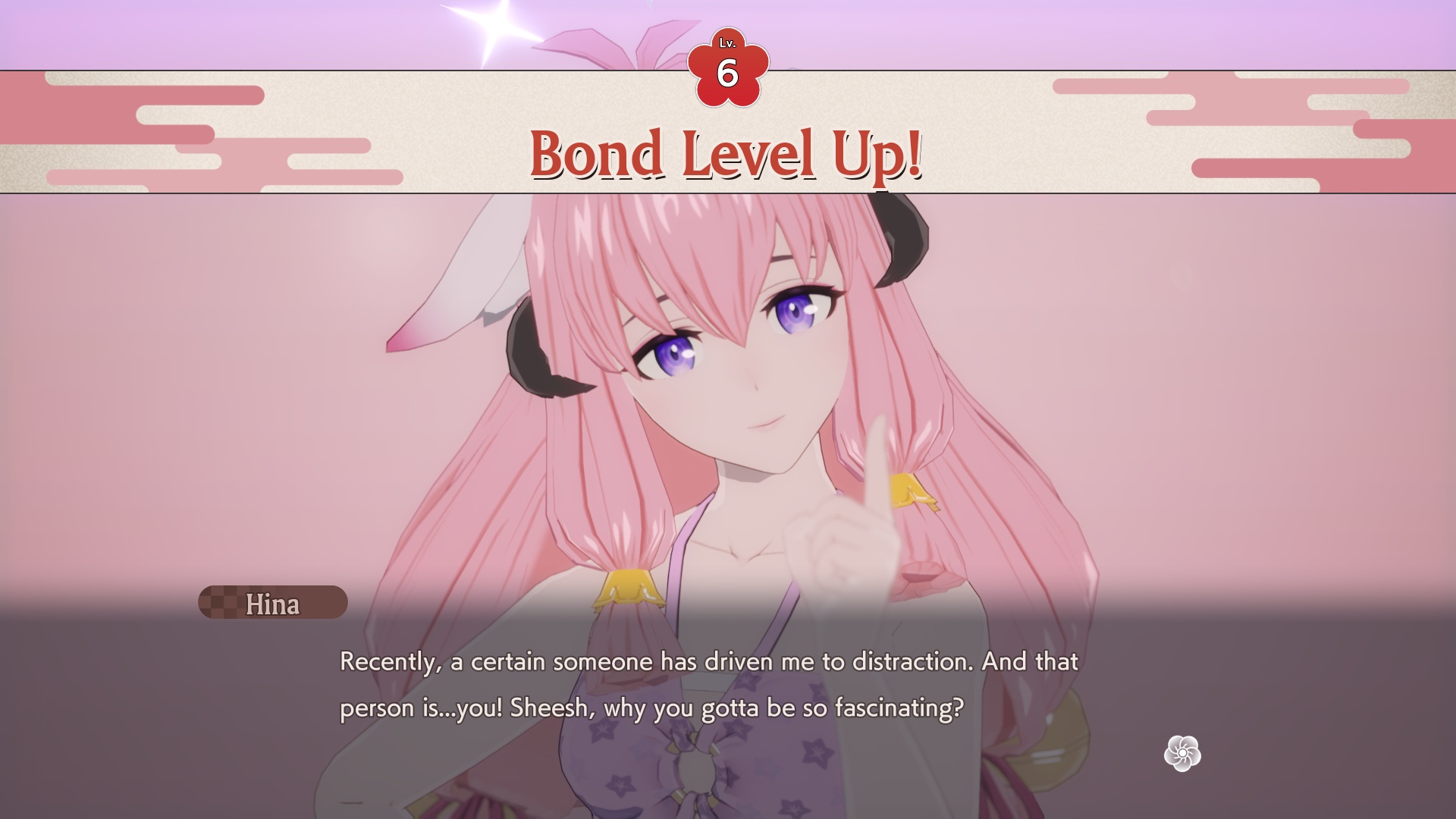
Interestingly enough, rather than simply include a “returning character” as a simple vendor like past entries have done with Raven and Margaret, this time around Guardians of Azuma brings Rune Factory 5’s Hina as a properly grown-up character seeking adventure and wanting to see the world and the vast discoveries that remain untouched. Interestingly enough, despite being called an Earth Dancer by everyone else, Hina will call the player an Earth Mate as per their usual designation in past entries. Hina is in fact only the tip of the iceberg however as far as bachelorettes go, as players will continue to meet new and dateable characters many hours into the game. Ironically, one of the best few are introduced right off the bat with another great batch closing out the roster of romance. Ulalaka, Hina, and Matsuri serve as a great start while Clarice and even Pilika can be more surprising than they let on and this is only touching on the bachelorette options. Oh, and making the opposite gender that the player didn’t select be a character in and of themselves and also giving them a personality and romance path is delightful.
Of course, there are the bachelor characters too and while we did see what some of their romance routes had to offer, especially the initially stand-offish Fubuki, we didn’t dive too deep but they are likely just as well-written. There are two unfortunate aspects to romance in Guardians of Azuma, one a personal annoyance and the second a troublesome trend. First and foremost Yachiyo and Tsubame are not romanceable in any way other than “forging bonds” with them and the other happens to be a bit more dire and that is both Pilika and Cuilang’s “romance” paths are DLC exclusive as part of the $10 Seasons of Love DLC bundle. Players can befriend them just fine and see their friendship events and missions, but unless players spend extra they cannot actually date these characters which is disappointing. Locking romance options behind DLC is a troublesome trend and one that hopefully will not be a sign of things going forward. This is especially true since Guardians of Azuma offers a fun little mechanic that many fans have wanted that allows players to, after a certain point, travel to an “alternate world” mimicking their own through Rewoven Fates and romance another character to see what “might have been,” giving players a chance to make their own little multidimensional harem if they feel like.
Gameplay
Generally Rune Factory games have players fall into a fairly predictable routine and that can still be the case in Guardians of Azuma, but this gameplay loop is far different than any other entry. While past entries may have seen players waking up, watering their crops, tilling the fields, breaking stumps and rocks, all while using RP (Rune Points) and selling their crops before making the rounds with their favorite villagers and then delving into a dungeon to fight monsters before running low on RP, in Guardians of Azuma there are quite a few more aspects to work with. Sure, all of these aspects are still there but they have all been modified with many being expanded upon and combat being a lot more simplified.
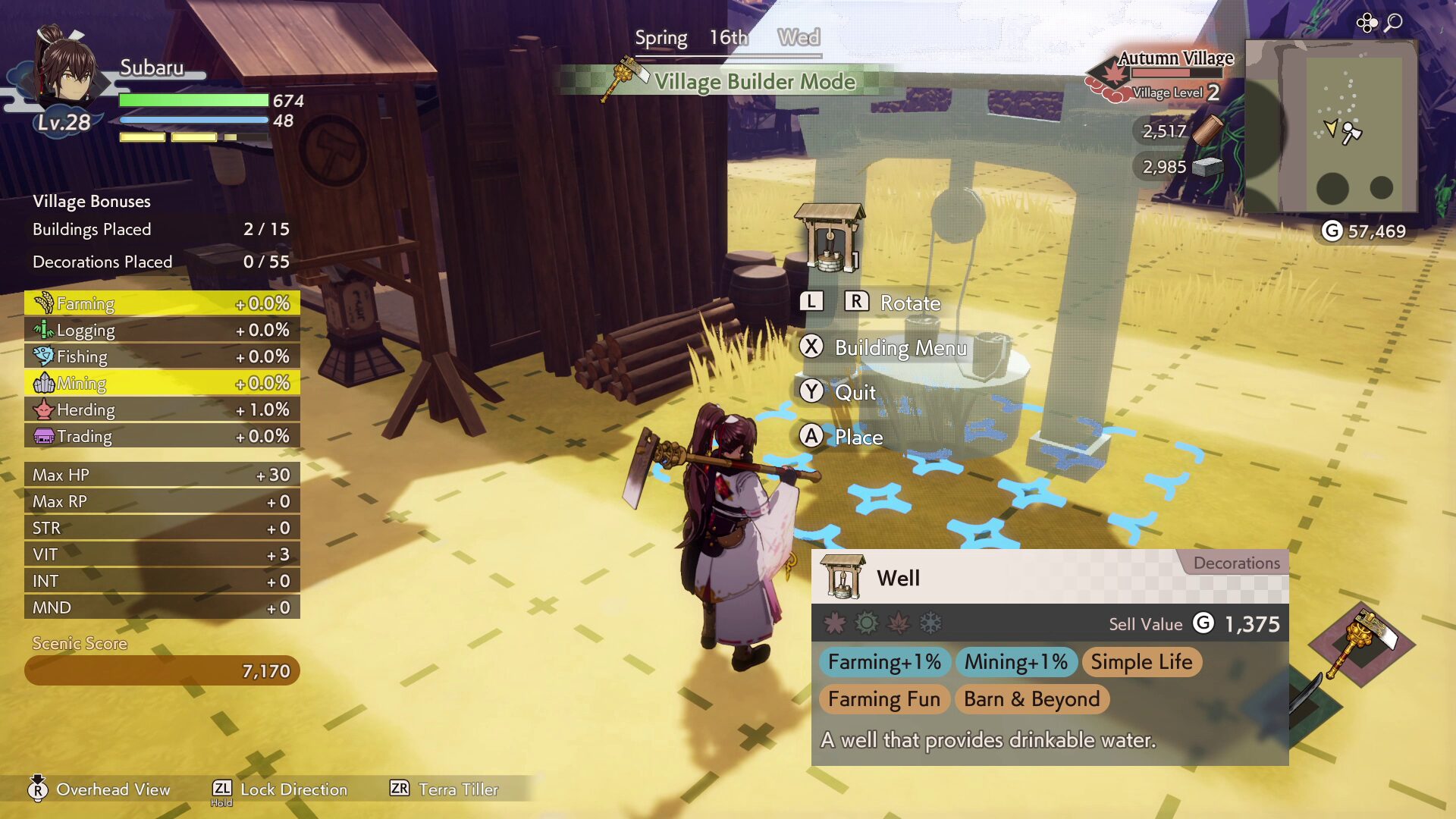
In Guardians of Azuma players will, in short order within visiting and completing each seasonal village’s initial quests, find themselves the village chief of the Spring, Summer, Autumn, and Winter villages and with this responsibility of managing the town and revitalizing it also comes with it some extra powers. Every village, of which players can quickly fast travel to at any point in time, even in the middle of combat, has different “development zones” that players can do literally whatever they want with. This can include simply telling Woolby to make some fields to place so crops can be planted and grown, planting fruit trees or those that are simply there for lumber, to having town decorations and buildings built at the local carpenter and then placed however the player wants within these locations. Some of these buildings simply help provide housing for additional villagers that can come in as players upgrade the level of the town by completing various tasks such as defeating enemies, shipping or harvesting a certain number and type of crops, accepting quest-board quests, etc. while others can provide useful town boosts to agriculture or vending or provide ingredients daily while decorations can often provide a “visual boost” to the town’s stats while also boosting the player’s own stats as well. For example placing a Lucky Cat down can automatically reward the player with a sizable strength boost, but only once for each item.
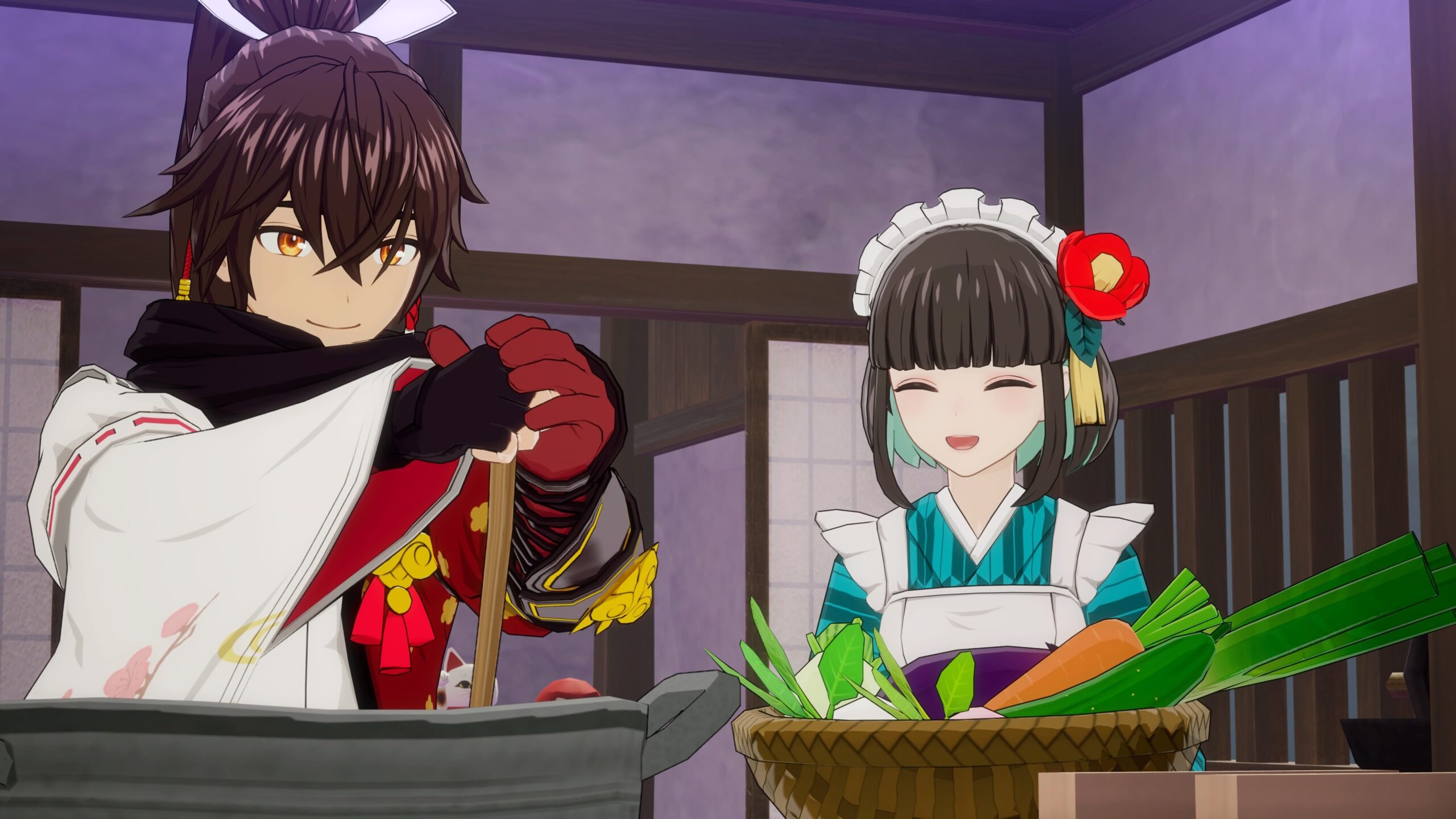
As players gain villagers they can assign each villager, random NPCs that join the town, a task through an easy to use villager management system that covers every village and villagers can be assigned to take care of the fields where they will water, harvest, and plant crops as the days goes by, automatically selling the crops while using new seeds they acquire every harvest to plant new ones, chop wood, mine for ore and materials, eventually manage the monster barn that players unlock shockingly late into the first act, and even manage a variety of shops that players can create to help bring more income into the town and also create more items that they themselves can purchase. It is worth noting that the latter option can require very specific villager types for some jobs, such as a carpenter or smith needing someone with a specific trait to actually run the store properly.
Unfortunately since the “traits” villagers have when they appear are random it sometimes means players may need to “evict” a useless one and hope they’ll get lucky the next time around or move a villager from one town to another, hoping they won’t get too upset at the prospect. It is also worth noting that the villager AI when it comes to managing the fields is incredibly strange. Most of the time players will have more than enough seeds available for planting and even have crops ready for harvest and see that they have empty field slots and unharvested or even unwatered crops. Thankfully players can utilize some Sacred Tools, such as Ululaka’s drum, to revitalize and even speed up crop growth, meaning that even though villagers can take care of most of the work, players will find that they will want to be checking on them to make sure things aren’t going to hell when they aren’t micromanaging them.
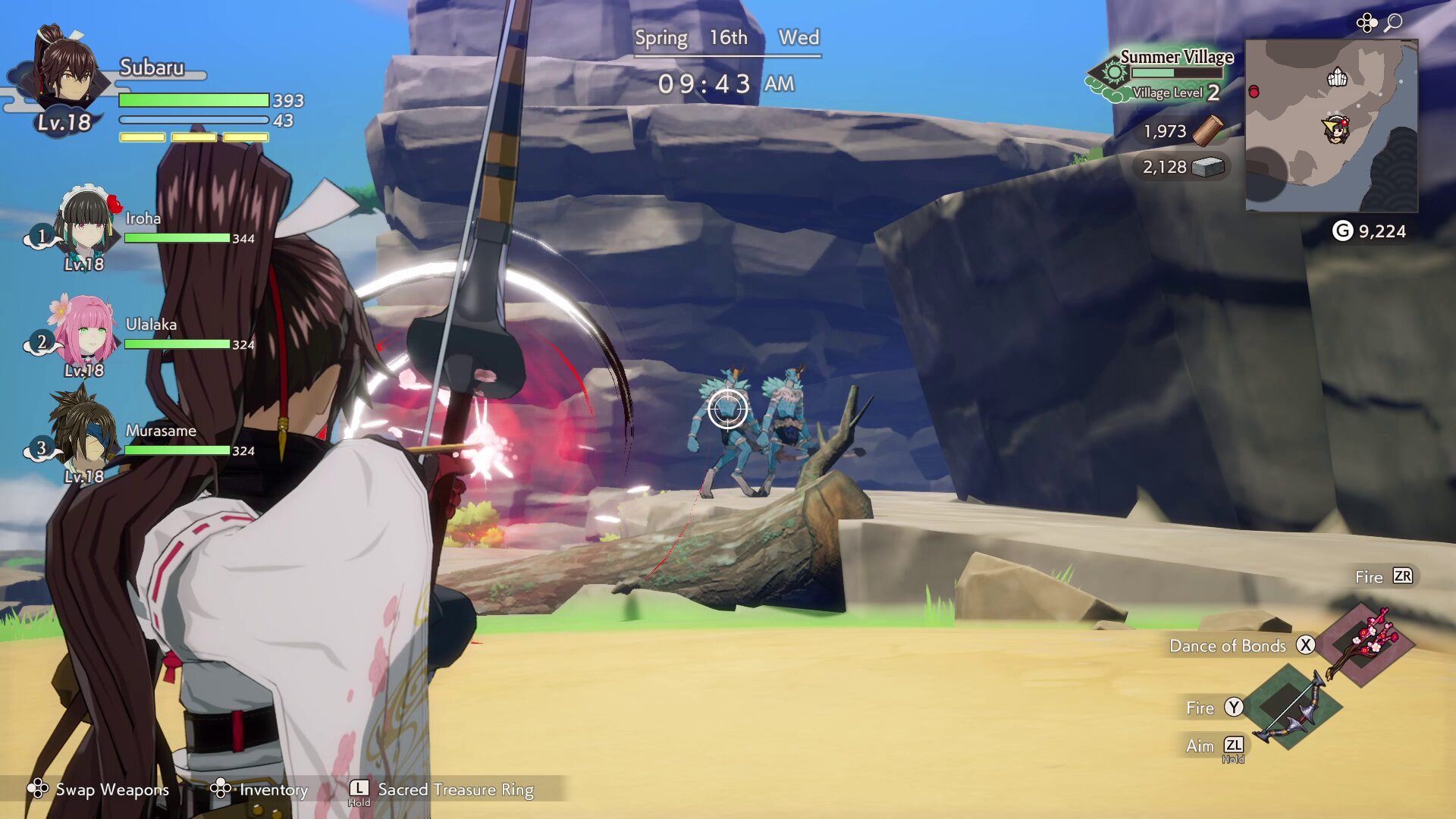
Since players no longer need to worry about their RP running out on simple chores, and even mining and chopping at trees doesn’t reduce it while out in the field, the only actual use for RP is using the Sacred Tools during exploration and combat. For exploration players will use a variety of tools to solve specific puzzles and clear Blighted pathways that might block their path or hide a secret and in combat they serve as powerful damage dealers with each weapon having a unique elemental type. Each tool also has a couple of different “ultimate” skills that players can utilize when they have enough meter and have the skill unlocked, either dealing straight damage or providing an area-of-effect type that varies from weapon to weapon. Speaking of weapons, players will find that Guardians of Azuma dials back the weapon types a bit and keeps things a bit more simple. This includes shortswords, dual blade, longswords, bows, talismans, and a few more but not nearly as many as past entries. Similarly there is no magic system or any unique spells outside of the aforementioned talismans and use of Sacred Tools, meaning magic has drastically been reduced.
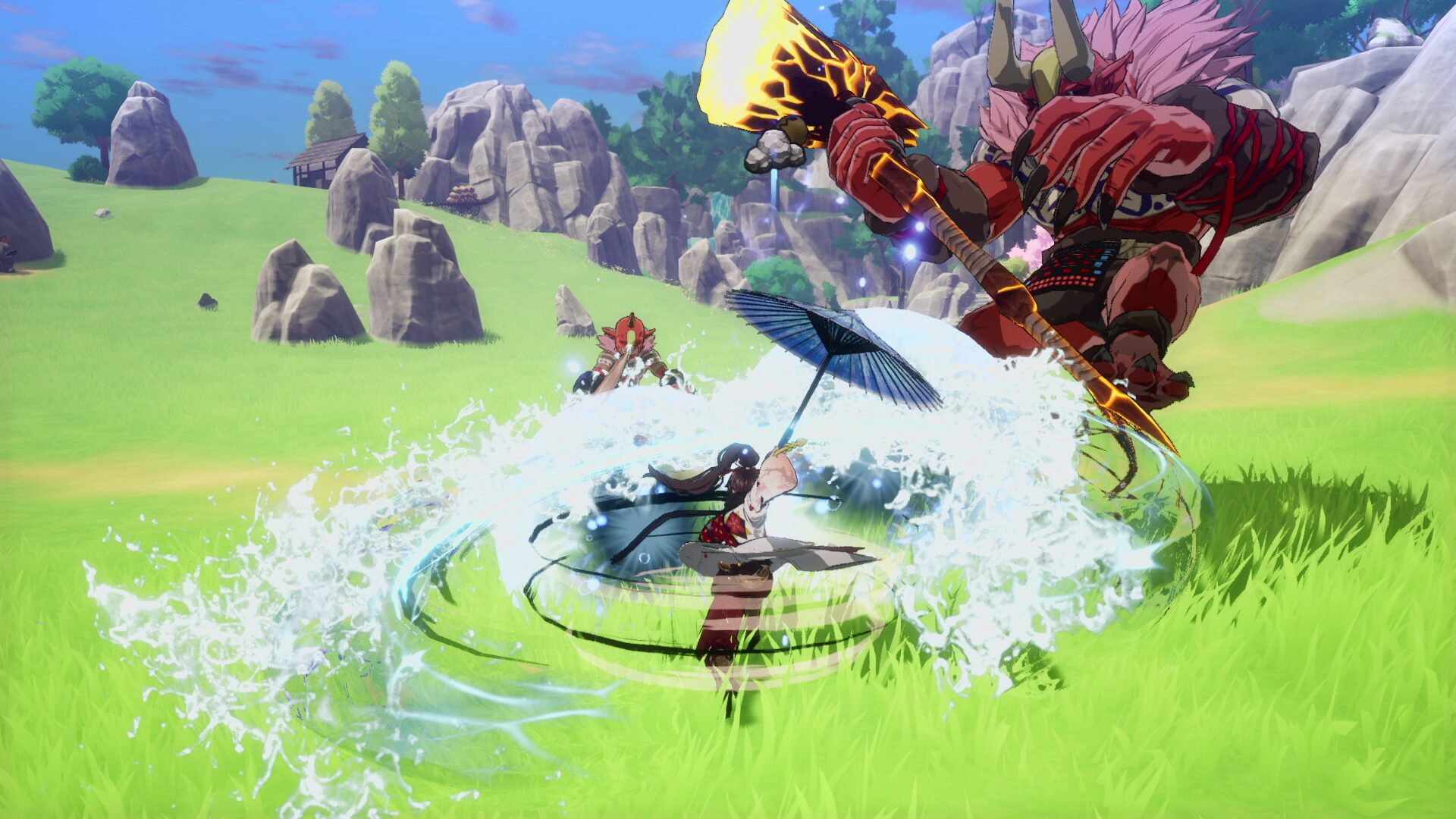
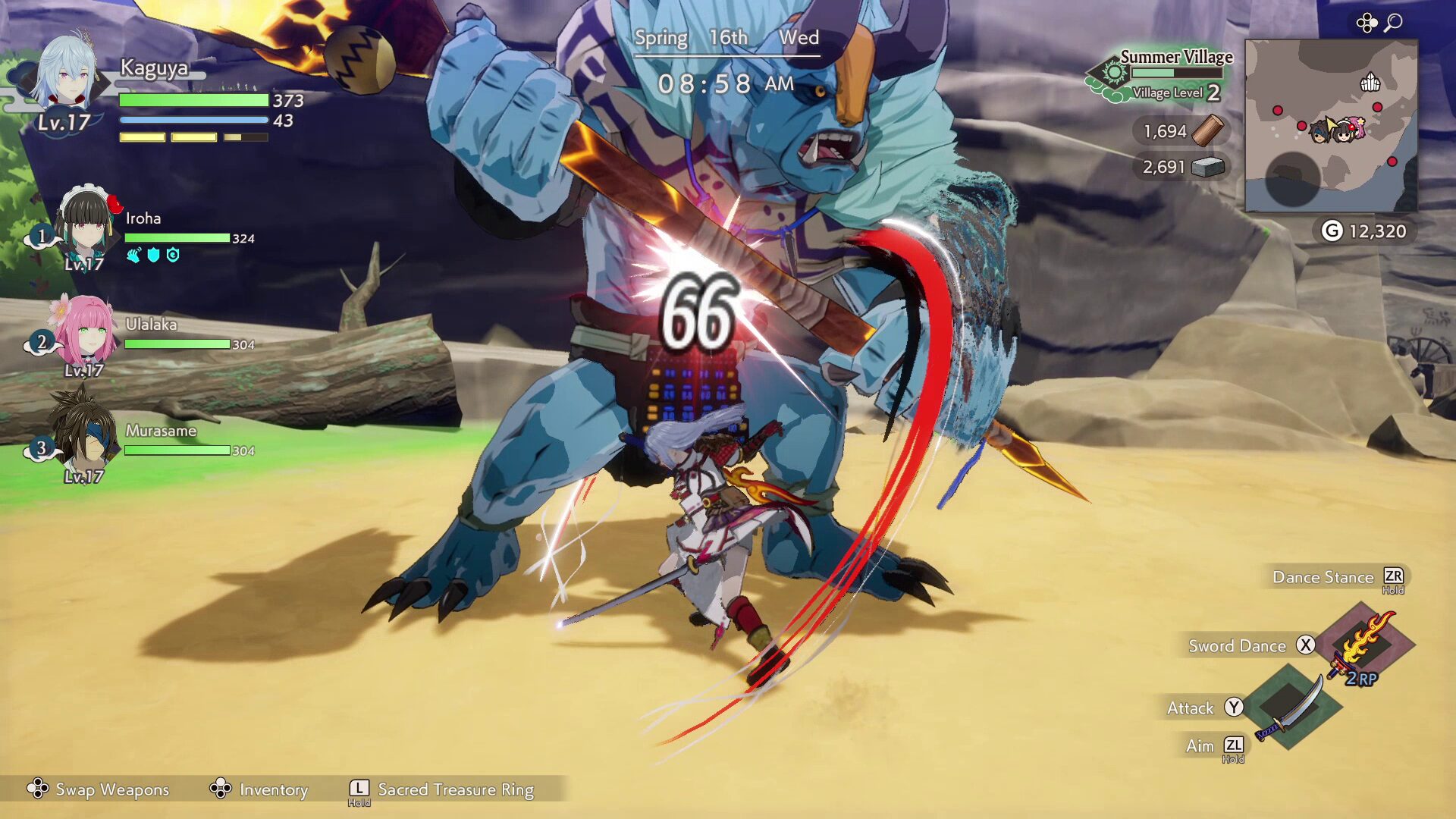
Actual combat with the weapons available feels quite fluid and easy to handle, with players gaining EXP with each weapon type and being able to unlock additional attack strings and improve their damage with a weapon type. Locking on and making use of a precisely timed dodge can slow down time and allow players to really lay into an enemy, especially bosses that can have their stamina broken down and leave them wide open for attacks on their weakpoints and dealing massive damage to them. Another aspect of the game’s combat system is the fact that it was designed around actually having a full party with the player at pretty much all times. While past games could have players bring one or three allies with them into the field, Guardians of Azuma has an entire party menu that allows players to assign their party of bonded characters that will venture out to fight alongside them. It is worth noting that since players only need a level 1 relationship with them to unlock this, every character including non-combatants can quickly become a potential ally. Eventually players can even bring monsters that they have tamed out as party members as well, including the ability to ride on specific larger monsters and attack from their backs. Even some bosses can be tamed though doing so is a hard challenge for a number of reasons, mostly since they tend to require specific offerings.
Speaking of offerings, as players explore the world they will come across a number of icons throughout each land and dungeon. These can range from being nodes where resources can be gathered to collectables like frog statues that reward the player with recipes, little shrine statues that when cleaned reward the player with rice balls, fishing spots which arrive shockingly late compared to a usual Rune Factory title, larger shrines where equipment recipes lay within, and more. Finding and obtaining these little collectables, including doing things like shooting targets or finding specific treats for mysterious creatures in holes help add a little extra spice to standard exploration alongside clearing the land of Blight. Interestingly enough, there is a new type of punishment for players who stay out “late” at night, perhaps to balance players no longer needing RP to perform standard tasks and having it slowly regenerate. Staying up past a certain point will start to rapidly reduce the player’s health making them either need to constantly heal or eat food to restore it or simply retreat back to their closest home and sleep.
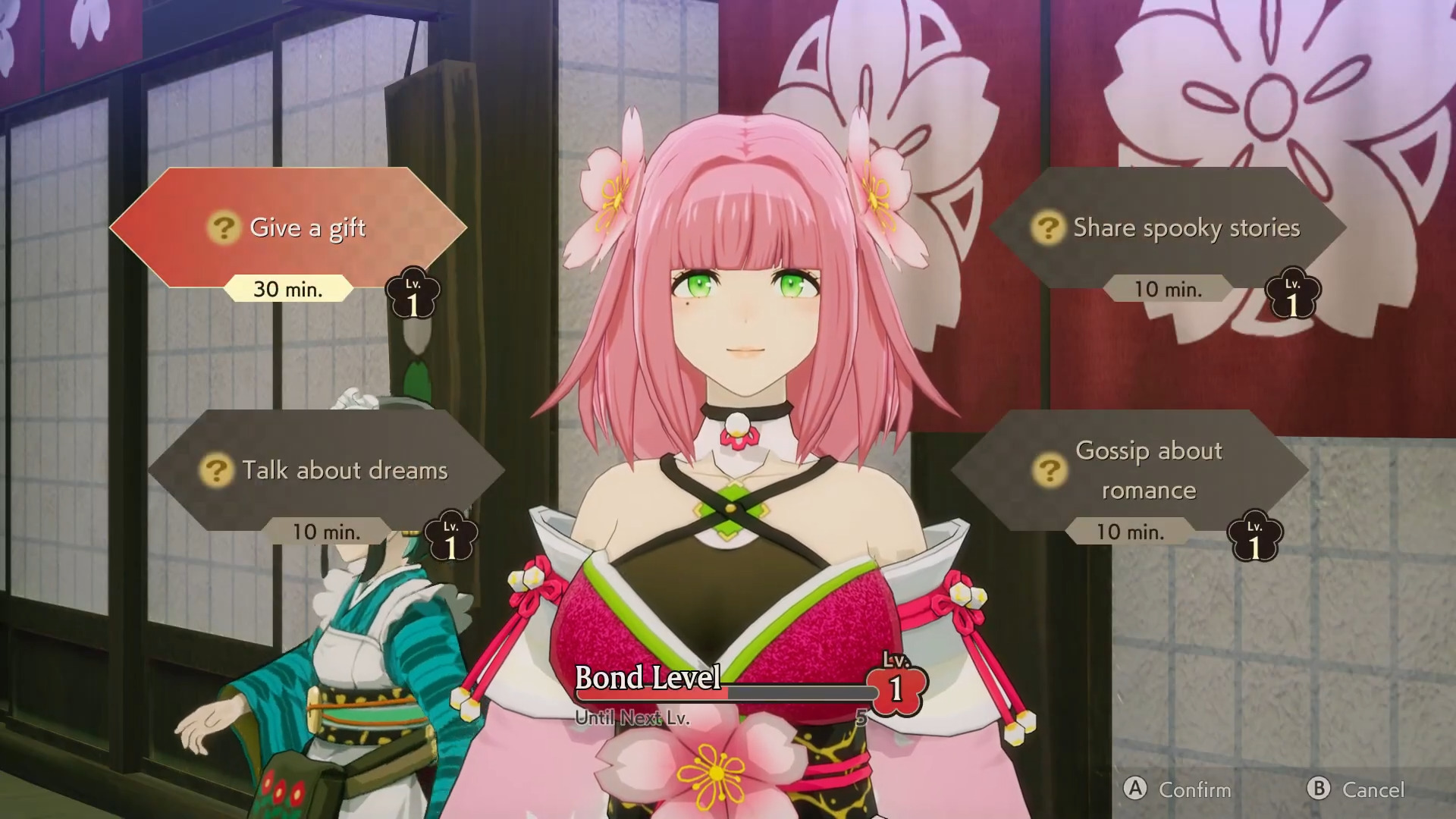
Now another newly modified aspect in Guardians of Azuma is the entire relationship system. Before players would simply find a character to talk to and give them whatever gift they may think they like and that’d be the most of it usually. Now however, players can talk with characters for a minor boost, adventure with them for an even smaller boost, and primarily “spend time” with them for the most relationship points. Anytime players spend time with a character they will be given four choices, all of which take different amounts of time. Simply making small talk about weaponry might only take ten minutes but if it is something players haven’t done before with a character they might not like it at all or give a very basic reaction. Similarly trying to ask a character out to eat too early will have them turning down the player if they aren’t close enough yet. Gifting items is always an option but players will need to guess what a character might like at first, though if they happen to find an item they like, love, or even dislike and hate it will be marked in their journal as a permanent reminder. That being said, there are some hints dropped through conversation and clues alone like Ulalaka liking her own spring blossoms and Hina still having a sweet tooth from Rune Factory 5. This creates a far more dynamic interaction system and allows for unique, albeit short, cutscenes here and there especially when players start to get into more romantic relationships with characters and have unlocked enough of the “communication” skill tree to obtain specific interactions.
One thing that is interesting to note is that while the game does technically have “seasons” and a calendar that includes character’s birthdays, the calendar is more for show than anything else. This is thanks to the fact that each village represents a season in and of itself, meaning growing winter plants in the Winter Village is always possible even in the middle of Spring. It is also worth noting that since players are the village chief now, there are no actual festivals in the game, outside of a couple specific ones. Instead, players will find that they will eventually gain the ability to set when a festival should be held and what type of festival it can be. Increasing the village level of specific villages can unlock additional festivals such as cooking, produce, fishing, and more.
Now it is worth noting that we reviewed Rune Factory: Guardians of Azuma on PC and have experienced a flawless experience even running on higher settings and using a locked framerate of our choosing and did not experience any slowdown during even the most chaotic looking fights against bosses and our party members or bugs beyond some dumb villager AI. It is unknown to us how well the Switch might be able to handle a game such as this, though the Switch 2 will likely be okay.
Audio & Visuals
One of the key aspects in Rune Factory: Guardians of Azuma is the fact that the developers have chosen to stylize the game around Japanese architecture and themes. While monster designs are as similar as many fans will remember, with returning favorites and a few too many reskins to be comfortable with, the villages that serve as home bases are decidedly Japanese in influence and design. Even the numerous crafting recipes that players gather for decorations all lean in this aesthetic and for the most part it honestly works quite well. The character models for the standard villagers are all outstanding and most have at least one other costume in the form of a swimsuit or something else that players can change at will and, as mentioned before, the fights are as fluid looking as one could expect and never experience slowdown in my time with the game.
The title comes with both an English dub as well as the original Japanese voice track and players can choose to swap between them at any time. The English voice cast does a solid job handling their characters well, with the boisterous Matsuri making bold cheers and claims as she fights at your side or the cute cheers of Suzu as she heals and buffs the party at the sidelines, nevermind their actual core storyline dialogue and side-quest dialogue that is all voiced as well. Those who want to listen to the Japanese voice track on the other hand will find it readily available. The soundtrack features a solid collection of background music that is all themed around Japanese themes that fit the nature of the game and work well both during exploration of towns, fields, and fighting in the dungeons though none of them really stand out much.
Overall
Rune Factory: Guardians of Azuma tries something new in almost every regard and in many ways it manages to succeed. Sure, villager AI can be a bit too dumb to manage crops properly and longtime fans may not like farming taking a bit of a backseat compared to building and managing each village, but these experiments are actually entertaining and chances for the franchise to grow. Combine this with a solid storyline and an absolutely wonderful cast of characters, both romanceable and non-romanceable and players will find themselves eagerly sinking countless hours into this Rune Factory just like the last, even if some of the combat elements and customization aspects aren’t as deep as before.
Capsule Computers review guidelines can be found here.
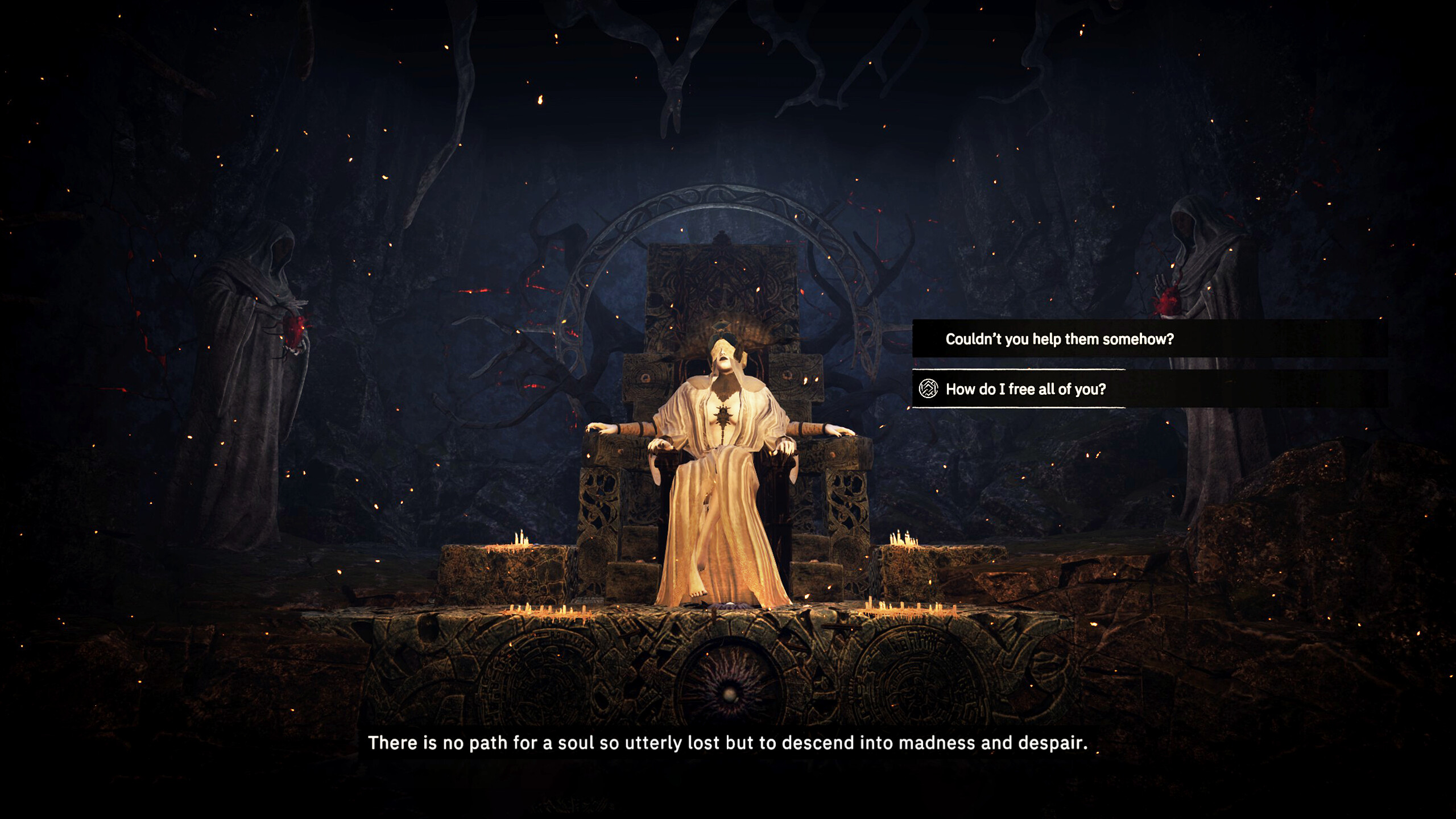
When it comes to legends and fables, very few have been tackled quite as many times or in as many ways as anything related to King Arthur. Anything relating to Arthurian legends and the knights of the round table have long been seen as prime material ripe for the picking for all manner of game genre, some flipping things around with Artoria in the Fate franchise or sticking as true to legend as possible with various tweaks to Arthur and Merlin’s legends. Arthurian legends have been dabbled in long before video games were created but that doesn’t make them ripe for the picking now and Questline and Awaken Realms have done just that by putting perhaps one of the darkest and most expansive offerings of Arthur’s legacy that fans could hope for in Tainted Grail: The Fall of Avalon. After spending two years in early-access and now being given its full console release, is this twisted take on these familiar legends worth delving into?
Story
Roughly six hundred years have passed since the great King Arthur perished, leaving his subjects in the land of Avalon with only the Knights of the Round Table to lead the way and guide the people. Over these hundreds of years though things have only grown more disastrous, between wars breaking out among the tribal folk and those loyal to Kamelot and the ever encroaching Wyrdness that permeates the land, twisting anything it touches with dark magics beyond most’s comprehension, many have turned to even darker rituals and attempts to try and cure the land of what ails it, even if it means purging everyone who may have had any influence or taking part in brutal human experimentation that would sicken even the hardest of stomachs.
The player wakes up in one such location, having been discovered by the Red Priests and imprisoned in an island asylum where they commit unspeakable acts in an effort to understand and perhaps cure the Red Death plague that has recently begun sweeping the land, killing anyone unfortunate enough to be infected by it and at worse turning them into an undead monstrosity. Stricken with the Red Death yourself, the player is saved from jail by a mysterious man who, after giving players a chance to explore and discover just how dark and twisted some things have become in this world, leads them to a potential escape route only for it to be a path to an otherworldly location containing none other than King Arthur’s soul. Or at least a part of it. This fragment of King Arthur, the long deceased king, attaches itself to the player in hopes of regaining his true form once again and reviving, but perhaps that might not be the best thing for the people of Avalon?
Tainted Grail: The Fall of Avalon doesn’t hold back its punches when it comes to showing off how brutal things can be. The entire first hour or so of the game (depending on how much players want to explore) can be spent reading into, talking to, and discovering various aspects of how far the Red Priests have been willing to go on this island asylum and experiment with both the dangerous Wyrdness and the plague victims themselves, something that no one in their right mind would sanction. Even once players finally leave the island and land upon the shores of Avalon in the Horns of the South things aren’t much better. Bandits run amok, the Wyrdness comes out every night to possess those caught in the open and spawn monstrosities, and locations that may have seemed like refuge once now are horrific shrines to good intentions gone horribly wrong.
The environmental storytelling in Tainted Grail: The Fall of Avalon is exceptional, what with horrific giants impaled into rocks or sunken giant statues, and when combined with the side-quests that often accompany many of the places players will explore it is made all the more clear how talented the writing team at Questline happens to be, especially when it comes to variety. One mission may have players trying to track down the remains of a sunken ship set to have a mysterious Wyrdness defying relic onboard only to discover the gruesome truth when found while another may involve helping an entitled woman find her husband and deciding to let him run away and escape his marriage, choosing to woo the new “widow” themselves, or even simply spend time chopping wood to repair the ramshackle parts of the refugee town to make lives a little better for those fleeing from the horrors beyond what few safe walls still remain.
These side-quests and environmental storytelling serve as wonderful side-dishes to the main storyline itself that features a wide variety of ways that players can often tackle some objectives. One of the first major goals players can have is to reach Excalibur, and while there is an expansive questline filled with many choices and unique encounters that expand greatly upon the game’s backstory and how dark Kamelot really is, it is also entirely possible to draw Excalibur without any help whatsoever, as long as players are ready for the challenge and choose to skip what would otherwise give the player aid. That being said, the main storyline of Tainted Grail: The Fall of Avalon is exceptionally well-done and players will need to make a number of meaningful choices throughout the game, especially at pivotal points, to help shape the fate of Avalon and its people.
When it comes to main storyline choices, many of these simply involve doing one task or another, but players can also come across a number of other random dialogue options as well in quests that can result in unique endings or possibilities as well. For example, players with enough spirituality stats may be able to convince the local necromancer that is causing havoc that he should go into healing the sick, rather than simply running in and stabbing him through with a spear. Many of these dialogue choices will state that the player may not have enough of a certain stat to select the option while others will give a percentage of success and these are true percentages of success and failure, not guaranteed ones. Of course, this does mean that save scumming for the best result is always an option but a welcome one.
Tainted Grail: The Fall of Avalon really does manage to hit that perfect blend of twisted darkness and near hopelessness with the player character and a few others being the last shining lights in the dark trying to strive to help as much as they can. Ironically, players can also choose to make things much worse in some cases between dialogue choices and main storyline ones. This creates some rather interesting dynamics in an already expansive story that players can easily sink well over sixty hours in and that isn’t even if they are exploring everything. What makes things even more interesting is the fact that Arthur’s fragmented ghost is along for the ride and often is chatty with the player around the campfire, wanting to talk about the various things that they’ve come across and done. Giving players a stark comparison to how things may have seemed in his time and how twisted they have become since his passing or the harsh reality of events that have been lost to the past. Those really wanting to delve through every cave, forgotten shrine, hatch a strange looking axolotl-like pet that does nothing but look cute, and much more will find well over that amount awaiting them within the Wyrd infected lands of Avalon.
Gameplay
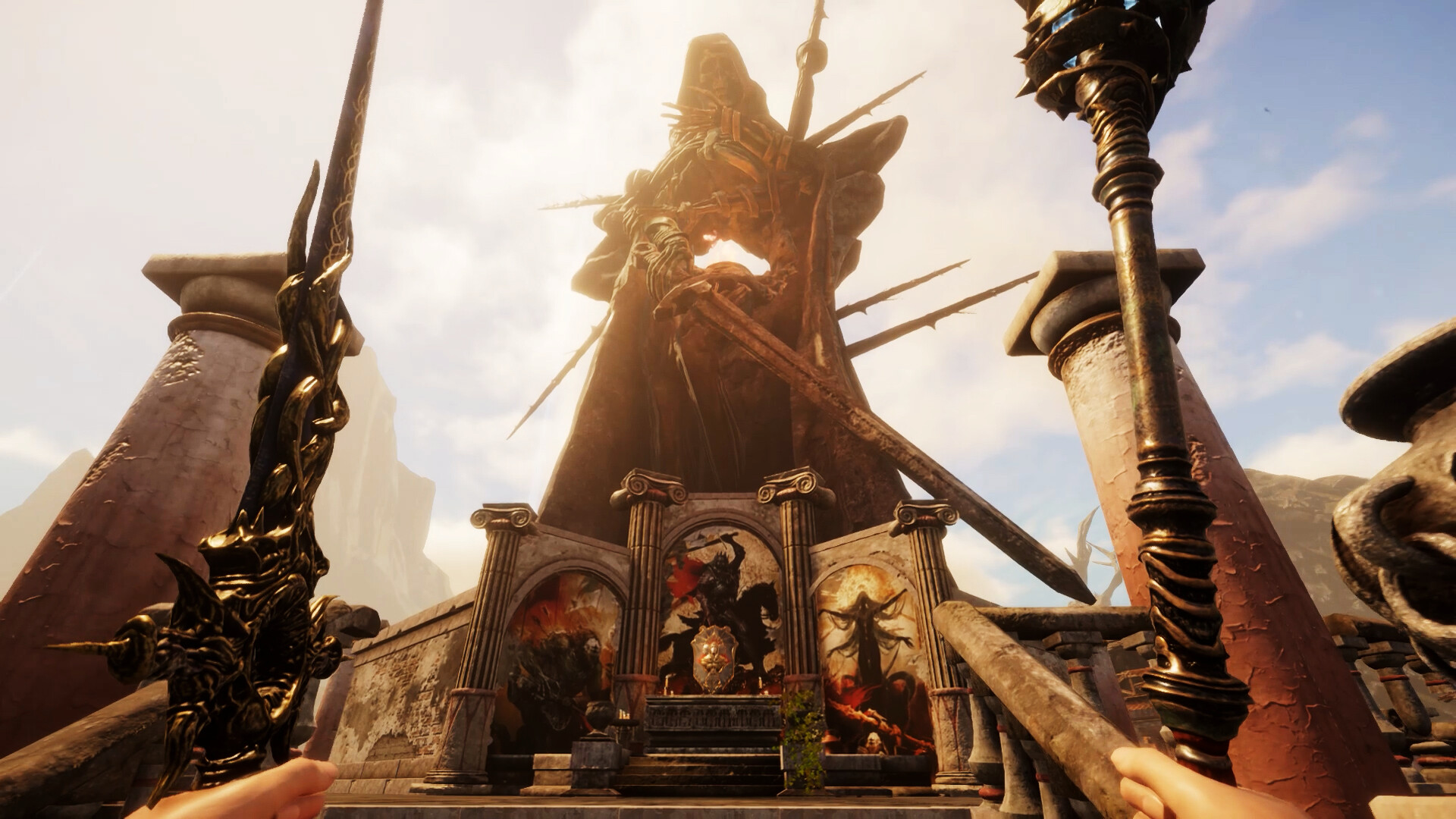
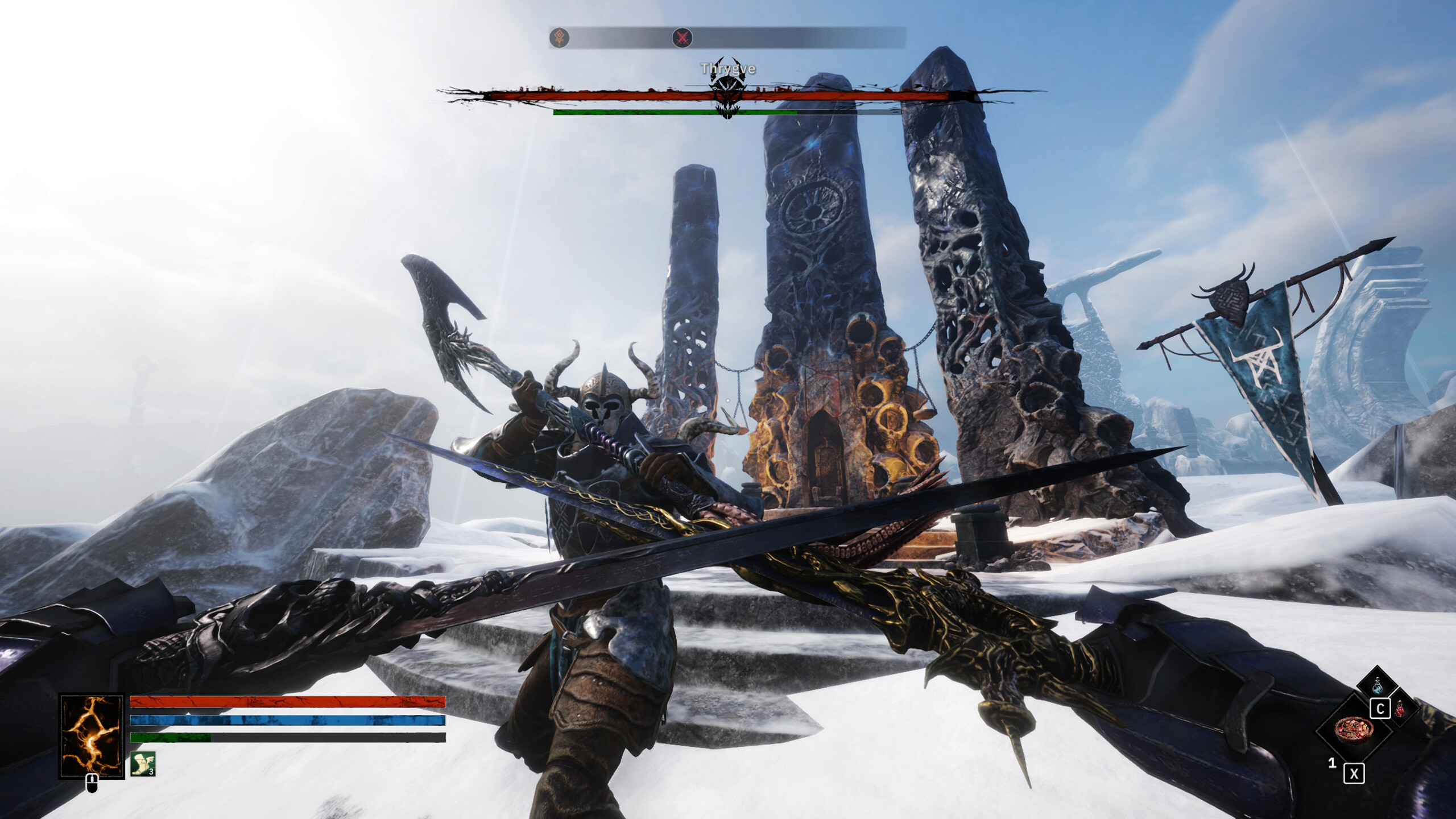
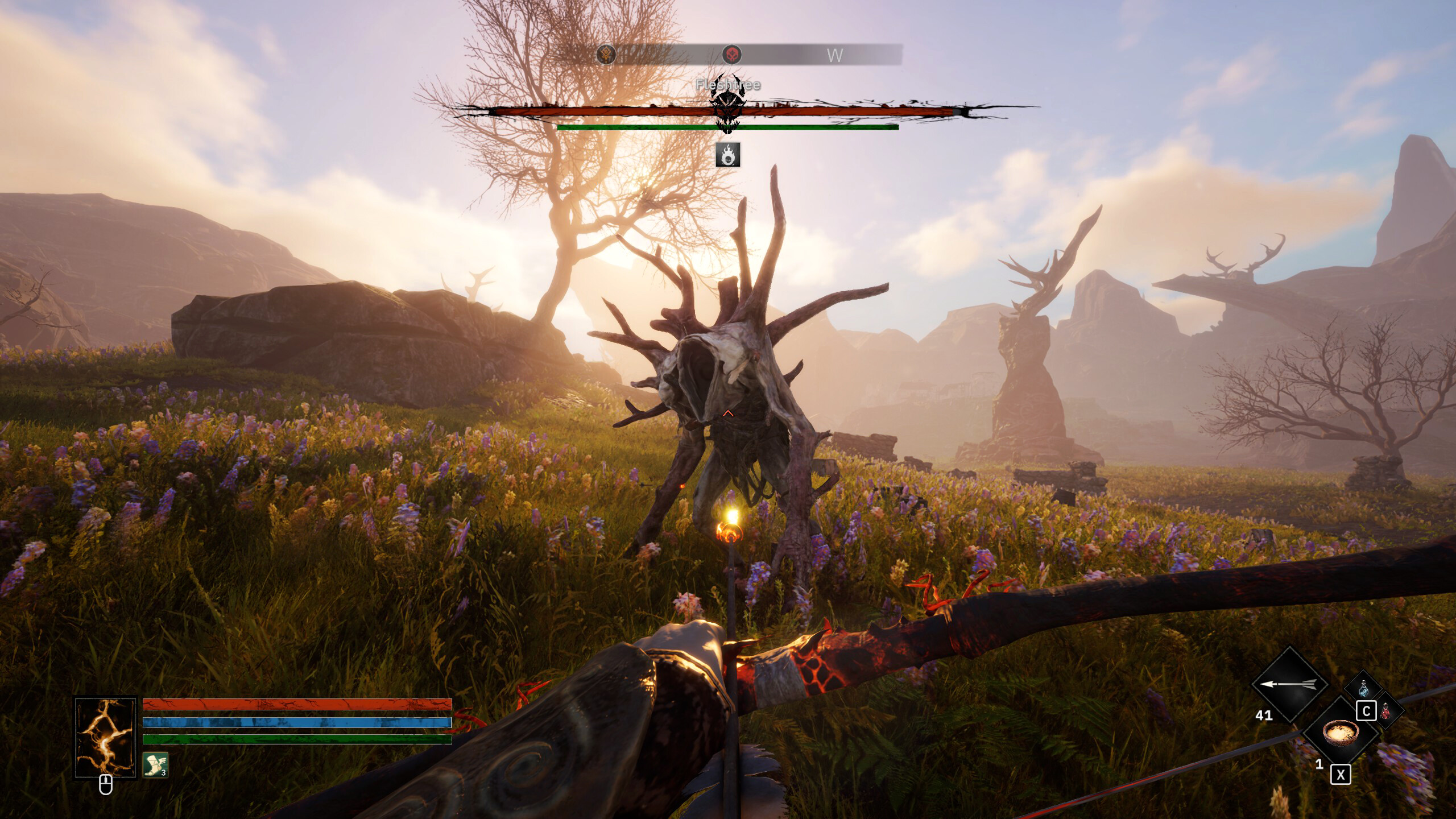
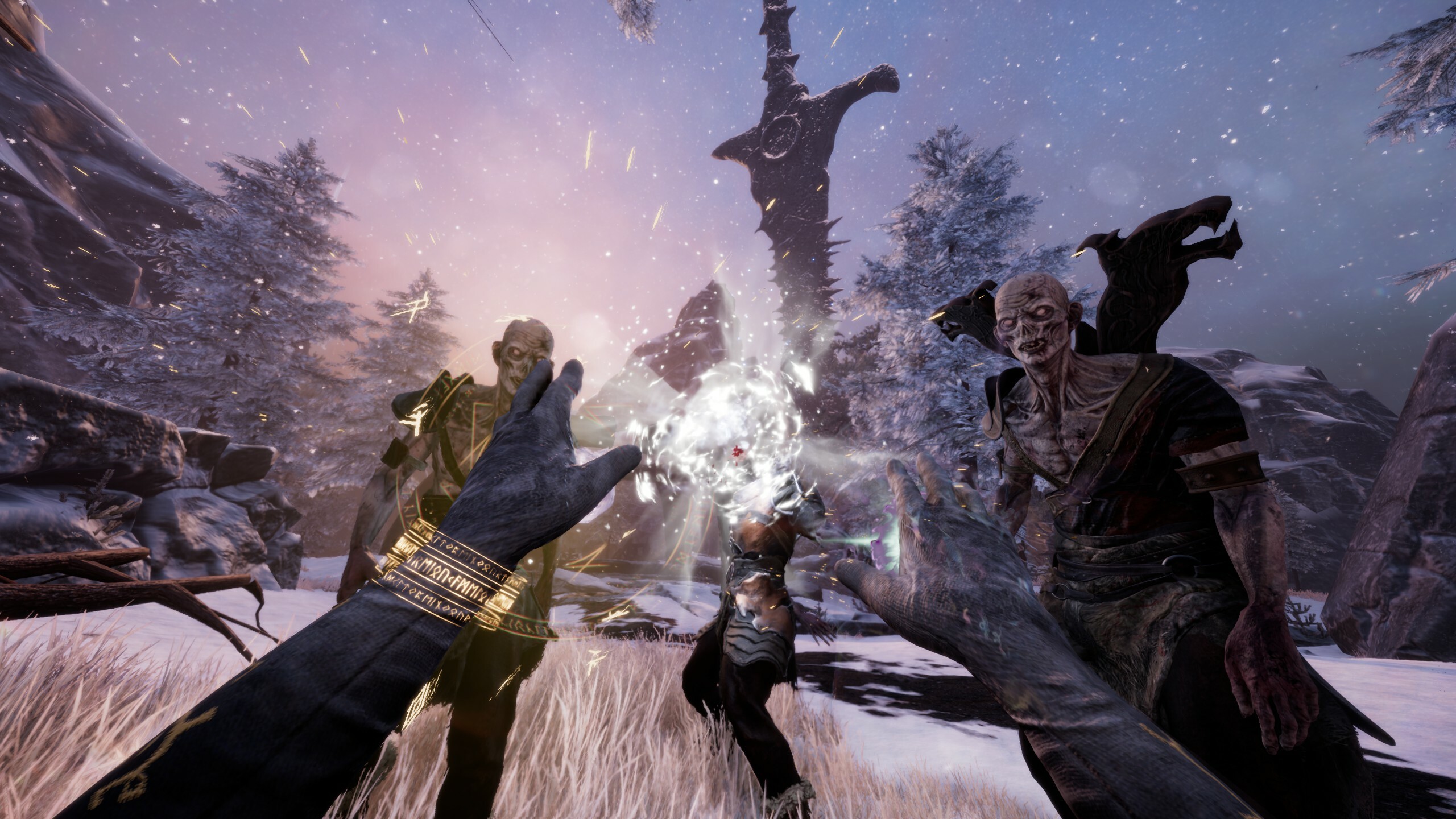
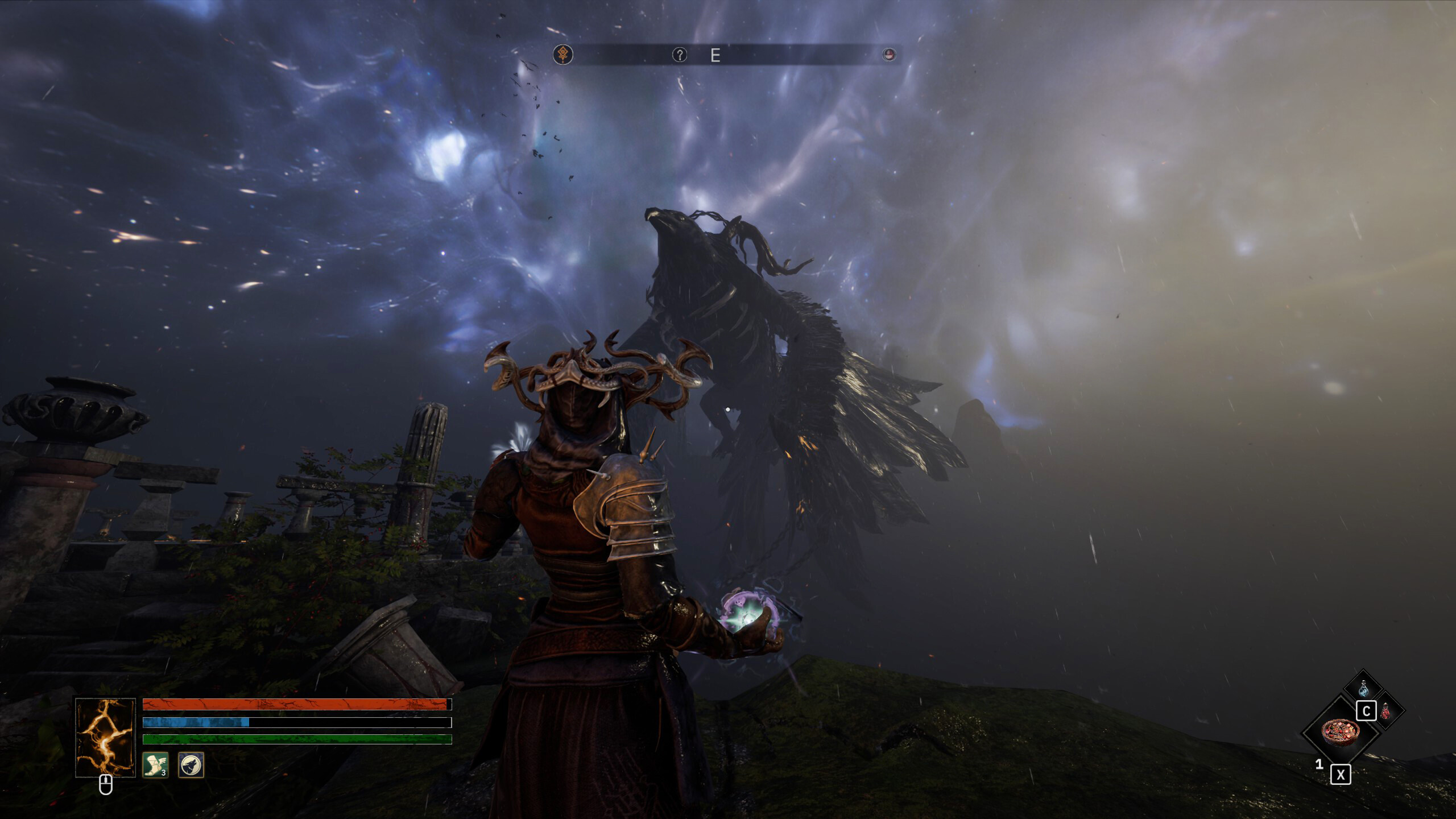
In a general sense we tend to avoid making direct comparisons to other titles, especially in the case of an up-and-coming developer’s major release but it is extremely clear that Tainted Grail: The Fall of Avalon has, at the very least, drawn inspiration from The Elder Scrolls when it comes to creating an expansive open world explored in first person where players will wield medieval weaponry and magics to defeat their foes. This is far from a bad thing, if anything it actually happens to work quite well and it is interesting to see where Questline has managed to deviate from the blueprint and create their own unique little mechanics and elements here and there. First and foremost, it is interesting to note that combat is extremely customizable thanks to the way players can not only manage numerous loadouts at once, quickswapping between four different possible sets at need, but also the way weaponry is handled.
Sure, there are tried and true staples such as using two-handed weapons like large polearms, giant maces, greatswords, or wielding a bow and arrow or simply going “sword and board” with a sword and shield but single-handed weaponry is where options open up greatly. This is because spells can be equipped to one hand while a blade or melee weapon can be equipped to the other, allowing for players to work a spell-blades, dual-wielding swords or daggers to unleash a flurry of attacks, or even dual wielding two different spells at once and firing away at foes with all different kinds of elemental attacks. Every magic spell has a light cast and a heavy cast variant, each performing a different variation of the spell and costing different mana. There are even summon spells within the game with an entire skill tree based around summoning up to six magical creatures (or people) to fight at the player’s command.
Keeping these units summoned does lower the cap on the player’s max mana but it also means that players can, in my particular instance for quite some time, summon five wolves and sic them on a group of bandits only to quick-swap to a bleed-inflicting spear, allowing me to stab away at enemies and inflict statuses and damage from a distance. This then evolved further as more powerful weaponry and summons became available throughout the game and this is only one of many possibilities that are open to players in combat. It is odd to note though that sometimes summons can glitch out in a variety of ways. One time saw a summon remain permanently draining MP despite being dispelled, with a reset being the only way to banish it, and another saw the summons randomly attacking a non-hostile NPC and downing him, though thankfully it appears that most non-hostile NPCs cannot be killed unless players “execute” them on the ground. Along these same lines, it is worth noting that the criminal system in Tainted Grail is quite rudimentary. Players can pickpocket by sneaking and, if successful, will never be noticed. Similar to picking locks with an extremely familiar lockpicking mini-game. If caught, players are simply given the option to pay the fine, go to jail, or resist but unless players are careless they’ll likely never even notice a punishment for any thefts.
Alongside the aforementioned similar lockpicking mini game players will find a number of random crafting systems as well, including blacksmithing random gear, creating potions with alchemy, cooking food, all using basic crafting menus, and even a fishing mini-game that is actually more complicated than simply casting the line and immediately catching something. Players can even get a horse they can summon at anytime but, unless players are wearing the heaviest gear possible which slows movement speed, they are better walking/running everywhere as the horse controls are absolutely awful. That being said, crafting is a bit of an annoyance primarily due to the game’s encumbrance system and inability to use materials from the player’s “stash” to craft. Like many RPGs of this type, players can only carry so much and practically everything is lootable. Trying to loot a table of food might see the player picking up the plate and drink cup before they snag the apples. Becoming over-encumbered means players cannot fast-travel using fast-travel points or their own fueled campfire and having to make sure players always are carrying around crafting materials instead of being able to stash away what they’ve gathered and using the materials from their stash to craft is annoyingly tedious and a strange oversight since players can sell to vendors from their stash.
As players beat monsters or level their skills such as one-handed or thievery or complete a myriad of quests they’ll earn XP and level up with these points being able to be allocated at a campfire. Every level rewards player with an attribute point and a skill point, with attribute points affecting their overall stats and potentially unlocking dialogue options and skill points being able to be distributed to a vast array of options ranging from increasing how much items sell for, the amount of health or damage the player does, and more. Another aspect of using the bonfire is to keep the Wyrdness at bay when resting or avoiding danger at night. As night falls upon Avalon, the Wyrdness runs rampant and can not only enhance the abilities of monsters already in the area, but even summon spectral beings of its own to punish the player. Even human enemies become possessed and deal far more damage and attack more aggressively at night. As such, players can use “Ethereal cobwebs” obtained from slaying enemies infected by the Wyrdness to fuel their campfire to keep it at bay, fast travel, identify mystery items also dropped by enemies at night, and even use it to make alchemical potions. This leads to a sort of risk and reward to battling at night, especially since there are some materials only available from those summoned from the darkness.
Now any open world RPG of the scale of Tainted Grail: The Fall of Avalon is bound to have bugs with it but there happen to be quite a few throughout our time with the game. Some of these were as simple as being stuck in the geometry and thankfully the game has a pre-built “unstick” option in the menu to help players here but other bugs arose as well. This includes quest targets randomly vanishing and requiring a reload to properly hunt down and slay, meaning players will want to keep frequent saves and make use of the hundred save slots available to make sure not to lock themselves out of progress, aforementioned bugs with summoned allies, dialogue either vanishing or not playing properly, and worst of all countless crashes. Throughout our time with the game we experienced well over ten different crashes to the Home screen at which point we stopped counting and while loading the game up is incredibly fast, having to do so and hope that the last auto-save isn’t too far back is an annoyance.
Audio & Visuals
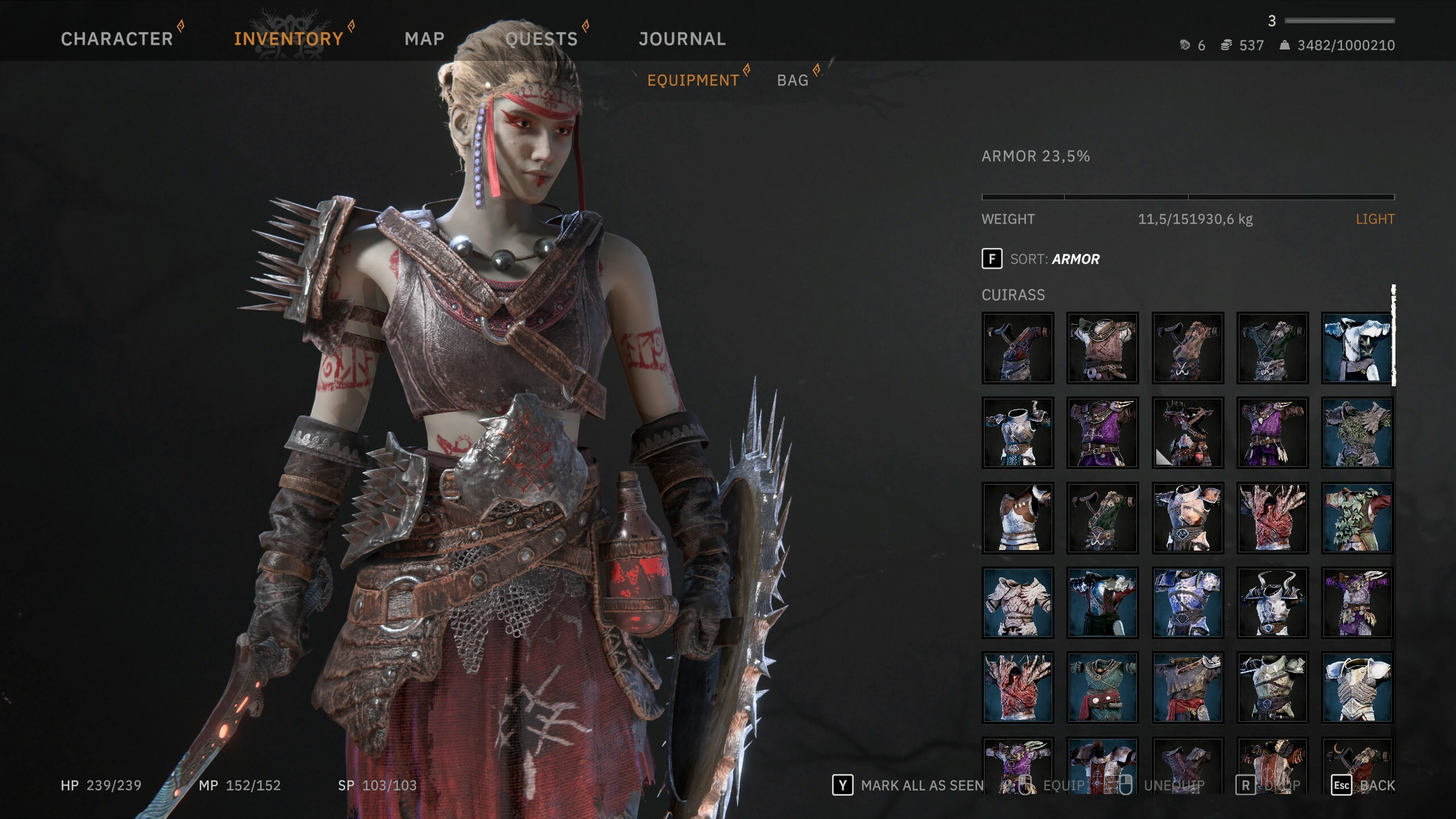
Tainted Grail: The Fall of Avalon is something of a mixed bag visually as standard exploration throughout the world can often feature far too many simplistic ruins or vistas that do little to impress or caves that lack any noteworthy detail. On the other hand, stumbling over the next hill might reveal a monolithic horror impaled on a rock or a dungeon filled with unique looking elements that will keep players guessing. That being said, there is still texture pop-in here and there as well as rough looking textures here and there. This is both good and bad since players never quite know whether their next journey will be one of wonder or of simplicity. Enemy models are fairly varied and character models are handled well, though they all feel a bit dated in appearance. One thing that is nice to note is that there is a wide-variety of equipment appearances available, including a large number of unique weapons and armor. That being said, while it is possible to play the game in third person, even the developers trigger a “pop up” saying the game was not intended to be played in this manner as it was developed first and foremost as a first person adventure game.
Nearly all of the dialogue in the game is voiced, with the few lines that appear to be unvoiced likely caused by bugs happening at the time and the performances of the characters are actually handled solidly given the vast array of random NPCs players will run into. Enemy barks do get a bit similar after a short period of time but this isn’t too bad. As for the background music the game’s soundtrack features a decent mix of tracks for exploration and for combat including far more intense sounding pieces of background music, including vocals, that appear during intense boss battles or during important story moments.
Overall
Tainted Grail: The Fall of Avalon may feel familiar to most fans of the genre but thankfully manages to put enough of its own unique twist on gameplay to make itself feel unique all while giving players perhaps some of the most dark and cruel portrayals of Arthurian legend in games. The core storyline itself is already impressively written and the side-quests only make things even better, it is just a shame that the game is so incredibly buggy and prone to crashing alongside a number of lacking quality of life elements. That being said, Tainted Grail: The Fall of Avalon manages to deliver an incredibly addicting feeling experience despite its flaws, perhaps due to its fun and varied combat or how players never quite know what’ll be around the next bend, just don’t expect a smooth experience along the way.
Capsule Computers review guidelines can be found here.