



Ghost of Yotei
Developer: Sucker Punch
Publisher: Sony
Platform: PlayStation 5
Release Date: Available Now
Price: $69.99 USD – Available Here $124.95 AUD – Available Here
Overview
When it comes to big budget sequels, it is always curious to see what the studio might have in mind. This is far from exclusive to video games, as any major series that saw a blockbuster hit will be tentative on what direction they should take their sequel, be it a movie, book, or game. With Sucker Punch and Sony landing quite the success story with Ghost of Tsushima five years ago, many wondered just how they would proceed, especially since Jin’s story had come to a fairly solid conclusion. Would they bring Jin back to the battlefield, would they reinvent the gameplay, or would they take and deliver more of what made the first so great but with a new protagonist and storyline? Well, Sucker Punch opted for the latter route and with Ghost of Yotei has a brought forth a brand new protagonist steeped in the same type of open world gameplay that fans loved from the first, but between some lackluster storytelling and a little too much recycling, it might not have hurt to try and reinvent Yotei at least a bit further.
Story
Set three hundred years after the first game, this journey takes us to the northern island of Japan in the Ezo region surrounding Mount Yōtei. With Jin being long forgotten to history at this point, this time the story focuses on Atsu, a mercenary that has honed her skills in battle serving as a mercenary throughout countless battles in the southern region of Japan for sixteen years. Finally believing she is ready for her revenge, Atsu returns to Ezo to do just that, enact revenge upon the Yōtei Six that slaughtered her family right in front of her eyes and left her for dead. With her father and mother lying dead in front of her and her brother out of sight, Atsu was pinned to the burning Ginko that served as the family’s signature tree by the so-called Lord Saito, the leader of the band.

Upon arriving in Ezo, Atsu tracks down her very first target, The Snake, and manages to slay him in dirty combat that leaves her on death’s door, only for her to miraculously come back, earning her the nickname “Onryō”, a ghost that haunts the men who pledge their loyalty to Saito’s side. From this point on Atsu’s journey fractures slightly as she finds herself being able to track down two of her targets primarily in either order, the Oni or the Kitsune, with the twin siblings Spider and Dragon being locked until players complete the other two. Atsu also learns that Saito is gathering an army, looking to establish himself as the so-called Shogun of the North to oppose the rising shogunate throughout Japan and current samurai class. As Atsu tears her way through the wandering ronin, forces looking to collect the bounty on her head, and even Saito’s men who have set up base throughout the region, news slowly trickles back proving Atsu is a force to be reckoned with, not just a mythological rumor to frighten the men and her journey is one that features plenty of highs and some unfortunate lows as it gets a bit lost in its own storytelling despite some strong side-content.
Ghost of Yotei tells a fairly by the numbers revenge story but happens to get lost within its own storyline a bit as even this basic concept of revenge gets muddled a bit too much for its own good. As Atsu continues her journey she will encounter a wide-range of twists and revelations that make for some incredibly poignant moments as well as an incredibly well-handled character shift that works both thematically and for the overall journey, especially since it gives Atsu some semblance of forgiveness even amongst her rage fueled journey for vengeance. Unfortunately this whole aspect of the plot quickly begins to fall apart in the third and final act, almost as if the writers didn’t know what they were doing or if they wanted to stick with the concept at all to a certain point. Sure, there is a solid conclusion when everything is said and done, Lord Saito makes for an incredibly bland villain even what players learn throughout the story and the final few confrontations are incredibly lacking. When you can’t even count the number of times a “big bad” escapes thanks to some convenient development on two hands, it’s some pretty poor writing.

Thankfully the side-content throughout Ghost of Yotei is handled incredibly well. While there is still the standard side-activities, collectables, and similar things we will discuss momentarily there are also a wide range of side quests that each have their own unique bits of story that help set the mood of the world and even provide some little twists to the standard formula. What makes this more interesting is that players can stumble on these side-quests just by arriving in locations during exploration, by talking to random passer-by’s on a dirt road, or even interrogating a surviving member of an enemy force for information. Atsu cares little for any samurai code and doesn’t care about honor, more than willing to hold a man hostage for info and even let players slice them through once they’ve spilled their guts. While we won’t go into detail about the side-quests here, it is nice to note that they come in all kinds of shapes and sizes and usually the rewards are definitely worth it. It is also interesting to note that there are “familiar spots” that allow Atsu to reminisce back to her younger self in these same locations and talk with her mother, father, and brother and interact here, adding extra emotion to exploring standard locations since they once held such personal importance to Atsu and now serve only as memories to help drive her further towards revenge, and usually an unlockable song, armor coloration, skill, or other useful reward.
Gameplay
Almost immediately after the short introduction of battling against The Snake as a short tutorial, players are dropped right into the open world where they can freely explore many of Ezo’s locations, though as mentioned before they can only directly choose to aim for either the Oni or Kitsune first as their primary missions. Other than that though, the world is once again wide-open and available with a massive amount of content on offer. Atsu can use her spyglass to locate various points of interest and unveil them on her map, purchase map pieces from a cartographer and line them up with the vague map she has to unveil shrines, hot springs, and other useful locations, or even interrogate enemies for other quest locations and tips against the Yōtei Six as mentioned earlier. This creates a very organic feeling to uncover the vast array of things to do rather than simply going from obvious place to place and encouraging players to stop by locations that may seem innocuous, since there is usually something of value to be found there even if it is just an extra armor color or weapon design.

Nearly all of the side-activities from the first game have returned here such as bamboo strikes to increase Atsu’s spirit that is used to restore health and perform skills in combat, hot springs to increase her health, shrines to unlock skills, and of course fox dens for charms and other bonuses. Alongside these we have Sumi-E paintings, bounties to hunt down, wolf dens to save to power up the wolf that occasionally joins Atsu’s side in fights, and even shamisen playing locations to learn songs. Some of these songs are nothing more than small bonuses but others can directly point the player to their nearest bamboo strike or other collectible using the wind, making them quite useful. It is also nice to note that fast-travel in the game is near instantaneous and players can fast-travel to any location they have visited before, be it a named field of flowers or a dining hall where the merchants tend to gather, reducing the need for redundant traveling if players happen to go far off-field for a side-quest or collectable.
There are various other mini-games and little side-activities that make use of every aspect of the DualSense controller’s capabilities. First and foremost it is worth noting that swiping up will trigger the guiding wind towards the current mission marker or pinpointed location while swiping left pulls out Atsu’s shamisen, swiping right sheathes her current weapon, and swiping down will bow. While out in the field players can camp in most locations to restore their health and spirit and while they can also be visited by members of her “Wolf Pack”, which are allies that tend to be merchants or people capable of refining their gear, where they can manufacture ammo, and it is also where they can cook meals for short buffs. Starting a campfire can involve swiping the touch pad up to strike the flint to light the tinder and either using L2/R2 to blow on the embers or literally using the microphone to do so if players want. Once the fire is started players can then move the controller around to cook their chosen food over the fire while trying not to burn it, though there isn’t a consequence for doing so. In fact, while novel, these processes can be skipped entirely by simply holding X and most will likely do so after their first time. The same can be said for upgrading Atsu’s weaponry at her father’s forge that sees players swinging the controller like a hammer, that can also be skipped. It is nice these elements are here, but the ability to skip them is far more welcoming in the end.
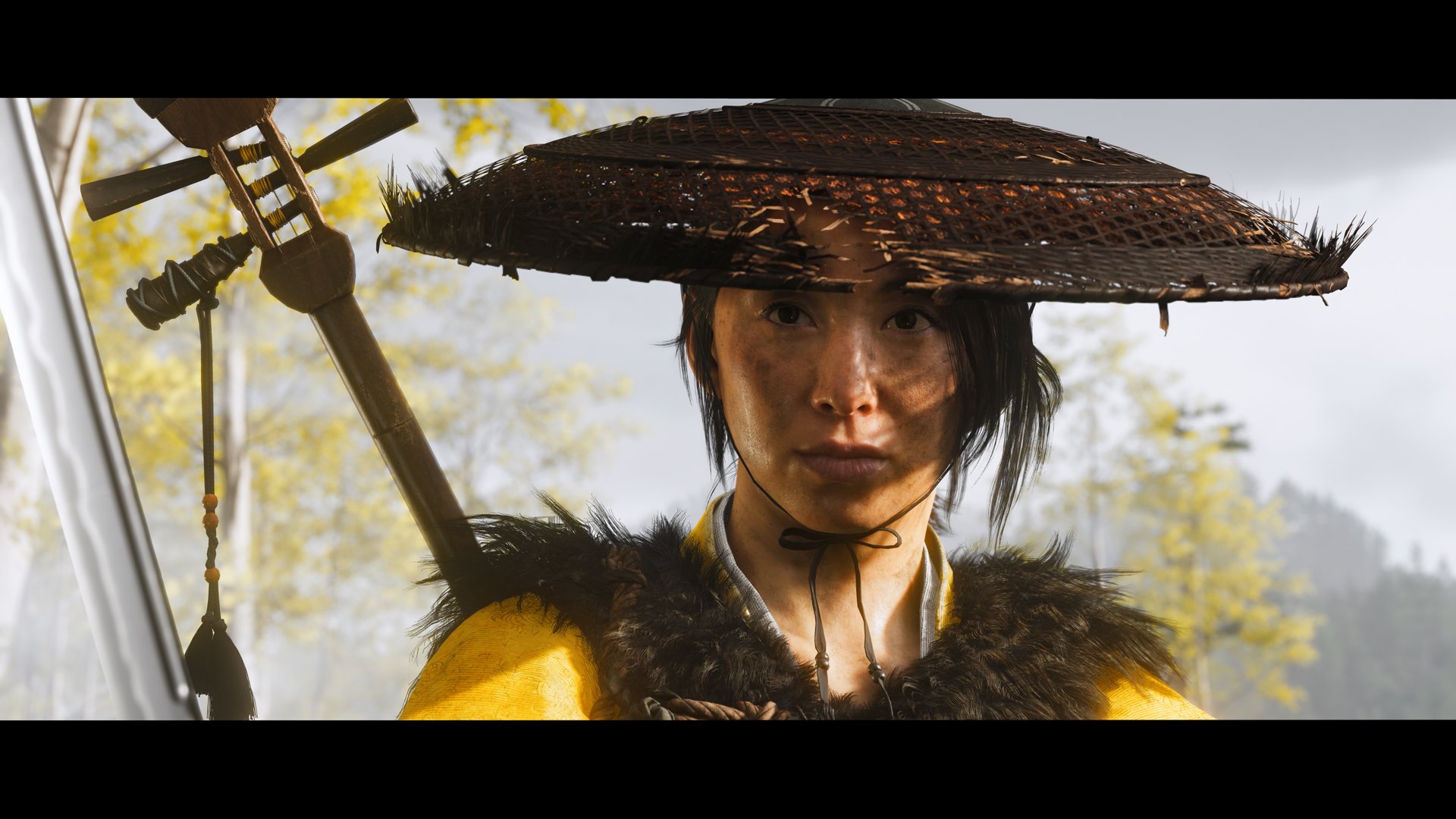
As players track down their various objectives and aren’t spending time using the controller for mini-games, they will be taking part in Ghost of Yotei’s most refined feature, its combat. For the most part the combat remains as fluid as fans can expect with each impact of the blades clashing together, slashes through enemies, and parried attacks feeling as intense as possible and the feeling of such a fluid combat system while attacking, parrying, and even using abilities remains solid throughout the game, but there are now a number of new tools that Atsu brings to the table and one of these replaces another element from the first game. Rather than having stances like Jin, Atsu is a trained mercenary and the farthest thing from an honorable samurai. As such she may wield her katana primarily but will also obtain multiple weapon types that she will wield instead, including dual katanas, the sickle-and-chain kusarigama, an odachi, and a yari (spear).
Each of these weapons have their own type of weapon that they are stronger against, with dual katanas outperforming spears and the kusarigama allowing for long-range assassinations and crowd-control. It is entirely possible to use weapons against an enemy that may be wielding the counter to the player’s gear, the fight will just be a bit harder as a result. Of course, Atsu isn’t afraid of a few “cheats” in fights either as players can unlock “quickfire” items that can be used at the tap of the button and range from throwing sand into an enemy’s eyes, igniting her weapon, and more. In fact, Atsu can even wield different kinds of bows and arrows to take out foes from a distance or eliminate a fleeing foe to put them down for good and, since time has jumped forward a few hundred years, players will eventually even gain access to a powerful, albeit slow loading, matchlock rifle and pistol.

Swapping between melee weapons and even ranged weapons can be done on the fly even in the middle of combat, allowing for players to keep themselves active and moving, even if the controls are a bit overwhelming at times, especially since for whatever reason the development team thought players needed a dedicated photo mode button rather than using it for any other aspect of gameplay. This may be a complaint of my own, but it is worth noting that since picking up items, mounting Atsu’s horse, or even interacting with people or things are all done with the same button as the weapon swap, meaning players may easily find themselves stuck trying in a weapon swap rather than interacting with the world like they intend.
Audio & Visuals
If there was anything that you can say about a Sucker Punch game is that they know how to make an absolutely gorgeous and varied environment. Ghost of Yotei is an outstanding example of how a game can offer a wide variety of vistas for players to explore even while traveling through the same biome. The plains players start in with Atsu are filled with fields of different kinds of vibrant flowers and battling against enemy bandits or ronin in these fields is a sight to behold. This doesn’t even touch upon the other different locations of Ezo that each feature their own wildly unique designs compared to the starting area, making sure to keep things varied for players throughout the game.

The character animations in combat are handled perfectly for Atsu, who is a smaller warrior and this is highlighted by how some of her finishing strikes rely on her either needing to step through to drag her sword through a foe or even roll over their corpse to withdraw her blade and face off against her next target. This type of squirting blood and muddy mess can be heightened even further by turning on various visual modes such as Miike mode that tightens the camera for more intense feeling fights and messier combat, making things a bit harder but far more impressive looking. Thankfully the “cinematic” bars can be removed by clicking R3 which is a personal recommendation even if it might heighten some of the more intense boss duels.
It is interesting to note that a lot of attention has been paid to making sure that various elements of Atsu’s equipment are all customizable in one way or another. Upgrading her armor will add additional pieces to every set and while some unlock various headbands and masks they can be removed just as easily. Everything can be dyed in various color patterns as well though players will need to trade “flowers” to merchants for that. Weapon kits allow for Atsu to adjust the way her weaponry looks, all giving players an extra level of customization far beyond what many may expect.

The title releases with both the Japanese voice track as well as the English voice track for those who want to use it and it is nice to note that the lip synching does appear to have been adjusted depending on the dub being used. That being said, while the English voice cast does a mostly solid job with their roles here, including Atsu’s adult voice actress, there are some members of the English cast that sound shockingly terrible, especially Atsu’s child-voice that is so incredibly off-base that it removes all immersion from flashback scenes. Thankfully the Japanese voice cast avoids these issues and also fits into the theme and setting of the game perfectly. As for the soundtrack, Ghost of Yotei offers an impressive array of thematic tracks that work both for the time period and for the more intense larger scale battles that break out throughout the story. There is even an additional soundtrack players can choose to turn on if they want a hip-hop style that’ll flow to combat, though we found it took away a bit from the experience.
Overall
Ghost of Yotei manages to build on its predecessor by expanding its open world elements and offering just as intuitive combat with plenty of modifications to keep the intense free flowing combat as fresh as ever. Unfortunately the by-the-numbers revenge storyline that slowly falls apart is only held together by the strong side-quests and few major twists that happen throughout Atsu’s journey through the gorgeous lands of Ezo, making this an open world action game that certainly lives up to expectations but won’t surpass them.
Capsule Computers review guidelines can be found here.

