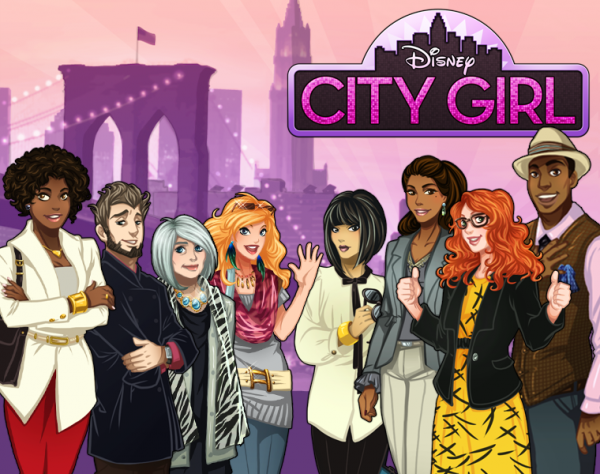
Disney City Girl is Disney Social Games’ new foray into Facebook games aimed at girls. They will have a chance to move their virtual avatars into New York City and start climbing the corporate ladder in a variety of jobs such as fashion designer and chef while they create chic outfits and design their apartments. Daily Look fashion competitions happy daily where users can vote on their favourite looks and earn points. The game features high quality 3d graphics for a realistic look.
Check out screenshots and the official trailer of Disney City Girl below. Play at Facebook hereor at Playdom here.
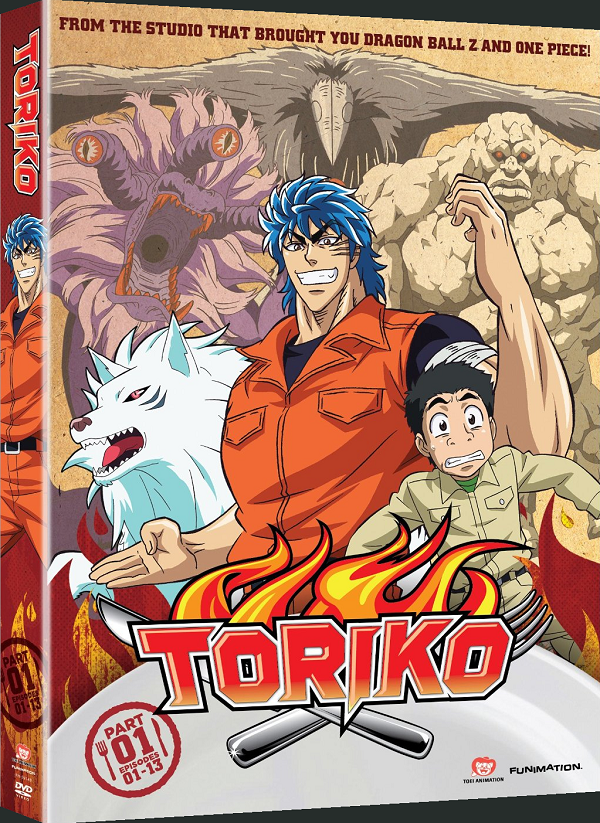
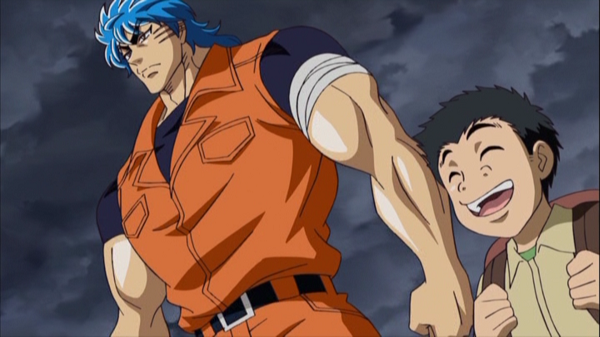
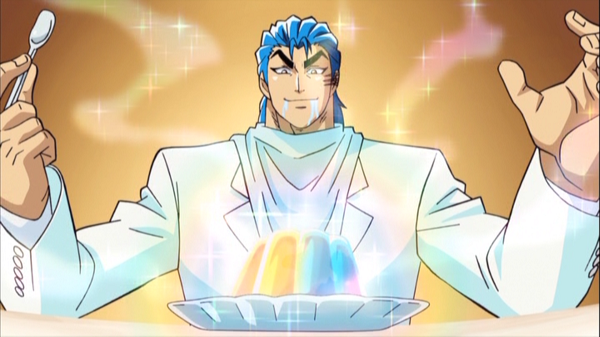
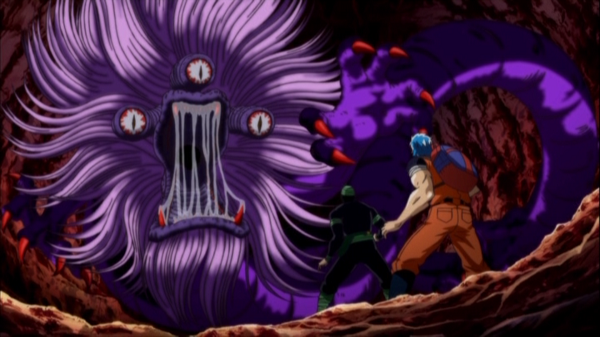
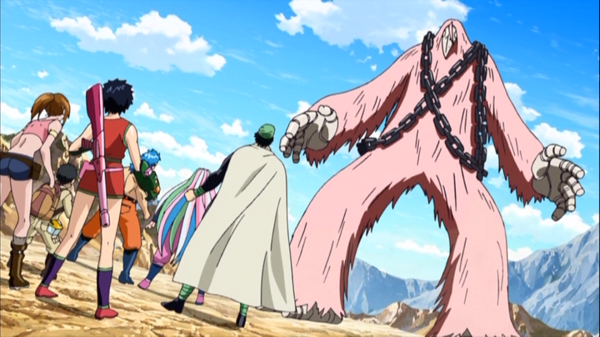
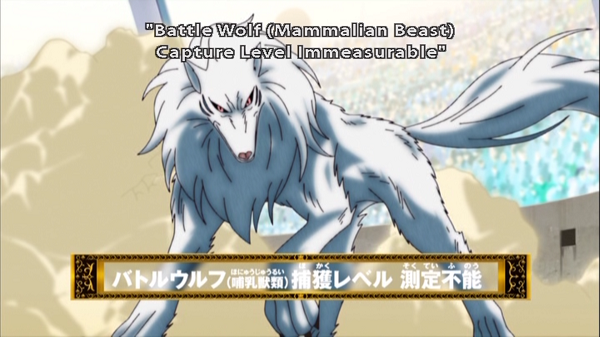
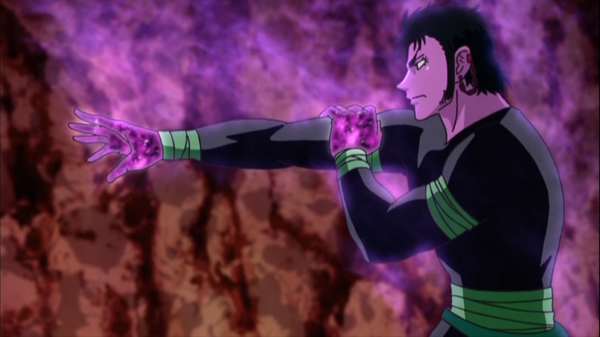
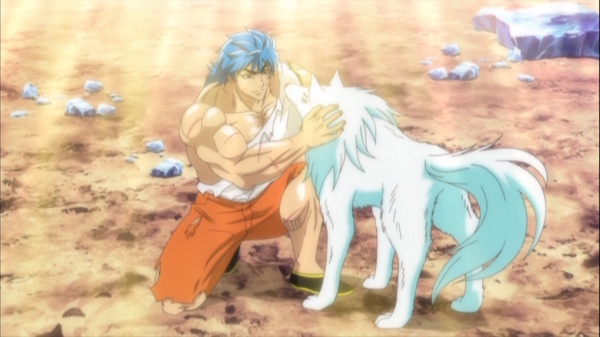
Toriko: Part 1 Studio: Toei Animation Publisher:FUNimation Format:DVD Release Date:January 22, 2013 Price: $39.98 – Available Here
Overview: The anime world is full of famous names that have worked on iconic series and sometimes it just so happens that every so often, a whole studio is recognized for greatness thanks to the series that they have produced in the past. As such when it was revealed that Toei would be handling the anime adaptation of Toriko, a rather unique take on the action and shōnen genre, many people were very excited to see how the popular manga would look in animated form. Thanks to this and the record of shōnen series in the West, FUNimation has brought Toriko over to the West. Now… will Toriko: Part 1 leave viewers drooling for more?
Story: The world of Toriko is something many of us have only dreamt of. In this world, the only conflict that ever seems to arise is over food, but not due to starvation. No these confrontations revolve around hunters taking down humongous exotic animals for the meat in their bodies. You see… Toriko takes place during the Gourmet Age where the entire world is full of wonders such as cheeseburger flowers, mystical fruits that contain seven wondrous flavors and some of the most dangerous creatures you will ever lay eyes on.
In the Gourmet Age, only the strongest and hungriest of fighters can obtain the rarest ingredients around and these people are known as Gourmet Hunters. Among these Gourmet Hunters there are four hunters known as “Heavenly Kings.” These hunters are known throughout the world for discovering the most ingredients and taking down the toughest creatures, as such when someone wants to obtain a rare ingredient, these hunters take to the scene, not because of the task at hand, but to fill their bellies full of succulent meats and track down the best tasting food in the world so they can complete their life-long journey… create a rare full-course meal consisting of the best food the world has to offer.
In a world full of hunters, rare ingredients and monstrous creatures, there are still those who have to properly prepare and cook these ingredients into delectable morsels. One such starting chef named Komatsu is tasked with tracking down a rare ingredient and ultimately seeks out the man who has discovered the most ingredients in the world, the Heavenly King Toriko, to help him out.
After working so well together, Toriko becomes quick friends with Komatsu and much of Part 1 follows the journeys of Toriko and Komatsu as they venture through a strange land and take down a beast desired for its rare meat. As such, the better part of Part 1 is something of a creature-of-the-week series with hints at a plot moving behind the scenes.
A little more than halfway through part one however, viewers are treated to some further plot development as the illustrious world of Toriko isn’t just sweets and monsters to defeat, there are also organizations attempting to gather rare ingredients for nefarious means. At the same time this organization, known as the Gourmet Corps, lead Toriko and his friends into the first actual story arc of the series so far, which ultimately is left to continue in part two.
Considering the fact that nearly every shōnen series mostly focuses on combat that takes place between two human or human-like fighters, it is rather interesting to see how Toriko and the rest of the fighting characters in the series take on many of the beasts that they face down. It is also worth noting that while there is zero character development within this first part, the show is not without dramatic moments and explanation of each character’s ideals.
As for the characters themselves, Toriko: Part 1 introduces a large number of the re-occurring cast throughout these first thirteen episodes and although none of them receive anything in the way of character development throughout this first release, viewers will find that the characters presented in Toriko are rather unique both personality wise and diversity. While there are certainly standard overpowering characters, Toriko keeps things fresh by also featuring plenty of weaker characters that continue to travel alongside Toriko and the rest despite the danger so that they can reach their final goal.
Ultimately, Part 1 of Toriko does a decent job laying the groundwork for the cast’s abilities and challenging them, however the actual plot begins to develop far too late into this first release and barely any character development occurs. Plus, because the series focuses on revealing already obtained powers or ridiculous overpowering of characters, nearly every fight lacks the tension and drama of a close-fought victory.
Visuals: One of the first things that will strike viewers is how bright and colorful everything in the world of Toriko looks. Every piece of food or rare ingredient is given a unique design and often looks quite delicious, especially when the designs are worked into the environment. The same can be said for some of the monsters the gang comes across, as many of them appear similar to animals similar to those found in the normal world, but with monstrous additions or size added to their already intimidating frame.
As for the character design, the Legendary Kings, such as Toriko and those revealed later in the release all are well designed for the most part. However it is clear throughout Part 1 that Toei took many short cuts with the series’ animation, especially when it comes to trying to keep the character design quality consistent. Quite often character designs will suffer significant drops in quality for any mid-range or group shots. It is also worth noting that the aforementioned monster designs begin to undergo whatwe call in videogames, palette swaping, which is basically taking a monster design, changing the color and releasing it as a new creature.
Audio: As standard with a FUNimation release, Toriko: Part 1 features both the original Japanese voice track as well as the newly recorded English dub. The English voice cast this time around actually consists of a few newer voice actors, but a large number of lead roles are filled with veteran voice actors. Toriko and Komatsu are voiced by veterans Ian Sinclair and Josh Grelle respectively and these two have some of the best chemistry together that you can ask for in a series such as this. Their voice work, and most of the voice work overall, is over-the-top at times but this actually manages to fit the fact that nearly everything in the series is over-the-top in one way or another, what with super-muscled fighters taking on gigantic creatures in an effort to obtain the rarest ingredients in the world.
Unfortunately Toriko’s background music can be simply seen as forgetful. In fact, while viewers may remember that there was music playing through certain fights, the background music falls into you’re standard generic shōnen type of songs. As for the title’s opening theme in this first half, we have “Gatsu Gatsu!” by Akira Kushida which opens things in a rather bad-ass way that highlights that the show you’re about to watch is about food and kicking monster butt. As for the ending theme, we have “Satisfaction” by F.T. Island which feels like a rather sub-par closing song for a series as over-the-top as Toriko is.
Extra: With the release of Toriko: Part 1, we have find a rather standard offering of bonus features which feature a clean version of both the opening and ending song, trailers for other FUNimation releases as well as the US trailer for the anime. Finally there are two episode commentaries provided with this release, one for episode one and the second for episode nine.
Episode one’s commentary features Ian Sinclair who voices Toriko and Josh Grelle who is the voice of Komatsu. Within this commentary we learn why these two voice actors have such great chemistry together and also about their food habits as they both reveal that they are actually foodies that have created their own personal full course menu of real life food. It is worth noting that the commentary does not follow the episode at all, but the chemistry and hilarity of these two put together makes up for that fact.
Ian Sinclair returns again for the episode nine commentary and this time he is joined by Leah Clark who voices Rin and the newcomer Aaron Roberts who voices Sunny. Aaron is one of the new voice actors mentioned earlier in the review and his portrayal of Sunny’s unique personality fits the character model and personality well. The commentary focuses more on the episode on the other, but the three continue to talk about food and how they enjoy certain types of food. The group also reveals how they managed to sound like they were eating during parts where their characters’ mouths were full.
Overall: Toriko: Part 1’s main course is the fact that these over-the-top Gourmets are taking down even crazier looking creatures simply to eat them. Unfortunately this main course is hindered by some rather sub-par animation and a storyline that feels like an unsatisfying appetizer that only becomes truly flavorful when you’ve already consumed half of it. Still, as an shōnen anime, Toriko is bursting with potential for greatness. Whether it will find that greatness has yet to be seen, but for now Toriko: Part 1 may not be worth including in your full-course anime meal.
Capsule Computers review guidelines can be found here.
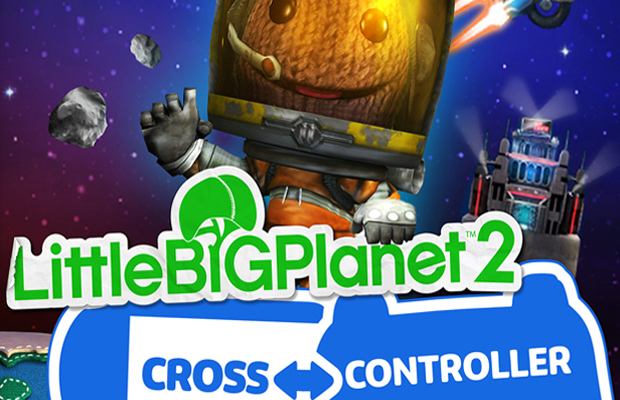
Little Big Planet 2 Cross Controller Pack Developer: Sumo Digital Publisher: Sony Platform : PlayStation Vita and PlayStation 3 Release Date: 19 December 2013 Price: $4.99
Overview
Sony leaps on to the dual screen bandwagon with the Little Big Planet 2 Cross Controller Pack. The DLC allows fans of Craftworld and Sackboy to use their PlayStation Vita as a controller for Little Big Planet 2, bringing with that basic functionality a bunch of new levels and creator tools. Obviously a Vita and a copy of Little Big Planet 2 are needed for the DLC to function.
With the recently released Wii U and Microsoft’s Smartglass, two screen gaming is the new motion control, so how does Sony’s effort fare?
Gameplay
As neat as the concept of Vita control may be the same certainly can’t be said for getting everything to work first time around. After downloading onto each system there will no doubt be some copious updating to slog through especially, if like me, you haven’t played the now 2 year old LBP2 for a while. Nineteen updates later and things are finally ready to roll, or are they?
Eventually you can select Cross controller from your LBP2 pod, and find it under ‘Remote Play’ on the Vita. Ready to play yet? ANOTHER download strikes, but thankfully it is the last. Forewarned is forearmed – setting this up may take a while!
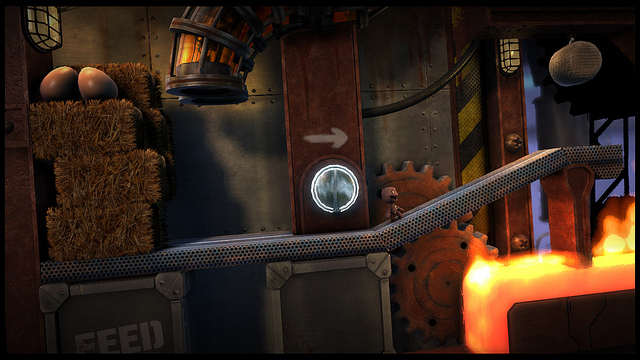
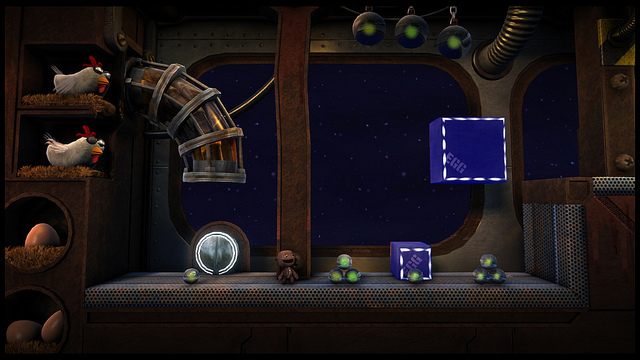
Six new levels by Sumo Digital ping into life complete in the usual Little Big Planet style. The plot sees a space faring Sackboy crash into a prison, accidentally setting off the escape plan of a bunch of space pirates. The pirates (who are very Metal Gear Solid in appearance for some reason) need Sackboy’s help to escape the evil Governor and steal a treasure map before heading off.
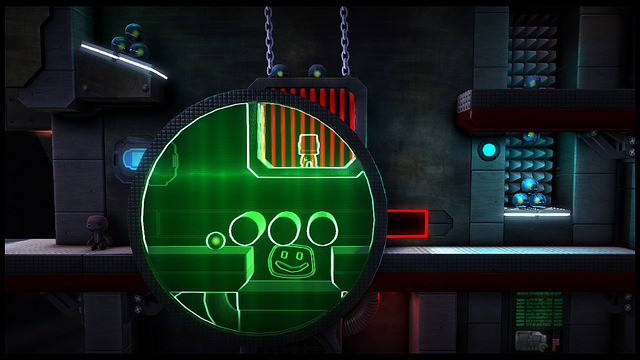
A voice from the Vita tells you that a blue flashing icon on screen signals that the Vita will be of some help in your quest. Using the touch screen reveals hidden dangers in the levels, with an appropriate level of beeping to alert you to the need for the second screen. On the Vita is a very Tronesque presentation of the level with the dangers highlighted in red. Dragging your finger on the screen of the Vita moves a scope on the TV, revealing the hazards so that Sackboy or the pirates can negotiate past them.
This works impressively well, with no lag at all between the two systems. The Vita segments are for the most part simple enough that they can be done without looking at the handheld, and if you’ve got flexible enough fingers you can even try and control Sackboy simultaneously. I had a few occasions where the connection stopped for no apparent reason and lost me all level progress, and you certainly have to be careful when pausing to prevent the Vita from sleeping and severing the connection that way.
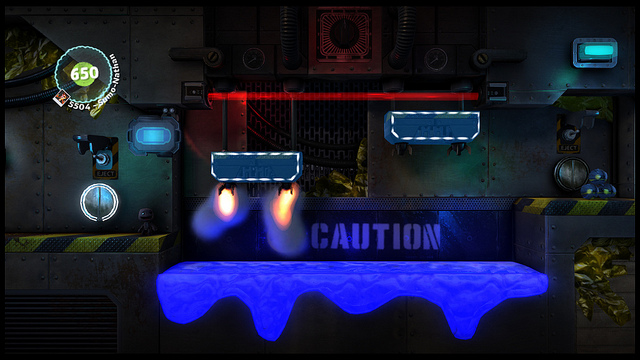
The levels are in the usual Little Big Planet Style, bringing along a heavy sci fi theme. The controls are as tight as ever and the challenge level is actually fairly high. There are even moments when the entirety of the action is transferred to the Vita screen, the first of which sees Sackboy traversing the outside of the prison ship in order to clear a route on the inside. Moments like this are a lot more worthy in multiplayer, where teamwork becomes a crucial part of the game and also allows for a lot more of the usual hijinks the series play style is somewhat synonymous with.
Fans of the series who have delved into the creation side of the game will be happy to know that the DLC also provides new content for their exploits. As ever some of the more complex gameplay mechanics (like getting Sackboy to hop between the PlayStation 3 and the Vita) take a lot of time and practice to pull off. The community for Little Big Planet has already produced some dazzling user generated content so no doubt these new tools will quickly give rise to even more mini masterpieces of level design.
As a whole the package is an extremely impressive demonstration of what the PlayStation 3 and PlayStation Vita are capable of when they work together. Sony prove that they are more than ready to take the leap into the dual screen era, and hopefully more robust uses of the technique are set to follow. Of course this is all dependent on the Vita’s success, as any emphasis on cross controlling in a new game is likely to set teeth on edge for those who haven’t forked out for the handheld.
Audio & Visual
Stylistically the DLC pack is what players have come to expect from Little Big Planet – a quirky cartoon style covering some strong level design and a good dose of imagination. Even the few tutorials that are included to explain the new creation features are given the usual voice over by Stephen Fry, a clear indication that even the smallest DLC pack still gets the level of polish that has come to be expected from the series.
Overall
Apart from a few reliability problems and the initial investment of time to get the thing up and running, the Cross Control Pack is a praiseworthy piece of DLC. It is reasonably priced, brings with it an entirely new gameplay mechanic and six new levels to test it out in. As ever creators will get the most out of the new tools on offer, but fans of the platforming can still get their mits on new costumes and collectibles.
We’ll pick the lucky winners on the 8th of February, so you have a roughly 3 weeks to enter. Please note that the film will be screening inselect Hoyts cinemas and as such, you should consider whether your local cinema will screen it before entering as we will not be able to cover travel expenses for winners. Also make sure you leave a valid email when you post your comment so we can email you if you win.
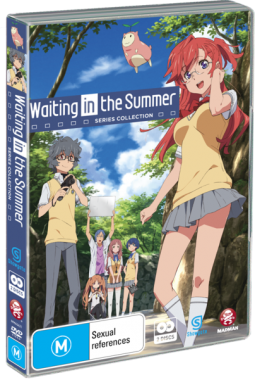
Waiting in the Summer Studio: J.C. Staff Publisher: Madman Entertainment Format: DVD (Subtitles Only) Release Date: January 9, 2013 Price: $59.95 – Available Here
Overview: Waiting in the Summer otherwise known by its Japanese title of Ano Natsu de Matteru is an exquisite look at teenage life and all the feelings and experiences that accompany it. What is it about our teen years that cause them to stay with us, even while childhood and adulthood can become a blur? Why do we look back on that time with nostalgic eyes, whether the memories are good or bad? Perhaps it’s because there is no other time in life when a revolution takes place inside you, a time in which you change so dramatically both physically and mentally. We all spent youthful summers under a blistering sun, that revolution we all know, its universal. We’ve all been waiting in the summer, for something unforgettable.
Story: This is anime that isn’t so much about something as it is about a feeling. That time of youth that almost everyone watching this series should be able to relate to, whether they have experienced it or are experiencing it right now. At its core Waiting in the Summer is a coming of age story, but it is all the layers on top of it that make this series special.
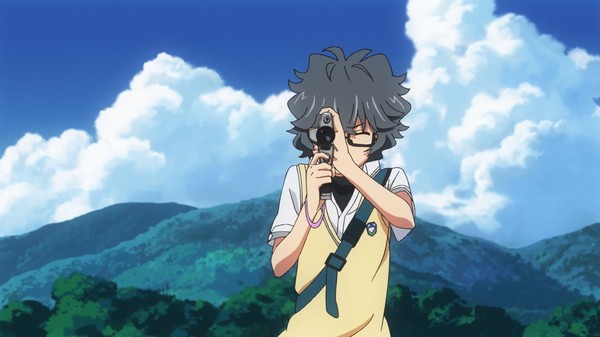
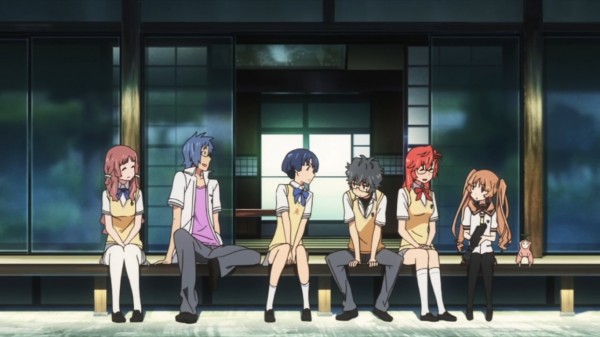
Waiting in the Summer follows budding film maker Kaito Kirishima and a group of his friends as they spend the summer trying to make a movie. A lot of the series focuses on their film making efforts but it is the complex string of relationships between these characters that is the real focal point. The cast is well realised and each character has a certain relationship with one another, each different and completely unique to their connections with the others. This tangled web of characters and their feelings is plucked at like a harp over the course of 11 episodes often to great emotional effect.
Whether it is love, friendship, family or the more bizarre of circumstances, the interactions and connections forged between this cast is as strong as they get and it is delightful to see that proverbial harp being played as these characters go back and forth with their lives playing out on and off camera.
Despite the fact that most of its runtime is firmly grounded in reality, there are some extraordinary aspects that while feeling somewhat out of place do completely fit with the tone and message of the story. The majority of this extraordinary comes from an extra-terrestrial girl by the name of Ichika, someone whom Kirishima relates to on a level that perhaps he doesn’t even understand. She is an alien and in many ways he feels like one. He is an outsider, has never met anyone like himself, existing on the fringes, at least in his own head. This bond they form ultimately leads to an incredible finale that you’d never see coming.
Waiting in the Summer ultimately is a journey down memory lane, one of nostalgic delight. It is evident that director Tatsuyuki Nagai wants to capture those moments, those feelings. Loneliness, big dreams, discovering the opposite sex, maturing, forming friendships, loss, first love, unrequited love and all that lies in between, these are the experiences that Waiting in the Summer looks back on through that affectionate lens. It’s a time many wish they could return to and for 11 episodes Waiting in the Summer lets you, even if its fleeting, you’ll feel it.
Visuals and Audio: J.C Staff have produced some beautiful visuals in the past but it is hard to go passed their effort here in Waiting for the Summer. Whether it is the beautiful Japanese country landscapes or the gorgeous character designs, there is so much aesthetic brilliance in this series that it cannot be denied that J.C Staff have truly created something breath-taking, artistic even. It’s easy to get lost in the jaw-dropping scenery of this series, with a great amount of detail and affection put into creating this world, which in and of itself is simply astonishing.
Not only is Waiting in the Summer amazing visually it features an excellent soundtrack composed with great care, showing a significant level of attention that clearly went into its composition. On top of that the opening and ending theme songs are both quality tracks that set the tone perfectly.
Extras: Undoubtedly it is great to see this release fast-tracked for Australian shores and Madman have done an admirable job with it by bringing it out roughly a year after it aired in Japan. While there isn’t a great deal of bonus content on this release instead opting for their usual textless opening and ending themes alongside some trailers, the content itself is good enough to warrant a release despite the lack of extras. It is worth noting however that this collection does not feature an English dub which could be a deal breaker for some, but believe me when I say that this series is worth the price of admission even without one. Regardless the quality of the Japanese voice cast and their performance is phenomenal in its own right.
Overall: It isn’t very often that a series such as Waiting in the Summer comes along. It’s a poignant reminder of youth that intimately follows the relationships and feelings of a group of teens over the course of one unforgettable summer. Stories like this will always connect with people, because it captures a time, a place and a spirit that everyone can relate to in one way or another. We all feel that revolution of youth at one point in our lives and that is what makes series like Waiting in the Summer so successful, because they touch viewers on a personal level and evoke a nostalgia that few other things can. Waiting in the Summer is a brilliant anime from start to finish and much like that titular summer and perhaps even the many summers that you have experienced, it is unforgettable.
Capsule Computers review guidelines can be found here.
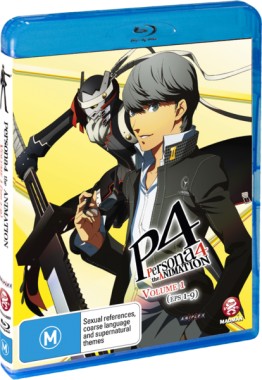
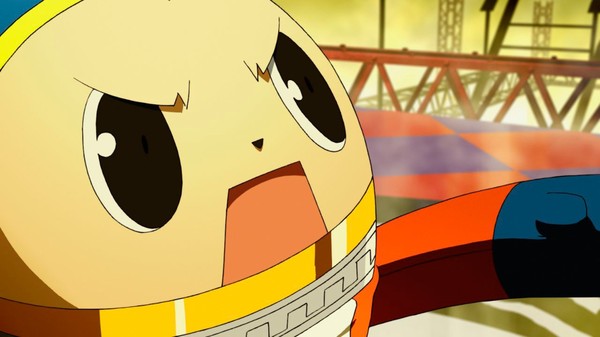
Persona 4 Animation Volume 1 Studio: AIC ASTA Publisher: Madman Entertainment Format: DVD, Blu-Ray (Reviewed) Release Date:January 9, 2013 Price:$39.95 – Available Here
Overview: What makes for a good adaptation? How does one bend one medium into another? Persona 4: The Animation asks this question to its audience, albeit complete unintentionally. It takes a popular video-game and simply reproduces it as an anime series, this isn’t so much an anime as it is a game without interactivity. So really now the big question is; does it work?
Story: The answer is no. Persona 4: The Animation isn’t necessary bad, but as an anime series it just doesn’t quite work. For starters the biggest failure with this series is the fact that it relies on the audience having had played the game upon which it is based to really fill in the pieces, seemingly skipping a number of crucial story-telling steps. This over-reliance on the audience have prior knowledge of the material is an error that can come with adapting material such as this.
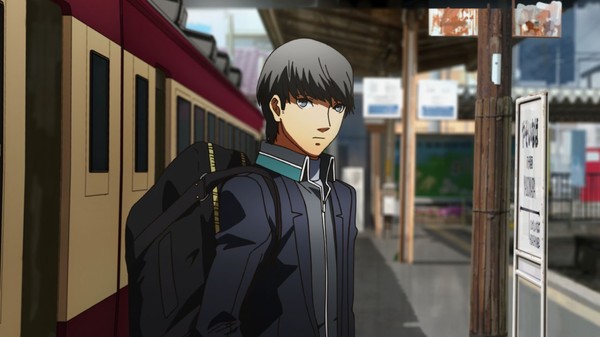
That isn’t the end of it though, the hero of the series appropriately named Yu, serves as the players avatar in the game, here he is nothing but a blank face that utters a few lines here and there seemingly devoid of any emotion or thought. It is rather ironic that for a series called Persona the protagonist seems to have nothing even close to resembling a personality. While this works in a game, it does not work at all in an anime series. In a game you can escape into this character and they become you. However in anime form such interaction doesn’t exist, anime just isn’t an interactive medium.
Problematic as all that may be it still is not all there is. Perhaps the most significant factor of why Persona 4 doesn’t work as an anime is the fact that it is just so painfully monotonous and at times just downright boring. The reasoning for this is simple, most of what we see feels like a collection of cut scenes surrounding gameplay with the actual playing aspect removed entirely, leaving nothing but cut scenes the sloppily play out one by one. The real heart of a game is how it plays, after all games are reliant on interactivity to work, anime doesn’t work in the same way. As you can imagine if you take the game out of a game there isn’t much left over and such is the result of Persona 4: The Animation, an anime series so depressingly void of any kind of life.
Without a doubt, Persona 4: The Animation is not recommended for the uninitiated, though fans of the game would undoubtedly get a real kick out of seeing things in anime form, even if it isn’t too greatly different from what they have played in the past. This really is a series reserved for the initiated.
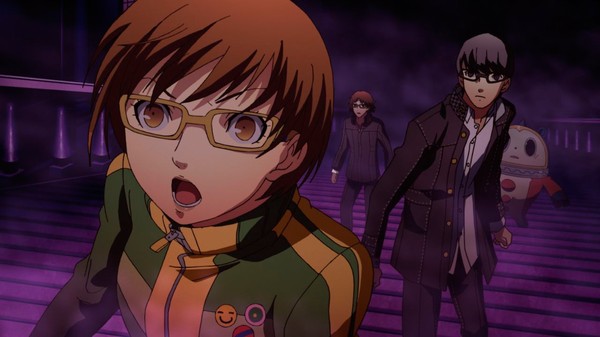
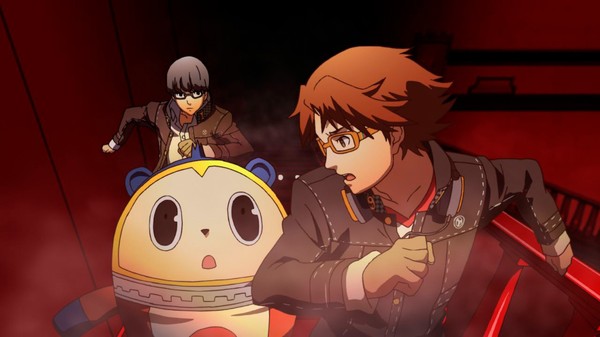
Visuals and Audio: While Persona 4: The Animation doesn’t hold up well in terms of plot it does feature some of the most awe-inspiring visuals in recent memory. The array of colours and fluidity to the shows proceedings is simply remarkable and a sight to truly behold. The character designs are well conceived albeit at times forgettable, but they feel decidedly at home with the world of Persona 4, both in its gloomy gray areas and flamboyant splash of colour that stand in juxtaposition to one another.
The soundtrack for this series is another real highlight. In fact this OST is almost too good for the content it is backing. I’m more the certain the majority of it is lifted directly from the game, much like seemingly everything else was. Regardless it does a great job supporting the action on screen. In terms of voice acting, the English dub for the anime is fairly average. There is a lot of wooden acting and awkward delivery, making for some strange viewing. It does the job however and that is about the best compliment I can give this dub.
Extras: Madman have done an impressive job with this release in terms of bonus content, however where they have left the product down is the inexplicable episode count comparison of the Blu-Ray to the DVD release of volume 1. Why does the Blu-Ray only have 9 episodes while the DVD has 12? Aren’t Blu-Rays meant to hold more data? I found this absolutely peculiar and to be honest rather disappointing. Despite that there are some decent extras on this Blu-Ray release such as the directors cut of Episode 1, textless themes, a special drama called ‘Jikken-Kun’, Japanese commentaries and of course trailers. Its a decent amount of bonus content, but the difference in episode count is really quite puzzling and leads me to recommend the DVD over the Blu-Ray for content alone.
Overall: Persona 4: The Animation is an adaptation that ultimately bound itself too strongly to its source material resulting in what can only be described as a grand mistake. This was not a game that should have been so literally transferred into anime form, it needed to be bent into the shape of an anime, not forced into it.
One could make a case that this is not an anime series for those who aren’t Persona 4 fans, but I will claim on the contrary that catering to such a small quantity of people is never a good idea as it leaves many on the outside. A great anime would invite all viewers into the fold, Persona 4 however keeps them at a distance for fear of having to actually explain things to those who don’t already know what is coming.
While Madman has done a decent job with this release, the Blu-Ray version is undoubtedly lacking comparatively with the DVD release in terms of content. Although the Blu-Ray is priced cheaper than the DVD, for those who would rather not wait for episodes, the DVD is the best option. If you are a Persona 4 fans, this might be something you’d like to add to your collection, however it is not recommended to those without any prior knowledge of the franchise as this is not a series that takes kindly to those new to it, which is a shame to say the very least. This had to potential to be a brilliant series given its excellent source material, but it isn’t, because it didn’t care to be anything other than a cheap aborted version of Persona 4.
Persona 4: The Animation is an anime severely lacking in one crucial thing – Ambition.
Capsule Computers review guidelines can be found here.
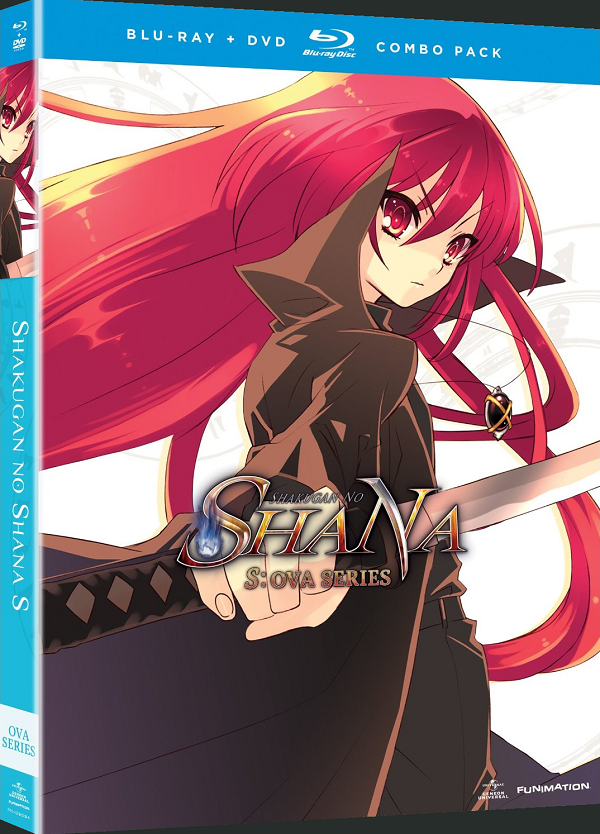
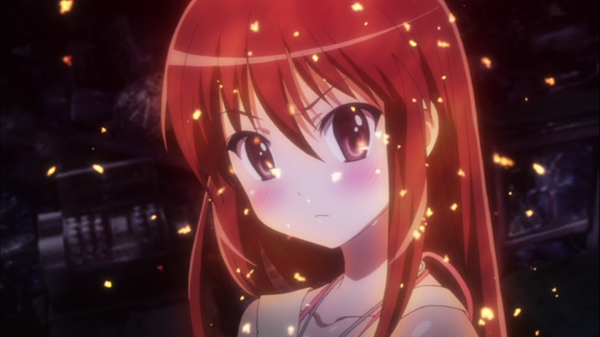
Shakugan no Shana S Studio: J.C. Staff Publisher: FUNimation Format:Blu-ray/DVD Combo Pack Release Date: January 22, 2013 Price: $34.98 – Available Here
Overview: Whenever there is a large enough gap in-between releases of any media, it is should be expected that publishers may be concerned that fans may start to wander away from the series. This is especially true when it comes to the anime world where many alternative programs air as competition every four months. As such, a three year gap between anime seasons could be devastating. To avoid this issue, J.C. Staff chose to create another release of Shakugan no Shana, called Shakugan no Shana S between seasons 2 and 3. Now that FUNimation has brought this OVA collection overseas, is it worth your time? Let’s find out.
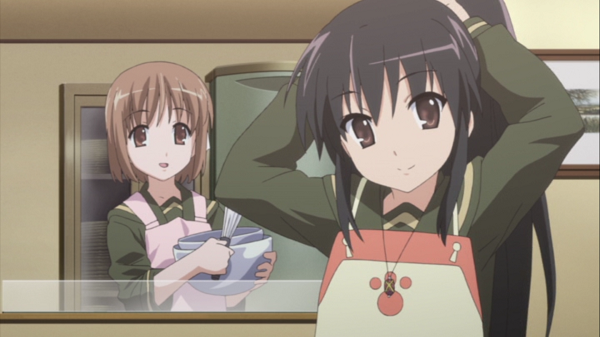
Story: As I mentioned earlier, the Shakugan no Shana S series is an OVA series. What this means is that the four episodes found on this release are actually short side-stories based off the Shana universe. As such, of these four OVAs only the two “Overture” episodes follow an actual plot while the other two simply follow the life of Yuji and Shana when Denizens or Crimson Lords aren’t breathing down their necks.
The first of these OVAs finds Shana and Yuji sifting through the massive collection of treasure tools that Friagne happened to gather in his life time. While sorting through these treasures, a special tool called Reshuffle activates and Shana and Yuji’s bodies are swapped. After learning about their situation, the two must try and fix the situation, however doing so may be harder than they think. This OVA follows plenty of gender/body-swapping clichés where these two must try to act like one another and also deal with being in the opposite sex’s body. This results in plenty of comedic and awkward moments and some mild development for Shana.
As for the second OVA, we find Wilhelmina concerned over Shana’s strange secrecy lately and after coming to her wits end, she enlists the help of the person she dislikes most, Yuji, to try and figure out what Shana may be up to. This time around we see Wilhelmina taking the spotlight alongside Yuji and it is certainly interesting seeing these two have to interact closely for once.
Finally the last two OVAs tell one complete story where viewers see Shana hunting down a Denizen in the recent past. This is before Shana ever met Yuji and therefore still features a cold personality. To get into the case, Shana rather horribly steals the life of a young girl who had become a Torch because of the Denizen and begins to track through her memories and close relations to find the culprit.
The story told within these two OVAs is hauntingly similar to what may have happened in the case of Yuji if only a few factors had been different. As we see Shana assume the role of this young girl who once had her whole life ahead of her, it is hard not to feel saddened by the loss of life and happiness of those around her. For in the end, viewers know the ultimate fate of a Torch and those around them, but even with this knowledge it is hard not to be emotional once everything is said and done.
Ultimately, Shakugan no Shana S feels like a miniature slice of what makes the Shana series enjoyable as a whole. Half of the offering focuses on slice-of-life events mixed with romantic comedy and the other half deals with mystery, a bit of action and plenty of drama. While there pretty much is no combat found within this release, this slice of Shana is certainly worth checking out as not only do fans receive more of the Shana and Yuji action they have come to expect, there is also an enjoyable story concerning Shana’s past. Thanks to this however, except for Wilhelmina all of the side-characters are pushed to the side for only bit-parts and at this point, only extremely well-versed viewers will understand the events in this release. Also it is worth noting that while the exact placing of each OVA in the story can be difficult to place, viewers are left with a clear transition and hint into the third and final season of Shakugan no Shana.
Visuals: Considering the fact that Shakugan no Shana S was originally released in Japan as an OVA series, each episode was released roughly four months after the previous one. As such J.C. Staff had plenty of time to make sure that these episodes came out with the best quality possible. The amount of attention paid throughout these OVAs is clear as not only are the visuals crisper, especially noticeable on Blu-ray, but they also feel more modernized and colorful.
While the first two anime seasons felt a bit rough around the edges whenever anything slice-of-life was focused on, the basic quality presented in Shakugan no Shana S remains quite high and improves greatly for dramatic sequences. While minimalistic in action, the overall attention to detail throughout these four OVAs is higher as the animation team appears to have avoided cutting corners in facial animations and other character details due to time constraints.
Audio: With the release of Shakugan no Shana S, as always, viewers can expect to find both the original Japanese voice track as well as the newly recorded English voice cast by FUNimation. Over the course of reviewing the past movie and complete second season of Shana, Josh Grelle’s voice work as Yuuji either has grown on my or he has found the proper way to get into the character as he seemed to fit well as Yuuji’s voice.
As for the rest of the cast, it was enjoyable hearing Carli Mosier’s Wilhelmina take a leading role this time around and of course, Cherami Leigh continues to impress as Shana’s voice actress. Also, special mention should go out to Josh and Cherami for their work with the character voices during the body-swapping incident.
The background music found throughout Shakugan no Shana S is more of the standard fair that viewers have heard throughout the series at this point and is suiting at best. Though the inserted song “Portamento” by Kawada played during a dramatic moment in the Overture arc hits hard. As far as the opening and ending go, both songs are once again performed by Kawada as the opening is titled “Prophecy” while the ending is titled “All in Good Time.” Compared to past themes, the opening theme feels a bit out of place but suitable enough for dramatic reasons while the ending theme fits well.
Extras: As far as bonus features go, FUNimation has provided a small set of extras for Shakugan no Shana S. There is you’re standard textless opening and closing songs as well as trailers for other FUNimation releases but there are also four Shakugan no Shana-Tan specials, totaling roughly twenty five minutes long, found within this release.
If you’ve seen the Shakugan no Shana series before then you may already know what to expect, but for everyone else these Shana-Tan specials feature a chibi-miniature version of Shana going through certain parts of the story with more attitude than before and the rest of the main characters also are placed in strange situations. It is worth noting that these Shana-Tan specials only feature the Japanese dub and of the four, only one serves to provide a little bit of backstory, however it is mostly for comedic purpose as it focuses on Tanaka and Satou while the rest of the cast boos. With this collection of Shana-Tan bonuses nearly running the length of an entire episode, there are plenty of laughs to be had as these bonuses are downright hilarious at times.
Overall: Shakugan no Shana S feels like a proper title for this collection of OVAs, as the release feels like it could simply be called Shakugan no Shana Slice or Shakugan no Shana Sample. Viewers are treated to what could have been four standard episodes mixed into the standard Shana seasons, as we receive equal amount drama and mystery as well as romantic comedy and slice-of-life events. With the English voice cast hitting their stride with the Shana series, Shakugan no Shana S is a bundle of everything that makes Shana great. With the English voice cast hitting their stride and the finale on the way, the Shakugan no Shana S: OVA release couldn’t have done a better job reminding fans why they enjoy the series.
Capsule Computers review guidelines can be found here.
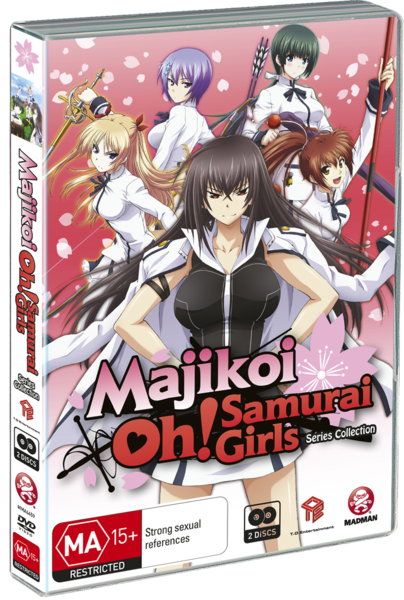
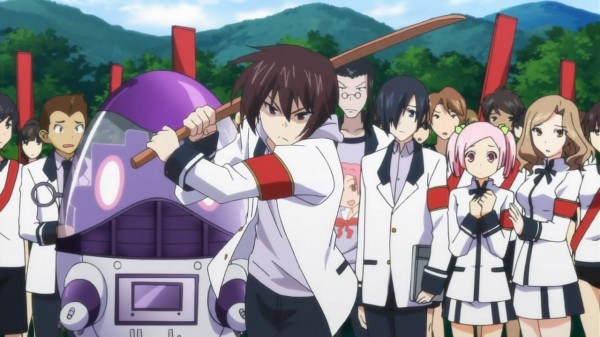
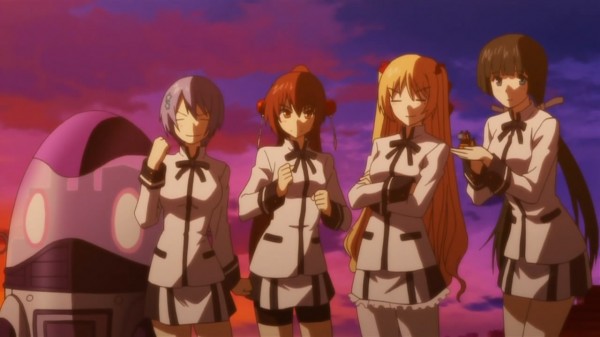
Majikoi Oh! Samurai Girls Studio:Lerche Publisher:Madman Format: DVD Release Date: Out Now Price: $59.95 (Buy Here)
Overview
An Eroge by the name of “Maji de Watashi ni Koi Shinasai!” was released by an adult developer over in Japan called Minato Soft. The title is translated as Seriously! Please Love Me in English, but the title in Japanese is cut down to Majikoi. Since then, the story has been adapted into an Anime series that is less risque (but still pretty risque) than the game was. This review follows the Anime adaptation and not the VN.
Read on for my thoughts.
Story
Maji de Watashi ni Koi Shinsai! follows the story of a group of students at the martial arts high school, The Kawakami Academy. These students are a group of girls and one guy named Yamato. Yamato is a guy that is really nothing too special in regards to fighting, in fact he is frequently attacked by his sensei (often incorrectly phrased as teacher, giving you this weird vibe throughout the show in the dub) in order to satiate her own fighting spirit. Even though this character is nothing too special outwardly, inwardly he is pretty cool. He has insane strategy skills and he has an alpha-as-heck personality that draws in all of the girls.
Yes, this is a harem Anime, with the main character being the man choice for every other girl in the story. And to be honest, the Harem aspect of this series is played through for 7 of 12 episodes until episode 8 comes along and the main storyline kicks in. And even then, it’s still harem-y. I don’t want to spoil the end, so you’ll have to watch to find out the choice that Yamato makes between the slutty girl, the shy girl, the lesbian girl and the foreign girl. I may be forgetting one…
The Eroge visual novel follows many different paths and while I haven’t played the game, I can only assume this Anime series follows one of the storylines, or has it’s own ending. Fortunately the Anime is hilarious and the storyline definitely benefits from this. The only issue I’d mention, like I did up there, is that the main story kicks in kind of late. I think it may have been better if they spread the comedy episodes between storyline episodes, but eh, it works this way.
Oh! There was that one other issue where a large emphasis is placed on how the school operates really early on, but is seemingly dropped or pushed into the background (like really far back) for the rest of the story. I would have loved to have seen more inter-school politics and wars, but that never happened.
Overall, for an Anime series adapted from an Adult Visual Novel, the story stands on its own just fine. While it is a little harem-y, it is still an hilarious watch from a story perspective. Things become a little heavy at the end, but the humour is still there.
Visuals
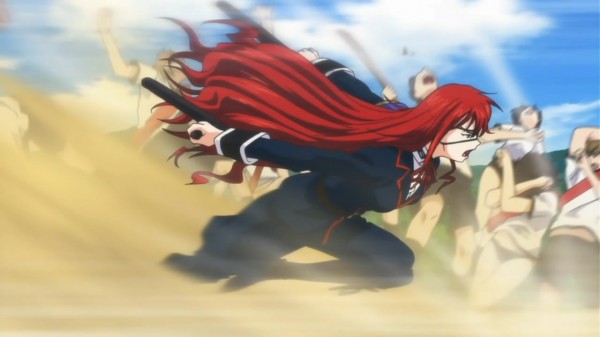
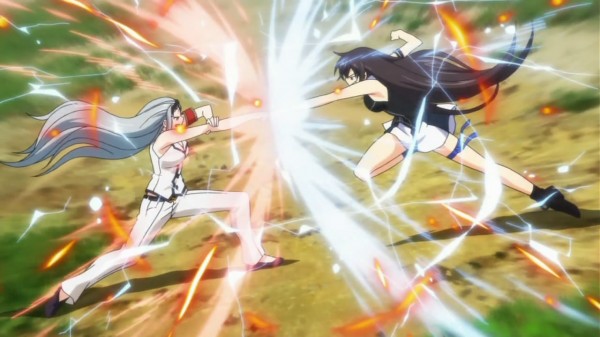
Visually speaking, Maji de Watashi ni Koi Shinsai! is quite hilarious. I think that with this series, it’s the visuals that really push the comedy elements forward and everything else exists to further the physical comedy within the show.
The best example of this is that one episode where the school is engaged in this festival celebrating what is essentially the male genitalia. Everything in that episode is a purely visual gag with supplementary audio work and story details. The town celebrates this appendage with various consumables, memorabilia and shrines crafted as giant “mushrooms” based on certain male models. And oh my god, that episode had every kind of visual gag you could think of. Small Mushrooms, girls suckling mushrooms, Loli holding mushroom making Lolicon almost die of bloodloss, and so many more that I can’t even go into detail with.
Trust me on this, if you’re watching Majikoi, you won’t be unentertained from a visual standpoint. Every episode is just a buildup of laughs after a buildup of laughs. The only reason you wouldn’t enjoy this show is if you don’t find low-brow humour hilarious. And really, who doesn’t find it at least a little funny?
This show also has a lot of the female anatomy on display throughout it. This is in-line with the shows background of being based on eroge novel, but it a lot more toned down in the Anime version. However, there are a bunch of hilariously perverse moments that you just can not help but laugh at the whole time. I could really use entire chunks of the Anime here as an example, but I’ll just point out a character to look forward to. The girl with the blue/purple hair. Keep your eyes on her. Hilarity ensues.
Audio
Maji de Watashi ni Koi Shinsai! has some of the most hilarious dialogue I’ve seen released on a licensed work in quite a while. Every joke is hilarious and even when the characters aren’t joking around, they’re usually doing or saying something that has an amazing comedic effect on the audience.
I particularly like the way characters interact with each other through the dialogue in this series. While each female character seems to only exist for Yamato, they all still seem to have a pretty decent relationship with each other, up until towards the end anyway. The one issue with the dialogue though is that the girls keep stating their attacks as they do them. I know that this is a trope of Anime and is probably a parody in this show, but it just doesn’t work for some reason.
The series also comes in both Japanese and English audio tracks. While I’m not entirely sure if the Japanese voice actors are the same as in the Visual Novel, they still sound pretty good. I have to admit though, that the English cast did a pretty good job of following the characters and had some pretty decent timing.
Extras
Majikoi has a bunch of extras that can be found on the second disc of the series as Special Features. These include a kind of recap like thing where the characters discuss the episode that corresponds with the track number, trailers, clean opening and closings and Japanese promotional videos. The cover also has some pretty nice artwork on the flip-side of the packaging. Umm… Maybe pretty nice is an understatement…
Overall
Majikoi Oh! Samurai Girls is an insanely hilarious series that any Anime fan will get a laugh out of. While it is not a quintessential Anime, or even one that would be regarded as important to watch, you would still be missing out by skipping this series. What would you be missing out on? Laughs. And really, what’s more important than laughter?
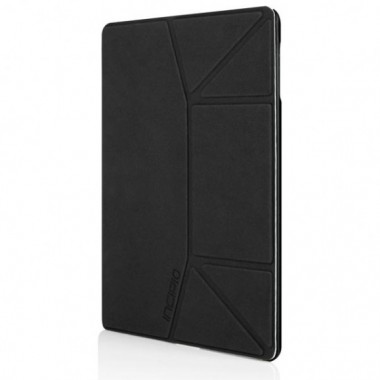
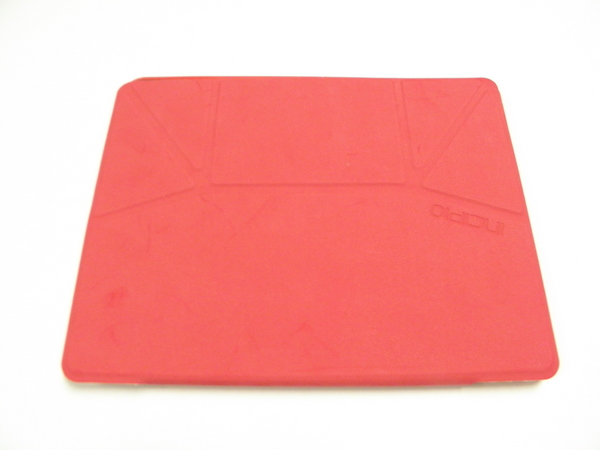
LGND Hard Shell Convertible Case Developer: Incipio Platforms: iPad 2-4 Price: $34.49 Get it Here
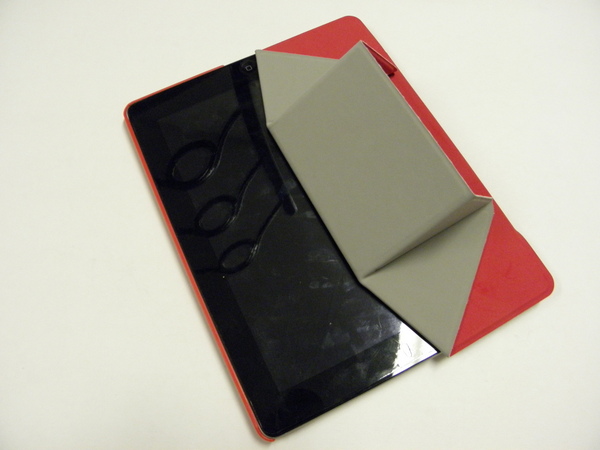
The LGND is a nubuck suede folio case with a hardshell back. It comes in four colours, red, pink, gray, and black. The case distinguishes itself from other folio cases with its unique origami style cover that provides a surface to prop the iPad up in two different viewing angles.
Installing the iPad into the LGND was extremely easy. The iPad simple snaps into the hard shell case where it is held into place by two lips running on the long sides of the iPad. The grip was perfectly balanced with holding the iPad tight with requiring herculean amount of strength to pry the iPad out of the case.
The LGND’s nubuck suede holds up to serious wear and tear decently. Through some extremely rough handling bouncing around in a backpack, I managed to break in the front cover. It emerged with some minor friction wear on one of the corners of the front folio, some stray threads on the edges of the case, and lines on the suede from where it was scratched. Although the lines were slightly darker than the rest of the suede, the blemish on the finish could be barely felt. Unfortunately, these lines are pretty common with suede materials, so if you are extremely religious about having your case hide every bump and scratch, the LGND may be a poor choice.
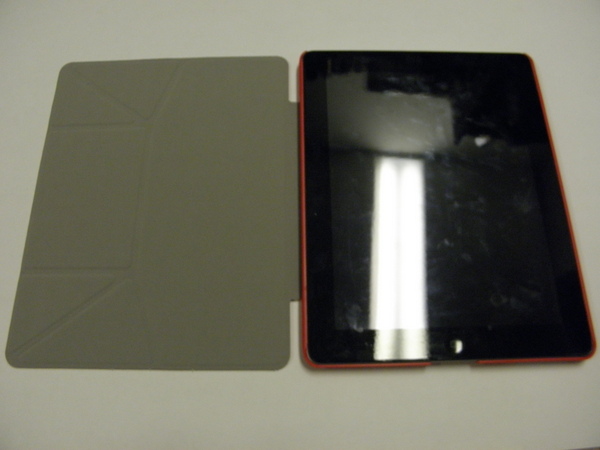
The front cover has magnets to activate the Smart Cover features of the iPad. The magnets in the cover are completely hidden. They are not noticeably poking out underneath the interior cover like some cheaply made cases. When closed, the cover aligns well with the iPad and does trigger the Smart Cover function unnecessarily.
The front cover folds with the help of several indentations on the cover to create a stand. It is held closed with the same magnets used to trigger the Smart Cover features of the iPad. This provides for a relatively stable platform for viewing and typing. The hands free viewing angle is perfect and for the most part stable. Its only weakness is an accidently push down and outwards can cause the magnets holding the origami fold together to disengage. Unfortunately, the typing angle was a little too steep for comfortable typing on the iPad. It was great for putting beside the breakfast cereal in the morning to catch up to the morning newspaper, but for regular typing I found myself propping the case on a thick book to make a more comfortable typing experience. My only other quibble with the origami folding system was every once in a while, I have to fix the fold or else one corner will fold in and the other will fold out. It’s an extremely minor annoyance, but when it does happen it interrupts the smooth movement to prop the case up.
The interior of the case is a soft microsuede material that Incipio uses for all their folio cases. It is a very fine suede material that is suitable for iPads without screen protectors. Short of catching some sort of grit between the cover and the screen, it should not scratch off the oleophobic coating used for the iPad. It feels a little sticky which will improve the grip on your iPad when having the folio cover completely opened.
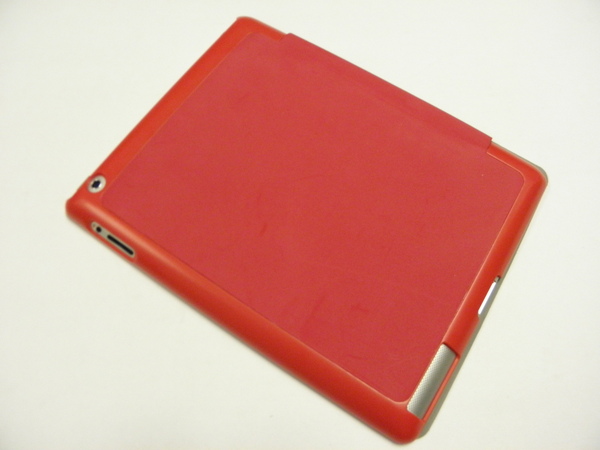
The back is a hard plastic shell with most of the back covered in the same nubuck suede that covers the front of the case. The hard shell case has great coverage on the bottom of the case, even having an extra piece to protect the gap between the speaker and the bottom edge of the iPad. In contrast, the top of the harshell is completely open. There is one large cut out for the microphone, headphone jack, and power button. I found this choice to be curious considering the high level of protection on the bottom of the case. I would have preferred for separate cut outs for each part of the iPad on the top. However, this is a minor issue considering the corners, which are the most vulnerable to damage, are fully protected. It would require a good amount of terrible luck to drop the iPad at the perfect angle to hit the exposed portion. The cut out for the volume and mute switch is one large hole which is a good balance of size and protection. It does not interfere with the operation of those two functions. The camera hole does not interfere with the camera either.
Nubuck suede covers the whole back portion of the hard shell that comes in contact with a table when laid down. The suede further extends as a joint to the front cover. The coverage on the back adds a lot of scratch protection for the hard shell case. However, due to the grippy nature of nubuck suede, the case does not slide well when rested on a table. This could be a good or a bad thing, depending on your preference. I personally prefer a case that slides around easily because I have a habit of sliding my iPad into my bookshelf built into my headboard at night.
Size wise, the LGND is one of the slimmest iPad folio cases I have worked with. Due to the edges of the folio being glued down versus folded in and stitched shut, the profile is very thin and feels great in the hands. The materials used are light and will add very little noticeable weight to the iPad.
The LGND is a good case if you do not mind your case bearing the battle scars of life. Although the case holds up relatively well, it shows the wear and tear its experience rather obviously. The edges have minor fraying that appears as small threads and the nubuck suede clearly shows every ding and scratch that has ever touched it. However, after all the abuse, the case still held up. This case will put up with a large amount of wear and tear, but will look beaten. The design of the hard shell back is a little confusing; the bottom of the case is incredibly well protected while the top’s protection is a little anemic. However, overall the case provides excellent protection for the iPad. The angles provided with the case are fantastic for viewing, but most people will find it too steep for typing. Even with the noticeable battle scars, the LGND is probably one of my favourite cases for the iPad due to its excellent balance between its small size and the level of protection offered.
Capsule Computers review guidelines can be found here.
Welcome back for this week’s iOS Game Suggestions. If you missed or are new to the suggestions, click on the link below and check what cool games you should be picking up for your iOS along with the introduction and disclaimer on how the suggestions work. (suggestions 1 has the disclaimer and how it all works)
An average week on iTunes, not a lot of titles but as always there certainly is a few must buy games this week in all departments, FREE, 99c and over 99c. This week i’ve suggested a total of 15 great quality titles. Make sure you check them all especially Temple Run 2, Tin Man Can, Heroes and Castles, Final Fantasy All The Bravest just to name a few.
Break down below :
6 – FREE Games
5 – $0.99c Games
4 – Over $0.99c Games
As always for this week’s suggestions are all new titles that you should take a look at and consider spending your hard earned iTunes cash / time on. Well the Free games just below certainly should all be given a shot as they won’t cost you anything!
For The Cheapskates – FREE GAMES
MASTERABBOTT’S FREE GAME PICK OF THE WEEK!
Temple Run 2 – Price : FREE – Publisher – Imangi Studios (The sequel to the smash hit phenomenon that took the world by storm! With over 170 million downloads, Temple Run redefined mobile gaming. Now get more of the exhilarating running, jumping, turning and sliding you love in Temple Run 2! Navigate perilous cliffs, zip lines, mines and forests as you try to escape with the cursed idol. How far can you run?!) on iPad & iPhone. GET IT NOW FOR FREE
Rise Of The Blobs – Price : FREE – Publisher –Robot Invader (You’ve never seen a puzzle game like this before! Waves of hungry blobs are making their way up a column towards our stranded marshmallow hero! Help Marsh Mal survive the invasion by filling blobs with fruit and popping them in massive chains. Once you’ve mastered the basics, a collection of other game modes are waiting to challenge you in new ways. You ready to rise to this colorful challenge?) runs on iPad & iPhone. GET IT NOW FOR FREE
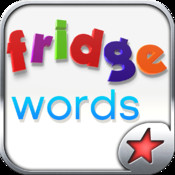
Fridge Words – Price : FREE – Publisher –Thumbstar Games (Fridge Words is a multiplayer word game that absolutely anyone can play! Each match you and your friend begin with the same set of alphabet fridge magnets and have one minute 30 seconds to make as many high scoring words from them as possible.) runs on iPad & iPhone. GET IT NOW FOR FREE
Ninja Inc – Price : FREE – Publisher –Our Palm / Hao Yun (Long long time ago, a sudden outbreak and wide spread of biochemical crisis imposed deadly threat to all human beings. Bloodthirsty zombies attacked the city and occupied the buildings. As our hero, literally the CEO of Ninja Inc., your mission is to lead an army of Ninjas to fight against evil Zombies, take back your hometown and establish a solid base for Ninja warriors. In the name of justice and world peace, let’s fight bravely till the end, and enjoy fantastic adventures in this exclusive Ninja’s world on our palms!) runs on iPad & iPhone. GET IT NOW FOR FREE
Undead Soccer – Price : FREE – Publisher –Bulkypix (Protect the world with your only weapon left : a soccer ball !!! After you had been banned from a match, you were waiting with anger in the athlete room. You walked back to the field because it seemed to be too quiet for such a big match and found everything has changed. All players, referees, and audiences became zombies!! Now you have only two things left with you; a soccer ball and a trashcan lid. Use them as your weapon and your shield. Your soccer skills will save you from these cruel zombies!!) runs on iPad & iPhone. GET IT NOW FOR FREE
Downfall: Clash Of Factions – Price : FREE – Publisher – Playmore(Downfall: Clash of Factions is an addictive mixture of strategy, combat and cooperation. Join a Faction or create your own and fight the battle to rule the earth! Someone bothering you? Deploy a tank battalion to take them down! Need more food for your troops? Take it. In this world, power prevails. Is your City under attack? Get your Faction members to reinforce you and take your enemy down!) on iPad & iPhone. GET IT NOW FOR FREE
For The Bargain Hunters – 99c Games
Momonga Pinball Adventures – Price : $0.99 – Publisher – Paladin Studios (Join Momo in the first episode of an epic adventure to save his tribe. A band of owls turned the momonga village to ashes. The owls took the momongas and vanished. Momo barely survived the attack. After the raid, Momo was found by a wandering panda in the outskirts of the village. A scar went deep from the top of his head to the tip of his tail. The panda, a Lorekeeper, took up the task to save the creature.) runs on iPhone & iPad. BUY NOW
Rocket Island – Price : $0.99 – Publisher – Handy Games (The End is near! The Moon becomes our refuge! Natural and cosmic disasters threaten your island. Rescue the inhabitants of this steampunk world and launch hundreds of rockets to the moon. Beat the high scores of your friends before the island is swallowed by the sea. The fate of our world lies in your hands!) runs on iPad & iPhone. BUY NOW
Zen Training – Price : $0.99 – Publisher – Forest Moon Games / Josh Presseisen (Zen Training combines clever puzzle dynamics in the style of a rhythm-game. The game is set in a classic Japanese Zen garden and is based on the concepts of Order and Chaos. In the heart of the garden there is a maple tree around which are located 5 stones with 5 different colored symbols to which correspond “mana stones” falling from the tree.
The player’s task is to match symbols and colors in order to promote Order and Harmony, flowing trough an infinite series of standard and bonus levels.) runs on iPhone & iPad. BUY NOW
Infestor– Price : $0.99 – Publisher – Ravenous Games (Get ready for a fun puzzle platformer created by the award-winning studio Ravenous Games! As the INFESTOR you need to reach the exit in each level by taking over your enemies and controlling their body. Each human has a special ability associated with it that you will need to take advantage of to overcome obstacles.) runs on iPhone & iPad. BUY NOW
Tin Man Can – Price : $0.99 – Publisher – Chillingo (Hover through four imaginative worlds and get Tic home safely. Soaring through the cosmos, unicycling HoverBot Tic was homeward bound when a wormhole appeared, dragging him and his ship into another dimension. Help Tic survive the pitfalls of four strange colorful worlds and gather enough scattered hovatrons and fuel cells he needs to get home in one piece.) runs on iPhone & iPad. BUY NOW
For The Millionaires – All games over $0.99
MasterAbbott’s over 99c Pick Of The Week!
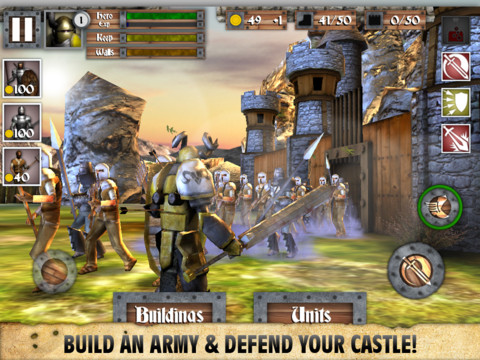
Heroes and Castles – Price : $1.99 – Publisher – Foursaken Media (The Undead Horde and their Orc and Goblin allies are at your castle gates, the King is on the brink of death, and only you stand between the enemy and complete annihilation! Choose one of 3 powerful heroes, summon an army to fight beside you, and defend your castle in Heroes & Castles, a seamless blend of 3rd person Action-RPG, Strategy, and Castle Defense elements!) runs on iPhone & iPad. BUY NOW
FINAL FANTASY ALL THE BRAVEST– Price : $3.99 – Publisher – Square-Enix (FINAL FANTASY ALL THE BRAVEST is a touch-action RPG in which you continuously battle enemies to advance through the game’s many stages. Defeating foes earns you the experience points you need to level up, which in turns grants you character slots to add more and more members to your party.Combat is based on the classic Active Time Battle (ATB) system of the FINAL FANTASY series. Every character possesses an ATB gauge that displays the time remaining until that character can execute an action. When the gauge is full, simply tap or drag your finger over the character to attack. Touch multiple characters in quick succession to experience exhilarating and fast-paced battle unlike anything you’ve ever played before!) runs on iPhone & iPad. BUY NOW
Busy Bags– Price : $1.99 – Publisher – Kaasa Solution (At the luggage reclaim of an airport every person is the same, no matter if it is a celebrity or a tourist. The wole world meets there and all have the same goal: Get the luggage quickly and get out of there. But that isn’t that easy as it sounds. Some persons have the impression that their bag is always the last one on the belt. As soon as the plane lands you are responsible to lead the passengers to their luggage. The faster they get it the better. The more patience they loose the more points you will miss.) runs on iPad. BUY NOW
Riven– Price : $6.49 – Publisher – Cyan Worlds (Taking up where Myst left off, Riven sets an amazing new standard for design, aesthetics, and immersion in gaming. Remember Atrus’ trap book, the Moiety intervention, the mag-lev ride, the Jungle village, Catherine’s prison, Gehn’s Age, the Wahrk throne? Now the entire Riven adventure can be experienced from wherever you are.) runs iPad. BUY NOW
There you have it folks, these games should keep you busy for quite some time, well till next week at least. I’ll be back next week for another dose of iOS goodness, in the meantime if anyone would also like to suggest their own suggestions, please feel free to share them in the comments section below or in the iOS forum section on the site here.