

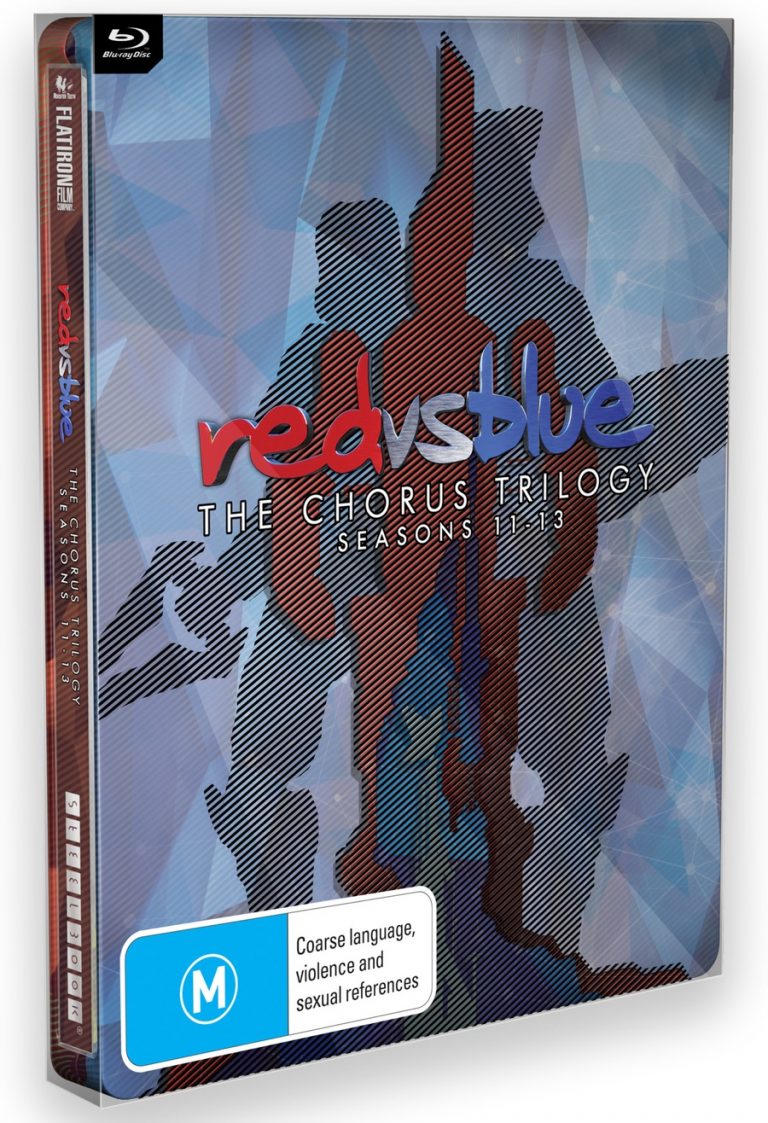
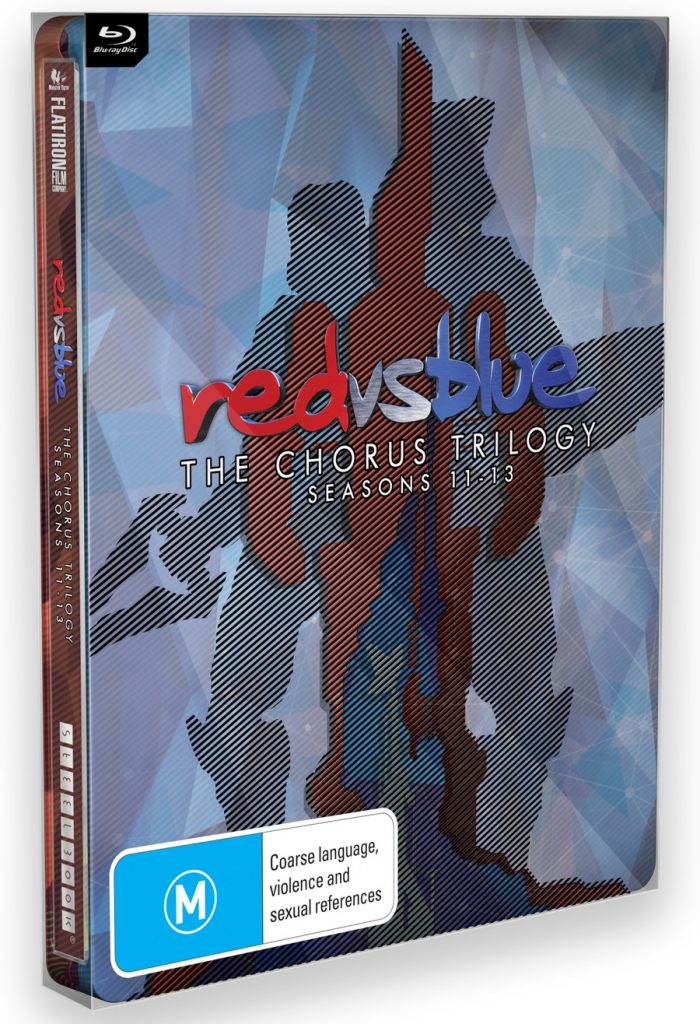
Red Vs Blue: The Chorus Trilogy SteelBook
Studio: Rooster Teeth
Publisher: Hanabee Entertainment
Platforms: Blu-ray (reviewed)
Release Date: July 14, 2016
Price: $59.99 AUD – Available Here (Region Free)
Overview
The Red Team, Blue Team and Agent Washington have crash landed in a canyon in the middle of nowhere. They are eventually reunited with Donut and Doc, but realise that no-one is coming to rescue them. They think they are alone, but they are in fact stranded on an inhabited planet known as Chorus. Following an attack by two mercenaries, they are separately captured by the two opposing sides of the planet’s civil war. Staying alive, finding their friends and defeating the enemy are now the main goals for each group of soldiers to achieve.
Story
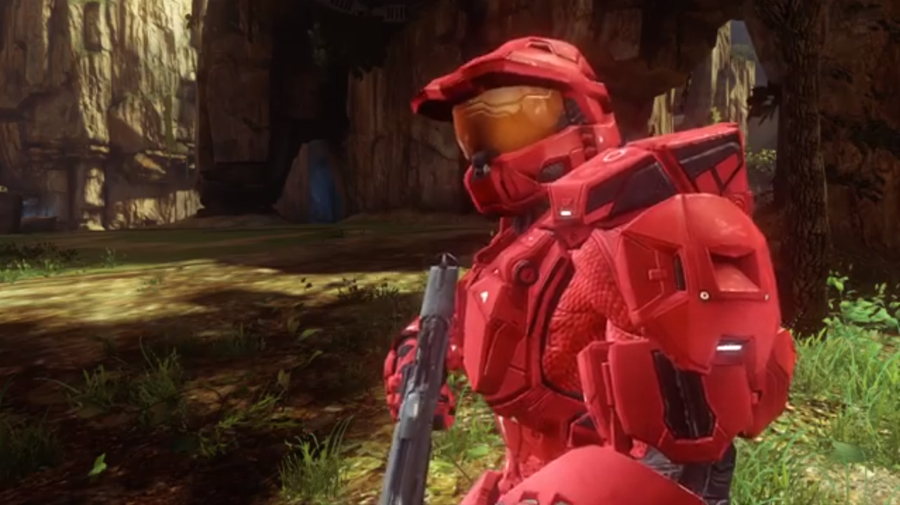
The Reds and Blues still do not trust each other. Few of them care about Agent Washington regardless of which team they are on, but the conflict between everyone is ultimately insignificant and meaningless. Much of the first part of season 11 is spent depicting the Reds doing stupid things, Tucker getting annoyed at Agent Washington and Caboose lamenting the loss of the previous leader of the Blue Team, Church. Caboose somehow manages to end up with a giant robot for a pet, so Sarge inevitably retaliates by getting the Reds to build a new robot. No plot progression occurs for some time, and that is great despite how that may seem on paper. What these random events feature is a return to the style of comedy that long-time fans will remember from the Blood Gulch Chronicles. Some of it is crude and some of it is clever, but it is almost all funny. Comedy is fundamental to Rooster Teeth’s productions, and the passion that consistently goes into making RvB is evident throughout.
As the story progresses, the Reds, Blues and Agent Washington become involved in the civil war on Chorus. They are split up amongst the two sides of the war and each become attached to the cause of their respective sides. The leaders of each side remain convinced that the other side is the enemy and must therefore be eliminated at all costs. However, things are not that straightforward; there are plenty of twists and surprises throughout the remainder of the trilogy. Some characters are not telling the truth and are fighting for an entirely different cause. It is recommended that anyone who purchases this release goes back and watches the previous five seasons to remember the story, as earlier events in this series are brought up. Most of the events that occur in this trilogy will make sense either way, but there are almost no flashbacks to earlier events whatsoever. This is good in one way; flashbacks might have ruined the otherwise effective pacing. Things happen neither too quickly nor too slowly; it is easy to become wrapped up in the story of yet another civil war in this crazy universe.
Visuals
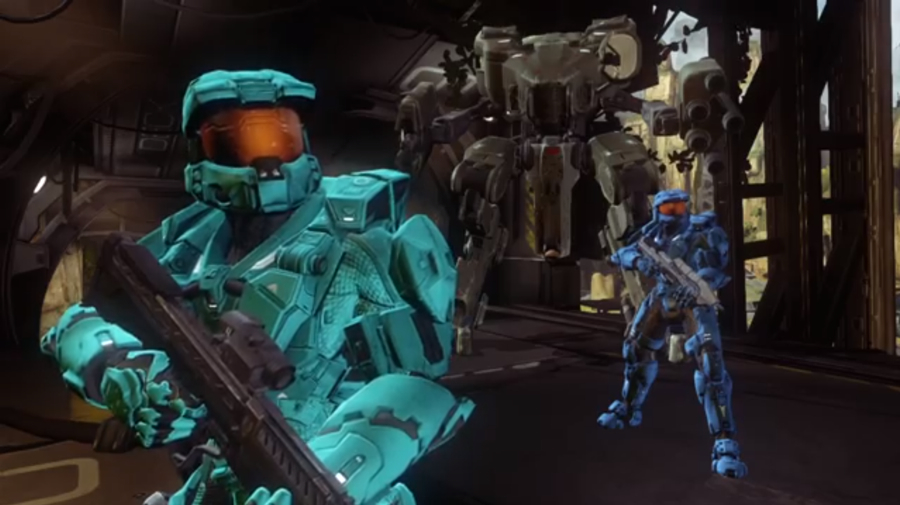
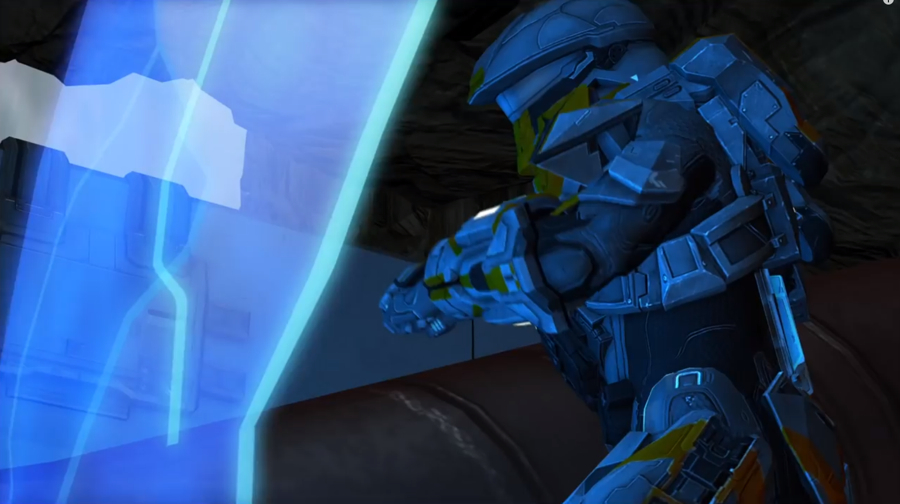
The majority of the series is comprised of machinima footage, however there are some scenes that utilise in-house animation. There is less of a reliance on new animation than in the previous season, but it is still present. The quality of the animation increases significantly during the scenes produced by Rooster Teeth’s animators. The new animation is more fluid and more detailed, and its inclusion allows for some shots that could never have been recorded in Halo. Unfortunately, it is somewhat jarring when the two visual styles are featured on-screen at the same time. It is not a major issue, and the difference may not be obvious to everyone, but it does stand out in both a good way and a bad way. What is more seamless is the layering of static 2D images on top of the footage, which is believable and contributes to the humour of the series. The action scenes are fantastic, which comes as no surprise given how much effort Rooster Teeth puts into Red vs Blue.
Audio
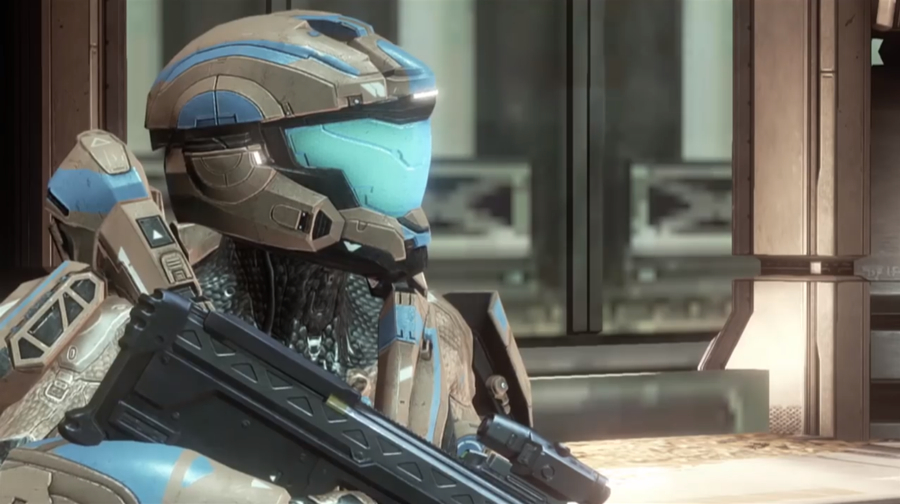
The RvB soundtrack has always been enhanced the atmosphere of the series, and more specifically, to the sense of isolation. The music used in these three seasons is no exception. Music is often used minimally in RvB, which is quite effective, but it does stand out when used. The voice acting is also as good as always. Unsurprisingly, Joel Heyman gives an impeccable performance as Michael J. Caboose. He manages to capture Caboose’s apparent stupidity perfectly and completely owns the role when he has to give a motivational speech. Most of the other voice actors are able to more-or-less use their normal voices, making it easy to identify which Rooster Teeth employee is voicing a minor or recurring character. Part of the fun is hearing Rooster Teeth’s prominent personalities voicing various characters from the crazy universe of Red vs Blue. The audio quality of the voices is not perfect; it sounds as if it has been run through a filter. This may simply be to simulate what it would sound like if the voice actors were inside one of the suits of armour, but it does mean that the volume has to be turned up in order to be able to make out what is being said.
Extras
These discs include an enormous amount of extras. Commentaries, outtakes, PSAs, deleted scenes and behind-the-scenes features are included. The deleted scenes are interesting but not as entertaining as the main features. The outtakes are absolutely hilarious. In particular, an outtakes reel featuring Joel Heyman very passionately arguing about something completely asinine is one of the best extras included. The behind-the-scenes videos are insightful and show just how much effort goes into making sure that everything is as good as possible. For some, the main attraction of this release may be the SteelBook. It is not indestructible, but it is a fairly sturdy case that features some cool artwork. If you have yet to purchase seasons 11, 12 and 13 but want to, this SteelBook is the way to go.
Overall
The Chorus Trilogy is an excellent continuation of Rooster Teeth’s flagship series. It simultaneously features a return to the comedy present in the Blood Gulch Chronicles and a thoroughly engaging plot with twists and revelations. It is stupid, but it is also hilarious and engaging.
Capsule Computers review guidelines can be found here.


 After being rescued by Strange Juice Yuta just so happens to see her panties as well and passes out completely. Upon passing out a strange beam of light forces Yuta from his body and transforms him into a wandering spirit that, with the spirit of a cat named Chiranosuke as his guide, can only regain his physical form with the help of a book that is somewhere in the Korai House where Yuta and the girls stay.
 If Punch Line’s premise sounds ridiculous to you, believe me it is. The concept of following a disembodied spirit who must try to retake his body back from something else that has occupied it while also doing his best to avoid catching glimpses of his neighbors’ underwear or risk destroying the world is something that this series focuses heavily on for the first half of the series and thanks to this it is also one that viewers likely will tune out of if they don’t like the wacky style of humor the show embraces during these episodes.
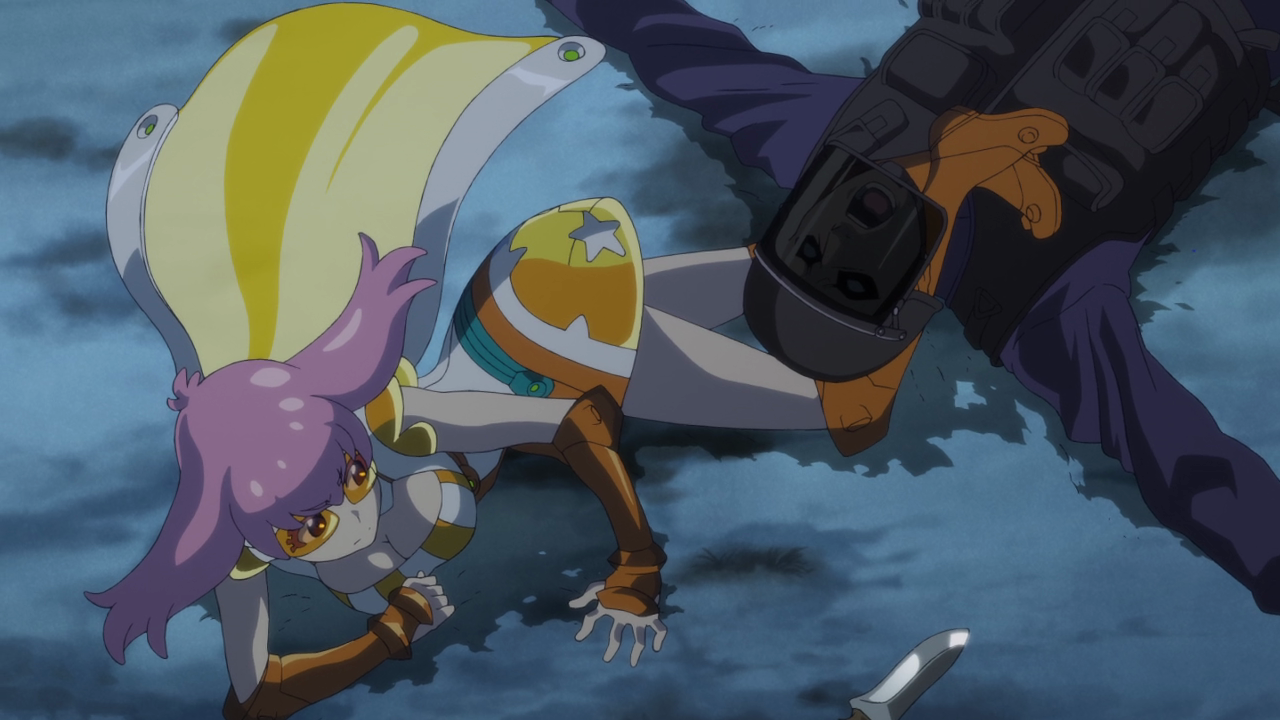 In fact, after the sixth and seventh episode reveal major events and plot points, Punch Line takes on an entirely different tone. While still featuring plenty of ridiculous comedy, the focus of Punch Line shifts to one that explores why these things are happening, Yuta’s past, and let’s just say that bit of time travel comes into play as well. Even elements such as Yuta’s panty apocalypse are explained and, given the way things are developed in the world, fairly believable.
 This means that while plenty of details are left up in the air, especially when certain previous plot elements that are described as essential are then played fast and loose or ignored entirely thanks to the loose nature that the time travel in the series is, Punch Line surprisingly manages to deliver an interesting story that you never would have guessed from the initial introduction and the repeated phrase of “Don’t think too hard about it.”
 It is worth noting that although Punch Line pushes itself as a series about seeing a girl’s underwear, that there are surprisingly very few focused fan service scenes since, most of the time, they are shown in a way to advance the story. That being said, it is clear that the animators knew that these underwear shots had to be highly detailed and varied to fit the personalities of the girls wearing them and also made sure that almost any time there is some sort of movement the viewer is given at least a glimpse of their panties rather than putting them front and center for the aforementioned story scenes.
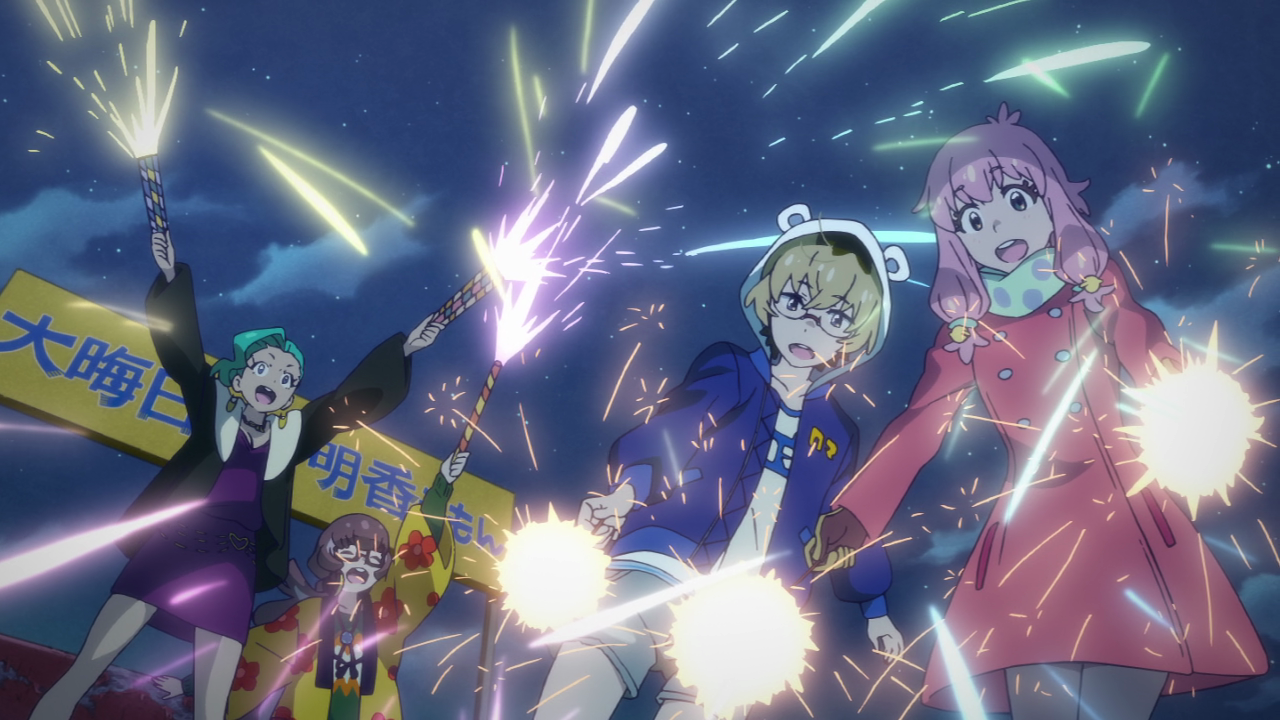 The soundtrack for the series if your standard fair for an anime such as this one though there are a number of scenes that are set to some very fitting and emotional sounding tracks. The opening theme is comedic in nature and plays on the way Punch Line sounds like “Pantsu” in Japanese and is simply called “Punch Line!” by Shokotan Denpa Gumi while the ending theme “Honey Honey Honey” by Ayumikurikamaki is a more emotional closer.




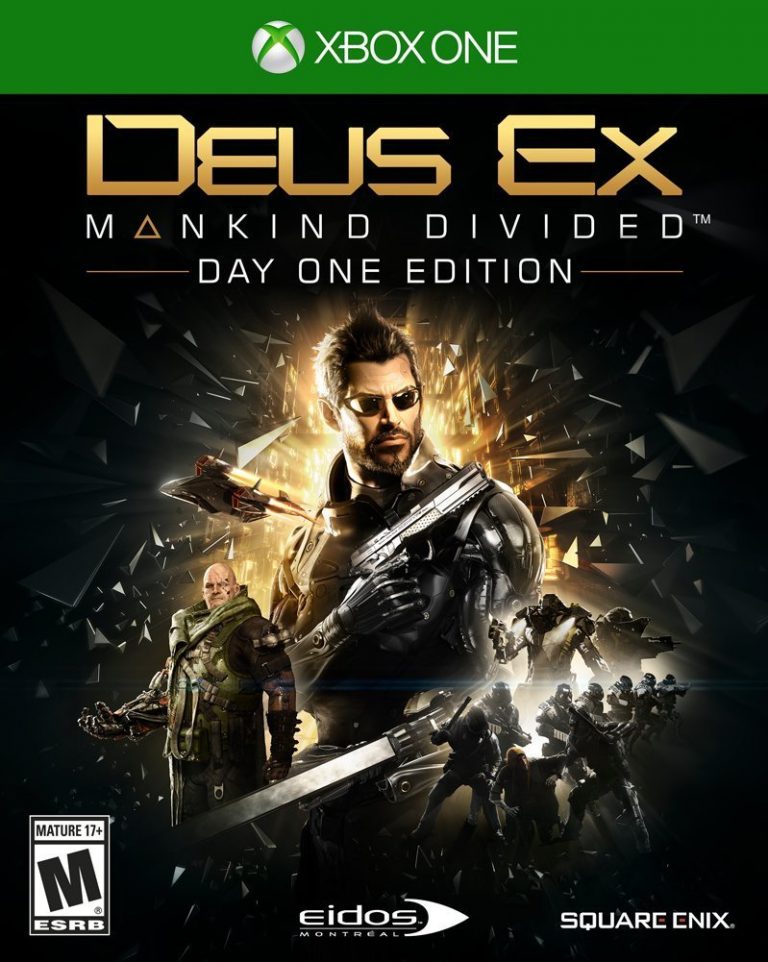
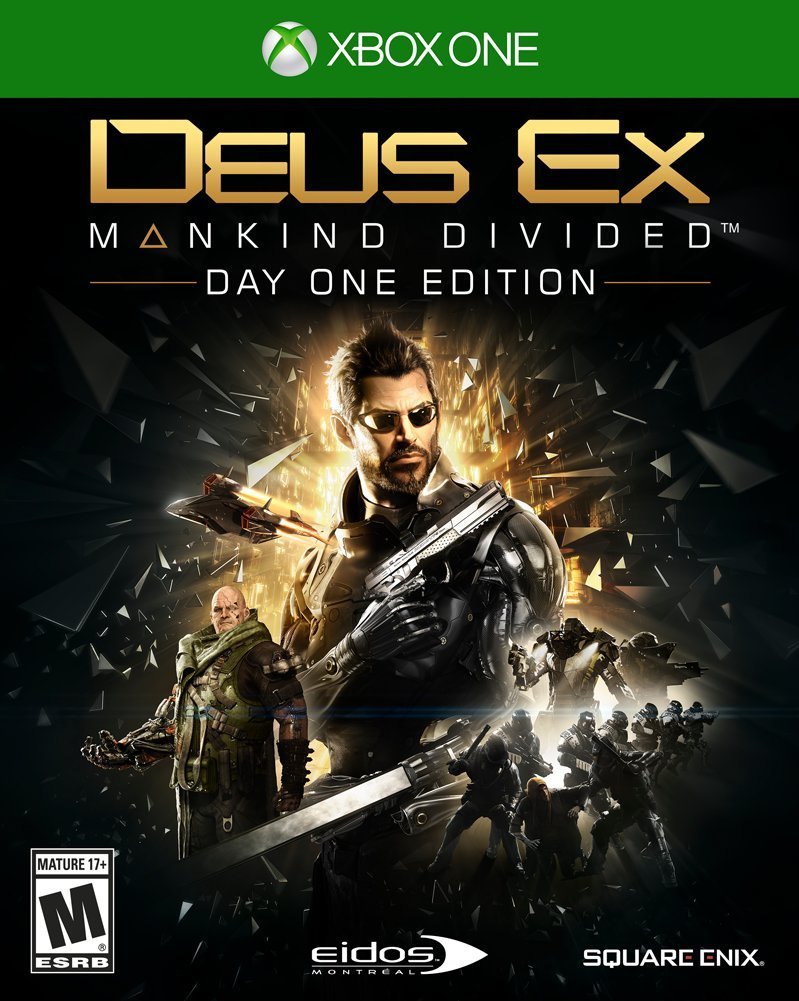
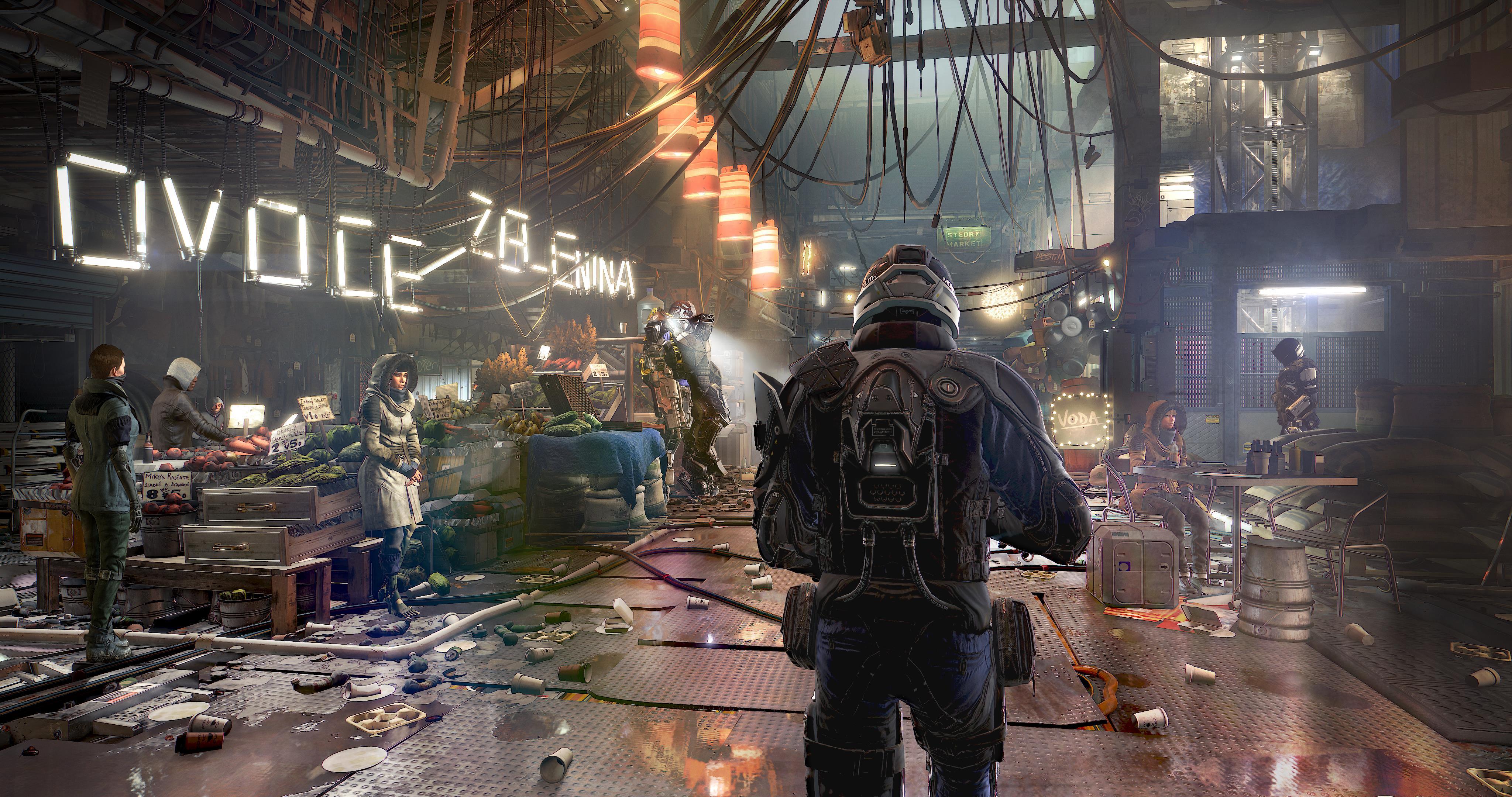
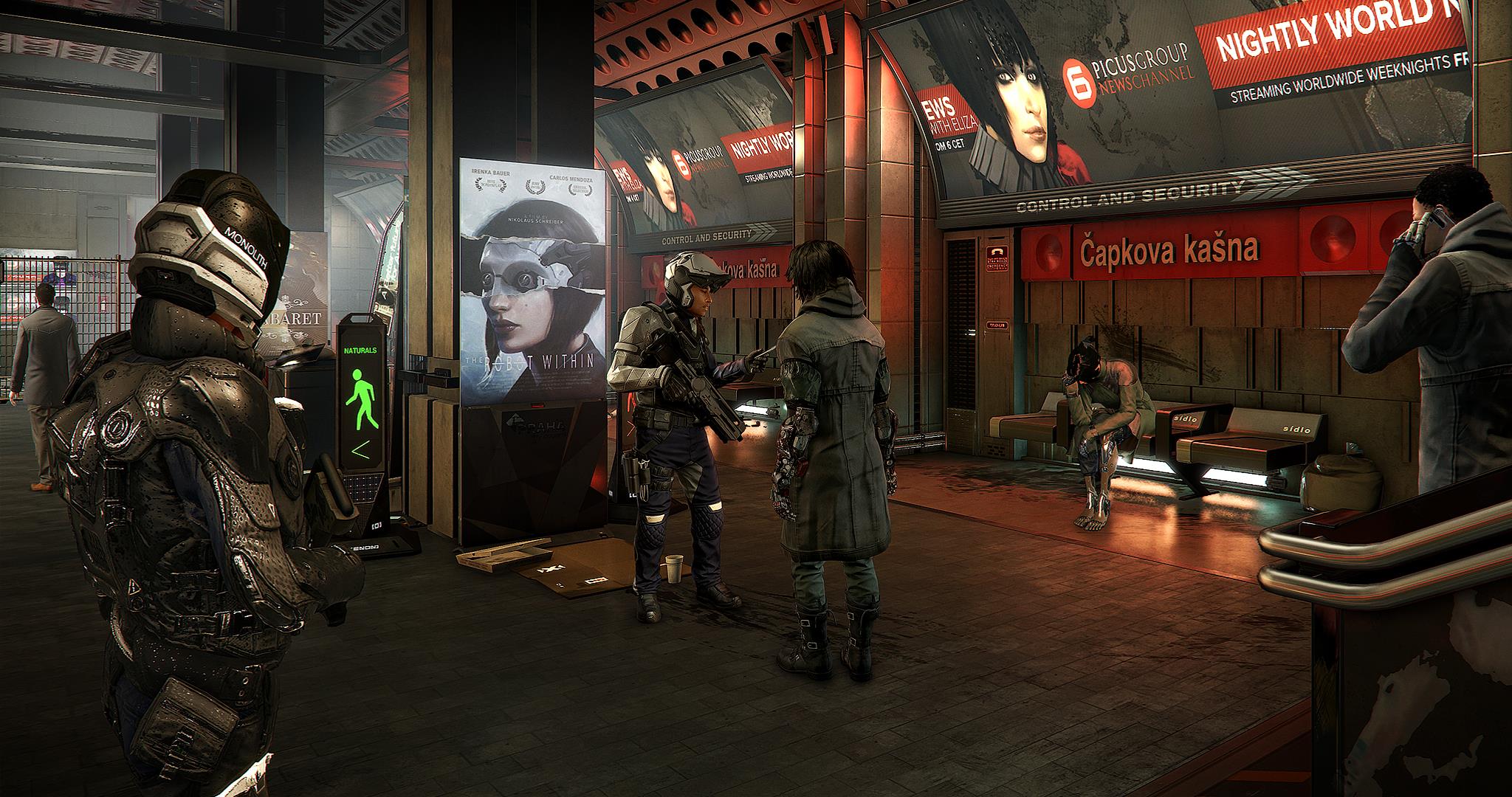 No longer employed as a security officer, Adam Jenson is now enlisted as a member of a special Interpol unit tasked with taking down terrorists as well as investigating various international events. It is clear from the moment players step outside the stating mission into the hub city of Prague that things have drastically changed in this world. While futuristic devices are still readily used by the public and technologically advanced buildings and ads are mixed in with the classic architecture of the old city, the tensions and feelings in the city live up to the game’s title.
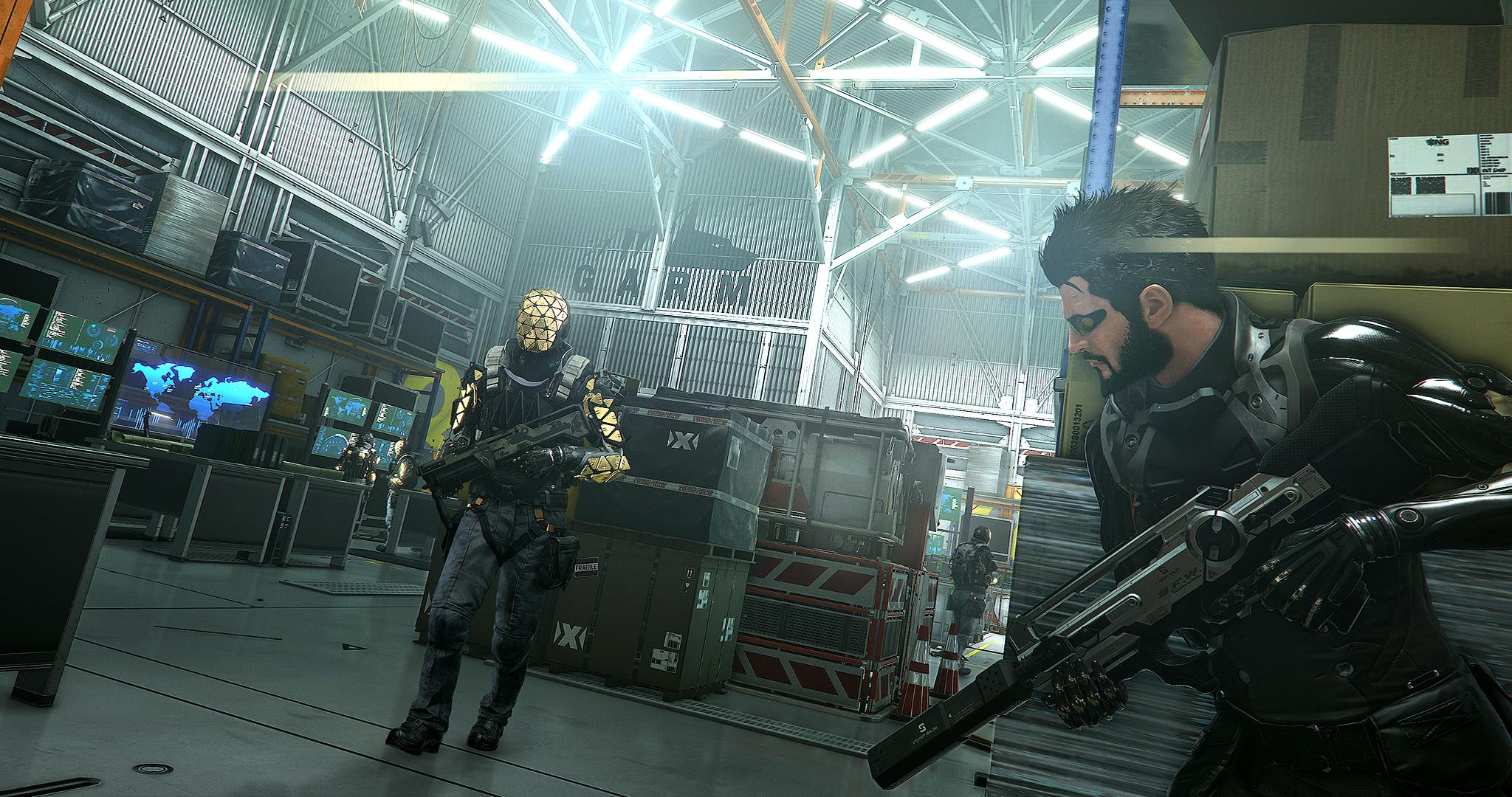 The side-quests in Deus Ex: Mankind Divided have a very organic feel to them as players will need to actively seek them out by speaking to characters or investigating something with no notification actually pointing out the start of such a quest, as opposed to simply littering the area with quest markers. This means that players are often rewarded for keeping an eye out on the world and noticing what changes as the game progresses.
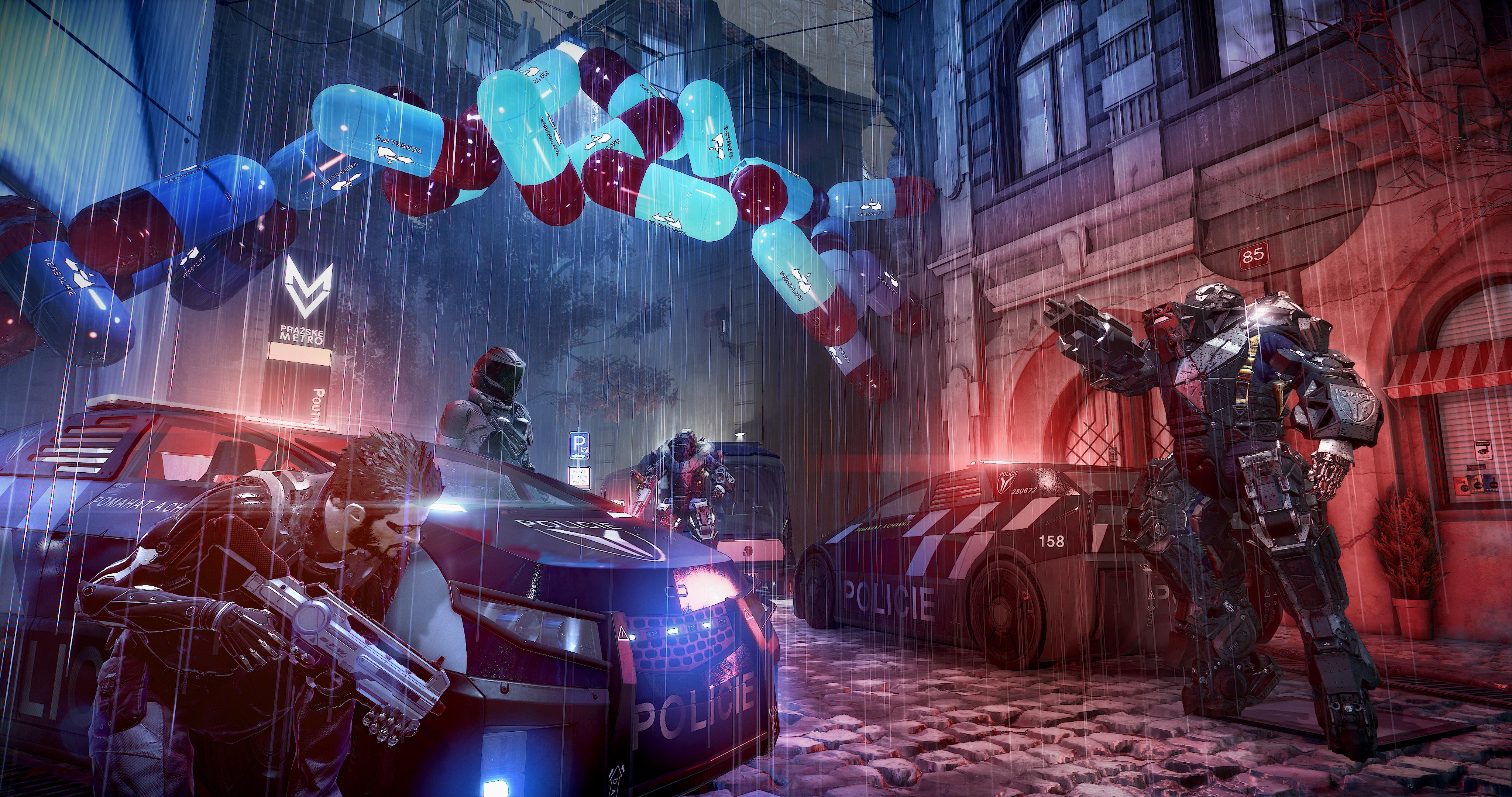 While initially limited by the fact that Jensen no longer has access to his wide array of augmentations, which is given a legitimate explanation, players will eventually be able to unlock his potential once more and by doing so they will be able to hack through secure doors and laptops using a more refined version of the hacking mini-game, lift and throw heavy objects such as vending machines, punch holes in weakened walls, carry additional items with an expanded inventory, jump to unreachable ledges and even climb up now thanks to the added grabbing mechanic, and much more as a number of new “experimental” augs have also been added to Jensen’s repertoire this time.
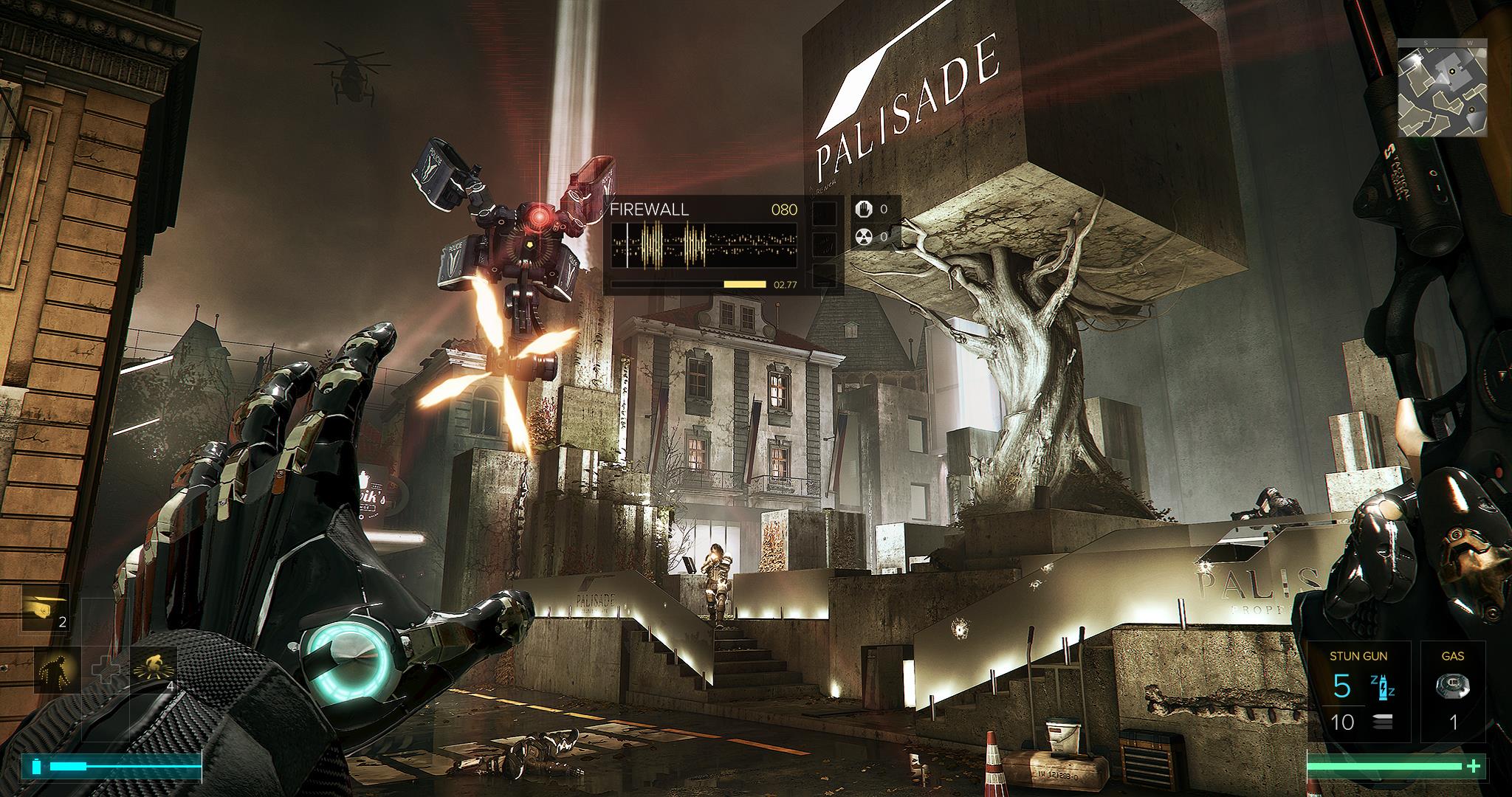 In fact, playing as a pacifist who talks his way out of conflict or avoids it altogether has been expanded greatly as numerous side quests, main quests, and even boss fights can be resolved without conflict or with one button press through the use of dialogue or clever navigation through a level. Even augmentations such as the previously deadly Typhoon now can be altered to only eject stunning gas rather than explosive rounds. These little additions and tweaks to the core gameplay of combat and stealth added in with the numerous routes that every stage has to explore means that players can easily play through this game more than a few time and see something new every time by altering their style.
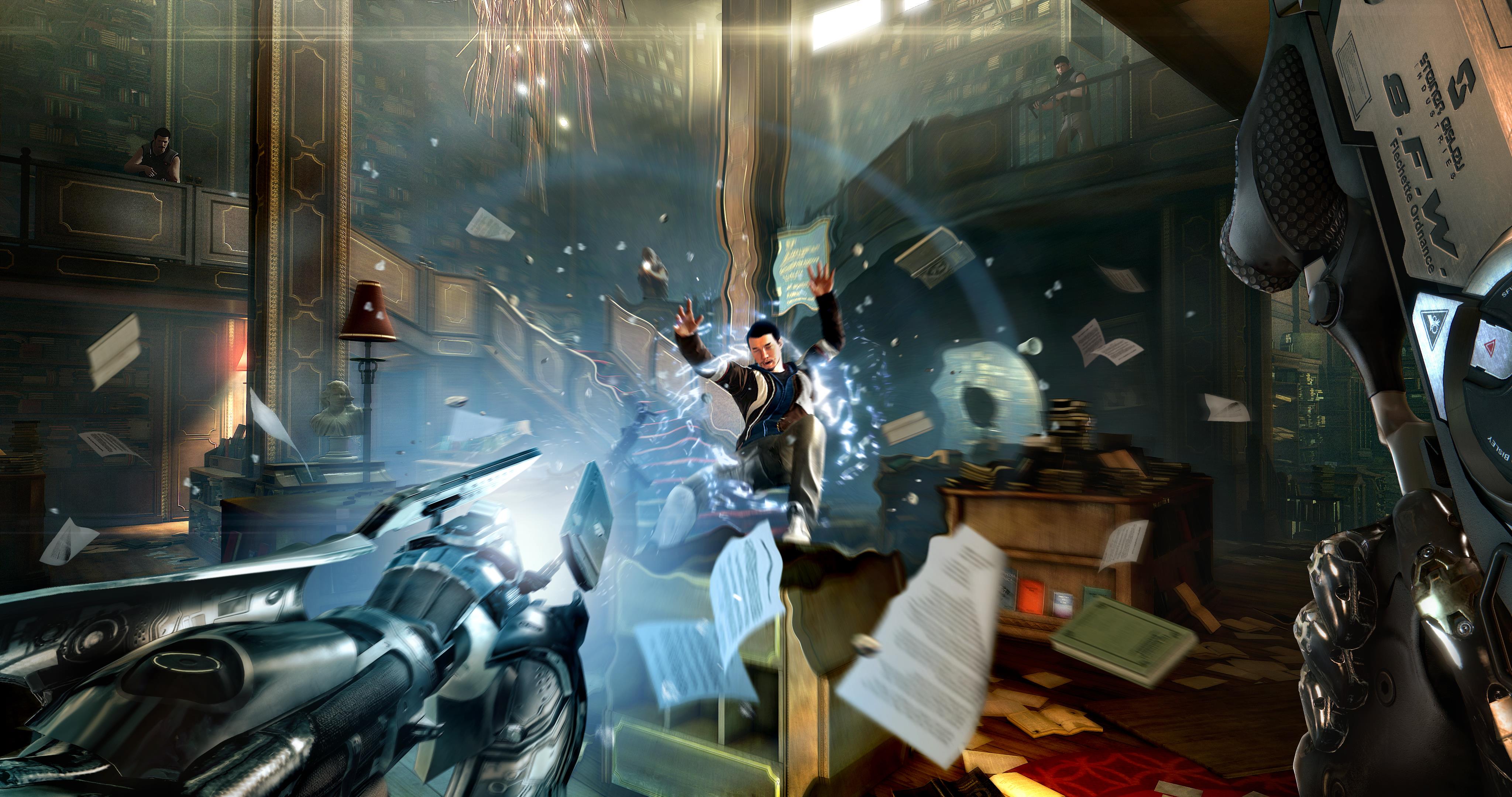 While many additions to this game have made it a far better offering than the first game from the developer, not everything that has been added in is great. A number of the new augments that players can unlock do help spice up the gameplay but others are just fancier versions of things that players already have access to. Using the Titan armor to survive explosions and reduce all incoming damage to practically zero or launching multiple stunning barbs with the Tesla upgrade is a huge plus but things such as being able to launch a nanoblade or blasting an enemy with a very noisy P.E.P.S. to stun them adds little to the experience.
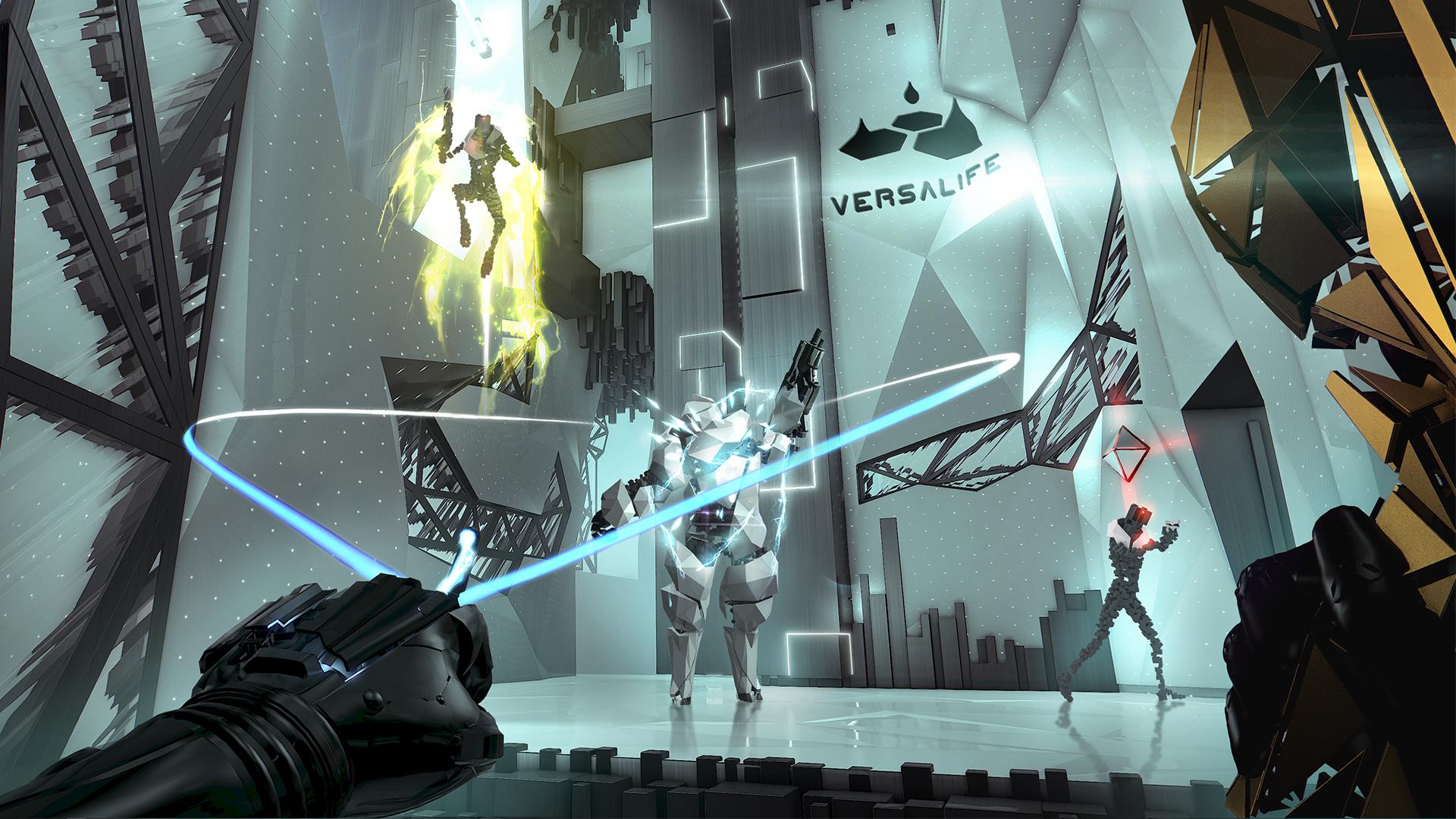 Outside of the main story mode players will also find that a new mode called Breach has been added in with this game. Breach takes place in a virtual reality setting where players must navigate through increasingly difficult stages to retrieve data and complete objectives in the fastest time. As you progress players will earn points depending on enemies taken down, speed of completion, and data downloaded and while this isn’t a huge offering, it is substantiated enough that those willing to challenge others on the leaderboards will enjoy the mode.
 The voice work is fairly impressive with Jensen’s voice actor standing out at as the best of the bunch while the soundtrack is a wonderful treat that fits perfectly with the game’s aesthetics.